brake YAMAHA YBR125 2003 Owner's Manual
[x] Cancel search | Manufacturer: YAMAHA, Model Year: 2003, Model line: YBR125, Model: YAMAHA YBR125 2003Pages: 90, PDF Size: 3.85 MB
Page 79 of 90
6-34
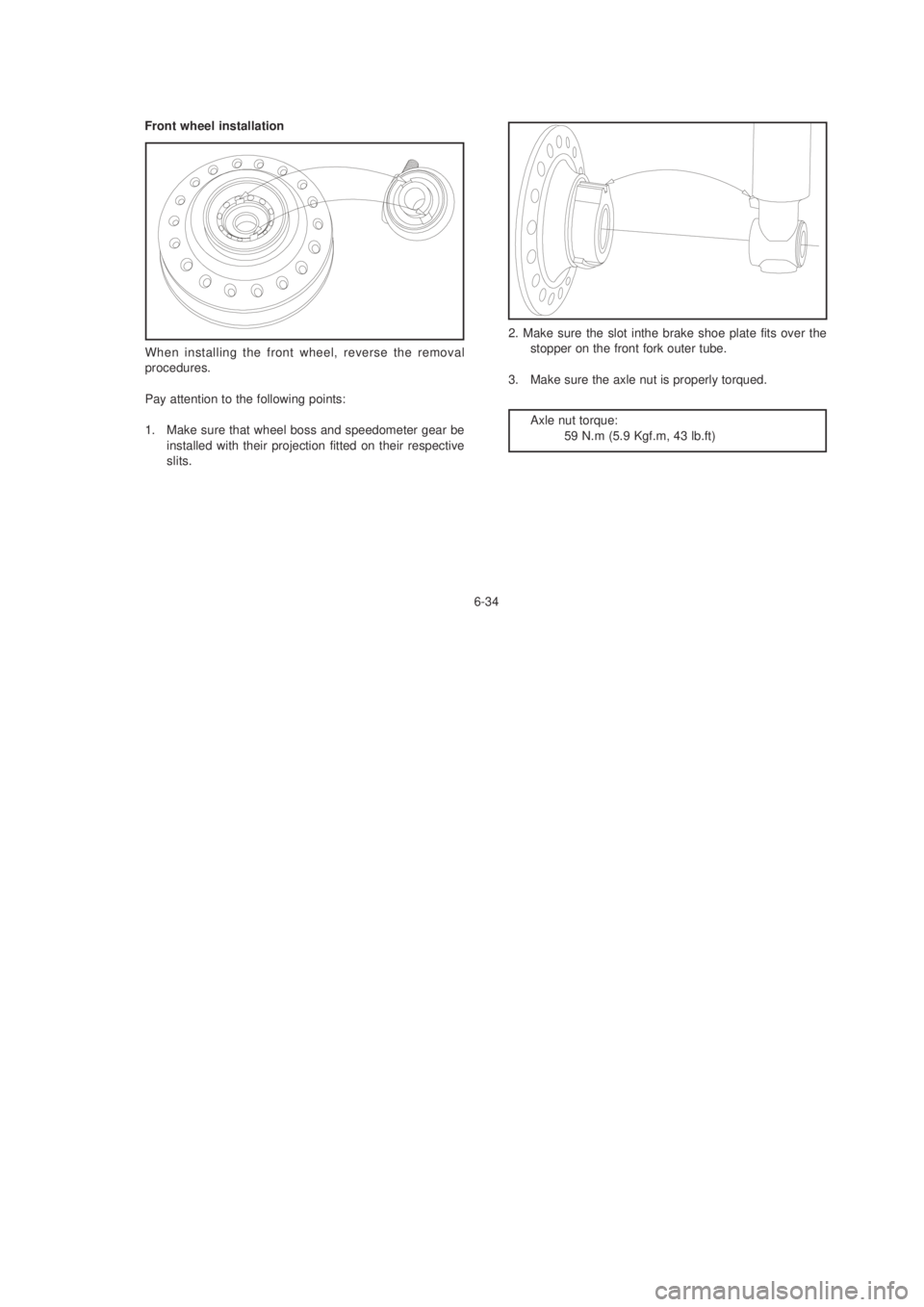
Front wheel installationWhen installing the front wheel, reverse the removal
procedures.
Pay attention to the following points:
1. Make sure that wheel boss and speedometer gear be installed with their projection fitted on their respective
slits. Axle nut torque:
59 N.m (5.9 Kgf.m, 43 lb.ft)
2. Make sure the slot inthe brake shoe plate fits over the
stopper on the front fork outer tube.
3. Make sure the axle nut is properly torqued.
6-34
Front wheel installation
When installing the front wheel, reverse the removal
procedures.
Pay attention to the following points:
1. Make sure that wheel boss and speedometer gear be installed with their projection fitted on their respective
slits. Axle nut torque:
59 N.m (5.9 Kgf.m, 43 lb.ft)
2. Make sure the slot inthe brake shoe plate fits over the
stopper on the front fork outer tube.
3. Make sure the axle nut is properly torqued.
Page 80 of 90
6-35
3
21
Rear wheel removal
It is advisable to have a Yamaha dealer service the
wheel.
Securely support the motorcycle so there is no danger
of it falling over.
1. Place the motorcycle on the centerstand.
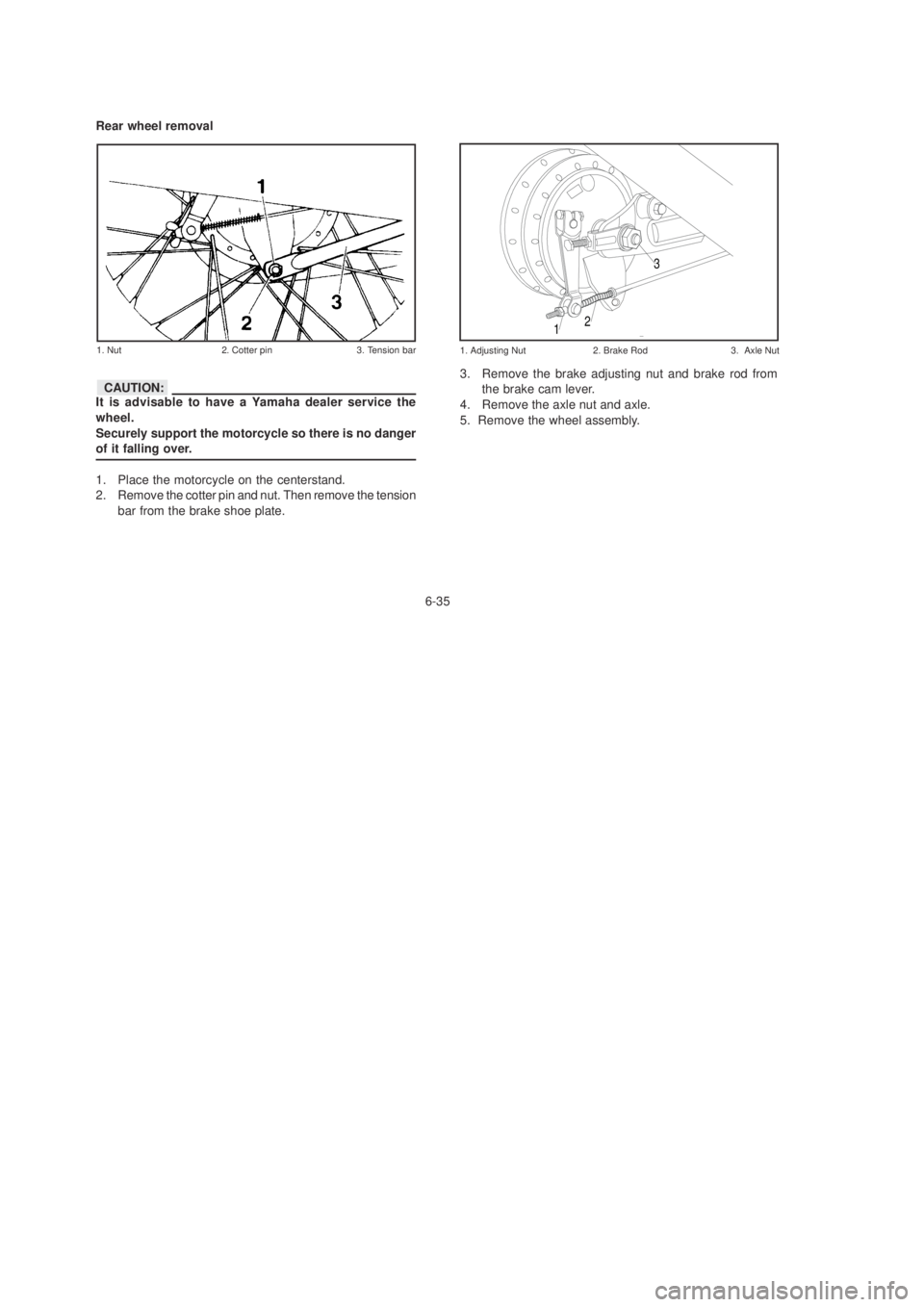
2. Remove the cotter pin and nut. Then remove the tension
bar from the brake shoe plate.3. Remove the brake adjusting nut and brake rod from
the brake cam lever.
4. Remove the axle nut and axle.
5. Remove the wheel assembly.
1. Nut 2. Cotter pin3. Tension bar
CAUTION:
1. Adjusting Nut 2. Brake Rod 3. Axle Nut
6-35
3
21
Rear wheel removal
It is advisable to have a Yamaha dealer service the
wheel.
Securely support the motorcycle so there is no danger
of it falling over.
1. Place the motorcycle on the centerstand.
2. Remove the cotter pin and nut. Then remove the tension
bar from the brake shoe plate.3. Remove the brake adjusting nut and brake rod from
the brake cam lever.
4. Remove the axle nut and axle.
5. Remove the wheel assembly.
1. Nut 2. Cotter pin3. Tension bar
CAUTION:
1. Adjusting Nut 2. Brake Rod 3. Axle Nut
Page 81 of 90
6-36
Rear wheel installation
When installing the rear wheel, reverse the removal
procedures. Pay attention to the following points:
1. Adjust the drive chain.
2. Tighten the axle nut and the tension bar nut to the
specified tightening torque.
Axle nut torque: 91 N.m ( 9.1 Kgf.m, 66 lbf.ft)
Tension bar nut: 19 N.m (1.9 Kgf.m, 14 lbf.ft)
3. Adjust the rear brake.
Check the operation of the brake light after adjusting the
rear brake Troubleshooting
Although Yamaha motorcycles receive a rigid inspection
before shipment from the factory, trouble may occur during
operation. Any problem in the fuel, compression, or ignition
systems can cause poor starting and loss of power. The
troubleshooting chart describes a quick, easy, procedure
for making checks. If your motorcycle requires any repair,
bring it to a Yamaha dealer. The skilled technicians at a
Yamaha dealership have the tools, experience, and know-
how to properly service your motorcycle. Use only genuine
Yamaha parts on your motorcycle. Imitation parts may look
like Yamaha parts, but they are often inferior. Consequently,
they have a shorter service life and can lead to expensive
repair bills.
CAUTION:
6-36
Rear wheel installation
When installing the rear wheel, reverse the removal
procedures. Pay attention to the following points:
1. Adjust the drive chain.
2. Tighten the axle nut and the tension bar nut to the
specified tightening torque.
Axle nut torque: 91 N.m ( 9.1 Kgf.m, 66 lbf.ft)
Tension bar nut:
19 N.m (1.9 Kgf.m, 14 lbf.ft)
3. Adjust the rear brake.
Check the operation of the brake light after adjusting the
rear brake Troubleshooting
Although Yamaha motorcycles receive a rigid inspection
before shipment from the factory, trouble may occur during
operation. Any problem in the fuel, compression, or ignition
systems can cause poor starting and loss of power. The
troubleshooting chart describes a quick, easy, procedure
for making checks. If your motorcycle requires any repair,
bring it to a Yamaha dealer. The skilled technicians at a
Yamaha dealership have the tools, experience, and know-
how to properly service your motorcycle. Use only genuine
Yamaha parts on your motorcycle. Imitation parts may look
like Yamaha parts, but they are often inferior. Consequently,
they have a shorter service life and can lead to expensive
repair bills.
CAUTION:
Page 83 of 90
7-1
CLEANING AND STORAGE
A. CLEANING
Frequent, thorough cleaning of your motorcycle will not only
enhance its appearance but will improve its general
performance and extend the useful life of many components.
1. Before cleaning the motorcycle:
a. Block off the end of the exhaust pipe to prevent water entry; a plastic bag and strong rubber band may be
used.
b. Make sure the spark plug and all filler caps are properly
installed.
2. If the engine case is excessively greasy, apply degreaser with a paint brush. Do not apply degreaser
to the chain, sprockets, or wheel axles.
3. Rinse the dirt and degreaser off with a garden hose, Use only enough pressure to do the job.
Excessive hose pressure may cause water seepage and
deterioration of wheel bearings, front fork, brakes,
transmission seals and electrical parts. Many expensive repair bills have resulted from improper
high pressure detergent applications such as those
available in coin-operated car washers.
4. Once the majority of the dirt has been hosed off, wash
all surfaces with warm water and mild, detergent-type
soap. An old toothbrush or bottle brush is handy for
hard-to-get-at places.
5. Rinse the motorcycle off immediately with clean water
and dry all surfaces with a chamois, clean towel, or
soft absorbent cloth.
6. Dry the chain and lubricate it to prevent rust.
7. Clean the seat with a vinyl upholstery cleaner to keep the cover pliable and glossy.
8. Automotive-type wax may be applied to all painted and
chrome-plated surfaces. Avoid combination cleaner-
waxes. Many contain abrasives which may mar the paint
or protective finish. When finished, start the engine and
let it idle for several minutes.
CAUTION:
CAUTION:
7-1
CLEANING AND STORAGE
A. CLEANING
Frequent, thorough cleaning of your motorcycle will not only
enhance its appearance but will improve its general
performance and extend the useful life of many components.
1. Before cleaning the motorcycle:
a. Block off the end of the exhaust pipe to prevent water entry; a plastic bag and strong rubber band may be
used.
b. Make sure the spark plug and all filler caps are properly
installed.
2. If the engine case is excessively greasy, apply degreaser with a paint brush. Do not apply degreaser
to the chain, sprockets, or wheel axles.
3. Rinse the dirt and degreaser off with a garden hose, Use only enough pressure to do the job.
Excessive hose pressure may cause water seepage and
deterioration of wheel bearings, front fork, brakes,
transmission seals and electrical parts. Many expensive repair bills have resulted from improper
high pressure detergent applications such as those
available in coin-operated car washers.
4. Once the majority of the dirt has been hosed off, wash
all surfaces with warm water and mild, detergent-type
soap. An old toothbrush or bottle brush is handy for
hard-to-get-at places.
5. Rinse the motorcycle off immediately with clean water
and dry all surfaces with a chamois, clean towel, or
soft absorbent cloth.
6. Dry the chain and lubricate it to prevent rust.
7. Clean the seat with a vinyl upholstery cleaner to keep the cover pliable and glossy.
8. Automotive-type wax may be applied to all painted and
chrome-plated surfaces. Avoid combination cleaner-
waxes. Many contain abrasives which may mar the paint
or protective finish. When finished, start the engine and
let it idle for several minutes.
CAUTION:
CAUTION:
Page 88 of 90
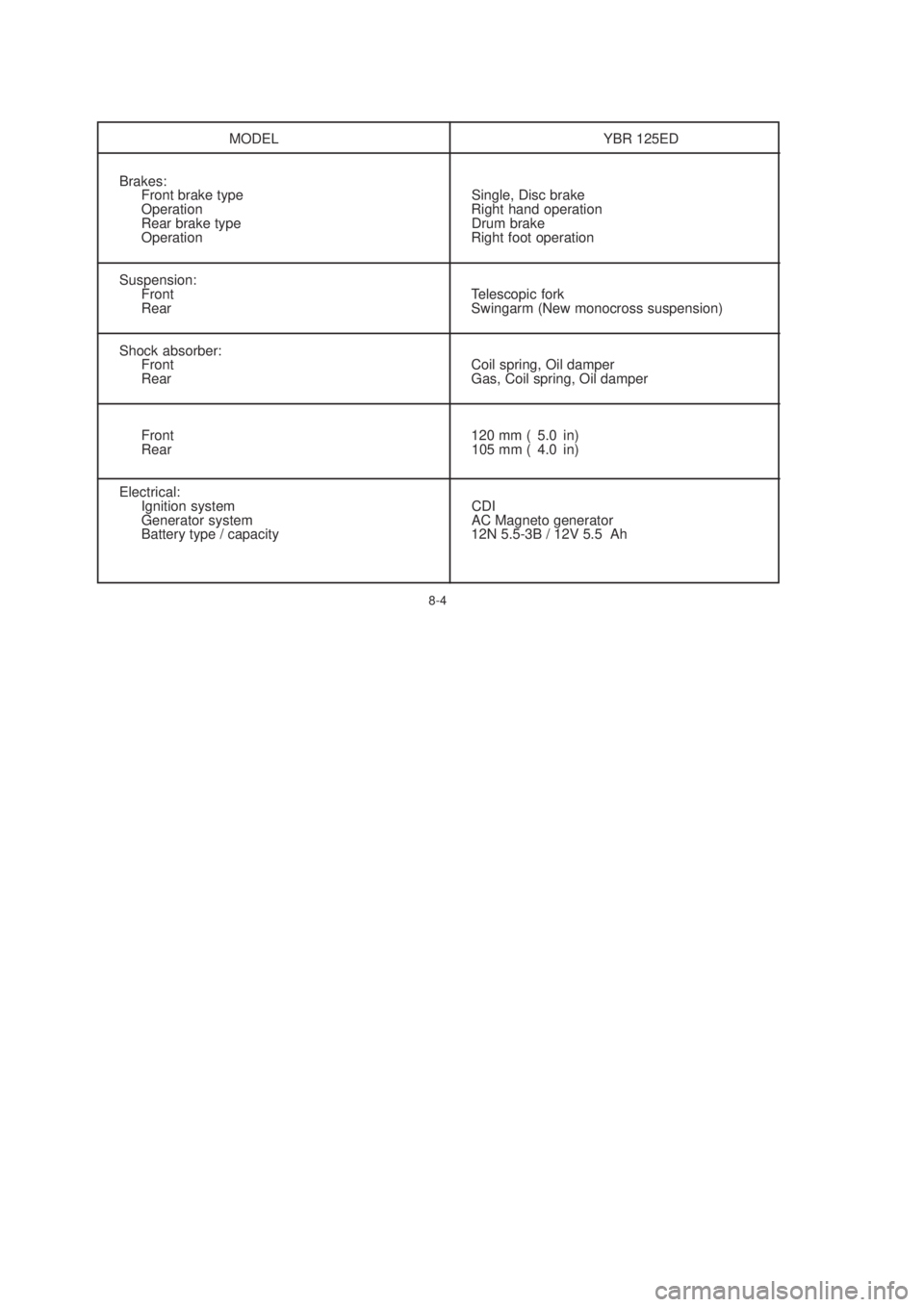
8-4
MODEL YBR 125ED
Brakes:
Front brake type Single, Disc brake
Operation Right hand operation
Rear brake type Drum brake
Operation Right foot operation
Suspension:
Front Telescopic fork
Rear Swingarm (New monocross suspension)
Shock absorber:
Front Coil spring, Oil damper
Rear Gas, Coil spring, Oil damper
Front 120 mm ( 5.0 in)
Rear 105 mm ( 4.0 in)
Electrical:
Ignition system CDI
Generator system AC Magneto generator
Battery type / capacity 12N 5.5-3B / 12V 5.5 Ah
8-4
MODEL YBR 125ED
Brakes:
Front brake type Single, Disc brake
Operation Right hand operation
Rear brake type Drum brake
Operation Right foot operation
Suspension:
Front Telescopic fork
Rear Swingarm (New monocross suspension)
Shock absorber:
Front Coil spring, Oil damper
Rear Gas, Coil spring, Oil damper
Front 120 mm ( 5.0 in)
Rear 105 mm ( 4.0 in)
Electrical:
Ignition system CDI
Generator system AC Magneto generator
Battery type / capacity 12N 5.5-3B / 12V 5.5 Ah
Page 89 of 90
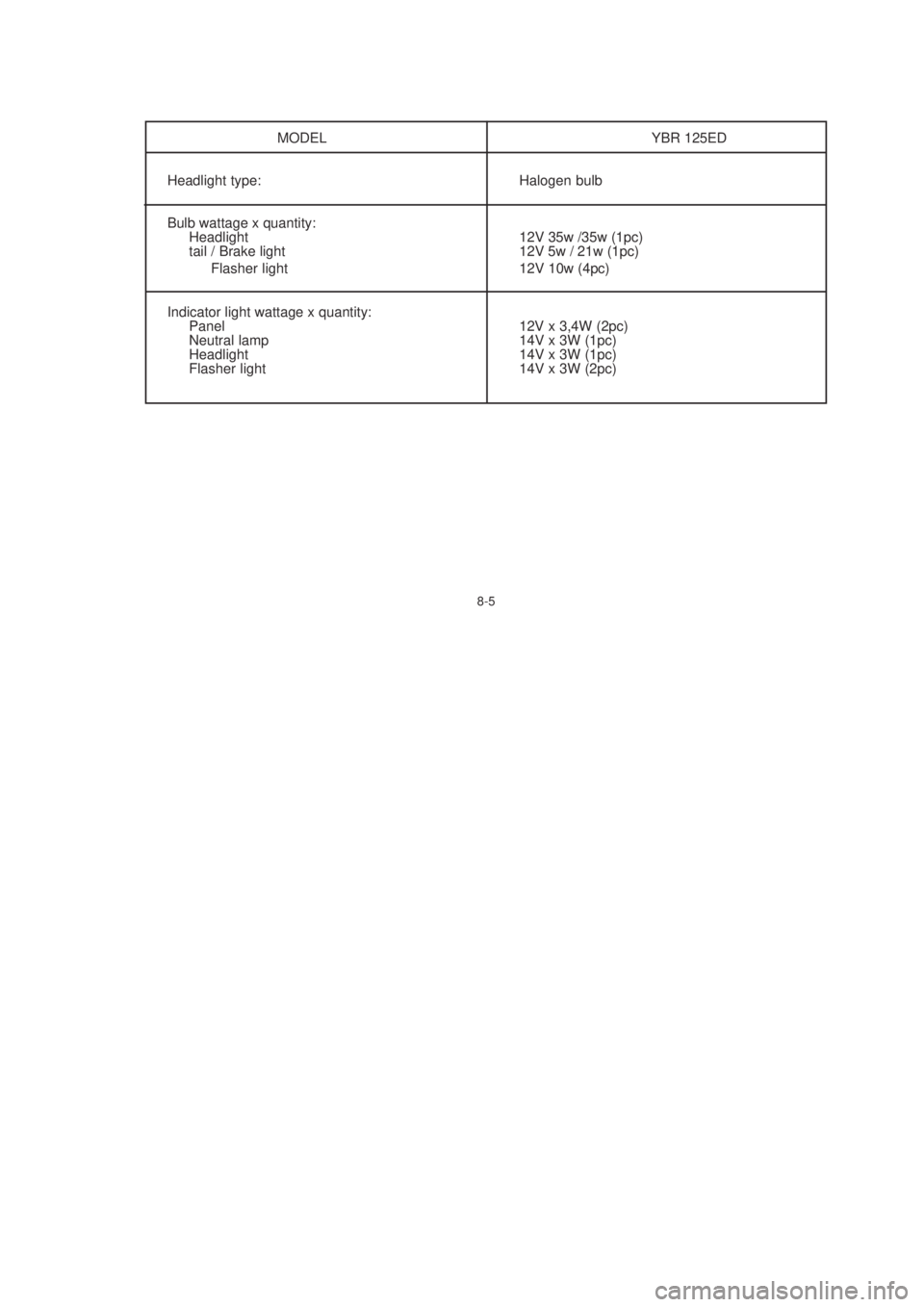
8-5
MODEL YBR 125ED
Headlight type: Halogen bulb
Bulb wattage x quantity: Headlight 12V 35w /35w (1pc)
tail / Brake light 12V 5w / 21w (1pc)
Flasher light 12V 10w (4pc)
Indicator light wattage x quantity: Panel 12V x 3,4W (2pc)
Neutral lamp 14V x 3W (1pc)
Headlight 14V x 3W (1pc)
Flasher light 14V x 3W (2pc)
8-5
MODEL YBR 125ED
Headlight type: Halogen bulb
Bulb wattage x quantity: Headlight 12V 35w /35w (1pc)
tail / Brake light 12V 5w / 21w (1pc)
Flasher light 12V 10w (4pc)
Indicator light wattage x quantity: Panel 12V x 3,4W (2pc)
Neutral lamp 14V x 3W (1pc)
Headlight 14V x 3W (1pc)
Flasher light 14V x 3W (2pc)