ECU YAMAHA YBR125 2003 Owners Manual
[x] Cancel search | Manufacturer: YAMAHA, Model Year: 2003, Model line: YBR125, Model: YAMAHA YBR125 2003Pages: 90, PDF Size: 3.85 MB
Page 35 of 90
4-6
Proper loading of your motorcycle is important for the
handling, braking, and other performance and safety
characteristics of your motorcyle. Do not carry loosely
packed items that can shift. Securely pack your
heaviest items close to the center of the motorcycle,
and distribute the weight evenly from side to side.
Properly adjust the suspension for your load, and
check the condition and pressure of your tires. NEVER
OVERLOAD YOUR MOTORCYCLE. Make sure the total
weight of the cargo, rider, passenger, and accessories
(fairing, saddlebags, etc. if approved for this model)
does not exceed the maximum load of the motorcycle.
Operation of an overloaded motorcycle could cause
tire damage, an accident, or even injury.
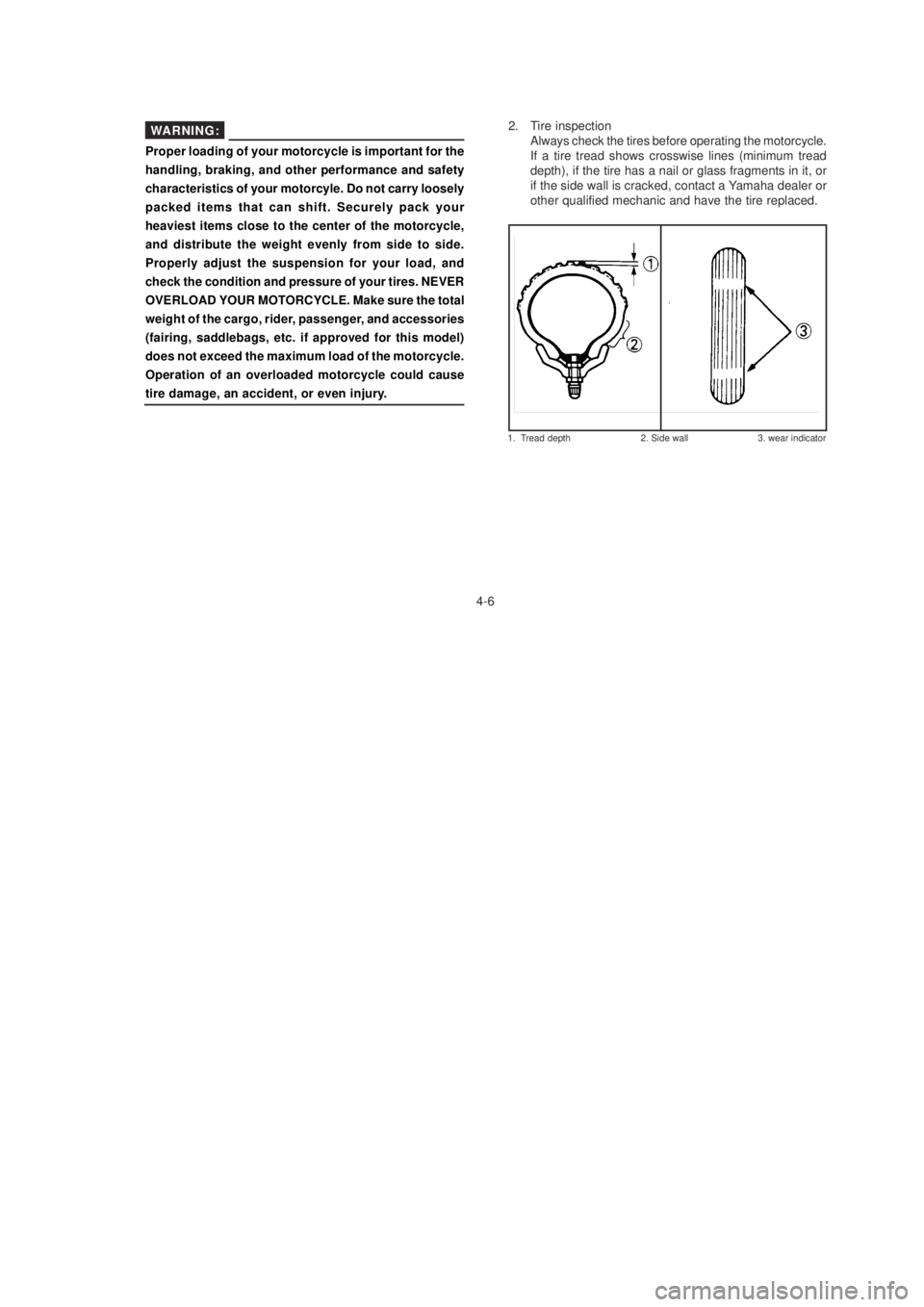
2. Tire inspection
Always check the tires before operating the motorcycle.
If a tire tread shows crosswise lines (minimum tread
depth), if the tire has a nail or glass fragments in it, or
if the side wall is cracked, contact a Yamaha dealer or
other qualified mechanic and have the tire replaced.
1. Tread depth 2. Side wall 3. wear indicator
WARNING:
4-6
Proper loading of your motorcycle is important for the
handling, braking, and other performance and safety
characteristics of your motorcyle. Do not carry loosely
packed items that can shift. Securely pack your
heaviest items close to the center of the motorcycle,
and distribute the weight evenly from side to side.
Properly adjust the suspension for your load, and
check the condition and pressure of your tires. NEVER
OVERLOAD YOUR MOTORCYCLE. Make sure the total
weight of the cargo, rider, passenger, and accessories
(fairing, saddlebags, etc. if approved for this model)
does not exceed the maximum load of the motorcycle.
Operation of an overloaded motorcycle could cause
tire damage, an accident, or even injury.
2. Tire inspection
Always check the tires before operating the motorcycle.
If a tire tread shows crosswise lines (minimum tread
depth), if the tire has a nail or glass fragments in it, or
if the side wall is cracked, contact a Yamaha dealer or
other qualified mechanic and have the tire replaced.
1. Tread depth 2. Side wall 3. wear indicator
WARNING:
Page 70 of 90
6-25
1. Visual check
Check for scratches or damage on the inner tube and
excessive oil leakage from the front fork.
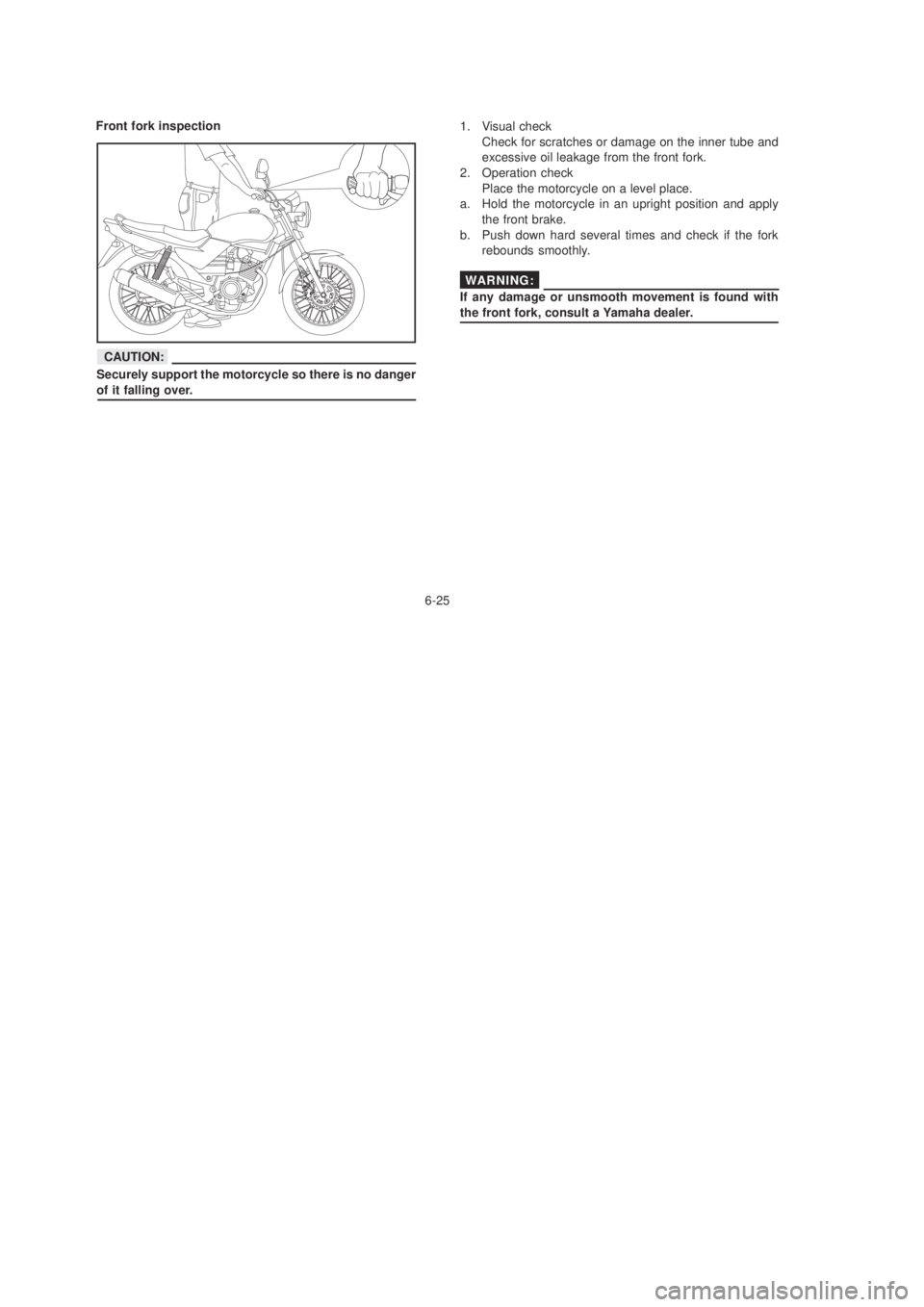
2. Operation check
Place the motorcycle on a level place.
a. Hold the motorcycle in an upright position and apply
the front brake.
b. Push down hard several times and check if the fork
rebounds smoothly.
If any damage or unsmooth movement is found with
the front fork, consult a Yamaha dealer. Front fork inspection
Securely support the motorcycle so there is no danger
of it falling over.
CAUTION:
WARNING:
6-25
1. Visual check
Check for scratches or damage on the inner tube and
excessive oil leakage from the front fork.
2. Operation check
Place the motorcycle on a level place.
a. Hold the motorcycle in an upright position and apply
the front brake.
b. Push down hard several times and check if the fork
rebounds smoothly.
If any damage or unsmooth movement is found with
the front fork, consult a Yamaha dealer. Front fork inspection
Securely support the motorcycle so there is no danger
of it falling over.
CAUTION:
WARNING:
Page 71 of 90
6-26
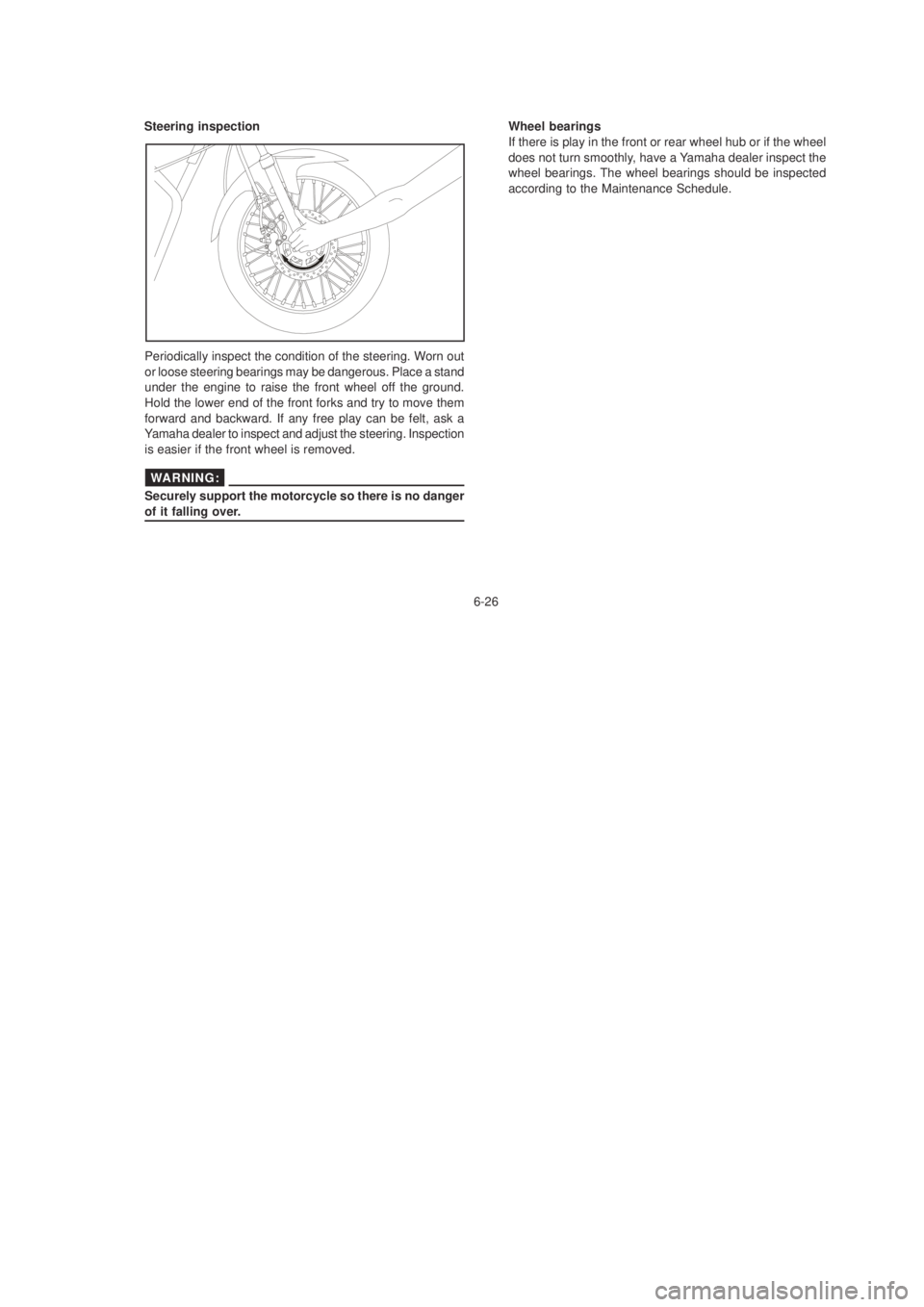
Periodically inspect the condition of the steering. Worn out
or loose steering bearings may be dangerous. Place a stand
under the engine to raise the front wheel off the ground.
Hold the lower end of the front forks and try to move them
forward and backward. If any free play can be felt, ask a
Yamaha dealer to inspect and adjust the steering. Inspection
is easier if the front wheel is removed.
Securely support the motorcycle so there is no danger
of it falling over.Wheel bearings
If there is play in the front or rear wheel hub or if the wheel
does not turn smoothly, have a Yamaha dealer inspect the
wheel bearings. The wheel bearings should be inspected
according to the Maintenance Schedule.
Steering inspection
WARNING:
6-26
Periodically inspect the condition of the steering. Worn out
or loose steering bearings may be dangerous. Place a stand
under the engine to raise the front wheel off the ground.
Hold the lower end of the front forks and try to move them
forward and backward. If any free play can be felt, ask a
Yamaha dealer to inspect and adjust the steering. Inspection
is easier if the front wheel is removed.
Securely support the motorcycle so there is no danger
of it falling over. Wheel bearings
If there is play in the front or rear wheel hub or if the wheel
does not turn smoothly, have a Yamaha dealer inspect the
wheel bearings. The wheel bearings should be inspected
according to the Maintenance Schedule.
Steering inspection
WARNING:
Page 78 of 90
6-33
It is advisable to have a Yamaha dealer service the
wheel.
Securely support the motorcycle so there is no danger
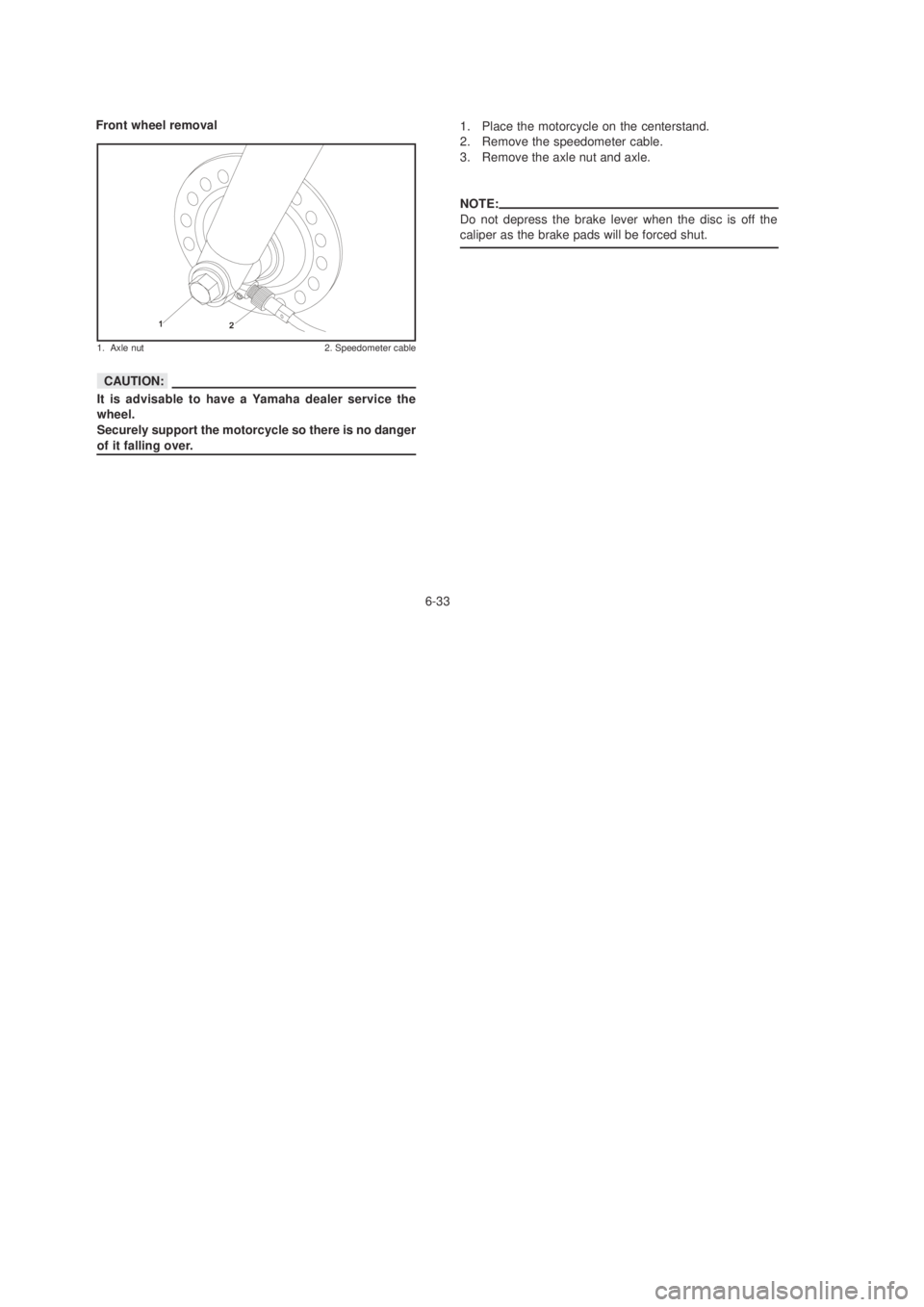
of it falling over. Front wheel removal
1. Place the motorcycle on the centerstand.
2. Remove the speedometer cable.
3. Remove the axle nut and axle.
NOTE:
Do not depress the brake lever when the disc is off the
caliper as the brake pads will be forced shut.
1. Axle nut 2. Speedometer cable
CAUTION:
6-33
It is advisable to have a Yamaha dealer service the
wheel.
Securely support the motorcycle so there is no danger
of it falling over. Front wheel removal
1. Place the motorcycle on the centerstand.
2. Remove the speedometer cable.
3. Remove the axle nut and axle.
NOTE:
Do not depress the brake lever when the disc is off the
caliper as the brake pads will be forced shut.
1. Axle nut 2. Speedometer cable
CAUTION:
Page 80 of 90
6-35
3
21
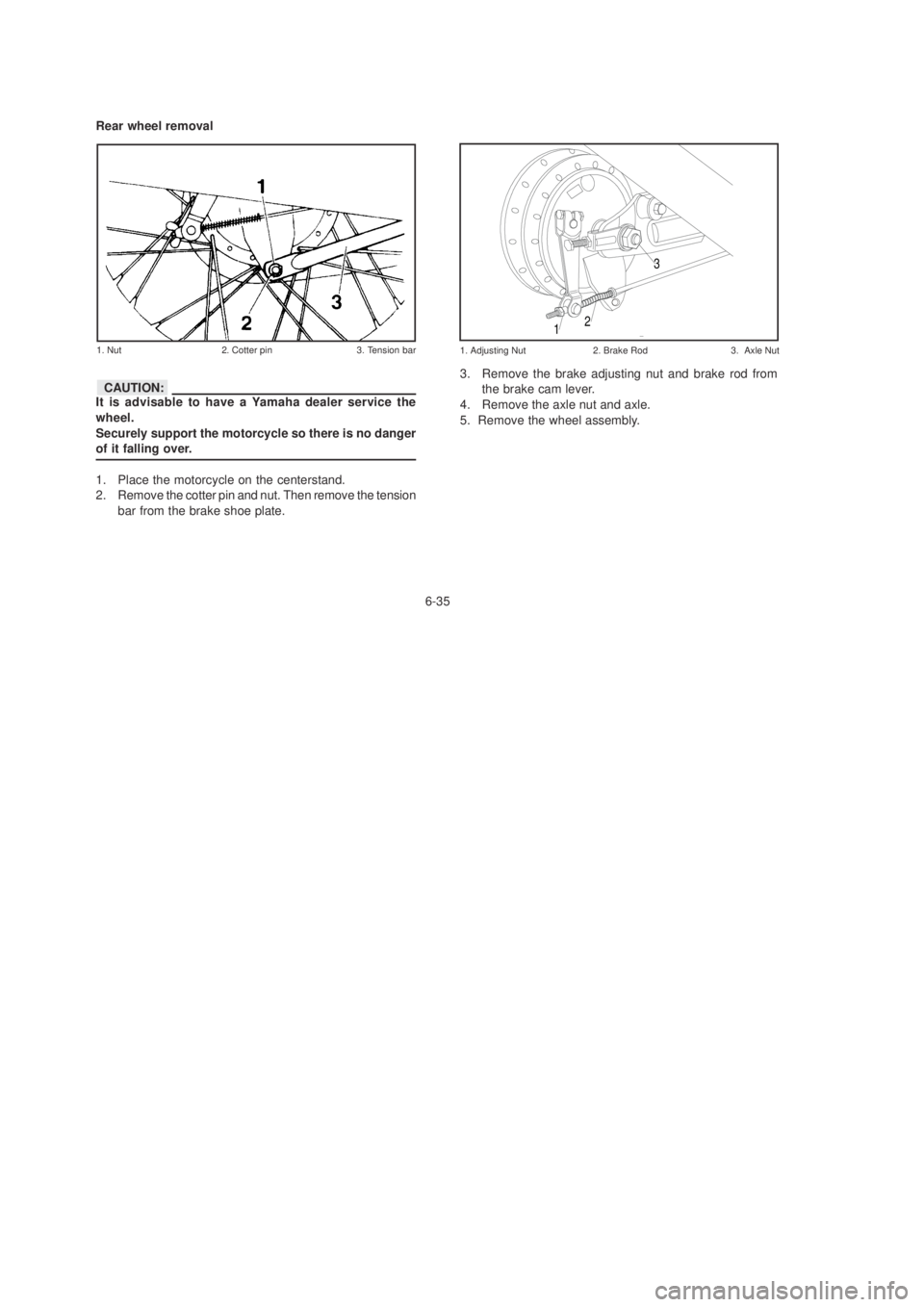
Rear wheel removal
It is advisable to have a Yamaha dealer service the
wheel.
Securely support the motorcycle so there is no danger
of it falling over.
1. Place the motorcycle on the centerstand.
2. Remove the cotter pin and nut. Then remove the tension
bar from the brake shoe plate.3. Remove the brake adjusting nut and brake rod from
the brake cam lever.
4. Remove the axle nut and axle.
5. Remove the wheel assembly.
1. Nut 2. Cotter pin3. Tension bar
CAUTION:
1. Adjusting Nut 2. Brake Rod 3. Axle Nut
6-35
3
21
Rear wheel removal
It is advisable to have a Yamaha dealer service the
wheel.
Securely support the motorcycle so there is no danger
of it falling over.
1. Place the motorcycle on the centerstand.
2. Remove the cotter pin and nut. Then remove the tension
bar from the brake shoe plate.3. Remove the brake adjusting nut and brake rod from
the brake cam lever.
4. Remove the axle nut and axle.
5. Remove the wheel assembly.
1. Nut 2. Cotter pin3. Tension bar
CAUTION:
1. Adjusting Nut 2. Brake Rod 3. Axle Nut