brake YAMAHA YBR125 2004 User Guide
[x] Cancel search | Manufacturer: YAMAHA, Model Year: 2004, Model line: YBR125, Model: YAMAHA YBR125 2004Pages: 83, PDF Size: 3.16 MB
Page 57 of 83
6-17
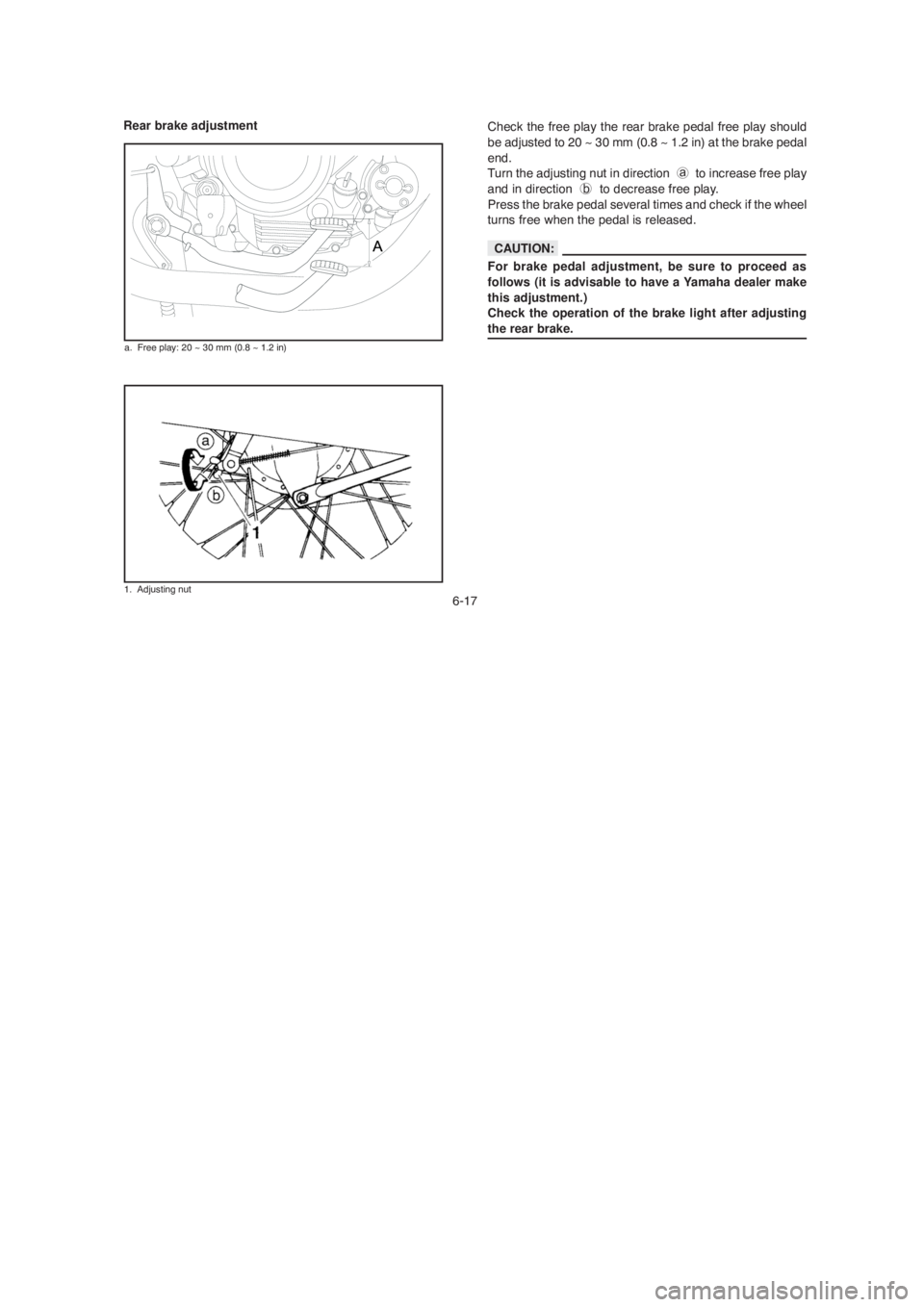
Rear brake adjustment
a. Free play: 20 ~ 30 mm (0.8 ~ 1.2 in)
Check the free play the rear brake pedal free play should
be adjusted to 20 ~ 30 mm (0.8 ~ 1.2 in) at the brake pedal
end.
Turn the adjusting nut in direction a to increase free play
and in direction b to decrease free play.
Press the brake pedal several times and check if the wheel
turns free when the pedal is released.
For brake pedal adjustment, be sure to proceed as
follows (it is advisable to have a Yamaha dealer make
this adjustment.)
Check the operation of the brake light after adjusting
the rear brake.
1. Adjusting nut
CAUTION:
6-17
Rear brake adjustment
a. Free play: 20 ~ 30 mm (0.8 ~ 1.2 in)
Check the free play the rear brake pedal free play should
be adjusted to 20 ~ 30 mm (0.8 ~ 1.2 in) at the brake pedal
end.
Turn the adjusting nut in direction a to increase free play
and in direction b to decrease free play.
Press the brake pedal several times and check if the wheel
turns free when the pedal is released.
For brake pedal adjustment, be sure to proceed as
follows (it is advisable to have a Yamaha dealer make
this adjustment.)
Check the operation of the brake light after adjusting
the rear brake.
1. Adjusting nut
CAUTION:
Page 58 of 83
6-18
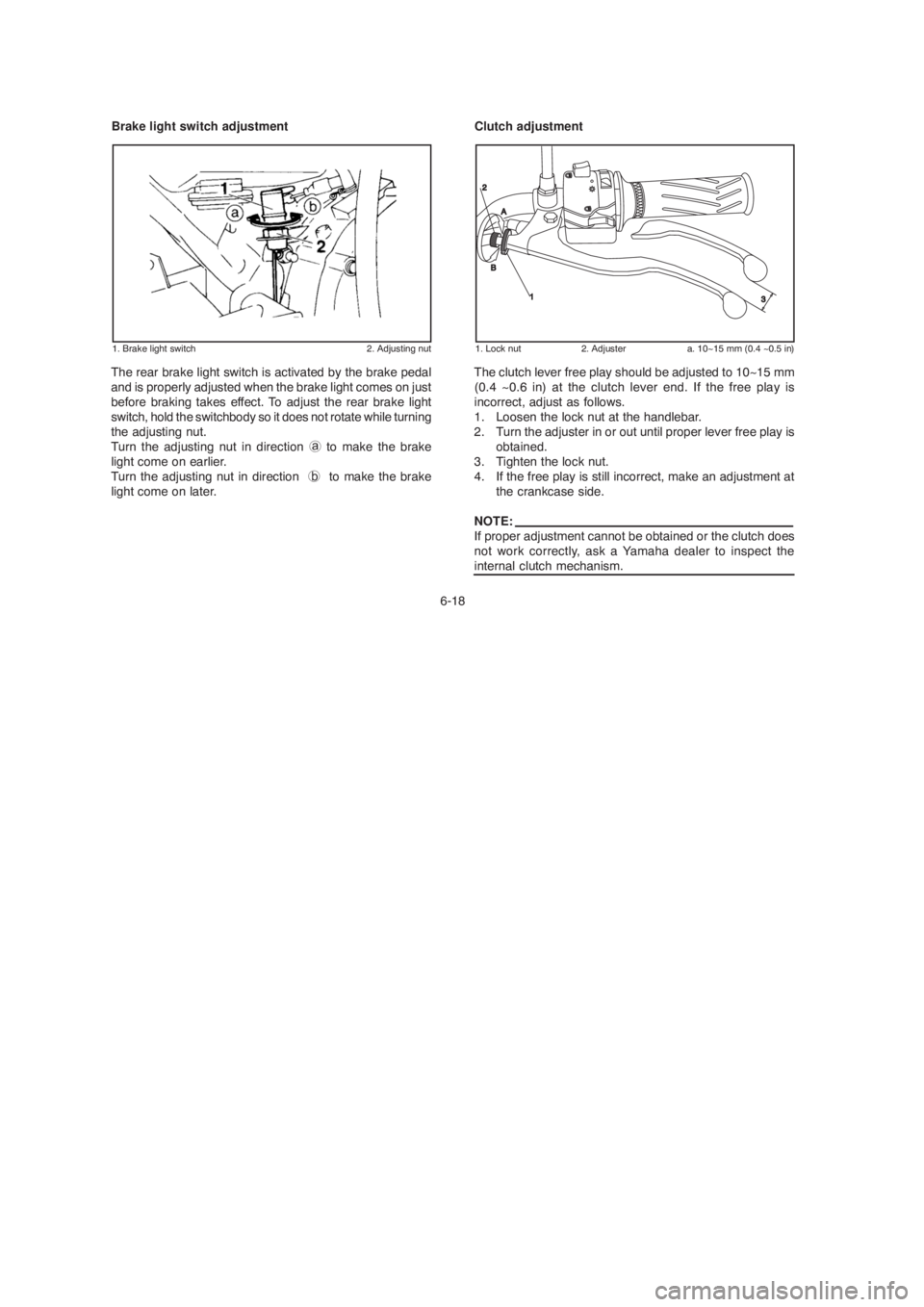
Brake light switch adjustment
The rear brake light switch is activated by the brake pedal
and is properly adjusted when the brake light comes on just
before braking takes effect. To adjust the rear brake light
switch, hold the switchbody so it does not rotate while turning
the adjusting nut.
Turn the adjusting nut in direction a to make the brake
light come on earlier.
Turn the adjusting nut in direction b to make the brake
light come on later.
1. Brake light switch 2. Adjusting nut
Clutch adjustment
The clutch lever free play should be adjusted to 10~15 mm
(0.4 ~0.6 in) at the clutch lever end. If the free play is
incorrect, adjust as follows.
1. Loosen the lock nut at the handlebar.
2. Turn the adjuster in or out until proper lever free play is
obtained.
3. Tighten the lock nut.
4. If the free play is still incorrect, make an adjustment at
the crankcase side.
NOTE:
If proper adjustment cannot be obtained or the clutch does
not work correctly, ask a Yamaha dealer to inspect the
internal clutch mechanism.
1. Lock nut 2. Adjuster a. 10~15 mm (0.4 ~0.5 in)
6-18
Brake light switch adjustment
The rear brake light switch is activated by the brake pedal
and is properly adjusted when the brake light comes on just
before braking takes effect. To adjust the rear brake light
switch, hold the switchbody so it does not rotate while turning
the adjusting nut.
Turn the adjusting nut in direction a to make the brake
light come on earlier.
Turn the adjusting nut in direction b to make the brake
light come on later.
1. Brake light switch 2. Adjusting nut
Clutch adjustment
The clutch lever free play should be adjusted to 10~15 mm
(0.4 ~0.6 in) at the clutch lever end. If the free play is
incorrect, adjust as follows.
1. Loosen the lock nut at the handlebar.
2. Turn the adjuster in or out until proper lever free play is
obtained.
3. Tighten the lock nut.
4. If the free play is still incorrect, make an adjustment at
the crankcase side.
NOTE:
If proper adjustment cannot be obtained or the clutch does
not work correctly, ask a Yamaha dealer to inspect the
internal clutch mechanism.
1. Lock nut 2. Adjuster a. 10~15 mm (0.4 ~0.5 in)
Page 60 of 83
6-20
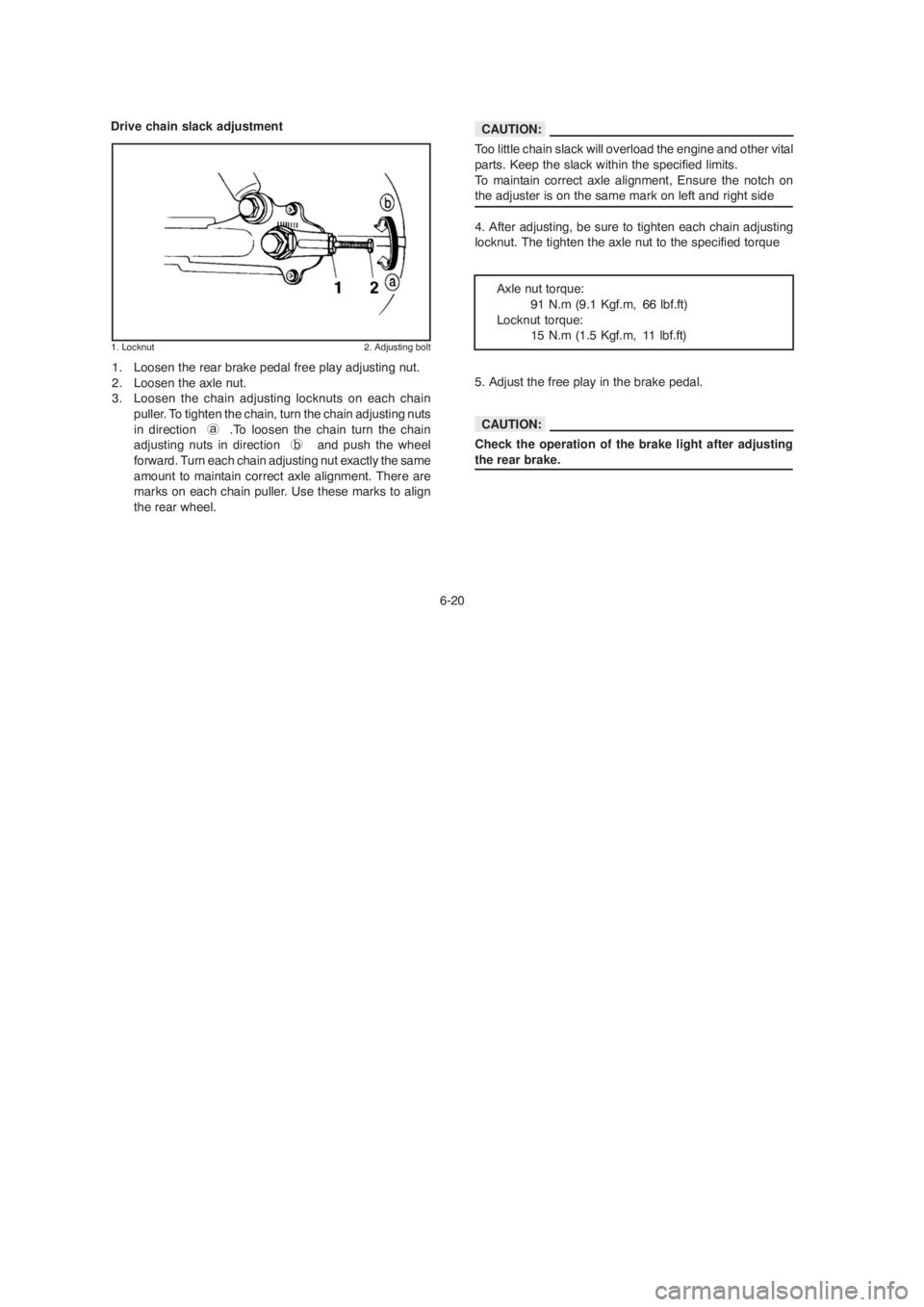
Drive chain slack adjustment
1. Locknut 2. Adjusting bolt
1. Loosen the rear brake pedal free play adjusting nut.
2. Loosen the axle nut.
3. Loosen the chain adjusting locknuts on each chain
puller. To tighten the chain, turn the chain adjusting nuts
in direction a .To loosen the chain turn the chain
adjusting nuts in direction b and push the wheel
forward. Turn each chain adjusting nut exactly the same
amount to maintain correct axle alignment. There are
marks on each chain puller. Use these marks to align
the rear wheel.Too little chain slack will overload the engine and other vital
parts. Keep the slack within the specified limits.
To maintain correct axle alignment, Ensure the notch on
the adjuster is on the same mark on left and right side
4. After adjusting, be sure to tighten each chain adjusting
locknut. The tighten the axle nut to the specified torque
Axle nut torque:
91 N.m (9.1 Kgf.m, 66 lbf.ft)
Locknut torque:
15 N.m (1.5 Kgf.m, 11 lbf.ft)
5. Adjust the free play in the brake pedal.
Check the operation of the brake light after adjusting
the rear brake.
CAUTION:
CAUTION:
6-20
Drive chain slack adjustment
1. Locknut 2. Adjusting bolt
1. Loosen the rear brake pedal free play adjusting nut.
2. Loosen the axle nut.
3. Loosen the chain adjusting locknuts on each chain
puller. To tighten the chain, turn the chain adjusting nuts
in direction a .To loosen the chain turn the chain
adjusting nuts in direction b and push the wheel
forward. Turn each chain adjusting nut exactly the same
amount to maintain correct axle alignment. There are
marks on each chain puller. Use these marks to align
the rear wheel.Too little chain slack will overload the engine and other vital
parts. Keep the slack within the specified limits.
To maintain correct axle alignment, Ensure the notch on
the adjuster is on the same mark on left and right side
4. After adjusting, be sure to tighten each chain adjusting
locknut. The tighten the axle nut to the specified torque
Axle nut torque:
91 N.m (9.1 Kgf.m, 66 lbf.ft)
Locknut torque:
15 N.m (1.5 Kgf.m, 11 lbf.ft)
5. Adjust the free play in the brake pedal.
Check the operation of the brake light after adjusting
the rear brake.
CAUTION:
CAUTION:
Page 62 of 83
6-22
Throttle cable and grip lubrication
The throttle twist grip assembly should be greased at the
time the cable is lubricated, since the grip must be removed
to get at the end of the throttle cable.
After removing the screws, hold the end of the cable up in
the air and put in several drops of lubricant. With the throttle
grip disassembled, coat the metal surface of the grip
assembly with a suitable all-purpose grease.Brake and shift pedals
Lubricate the pivoting parts.
RECOMMENDED LUBRICANT:
Engine oil SAE 20W50
Brake and clutch levers
Lubricate the pivoting parts.
RECOMMENDED LUBRICANT:
Engine oil SAE 20W50
Sidestand
Lubricate the pivoting parts. Check to see that the sidestand
moves up and down smoothly.
RECOMMENDED LUBRICANT:
Engine oil SAE 20W50
WARNING:
If the sidestand does not move smoothly, consult a
Yamaha dealer.
CAUTION:
6-22
Throttle cable and grip lubrication
The throttle twist grip assembly should be greased at the
time the cable is lubricated, since the grip must be removed
to get at the end of the throttle cable.
After removing the screws, hold the end of the cable up in
the air and put in several drops of lubricant. With the throttle
grip disassembled, coat the metal surface of the grip
assembly with a suitable all-purpose grease.Brake and shift pedals
Lubricate the pivoting parts.
RECOMMENDED LUBRICANT:
Engine oil SAE 20W50
Brake and clutch levers
Lubricate the pivoting parts.
RECOMMENDED LUBRICANT:
Engine oil SAE 20W50
Sidestand
Lubricate the pivoting parts. Check to see that the sidestand
moves up and down smoothly.
RECOMMENDED LUBRICANT:
Engine oil SAE 20W50
WARNING:
If the sidestand does not move smoothly, consult a
Yamaha dealer.
CAUTION:
Page 63 of 83
6-23
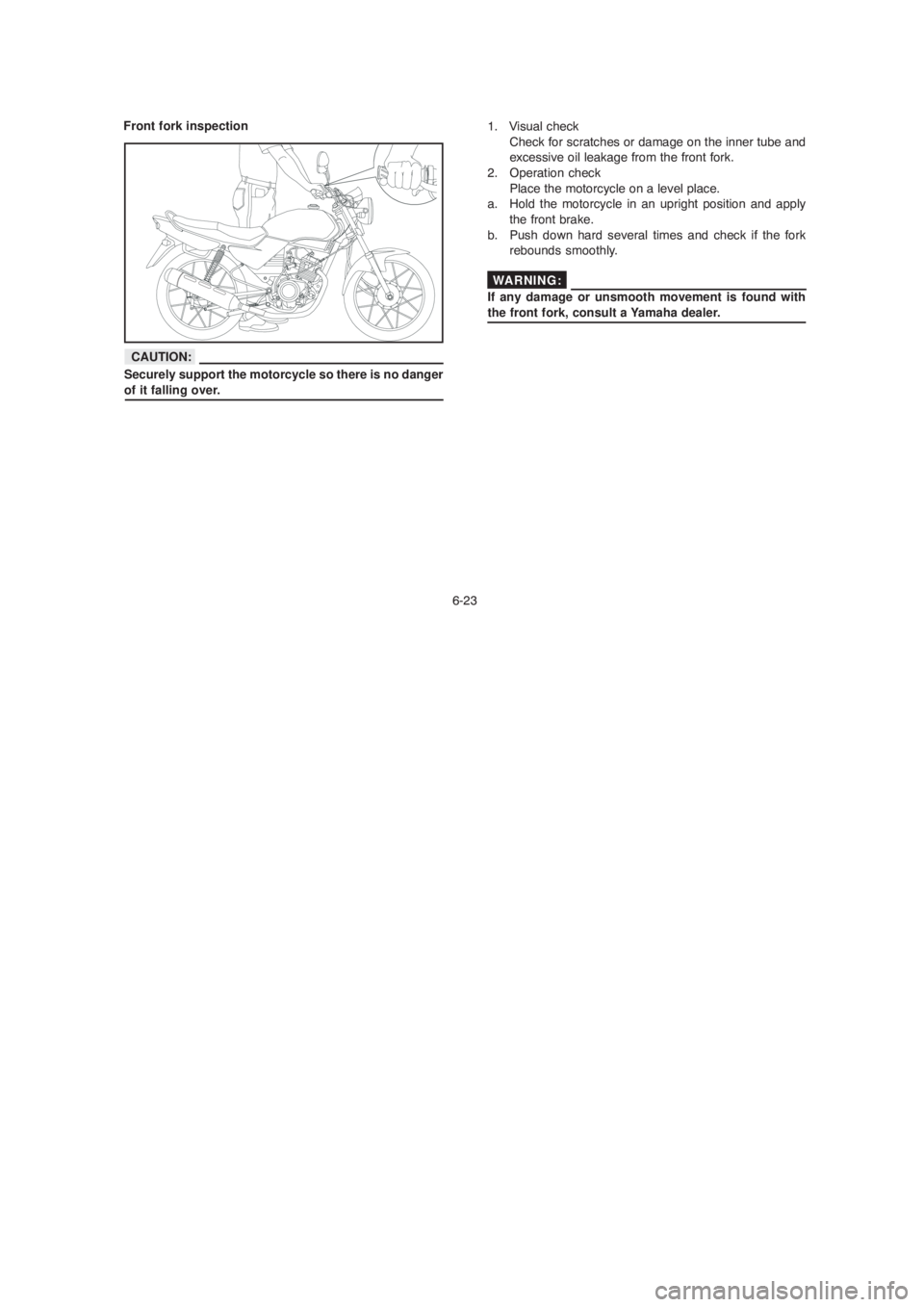
1. Visual check
Check for scratches or damage on the inner tube and
excessive oil leakage from the front fork.
2. Operation check
Place the motorcycle on a level place.
a. Hold the motorcycle in an upright position and apply
the front brake.
b. Push down hard several times and check if the fork
rebounds smoothly.
If any damage or unsmooth movement is found with
the front fork, consult a Yamaha dealer. Front fork inspection
Securely support the motorcycle so there is no danger
of it falling over.
CAUTION:
WARNING:
6-23
1. Visual check
Check for scratches or damage on the inner tube and
excessive oil leakage from the front fork.
2. Operation check
Place the motorcycle on a level place.
a. Hold the motorcycle in an upright position and apply
the front brake.
b. Push down hard several times and check if the fork
rebounds smoothly.
If any damage or unsmooth movement is found with
the front fork, consult a Yamaha dealer. Front fork inspection
Securely support the motorcycle so there is no danger
of it falling over.
CAUTION:
WARNING:
Page 71 of 83
6-31
It is advisable to have a Yamaha dealer service the
wheel.
Securely support the motorcycle so there is no danger
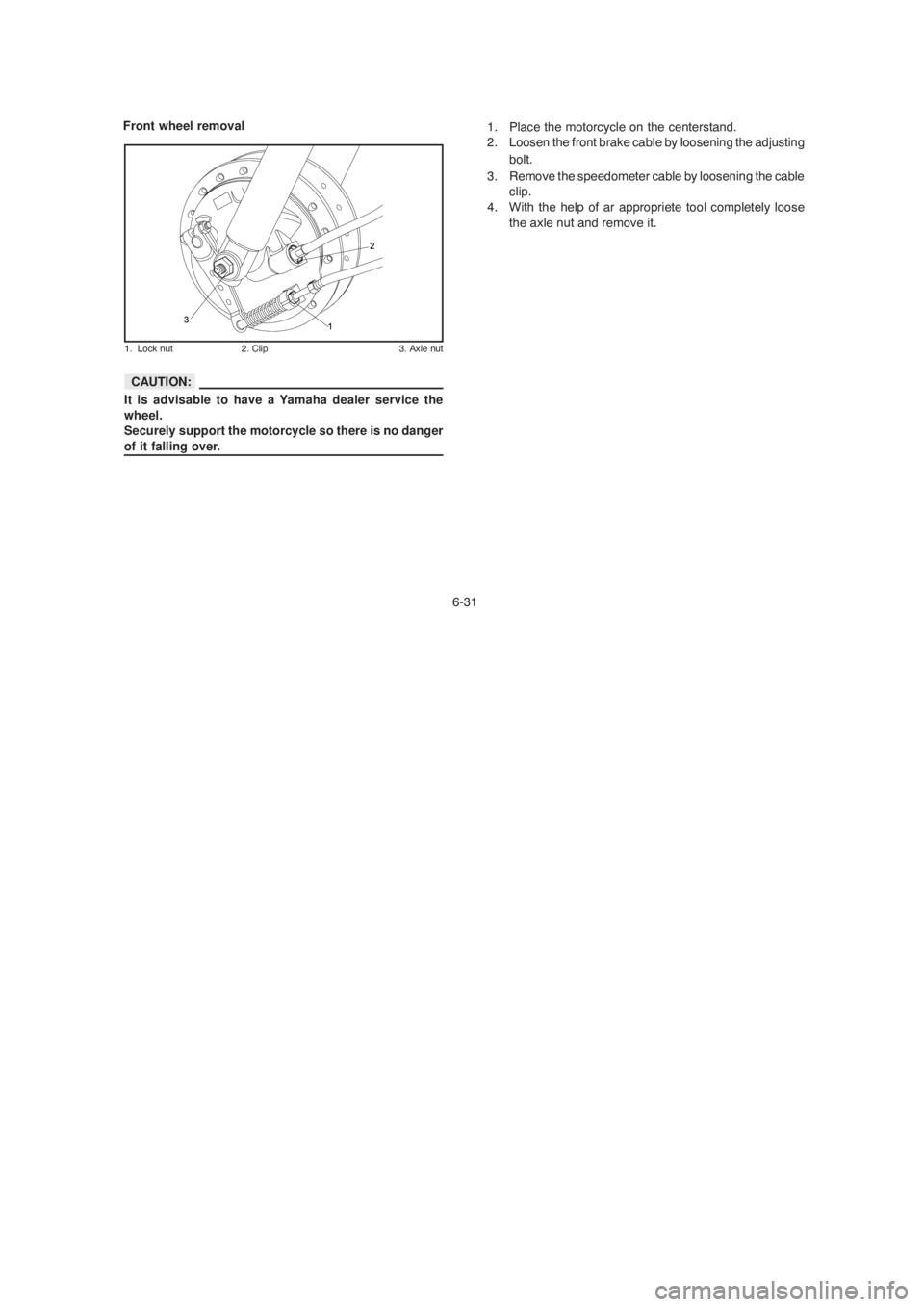
of it falling over. Front wheel removal
1. Place the motorcycle on the centerstand.
2. Loosen the front brake cable by loosening the adjusting
bolt.
3. Remove the speedometer cable by loosening the cable
clip.
4. With the help of ar appropriete tool completely loose
the axle nut and remove it.
1. Lock nut 2. Clip 3. Axle nut
CAUTION:
6-31
It is advisable to have a Yamaha dealer service the
wheel.
Securely support the motorcycle so there is no danger
of it falling over. Front wheel removal
1. Place the motorcycle on the centerstand.
2. Loosen the front brake cable by loosening the adjusting
bolt.
3. Remove the speedometer cable by loosening the cable
clip.
4. With the help of ar appropriete tool completely loose
the axle nut and remove it.
1. Lock nut 2. Clip 3. Axle nut
CAUTION:
Page 72 of 83
6-32
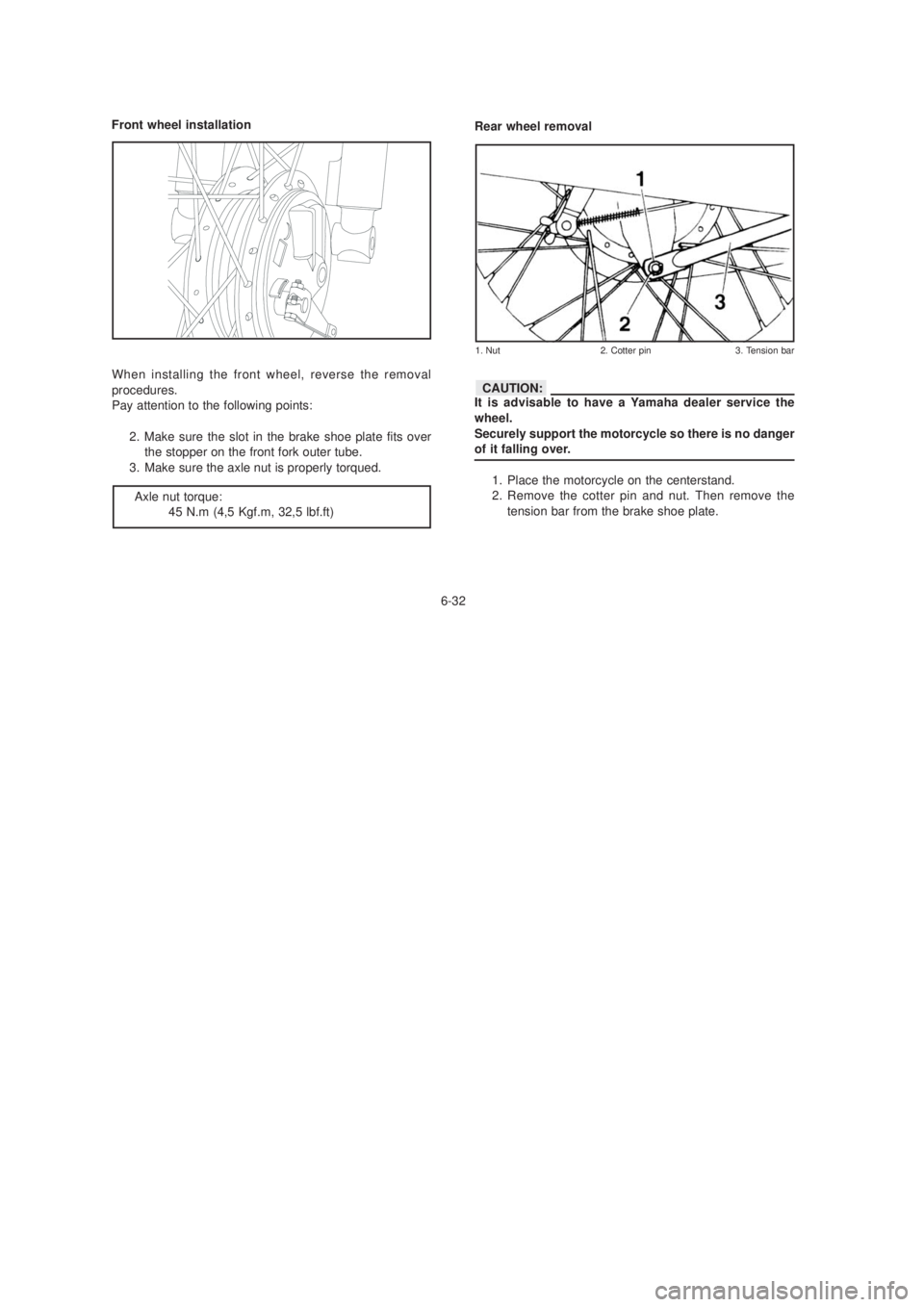
Front wheel installation
When installing the front wheel, reverse the removal
procedures.
Pay attention to the following points: 2. Make sure the slot in the brake shoe plate fits overthe stopper on the front fork outer tube.
3. Make sure the axle nut is properly torqued.
Axle nut torque: 45 N.m (4,5 Kgf.m, 32,5 lbf.ft)
Rear wheel removal
It is advisable to have a Yamaha dealer service the
wheel.
Securely support the motorcycle so there is no danger
of it falling over. 1. Place the motorcycle on the centerstand.
2. Remove the cotter pin and nut. Then remove thetension bar from the brake shoe plate.
1. Nut 2. Cotter pin 3. Tension bar
CAUTION:
6-32
Front wheel installation
When installing the front wheel, reverse the removal
procedures.
Pay attention to the following points: 2. Make sure the slot in the brake shoe plate fits overthe stopper on the front fork outer tube.
3. Make sure the axle nut is properly torqued.
Axle nut torque: 45 N.m (4,5 Kgf.m, 32,5 lbf.ft)
Rear wheel removal
It is advisable to have a Yamaha dealer service the
wheel.
Securely support the motorcycle so there is no danger
of it falling over. 1. Place the motorcycle on the centerstand.
2. Remove the cotter pin and nut. Then remove thetension bar from the brake shoe plate.
1. Nut 2. Cotter pin 3. Tension bar
CAUTION:
Page 73 of 83
6-33
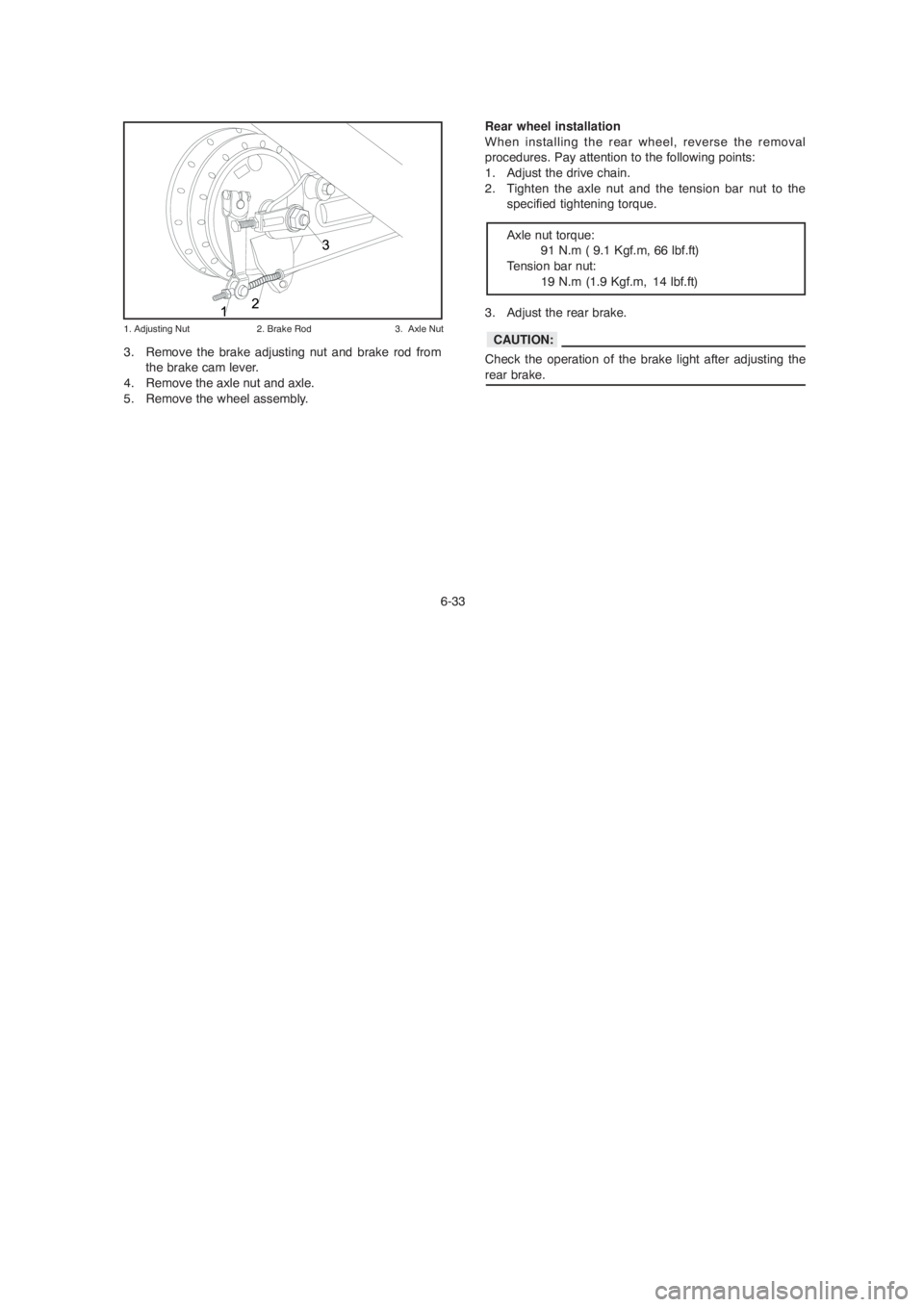
3. Remove the brake adjusting nut and brake rod from
the brake cam lever.
4. Remove the axle nut and axle.
5. Remove the wheel assembly.
1. Adjusting Nut 2. Brake Rod 3. Axle Nut
Rear wheel installation
When installing the rear wheel, reverse the removal
procedures. Pay attention to the following points:
1. Adjust the drive chain.
2. Tighten the axle nut and the tension bar nut to the
specified tightening torque.
Axle nut torque:
91 N.m ( 9.1 Kgf.m, 66 lbf.ft)
Tension bar nut:
19 N.m (1.9 Kgf.m, 14 lbf.ft)
3. Adjust the rear brake.
Check the operation of the brake light after adjusting the
rear brake.
CAUTION:
6-33
3. Remove the brake adjusting nut and brake rod from
the brake cam lever.
4. Remove the axle nut and axle.
5. Remove the wheel assembly.
1. Adjusting Nut 2. Brake Rod 3. Axle Nut
Rear wheel installation
When installing the rear wheel, reverse the removal
procedures. Pay attention to the following points:
1. Adjust the drive chain.
2. Tighten the axle nut and the tension bar nut to the
specified tightening torque.
Axle nut torque:
91 N.m ( 9.1 Kgf.m, 66 lbf.ft)
Tension bar nut:
19 N.m (1.9 Kgf.m, 14 lbf.ft)
3. Adjust the rear brake.
Check the operation of the brake light after adjusting the
rear brake.
CAUTION:
Page 76 of 83
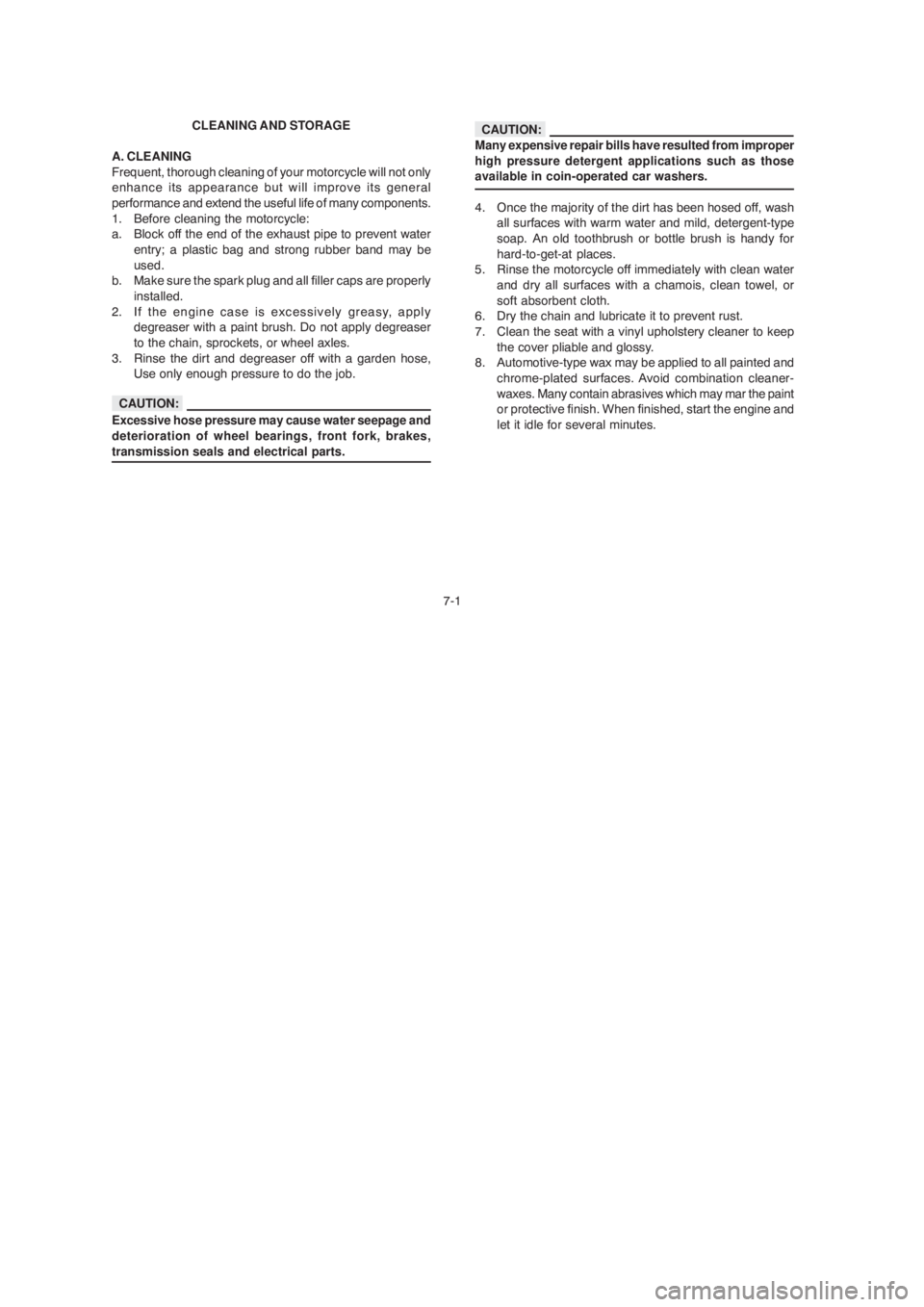
7-1 CLEANING AND STORAGE
A. CLEANING
Frequent, thorough cleaning of your motorcycle will not only
enhance its appearance but will improve its general
performance and extend the useful life of many components.
1. Before cleaning the motorcycle:
a. Block off the end of the exhaust pipe to prevent water
entry; a plastic bag and strong rubber band may be
used.
b. Make sure the spark plug and all filler caps are properly
installed.
2. If the engine case is excessively greasy, apply
degreaser with a paint brush. Do not apply degreaser
to the chain, sprockets, or wheel axles.
3. Rinse the dirt and degreaser off with a garden hose,
Use only enough pressure to do the job.
Excessive hose pressure may cause water seepage and
deterioration of wheel bearings, front fork, brakes,
transmission seals and electrical parts.Many expensive repair bills have resulted from improper
high pressure detergent applications such as those
available in coin-operated car washers.
4. Once the majority of the dirt has been hosed off, wash
all surfaces with warm water and mild, detergent-type
soap. An old toothbrush or bottle brush is handy for
hard-to-get-at places.
5. Rinse the motorcycle off immediately with clean water
and dry all surfaces with a chamois, clean towel, or
soft absorbent cloth.
6. Dry the chain and lubricate it to prevent rust.
7. Clean the seat with a vinyl upholstery cleaner to keep
the cover pliable and glossy.
8. Automotive-type wax may be applied to all painted and
chrome-plated surfaces. Avoid combination cleaner-
waxes. Many contain abrasives which may mar the paint
or protective finish. When finished, start the engine and
let it idle for several minutes.
CAUTION:
CAUTION:
7-1 CLEANING AND STORAGE
A. CLEANING
Frequent, thorough cleaning of your motorcycle will not only
enhance its appearance but will improve its general
performance and extend the useful life of many components.
1. Before cleaning the motorcycle:
a. Block off the end of the exhaust pipe to prevent water
entry; a plastic bag and strong rubber band may be
used.
b. Make sure the spark plug and all filler caps are properly
installed.
2. If the engine case is excessively greasy, apply
degreaser with a paint brush. Do not apply degreaser
to the chain, sprockets, or wheel axles.
3. Rinse the dirt and degreaser off with a garden hose,
Use only enough pressure to do the job.
Excessive hose pressure may cause water seepage and
deterioration of wheel bearings, front fork, brakes,
transmission seals and electrical parts.Many expensive repair bills have resulted from improper
high pressure detergent applications such as those
available in coin-operated car washers.
4. Once the majority of the dirt has been hosed off, wash
all surfaces with warm water and mild, detergent-type
soap. An old toothbrush or bottle brush is handy for
hard-to-get-at places.
5. Rinse the motorcycle off immediately with clean water
and dry all surfaces with a chamois, clean towel, or
soft absorbent cloth.
6. Dry the chain and lubricate it to prevent rust.
7. Clean the seat with a vinyl upholstery cleaner to keep
the cover pliable and glossy.
8. Automotive-type wax may be applied to all painted and
chrome-plated surfaces. Avoid combination cleaner-
waxes. Many contain abrasives which may mar the paint
or protective finish. When finished, start the engine and
let it idle for several minutes.
CAUTION:
CAUTION:
Page 81 of 83
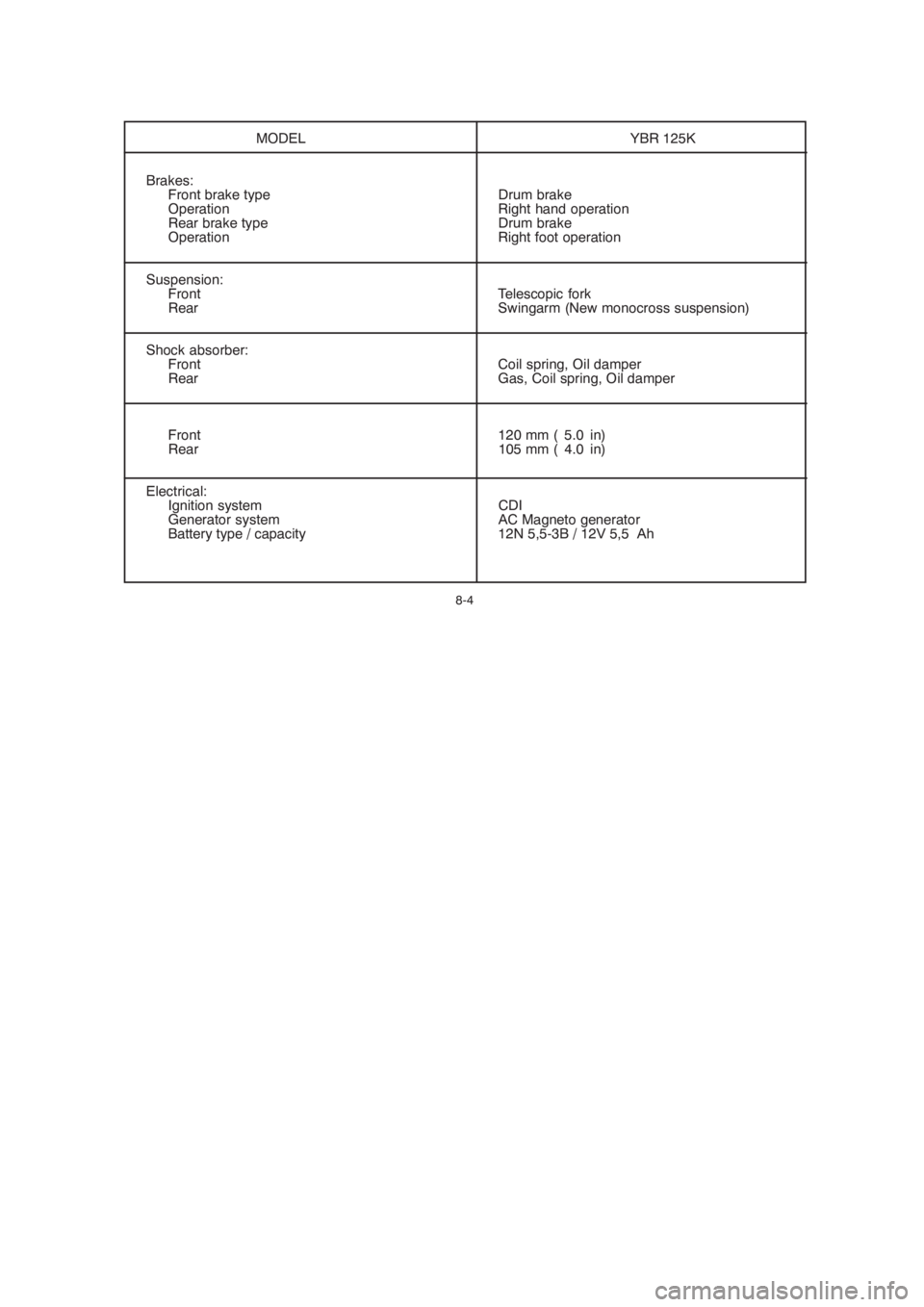
8-4
MODEL YBR 125K
Brakes:
Front brake type Drum brake
Operation Right hand operation
Rear brake type Drum brake
Operation Right foot operation
Suspension:
Front Telescopic fork
Rear Swingarm (New monocross suspension)
Shock absorber:
Front Coil spring, Oil damper
Rear Gas, Coil spring, Oil damper
Front 120 mm ( 5.0 in)
Rear 105 mm ( 4.0 in)
Electrical:
Ignition system CDI
Generator system AC Magneto generator
Battery type / capacity 12N 5,5-3B / 12V 5,5 Ah
8-4
MODEL YBR 125K
Brakes:
Front brake type Drum brake
Operation Right hand operation
Rear brake type Drum brake
Operation Right foot operation
Suspension:
Front Telescopic fork
Rear Swingarm (New monocross suspension)
Shock absorber:
Front Coil spring, Oil damper
Rear Gas, Coil spring, Oil damper
Front 120 mm ( 5.0 in)
Rear 105 mm ( 4.0 in)
Electrical:
Ignition system CDI
Generator system AC Magneto generator
Battery type / capacity 12N 5,5-3B / 12V 5,5 Ah