light YAMAHA YBR125 2004 User Guide
[x] Cancel search | Manufacturer: YAMAHA, Model Year: 2004, Model line: YBR125, Model: YAMAHA YBR125 2004Pages: 83, PDF Size: 3.16 MB
Page 44 of 83
6-4 *
**
***: It is recommended that these items be serviced by a Yamaha dealer.
: Molybdenum disulfide grease.
: Lithium soap based grease.
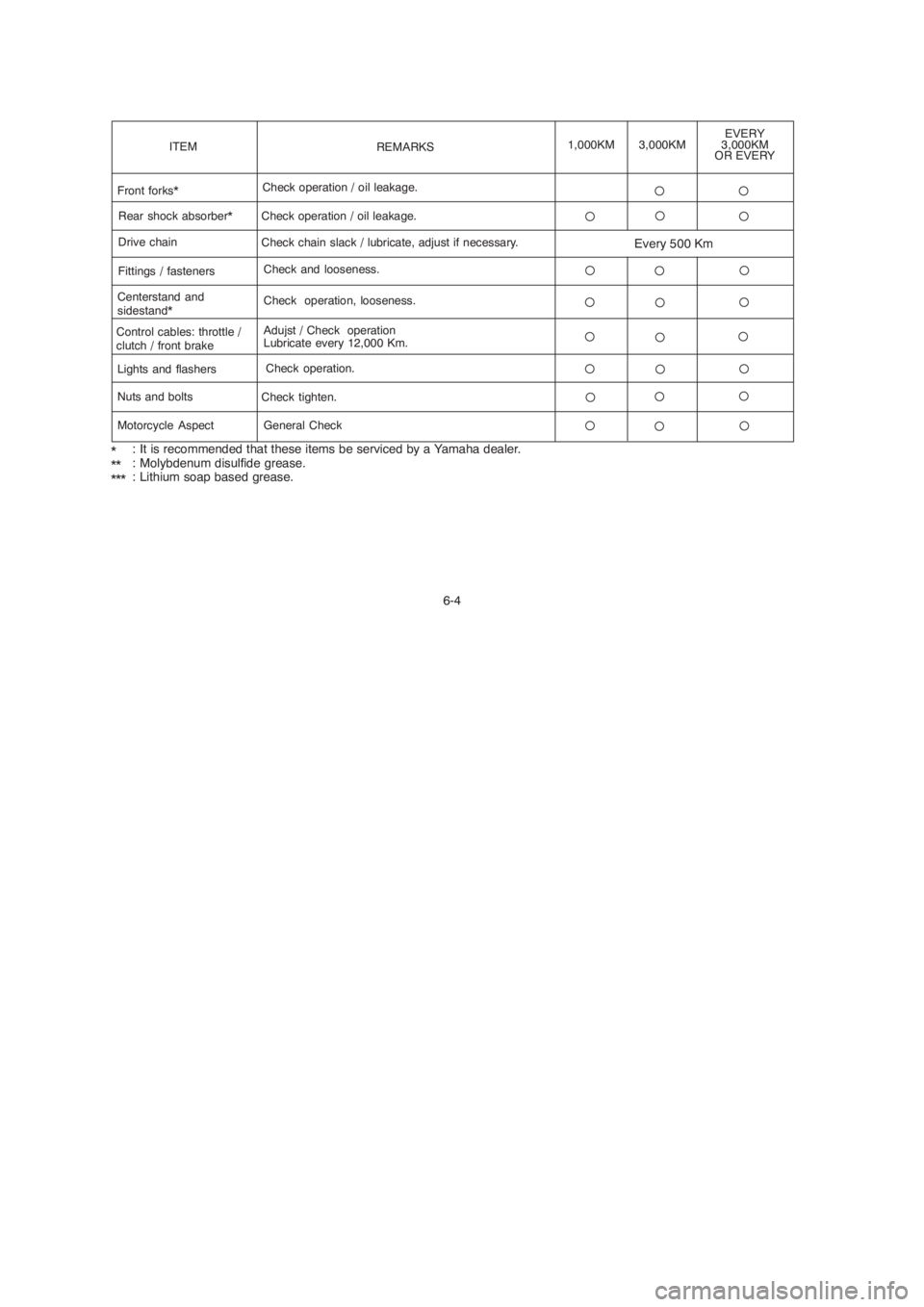
ITEM
Front forks*
Centerstand and
sidestand*
Control cables: throttle /
clutch / front brakeRear shock absorber*
Drive chain
Fittings / fastenersCheck operation / oil leakage.
Check operation, looseness.
Adujst / Check operation
Lubricate every 12,000 Km. Check chain slack / lubricate, adjust if necessary.
Check and looseness.REMARKS1,000KM
Lights and flashers
Nuts and bolts
Motorcycle AspectCheck operation.
Check tighten.
General Check
EVERY
3,000KM
OR EVERY3,000KM
Check operation / oil leakage.
Every 500 Km
6-4 *
**
***: It is recommended that these items be serviced by a Yamaha dealer.
: Molybdenum disulfide grease.
: Lithium soap based grease.
ITEM
Front forks*
Centerstand and
sidestand*
Control cables: throttle /
clutch / front brakeRear shock absorber*
Drive chain
Fittings / fastenersCheck operation / oil leakage.
Check operation, looseness.
Adujst / Check operation
Lubricate every 12,000 Km. Check chain slack / lubricate, adjust if necessary.
Check and looseness.REMARKS1,000KM
Lights and flashers
Nuts and bolts
Motorcycle AspectCheck operation.
Check tighten.
General Check
EVERY
3,000KM
OR EVERY3,000KM
Check operation / oil leakage.
Every 500 Km
Page 46 of 83

6-6
1. Engine oil filler cap
1. Maximum mark 2.Minimum mark
Engine oil
1. Oil level measurement
a. Place the motorcycle on a level place and hold it in an
upright position. Warm up the engine for several
minutes.
NOTE:
Be sure the motorcycle is positioned straight up when
checking the oil level. A slight tilt toward the side can result
in false readings.
b. With the engine stopped, with the engine stopped,
unscrew the oil filler cap/ dispstick and rest it on the
threads of the ok.
NOTE:
Wait a few minutes until the oil level settles before checking.
c. Remove the oil filler cap/ dispstick, clean it with a dry
cloth and check the oil level.
NOTE:
To check the oil level the oil filler cap/ dispstick can not be
screwed, just lightly seated in place.
d. The oil level should be between the maximum and
minimum marks. If the level is low, add oil to raise it to the
indicated level, check for oil leakage.
6-6
1. Engine oil filler cap
1. Maximum mark 2.Minimum mark
Engine oil
1. Oil level measurement
a. Place the motorcycle on a level place and hold it in an
upright position. Warm up the engine for several
minutes.
NOTE:
Be sure the motorcycle is positioned straight up when
checking the oil level. A slight tilt toward the side can result
in false readings.
b. With the engine stopped, with the engine stopped,
unscrew the oil filler cap/ dispstick and rest it on the
threads of the ok.
NOTE:
Wait a few minutes until the oil level settles before checking.
c. Remove the oil filler cap/ dispstick, clean it with a dry
cloth and check the oil level.
NOTE:
To check the oil level the oil filler cap/ dispstick can not be
screwed, just lightly seated in place.
d. The oil level should be between the maximum and
minimum marks. If the level is low, add oil to raise it to the
indicated level, check for oil leakage.
Page 55 of 83
6-15
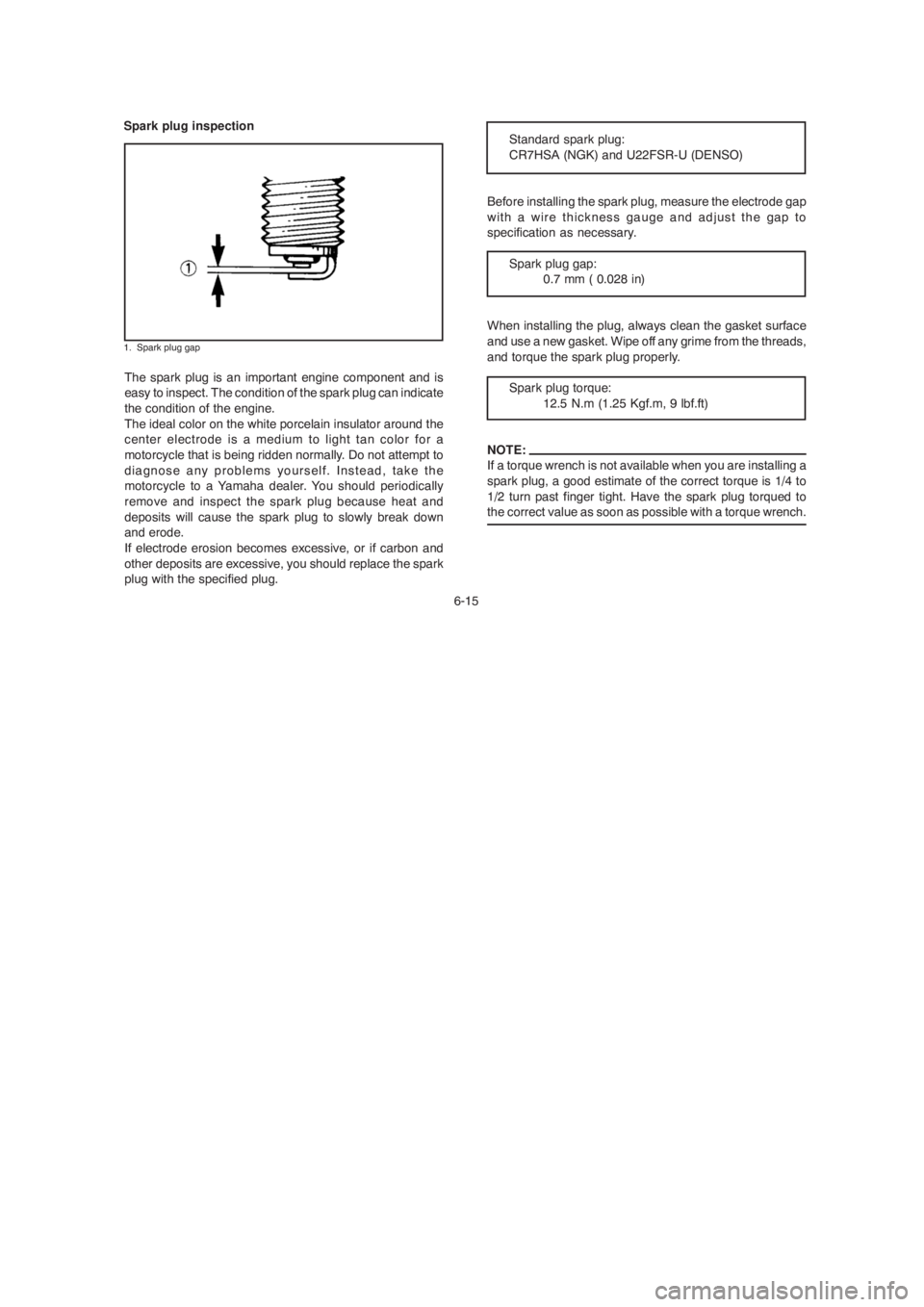
1. Spark plug gap
Spark plug inspection
The spark plug is an important engine component and is
easy to inspect. The condition of the spark plug can indicate
the condition of the engine.
The ideal color on the white porcelain insulator around the
center electrode is a medium to light tan color for a
motorcycle that is being ridden normally. Do not attempt to
diagnose any problems yourself. Instead, take the
motorcycle to a Yamaha dealer. You should periodically
remove and inspect the spark plug because heat and
deposits will cause the spark plug to slowly break down
and erode.
If electrode erosion becomes excessive, or if carbon and
other deposits are excessive, you should replace the spark
plug with the specified plug.Standard spark plug:
CR7HSA (NGK) and U22FSR-U (DENSO)
Before installing the spark plug, measure the electrode gap
with a wire thickness gauge and adjust the gap to
specification as necessary.
Spark plug gap:
0.7 mm ( 0.028 in)
When installing the plug, always clean the gasket surface
and use a new gasket. Wipe off any grime from the threads,
and torque the spark plug properly.
Spark plug torque:
12.5 N.m (1.25 Kgf.m, 9 lbf.ft)
NOTE:
If a torque wrench is not available when you are installing a
spark plug, a good estimate of the correct torque is 1/4 to
1/2 turn past finger tight. Have the spark plug torqued to
the correct value as soon as possible with a torque wrench.
6-15
1. Spark plug gap
Spark plug inspection
The spark plug is an important engine component and is
easy to inspect. The condition of the spark plug can indicate
the condition of the engine.
The ideal color on the white porcelain insulator around the
center electrode is a medium to light tan color for a
motorcycle that is being ridden normally. Do not attempt to
diagnose any problems yourself. Instead, take the
motorcycle to a Yamaha dealer. You should periodically
remove and inspect the spark plug because heat and
deposits will cause the spark plug to slowly break down
and erode.
If electrode erosion becomes excessive, or if carbon and
other deposits are excessive, you should replace the spark
plug with the specified plug.Standard spark plug:
CR7HSA (NGK) and U22FSR-U (DENSO)
Before installing the spark plug, measure the electrode gap
with a wire thickness gauge and adjust the gap to
specification as necessary.
Spark plug gap:
0.7 mm ( 0.028 in)
When installing the plug, always clean the gasket surface
and use a new gasket. Wipe off any grime from the threads,
and torque the spark plug properly.
Spark plug torque:
12.5 N.m (1.25 Kgf.m, 9 lbf.ft)
NOTE:
If a torque wrench is not available when you are installing a
spark plug, a good estimate of the correct torque is 1/4 to
1/2 turn past finger tight. Have the spark plug torqued to
the correct value as soon as possible with a torque wrench.
Page 57 of 83
6-17
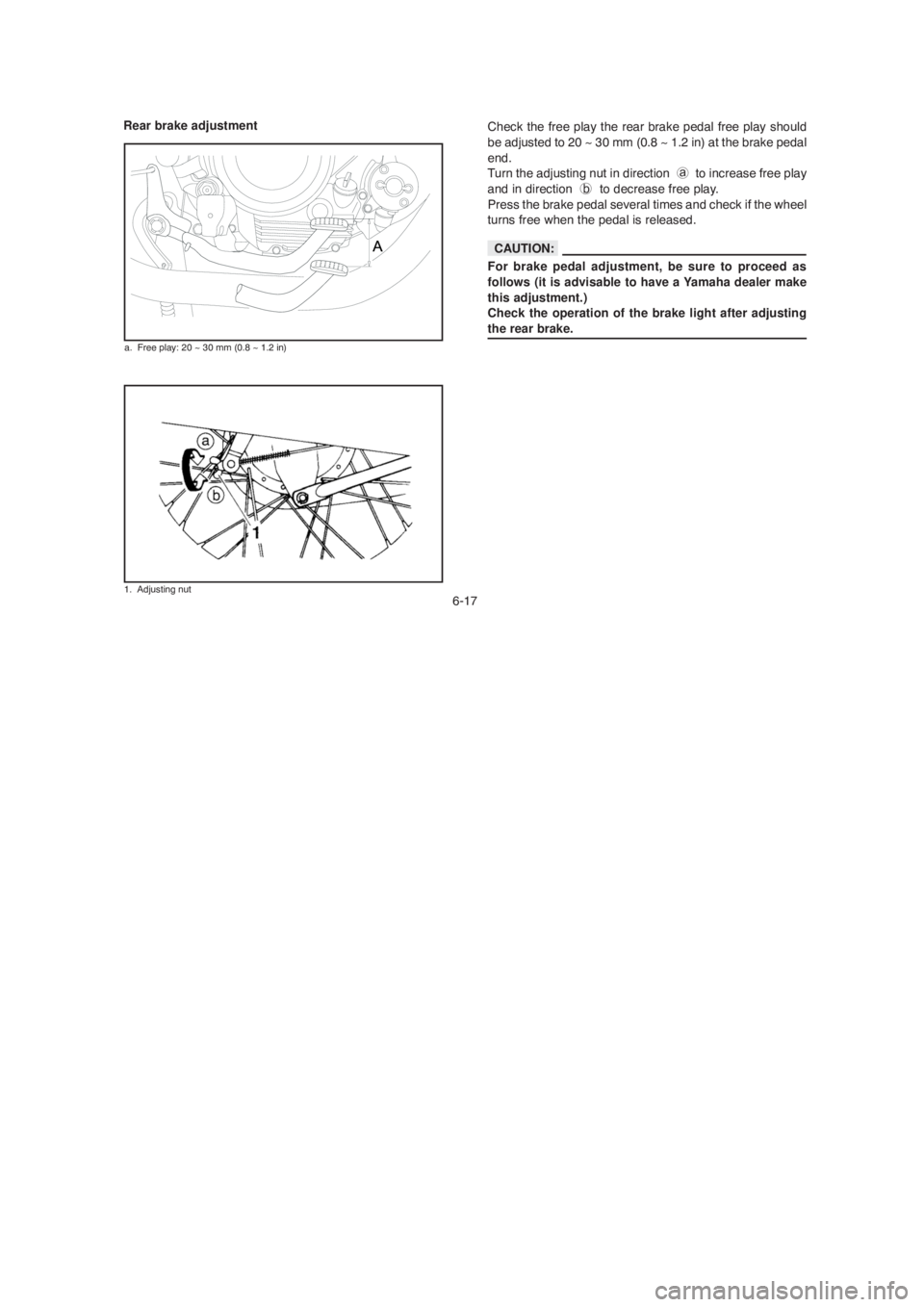
Rear brake adjustment
a. Free play: 20 ~ 30 mm (0.8 ~ 1.2 in)
Check the free play the rear brake pedal free play should
be adjusted to 20 ~ 30 mm (0.8 ~ 1.2 in) at the brake pedal
end.
Turn the adjusting nut in direction a to increase free play
and in direction b to decrease free play.
Press the brake pedal several times and check if the wheel
turns free when the pedal is released.
For brake pedal adjustment, be sure to proceed as
follows (it is advisable to have a Yamaha dealer make
this adjustment.)
Check the operation of the brake light after adjusting
the rear brake.
1. Adjusting nut
CAUTION:
6-17
Rear brake adjustment
a. Free play: 20 ~ 30 mm (0.8 ~ 1.2 in)
Check the free play the rear brake pedal free play should
be adjusted to 20 ~ 30 mm (0.8 ~ 1.2 in) at the brake pedal
end.
Turn the adjusting nut in direction a to increase free play
and in direction b to decrease free play.
Press the brake pedal several times and check if the wheel
turns free when the pedal is released.
For brake pedal adjustment, be sure to proceed as
follows (it is advisable to have a Yamaha dealer make
this adjustment.)
Check the operation of the brake light after adjusting
the rear brake.
1. Adjusting nut
CAUTION:
Page 58 of 83
6-18
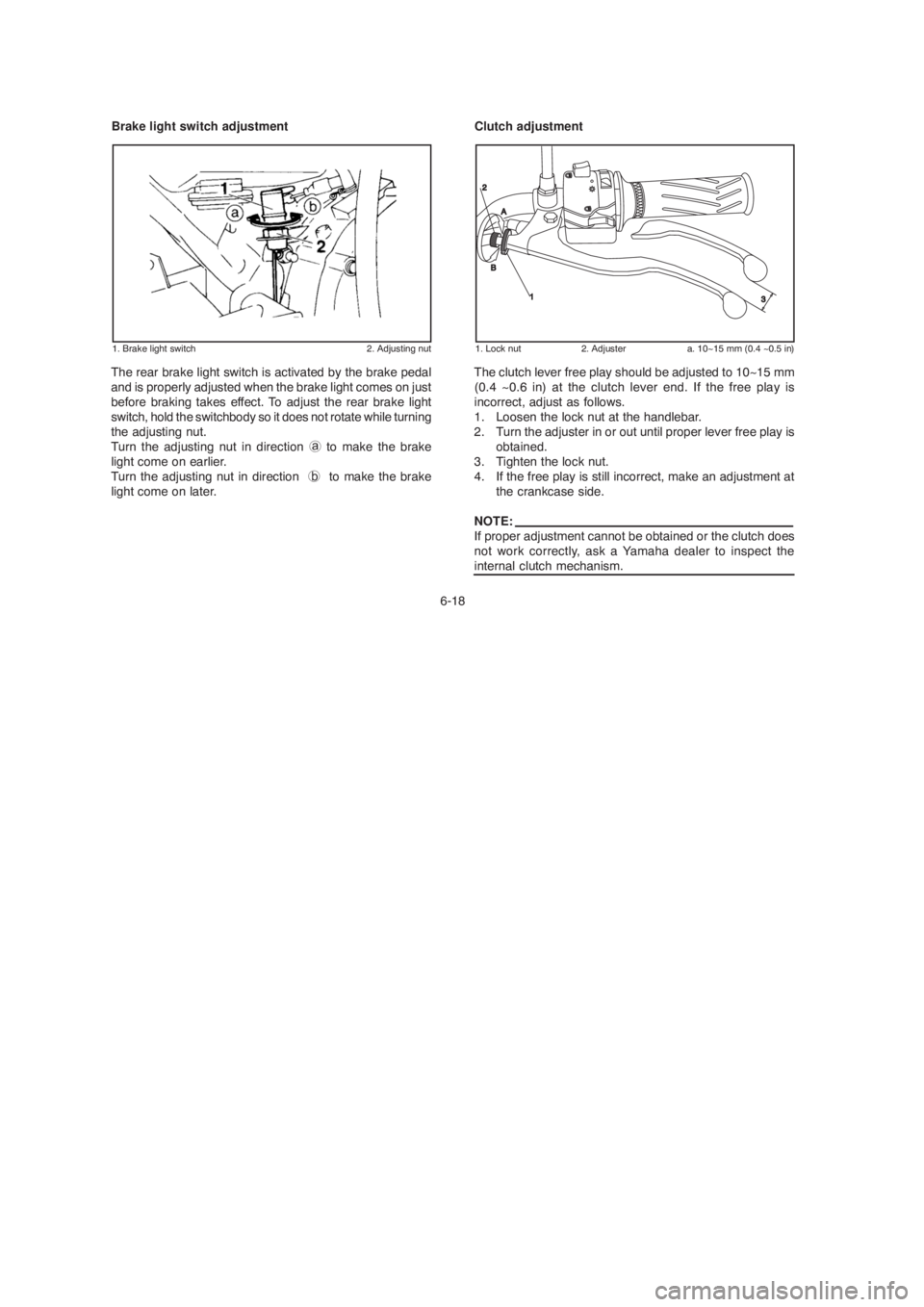
Brake light switch adjustment
The rear brake light switch is activated by the brake pedal
and is properly adjusted when the brake light comes on just
before braking takes effect. To adjust the rear brake light
switch, hold the switchbody so it does not rotate while turning
the adjusting nut.
Turn the adjusting nut in direction a to make the brake
light come on earlier.
Turn the adjusting nut in direction b to make the brake
light come on later.
1. Brake light switch 2. Adjusting nut
Clutch adjustment
The clutch lever free play should be adjusted to 10~15 mm
(0.4 ~0.6 in) at the clutch lever end. If the free play is
incorrect, adjust as follows.
1. Loosen the lock nut at the handlebar.
2. Turn the adjuster in or out until proper lever free play is
obtained.
3. Tighten the lock nut.
4. If the free play is still incorrect, make an adjustment at
the crankcase side.
NOTE:
If proper adjustment cannot be obtained or the clutch does
not work correctly, ask a Yamaha dealer to inspect the
internal clutch mechanism.
1. Lock nut 2. Adjuster a. 10~15 mm (0.4 ~0.5 in)
6-18
Brake light switch adjustment
The rear brake light switch is activated by the brake pedal
and is properly adjusted when the brake light comes on just
before braking takes effect. To adjust the rear brake light
switch, hold the switchbody so it does not rotate while turning
the adjusting nut.
Turn the adjusting nut in direction a to make the brake
light come on earlier.
Turn the adjusting nut in direction b to make the brake
light come on later.
1. Brake light switch 2. Adjusting nut
Clutch adjustment
The clutch lever free play should be adjusted to 10~15 mm
(0.4 ~0.6 in) at the clutch lever end. If the free play is
incorrect, adjust as follows.
1. Loosen the lock nut at the handlebar.
2. Turn the adjuster in or out until proper lever free play is
obtained.
3. Tighten the lock nut.
4. If the free play is still incorrect, make an adjustment at
the crankcase side.
NOTE:
If proper adjustment cannot be obtained or the clutch does
not work correctly, ask a Yamaha dealer to inspect the
internal clutch mechanism.
1. Lock nut 2. Adjuster a. 10~15 mm (0.4 ~0.5 in)
Page 60 of 83
6-20
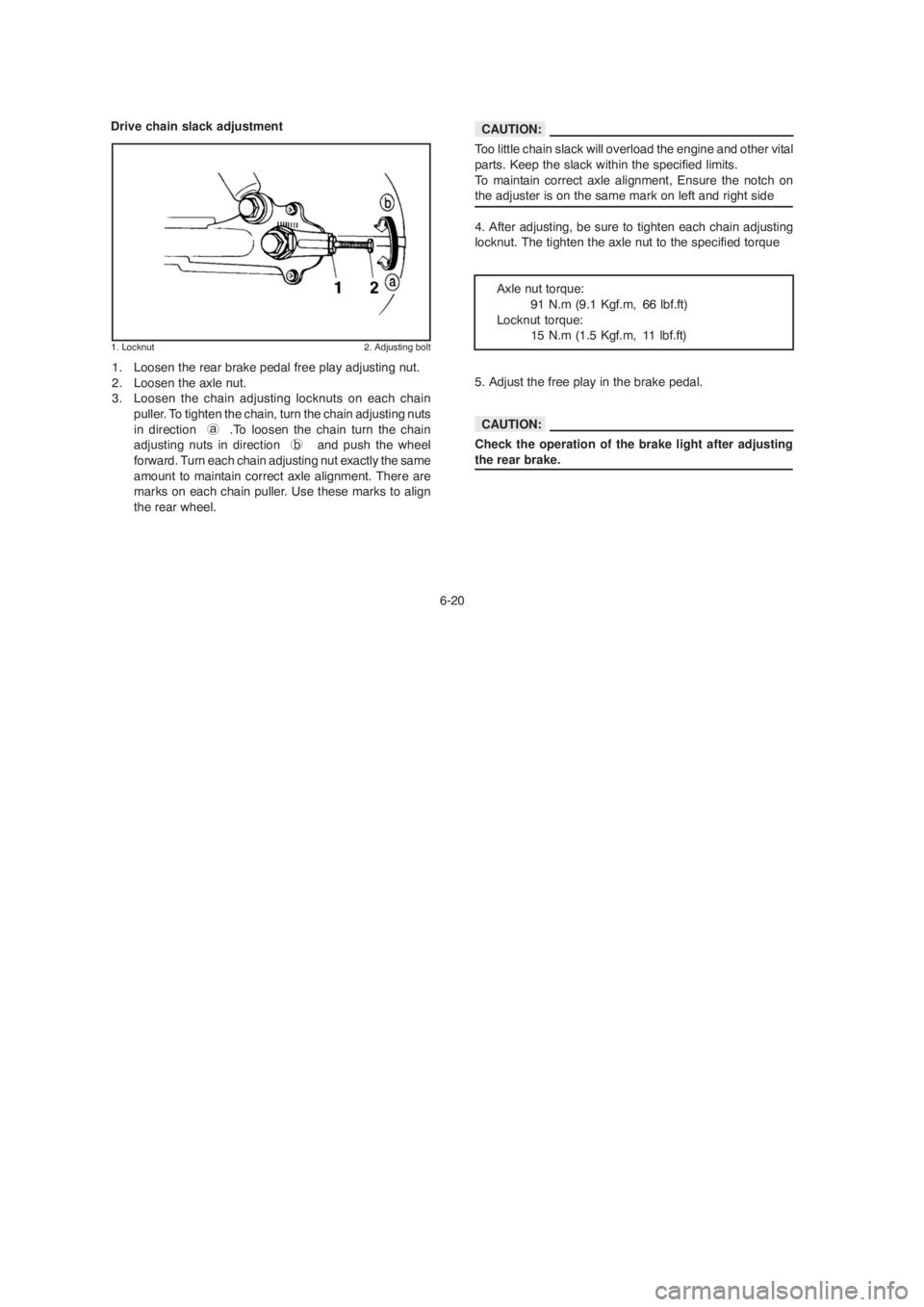
Drive chain slack adjustment
1. Locknut 2. Adjusting bolt
1. Loosen the rear brake pedal free play adjusting nut.
2. Loosen the axle nut.
3. Loosen the chain adjusting locknuts on each chain
puller. To tighten the chain, turn the chain adjusting nuts
in direction a .To loosen the chain turn the chain
adjusting nuts in direction b and push the wheel
forward. Turn each chain adjusting nut exactly the same
amount to maintain correct axle alignment. There are
marks on each chain puller. Use these marks to align
the rear wheel.Too little chain slack will overload the engine and other vital
parts. Keep the slack within the specified limits.
To maintain correct axle alignment, Ensure the notch on
the adjuster is on the same mark on left and right side
4. After adjusting, be sure to tighten each chain adjusting
locknut. The tighten the axle nut to the specified torque
Axle nut torque:
91 N.m (9.1 Kgf.m, 66 lbf.ft)
Locknut torque:
15 N.m (1.5 Kgf.m, 11 lbf.ft)
5. Adjust the free play in the brake pedal.
Check the operation of the brake light after adjusting
the rear brake.
CAUTION:
CAUTION:
6-20
Drive chain slack adjustment
1. Locknut 2. Adjusting bolt
1. Loosen the rear brake pedal free play adjusting nut.
2. Loosen the axle nut.
3. Loosen the chain adjusting locknuts on each chain
puller. To tighten the chain, turn the chain adjusting nuts
in direction a .To loosen the chain turn the chain
adjusting nuts in direction b and push the wheel
forward. Turn each chain adjusting nut exactly the same
amount to maintain correct axle alignment. There are
marks on each chain puller. Use these marks to align
the rear wheel.Too little chain slack will overload the engine and other vital
parts. Keep the slack within the specified limits.
To maintain correct axle alignment, Ensure the notch on
the adjuster is on the same mark on left and right side
4. After adjusting, be sure to tighten each chain adjusting
locknut. The tighten the axle nut to the specified torque
Axle nut torque:
91 N.m (9.1 Kgf.m, 66 lbf.ft)
Locknut torque:
15 N.m (1.5 Kgf.m, 11 lbf.ft)
5. Adjust the free play in the brake pedal.
Check the operation of the brake light after adjusting
the rear brake.
CAUTION:
CAUTION:
Page 68 of 83
6-28
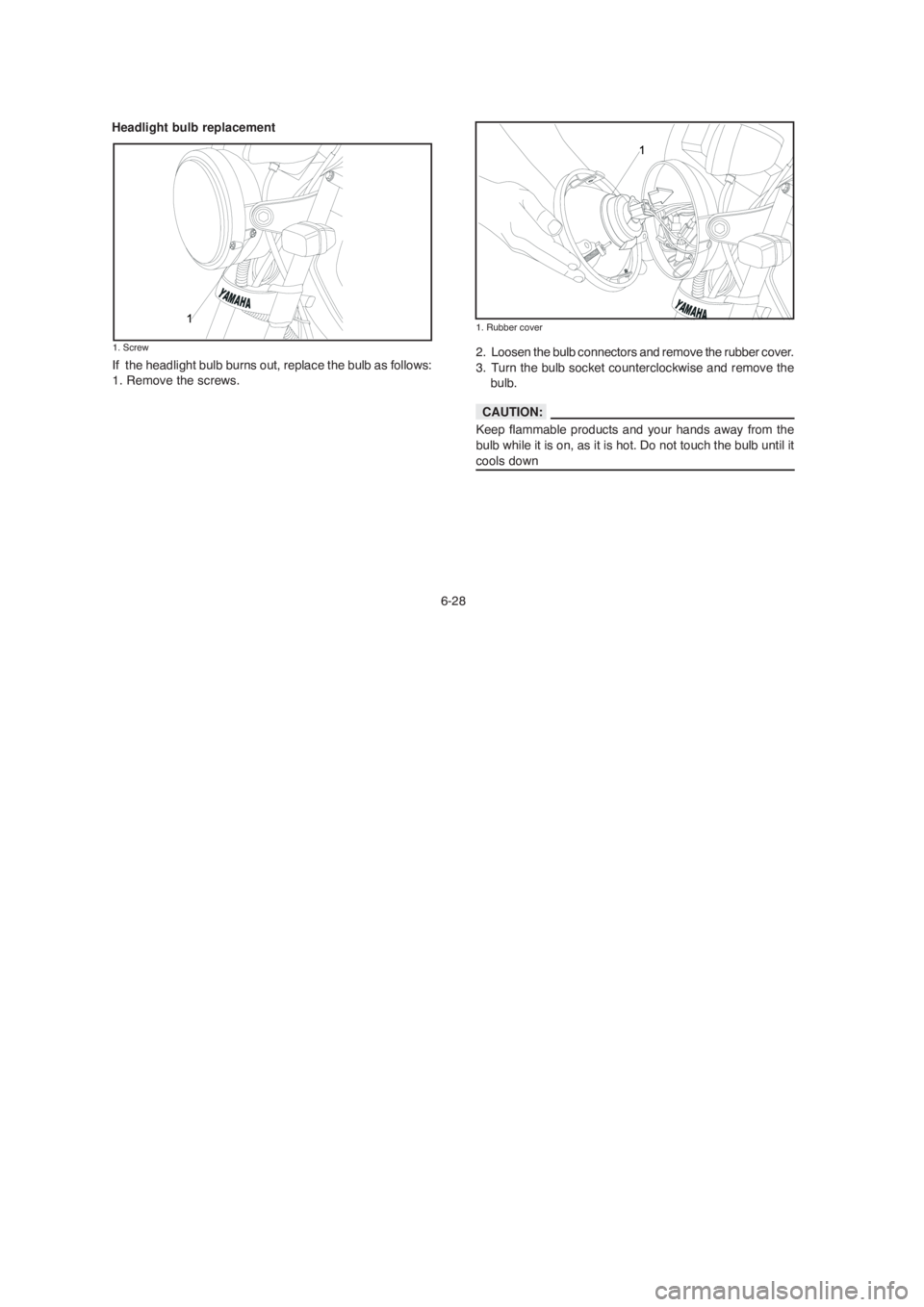
1. Screw
Headlight bulb replacement
If the headlight bulb burns out, replace the bulb as follows:
1. Remove the screws.2. Loosen the bulb connectors and remove the rubber cover.
3. Turn the bulb socket counterclockwise and remove the
bulb.
Keep flammable products and your hands away from the
bulb while it is on, as it is hot. Do not touch the bulb until it
cools down
1. Rubber cover
CAUTION:
6-28
1. Screw
Headlight bulb replacement
If the headlight bulb burns out, replace the bulb as follows:
1. Remove the screws.2. Loosen the bulb connectors and remove the rubber cover.
3. Turn the bulb socket counterclockwise and remove the
bulb.
Keep flammable products and your hands away from the
bulb while it is on, as it is hot. Do not touch the bulb until it
cools down
1. Rubber cover
CAUTION:
Page 69 of 83
6-29
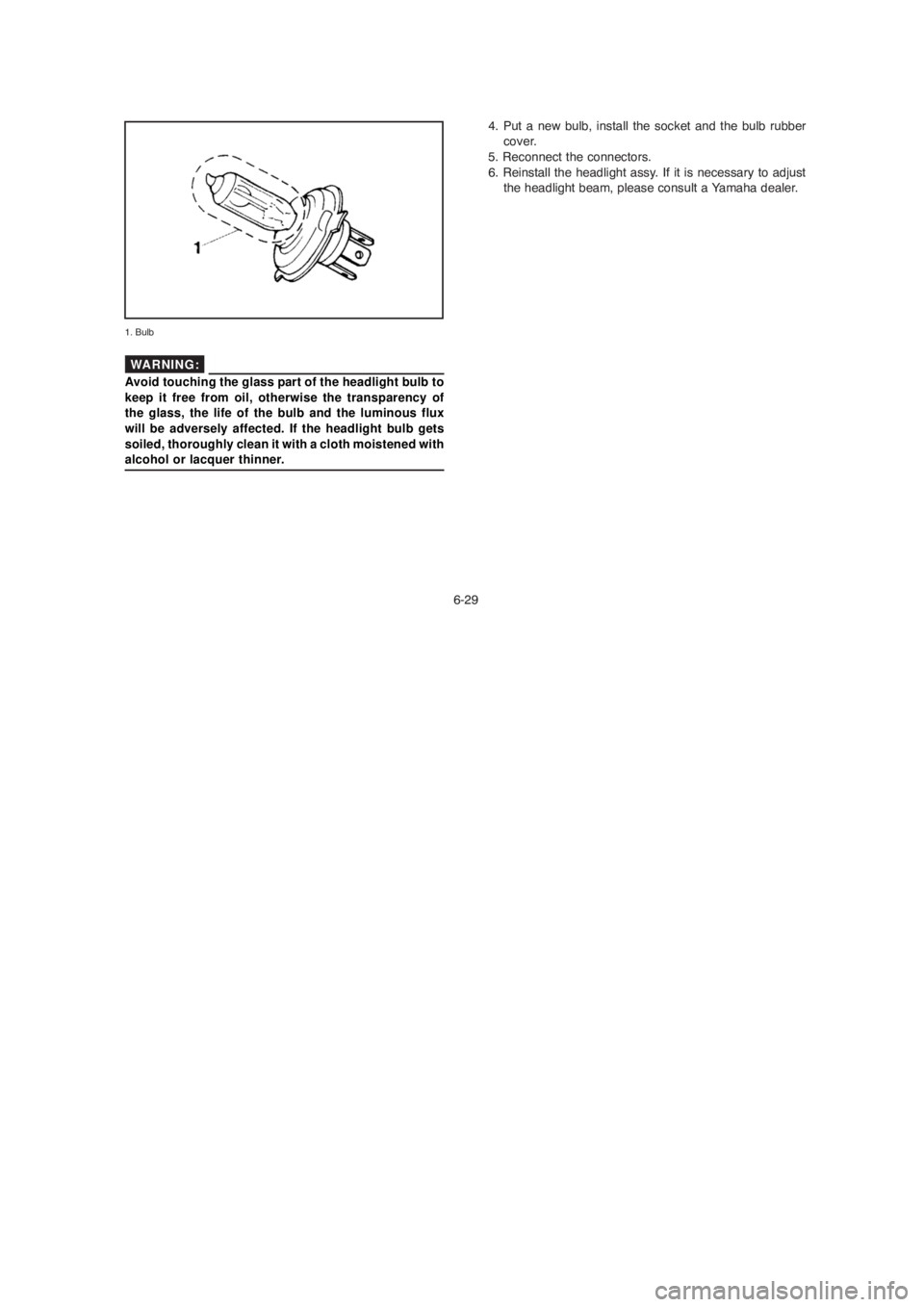
1. Bulb
4. Put a new bulb, install the socket and the bulb rubber
cover.
5. Reconnect the connectors.
6. Reinstall the headlight assy. If it is necessary to adjust
the headlight beam, please consult a Yamaha dealer.
Avoid touching the glass part of the headlight bulb to
keep it free from oil, otherwise the transparency of
the glass, the life of the bulb and the luminous flux
will be adversely affected. If the headlight bulb gets
soiled, thoroughly clean it with a cloth moistened with
alcohol or lacquer thinner.
WARNING:
6-29
1. Bulb
4. Put a new bulb, install the socket and the bulb rubber
cover.
5. Reconnect the connectors.
6. Reinstall the headlight assy. If it is necessary to adjust
the headlight beam, please consult a Yamaha dealer.
Avoid touching the glass part of the headlight bulb to
keep it free from oil, otherwise the transparency of
the glass, the life of the bulb and the luminous flux
will be adversely affected. If the headlight bulb gets
soiled, thoroughly clean it with a cloth moistened with
alcohol or lacquer thinner.
WARNING:
Page 70 of 83
6-30 Turn signal bulb replacement
1. Remove the screws and the lens.
2. Push the bulb inward and turn it counterclockwise.
3. Place a new bulb in the socket.
4. Install the lens and the screws.
Do not over-tighten the screws as the lens may break.Taillight bulb replacement
1. Remove the lens.
2. Push the bulb inward and turn it counterclockwise.
3. Place a new bulb in the socket.
4. Install the lens.
CAUTION:
6-30 Turn signal bulb replacement
1. Remove the screws and the lens.
2. Push the bulb inward and turn it counterclockwise.
3. Place a new bulb in the socket.
4. Install the lens and the screws.
Do not over-tighten the screws as the lens may break.Taillight bulb replacement
1. Remove the lens.
2. Push the bulb inward and turn it counterclockwise.
3. Place a new bulb in the socket.
4. Install the lens.
CAUTION:
Page 73 of 83
6-33
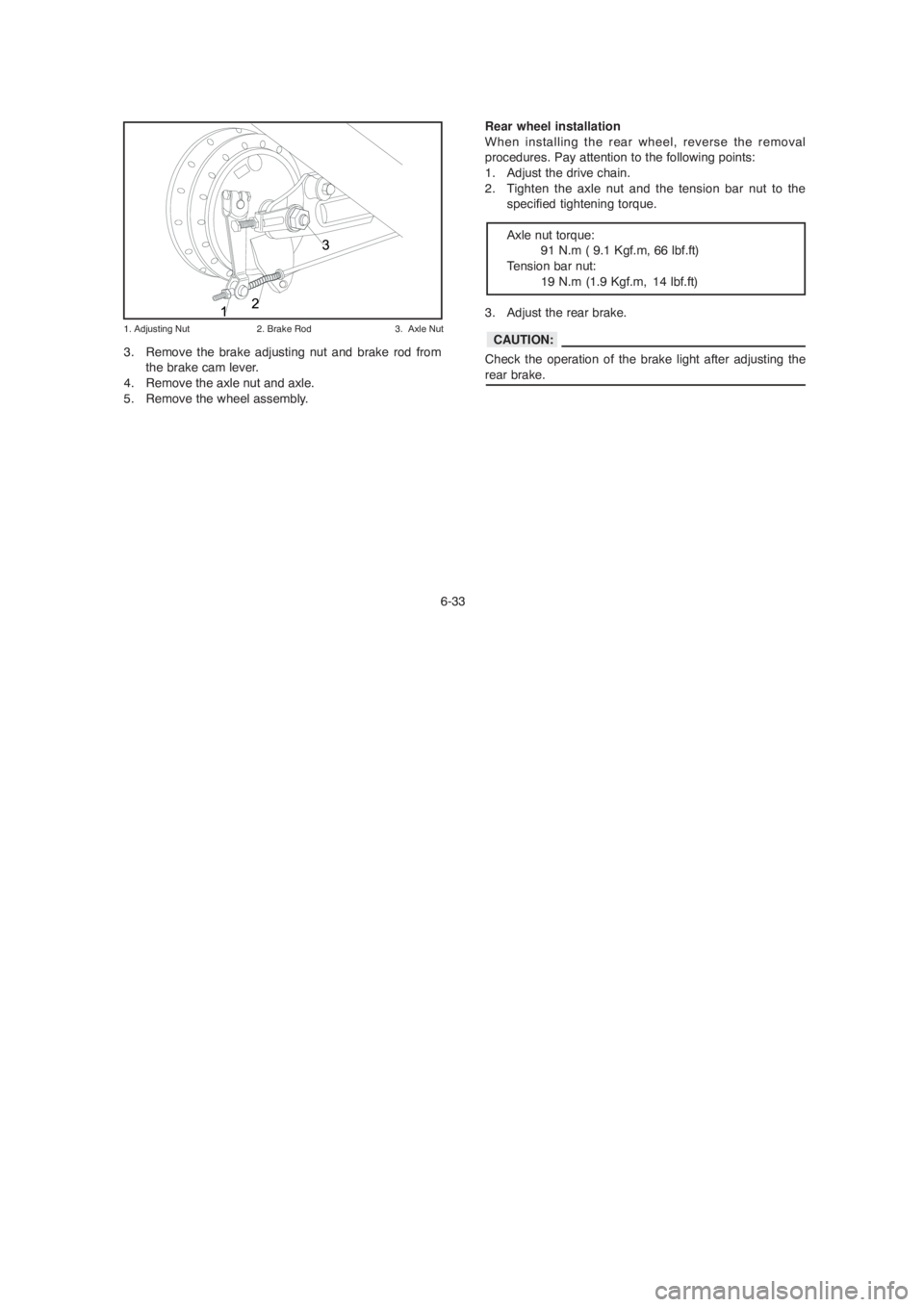
3. Remove the brake adjusting nut and brake rod from
the brake cam lever.
4. Remove the axle nut and axle.
5. Remove the wheel assembly.
1. Adjusting Nut 2. Brake Rod 3. Axle Nut
Rear wheel installation
When installing the rear wheel, reverse the removal
procedures. Pay attention to the following points:
1. Adjust the drive chain.
2. Tighten the axle nut and the tension bar nut to the
specified tightening torque.
Axle nut torque:
91 N.m ( 9.1 Kgf.m, 66 lbf.ft)
Tension bar nut:
19 N.m (1.9 Kgf.m, 14 lbf.ft)
3. Adjust the rear brake.
Check the operation of the brake light after adjusting the
rear brake.
CAUTION:
6-33
3. Remove the brake adjusting nut and brake rod from
the brake cam lever.
4. Remove the axle nut and axle.
5. Remove the wheel assembly.
1. Adjusting Nut 2. Brake Rod 3. Axle Nut
Rear wheel installation
When installing the rear wheel, reverse the removal
procedures. Pay attention to the following points:
1. Adjust the drive chain.
2. Tighten the axle nut and the tension bar nut to the
specified tightening torque.
Axle nut torque:
91 N.m ( 9.1 Kgf.m, 66 lbf.ft)
Tension bar nut:
19 N.m (1.9 Kgf.m, 14 lbf.ft)
3. Adjust the rear brake.
Check the operation of the brake light after adjusting the
rear brake.
CAUTION: