lock YAMAHA YBR125 2004 User Guide
[x] Cancel search | Manufacturer: YAMAHA, Model Year: 2004, Model line: YBR125, Model: YAMAHA YBR125 2004Pages: 83, PDF Size: 3.16 MB
Page 60 of 83
6-20
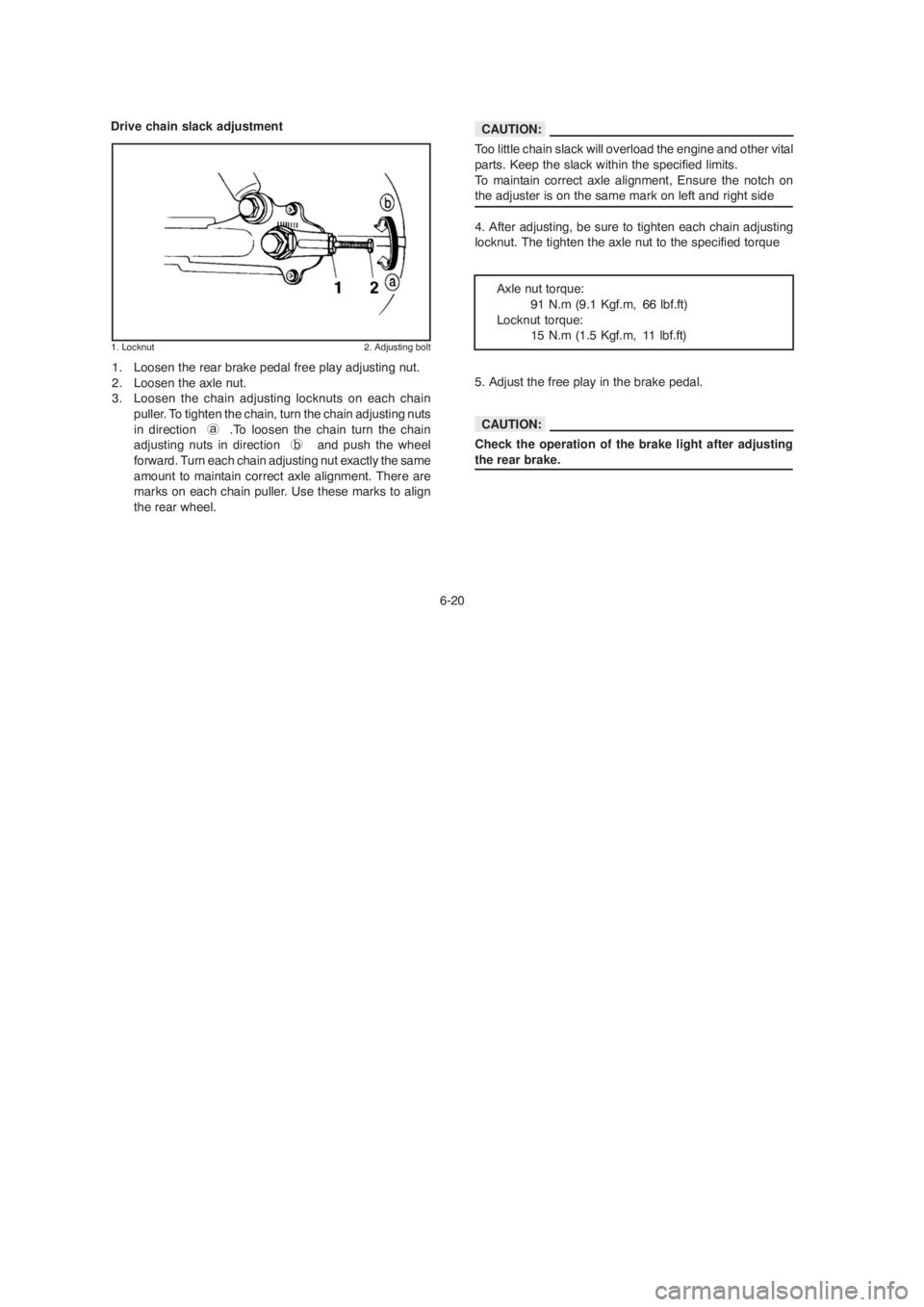
Drive chain slack adjustment
1. Locknut 2. Adjusting bolt
1. Loosen the rear brake pedal free play adjusting nut.
2. Loosen the axle nut.
3. Loosen the chain adjusting locknuts on each chain
puller. To tighten the chain, turn the chain adjusting nuts
in direction a .To loosen the chain turn the chain
adjusting nuts in direction b and push the wheel
forward. Turn each chain adjusting nut exactly the same
amount to maintain correct axle alignment. There are
marks on each chain puller. Use these marks to align
the rear wheel.Too little chain slack will overload the engine and other vital
parts. Keep the slack within the specified limits.
To maintain correct axle alignment, Ensure the notch on
the adjuster is on the same mark on left and right side
4. After adjusting, be sure to tighten each chain adjusting
locknut. The tighten the axle nut to the specified torque
Axle nut torque:
91 N.m (9.1 Kgf.m, 66 lbf.ft)
Locknut torque:
15 N.m (1.5 Kgf.m, 11 lbf.ft)
5. Adjust the free play in the brake pedal.
Check the operation of the brake light after adjusting
the rear brake.
CAUTION:
CAUTION:
6-20
Drive chain slack adjustment
1. Locknut 2. Adjusting bolt
1. Loosen the rear brake pedal free play adjusting nut.
2. Loosen the axle nut.
3. Loosen the chain adjusting locknuts on each chain
puller. To tighten the chain, turn the chain adjusting nuts
in direction a .To loosen the chain turn the chain
adjusting nuts in direction b and push the wheel
forward. Turn each chain adjusting nut exactly the same
amount to maintain correct axle alignment. There are
marks on each chain puller. Use these marks to align
the rear wheel.Too little chain slack will overload the engine and other vital
parts. Keep the slack within the specified limits.
To maintain correct axle alignment, Ensure the notch on
the adjuster is on the same mark on left and right side
4. After adjusting, be sure to tighten each chain adjusting
locknut. The tighten the axle nut to the specified torque
Axle nut torque:
91 N.m (9.1 Kgf.m, 66 lbf.ft)
Locknut torque:
15 N.m (1.5 Kgf.m, 11 lbf.ft)
5. Adjust the free play in the brake pedal.
Check the operation of the brake light after adjusting
the rear brake.
CAUTION:
CAUTION:
Page 68 of 83
6-28
1. Screw
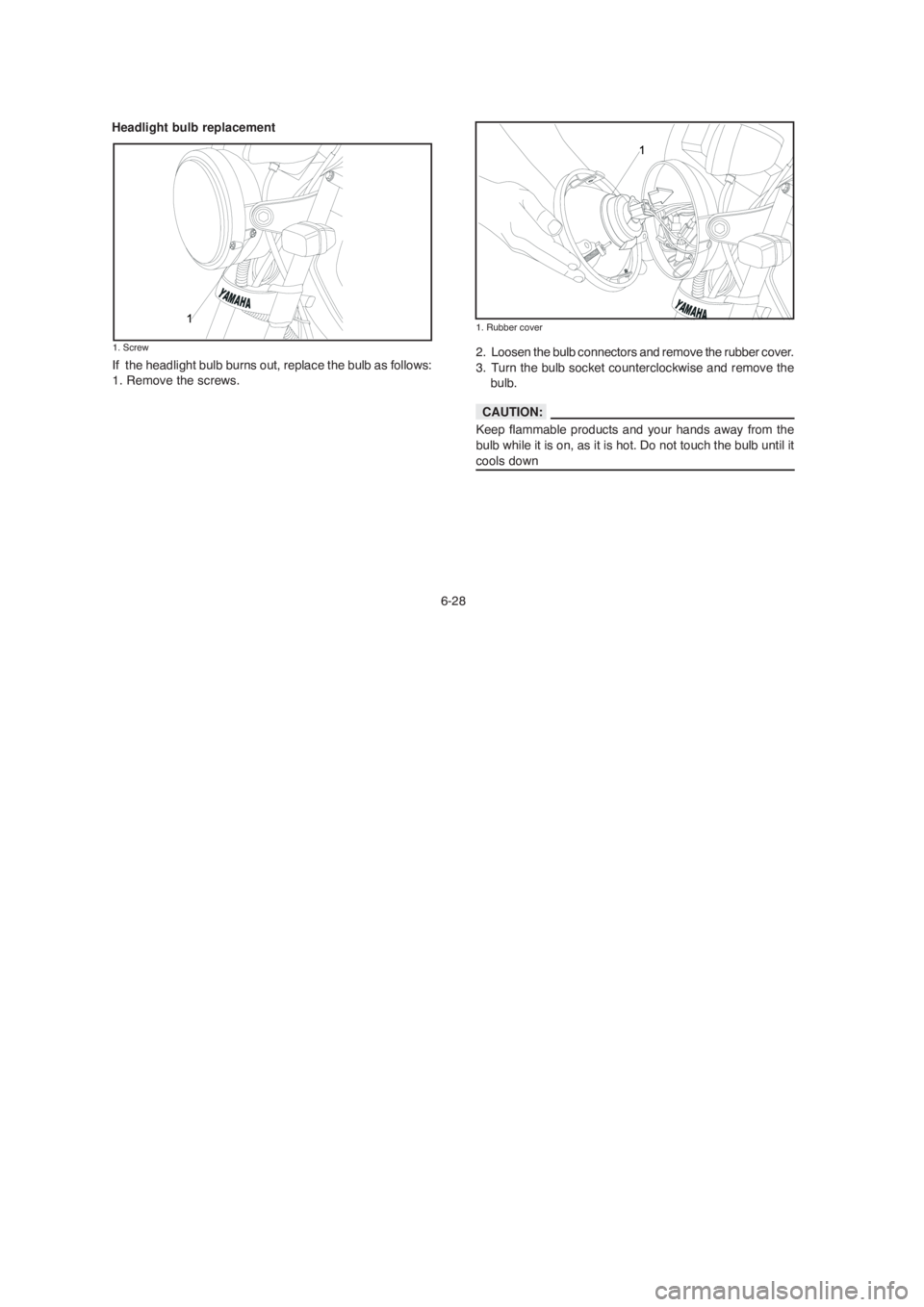
Headlight bulb replacement
If the headlight bulb burns out, replace the bulb as follows:
1. Remove the screws.2. Loosen the bulb connectors and remove the rubber cover.
3. Turn the bulb socket counterclockwise and remove the
bulb.
Keep flammable products and your hands away from the
bulb while it is on, as it is hot. Do not touch the bulb until it
cools down
1. Rubber cover
CAUTION:
6-28
1. Screw
Headlight bulb replacement
If the headlight bulb burns out, replace the bulb as follows:
1. Remove the screws.2. Loosen the bulb connectors and remove the rubber cover.
3. Turn the bulb socket counterclockwise and remove the
bulb.
Keep flammable products and your hands away from the
bulb while it is on, as it is hot. Do not touch the bulb until it
cools down
1. Rubber cover
CAUTION:
Page 70 of 83

6-30 Turn signal bulb replacement
1. Remove the screws and the lens.
2. Push the bulb inward and turn it counterclockwise.
3. Place a new bulb in the socket.
4. Install the lens and the screws.
Do not over-tighten the screws as the lens may break.Taillight bulb replacement
1. Remove the lens.
2. Push the bulb inward and turn it counterclockwise.
3. Place a new bulb in the socket.
4. Install the lens.
CAUTION:
6-30 Turn signal bulb replacement
1. Remove the screws and the lens.
2. Push the bulb inward and turn it counterclockwise.
3. Place a new bulb in the socket.
4. Install the lens and the screws.
Do not over-tighten the screws as the lens may break.Taillight bulb replacement
1. Remove the lens.
2. Push the bulb inward and turn it counterclockwise.
3. Place a new bulb in the socket.
4. Install the lens.
CAUTION:
Page 71 of 83
6-31
It is advisable to have a Yamaha dealer service the
wheel.
Securely support the motorcycle so there is no danger
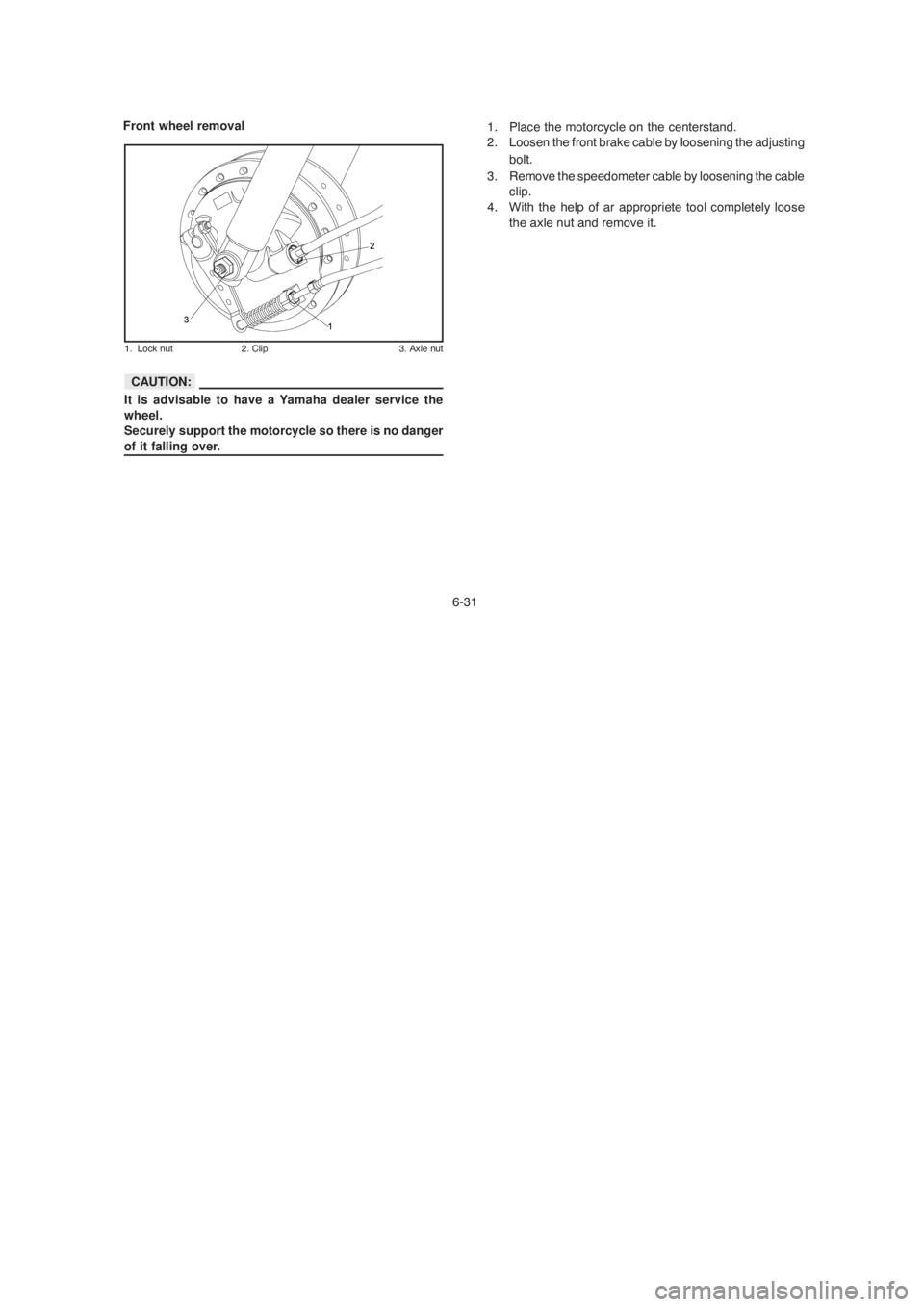
of it falling over. Front wheel removal
1. Place the motorcycle on the centerstand.
2. Loosen the front brake cable by loosening the adjusting
bolt.
3. Remove the speedometer cable by loosening the cable
clip.
4. With the help of ar appropriete tool completely loose
the axle nut and remove it.
1. Lock nut 2. Clip 3. Axle nut
CAUTION:
6-31
It is advisable to have a Yamaha dealer service the
wheel.
Securely support the motorcycle so there is no danger
of it falling over. Front wheel removal
1. Place the motorcycle on the centerstand.
2. Loosen the front brake cable by loosening the adjusting
bolt.
3. Remove the speedometer cable by loosening the cable
clip.
4. With the help of ar appropriete tool completely loose
the axle nut and remove it.
1. Lock nut 2. Clip 3. Axle nut
CAUTION:
Page 76 of 83
7-1 CLEANING AND STORAGE
A. CLEANING
Frequent, thorough cleaning of your motorcycle will not only
enhance its appearance but will improve its general
performance and extend the useful life of many components.
1. Before cleaning the motorcycle:
a. Block off the end of the exhaust pipe to prevent water
entry; a plastic bag and strong rubber band may be
used.
b. Make sure the spark plug and all filler caps are properly
installed.
2. If the engine case is excessively greasy, apply
degreaser with a paint brush. Do not apply degreaser
to the chain, sprockets, or wheel axles.
3. Rinse the dirt and degreaser off with a garden hose,
Use only enough pressure to do the job.
Excessive hose pressure may cause water seepage and
deterioration of wheel bearings, front fork, brakes,
transmission seals and electrical parts.Many expensive repair bills have resulted from improper
high pressure detergent applications such as those
available in coin-operated car washers.
4. Once the majority of the dirt has been hosed off, wash
all surfaces with warm water and mild, detergent-type
soap. An old toothbrush or bottle brush is handy for
hard-to-get-at places.
5. Rinse the motorcycle off immediately with clean water
and dry all surfaces with a chamois, clean towel, or
soft absorbent cloth.
6. Dry the chain and lubricate it to prevent rust.
7. Clean the seat with a vinyl upholstery cleaner to keep
the cover pliable and glossy.
8. Automotive-type wax may be applied to all painted and
chrome-plated surfaces. Avoid combination cleaner-
waxes. Many contain abrasives which may mar the paint
or protective finish. When finished, start the engine and
let it idle for several minutes.
CAUTION:
CAUTION:
7-1 CLEANING AND STORAGE
A. CLEANING
Frequent, thorough cleaning of your motorcycle will not only
enhance its appearance but will improve its general
performance and extend the useful life of many components.
1. Before cleaning the motorcycle:
a. Block off the end of the exhaust pipe to prevent water
entry; a plastic bag and strong rubber band may be
used.
b. Make sure the spark plug and all filler caps are properly
installed.
2. If the engine case is excessively greasy, apply
degreaser with a paint brush. Do not apply degreaser
to the chain, sprockets, or wheel axles.
3. Rinse the dirt and degreaser off with a garden hose,
Use only enough pressure to do the job.
Excessive hose pressure may cause water seepage and
deterioration of wheel bearings, front fork, brakes,
transmission seals and electrical parts.Many expensive repair bills have resulted from improper
high pressure detergent applications such as those
available in coin-operated car washers.
4. Once the majority of the dirt has been hosed off, wash
all surfaces with warm water and mild, detergent-type
soap. An old toothbrush or bottle brush is handy for
hard-to-get-at places.
5. Rinse the motorcycle off immediately with clean water
and dry all surfaces with a chamois, clean towel, or
soft absorbent cloth.
6. Dry the chain and lubricate it to prevent rust.
7. Clean the seat with a vinyl upholstery cleaner to keep
the cover pliable and glossy.
8. Automotive-type wax may be applied to all painted and
chrome-plated surfaces. Avoid combination cleaner-
waxes. Many contain abrasives which may mar the paint
or protective finish. When finished, start the engine and
let it idle for several minutes.
CAUTION:
CAUTION:
Page 77 of 83
7-2 B. STORAGE
Long term storage (30 days or more) of your machine will
require some preventive procedures to guard against
deterioration. After thoroughly cleaning the machine,
prepare for storage as follows:
1. Drain the fuel tank, fuel lines, and carburetor float
bowl(s).
2. Remove the spark plug(s), pour about one tablespoon
of SAE 20W50 motor oil in the spark plug hole(s) and
reinstall the spark plug(s).
Kick the engine over several times (with the
ignition off) to coat the cylinder walls with oil.
3. Remove the drive chain. Clean it thoroughly with
solvent and lubricate it.
Reinstall the chain or store it in a plastic bag
(tied to frame for safe-keeping).
4. Lubricate all control cables.
5. Block up the frame to raise both wheels off the
ground.
6. Tie a plastic bag over the exhaust pipe outlet to
prevent moisture from entering.7. If storing in a humid or salt-air atmosphere, coat
all exposed metal surfaces with a light film of
oil. Do not apply oil to any rubber parts or the
seat cover.
8. Remove the battery and charge it. Store it in a dry place
and recharge it once a month. Do not store the battery
in an excessively warm or cold place (less than 0∫C
(30∫F) or more than 30∫C (90∫F).
NOTE:
Make any necessary repairs before storing the machine.
7-2 B. STORAGE
Long term storage (30 days or more) of your machine will
require some preventive procedures to guard against
deterioration. After thoroughly cleaning the machine,
prepare for storage as follows:
1. Drain the fuel tank, fuel lines, and carburetor float
bowl(s).
2. Remove the spark plug(s), pour about one tablespoon
of SAE 20W50 motor oil in the spark plug hole(s) and
reinstall the spark plug(s).
Kick the engine over several times (with the
ignition off) to coat the cylinder walls with oil.
3. Remove the drive chain. Clean it thoroughly with
solvent and lubricate it.
Reinstall the chain or store it in a plastic bag
(tied to frame for safe-keeping).
4. Lubricate all control cables.
5. Block up the frame to raise both wheels off the
ground.
6. Tie a plastic bag over the exhaust pipe outlet to
prevent moisture from entering.7. If storing in a humid or salt-air atmosphere, coat
all exposed metal surfaces with a light film of
oil. Do not apply oil to any rubber parts or the
seat cover.
8. Remove the battery and charge it. Store it in a dry place
and recharge it once a month. Do not store the battery
in an excessively warm or cold place (less than 0∫C
(30∫F) or more than 30∫C (90∫F).
NOTE:
Make any necessary repairs before storing the machine.