oil YAMAHA YBR125 2004 User Guide
[x] Cancel search | Manufacturer: YAMAHA, Model Year: 2004, Model line: YBR125, Model: YAMAHA YBR125 2004Pages: 83, PDF Size: 3.16 MB
Page 47 of 83
6-7
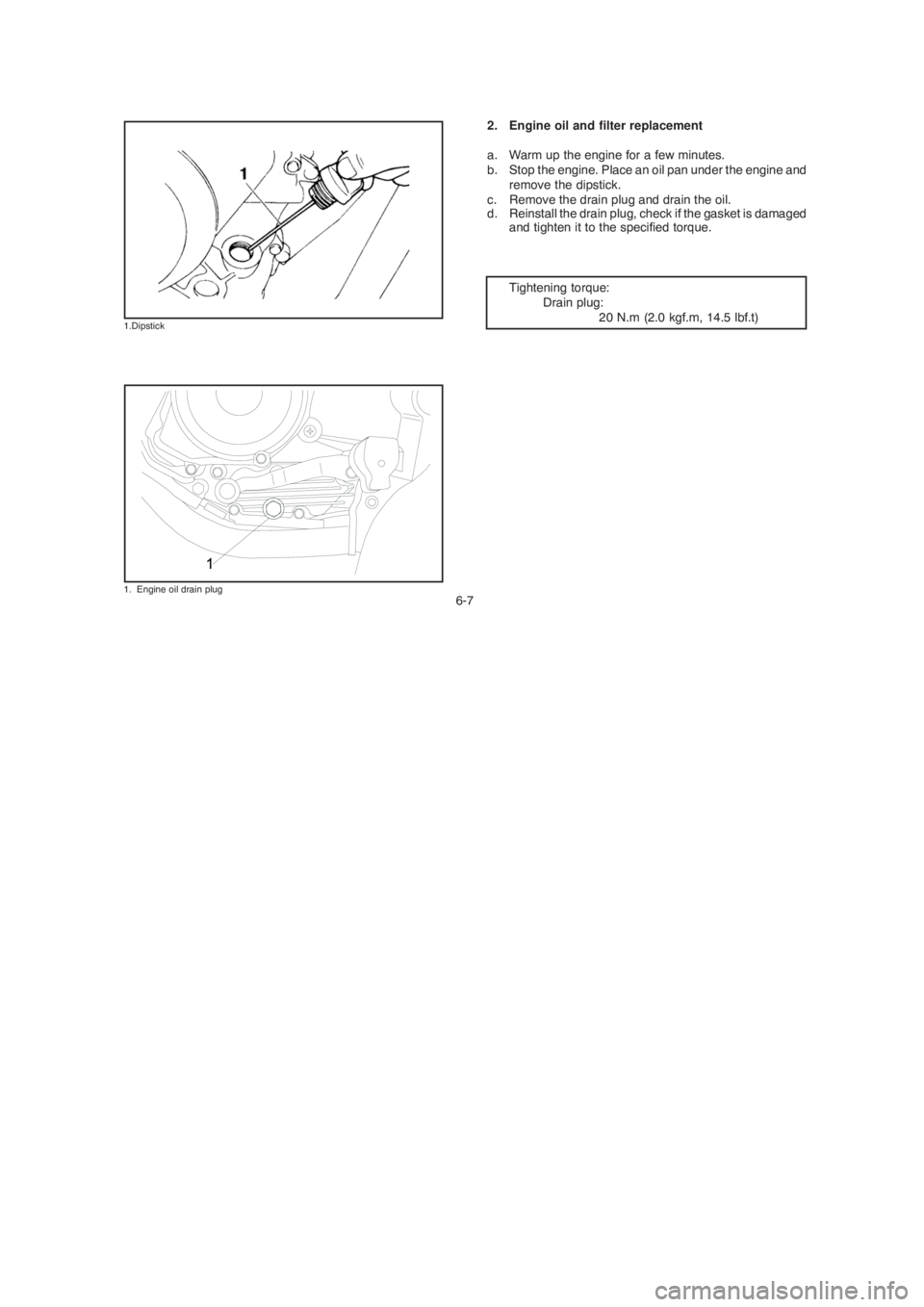
2. Engine oil and filter replacement
a. Warm up the engine for a few minutes.
b. Stop the engine. Place an oil pan under the engine and
remove the dipstick.
c. Remove the drain plug and drain the oil.
d. Reinstall the drain plug, check if the gasket is damaged
and tighten it to the specified torque.
Tightening torque:
Drain plug:
20 N.m (2.0 kgf.m, 14.5 lbf.t)
1.Dipstick
1. Engine oil drain plug
6-7
2. Engine oil and filter replacement
a. Warm up the engine for a few minutes.
b. Stop the engine. Place an oil pan under the engine and
remove the dipstick.
c. Remove the drain plug and drain the oil.
d. Reinstall the drain plug, check if the gasket is damaged
and tighten it to the specified torque.
Tightening torque:
Drain plug:
20 N.m (2.0 kgf.m, 14.5 lbf.t)
1.Dipstick
1. Engine oil drain plug
Page 48 of 83
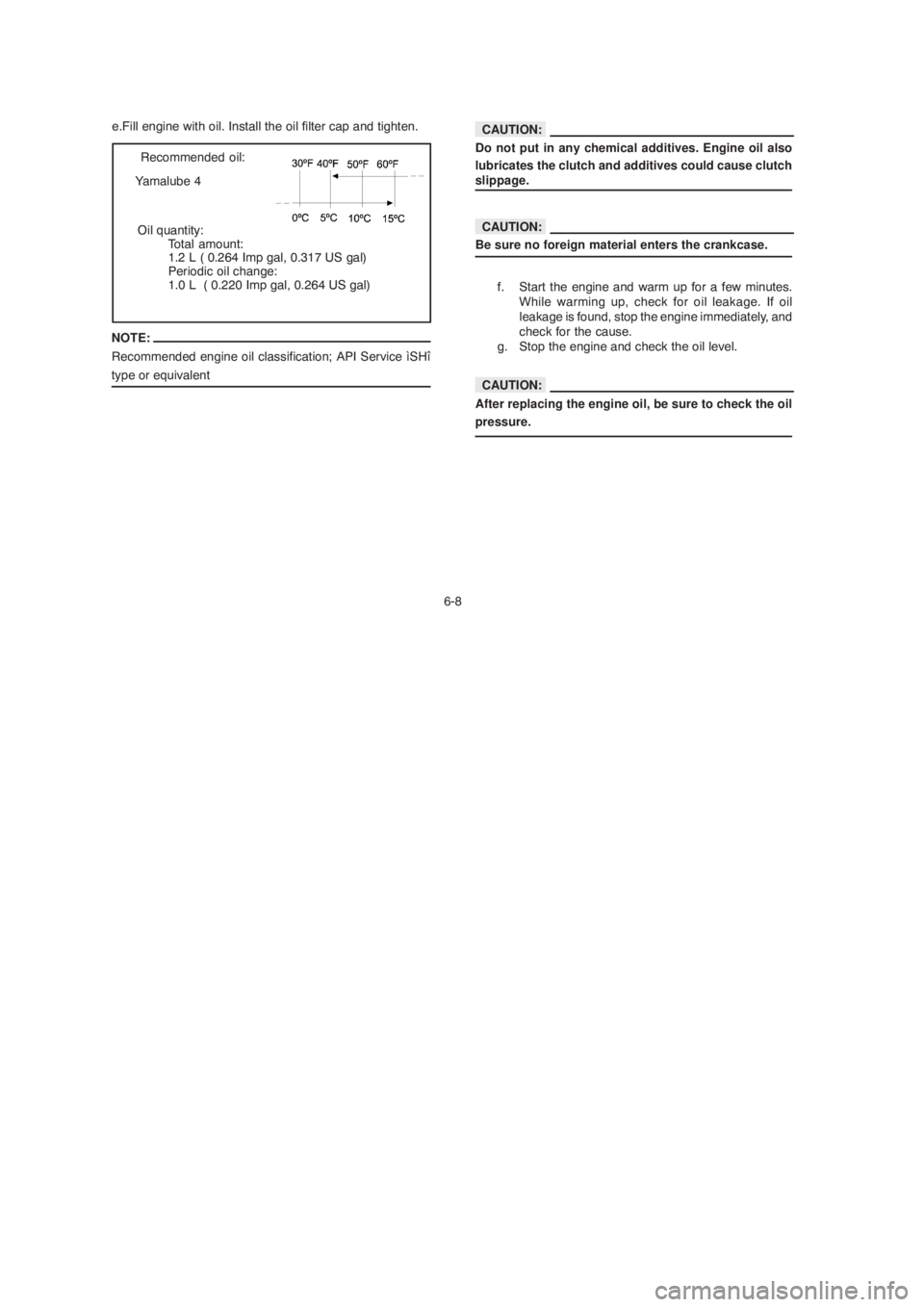
6-8 e.Fill engine with oil. Install the oil filter cap and tighten.
NOTE:
Recommended engine oil classification; API Service ìSHî
type or equivalent
Do not put in any chemical additives. Engine oil also
lubricates the clutch and additives could cause clutch
slippage.
Be sure no foreign material enters the crankcase.
f. Start the engine and warm up for a few minutes.
While warming up, check for oil leakage. If oil
leakage is found, stop the engine immediately, and
check for the cause.
g. Stop the engine and check the oil level.
After replacing the engine oil, be sure to check the oil
pressure.
Oil quantity:
Total amount:
1.2 L ( 0.264 Imp gal, 0.317 US gal)
Periodic oil change:
1.0 L ( 0.220 Imp gal, 0.264 US gal) Recommended oil:
Yamalube 4
CAUTION:
CAUTION:
CAUTION:
6-8 e.Fill engine with oil. Install the oil filter cap and tighten.
NOTE:
Recommended engine oil classification; API Service ìSHî
type or equivalent
Do not put in any chemical additives. Engine oil also
lubricates the clutch and additives could cause clutch
slippage.
Be sure no foreign material enters the crankcase.
f. Start the engine and warm up for a few minutes.
While warming up, check for oil leakage. If oil
leakage is found, stop the engine immediately, and
check for the cause.
g. Stop the engine and check the oil level.
After replacing the engine oil, be sure to check the oil
pressure.
Oil quantity:
Total amount:
1.2 L ( 0.264 Imp gal, 0.317 US gal)
Periodic oil change:
1.0 L ( 0.220 Imp gal, 0.264 US gal) Recommended oil:
Yamalube 4
CAUTION:
CAUTION:
CAUTION:
Page 49 of 83
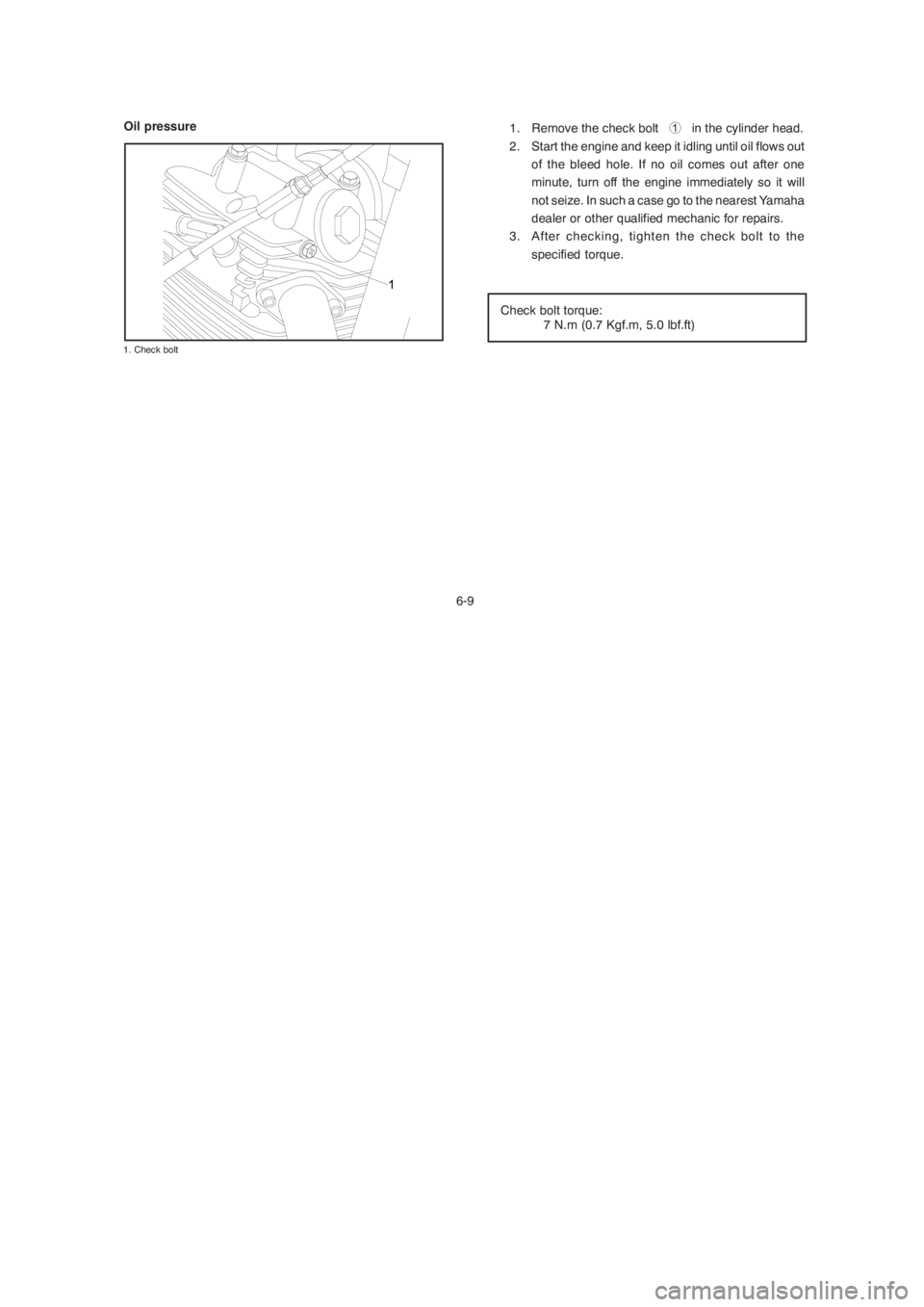
6-9 Oil pressure
1. Remove the check bolt 1 in the cylinder head.
2. Start the engine and keep it idling until oil flows out
of the bleed hole. If no oil comes out after one
minute, turn off the engine immediately so it will
not seize. In such a case go to the nearest Yamaha
dealer or other qualified mechanic for repairs.
3. After checking, tighten the check bolt to the
specified torque.
Check bolt torque:
7 N.m (0.7 Kgf.m, 5.0 lbf.ft)
1. Check bolt
6-9 Oil pressure
1. Remove the check bolt 1 in the cylinder head.
2. Start the engine and keep it idling until oil flows out
of the bleed hole. If no oil comes out after one
minute, turn off the engine immediately so it will
not seize. In such a case go to the nearest Yamaha
dealer or other qualified mechanic for repairs.
3. After checking, tighten the check bolt to the
specified torque.
Check bolt torque:
7 N.m (0.7 Kgf.m, 5.0 lbf.ft)
1. Check bolt
Page 51 of 83
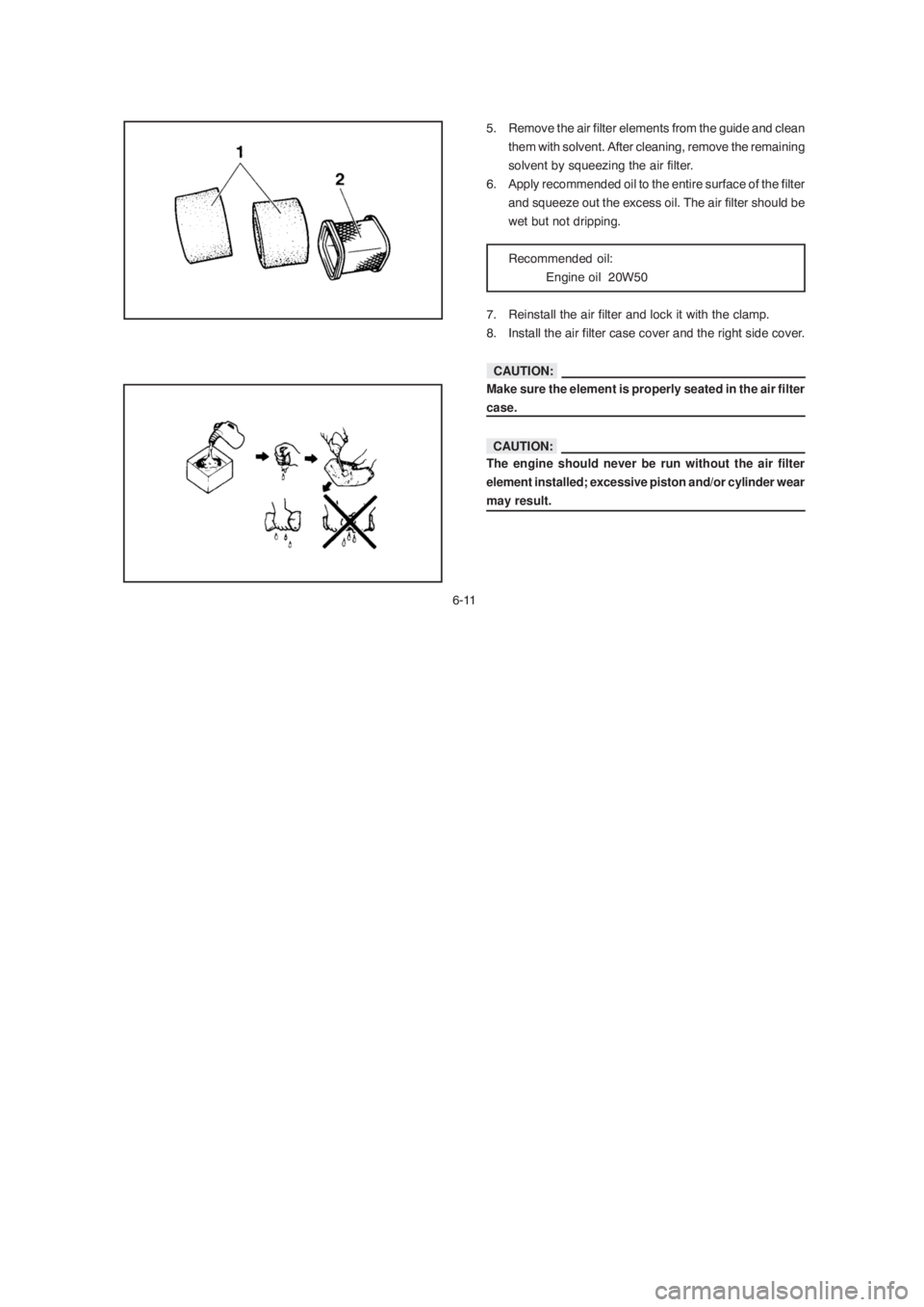
5. Remove the air filter elements from the guide and clean
them with solvent. After cleaning, remove the remaining
solvent by squeezing the air filter.
6. Apply recommended oil to the entire surface of the filter
and squeeze out the excess oil. The air filter should be
wet but not dripping.
Recommended oil:
Engine oil 20W50
7. Reinstall the air filter and lock it with the clamp.
8. Install the air filter case cover and the right side cover.
Make sure the element is properly seated in the air filter
case.
The engine should never be run without the air filter
element installed; excessive piston and/or cylinder wear
may result.
6-11
CAUTION:
CAUTION:
5. Remove the air filter elements from the guide and clean
them with solvent. After cleaning, remove the remaining
solvent by squeezing the air filter.
6. Apply recommended oil to the entire surface of the filter
and squeeze out the excess oil. The air filter should be
wet but not dripping.
Recommended oil:
Engine oil 20W50
7. Reinstall the air filter and lock it with the clamp.
8. Install the air filter case cover and the right side cover.
Make sure the element is properly seated in the air filter
case.
The engine should never be run without the air filter
element installed; excessive piston and/or cylinder wear
may result.
6-11
CAUTION:
CAUTION:
Page 61 of 83
6-21 Drive chain lubrication
The chain consists of many parts which work with each
other. If the chain is not maintained properly, it will wear out
quickly. Therefore, the chain must be serviced regularly.
This service is especially necessary when riding in dusty
areas.
1. Use Yamaha Chain and Cable Lube or any
brands of spray-type chain lubricant. First,
remove all dirt and mud from the chain with a
brush or cloth, then spray lubricant between both
rows of side plates and on all center rollers. The
chain should be lubricated every 500 km (300 mi).
2. To clean the chain, remove it from the machine,
dip it in solvent, and clean out as much dirt as
possible. Take the chain out of the solvent and
dry it. Immediately lubricate the chain to prevent
it from rusting.Cable inspection and lubrication
Damage to the outer housing of cables may allow
internal rusting and cause interfere with cable
movement. Replace damaged cables as soon as
possible to prevent unsafe conditions.
Lubricate the inner cable and the cable end. If it does not
operate smoothly, ask a Yamaha dealer to replace them.
RECOMMENDED LUBRICANT:
Engine oil SAE 20W50
WARNING:
6-21 Drive chain lubrication
The chain consists of many parts which work with each
other. If the chain is not maintained properly, it will wear out
quickly. Therefore, the chain must be serviced regularly.
This service is especially necessary when riding in dusty
areas.
1. Use Yamaha Chain and Cable Lube or any
brands of spray-type chain lubricant. First,
remove all dirt and mud from the chain with a
brush or cloth, then spray lubricant between both
rows of side plates and on all center rollers. The
chain should be lubricated every 500 km (300 mi).
2. To clean the chain, remove it from the machine,
dip it in solvent, and clean out as much dirt as
possible. Take the chain out of the solvent and
dry it. Immediately lubricate the chain to prevent
it from rusting.Cable inspection and lubrication
Damage to the outer housing of cables may allow
internal rusting and cause interfere with cable
movement. Replace damaged cables as soon as
possible to prevent unsafe conditions.
Lubricate the inner cable and the cable end. If it does not
operate smoothly, ask a Yamaha dealer to replace them.
RECOMMENDED LUBRICANT:
Engine oil SAE 20W50
WARNING:
Page 62 of 83
6-22
Throttle cable and grip lubrication
The throttle twist grip assembly should be greased at the
time the cable is lubricated, since the grip must be removed
to get at the end of the throttle cable.
After removing the screws, hold the end of the cable up in
the air and put in several drops of lubricant. With the throttle
grip disassembled, coat the metal surface of the grip
assembly with a suitable all-purpose grease.Brake and shift pedals
Lubricate the pivoting parts.
RECOMMENDED LUBRICANT:
Engine oil SAE 20W50
Brake and clutch levers
Lubricate the pivoting parts.
RECOMMENDED LUBRICANT:
Engine oil SAE 20W50
Sidestand
Lubricate the pivoting parts. Check to see that the sidestand
moves up and down smoothly.
RECOMMENDED LUBRICANT:
Engine oil SAE 20W50
WARNING:
If the sidestand does not move smoothly, consult a
Yamaha dealer.
CAUTION:
6-22
Throttle cable and grip lubrication
The throttle twist grip assembly should be greased at the
time the cable is lubricated, since the grip must be removed
to get at the end of the throttle cable.
After removing the screws, hold the end of the cable up in
the air and put in several drops of lubricant. With the throttle
grip disassembled, coat the metal surface of the grip
assembly with a suitable all-purpose grease.Brake and shift pedals
Lubricate the pivoting parts.
RECOMMENDED LUBRICANT:
Engine oil SAE 20W50
Brake and clutch levers
Lubricate the pivoting parts.
RECOMMENDED LUBRICANT:
Engine oil SAE 20W50
Sidestand
Lubricate the pivoting parts. Check to see that the sidestand
moves up and down smoothly.
RECOMMENDED LUBRICANT:
Engine oil SAE 20W50
WARNING:
If the sidestand does not move smoothly, consult a
Yamaha dealer.
CAUTION:
Page 63 of 83
6-23
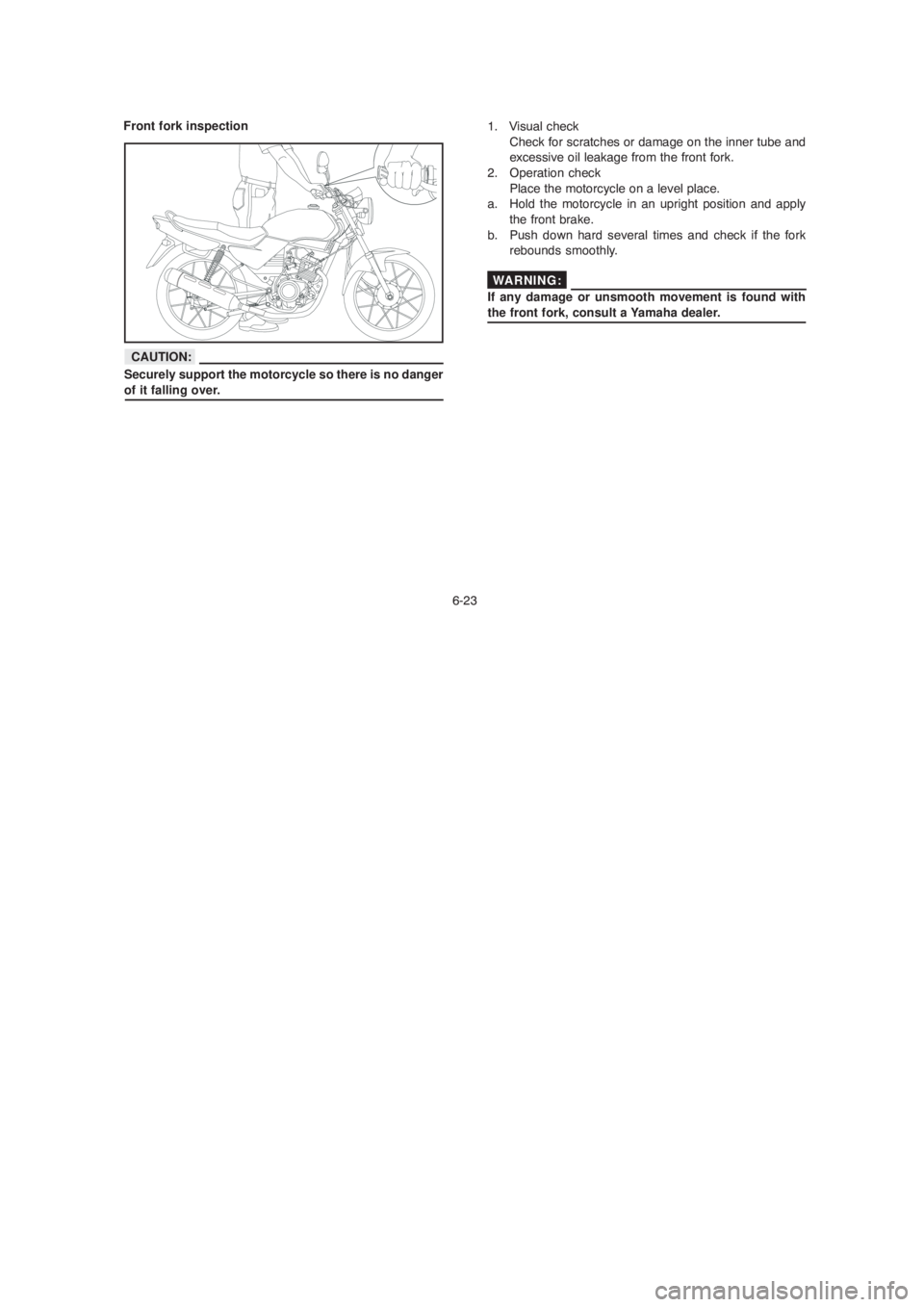
1. Visual check
Check for scratches or damage on the inner tube and
excessive oil leakage from the front fork.
2. Operation check
Place the motorcycle on a level place.
a. Hold the motorcycle in an upright position and apply
the front brake.
b. Push down hard several times and check if the fork
rebounds smoothly.
If any damage or unsmooth movement is found with
the front fork, consult a Yamaha dealer. Front fork inspection
Securely support the motorcycle so there is no danger
of it falling over.
CAUTION:
WARNING:
6-23
1. Visual check
Check for scratches or damage on the inner tube and
excessive oil leakage from the front fork.
2. Operation check
Place the motorcycle on a level place.
a. Hold the motorcycle in an upright position and apply
the front brake.
b. Push down hard several times and check if the fork
rebounds smoothly.
If any damage or unsmooth movement is found with
the front fork, consult a Yamaha dealer. Front fork inspection
Securely support the motorcycle so there is no danger
of it falling over.
CAUTION:
WARNING:
Page 66 of 83
6-26
Battery electrolyte is poisonous and dangerous,
causing severe burns, etc. It contains sulfuric acid.
Avoid contact with skin, eyes or clothing.
Antidote:
EXTERNAL: Flush with water.
INTERNAL: Drink large quantities of water or milk.
Follow with milk of magnesia, beaten egg, or vegetable
oil. Call a physician immediately.
EYES: Flush with water for 15 minutes and get prompt
medical attention.
Batteries produce explosive gases. Keep sparks, flame,
cigarrettes, etc., away. Ventilate when charging or using
it in an enclosed space. Always shield your eyes when
working near batteries.
KEEP OUT OF REACH OF CHILDREN.
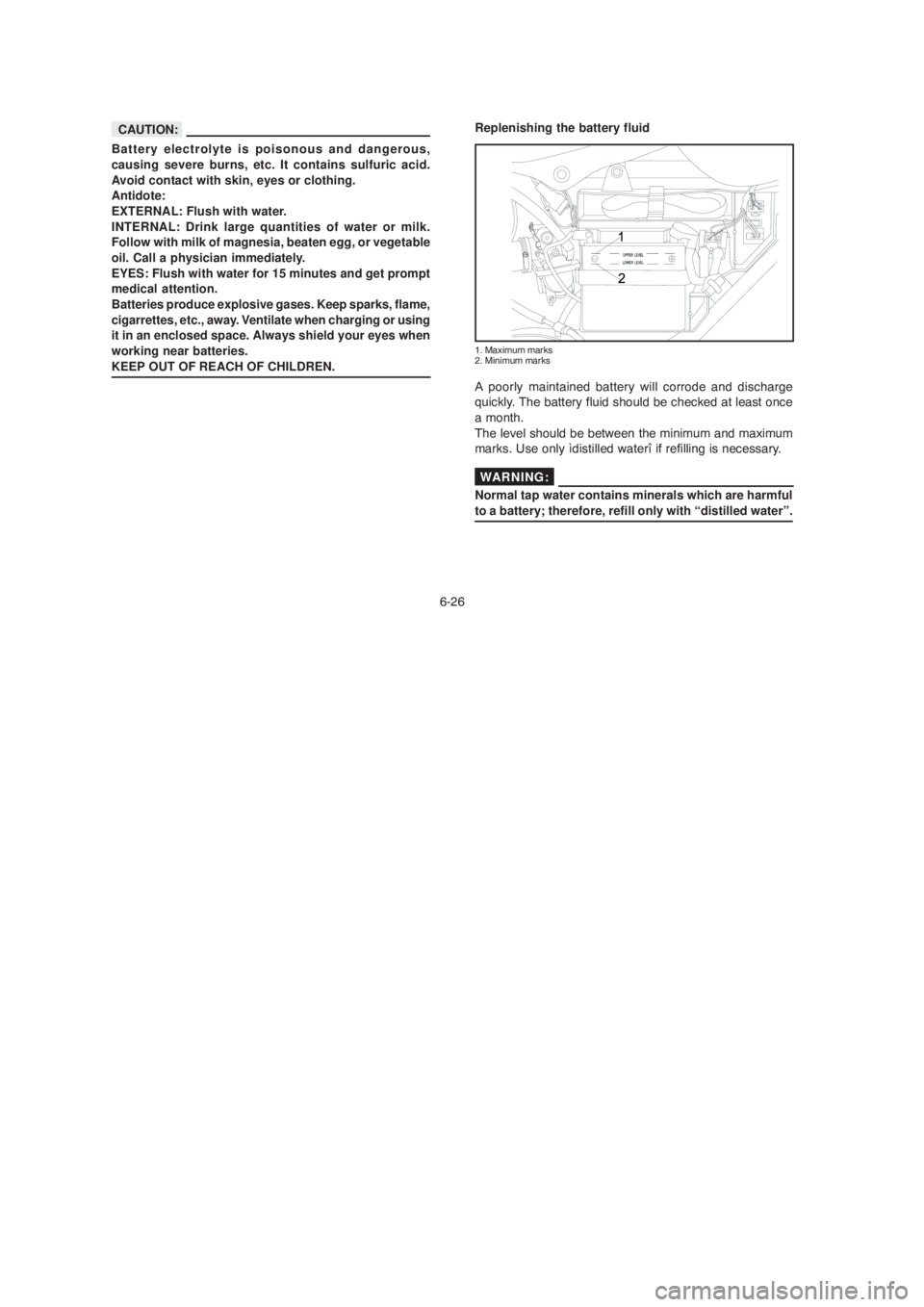
A poorly maintained battery will corrode and discharge
quickly. The battery fluid should be checked at least once
a month.
The level should be between the minimum and maximum
marks. Use only ìdistilled waterî if refilling is necessary.
Normal tap water contains minerals which are harmful
to a battery; therefore, refill only with “distilled water”. Replenishing the battery fluid
1. Maximum marks
2. Minimum marks
CAUTION:
WARNING:
6-26
Battery electrolyte is poisonous and dangerous,
causing severe burns, etc. It contains sulfuric acid.
Avoid contact with skin, eyes or clothing.
Antidote:
EXTERNAL: Flush with water.
INTERNAL: Drink large quantities of water or milk.
Follow with milk of magnesia, beaten egg, or vegetable
oil. Call a physician immediately.
EYES: Flush with water for 15 minutes and get prompt
medical attention.
Batteries produce explosive gases. Keep sparks, flame,
cigarrettes, etc., away. Ventilate when charging or using
it in an enclosed space. Always shield your eyes when
working near batteries.
KEEP OUT OF REACH OF CHILDREN.
A poorly maintained battery will corrode and discharge
quickly. The battery fluid should be checked at least once
a month.
The level should be between the minimum and maximum
marks. Use only ìdistilled waterî if refilling is necessary.
Normal tap water contains minerals which are harmful
to a battery; therefore, refill only with “distilled water”. Replenishing the battery fluid
1. Maximum marks
2. Minimum marks
CAUTION:
WARNING:
Page 69 of 83
6-29
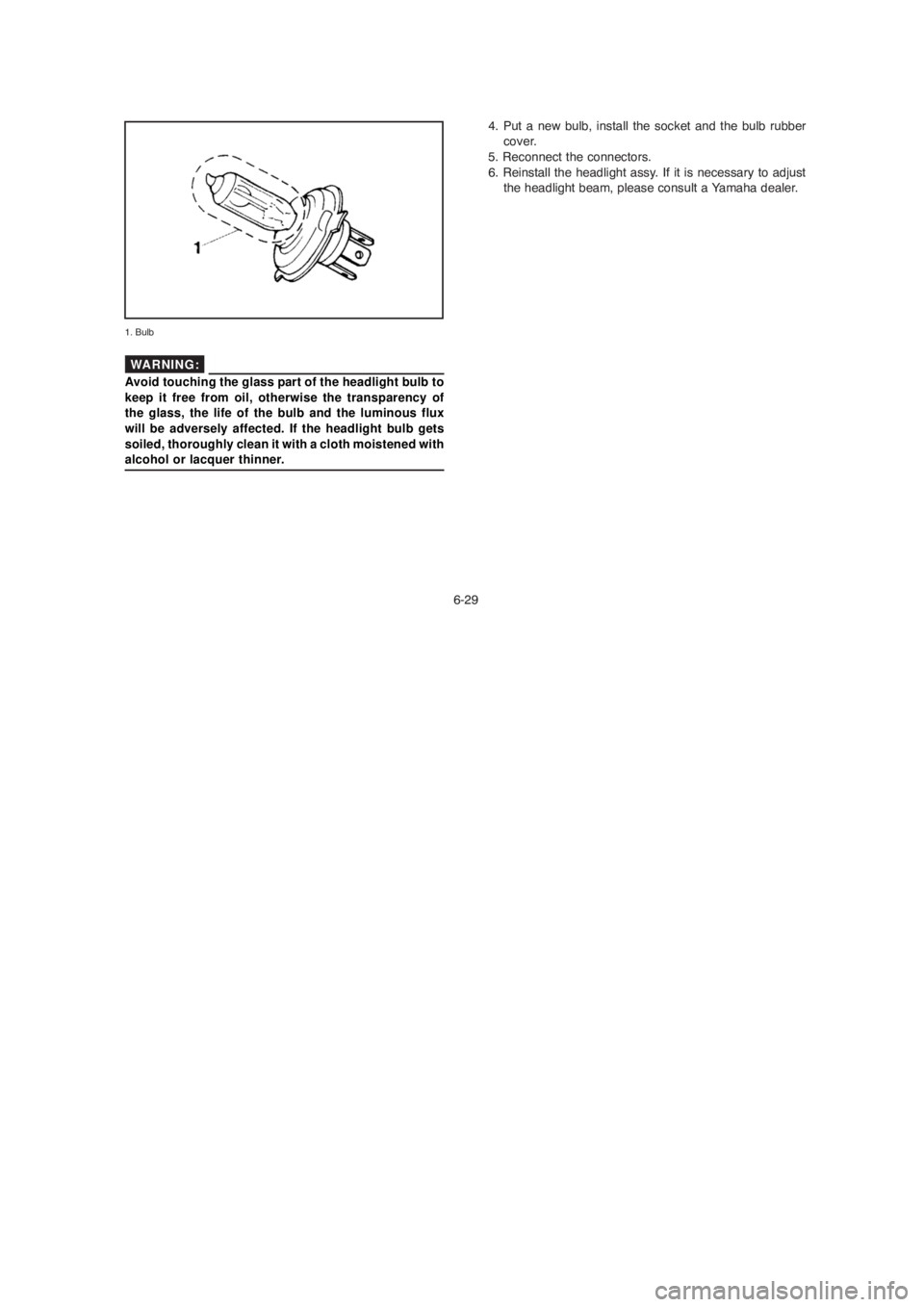
1. Bulb
4. Put a new bulb, install the socket and the bulb rubber
cover.
5. Reconnect the connectors.
6. Reinstall the headlight assy. If it is necessary to adjust
the headlight beam, please consult a Yamaha dealer.
Avoid touching the glass part of the headlight bulb to
keep it free from oil, otherwise the transparency of
the glass, the life of the bulb and the luminous flux
will be adversely affected. If the headlight bulb gets
soiled, thoroughly clean it with a cloth moistened with
alcohol or lacquer thinner.
WARNING:
6-29
1. Bulb
4. Put a new bulb, install the socket and the bulb rubber
cover.
5. Reconnect the connectors.
6. Reinstall the headlight assy. If it is necessary to adjust
the headlight beam, please consult a Yamaha dealer.
Avoid touching the glass part of the headlight bulb to
keep it free from oil, otherwise the transparency of
the glass, the life of the bulb and the luminous flux
will be adversely affected. If the headlight bulb gets
soiled, thoroughly clean it with a cloth moistened with
alcohol or lacquer thinner.
WARNING:
Page 77 of 83
7-2 B. STORAGE
Long term storage (30 days or more) of your machine will
require some preventive procedures to guard against
deterioration. After thoroughly cleaning the machine,
prepare for storage as follows:
1. Drain the fuel tank, fuel lines, and carburetor float
bowl(s).
2. Remove the spark plug(s), pour about one tablespoon
of SAE 20W50 motor oil in the spark plug hole(s) and
reinstall the spark plug(s).
Kick the engine over several times (with the
ignition off) to coat the cylinder walls with oil.
3. Remove the drive chain. Clean it thoroughly with
solvent and lubricate it.
Reinstall the chain or store it in a plastic bag
(tied to frame for safe-keeping).
4. Lubricate all control cables.
5. Block up the frame to raise both wheels off the
ground.
6. Tie a plastic bag over the exhaust pipe outlet to
prevent moisture from entering.7. If storing in a humid or salt-air atmosphere, coat
all exposed metal surfaces with a light film of
oil. Do not apply oil to any rubber parts or the
seat cover.
8. Remove the battery and charge it. Store it in a dry place
and recharge it once a month. Do not store the battery
in an excessively warm or cold place (less than 0∫C
(30∫F) or more than 30∫C (90∫F).
NOTE:
Make any necessary repairs before storing the machine.
7-2 B. STORAGE
Long term storage (30 days or more) of your machine will
require some preventive procedures to guard against
deterioration. After thoroughly cleaning the machine,
prepare for storage as follows:
1. Drain the fuel tank, fuel lines, and carburetor float
bowl(s).
2. Remove the spark plug(s), pour about one tablespoon
of SAE 20W50 motor oil in the spark plug hole(s) and
reinstall the spark plug(s).
Kick the engine over several times (with the
ignition off) to coat the cylinder walls with oil.
3. Remove the drive chain. Clean it thoroughly with
solvent and lubricate it.
Reinstall the chain or store it in a plastic bag
(tied to frame for safe-keeping).
4. Lubricate all control cables.
5. Block up the frame to raise both wheels off the
ground.
6. Tie a plastic bag over the exhaust pipe outlet to
prevent moisture from entering.7. If storing in a humid or salt-air atmosphere, coat
all exposed metal surfaces with a light film of
oil. Do not apply oil to any rubber parts or the
seat cover.
8. Remove the battery and charge it. Store it in a dry place
and recharge it once a month. Do not store the battery
in an excessively warm or cold place (less than 0∫C
(30∫F) or more than 30∫C (90∫F).
NOTE:
Make any necessary repairs before storing the machine.