wheel torque YAMAHA YBR125 2004 Owners Manual
[x] Cancel search | Manufacturer: YAMAHA, Model Year: 2004, Model line: YBR125, Model: YAMAHA YBR125 2004Pages: 83, PDF Size: 3.16 MB
Page 12 of 83
PERIODIC MAINTENANCE AND MINOR REPAIRS..... 6-1
Tool kit..................................................................... 6-2
PERIODIC MAINTENANCE/LUBRICATION......... 6-3
Torque specifications............................................. 6-5
Engine oil................................................................ 6-6
Oil pressure............................................................ 6-9
Air filter.................................................................6-10
Carburetor adjustment.........................................6-12
Valve clearance adjustment.................................6-12
Idle speed adjustment..........................................6-13
Throttle cable adjustment....................................6-14
Spark plug inspection...........................................6-15
Front brake adjustment........................................6-16
Checking the brake shoes ...................................6-16
Rear brake adjustment.........................................6-17
Brake light switch adjustment ..............................6-18
Clutch adjustment................................................ 6-18
Drive chain slack check.......................................6-19
Drive chain slack adjustment...............................6-20
Drive chain lubrication..........................................6-21
Cable inspection and lubrication.......................... 6-21
Throttle cable and grip lubrication .......................6-22
Brake and shift pedals .........................................6-22
Brake and clutch levers .......................................6-22
Sidestand.............................................................6-22
Front fork inspection............................................6-23Steering inspection.............................................. 6-24
Wheel bearings.................................................... 6-24
Battery.................................................................. 6-25
Replenishing the battery fluid .............................. 6-26
Storage the battery.............................................. 6-27
Fuse replacement................................................ 6-27
Headlight bulb replacement................................. 6-28
Turn signal bulb replacement.............................. 6-30
Taillight bulb replacement.................................... 6-30
Front wheel removal............................................. 6-31
Front wheel installation........................................ 6-32
Rear wheel removal............................................. 6-32
Rear wheel installation......................................... 6-33
Troubleshooting.................................................... 6-34
Troubleshooting chart.......................................... 6-35
CLEANING AND STORAGE....................................... 7-1
CLEANING............................................................. 7-1
STORAGE.............................................................. 7-2
SPECIFICATIONS ........................................................ 8-1
XII
CONTENTS
DESCRIPTION............................................................. 1-1
MACHINE IDENTIFICATION....................................... 2-1
Vehicle identikfication number ............................... 2-1
Engine serial number............................................ 2-1
CONTROL FUNCTIONS.............................................. 3-1
Main switch ............................................................ 3-1
Indicator lights ........................................................ 3-2
Speedometer..........................................................3-3
Fuel gauge............................................................. 3-3
Handlebar switches over left .................................. 3-4
Handlebar switches over right.............................. 3-5
Clutch lever............................................................ 3-6
Shift pedal............................................................. 3-6
Front brake lever................................................... 3-7
Rear brake pedal................................................... 3-7
Fuel tank cap......................................................... 3-8
Fuel cock............................................................... 3-9
Starter lever......................................................... 3-10
Kick starter .......................................................... 3-10
Steering lock....................................................... 3-11
Seat......................................................................3-12
Side covers......................................................... 3-13
Rear shock absorber adjustment ....................... 3-14
XIPRE-OPERATION CHECKS........................................ 4-1
Engine oil................................................................ 4-3
Tires........................................................................4-3
Fitting/Fasteners....................................................4-6
Switches................................................................ 4-6
Wheels ......................................................... 4-6
Fuel ........................................................... 4-7
OPERATION AND IMPORTANT RIDING POINTS....... 5-1
Starting a cold engine........................................... 5-2
Starting a warm engine .......................................... 5-2
Warming up the engine .......................................... 5-2
Shifting ................................................................... 5-3
Tips for reduccing fuel consumption...................... 5-4
Engine Break-in...................................................... 5-4
Parking ................................................................... 5-5
Page 34 of 83

4-6
1. It is dangerous to ride with a worn-out tire. When
the tire tread begin to show signs of wear, replace
the tire immediately. Brakes, tires and related wheel
parts should be left to a Yamaha dealer.
2. Patching a punctured tube is not recommended. If
it is absolutely necessary to do so, use great care
and replace the tube as soon as possible with a
good quality replacement.
Fitting/Fasteners
Alway check the tightness of chassis fittings and fasteners
before a ride. Use the chart on page 6-5 to find the correct
torque.
Switches
Check the operation of the starter switch, main switch,
ì Engine Stopî switch.
WARNING:Wheels
To ensure maximum performance, long service, and safe
operation, note the following:
1. Always inspect the wheels before a ride. Check for
cracks, bends, or warpage of the wheel; be sure the
spokes are tight and undamaged. If any abnormal
condition exists in a wheel, consult a Yamaha dealer or
other qualified mechanic. Do not attempt even small
repairs to the wheel. If a wheel is deformed or cracked,
it must be replaced.
2. Tires and wheels should be balanced whenever either
one is changed or replaced. Failure to have a wheel
balanced can result in poor performance, adverse
handling characteristics, and shortened tire life.
3. After installing a tire, ride conservatively to allow the
tire to seat itself on the rim properly. Failure to allow
proper seating may cause tire failure, resulting in
damage to the motorcycle and injury to the rider.
4-6
1. It is dangerous to ride with a worn-out tire. When
the tire tread begin to show signs of wear, replace
the tire immediately. Brakes, tires and related wheel
parts should be left to a Yamaha dealer.
2. Patching a punctured tube is not recommended. If
it is absolutely necessary to do so, use great care
and replace the tube as soon as possible with a
good quality replacement.
Fitting/Fasteners
Alway check the tightness of chassis fittings and fasteners
before a ride. Use the chart on page 6-5 to find the correct
torque.
Switches
Check the operation of the starter switch, main switch,
ì Engine Stopî switch.
WARNING:Wheels
To ensure maximum performance, long service, and safe
operation, note the following:
1. Always inspect the wheels before a ride. Check for
cracks, bends, or warpage of the wheel; be sure the
spokes are tight and undamaged. If any abnormal
condition exists in a wheel, consult a Yamaha dealer or
other qualified mechanic. Do not attempt even small
repairs to the wheel. If a wheel is deformed or cracked,
it must be replaced.
2. Tires and wheels should be balanced whenever either
one is changed or replaced. Failure to have a wheel
balanced can result in poor performance, adverse
handling characteristics, and shortened tire life.
3. After installing a tire, ride conservatively to allow the
tire to seat itself on the rim properly. Failure to allow
proper seating may cause tire failure, resulting in
damage to the motorcycle and injury to the rider.
Page 45 of 83

Torque specifications
Use a torque wrench to tighten these items. It is
recommended that these items be checked occasionally,
specially before a long trip. Always check the tightness of
these items whenever they are loosened for any reason.
6-5
Torque
Nm
kgf.m Item
Spark plug
Engine oil drain plug
Oil check bolt
Front wheel axle nut
Rear wheel axle nut
12,5
20
7
45
911,25
2,0
0,7
4,5
9,1
A
(Nut)
10 mm
12 mm
14 mm
17 mm
19 mm
22 mmB
(Bolt)
6 mm
8 mm
10 mm
12 mm
14 mm
16 mmGeneral torque especifications
Nm
6
15
30
55
85
130kgf.m
0,6
1,5
3,0
5,5
8,5
13,0lbf. ft
4,3
11
22
40
61
94
lbf.ft
9.0
14.5
5.0
32.5
66
Torque specifications
Use a torque wrench to tighten these items. It is
recommended that these items be checked occasionally,
specially before a long trip. Always check the tightness of
these items whenever they are loosened for any reason.
6-5
Torque
Nm
kgf.m Item
Spark plug
Engine oil drain plug
Oil check bolt
Front wheel axle nut
Rear wheel axle nut
12,5
20
7
45
911,25
2,0
0,7
4,5
9,1
A
(Nut)
10 mm
12 mm
14 mm
17 mm
19 mm
22 mmB
(Bolt)
6 mm
8 mm
10 mm
12 mm
14 mm
16 mmGeneral torque especifications
Nm
6
15
30
55
85
130kgf.m
0,6
1,5
3,0
5,5
8,5
13,0lbf. ft
4,3
11
22
40
61
94
lbf.ft
9.0
14.5
5.0
32.5
66
Page 60 of 83
6-20
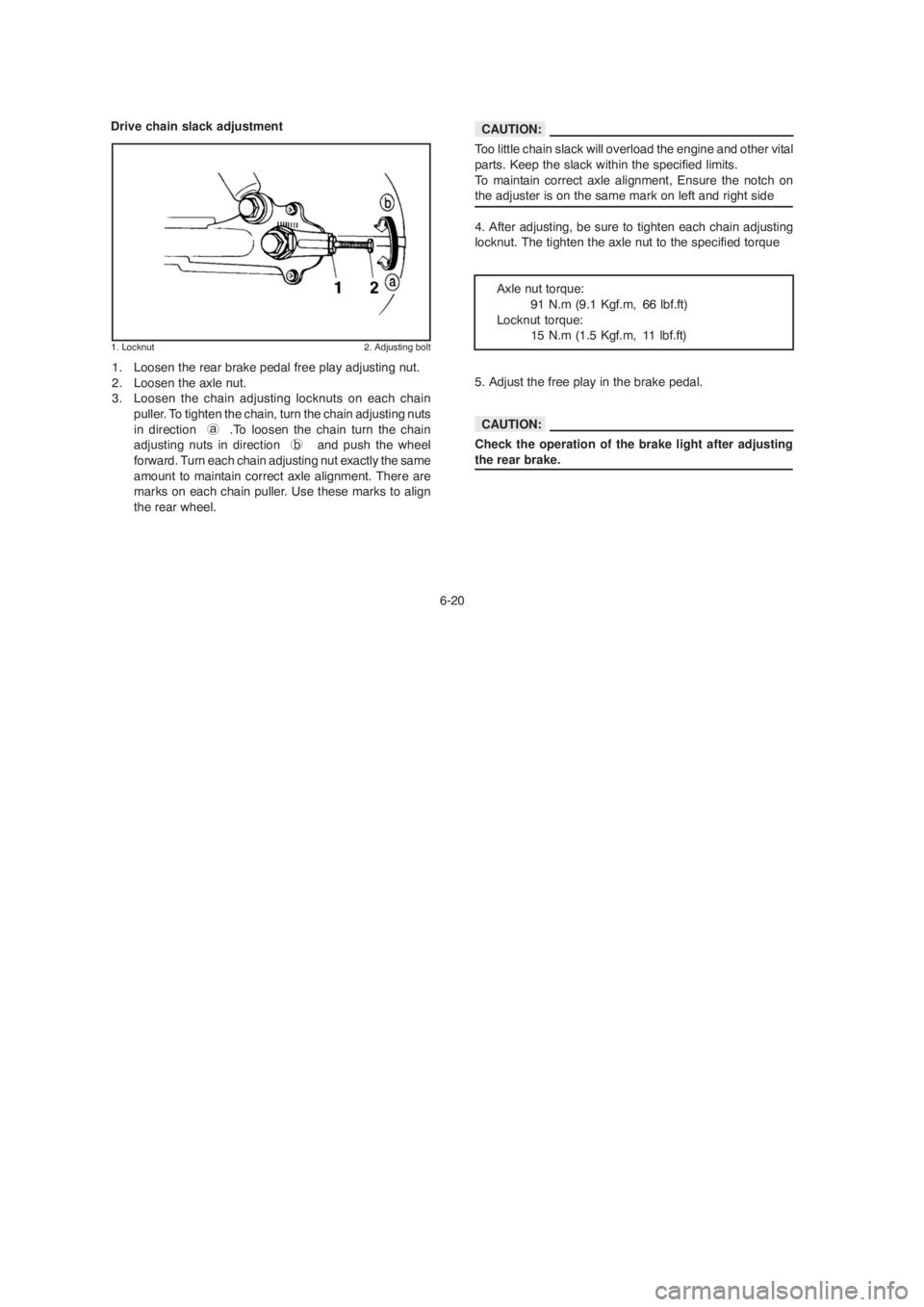
Drive chain slack adjustment
1. Locknut 2. Adjusting bolt
1. Loosen the rear brake pedal free play adjusting nut.
2. Loosen the axle nut.
3. Loosen the chain adjusting locknuts on each chain
puller. To tighten the chain, turn the chain adjusting nuts
in direction a .To loosen the chain turn the chain
adjusting nuts in direction b and push the wheel
forward. Turn each chain adjusting nut exactly the same
amount to maintain correct axle alignment. There are
marks on each chain puller. Use these marks to align
the rear wheel.Too little chain slack will overload the engine and other vital
parts. Keep the slack within the specified limits.
To maintain correct axle alignment, Ensure the notch on
the adjuster is on the same mark on left and right side
4. After adjusting, be sure to tighten each chain adjusting
locknut. The tighten the axle nut to the specified torque
Axle nut torque:
91 N.m (9.1 Kgf.m, 66 lbf.ft)
Locknut torque:
15 N.m (1.5 Kgf.m, 11 lbf.ft)
5. Adjust the free play in the brake pedal.
Check the operation of the brake light after adjusting
the rear brake.
CAUTION:
CAUTION:
6-20
Drive chain slack adjustment
1. Locknut 2. Adjusting bolt
1. Loosen the rear brake pedal free play adjusting nut.
2. Loosen the axle nut.
3. Loosen the chain adjusting locknuts on each chain
puller. To tighten the chain, turn the chain adjusting nuts
in direction a .To loosen the chain turn the chain
adjusting nuts in direction b and push the wheel
forward. Turn each chain adjusting nut exactly the same
amount to maintain correct axle alignment. There are
marks on each chain puller. Use these marks to align
the rear wheel.Too little chain slack will overload the engine and other vital
parts. Keep the slack within the specified limits.
To maintain correct axle alignment, Ensure the notch on
the adjuster is on the same mark on left and right side
4. After adjusting, be sure to tighten each chain adjusting
locknut. The tighten the axle nut to the specified torque
Axle nut torque:
91 N.m (9.1 Kgf.m, 66 lbf.ft)
Locknut torque:
15 N.m (1.5 Kgf.m, 11 lbf.ft)
5. Adjust the free play in the brake pedal.
Check the operation of the brake light after adjusting
the rear brake.
CAUTION:
CAUTION:
Page 72 of 83
6-32
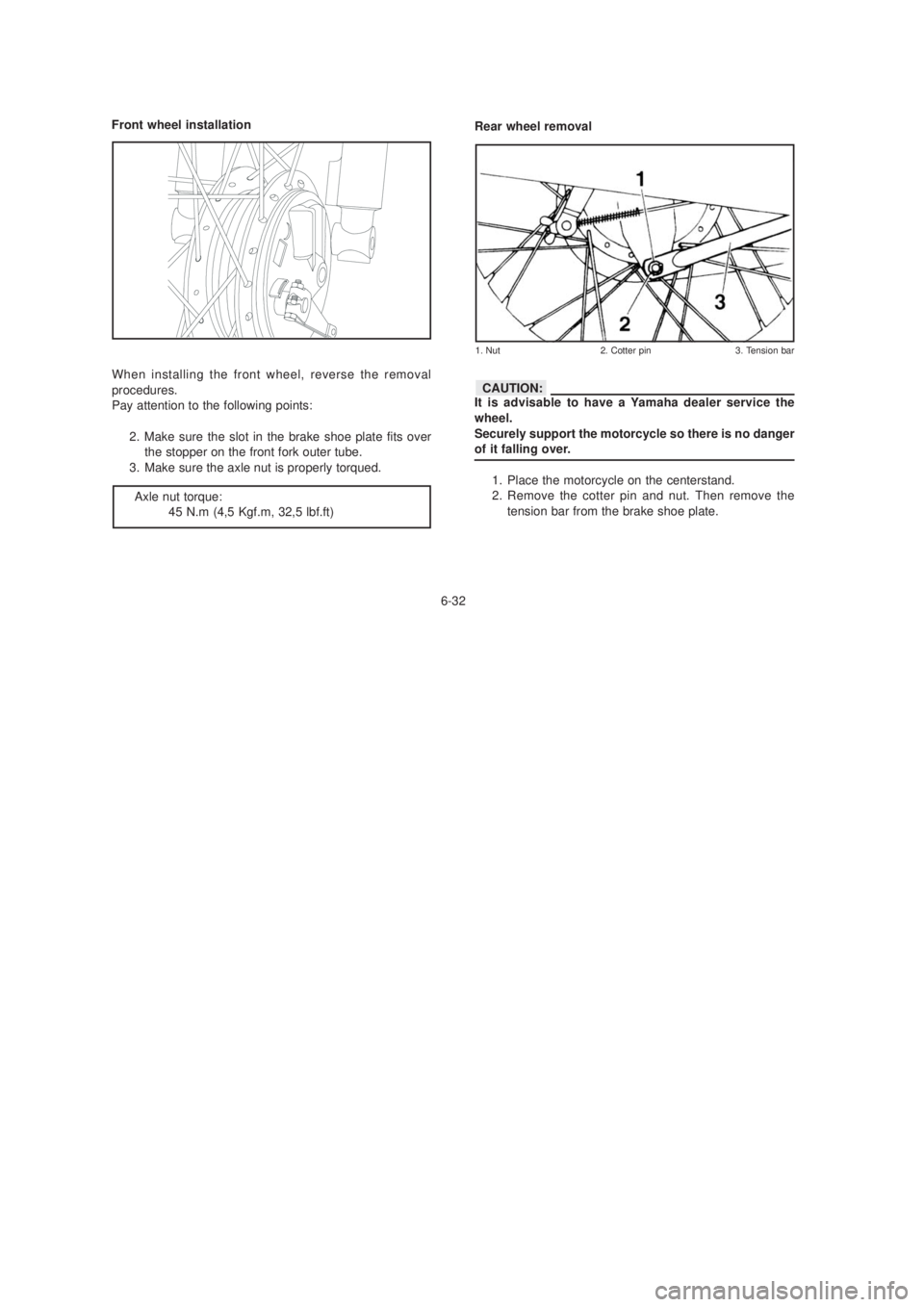
Front wheel installation
When installing the front wheel, reverse the removal
procedures.
Pay attention to the following points: 2. Make sure the slot in the brake shoe plate fits overthe stopper on the front fork outer tube.
3. Make sure the axle nut is properly torqued.
Axle nut torque: 45 N.m (4,5 Kgf.m, 32,5 lbf.ft)
Rear wheel removal
It is advisable to have a Yamaha dealer service the
wheel.
Securely support the motorcycle so there is no danger
of it falling over. 1. Place the motorcycle on the centerstand.
2. Remove the cotter pin and nut. Then remove thetension bar from the brake shoe plate.
1. Nut 2. Cotter pin 3. Tension bar
CAUTION:
6-32
Front wheel installation
When installing the front wheel, reverse the removal
procedures.
Pay attention to the following points: 2. Make sure the slot in the brake shoe plate fits overthe stopper on the front fork outer tube.
3. Make sure the axle nut is properly torqued.
Axle nut torque: 45 N.m (4,5 Kgf.m, 32,5 lbf.ft)
Rear wheel removal
It is advisable to have a Yamaha dealer service the
wheel.
Securely support the motorcycle so there is no danger
of it falling over. 1. Place the motorcycle on the centerstand.
2. Remove the cotter pin and nut. Then remove thetension bar from the brake shoe plate.
1. Nut 2. Cotter pin 3. Tension bar
CAUTION:
Page 73 of 83
6-33
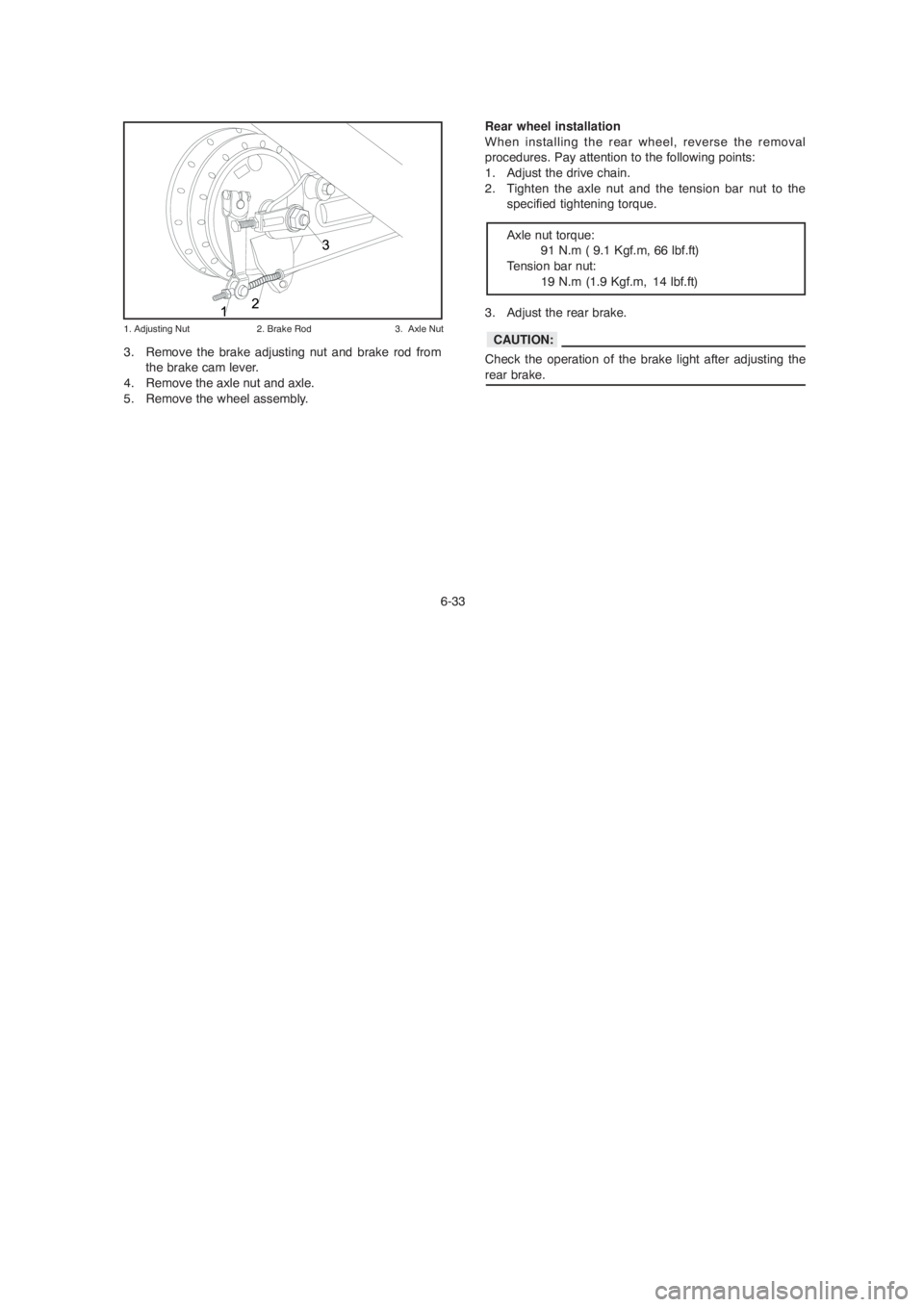
3. Remove the brake adjusting nut and brake rod from
the brake cam lever.
4. Remove the axle nut and axle.
5. Remove the wheel assembly.
1. Adjusting Nut 2. Brake Rod 3. Axle Nut
Rear wheel installation
When installing the rear wheel, reverse the removal
procedures. Pay attention to the following points:
1. Adjust the drive chain.
2. Tighten the axle nut and the tension bar nut to the
specified tightening torque.
Axle nut torque:
91 N.m ( 9.1 Kgf.m, 66 lbf.ft)
Tension bar nut:
19 N.m (1.9 Kgf.m, 14 lbf.ft)
3. Adjust the rear brake.
Check the operation of the brake light after adjusting the
rear brake.
CAUTION:
6-33
3. Remove the brake adjusting nut and brake rod from
the brake cam lever.
4. Remove the axle nut and axle.
5. Remove the wheel assembly.
1. Adjusting Nut 2. Brake Rod 3. Axle Nut
Rear wheel installation
When installing the rear wheel, reverse the removal
procedures. Pay attention to the following points:
1. Adjust the drive chain.
2. Tighten the axle nut and the tension bar nut to the
specified tightening torque.
Axle nut torque:
91 N.m ( 9.1 Kgf.m, 66 lbf.ft)
Tension bar nut:
19 N.m (1.9 Kgf.m, 14 lbf.ft)
3. Adjust the rear brake.
Check the operation of the brake light after adjusting the
rear brake.
CAUTION: