warning YAMAHA YBR125 2007 User Guide
[x] Cancel search | Manufacturer: YAMAHA, Model Year: 2007, Model line: YBR125, Model: YAMAHA YBR125 2007Pages: 79, PDF Size: 2.08 MB
Page 40 of 79
WARNING
WARNING
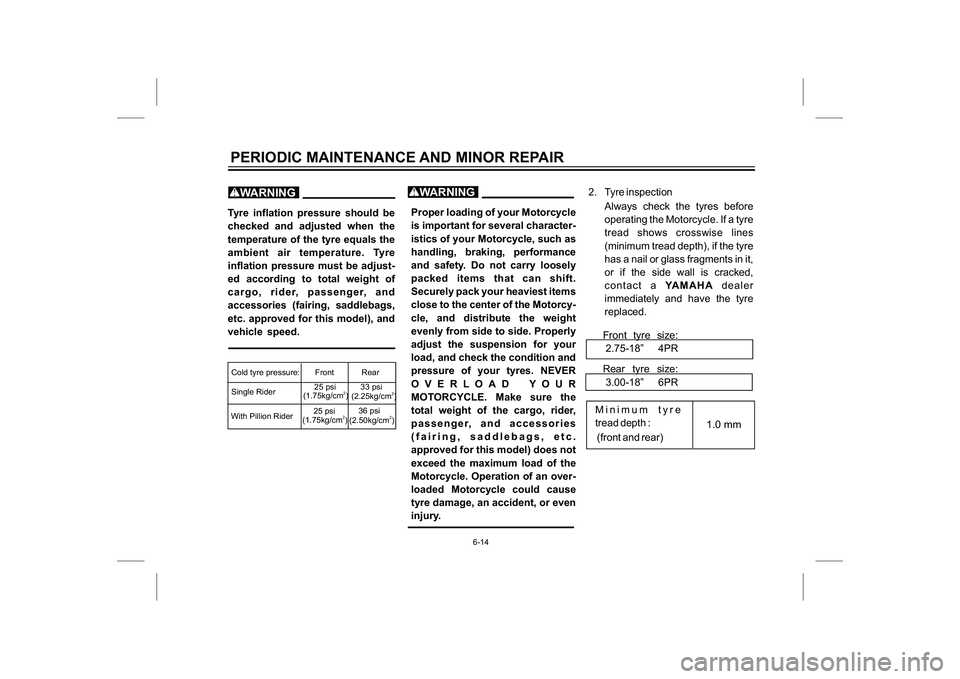
Minimum tyre
tread depth :
(front and rear)
1.0 mm
Tyre inflation pressure should be
checked and adjusted when the
temperature of the tyre equals the
ambient air temperature. Tyre
inflation pressure must be adjust-
ed according to total weight of
cargo, rider, passenger, and
accessories (fairing, saddlebags,
etc. approved for this model), and
vehicle speed.Proper loading of your Motorcycle
is important for several character-
istics of your Motorcycle, such as
handling, braking, performance
and safety. Do not carry loosely
packed items that can shift.
Securely pack your heaviest items
close to the center of the Motorcy-
cle, and distribute the weight
evenly from side to side. Properly
adjust the suspension for your
load, and check the condition and
pressure of your tyres. NEVER
OVERLOAD YOUR
MOTORCYCLE. Make sure the
total weight of the cargo, rider,
passenger, and accessories
(fairing, saddlebags, etc.
approved for this model) does not
exceed the maximum load of the
Motorcycle. Operation of an over-
loaded Motorcycle could cause
tyre damage, an accident, or even
injury.2. Tyre inspection
Always check the tyres before
operating the Motorcycle. If a tyre
tread shows crosswise lines
(minimum tread depth), if the tyre
has a nail or glass fragments in it,
or if the side wall is cracked,
contact a dealer
immediately and have the tyre
replaced.YAMAHAPERIODIC MAINTENANCE AND MINOR REPAIR
6-14
Front Rear Cold tyre pressure:
Single Rider25 psi
25 psi (1.75kg/cm )
2
(1.75kg/cm )
2(2.25kg/cm )
2
(2.50kg/cm )
2
33 psi
36 psi
With Pillion Rider
Front tyre size:
2.75-18” 4PR
Rear tyre size:
3.00-18” 6PR
Page 41 of 79
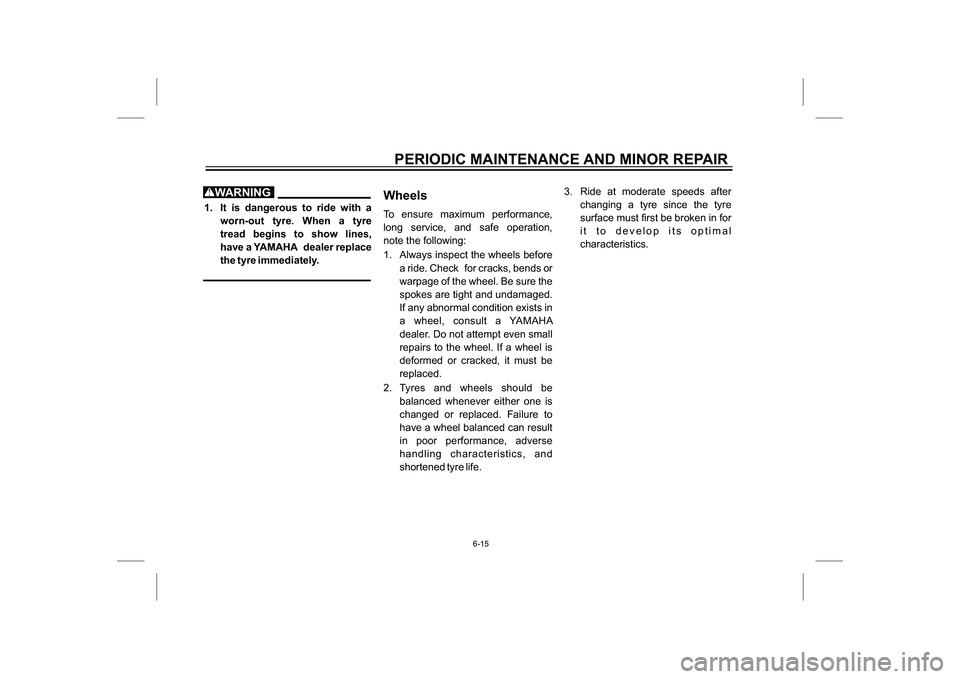
WARNING1. It is dangerous to ride with a
worn-out tyre. When a tyre
tread begins to show lines,
have a YAMAHA dealer replace
the tyre immediately.
WheelsTo ensure maximum performance,
long service, and safe operation,
note the following:
1. Always inspect the wheels before
a ride. Check for cracks, bends or
warpage of the wheel. Be sure the
spokes are tight and undamaged.
If any abnormal condition exists in
a wheel, consult a YAMAHA
dealer. Do not attempt even small
repairs to the wheel. If a wheel is
deformed or cracked, it must be
replaced.
2. Tyres and wheels should be
balanced whenever either one is
changed or replaced. Failure to
have a wheel balanced can result
in poor performance, adverse
handling characteristics, and
shortened tyre life.3. Ride at moderate speeds after
changing a tyre since the tyre
surface must first be broken in for
it to develop its optimal
characteristics.PERIODIC MAINTENANCE AND MINOR REPAIR
6-15
Page 42 of 79

1. Locknut
2. Adjusting nut
3. Free playClutch lever free play
adjustmentThe clutch lever free play should be
adjusted to 10 ~ 15 mm. If the free
play is incorrect, adjust as follows.
1 . Loosen the locknut.
2. Turn the adjusting nut in direction
to increase free play or in
direction to decrease free
play.
3. Tighten the locknut.è
çIf proper adjustment cannot be
obtained or the clutch does not work
correctly, ask a dealer to
inspect the internal clutch
mechanism.YAMAHA
1. Adjusting nut
2. Free playFront brake adjustmentThe front brake lever free play should
be adjusted to 10 ~ 15 mm.
1. Turn the adjusting nut in direction
to increase free play and
direction to decrease free play. ç
è
When it is impossible to make the
proper adjustment, ask a YAMAHA
dealer.
PERIODIC MAINTENANCE AND MINOR REPAIR
6-16
NOTE :
WARNING
Page 43 of 79

1. Adjusting NutRear brake adjustmentThe rear brake pedal free play
should be adjusted to 20 ~ 30 mm at
the brake pedal end. Turn the
adjusting nut in direction to
increase free play and in direction
to decrease free play.ç
è
a. Freeplay When it is impossible to make
the proper adjustment, ask a
YAMAHA dealer.
Check the operation of the
brake light after adjusting the
rear brake.
1. Brake light switch
2. Adjusting nutBrake light switch adjustmentThe rear brake light switch is acti-
vated by the brake pedal and is
properly adjusted when the brake
light comes on just before braking
takes effect. To adjust the rear
brake light switch, hold the switch
body so it does not rotate while
turning the adjusting nut.
Turn the adjusting nut in direction ç
to make the brake light come on
earlier.
Turn the adjusting nut in direction è
to make the brake light come on
later.
PERIODIC MAINTENANCE AND MINOR REPAIR
6-17
WARNING
1
2
çè
Page 46 of 79

CAUTION :
5. After adjusting, be sure to tighten
each chain adjusting locknut.
Then tighten the axle nut to the
specified torque.Maintain chain slackness
within specified limits as per
specifications.
To maintain correct axle
alignment, Ensure the notch
on the adjuster is on the same
Mark on Left and Right Side.
Tightening torque:
Axle nut:
65 ft-lb (9.05 m-kg)
1. Cotter pin6. Insert a new cotter pin into the
axle nut and bend the end of the
cotter pin as shown. If the notch in
the axle nut and the cotter pin
hole do not match, tighten the nut
slightly to align them.
Always use a new cotter pin on
the axle nut.7 Adjust the free play in the
brake pedal.
Check the operation of the brake
light after adjusting the rear
brake.
PERIODIC MAINTENANCE AND MINOR REPAIR
6-20
WARNING
WARNING
Page 47 of 79

Drive chain lubricationThe chain consists of many parts
which work with each other. If the
chain is not maintained properly, it
will wear out quickly. Therefore, the
chain must be serviced regularly.
This service is especially necessary
when riding in dusty areas.
1. The drive chain should be
lubricated every 5,000 km.
2. To clean the chain thoroughly,
remove it from the Motorcycle,
dip it in solvent, and clean out as
much dirt as possible. Then, take
the chain out of the solvent to dry
it, and then dip the chain in oil of
20W40. Remove the chain and
hang it on a peg for a while till the
excess oil drips down completely.
Then using a clean cloth wipe the
chain.
Cable inspection and
lubricationDamage to the outer housing of
cables may lead to internal rusting
and interfere with the cable
movement. Replace damaged
cables as soon as possible to
prevent unsafe conditions.
Lubricate the cables with anti-
corrosive oil and cable ends. If a
cable does not operate smoothly,
ask a YAMAHA dealer to replace it.
Recommended lubricant:
20W40 Type SG
Throttle cable and grip
lubricationThe throttle twist grip assembly
should be greased at the time that
the cable is lubricated, since the
grip must be removed to get at the
end of the throttle cable. After
removing the screws, hold the end
of the cable up in the air and put in
several drops of lubricant. With the
throttle grip disassembled, coat the
metal surface of the grip assembly
with a suitable all purpose grease.
PERIODIC MAINTENANCE AND MINOR REPAIR
6-21
WARNING
Page 48 of 79

Brake and shift pedal
lubricationLubricate the pivoting parts.
Recommended lubricant:
20W40 Type SG
Brake and Clutch Lever
GreasingGrease the pivoting parts.
MULTIPURPOSE Recommended Grease :
Center and sidestand
lubricationLubricate the pivoting and mating
joints.
Check to see that the center and
sidestand move up and down
smoothly.
Recommended lubricant:
If the center and/or sidestand does
not move smoothly, consult
aYAMAHA dealer.20W40 Type SG
PERIODIC MAINTENANCE AND MINOR REPAIR
6-22
WARNING
Page 49 of 79

CAUTION :
Front fork inspectionSecurely support the Motorcycle
so there is no danger of it falling
over.
1. Visual check
Check for scratches or damage
on the inner tube and traces of oil
leakage from the front fork.2. Operation check
Place the Motorcycle on a level
place.
a. Hold the Motorcycle in an
upright position and apply the
front brake.
b. Push down hard on the
handlebars several times and
check if the fork rebounds
smoothly.
If any damage or unsmooth
movement is found with the front
fork, consult a YAMAHA dealer.
Steering inspectionPeriodically inspect the condition of
the steering. Worn out or loose
steering bearings may be danger-
ous. Place a stand under the engine
to raise the front wheel off the
ground. Hold the lower end of the
front forks and try to move them
forward and backward. If any free
play can be felt, ask a YAMAHA
dealer to inspect and adjust the
steering. Inspection is easier if the
front wheel is removed.
PERIODIC MAINTENANCE AND MINOR REPAIR
6-23
WARNING
Page 50 of 79

Securely support the Motorcycle
so there is no danger of it falling
over.
Wheel bearingsIf there is play in the front or rear
wheel hub or if the wheel does not
turn smoothly, have a YAMAHA
dealer inspect the wheel bearings.
1. Maximum level mark
2. Minimum level markBattery1. Battery is located inside the
L.H. side panel (for removal &
installation of L.H. side panel
please refer page 6-5)
2. Open the lid.
3. Check the level of the battery
electrolyte and make sure that
the terminals are tight.
Top up with distilled water if the
electrolyte level is low.
PERIODIC MAINTENANCE AND MINOR REPAIR
6-24
WARNING
Page 51 of 79

When inspecting the battery, be
sure the breather hose is routed
correctly. If the breather hose is
positioned in such a way as to
cause battery electrolyte or gas to
exit onto the frame, structural and
cosmetic damage to the
Motorcycle can occur.
Battery electrolyte is poisonous
and dangerous, causing severe
burns, etc. It contains sulfuric
acid. Avoid contact with skin, eyes
or clothing.Antidote:
EXTERNAL: Flush with water.
INTERNAL: Drink large quantities
of water or milk. Follow with milk of
magnesia, beaten egg, or
vegetable oil. Call a physician
immediately. EYES: Flush with
water for 15 minutes and get
prompt medical attention.
Batteries produce explosive
gases. Keep sparks, flame,
cigarettes etc., away. Ventilate
when charging or using in an
enclosed space. Always shield
your eyes when working near
batteries. KEEP OUT OF REACH
OF CHILDREN.Replenishing the battery fluid
Normal tap water contains
minerals which are harmful to a
battery; therefore, refill only with
distilled water.
Take care not to spill battery fluid
on the chain. Battery fluid may
weaken the chain causing shorter
chain life and possibly result in an
accident A poorly maintained battery will
corrode and discharge quickly. The
battery fluid should be checked at
least once a month. The level should
be between the minimum level and
maximum level marks. Use only
distilled water if refilling is necessary.
PERIODIC MAINTENANCE AND MINOR REPAIR
6-25
ENSURE THAT BATTERY ELECTROLYTE LEVEL IS MAINTAINED BETWEEN
MAX . AND MIN. MARKS. IF REQUIRED, ADD DISTILLED WATER ONLY
CAUTION :
CAUTION :WARNING