light YAMAHA YBR125 2014 User Guide
[x] Cancel search | Manufacturer: YAMAHA, Model Year: 2014, Model line: YBR125, Model: YAMAHA YBR125 2014Pages: 84, PDF Size: 1.82 MB
Page 24 of 84
INSTRUMENT AND CONTROL FUNCTIONS
3-9
3
EAU43151
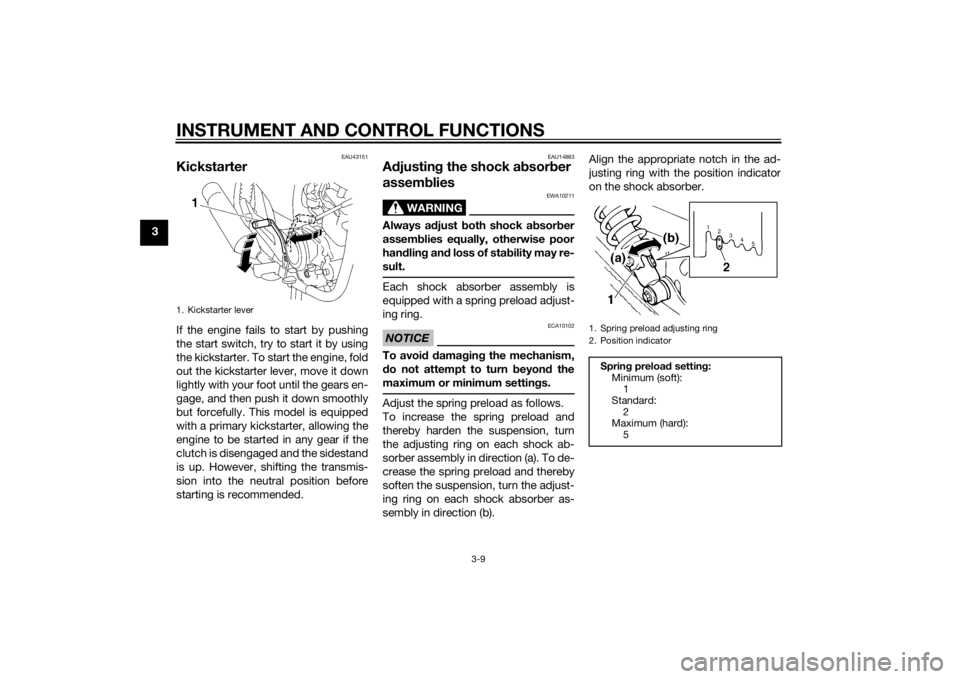
KickstarterIf the engine fails to start by pushing
the start switch, try to start it by using
the kickstarter. To start the engine, fold
out the kickstarter lever, move it down
lightly with your foot until the gears en-
gage, and then push it down smoothly
but forcefully. This model is equipped
with a primary kickstarter, allowing the
engine to be started in any gear if the
clutch is disengaged and the sidestand
is up. However, shifting the transmis-
sion into the neutral position before
starting is recommended.
EAU14883
Adjustin g the shock a bsorb er
assem blies
WARNING
EWA10211
Always a djust both shock ab sorber
assem blies equally, otherwise poor
han dlin g an d loss of sta bility may re-
sult.Each shock absorber assembly is
equipped with a spring preload adjust-
ing ring.NOTICE
ECA10102
To avoi d d amag ing the mechanism,
d o not attempt to turn b eyond the
maximum or minimum settin gs.Adjust the spring preload as follows.
To increase the spring preload and
thereby harden the suspension, turn
the adjusting ring on each shock ab-
sorber assembly in direction (a). To de-
crease the spring preload and thereby
soften the suspension, turn the adjust-
ing ring on each shock absorber as-
sembly in direction (b). Align the appropriate notch in the ad-
justing ring with the position indicator
on the shock absorber.
1. Kickstarter lever
1. Spring preload adjusting ring
2. Position indicatorSprin
g preloa d setting :
Minimum (soft): 1
Standard:
2
Maximum (hard): 5
U51DE1E0.book Page 9 Thursday, August 29, 2013 4:41 PM
Page 30 of 84
OPERATION AND IMPORTANT RIDING POINTS
5-1
5
EAU15952
Read the Owner’s Manual carefully to
become familiar with all controls. If
there is a control or function you do not
understand, ask your Yamaha dealer.
WARNING
EWA10272
Failure to familiarize yourself with
the controls can lead to loss of con-
trol, which coul d cause an acci dent
or injury.
EAU45311
TIPThis model is equipped with a lean an-
gle sensor to stop the engine in case of
a turnover. To start the engine after a
turnover, be sure to turn the main
switch to “OFF” and then to “ON”. Fail-
ing to do so will prevent the engine
from starting even though the engine
will crank when pushing the start
switch.
EAU43187
Startin g the en gineIn order for the ignition circuit cut-off
system to enable starting, one of the
following conditions must be met:
The transmission is in the neutral
position.
The transmission is in gear with
the clutch lever pulled and the
sidestand up.
See page 3-11 for more informa-
tion.
1. Turn the key to “ON”. The engine trouble warning light
should come on for a few sec-
onds, then go off.NOTICE
ECA16712
If the warnin g li ght does not come
on initially when the key is turne d to
“ON”, or if the warnin g li ght remains
on, see pa ge 3-2 for the warnin g
li g ht circuit check.2. Shift the transmission into the
neutral position. The neutral indi-
cator light should come on. If not,
ask a Yamaha dealer to check the
electrical circuit.
U51DE1E0.book Page 1 Thursday, August 29, 2013 4:41 PM
Page 31 of 84
OPERATION AND IMPORTANT RIDING POINTS
5-2
5
3. Start the engine by pushing the
start switch or by pushing the
kickstarter lever down.
If the engine fails to start when us-
ing the start switch, release it, wait
a few seconds, and then try again.
Each starting attempt should be
as short as possible to preserve
the battery. Do not crank the en-
gine more than 10 seconds on any
one attempt. If the engine does
not start with the starter motor, try
using the kickstarter.
NOTICE
ECA11043
For maximum en gine life, never ac-
celerate har d when the en gine is
col d!
EAU16672
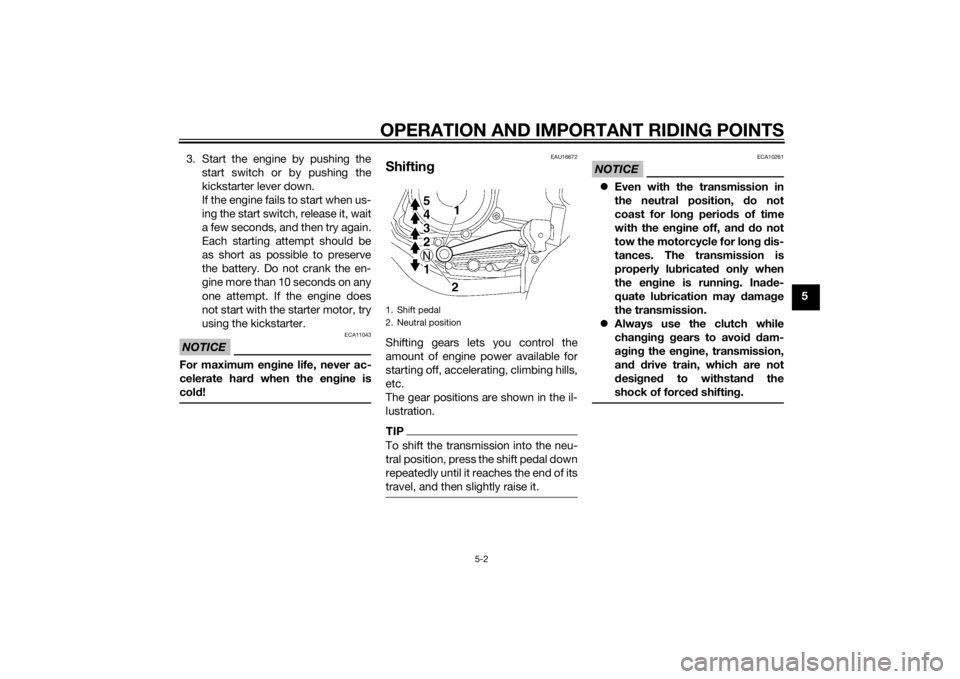
Shiftin gShifting gears lets you control the
amount of engine power available for
starting off, accelerating, climbing hills,
etc.
The gear positions are shown in the il-
lustration.TIPTo shift the transmission into the neu-
tral position, press the shift pedal down
repeatedly until it reaches the end of its
travel, and then slightly raise it.
NOTICE
ECA10261
Even with the transmission in
the neutral position, d o not
coast for lon g period s of time
with the en gine off, an d d o not
tow the motorcycle for lon g d is-
tances. The transmission is
properly lu bricated only when
the en gine is runnin g. Ina de-
quate lu brication may d amage
the transmission.
Always use the clutch while
chan gin g g ears to avoi d d am-
a g in g the en gine, transmission,
an d d rive train, which are not
d esi gne d to withstan d the
shock of force d shiftin g.
1. Shift pedal
2. Neutral position
U51DE1E0.book Page 2 Thursday, August 29, 2013 4:41 PM
Page 32 of 84

OPERATION AND IMPORTANT RIDING POINTS
5-3
5
EAU16811
Tips for reducin g fuel con-
sumptionFuel consumption depends largely on
your riding style. Consider the follow-
ing tips to reduce fuel consumption:
Shift up swiftly, and avoid high en-
gine speeds during acceleration.
Do not rev the engine while shift-
ing down, and avoid high engine
speeds with no load on the en-
gine.
Turn the engine off instead of let-
ting it idle for an extended length
of time (e.g., in traffic jams, at traf-
fic lights or at railroad crossings).
EAU16831
Engine break-inThere is never a more important period
in the life of your engine than the period
between 0 and 1000 km (600 mi). For
this reason, you should read the fol-
lowing material carefully.
Since the engine is brand new, do not
put an excessive load on it for the first
1000 km (600 mi). The various parts in
the engine wear and polish themselves
to the correct operating clearances.
During this period, prolonged full-throt-
tle operation or any condition that
might result in engine overheating
must be avoided.
EAU49211
0–150 km (0–90 mi)
Avoid prolonged operation above 5000
r/min.
After every hour of operation, stop the
engine, and then let it cool for five to
ten minutes.
Vary the engine speed from time to
time. Do not operate the engine at one
set throttle position. 150–500 km (90–300 mi)
Avoid prolonged operation above 6000
r/min.
Rev the engine freely through the
gears, but do not use full throttle at any
time.
500–1000 km (300–600 mi)
Avoid prolonged full-throttle operation.
Avoid prolonged operation above 7500
r/min.
NOTICE: After 1000 km (600
mi) of operation, the en gine oil must
b e chan ged .
[ECA10282]
1000 km (600 mi) an d b eyon d
The vehicle can now be operated nor-
mally.NOTICE
ECA10311
Keep the en gine spee d out of
the tachometer red zone.
If any en gine trou ble shoul d oc-
cur during the en gine break-in
period , imme diately have a
Yamaha dealer check the vehi-
cle.
U51DE1E0.book Page 3 Thursday, August 29, 2013 4:41 PM
Page 39 of 84
PERIODIC MAINTENANCE AND ADJUSTMENT
6-6
6
EAU18661
TIPThe air filter needs more frequent service if you are riding in unusually wet or dusty areas.
Hydraulic brake service
• Regularly check and, if necessary, correct the brake fluid level.
• Every two years replace the internal components of the brake master cylinder and caliper, and change the brake fluid.
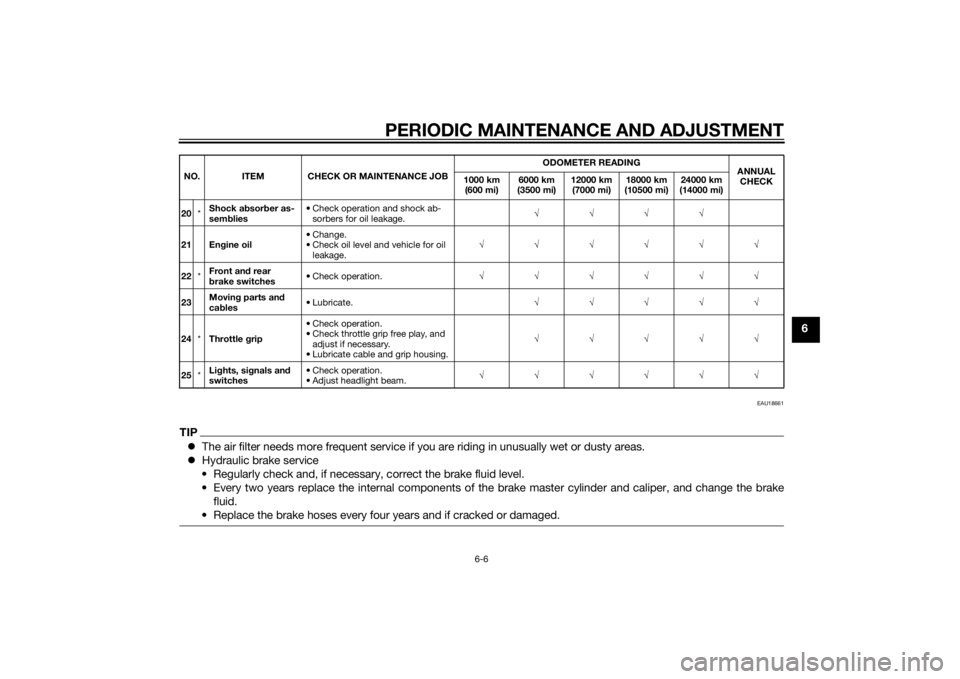
• Replace the brake hoses every four years and if cracked or damaged.20 *Shock a
bsor ber as-
sem blies • Check operation and shock ab-
sorbers for oil leakage. √√√√
21 En gine oil • Change.
• Check oil level and vehicle for oil
leakage. √√√√√√
22 *Front an
d rear
b rake switches • Check operation.
√√√√√√
23 Movin
g parts an d
ca bles • Lubricate.
√√√√√
24 *Throttle g rip • Check operation.
• Check throttle grip free play, and
adjust if necessary.
• Lubricate cable and grip housing. √√√√√
25 *Li
ghts, si gnals an d
switches • Check operation.
• Adjust headlight beam.
√√√√√√
NO. ITEM CHECK OR MAINTENANCE JOB
ODOMETER READING
ANNUAL
CHECK
1000 km
(600 mi) 6000 km
(3500 mi) 12000 km
(7000 mi) 18000 km
(10500 mi) 24000 km
(14000 mi)
U51DE1E0.book Page 6 Thursday, August 29, 2013 4:41 PM
Page 42 of 84
PERIODIC MAINTENANCE AND ADJUSTMENT
6-9
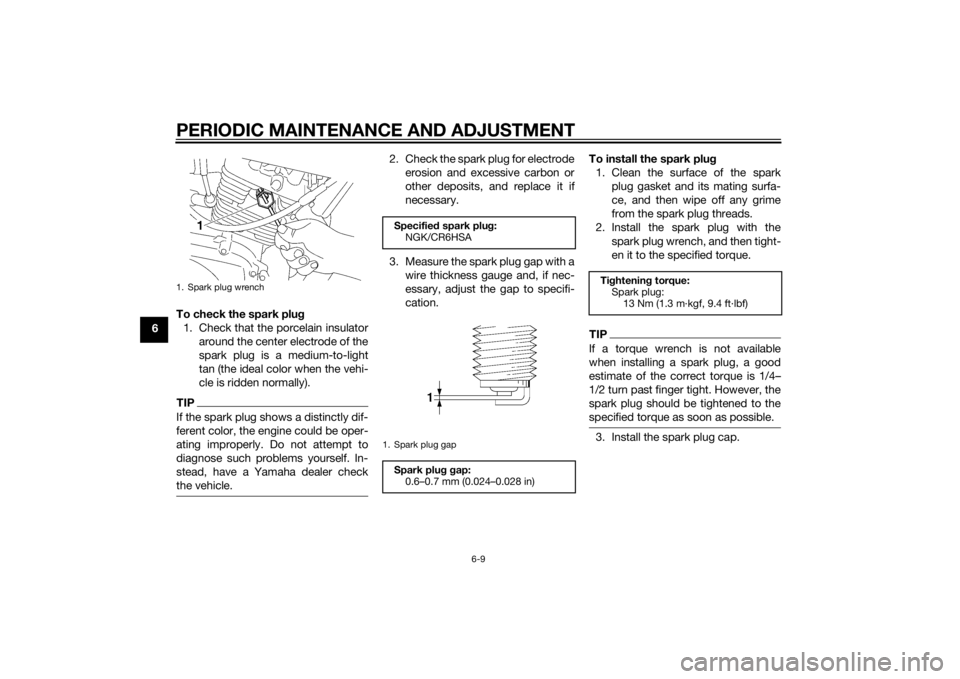
6To check the spark plu
g
1. Check that the porcelain insulator around the center electrode of the
spark plug is a medium-to-light
tan (the ideal color when the vehi-
cle is ridden normally).
TIPIf the spark plug shows a distinctly dif-
ferent color, the engine could be oper-
ating improperly. Do not attempt to
diagnose such problems yourself. In-
stead, have a Yamaha dealer check
the vehicle.
2. Check the spark plug for electrodeerosion and excessive carbon or
other deposits, and replace it if
necessary.
3. Measure the spark plug gap with a wire thickness gauge and, if nec-
essary, adjust the gap to specifi-
cation. To install the spark plu
g
1. Clean the surface of the spark plug gasket and its mating surfa-
ce, and then wipe off any grime
from the spark plug threads.
2. Install the spark plug with the spark plug wrench, and then tight-
en it to the specified torque.
TIPIf a torque wrench is not available
when installing a spark plug, a good
estimate of the correct torque is 1/4–
1/2 turn past finger tight. However, the
spark plug should be tightened to the
specified torque as soon as possible.3. Install the spark plug cap.
1. Spark plug wrench
Specifie d spark plu g:
NGK/CR6HSA1. Spark plug gapSpark plu g g ap:
0.6–0.7 mm (0.024–0.028 in)
Ti ghtenin g torque:
Spark plug: 13 Nm (1.3 m·kgf, 9.4 ft·lbf)
U51DE1E0.book Page 9 Thursday, August 29, 2013 4:41 PM
Page 43 of 84
PERIODIC MAINTENANCE AND ADJUSTMENT
6-10
6
EAU37175
Engine oilThe engine oil level should be checked
before each ride. In addition, the oil
must be changed at the intervals spec-
ified in the periodic maintenance and
lubrication chart.
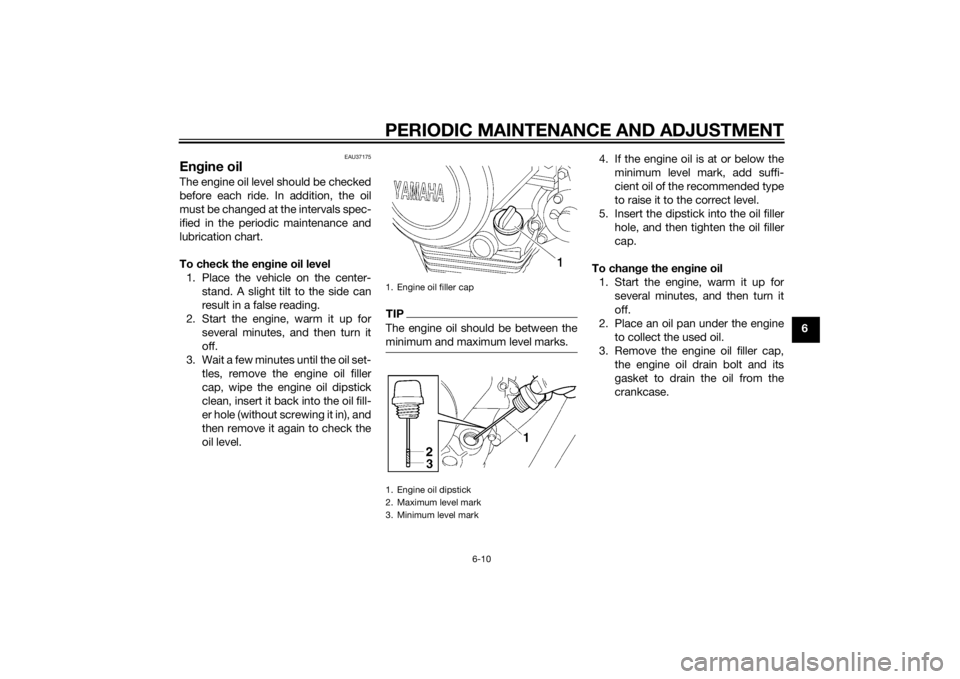
To check the en gine oil level
1. Place the vehicle on the center- stand. A slight tilt to the side can
result in a false reading.
2. Start the engine, warm it up for several minutes, and then turn it
off.
3. Wait a few minutes until the oil set- tles, remove the engine oil filler
cap, wipe the engine oil dipstick
clean, insert it back into the oil fill-
er hole (without screwing it in), and
then remove it again to check the
oil level.
TIPThe engine oil should be between the
minimum and maximum level marks.
4. If the engine oil is at or below theminimum level mark, add suffi-
cient oil of the recommended type
to raise it to the correct level.
5. Insert the dipstick into the oil filler hole, and then tighten the oil filler
cap.
To chan ge the en gine oil
1. Start the engine, warm it up for several minutes, and then turn it
off.
2. Place an oil pan under the engine to collect the used oil.
3. Remove the engine oil filler cap, the engine oil drain bolt and its
gasket to drain the oil from the
crankcase.
1. Engine oil filler cap
1. Engine oil dipstick
2. Maximum level mark
3. Minimum level mark
U51DE1E0.book Page 10 Thursday, August 29, 2013 4:41 PM
Page 45 of 84
PERIODIC MAINTENANCE AND ADJUSTMENT
6-12
6
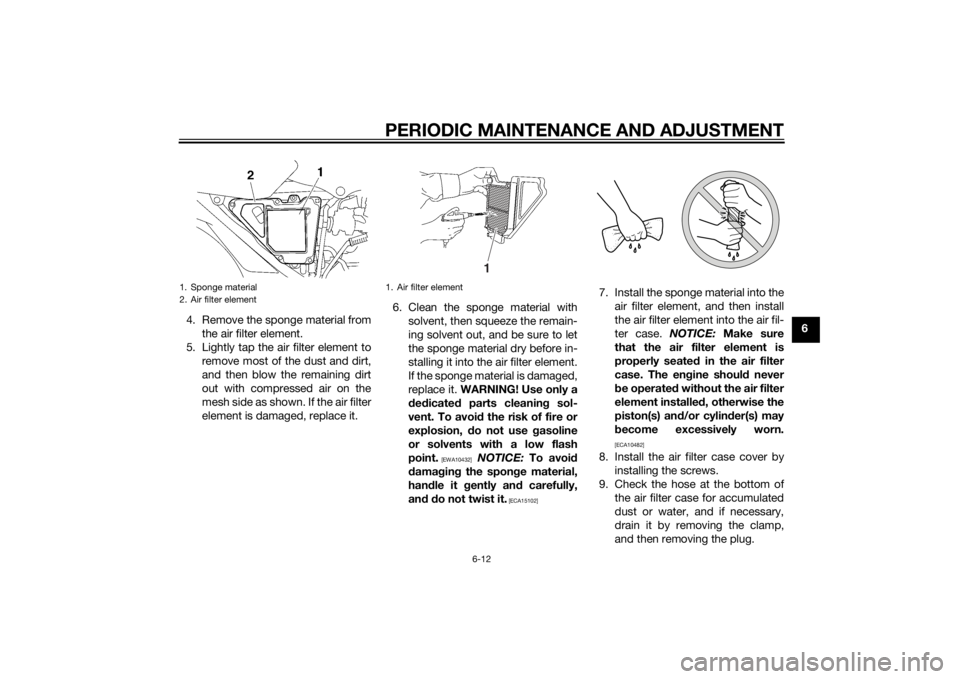
4. Remove the sponge material from
the air filter element.
5. Lightly tap the air filter element to remove most of the dust and dirt,
and then blow the remaining dirt
out with compressed air on the
mesh side as shown. If the air filter
element is damaged, replace it. 6. Clean the sponge material with
solvent, then squeeze the remain-
ing solvent out, and be sure to let
the sponge material dry before in-
stalling it into the air filter element.
If the sponge material is damaged,
replace it. WARNING! Use only a
d ed icated parts cleanin g sol-
vent. To avoi d the risk of fire or
explosion, do not use gasoline
or solvents with a low flash
point.
[EWA10432]
NOTICE: To avoi d
d amag ing the spon ge material,
han dle it g ently an d carefully,
an d d o not twist it.
[ECA15102]
7. Install the sponge material into the
air filter element, and then install
the air filter element into the air fil-
ter case. NOTICE: Make sure
that the air filter element is
properly seated in the air filter
case. The en gine shoul d never
b e operated without the air filter
element installed , otherwise the
piston(s) an d/or cylin der(s) may
b ecome excessively worn.
[ECA10482]
8. Install the air filter case cover by
installing the screws.
9. Check the hose at the bottom of the air filter case for accumulated
dust or water, and if necessary,
drain it by removing the clamp,
and then removing the plug.
1. Sponge material
2. Air filter element
1. Air filter element
1
U51DE1E0.book Page 12 Thursday, August 29, 2013 4:41 PM
Page 52 of 84
PERIODIC MAINTENANCE AND ADJUSTMENT
6-19
6
EAU22295
Brake light switchesThe brake light, which is activated by
the brake pedal and brake lever,
should come on just before braking
takes effect. If necessary, adjust the
rear brake light switch as follows, but
the front brake light switch should be
adjusted by a Yamaha dealer.
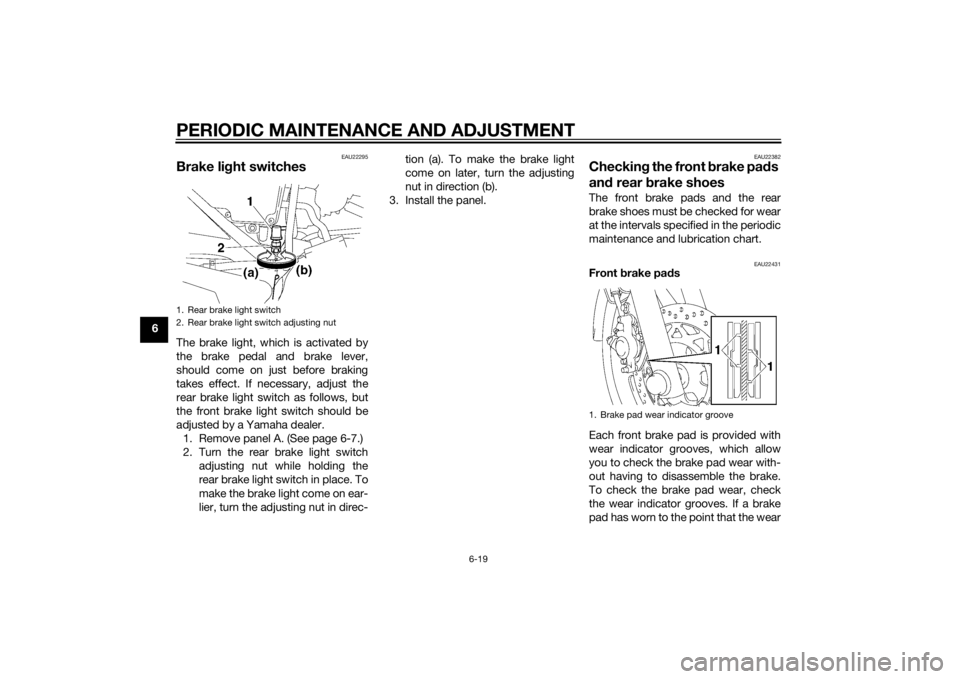
1. Remove panel A. (See page 6-7.)
2. Turn the rear brake light switch adjusting nut while holding the
rear brake light switch in place. To
make the brake light come on ear-
lier, turn the adjusting nut in direc- tion (a). To make the brake light
come on later, turn the adjusting
nut in direction (b).
3. Install the panel.
EAU22382
Checkin g the front brake pa ds
an d rear brake shoes The front brake pads and the rear
brake shoes must be checked for wear
at the intervals specified in the periodic
maintenance and lubrication chart.
EAU22431
Front brake pa ds
Each front brake pad is provided with
wear indicator grooves, which allow
you to check the brake pad wear with-
out having to disassemble the brake.
To check the brake pad wear, check
the wear indicator grooves. If a brake
pad has worn to the point that the wear
1. Rear brake light switch
2. Rear brake light switch adjusting nut
1. Brake pad wear indicator groove
U51DE1E0.book Page 19 Thursday, August 29, 2013 4:41 PM
Page 63 of 84
![YAMAHA YBR125 2014 User Guide PERIODIC MAINTENANCE AND ADJUSTMENT
6-30
6
avoi
d causin g extensive dam-
a g e to the electrical system an d
possi bly a fire.
[EWA15132]
3. Turn the key to “ON” and turn on
the electrical circ](/img/51/53616/w960_53616-62.png "YAMAHA YBR125 2014 User Guide PERIODIC MAINTENANCE AND ADJUSTMENT
6-30
6
avoi
d causin g extensive dam-
a g e to the electrical system an d
possi bly a fire.
[EWA15132]
3. Turn the key to “ON” and turn on
the electrical circ")
PERIODIC MAINTENANCE AND ADJUSTMENT
6-30
6
avoi
d causin g extensive dam-
a g e to the electrical system an d
possi bly a fire.
[EWA15132]
3. Turn the key to “ON” and turn on
the electrical circuits to check if
the devices operate.
4. If the fuse immediately blows again, have a Yamaha dealer
check the electrical system.
EAU49112
Replacin g the hea dlig ht bul bThis model is equipped with a halogen
bulb headlight. If the headlight bulb
burns out, replace it as follows.NOTICE
ECA10651
Take care not to damag e the follow-
in g parts:
Hea dlig ht bul b
Do not touch the glass part of
the hea dlig ht bul b to keep it free
from oil, otherwise the transpar-
ency of the g lass, the luminosity
of the b ulb, an d the b ulb life will
b e ad versely affected . Thor-
ou ghly clean off any d irt and fin-
g erprints on the hea dlig ht bul b
using a cloth moistene d with al-
cohol or thinner.
Hea dlig ht lens
Do not affix any type of tinted
film or stickers to the head light
lens.
Do not use a hea dlig ht bul b of a
watta ge hi gher than specifie d.
1. Remove the headlight cowling to-
gether with the headlight unit by
removing the bolts and pulling for-
ward.
Specifie d fuse:
15.0 A
1. Do not touch the glass part of the bulb.
1. Bolt
1
1
U51DE1E0.book Page 30 Thursday, August 29, 2013 4:41 PM