engine oil YAMAHA YBR125 2014 Owners Manual
[x] Cancel search | Manufacturer: YAMAHA, Model Year: 2014, Model line: YBR125, Model: YAMAHA YBR125 2014Pages: 84, PDF Size: 1.82 MB
Page 6 of 84

TABLE OF CONTENTSSAFETY INFORMATION.................. 1-1
DESCRIPTION .................................. 2-1
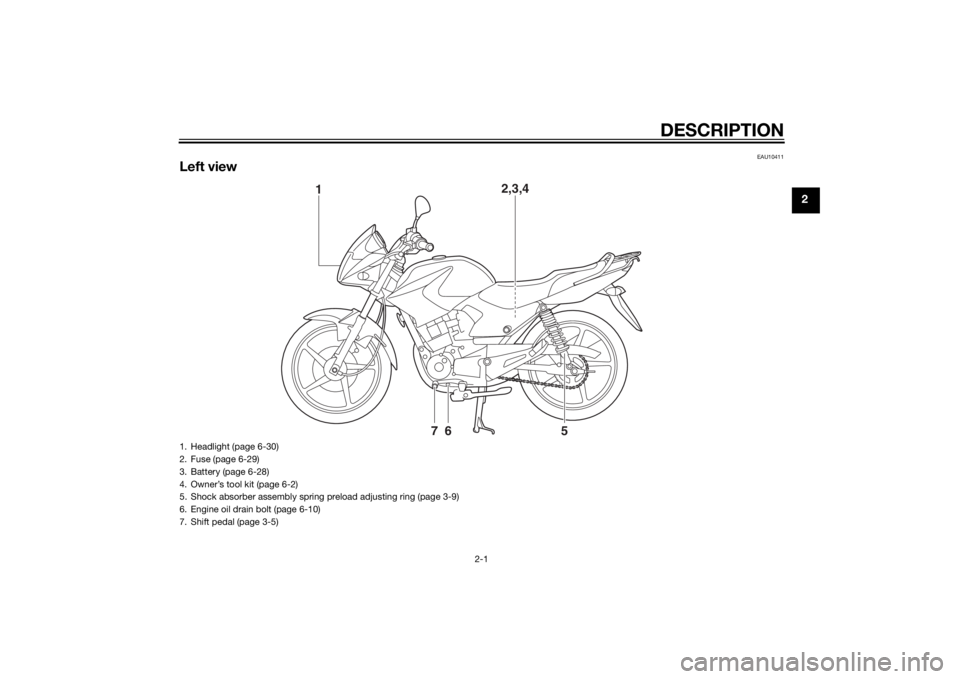
Left view ......................................... 2-1
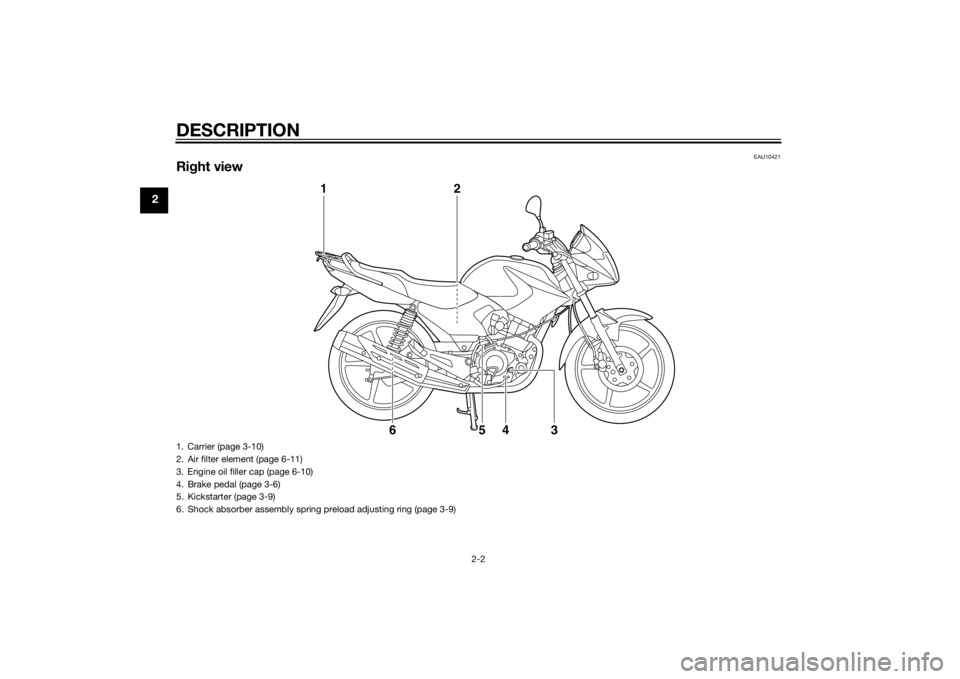
Right view ....................................... 2-2
Controls and instruments ............... 2-3
INSTRUMENT AND CONTROL
FUNCTIONS ...................................... 3-1
Main switch/steering lock............... 3-1
Indicator lights and warning light ... 3-2
Speedometer unit ........................... 3-3
Tachometer .................................... 3-3
Self-diagnosis device ..................... 3-3
Fuel gauge ...................................... 3-4
Handlebar switches ........................ 3-4
Clutch lever .................................... 3-5
Shift pedal ...................................... 3-5
Brake lever...................................... 3-5
Brake pedal .................................... 3-6
Fuel tank cap .................................. 3-6
Fuel ................................................. 3-7
Catalytic converters........................ 3-8
Kickstarter ...................................... 3-9
Adjusting the shock absorber assemblies .................................. 3-9
Carrier ........................................... 3-10
Sidestand ..................................... 3-10
Ignition circuit cut-off system ....... 3-11 FOR YOUR SAFETY –
PRE-OPERATION CHECKS
............. 4-1
OPERATION AND IMPORTANT
RIDING POINTS ................................ 5-1
Starting the engine .......................... 5-1
Shifting ............................................ 5-2
Tips for reducing fuel consumption ................................ 5-3
Engine break-in ............................... 5-3
Parking ............................................ 5-4
PERIODIC MAINTENANCE AND
ADJUSTMENT ................................... 6-1
Owner’s tool kit ............................... 6-2
Periodic maintenance chart for the emission control system .............. 6-3
General maintenance and lubrication chart ........................... 6-4
Removing and installing panels ...... 6-7
Checking the spark plug ................. 6-8
Engine oil....................................... 6-10
Cleaning the air filter element ....... 6-11
Checking the engine idling
speed ......................................... 6-13
Checking the throttle grip free
play ............................................ 6-13
Valve clearance ............................. 6-14
Tires .............................................. 6-14
Cast wheels................................... 6-16 Adjusting the clutch lever free
play ............................................ 6-16
Checking the brake lever free play ............................................ 6-17
Adjusting the brake pedal free
play ............................................ 6-18
Checking the shift pedal ............... 6-18
Brake light switches ..................... 6-19
Checking the front brake pads and rear brake shoes ............... 6-19
Checking the brake fluid level ...... 6-20
Changing the brake fluid .............. 6-21
Drive chain slack........................... 6-21
Cleaning and lubricating the drive
chain.......................................... 6-23
Checking and lubricating the cables ........................................ 6-24
Checking and lubricating the throttle grip and cable ............... 6-24
Checking and lubricating the
brake and clutch levers ............. 6-24
Checking and lubricating the brake pedal ............................... 6-25
Checking and lubricating the centerstand and sidestand........ 6-25
Lubricating the swingarm
pivots......................................... 6-26
Checking the front fork ................. 6-26
Checking the steering................... 6-27
Checking the wheel bearings ....... 6-27
Battery .......................................... 6-28U51DE1E0.book Page 1 Thursday, August 29, 2013 4:41 PM
Page 13 of 84
DESCRIPTION
2-1
2
EAU10411
Left view
1
2,3,4
6
7
5
1. Headlight (page 6-30)
2. Fuse (page 6-29)
3. Battery (page 6-28)
4. Owner’s tool kit (page 6-2)
5. Shock absorber assembly spring preload adjusting ring (page 3-9)
6. Engine oil drain bolt (page 6-10)
7. Shift pedal (page 3-5)
U51DE1E0.book Page 1 Thursday, August 29, 2013 4:41 PM
Page 14 of 84
DESCRIPTION
2-2
2
EAU10421
Right view
1
2
3
4
5
6
1. Carrier (page 3-10)
2. Air filter element (page 6-11)
3. Engine oil filler cap (page 6-10)
4. Brake pedal (page 3-6)
5. Kickstarter (page 3-9)
6. Shock absorber assembly spring preload adjusting ring (page 3-9)U51DE1E0.book Page 2 Thursday, August 29, 2013 4:41 PM
Page 28 of 84
FOR YOUR SAFETY – PRE-OPERATION CHECKS
4-1
4
EAU15598
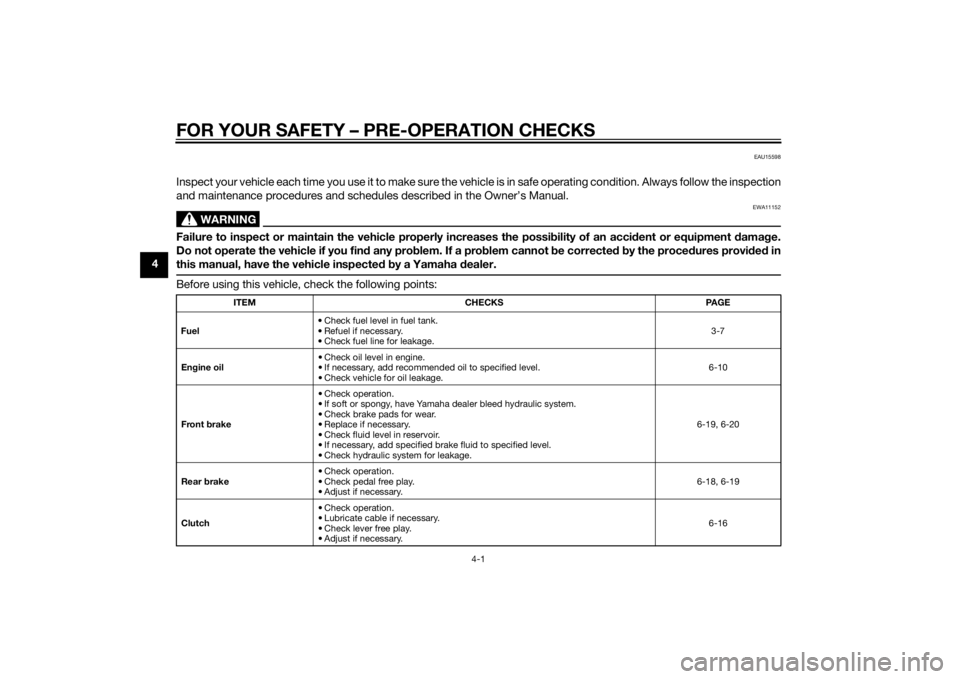
Inspect your vehicle each time you use it to make sure the vehicle is in safe operating condition. Always follow the inspection
and maintenance procedures and schedules described in the Owner’s Manual.
WARNING
EWA11152
Failure to inspect or maintain the vehicle properly increases the possibility of an acci dent or equipment damag e.
Do not operate the vehicle if you fin d any pro blem. If a pro blem cannot be corrected b y the proce dures provi ded in
this manual, have the vehicle inspecte d b y a Yamaha dealer.Before using this vehicle, check the following points:
ITEM CHECKS PAGE
Fuel • Check fuel level in fuel tank.
• Refuel if necessary.
• Check fuel line for leakage. 3-7
En gine oil • Check oil level in engine.
• If necessary, add recommended oil to specified level.
• Check vehicle for oil leakage. 6-10
Front brake • Check operation.
• If soft or spongy, have Yamaha dealer bleed hydraulic system.
• Check brake pads for wear.
• Replace if necessary.
• Check fluid level in reservoir.
• If necessary, add specified brake fluid to specified level.
• Check hydraulic system for leakage. 6-19, 6-20
Rear brake • Check operation.
• Check pedal free play.
• Adjust if necessary. 6-18, 6-19
Clutch • Check operation.
• Lubricate cable if necessary.
• Check lever free play.
• Adjust if necessary. 6-16
U51DE1E0.book Page 1 Thursday, August 29, 2013 4:41 PM
Page 32 of 84
OPERATION AND IMPORTANT RIDING POINTS
5-3
5
EAU16811
Tips for reducin g fuel con-
sumptionFuel consumption depends largely on
your riding style. Consider the follow-
ing tips to reduce fuel consumption:
Shift up swiftly, and avoid high en-
gine speeds during acceleration.
Do not rev the engine while shift-
ing down, and avoid high engine
speeds with no load on the en-
gine.
Turn the engine off instead of let-
ting it idle for an extended length
of time (e.g., in traffic jams, at traf-
fic lights or at railroad crossings).
EAU16831
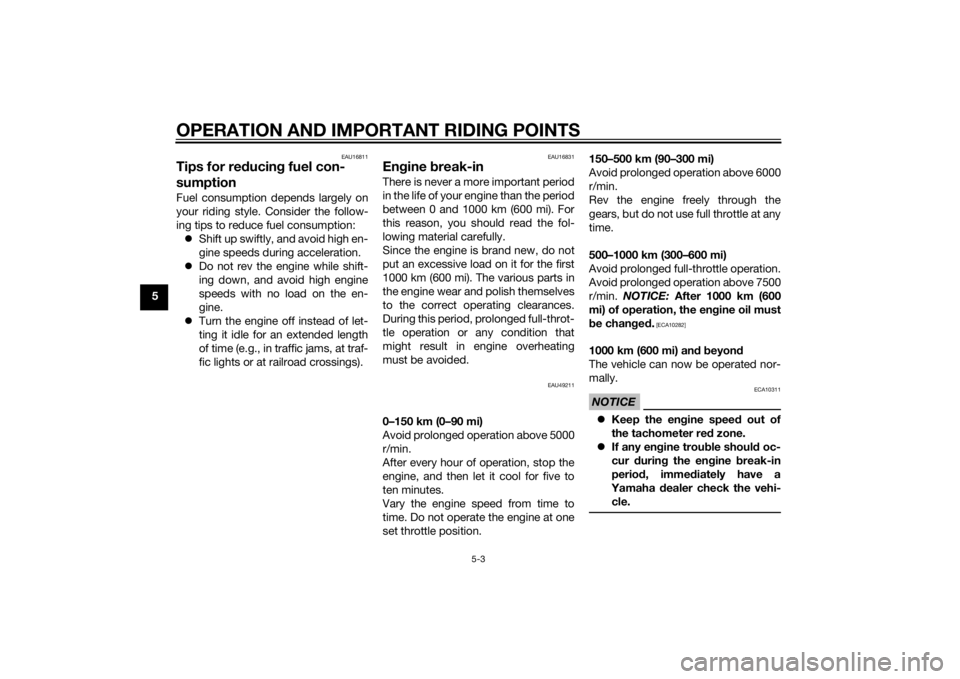
Engine break-inThere is never a more important period
in the life of your engine than the period
between 0 and 1000 km (600 mi). For
this reason, you should read the fol-
lowing material carefully.
Since the engine is brand new, do not
put an excessive load on it for the first
1000 km (600 mi). The various parts in
the engine wear and polish themselves
to the correct operating clearances.
During this period, prolonged full-throt-
tle operation or any condition that
might result in engine overheating
must be avoided.
EAU49211
0–150 km (0–90 mi)
Avoid prolonged operation above 5000
r/min.
After every hour of operation, stop the
engine, and then let it cool for five to
ten minutes.
Vary the engine speed from time to
time. Do not operate the engine at one
set throttle position. 150–500 km (90–300 mi)
Avoid prolonged operation above 6000
r/min.
Rev the engine freely through the
gears, but do not use full throttle at any
time.
500–1000 km (300–600 mi)
Avoid prolonged full-throttle operation.
Avoid prolonged operation above 7500
r/min.
NOTICE: After 1000 km (600
mi) of operation, the en gine oil must
b e chan ged .
[ECA10282]
1000 km (600 mi) an d b eyon d
The vehicle can now be operated nor-
mally.NOTICE
ECA10311
Keep the en gine spee d out of
the tachometer red zone.
If any en gine trou ble shoul d oc-
cur during the en gine break-in
period , imme diately have a
Yamaha dealer check the vehi-
cle.
U51DE1E0.book Page 3 Thursday, August 29, 2013 4:41 PM
Page 43 of 84
PERIODIC MAINTENANCE AND ADJUSTMENT
6-10
6
EAU37175
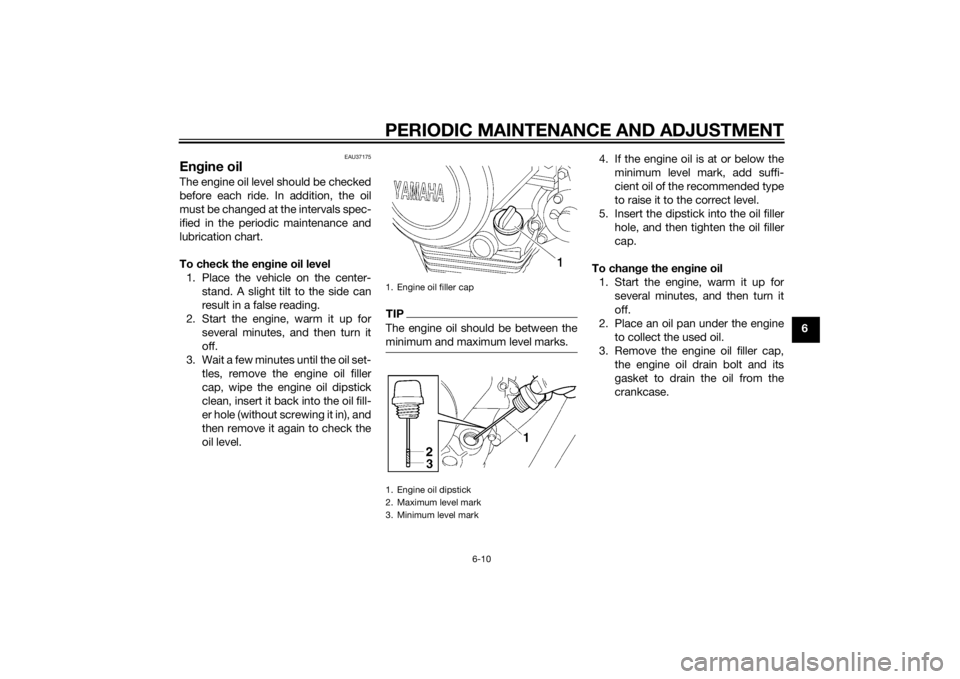
Engine oilThe engine oil level should be checked
before each ride. In addition, the oil
must be changed at the intervals spec-
ified in the periodic maintenance and
lubrication chart.
To check the en gine oil level
1. Place the vehicle on the center- stand. A slight tilt to the side can
result in a false reading.
2. Start the engine, warm it up for several minutes, and then turn it
off.
3. Wait a few minutes until the oil set- tles, remove the engine oil filler
cap, wipe the engine oil dipstick
clean, insert it back into the oil fill-
er hole (without screwing it in), and
then remove it again to check the
oil level.
TIPThe engine oil should be between the
minimum and maximum level marks.
4. If the engine oil is at or below theminimum level mark, add suffi-
cient oil of the recommended type
to raise it to the correct level.
5. Insert the dipstick into the oil filler hole, and then tighten the oil filler
cap.
To chan ge the en gine oil
1. Start the engine, warm it up for several minutes, and then turn it
off.
2. Place an oil pan under the engine to collect the used oil.
3. Remove the engine oil filler cap, the engine oil drain bolt and its
gasket to drain the oil from the
crankcase.
1. Engine oil filler cap
1. Engine oil dipstick
2. Maximum level mark
3. Minimum level mark
U51DE1E0.book Page 10 Thursday, August 29, 2013 4:41 PM
Page 44 of 84
PERIODIC MAINTENANCE AND ADJUSTMENT
6-11
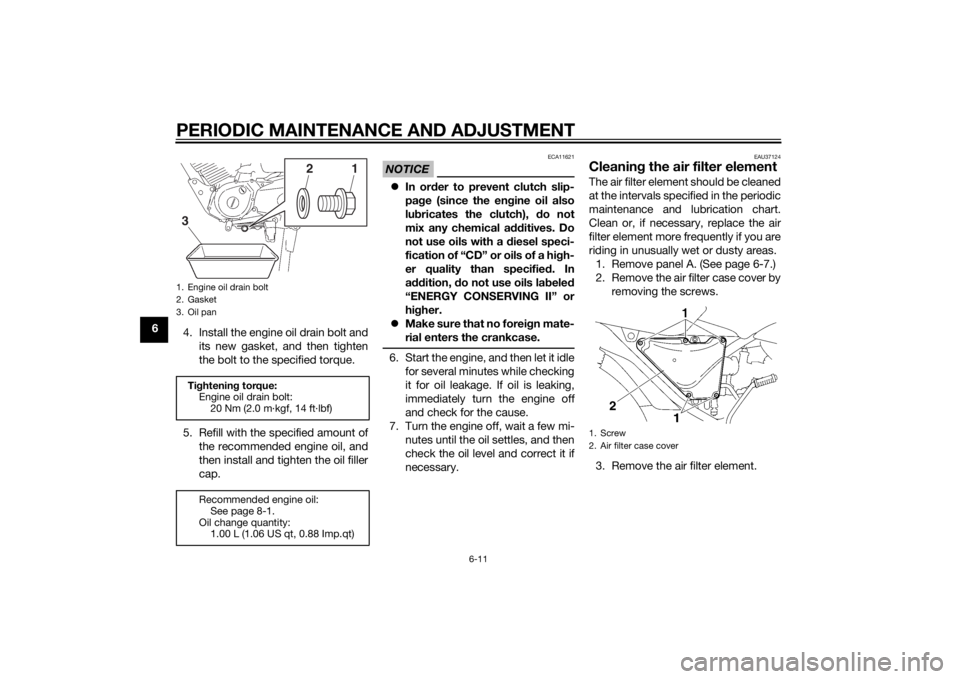
64. Install the engine oil drain bolt and
its new gasket, and then tighten
the bolt to the specified torque.
5. Refill with the specified amount of the recommended engine oil, and
then install and tighten the oil filler
cap.
NOTICE
ECA11621
In or der to prevent clutch slip-
pa ge (since the en gine oil also
lu bricates the clutch), do not
mix any chemical additives. Do
not use oils with a diesel speci-
fication of “CD” or oils of a hi gh-
er quality than specifie d. In
a ddition, do not use oils la beled
“ENERGY CONSERVING II” or
hi gher.
Make sure that no forei gn mate-
rial enters the crankcase.6. Start the engine, and then let it idle for several minutes while checking
it for oil leakage. If oil is leaking,
immediately turn the engine off
and check for the cause.
7. Turn the engine off, wait a few mi- nutes until the oil settles, and then
check the oil level and correct it if
necessary.
EAU37124
Cleanin g the air filter elementThe air filter element should be cleaned
at the intervals specified in the periodic
maintenance and lubrication chart.
Clean or, if necessary, replace the air
filter element more frequently if you are
riding in unusually wet or dusty areas.
1. Remove panel A. (See page 6-7.)
2. Remove the air filter case cover by removing the screws.
3. Remove the air filter element.
1. Engine oil drain bolt
2. Gasket
3. Oil panTi ghtenin g torque:
Engine oil drain bolt:
20 Nm (2.0 m·kgf, 14 ft·lbf)
Recommended engine oil: See page 8-1.
Oil change quantity: 1.00 L (1.06 US qt, 0.88 Imp.qt)3
2
1
1. Screw
2. Air filter case cover
U51DE1E0.book Page 11 Thursday, August 29, 2013 4:41 PM
Page 72 of 84
MOTORCYCLE CARE AND STORAGE
7-1
7
EAU37834
Matte color cautionNOTICE
ECA15193
Some models are equipped with
matte colore d finishe d parts. Be
sure to consult a Yamaha d ealer for
a d vice on what prod ucts to use be-
fore cleanin g the vehicle. Usin g a
b rush, harsh chemical prod ucts or
cleanin g compoun ds when cleanin g
these parts will scratch or damag e
their surface. Wax also shoul d not
b e applied to any matte colore d fin-
ishe d parts.
EAU57020
CareWhile the open design of a motorcycle
reveals the attractiveness of the tech-
nology, it also makes it more vulnera-
ble. Rust and corrosion can develop
even if high-quality components are
used. A rusty exhaust pipe may go un-
noticed on a car, however, it detracts
from the overall appearance of a mo-
torcycle. Frequent and proper care
does not only comply with the terms of
the warranty, but it will also keep your
motorcycle looking good, extend its
life and optimize its performance.
Before cleanin g
1. Cover the muffler outlet with a plastic bag after the engine has
cooled down.
2. Make sure that all caps and cov- ers as well as all electrical cou-
plers and connectors, including
the spark plug cap, are tightly in-
stalled.
3. Remove extremely stubborn dirt, like oil burnt onto the crankcase,
with a degreasing agent and a
brush, but never apply such prod- ucts onto seals, gaskets, sprock-
ets, the drive chain and wheel
axles. Always rinse the dirt and
degreaser off with water.
Cleanin g
NOTICE
ECA10773
Avoi d usin g stron g aci dic wheel
cleaners, especially on spoke d
wheels. If such pro ducts are
use d on har d-to-remove dirt, do
not leave the cleaner on the af-
fected area any lon ger than in-
structe d. Also, thorou ghly rinse
the area off with water, imme di-
ately dry it, an d then apply a cor-
rosion protection spray.
Improper cleanin g can d amage
plastic parts (such as cowlin gs,
panels, win dshiel ds, hea dlig ht
lenses, meter lenses, etc.) an d
the mufflers. Use only a soft,
clean cloth or spon ge with wa-
ter to clean plastic. However, if
the plastic parts cannot b e thor-
ou ghly cleaned with water, di-
lute d mil d d eter gent with water
may be used . Be sure to rinse
U51DE1E0.book Page 1 Thursday, August 29, 2013 4:41 PM
Page 75 of 84
MOTORCYCLE CARE AND STORAGE7-4
7
EAU43203
StorageShort-term
Always store your motorcycle in a cool,
dry place and, if necessary, protect it
against dust with a porous cover. Be
sure the engine and the exhaust sys-
tem are cool before covering the mo-
torcycle.NOTICE
ECA10811
Storin g the motorcycle in a
poorly ventilate d room or cover-
in g it with a tarp, while it is still
wet, will allow water an d humi d-
ity to seep in an d cause rust.
To prevent corrosion, avoi d
d amp cellars, sta bles ( because
of the presence of ammonia)
an d areas where stron g chemi-
cals are store d.Lon g-term
Before storing your motorcycle for sev-
eral months: 1. Follow all the instructions in the “Care” section of this chapter. 2. Fill up the fuel tank and add fuel
stabilizer (if available) to prevent
the fuel tank from rusting and the
fuel from deteriorating.
3. Perform the following steps to protect the cylinder, piston rings,
etc. from corrosion.a. Remove the spark plug cap and spark plug.
b. Pour a teaspoonful of engine oil into the spark plug bore.
c. Install the spark plug cap onto the spark plug, and then place
the spark plug on the cylinder
head so that the electrodes are
grounded. (This will limit spark-
ing during the next step.)
d. Turn the engine over several times with the starter. (This will
coat the cylinder wall with oil.)
e. Remove the spark plug cap from the spark plug, and then
install the spark plug and the
spark plug cap. WARNING! To
prevent damag e or injury
from sparkin g, make sure to
g roun d the spark plu g elec-
tro des while turnin g the en-
g ine over.
[EWA10952]
4. Lubricate all control cables and
the pivoting points of all levers and
pedals as well as of the side-
stand/centerstand.
5. Check and, if necessary, correct the tire air pressure, and then lift
the motorcycle so that both of its
wheels are off the ground. Alterna-
tively, turn the wheels a little every
month in order to prevent the tires
from becoming degraded in one
spot.
6. Cover the muffler outlet with a plastic bag to prevent moisture
from entering it.
7. Remove the battery and fully char- ge it. Store it in a cool, dry place
and charge it once a month. Do
not store the battery in an exces-
sively cold or warm place [less
than 0 °C (30 °F) or more than 30
°C (90 °F)]. For more information
on storing the battery, see page
6-28.TIPMake any necessary repairs before
storing the motorcycle.
U51DE1E0.book Page 4 Thursday, August 29, 2013 4:41 PM
Page 76 of 84
SPECIFICATIONS
8-1
8
Dimensions:Overall length:1985 mm (78.1 in)
Overall width:
745 mm (29.3 in)
Overall height: 1100 mm (43.3 in)
Seat height: 780 mm (30.7 in)
Wheelbase:
1290 mm (50.8 in)
Ground clearance: 160 mm (6.30 in)
Minimum turning radius: 2080 mm (81.9 in)Wei ght:Curb weight:
126 kg (278 lb)Engine:Engine type:
Air cooled 4-stroke, SOHC
Cylinder arrangement: Single cylinder
Displacement: 124 cm³
Bore × stroke:
54.0 × 54.0 mm (2.13 × 2.13 in)
Compression ratio: 10.00 : 1
Starting system: Electric starter and kickstarter
Lubrication system:
Wet sump
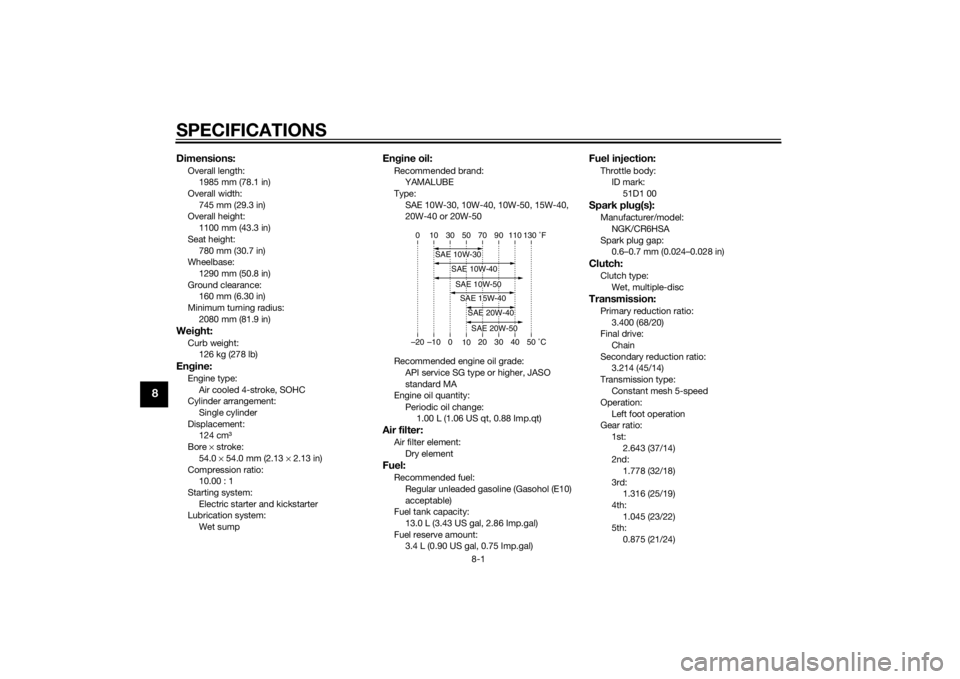
Engine oil:Recommended brand:
YAMALUBE
Type:
SAE 10W-30, 10W-40, 10W-50, 15W-40,
20W-40 or 20W-50
Recommended engine oil grade: API service SG type or higher, JASO
standard MA
Engine oil quantity:
Periodic oil change: 1.00 L (1.06 US qt, 0.88 Imp.qt)Air filter:Air filter element:Dry elementFuel:Recommended fuel:
Regular unleaded gasoline (Gasohol (E10)
acceptable)
Fuel tank capacity:
13.0 L (3.43 US gal, 2.86 Imp.gal)
Fuel reserve amount: 3.4 L (0.90 US gal, 0.75 Imp.gal)
Fuel injection:Throttle body:ID mark: 51D1 00Spark plu g(s):Manufacturer/model:
NGK/CR6HSA
Spark plug gap: 0.6–0.7 mm (0.024–0.028 in)Clutch:Clutch type:
Wet, multiple-discTransmission:Primary reduction ratio:3.400 (68/20)
Final drive:
Chain
Secondary reduction ratio: 3.214 (45/14)
Transmission type: Constant mesh 5-speed
Operation:
Left foot operation
Gear ratio: 1st:
2.643 (37/14)
2nd: 1.778 (32/18)
3rd: 1.316 (25/19)
4th:
1.045 (23/22)
5th: 0.875 (21/24)
–20 –10 0 1020 30 40 50 C
10 30 50 70 90 110
0 130 F
SAE 10W-30
SAE 15W-40SAE 20W-40SAE 20W-50
SAE 10W-40SAE 10W-50
U51DE1E0.book Page 1 Thursday, August 29, 2013 4:41 PM