light YAMAHA YFM250R 2013 Owner's Manual
[x] Cancel search | Manufacturer: YAMAHA, Model Year: 2013, Model line: YFM250R, Model: YAMAHA YFM250R 2013Pages: 136, PDF Size: 3.44 MB
Page 88 of 136
8-9
8
EBU23213Checking the spark plug The spark plug is an important engine component,
which is easy to check. Since heat and deposits
will cause any spark plug to slowly erode, the spark
plug should be removed and checked in accor-
dance with the periodic maintenance and lubrica-
tion chart. In addition, the condition of the spark
plug can reveal the condition of the engine.
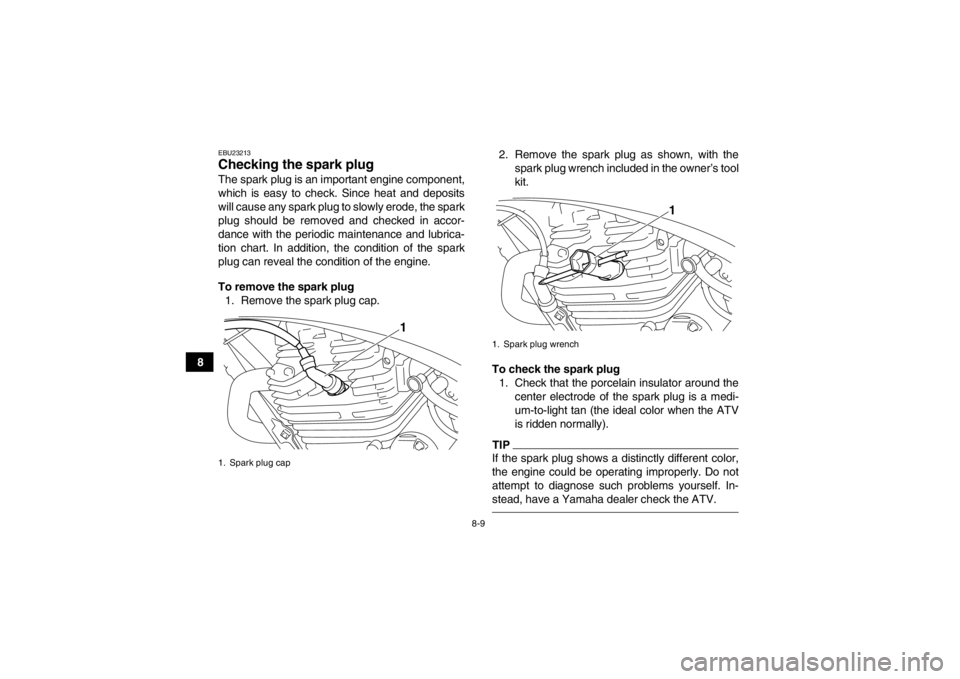
To remove the spark plug1. Remove the spark plug cap. 2. Remove the spark plug as shown, with the
spark plug wrench included in the owner’s tool
kit.
To check the spark plug 1. Check that the porcelain insulator around the center electrode of the spark plug is a medi-
um-to-light tan (the ideal color when the ATV
is ridden normally).
TIPIf the spark plug shows a distinctly different color,
the engine could be operating improperly. Do not
attempt to diagnose such problems yourself. In-
stead, have a Yamaha dealer check the ATV.
1. Spark plug cap
1
1. Spark plug wrench
1
U1BT63E0.book Page 9 Friday, March 9, 2012 11:22 AM
Page 97 of 136
8-18
8
17. Install the seat.
TIPThe air filter element should be cleaned every 20–
40 hours. It should be cleaned and lubricated more
often if the ATV is operated in extremely dusty ar-
eas. Each time the air filter element maintenance
is performed, check the air inlet of the air filter case
for obstructions. Check the air filter case rubber
joint to the carburetor fittings and the rubber joint
manifold fittings for an air-tight seal. Tighten all fit-
tings securely to avoid the possibility of unfiltered
air entering the engine.EBU28903Cleaning the spark arrester Be sure the exhaust pipe and muffler are cool be-
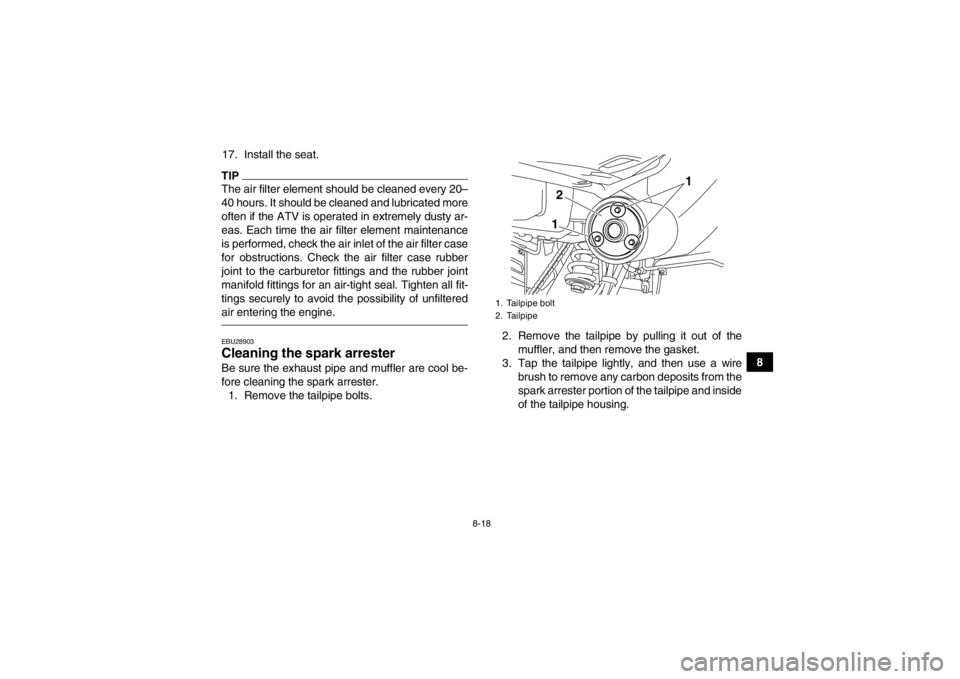
fore cleaning the spark arrester.
1. Remove the tailpipe bolts. 2. Remove the tailpipe by pulling it out of the
muffler, and then remove the gasket.
3. Tap the tailpipe lightly, and then use a wire brush to remove any carbon deposits from the
spark arrester portion of the tailpipe and inside
of the tailpipe housing.
1. Tailpipe bolt
2. Tailpipe
2
1 1
U1BT63E0.book Page 18 Friday, March 9, 2012 11:22 AM
Page 106 of 136
8-27
8
TIPIf the cable length cannot be adjusted to specifica-
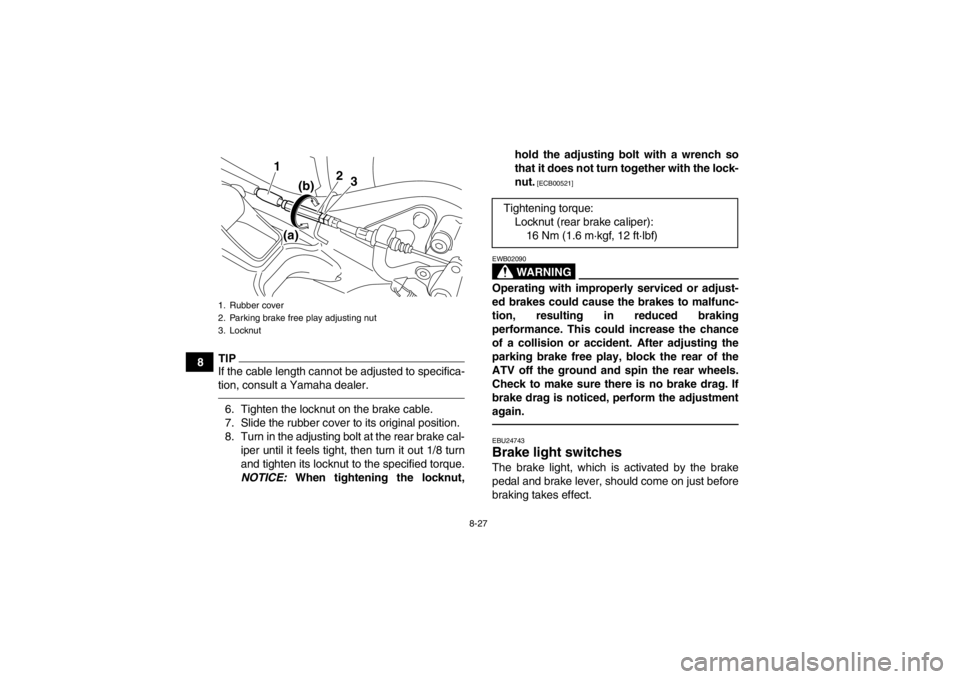
tion, consult a Yamaha dealer.6. Tighten the locknut on the brake cable.
7. Slide the rubber cover to its original position.
8. Turn in the adjusting bolt at the rear brake cal-iper until it feels tight, then turn it out 1/8 turn
and tighten its locknut to the specified torque.
NOTICE: When tightening the locknut, hold the adjusting bolt with a wrench so
that it does not turn together with the lock-
nut.
[ECB00521]
WARNING
EWB02090Operating with improperly serviced or adjust-
ed brakes could cause the brakes to malfunc-
tion, resulting in reduced braking
performance. This could increase the chance
of a collision or accident. After adjusting the
parking brake free play, block the rear of the
ATV off the ground and spin the rear wheels.
Check to make sure there is no brake drag. If
brake drag is noticed, perform the adjustment
again.EBU24743Brake light switches The brake light, which is activated by the brake
pedal and brake lever, should come on just before
braking takes effect.
1. Rubber cover
2. Parking brake free play adjusting nut
3. Locknut
2
3
1(a) (b)
Tightening torque:
Locknut (rear brake caliper):16 Nm (1.6 m·kgf, 12 ft·lbf)
U1BT63E0.book Page 27 Friday, March 9, 2012 11:22 AM
Page 107 of 136
8-28
8
The brake light switch for the brake pedal can be
adjusted as follows, but the front brake light switch
should be adjusted by a Yamaha dealer.
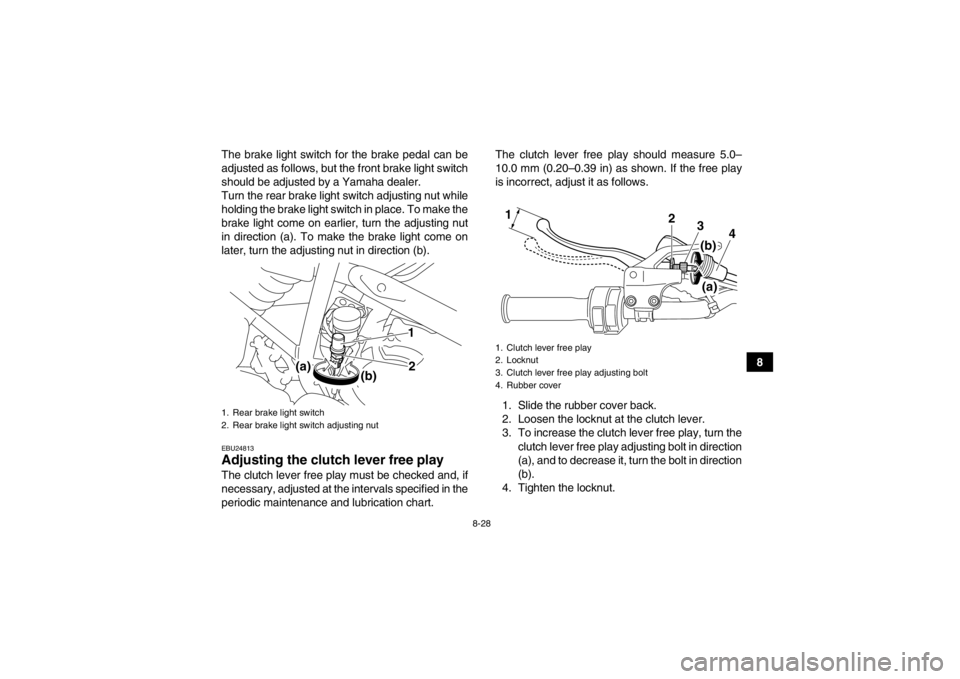
Turn the rear brake light switch adjusting nut while
holding the brake light switch in place. To make the
brake light come on earlier, turn the adjusting nut
in direction (a). To make the brake light come on
later, turn the adjusting nut in direction (b).
EBU24813Adjusting the clutch lever free play The clutch lever free play must be checked and, if
necessary, adjusted at the intervals specified in the
periodic maintenance and lubrication chart. The clutch lever free play should measure 5.0–
10.0 mm (0.20–0.39 in) as shown. If the free play
is incorrect, adjust it as follows.
1. Slide the rubber cover back.
2. Loosen the locknut at the clutch lever.
3. To increase the clutch lever free play, turn the clutch lever free play adjusting bolt in direction
(a), and to decrease it, turn the bolt in direction
(b).
4. Tighten the locknut.1. Rear brake light switch
2. Rear brake light switch adjusting nut
12
(b)
(a)
1. Clutch lever free play
2. Locknut
3. Clutch lever free play adjusting bolt
4. Rubber cover1
3
4
(a)
(b)
2
U1BT63E0.book Page 28 Friday, March 9, 2012 11:22 AM
Page 118 of 136
![YAMAHA YFM250R 2013 Owners Manual 8-39
8ject in place of the proper fuse. An
improper fuse or a substitute object can
cause damage to the electrical system,
which could lead to a fire.
[EWB02172]
3. Turn the key to “ON” and turn](/img/51/53676/w960_53676-117.png "YAMAHA YFM250R 2013 Owners Manual 8-39
8ject in place of the proper fuse. An
improper fuse or a substitute object can
cause damage to the electrical system,
which could lead to a fire.
[EWB02172]
3. Turn the key to “ON” and turn")
8-39
8ject in place of the proper fuse. An
improper fuse or a substitute object can
cause damage to the electrical system,
which could lead to a fire.
[EWB02172]
3. Turn the key to “ON” and turn on the electrical
circuits to check if the devices operate.
4. If the fuse immediately blows again, have a Yamaha dealer check the electrical system.
5. Install the battery holding plate by installing the bolts, and then hook the band to secure
the owner’s tool kit.
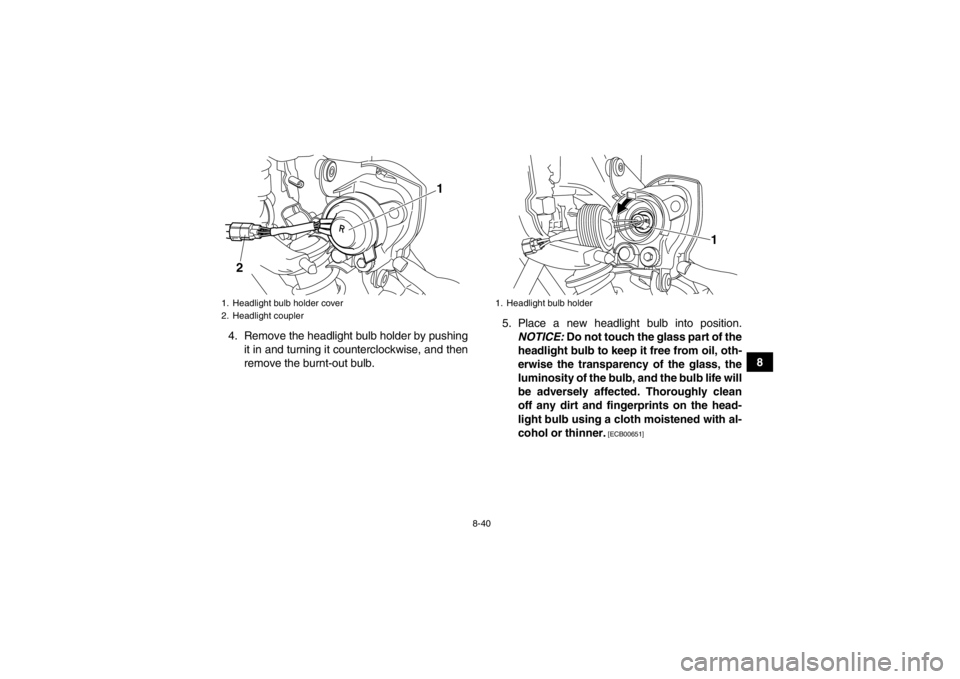
6. Install the seat.EBU25444Replacing a headlight bulb If a headlight bulb burns out, replace it as follows. 1. Remove the headlight unit by removing the bolt and pulling the headlight unit outward as
shown. 2. Disconnect the headlight coupler.
3. Remove the headlight bulb holder cover.
Specified fuse:
Fuse:15.0 A
1. Headlight unit
2. Bolt
1
2
U1BT63E0.book Page 39 Friday, March 9, 2012 11:22 AM
Page 119 of 136
8-40
8
4. Remove the headlight bulb holder by pushing
it in and turning it counterclockwise, and then
remove the burnt-out bulb. 5. Place a new headlight bulb into position.
NOTICE: Do not touch the glass part of the
headlight bulb to keep it free from oil, oth-
erwise the transparency of the glass, the
luminosity of the bulb, and the bulb life will
be adversely affected. Thoroughly clean
off any dirt and fingerprints on the head-
light bulb using a cloth moistened with al-
cohol or thinner.
[ECB00651]
1. Headlight bulb holder cover
2. Headlight coupler
1
2
1. Headlight bulb holder
1
U1BT63E0.book Page 40 Friday, March 9, 2012 11:22 AM
Page 120 of 136
8-41
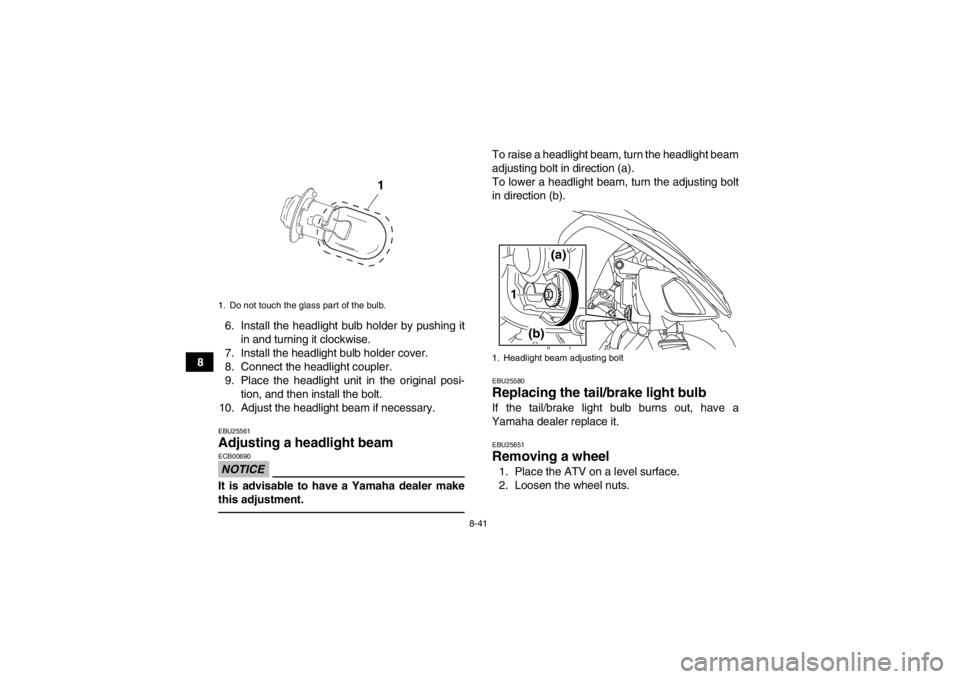
86. Install the headlight bulb holder by pushing it
in and turning it clockwise.
7. Install the headlight bulb holder cover.
8. Connect the headlight coupler.
9. Place the headlight unit in the original posi- tion, and then install the bolt.
10. Adjust the headlight beam if necessary.
EBU25561Adjusting a headlight beam NOTICEECB00690It is advisable to have a Yamaha dealer make
this adjustment.
To raise a headlight beam, turn the headlight beam
adjusting bolt in direction (a).
To lower a headlight beam, turn the adjusting bolt
in direction (b).EBU25580Replacing the tail/brake light bulb If the tail/brake light bulb burns out, have a
Yamaha dealer replace it.EBU25651Removing a wheel 1. Place the ATV on a level surface.
2. Loosen the wheel nuts.
1. Do not touch the glass part of the bulb.
1
1. Headlight beam adjusting bolt
1 (a)
(b)
U1BT63E0.book Page 41 Friday, March 9, 2012 11:22 AM
Page 122 of 136
8-43
83. Lower the ATV to the ground.
4. Tighten the wheel nuts to the specified
torques.
EBU25720Troubleshooting Although Yamaha ATVs receive a thorough in-
spection before shipment from the factory, trouble
may occur during operation. Any problem in the fu-
el, compression, or ignition systems, for example,
can cause poor starting and loss of power.
The following troubleshooting chart represents a
quick and easy procedure for checking these vital
systems yourself. However, should your ATV re-
quire any repair, take it to a Yamaha dealer, whose
skilled technicians have the necessary tools, expe-
rience, and know-how to service the ATV properly.
Use only genuine Yamaha replacement parts. Im-
itation parts may look like Yamaha parts, but they
are often inferior, have a shorter service life and
can lead to expensive repair bills.
WARNING
EWB02280Do not smoke when checking the fuel system.
Fuel can ignite or explode, causing severe inju-
ry or property damage. Make sure there are no
open flames or sparks in the area, including pi-
lot lights from water heaters or furnaces.
Tightening torques:Front wheel nut:45 Nm (4.5 m·kgf, 33 ft·lbf)
Rear wheel nut: 45 Nm (4.5 m·kgf, 33 ft·lbf)
U1BT63E0.book Page 43 Friday, March 9, 2012 11:22 AM
Page 130 of 136

10-4
10
Specified brake fluid:DOT 4Rear brake:Type:
Disc brake
Operation: Right foot operation
Specified brake fluid: DOT 4Front suspension:Type:Double wishbone
Spring/shock absorber type: Coil spring/oil damper
Wheel travel:
190 mm (7.5 in)Rear suspension:Type:Swingarm
Spring/shock absorber type:
Coil spring/gas-oil damper
Wheel travel: 200 mm (7.9 in)Electrical system:Ignition system:
DC CDI
Charging system: AC magnetoBattery:Model:
YTZ7S Voltage, capacity:
12 V, 6.0 Ah
Headlight:Bulb type:
Krypton bulbBulb voltage, wattage × quantity:Headlight:
12 V, 30.0/30.0 W × 2
Tail/brake light:
12 V, 5.0/21.0 W × 1
Neutral indicator light: 12 V, 1.7 W × 1Fuse:Fuse:
15.0 AEBU30401For Europe only
The figures quoted are emission levels and are not
necessarily safe working levels. Whilst there is a
correlation between the emission and exposure
levels, this cannot be used reliably to determine
whether or not further precautions are required.
Factors that influence the actual level of exposure
of work-force include the characteristics of the
work room, the other sources of noise, etc. i.e. the
number of machines and other adjacent process-
es, and the length of time for which an operator is
U1BT63E0.book Page 4 Friday, March 9, 2012 11:22 AM
Page 134 of 136

INDEX
AAccessories and loading ................................................ 6-6
Air filter element, cleaning ............................................ 8-14BBattery .......................................................................... 8-35
Brake and clutch levers, checking and lubricating ....... 8-32
Brake fluid, changing .................................................... 8-25
Brake fluid level, checking ............................................ 8-23
Brake lever ..................................................................... 4-5
Brake lever free play, checking the front ...................... 8-25
Brake light switches ..................................................... 8-27
Brake pads, checking the front and rear ...................... 8-22
Brake pedal .................................................................... 4-5
Brake pedal, checking and lubricating ......................... 8-33
Brake pedal height, checking ....................................... 8-25
Brakes .......................................................................... 8-22
Brakes, front and rear .................................................... 5-3CCables, checking and lubricating ................................. 8-31
Carburetor, adjusting .................................................... 8-20
Chassis fasteners ........................................................... 5-6
Cleaning ......................................................................... 9-1
Clutch lever .................................................................... 4-4
Clutch lever free play, adjusting ................................... 8-28DDrive chain ..................................................................... 5-4
Drive chain, lubricating ................................................. 8-31
Drive chain slack .......................................................... 8-29
EEngine break-in .............................................................. 6-4
Engine, cold start ........................................................... 6-1
Engine idling speed ...................................................... 8-20
Engine oil ....................................................................... 5-3
Engine oil and oil filter element .................................... 8-11
Engine, starting a warm ................................................. 6-2
Engine stop switch ......................................................... 4-2FFuel ......................................................................... 4-8, 5-3
Fuel cock ........................................................................ 4-9
Fuel tank cap .................................................................. 4-7
Fuse, replacing ............................................................. 8-38HHandlebar switches ........................................................ 4-2
Headlight beam, adjusting ............................................ 8-41
Headlight bulb, replacing .............................................. 8-39IIdentification numbers .................................................. 11-1
Indicator light .................................................................. 4-2
Instruments, lights and switches .................................... 5-6LLabel locations ............................................................... 1-1
Light switch .................................................................... 4-3MMain switch .................................................................... 4-1
Maintenance and lubrication chart ................................. 8-5
Maintenance chart, emission control system ................. 8-3
U1BT63E0.book Page 1 Friday, March 9, 2012 11:22 AM