wheel YAMAHA YFM250R 2013 Owner's Manual
[x] Cancel search | Manufacturer: YAMAHA, Model Year: 2013, Model line: YFM250R, Model: YAMAHA YFM250R 2013Pages: 136, PDF Size: 3.44 MB
Page 108 of 136
8-29
85. Slide the rubber cover back to its original po-
sition.
TIPIf the specified free play cannot be obtained as de-
scribed above or if the clutch does not operate cor-
rectly, have a Yamaha dealer check the internal
clutch mechanism.EBU26864Drive chain slack The drive chain slack should be checked before
each ride and adjusted if necessary.
To check the drive chain slack1. Place the ATV on a level surface.TIPWhen checking and adjusting the drive chain
slack, there should be no weight on the ATV and
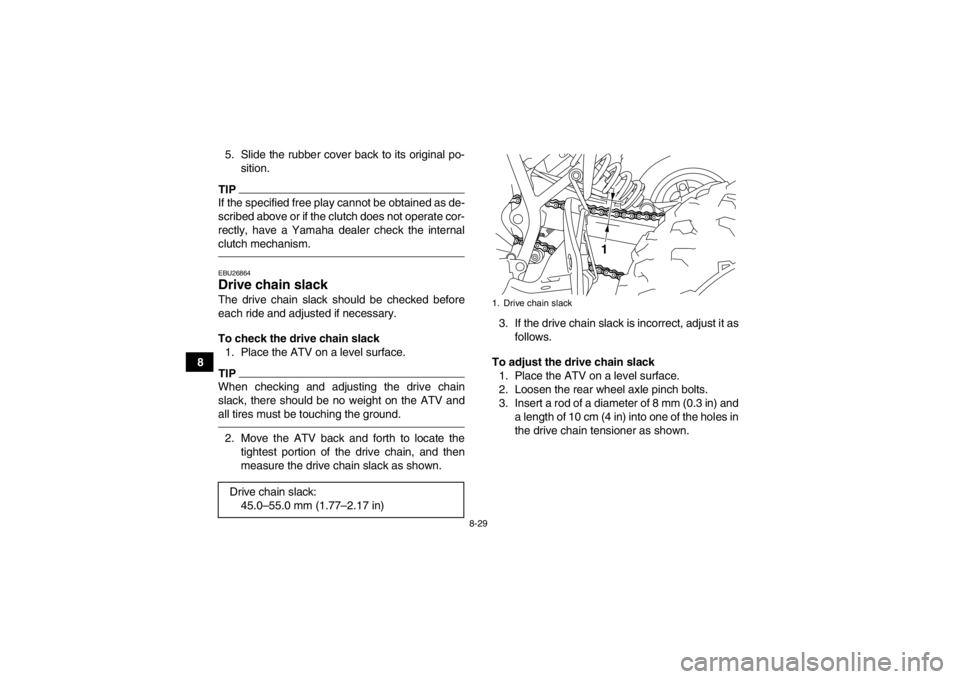
all tires must be touching the ground.2. Move the ATV back and forth to locate the tightest portion of the drive chain, and then
measure the drive chain slack as shown. 3. If the drive chain slack is incorrect, adjust it as
follows.
To adjust the drive chain slack 1. Place the ATV on a level surface.
2. Loosen the rear wheel axle pinch bolts.
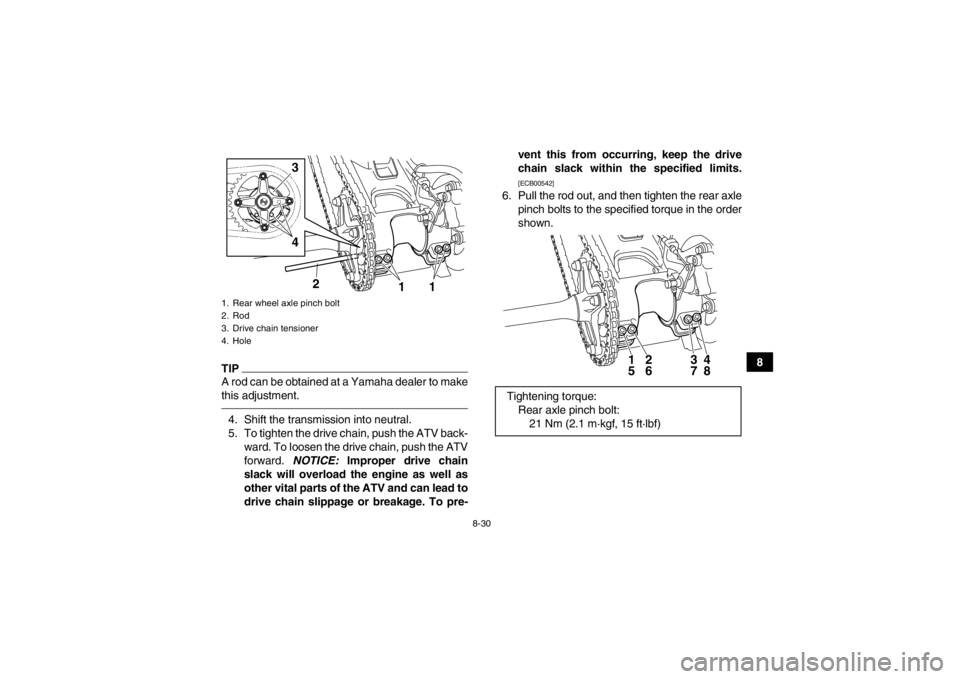
3. Insert a rod of a diameter of 8 mm (0.3 in) and a length of 10 cm (4 in) into one of the holes in
the drive chain tensioner as shown.
Drive chain slack: 45.0–55.0 mm (1.77–2.17 in)
1. Drive chain slack
1
U1BT63E0.book Page 29 Friday, March 9, 2012 11:22 AM
Page 109 of 136
8-30
8
TIPA rod can be obtained at a Yamaha dealer to make
this adjustment.4. Shift the transmission into neutral.
5. To tighten the drive chain, push the ATV back-ward. To loosen the drive chain, push the ATV
forward. NOTICE: Improper drive chain
slack will overload the engine as well as
other vital parts of the ATV and can lead to
drive chain slippage or breakage. To pre- vent this from occurring, keep the drive
chain slack within the specified limits.
[ECB00542]
6. Pull the rod out, and then tighten the rear axle
pinch bolts to the specified torque in the order
shown.
1. Rear wheel axle pinch bolt
2. Rod
3. Drive chain tensioner
4. Hole
2 11
3
4
Tightening torque:
Rear axle pinch bolt:21 Nm (2.1 m·kgf, 15 ft·lbf)
12 34
56 78
U1BT63E0.book Page 30 Friday, March 9, 2012 11:22 AM
Page 112 of 136
8-33
8Clutch lever
EBUM0170Checking the shift pedal The operation of the shift pedal should be checked
before each ride. If operation is not smooth, have
a Yamaha dealer check the vehicle.EBU28871Checking and lubricating the brake
pedal The operation of the brake pedal should be
checked before each ride, and the pedal pivot
should be lubricated if necessary.
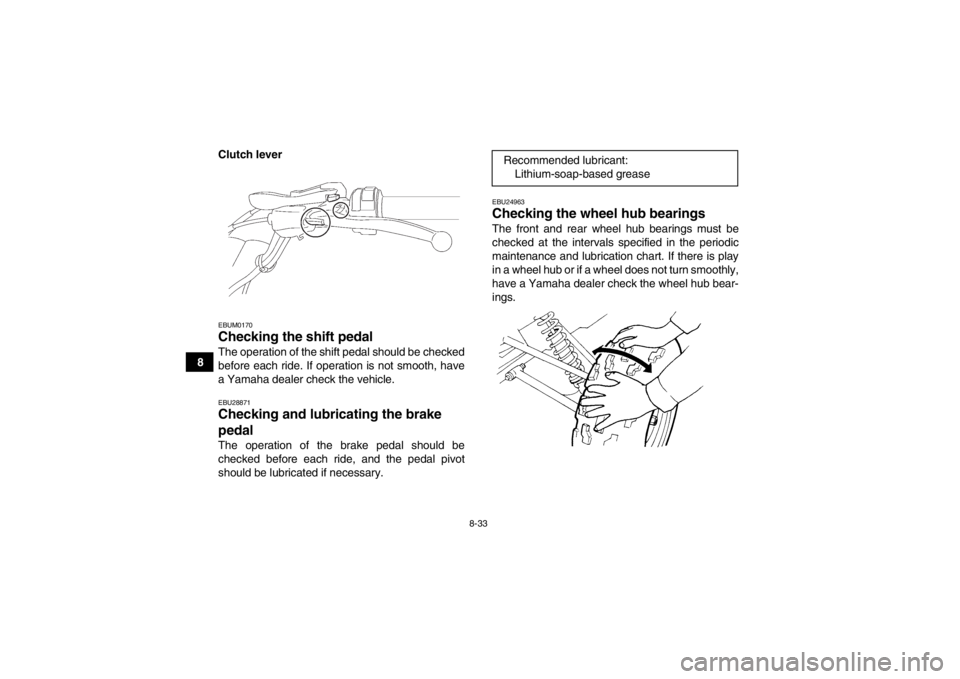
EBU24963Checking the wheel hub bearings The front and rear wheel hub bearings must be
checked at the intervals specified in the periodic
maintenance and lubrication chart. If there is play
in a wheel hub or if a wheel does not turn smoothly,
have a Yamaha dealer check the wheel hub bear-
ings.Recommended lubricant:
Lithium-soap-based grease
U1BT63E0.book Page 33 Friday, March 9, 2012 11:22 AM
Page 120 of 136
8-41
86. Install the headlight bulb holder by pushing it
in and turning it clockwise.
7. Install the headlight bulb holder cover.
8. Connect the headlight coupler.
9. Place the headlight unit in the original posi- tion, and then install the bolt.
10. Adjust the headlight beam if necessary.
EBU25561Adjusting a headlight beam NOTICEECB00690It is advisable to have a Yamaha dealer make
this adjustment.
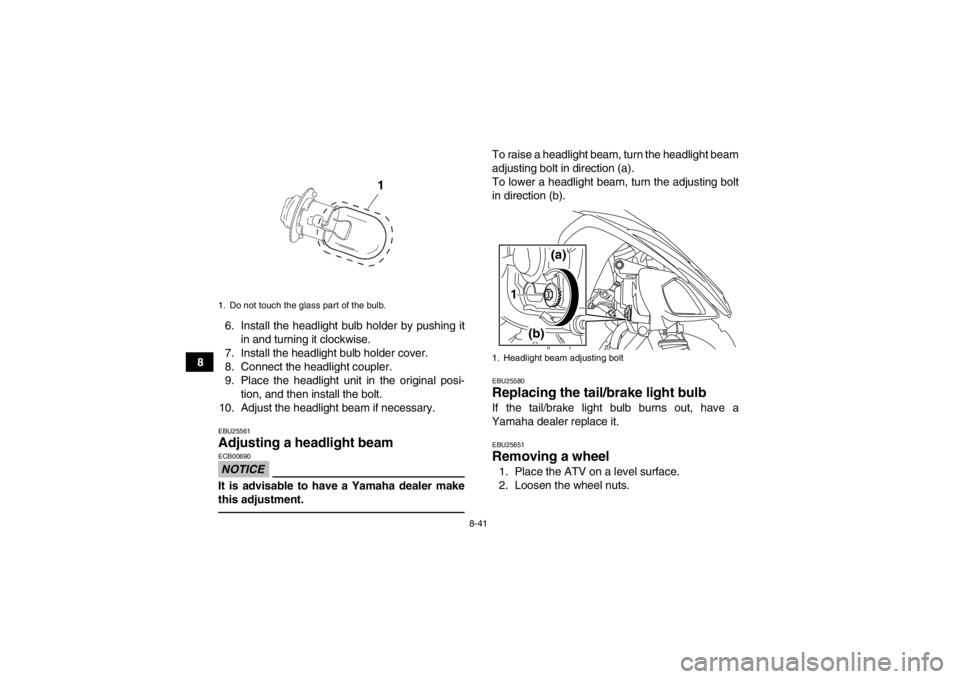
To raise a headlight beam, turn the headlight beam
adjusting bolt in direction (a).
To lower a headlight beam, turn the adjusting bolt
in direction (b).EBU25580Replacing the tail/brake light bulb If the tail/brake light bulb burns out, have a
Yamaha dealer replace it.EBU25651Removing a wheel 1. Place the ATV on a level surface.
2. Loosen the wheel nuts.
1. Do not touch the glass part of the bulb.
1
1. Headlight beam adjusting bolt
1 (a)
(b)
U1BT63E0.book Page 41 Friday, March 9, 2012 11:22 AM
Page 121 of 136
8-42
8
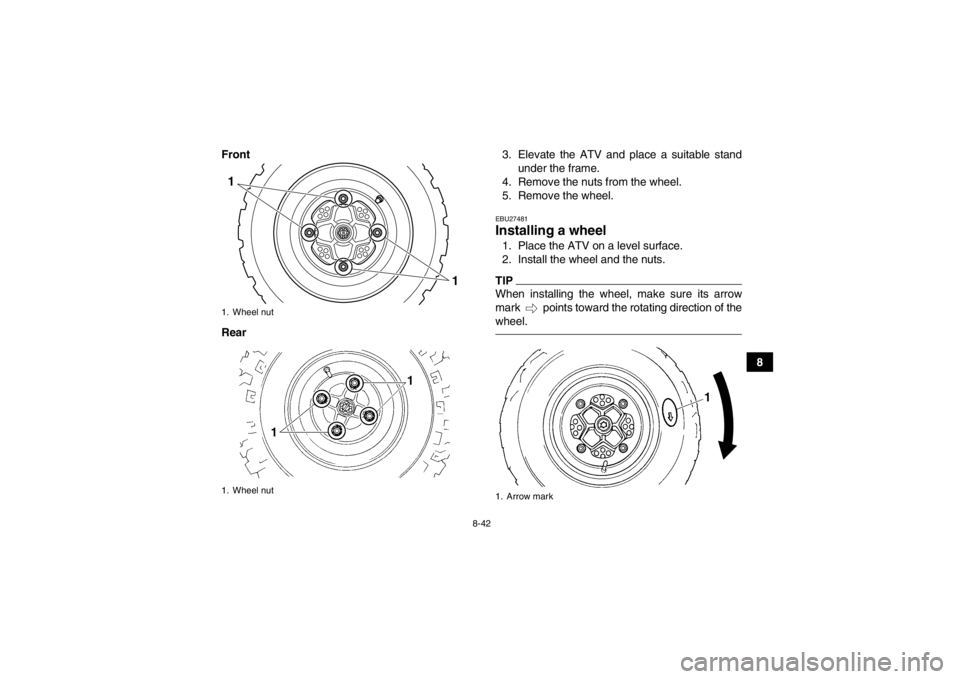
Front
Rear
3. Elevate the ATV and place a suitable stand
under the frame.
4. Remove the nuts from the wheel.
5. Remove the wheel.
EBU27481Installing a wheel 1. Place the ATV on a level surface.
2. Install the wheel and the nuts.TIPWhen installing the wheel, make sure its arrow
mark points toward the rotating direction of the
wheel.
1. Wheel nut
1. Wheel nut1
1
1. Arrow mark
U1BT63E0.book Page 42 Friday, March 9, 2012 11:22 AM
Page 122 of 136

8-43
83. Lower the ATV to the ground.
4. Tighten the wheel nuts to the specified
torques.
EBU25720Troubleshooting Although Yamaha ATVs receive a thorough in-
spection before shipment from the factory, trouble
may occur during operation. Any problem in the fu-
el, compression, or ignition systems, for example,
can cause poor starting and loss of power.
The following troubleshooting chart represents a
quick and easy procedure for checking these vital
systems yourself. However, should your ATV re-
quire any repair, take it to a Yamaha dealer, whose
skilled technicians have the necessary tools, expe-
rience, and know-how to service the ATV properly.
Use only genuine Yamaha replacement parts. Im-
itation parts may look like Yamaha parts, but they
are often inferior, have a shorter service life and
can lead to expensive repair bills.
WARNING
EWB02280Do not smoke when checking the fuel system.
Fuel can ignite or explode, causing severe inju-
ry or property damage. Make sure there are no
open flames or sparks in the area, including pi-
lot lights from water heaters or furnaces.
Tightening torques:Front wheel nut:45 Nm (4.5 m·kgf, 33 ft·lbf)
Rear wheel nut: 45 Nm (4.5 m·kgf, 33 ft·lbf)
U1BT63E0.book Page 43 Friday, March 9, 2012 11:22 AM
Page 124 of 136

9-1
9
EBU25860
CLEANING AND STORAGE
EBU25902Cleaning Frequent, thorough cleaning of your ATV will not
only enhance its appearance but will improve its
general performance and extend the useful life of
many components.1. Before cleaning the ATV: a. Block off the end of the exhaust pipe toprevent water entry. A plastic bag and
strong rubber band may be used.
b. Make sure the spark plug and all filler caps are properly installed.
2. If the engine case is excessively greasy, apply degreaser with a paint brush. Do not apply de-
greaser to the chain, sprockets or wheel ax-
les.
3. Rinse the dirt and degreaser off with a garden hose. Use only enough pressure to do the job.
WARNING! Wet brakes may have reduced
stopping ability, increasing the chance of
an accident. Test the brakes after washing.
Apply the brakes several times at slow
speeds to let friction dry out the linings.
[EWB02311]
NOTICE: Excessive water pressure may cause water seepage and deteriora-
tion of wheel bearings, brakes, transmis-
sion seals and electrical devices. Many
expensive repair bills have resulted from
improper high-pressure detergent applica-
tions such as those available in coin-oper-
ated car washers.
[ECB00711]
4. Once most of the dirt has been hosed off,
wash all surfaces with warm water and mild,
detergent-type soap. An old toothbrush or bot-
tle brush is handy for hard-to-reach places.
5. Rinse the ATV off immediately with clean wa- ter and dry all surfaces with a chamois, clean
towel or soft absorbing cloth.
6. Dry the chain and lubricate it to prevent it from rusting.
7. Clean the seat with a vinyl upholstery cleaner to keep the cover pliable and glossy.
8. Automotive type wax may be applied to all painted and chrome plated surfaces. Avoid
combination cleaner-waxes. Many contain
abrasives which may mar the paint or protec-
tive finish. When finished cleaning, start the
engine and let it idle for several minutes.
U1BT63E0.book Page 1 Friday, March 9, 2012 11:22 AM
Page 125 of 136

9-2
9
EBU25933Storage Short-term
Always store your ATV in a cool, dry place and, if
necessary, protect it against dust with a porous
cover. NOTICE: Storing the ATV in a poorly ven-
tilated room or covering it with a tarp while it is
still wet, will allow water and humidity to seep
in and cause rust. To prevent corrosion, avoid
damp cellars, stables (because of the presence
of ammonia) and areas where strong chemi-
cals are stored.
[ECB00721]
Long-term
Before storing your ATV for several months: 1. Follow all the instructions in the “Cleaning” section of this chapter.
2. Turn the fuel cock lever to “OFF”.
3. Drain the carburetor float chamber by loosen- ing the drain bolt; this will prevent fuel deposits
from building up. Pour the drained fuel into the
fuel tank.
4. Fill up the fuel tank and add fuel stabilizer (if available) to prevent the fuel from deteriorat-
ing. 5. Perform the following steps to protect the cyl-
inder, piston rings, etc. from corrosion.a. Remove the spark plug cap and spark plug.
b. Pour a teaspoonful of engine oil into the spark plug bore.
c. Install the spark plug cap onto the spark plug, and then place the spark plug on the
cylinder head so that the electrodes are
grounded. (This will limit sparking during
the next step.)
d. Turn the engine over several times with the starter. (This will coat the cylinder wall with
oil.)
e. Remove the spark plug cap from the spark plug, and then install the spark plug and
the spark plug cap.
6. Lubricate all control cables and the pivoting points of all levers and pedals.
7. Check and, if necessary, correct the tire air pressure, and then block up the ATV so that
all of its wheels are off the ground. Alternative-
Specified amount:
7.5 ml of stabilizer to each liter of fuel (or 1
oz of stabilizer to each gallon of fuel)U1BT63E0.book Page 2 Friday, March 9, 2012 11:22 AM
Page 126 of 136
9-3
9ly, turn the wheels a little every month in order
to prevent the tires from becoming degraded
in one spot.
8. Cover the muffler outlet with a plastic bag to prevent moisture from entering it.
9. Remove the battery and fully charge it. Store it in a cool, dry place and charge it once a
month. Do not store the battery in an exces-
sively cold or warm place [less than 0 °C (30
°F) or more than 30 °C (90 °F)]. For more in-
formation on storing the battery, see page
8-35.
TIPMake any necessary repairs before storing the
ATV.U1BT63E0.book Page 3 Friday, March 9, 2012 11:22 AM
Page 127 of 136

10-1
10
EBU25961
SPECIFICATIONS
Dimensions:Overall length:1625 mm (64.0 in)
Overall width: 1072 mm (42.2 in)
Overall height:
1040 mm (40.9 in)
Seat height: 730 mm (28.7 in)
Wheelbase: 1110 mm (43.7 in)
Ground clearance:
100 mm (3.9 in)
Minimum turning radius: 2900 mm (114 in)Weight:With oil and fuel:
150.0 kg (331 lb)Noise and vibration level:Noise level (77/311/EEC):YFM25RD 81.0 dB(A)@3500 r/min
A-weighted sound power level:
YFM25RD 93.0 dB(A)@3500 r/min
Vibration on seat (EN1032, ISO5008): YFM25RD Will not exceed 0.5 m/s²
Vibration on handlebar (EN1032, ISO5008): YFM25RD Will not exceed 2.5 m/s²
Engine:Engine type:Air cooled 4-stroke, SOHC
Cylinder arrangement: Single cylinder
Displacement:
249 cm³
Bore × stroke:
74.0 × 58.0 mm (2.91 × 2.28 in)
Compression ratio: 9.50 : 1
Starting system:
Electric starter
Lubrication system: Wet sumpEngine oil:Recommended brand:
YAMALUBE
U1BT63E0.book Page 1 Friday, March 9, 2012 11:22 AM