clutch YAMAHA YFM250R 2013 Owners Manual
[x] Cancel search | Manufacturer: YAMAHA, Model Year: 2013, Model line: YFM250R, Model: YAMAHA YFM250R 2013Pages: 136, PDF Size: 3.44 MB
Page 8 of 136

EBU17420
TABLE OF CONTENTS
LOCATION OF THE WARNING AND
SPECIFICATION LABELS ............................ 1-1
SAFETY INFORMATION .............................. 2-1
DESCRIPTION .............................................. 3-1Left view ...................................................... 3-1
Right view.................................................... 3-1
Controls and instruments ............................ 3-2
INSTRUMENT AND CONTROL
FUNCTIONS .................................................. 4-1 Main switch ................................................ 4-1
Indicator light .............................................. 4-2
Handlebar switches .................................... 4-2
Throttle lever .............................................. 4-3
Speed limiter .............................................. 4-4
Clutch lever ................................................ 4-4
Brake lever ................................................. 4-5
Brake pedal ................................................ 4-5
Parking brake lever .................................... 4-6
Shift pedal .................................................. 4-7
Fuel tank cap .............................................. 4-7
Fuel ............................................................ 4-8 Fuel cock ....................................................4-9
Starter (choke) ..........................................4-11
Seat ..........................................................4-11
Adjusting the front shock absorber
assemblies ..............................................4-12
Adjusting the rear shock absorber assembly .................................................4-13
PRE-OPERATION CHECKS ..........................5-1 Fuel .............................................................5-3
Engine oil ....................................................5-3
Front and rear brakes .................................5-3
Throttle lever ...............................................5-3
Drive chain ..................................................5-4
Tires ............................................................5-4
Chassis fasteners .......................................5-6
Instruments, lights and switches .................5-6
OPERATION...................................................6-1 Starting a cold engine .................................6-1
Starting a warm engine ...............................6-2
Shifting ........................................................6-3
Engine break-in ...........................................6-4
Parking ........................................................6-5U1BT63E0.book Page 1 Friday, March 9, 2012 11:22 AM
Page 9 of 136

Parking on a slope ..................................... 6-5
Accessories and loading ............................ 6-6
RIDING YOUR ATV ...................................... 7-1 GETTING TO KNOW YOUR ATV............... 7-2
RIDE WITH CARE AND GOOD JUDGMENT .............................................. 7-2
BE CAREFUL WHERE YOU RIDE ............. 7-9
TURNING YOUR ATV .............................. 7-12
CLIMBING UPHILL ................................... 7-13
RIDING DOWNHILL.................................. 7-16
CROSSING A SLOPE............................... 7-18
CROSSING THROUGH SHALLOW WATER ................................................... 7-19
RIDING OVER ROUGH TERRAIN ........... 7-20
SLIDING AND SKIDDING ......................... 7-21
WHAT TO DO IF... .................................... 7-22
WHAT TO DO... ........................................ 7-22
PERIODIC MAINTENANCE AND
ADJUSTMENT ............................................... 8-1 Owner’s manual and tool kit ....................... 8-2
Periodic maintenance chart for the emission control system ........................... 8-3
General maintenance and lubrication chart ......................................................... 8-5
Checking the spark plug ............................. 8-9 Engine oil and oil filter element .................8-11
Cleaning the air filter element ...................8-14
Cleaning the spark arrester ......................8-18
Adjusting the carburetor ............................8-20
Adjusting the engine idling speed .............8-20
Adjusting the throttle lever free play .........8-21
Valve clearance ........................................8-22
Brakes .......................................................8-22
Checking the front and rear brake pads ...8-22
Checking the brake fluid level ...................8-23
Changing the brake fluid ...........................8-25
Checking the front brake lever free play ...8-25
Checking the brake pedal height ..............8-25
Adjusting the parking brake free play .......8-26
Brake light switches ..................................8-27
Adjusting the clutch lever free play ...........8-28
Drive chain slack .......................................8-29
Lubricating the drive chain ........................8-31
Checking and lubricating the cables .........8-31
Checking and lubricating the brake and
clutch levers ............................................8-32
Checking the shift pedal ...........................8-33
Checking and lubricating the brake pedal .......................................................8-33
Checking the wheel hub bearings .............8-33
Lubricating the swingarm pivots ...............8-34
U1BT63E0.book Page 2 Friday, March 9, 2012 11:22 AM
Page 27 of 136
3-2
3
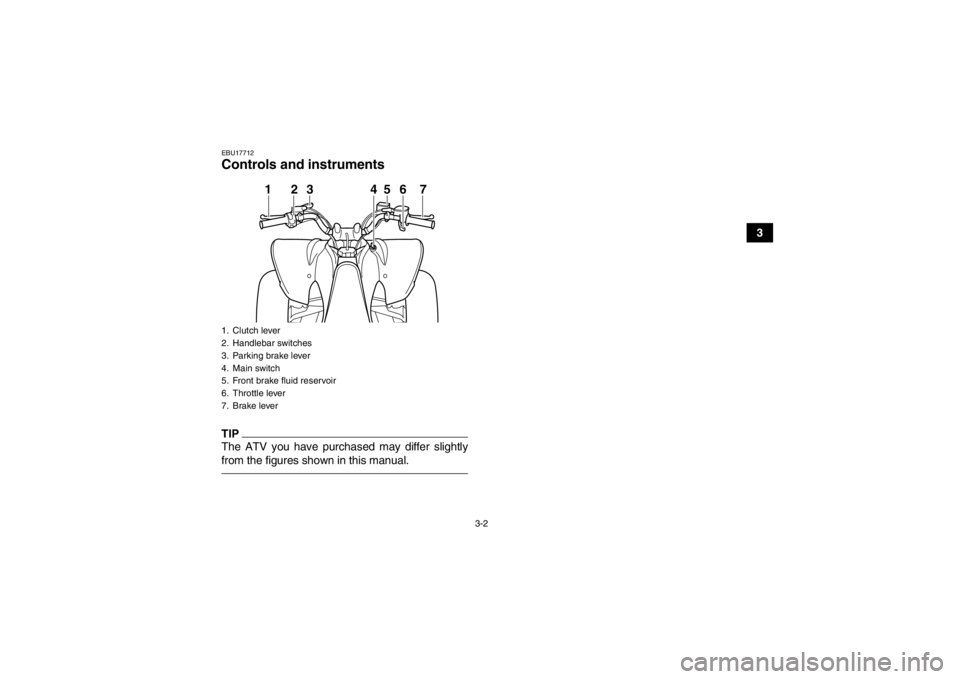
EBU17712Controls and instrumentsTIPThe ATV you have purchased may differ slightly
from the figures shown in this manual.1. Clutch lever
2. Handlebar switches
3. Parking brake lever
4. Main switch
5. Front brake fluid reservoir
6. Throttle lever
7. Brake lever
1
2
3
4
6
7
5
U1BT63E0.book Page 2 Friday, March 9, 2012 11:22 AM
Page 31 of 136
4-4
4
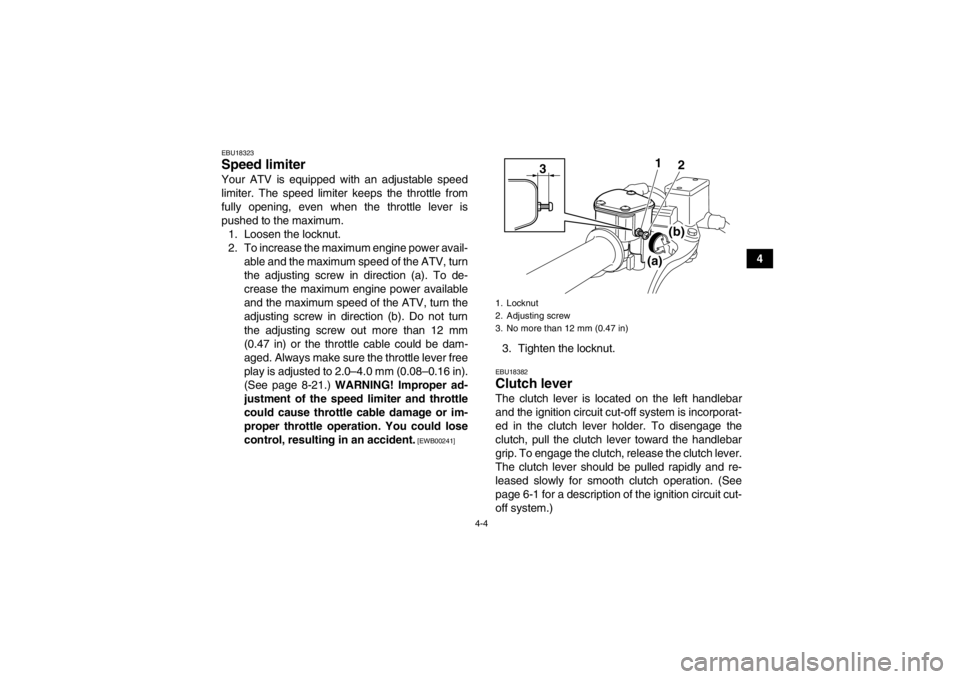
EBU18323Speed limiter Your ATV is equipped with an adjustable speed
limiter. The speed limiter keeps the throttle from
fully opening, even when the throttle lever is
pushed to the maximum.1. Loosen the locknut.
2. To increase the maximum engine power avail- able and the maximum speed of the ATV, turn
the adjusting screw in direction (a). To de-
crease the maximum engine power available
and the maximum speed of the ATV, turn the
adjusting screw in direction (b). Do not turn
the adjusting screw out more than 12 mm
(0.47 in) or the throttle cable could be dam-
aged. Always make sure the throttle lever free
play is adjusted to 2.0–4.0 mm (0.08–0.16 in).
(See page 8-21.) WARNING! Improper ad-
justment of the speed limiter and throttle
could cause throttle cable damage or im-
proper throttle operation. You could lose
control, resulting in an accident.
[EWB00241]
3. Tighten the locknut.EBU18382Clutch lever The clutch lever is located on the left handlebar
and the ignition circuit cut-off system is incorporat-
ed in the clutch lever holder. To disengage the
clutch, pull the clutch lever toward the handlebar
grip. To engage the clutch, release the clutch lever.
The clutch lever should be pulled rapidly and re-
leased slowly for smooth clutch operation. (See
page 6-1 for a description of the ignition circuit cut-
off system.)1. Locknut
2. Adjusting screw
3. No more than 12 mm (0.47 in)
3 1
2
(a)(b)
U1BT63E0.book Page 4 Friday, March 9, 2012 11:22 AM
Page 32 of 136
4-5
4
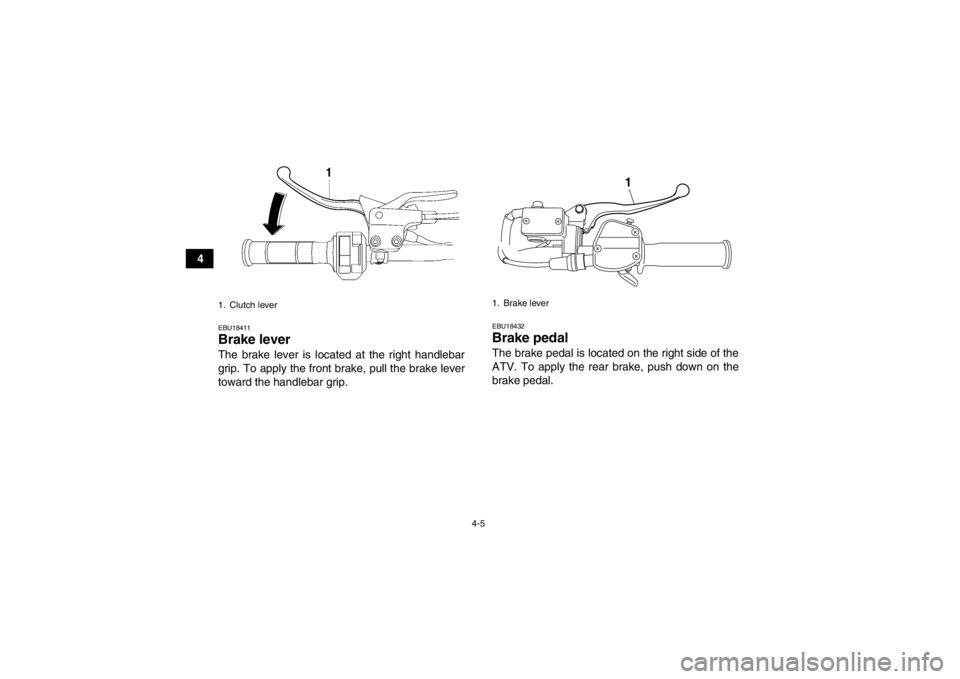
EBU18411Brake lever The brake lever is located at the right handlebar
grip. To apply the front brake, pull the brake lever
toward the handlebar grip.
EBU18432Brake pedal The brake pedal is located on the right side of the
ATV. To apply the rear brake, push down on the
brake pedal.
1. Clutch lever
1. Brake lever
1
U1BT63E0.book Page 5 Friday, March 9, 2012 11:22 AM
Page 34 of 136
4-7
4
WARNING
EWB00220●Always set the parking brake before starting
the engine. The ATV could start moving un-
expectedly if the parking brake is not ap-
plied. This could cause loss of control or a
collision.●Always be sure you have released the park-
ing brake before you begin to ride. The brake
could overheat if you ride the ATV without re-
leasing the parking brake. You could lose
braking performance which could cause an
accident. You could also wear out the brakes
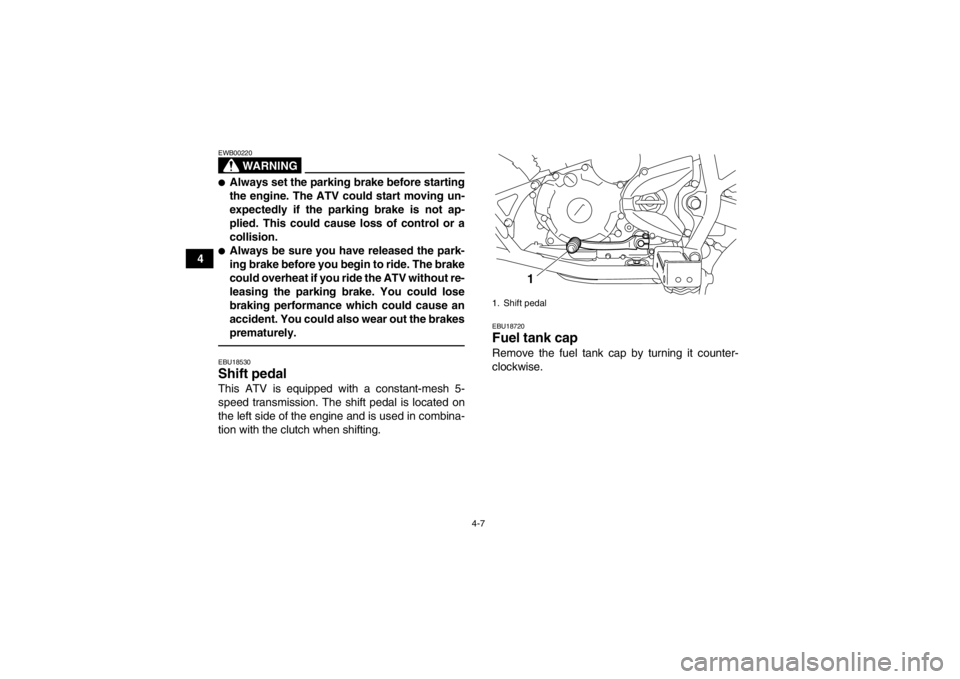
prematurely.EBU18530Shift pedal This ATV is equipped with a constant-mesh 5-
speed transmission. The shift pedal is located on
the left side of the engine and is used in combina-
tion with the clutch when shifting.
EBU18720Fuel tank cap Remove the fuel tank cap by turning it counter-
clockwise.1. Shift pedal
1
U1BT63E0.book Page 7 Friday, March 9, 2012 11:22 AM
Page 44 of 136

5-2
5
Rear brake Check operation. If soft or spongy, have Yamaha dealer bleed hy-
draulic system.
Check brake pads for wear , and replace if necessary.
Check brake fluid level in reservoir, and add specified brake fluid to specified level if necessary.
Check hydraulic system for leakage. Correct if necessary. 5-3, 8-22, 8-23, 8-25
Clutch Check operation, and correct if necessary.
Lubricate cable if necessary.
Check lever free play, and adjust if necessary. 8-28
Throttle lever Make sure that operation is smooth. Lubricate cable and lever hous-
ing if necessary.
Check lever free play, and adjust if necessary. 5-3, 8-21
Control cables Make sure that operation is smooth. Lubricate if necessary. 8-31
Drive chain Check chain slack, and adjust if necessary.
Check chain condition. Lubricate if necessary.
5-4, 8-29, 8-31
Wheels and tires Check wheel condition, and replace if damaged.
Check tire condition and tread depth. Replace if necessary.
Check air pressure. Correct if necessary. 5-4
Shift pedal Make sure that operation is smooth.
Correct if necessary. 8-33
Brake pedal Make sure that operation is smooth. Lubricate pedal pivoting point if
necessary. 8-33
Brake and clutch levers Make sure that operation is smooth. Lubricate lever pivoting points if
necessary. 8-32
Chassis fasteners Make sure that all nuts, bolts and screws are properly tightened. 5-6
Instruments, lights and
switches Check operation, and correct if necessary. 5-6
ITEM ROUTINE PAGEU1BT63E0.book Page 2 Friday, March 9, 2012 11:22 AM
Page 49 of 136
6-1
6
EBU19881
OPERATION
EBU19901Read the Owner’s Manual carefully before riding
the ATV. If there is a control or function you do not
understand, ask your Yamaha dealer.
WARNING
EWB00631Read the Owner’s Manual carefully to become
familiar with all controls in order to help pre-
vent any loss of control, which could cause an
accident or injury.EBU20184Starting a cold engine NOTICEECB00150See the “Engine break-in” section on page 6-4
prior to operating the engine for the first time.1. Set the parking brake.
2. Turn the fuel cock to “ON”.
3. Turn the key to “ON” and the engine stopswitch to “ ”. 4. Shift the transmission into neutral. The neutral
indicator light should come on. If the indicator
light does not come on, have a Yamaha deal-
er check the electrical circuit.
TIPThis model is equipped with an ignition circuit cut-
off system. The engine can be started under the
following conditions.●The transmission is in neutral.●The clutch is disengaged with the transmission
in gear. However, it is recommended to shift into
neutral before starting the engine.5. Use the starter (choke) in reference to the fig-ure:
Position (1):
Cold engine start with ambient temperature
below 5 °C (40 °F).
Position (2):
Cold engine start with ambient temperature
between 0 °C (30 °F) and 30 °C (90 °F).
Position (3):
Cold engine start with ambient temperature
above 25 °C (80 °F).
U1BT63E0.book Page 1 Friday, March 9, 2012 11:22 AM
Page 51 of 136
6-3
6
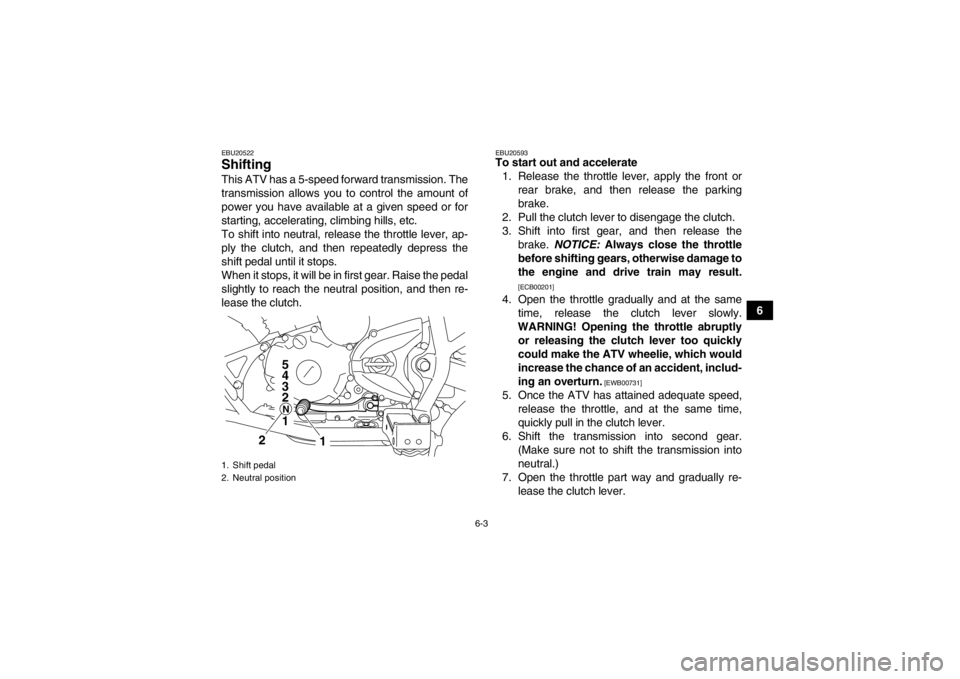
EBU20522Shifting This ATV has a 5-speed forward transmission. The
transmission allows you to control the amount of
power you have available at a given speed or for
starting, accelerating, climbing hills, etc.
To shift into neutral, release the throttle lever, ap-
ply the clutch, and then repeatedly depress the
shift pedal until it stops.
When it stops, it will be in first gear. Raise the pedal
slightly to reach the neutral position, and then re-
lease the clutch.
EBU20593To start out and accelerate1. Release the throttle lever, apply the front or rear brake, and then release the parking
brake.
2. Pull the clutch lever to disengage the clutch.
3. Shift into first gear, and then release the brake. NOTICE: Always close the throttle
before shifting gears, otherwise damage to
the engine and drive train may result.
[ECB00201]
4. Open the throttle gradually and at the same time, release the clutch lever slowly.
WARNING! Opening the throttle abruptly or releasing the clutch lever too quickly
could make the ATV wheelie, which would
increase the chance of an accident, includ-
ing an overturn.
[EWB00731]
5. Once the ATV has attained adequate speed, release the throttle, and at the same time,
quickly pull in the clutch lever.
6. Shift the transmission into second gear. (Make sure not to shift the transmission into
neutral.)
7. Open the throttle part way and gradually re- lease the clutch lever.
1. Shift pedal
2. Neutral position
1
2
2 3 4 5N1
U1BT63E0.book Page 3 Friday, March 9, 2012 11:22 AM
Page 52 of 136
6-4
68. Follow the same procedure when shifting to
the next higher gear.
EBU20650To decelerate
When slowing down or stopping, release the throt-
tle and apply the brakes smoothly and evenly. As
you slow down, shift to a lower gear. Be sure that
the engine has sufficiently slowed before engaging
a lower gear. Improper use of the brakes or shifting
can cause the tires to lose traction, reducing con-
trol and increasing the possibility of an accident.
WARNING
EWB00710Make sure the engine has sufficiently slowed
before shifting to a lower gear. Engaging a low-
er gear when the engine speed is too high
could make the wheels stop rotating and lose
traction. This could cause loss of control, an
accident and injury. It could also cause engine
or drive train damage.NOTICEECB00180●Even with the transmission in the neutral po-
sition, do not coast for long periods of time
with the engine off, and do not tow the ATV for long distances. The transmission is prop-
erly lubricated only when the engine is run-
ning. Inadequate lubrication may damage
the transmission.
●Always use the clutch when changing gears.
The engine, transmission and drive train are
not designed to withstand the shock of
forced shifting and can be damaged by shift-
ing without using the clutch.EBU20672Engine break-in TIP●For ATVs equipped with an odometer or an hour
meter, follow the figures given in km (mi) or the
figures given in hours.●For ATVs not equipped with an odometer or
hour meter, follow the figures given in hours.There is never a more important period in the life of
your engine than the first 320 km (200 mi) or 20
hours of riding. For this reason, you should read
the following material carefully.
Since the engine is brand new, do not put an ex-
cessive load on it for the first 320 km (200 mi) or 20
hours. The various parts in the engine wear and
U1BT63E0.book Page 4 Friday, March 9, 2012 11:22 AM