warning YAMAHA YFM350R 2013 Service Manual
[x] Cancel search | Manufacturer: YAMAHA, Model Year: 2013, Model line: YFM350R, Model: YAMAHA YFM350R 2013Pages: 140, PDF Size: 2.95 MB
Page 98 of 140
8-17
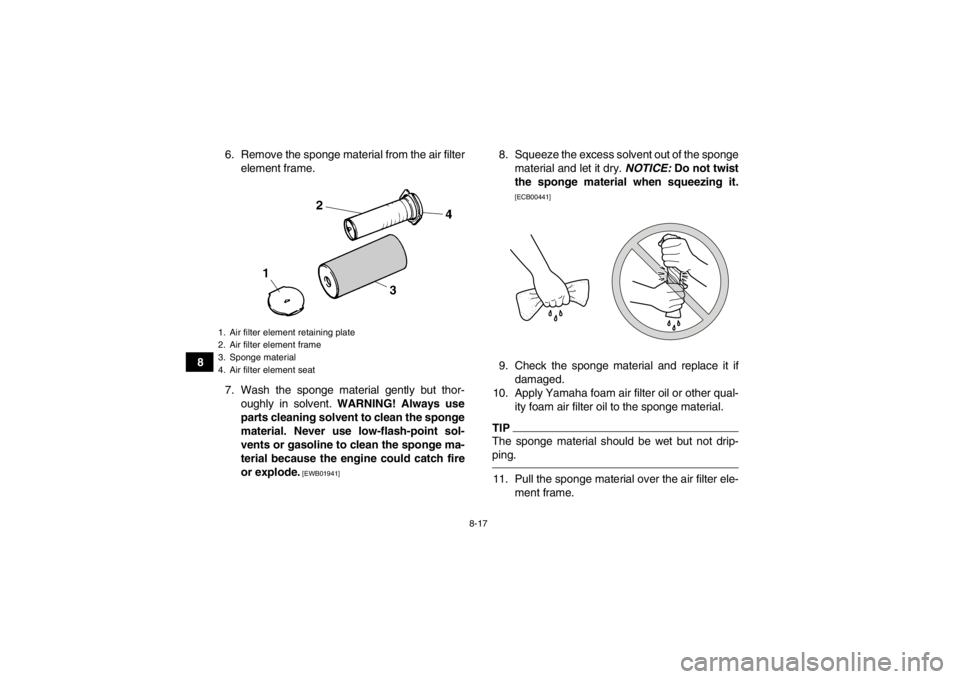
86. Remove the sponge material from the air filter
element frame.
7. Wash the sponge material gently but thor- oughly in solvent. WARNING! Always use
parts cleaning solvent to clean the sponge
material. Never use low-flash-point sol-
vents or gasoline to clean the sponge ma-
terial because the engine could catch fire
or explode.
[EWB01941]
8. Squeeze the excess solvent out of the sponge material and let it dry. NOTICE: Do not twist
the sponge material when squeezing it.
[ECB00441]
9. Check the sponge material and replace it if damaged.
10. Apply Yamaha foam air filter oil or other qual- ity foam air filter oil to the sponge material.TIPThe sponge material should be wet but not drip-
ping.11. Pull the sponge material over the air filter ele-ment frame.
1. Air filter element retaining plate
2. Air filter element frame
3. Sponge material
4. Air filter element seatU1BS63E0.book Page 17 Tuesday, March 13, 2012 11:43 AM
Page 101 of 140
8-20
8
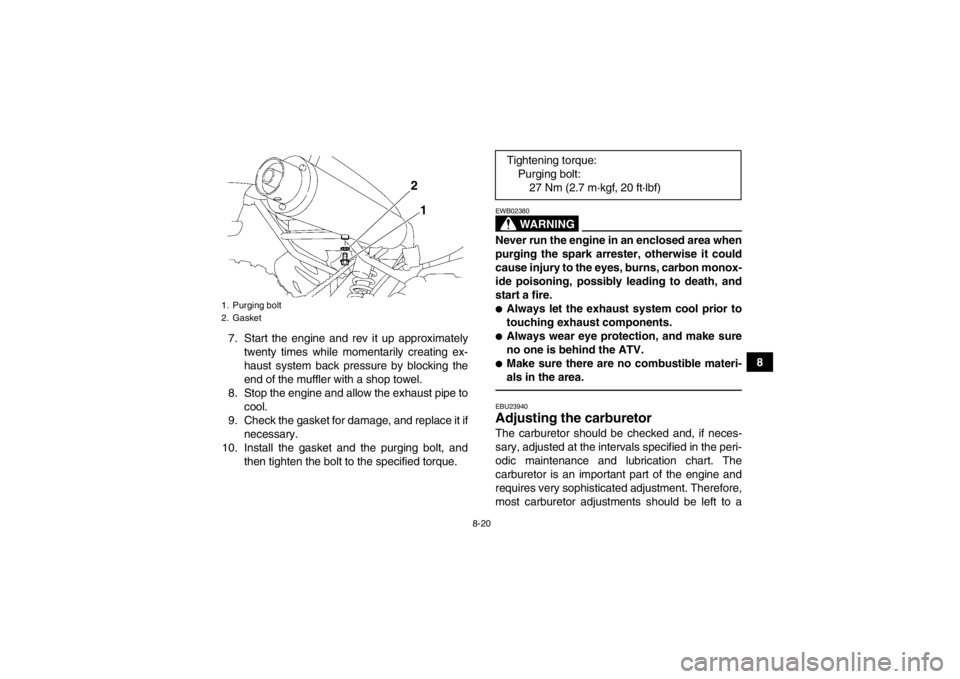
7. Start the engine and rev it up approximately
twenty times while momentarily creating ex-
haust system back pressure by blocking the
end of the muffler with a shop towel.
8. Stop the engine and allow the exhaust pipe to cool.
9. Check the gasket for damage, and replace it if necessary.
10. Install the gasket and the purging bolt, and then tighten the bolt to the specified torque.
WARNING
EWB02380Never run the engine in an enclosed area when
purging the spark arrester, otherwise it could
cause injury to the eyes, burns, carbon monox-
ide poisoning, possibly leading to death, and
start a fire.●Always let the exhaust system cool prior to
touching exhaust components.●Always wear eye protection, and make sure
no one is behind the ATV.●Make sure there are no combustible materi-
als in the area.EBU23940Adjusting the carburetor The carburetor should be checked and, if neces-
sary, adjusted at the intervals specified in the peri-
odic maintenance and lubrication chart. The
carburetor is an important part of the engine and
requires very sophisticated adjustment. Therefore,
most carburetor adjustments should be left to a
1. Purging bolt
2. Gasket
12
Tightening torque:Purging bolt:27 Nm (2.7 m·kgf, 20 ft·lbf)
U1BS63E0.book Page 20 Tuesday, March 13, 2012 11:43 AM
Page 104 of 140
8-23
8
EBU29601Brakes Replacement of brake components requires pro-
fessional knowledge. Brake service should be per-
formed by a Yamaha dealer.
WARNING
EWB02571Operating with improperly serviced or adjust-
ed brakes could lead to a loss in braking ability
and an accident.EBU24130Checking the front and rear brake pads The front and rear brake pads must be checked for
wear at the intervals specified in the periodic main-
tenance and lubrication chart.EBU28791Front brake pads
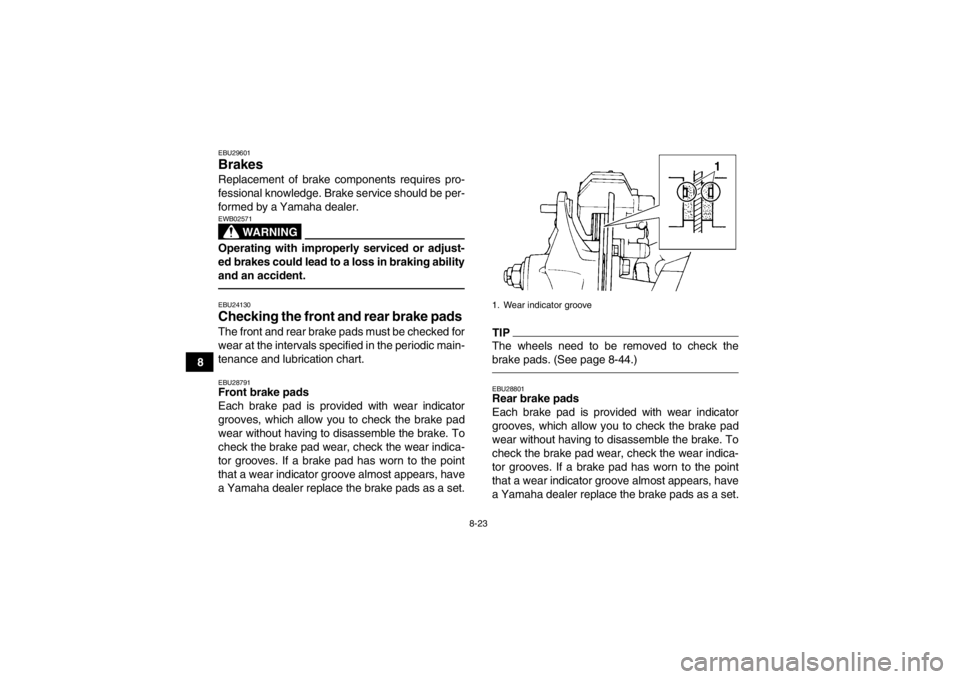
Each brake pad is provided with wear indicator
grooves, which allow you to check the brake pad
wear without having to disassemble the brake. To
check the brake pad wear, check the wear indica-
tor grooves. If a brake pad has worn to the point
that a wear indicator groove almost appears, have
a Yamaha dealer replace the brake pads as a set.
TIPThe wheels need to be removed to check the
brake pads. (See page 8-44.)EBU28801Rear brake pads
Each brake pad is provided with wear indicator
grooves, which allow you to check the brake pad
wear without having to disassemble the brake. To
check the brake pad wear, check the wear indica-
tor grooves. If a brake pad has worn to the point
that a wear indicator groove almost appears, have
a Yamaha dealer replace the brake pads as a set.1. Wear indicator groove
U1BS63E0.book Page 23 Tuesday, March 13, 2012 11:43 AM
Page 106 of 140
8-25
8
WARNING
EWB02720Improper maintenance can result in loss of
braking ability. Observe these precautions:●Insufficient brake fluid may allow air to enter
the brake system, reducing braking perfor-
mance.●Clean the filler cap before removing. Use
only DOT 4 brake fluid from a sealed contain-
er.●Use only the specified brake fluid; otherwise,
the rubber seals may deteriorate, causing
leakage.●Refill with the same type of brake fluid. Add-
ing a brake fluid other than DOT 4 may result
in a harmful chemical reaction.●Be careful that water does not enter the
brake fluid reservoir when refilling. Water
will significantly lower the boiling point of
the fluid and may result in vapor lock.
NOTICEECB01160Brake fluid may damage painted surfaces or
plastic parts. Always clean up spilled fluid im-
mediately.As the brake pads wear, it is normal for the brake
fluid level to gradually go down. A low brake fluid
level may indicate worn brake pads and/or brake
system leakage; therefore, be sure to check the
brake pads for wear and the brake system for leak-
age. If the brake fluid level goes down suddenly,
have a Yamaha dealer check the cause before fur-
ther riding.EBU24291Changing the brake fluid Have a Yamaha dealer change the brake fluid at
the intervals specified in the TIP after the periodic
maintenance and lubrication chart. In addition,
have the oil seals of the master cylinders and cali-
pers as well as the brake hoses replaced at the in-
tervals listed below or whenever they are damaged
or leaking.●Oil seals: Replace every two years.●Brake hoses: Replace every four years.
Specified brake fluid:
DOT 4
U1BS63E0.book Page 25 Tuesday, March 13, 2012 11:43 AM
Page 109 of 140
![YAMAHA YFM350R 2013 Service Manual 8-28
8
hold the adjusting bolt with a wrench so
that it does not turn together with the lock-
nut.
[ECB00521]
WARNING
EWB02090Operating with improperly serviced or adjust-
ed brakes could cause the b](/img/51/53698/w960_53698-108.png "YAMAHA YFM350R 2013 Service Manual 8-28
8
hold the adjusting bolt with a wrench so
that it does not turn together with the lock-
nut.
[ECB00521]
WARNING
EWB02090Operating with improperly serviced or adjust-
ed brakes could cause the b")
8-28
8
hold the adjusting bolt with a wrench so
that it does not turn together with the lock-
nut.
[ECB00521]
WARNING
EWB02090Operating with improperly serviced or adjust-
ed brakes could cause the brakes to malfunc-
tion, resulting in reduced braking
performance. This could increase the chance
of a collision or accident. After adjusting the
parking brake free play, block the rear of the
ATV off the ground and spin the rear wheels.
Check to make sure there is no brake drag. If
brake drag is noticed, perform the adjustment
again.EBU24743Brake light switches The brake light, which is activated by the brake
pedal and brake lever, should come on just before
braking takes effect. The brake light switch for the brake pedal can be
adjusted as follows, but the front brake light switch
should be adjusted by a Yamaha dealer.
Turn the rear brake light switch adjusting nut while
holding the brake light switch in place. To make the
brake light come on earlier, turn the adjusting nut
in direction (a). To make the brake light come on
later, turn the adjusting nut in direction (b).
EBU30120Adjusting the clutch lever free play The clutch lever free play must be checked and, if
necessary, adjusted at the intervals specified in the
periodic maintenance and lubrication chart.
Tightening torque:
Locknut (rear brake caliper):16 Nm (1.6 m·kgf, 12 ft·lbf)1. Rear brake light switch
2. Rear brake light switch adjusting nut
U1BS63E0.book Page 28 Tuesday, March 13, 2012 11:43 AM
Page 114 of 140
8-33
8essary. If a cable is damaged or does not move
smoothly, have a Yamaha dealer check or replace
it.
WARNING
EWB02581●Inspect cables frequently and replace if dam-
aged. Corrosion can result when the cable
sheaths become damaged, and cables can
also become frayed or kinked, which could
restrict the operation of controls and lead to
an accident or injury.●Always make sure all control cables work
smoothly before you begin riding in cold
weather. If the control cables are frozen or do
not work smoothly, you could be unable to
control the ATV, which could lead to an acci-
dent or collision.
EBU24922Checking and lubricating the brake and
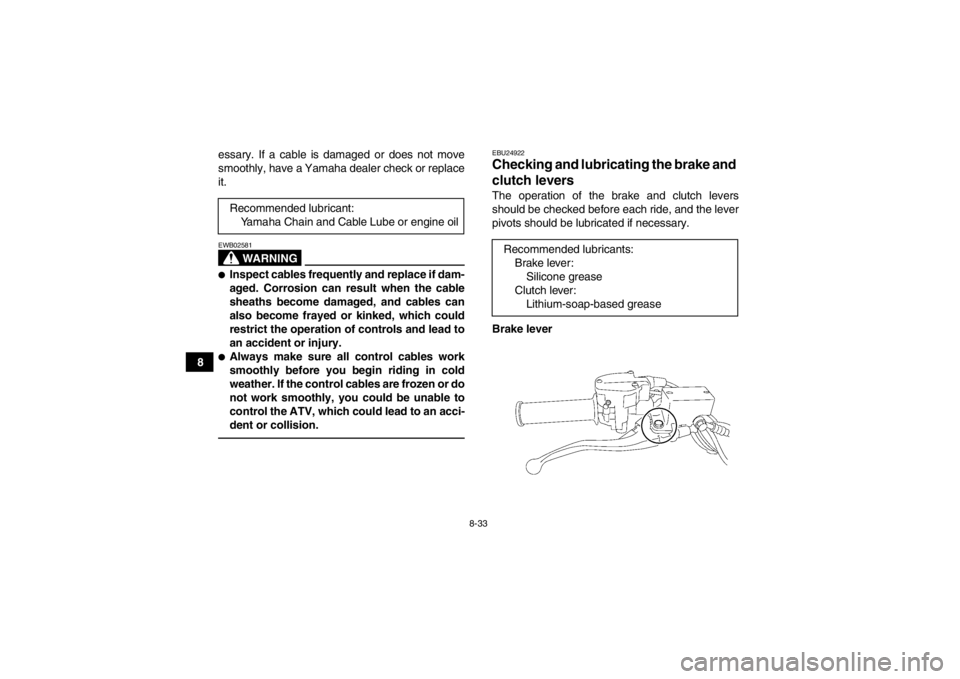
clutch levers The operation of the brake and clutch levers
should be checked before each ride, and the lever
pivots should be lubricated if necessary.
Brake lever
Recommended lubricant:
Yamaha Chain and Cable Lube or engine oilRecommended lubricants: Brake lever:Silicone grease
Clutch lever: Lithium-soap-based grease
U1BS63E0.book Page 33 Tuesday, March 13, 2012 11:43 AM
Page 119 of 140
8-38
8
EBU2522EBattery The battery is located under the seat. (See page
4-12.)
This model is equipped with a VRLA (Valve Regu-
lated Lead Acid) battery. There is no need to check
the electrolyte or to add distilled water. However,
the battery lead connections need to be checked
and, if necessary, tightened.
WARNING
EWB02160Battery electrolyte is poisonous and danger-
ous, as it contains sulfuric acid, which can
cause severe burns. Avoid contact with skin,
eyes or clothing. Always shield your eyes
when working near batteries.
Antidote:
EXTERNAL: Flush with water.
INTERNAL: Drink large quantities of water or
milk. Follow with milk of magnesia, beaten egg
or vegetable oil. Call a physician immediately.
EYES: Flush with water for 15 minutes and get
prompt medical attention.
Batteries produce explosive gases. Keep
sparks, flame, cigarettes or other sources of ig-
nition away. Ventilate when charging or using
in an enclosed space.KEEP OUT OF REACH OF CHILDREN.
NOTICEECB00620Never attempt to remove the battery cell seals,
as this would permanently damage the battery.To remove the battery
1. Remove the seat. (See page 4-12.)
2. Unhook the band securing the owner’s tool kit, and then remove the battery holding plate by
removing the bolts.
3. Disconnect the negative battery lead first, then the positive battery lead by removing
their bolt. NOTICE: When removing the bat-
tery, the main switch must be off, and the
negative lead must be disconnected be-
fore the positive lead.
[ECB01001]
U1BS63E0.book Page 38 Tuesday, March 13, 2012 11:43 AM
Page 122 of 140
8-41
82. Remove the blown fuse, and then install a
new fuse of the specified amperage.
WARNING! Always use a fuse of the spec-
ified rating, and never use a substitute ob-
ject in place of the proper fuse. An
improper fuse or a substitute object can
cause damage to the electrical system,
which could lead to a fire.
[EWB02172]
3. Turn the key to “ON” and turn on the electricalcircuits to check if the devices operate.
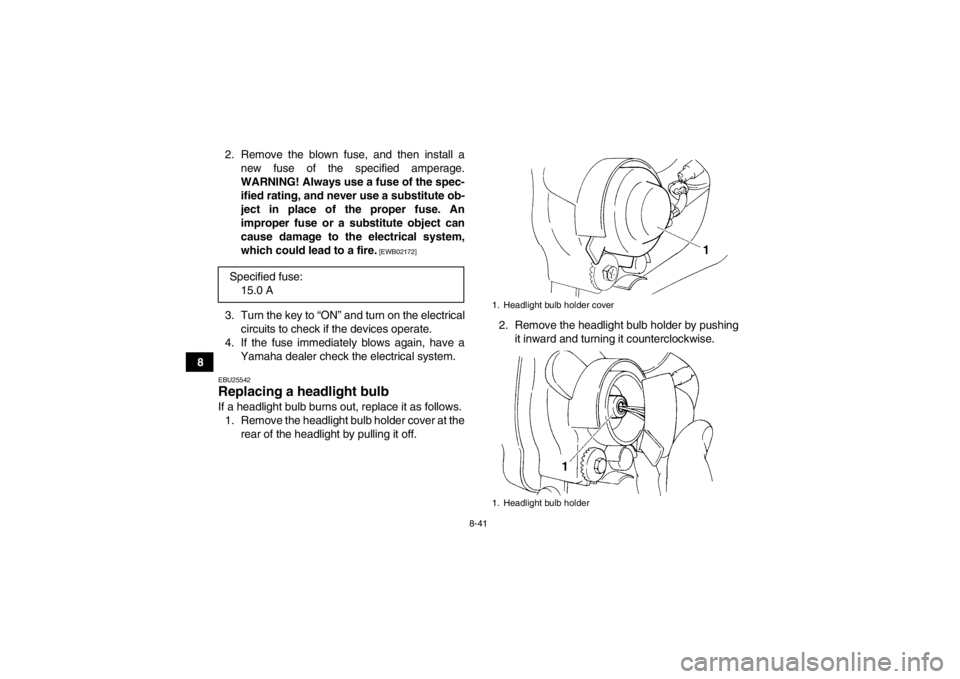
4. If the fuse immediately blows again, have a Yamaha dealer check the electrical system.EBU25542Replacing a headlight bulb If a headlight bulb burns out, replace it as follows.1. Remove the headlight bulb holder cover at the rear of the headlight by pulling it off. 2. Remove the headlight bulb holder by pushing
it inward and turning it counterclockwise.
Specified fuse:
15.0 A
1. Headlight bulb holder cover
1. Headlight bulb holder
U1BS63E0.book Page 41 Tuesday, March 13, 2012 11:43 AM
Page 126 of 140
8-45
8
EBU25720Troubleshooting Although Yamaha ATVs receive a thorough in-
spection before shipment from the factory, trouble
may occur during operation. Any problem in the fu-
el, compression, or ignition systems, for example,
can cause poor starting and loss of power.
The following troubleshooting chart represents a
quick and easy procedure for checking these vital
systems yourself. However, should your ATV re-
quire any repair, take it to a Yamaha dealer, whose
skilled technicians have the necessary tools, expe-
rience, and know-how to service the ATV properly.
Use only genuine Yamaha replacement parts. Im-
itation parts may look like Yamaha parts, but they
are often inferior, have a shorter service life and
can lead to expensive repair bills.
WARNING
EWB02280Do not smoke when checking the fuel system.
Fuel can ignite or explode, causing severe inju-
ry or property damage. Make sure there are no
open flames or sparks in the area, including pi-
lot lights from water heaters or furnaces.
Tightening torques:Front wheel nut:45 Nm (4.5 m·kgf, 33 ft·lbf)
Rear wheel nut: 45 Nm (4.5 m·kgf, 33 ft·lbf)
U1BS63E0.book Page 45 Tuesday, March 13, 2012 11:43 AM
Page 128 of 140

9-1
9
EBU25860
CLEANING AND STORAGE
EBU25902Cleaning Frequent, thorough cleaning of your ATV will not
only enhance its appearance but will improve its
general performance and extend the useful life of
many components.1. Before cleaning the ATV: a. Block off the end of the exhaust pipe toprevent water entry. A plastic bag and
strong rubber band may be used.
b. Make sure the spark plug and all filler caps are properly installed.
2. If the engine case is excessively greasy, apply degreaser with a paint brush. Do not apply de-
greaser to the chain, sprockets or wheel ax-
les.
3. Rinse the dirt and degreaser off with a garden hose. Use only enough pressure to do the job.
WARNING! Wet brakes may have reduced
stopping ability, increasing the chance of
an accident. Test the brakes after washing.
Apply the brakes several times at slow
speeds to let friction dry out the linings.
[EWB02311]
NOTICE: Excessive water pressure may cause water seepage and deteriora-
tion of wheel bearings, brakes, transmis-
sion seals and electrical devices. Many
expensive repair bills have resulted from
improper high-pressure detergent applica-
tions such as those available in coin-oper-
ated car washers.
[ECB00711]
4. Once most of the dirt has been hosed off,
wash all surfaces with warm water and mild,
detergent-type soap. An old toothbrush or bot-
tle brush is handy for hard-to-reach places.
5. Rinse the ATV off immediately with clean wa- ter and dry all surfaces with a chamois, clean
towel or soft absorbing cloth.
6. Dry the chain and lubricate it to prevent it from rusting.
7. Clean the seat with a vinyl upholstery cleaner to keep the cover pliable and glossy.
8. Automotive type wax may be applied to all painted and chrome plated surfaces. Avoid
combination cleaner-waxes. Many contain
abrasives which may mar the paint or protec-
tive finish. When finished cleaning, start the
engine and let it idle for several minutes.
U1BS63E0.book Page 1 Tuesday, March 13, 2012 11:43 AM