weight YAMAHA YFM400F 2001 User Guide
[x] Cancel search | Manufacturer: YAMAHA, Model Year: 2001, Model line: YFM400F, Model: YAMAHA YFM400F 2001Pages: 426, PDF Size: 21.5 MB
Page 222 of 426

7-45
Yuki_Data:Yuki_data:Yuki:Yuki_1:ATV:HM00B061_YFM400FWA-61:YFM600-7.frame
EL
CLIMBING UPHILL
Use proper riding techniques to avoid vehicle
overturns on hills. Be sure that you can maneu-
ver your ATV well on flat ground before at-
tempting any incline and then practice riding
first on gentle slopes. Try more difficult climbs
only after you have developed your skill. In all
cases avoid inclines with slippery or loose sur-
faces, or obstacles that might cause you to lose
control.
WARNING
Never operate the ATV on hills too steep for
the ATV or for your abilities. The vehicle can
overturn more easily on extremely steep hills
than on level surfaces or small hills. Practiceon smaller hills before attempting large hills.
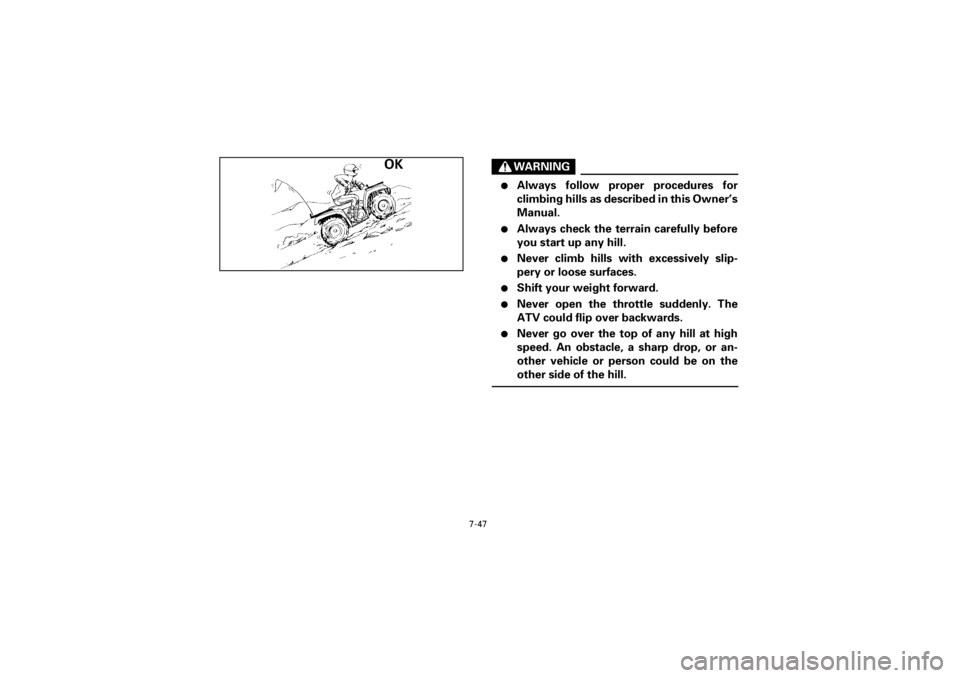
It is important when climbing a hill to make
sure that your weight is transferred forward on
the ATV. This can be accomplished by leaning
forward and, on steeper inclines, standing on
the footboards and leaning forward over the
handlebars.
Page 224 of 426
7-47
Yuki_Data:Yuki_data:Yuki:Yuki_1:ATV:HM00B061_YFM400FWA-61:YFM600-7.frame
EL
WARNING
l
Always follow proper procedures for
climbing hills as described in this Owner’s
Manual.
l
Always check the terrain carefully before
you start up any hill.
l
Never climb hills with excessively slip-
pery or loose surfaces.
l
Shift your weight forward.
l
Never open the throttle suddenly. The
ATV could flip over backwards.
l
Never go over the top of any hill at high
speed. An obstacle, a sharp drop, or an-
other vehicle or person could be on theother side of the hill.
Page 226 of 426
7-49
Yuki_Data:Yuki_data:Yuki:Yuki_1:ATV:HM00B061_YFM400FWA-61:YFM600-7.frame
EL
If you are climbing a hill and you find that you
have not properly judged your ability to make
it to the top, you should turn the ATV around
while you still have forward motion (provided
you have the room to do so) and go down the
hill.
WARNING
Never attempt to turn the ATV around on any
hill until you have mastered the turning tech-
nique as described in the Owner’s Manual on
level ground. Be very careful when turning on
any hill. Avoid crossing the side of a steep hill
if possible.
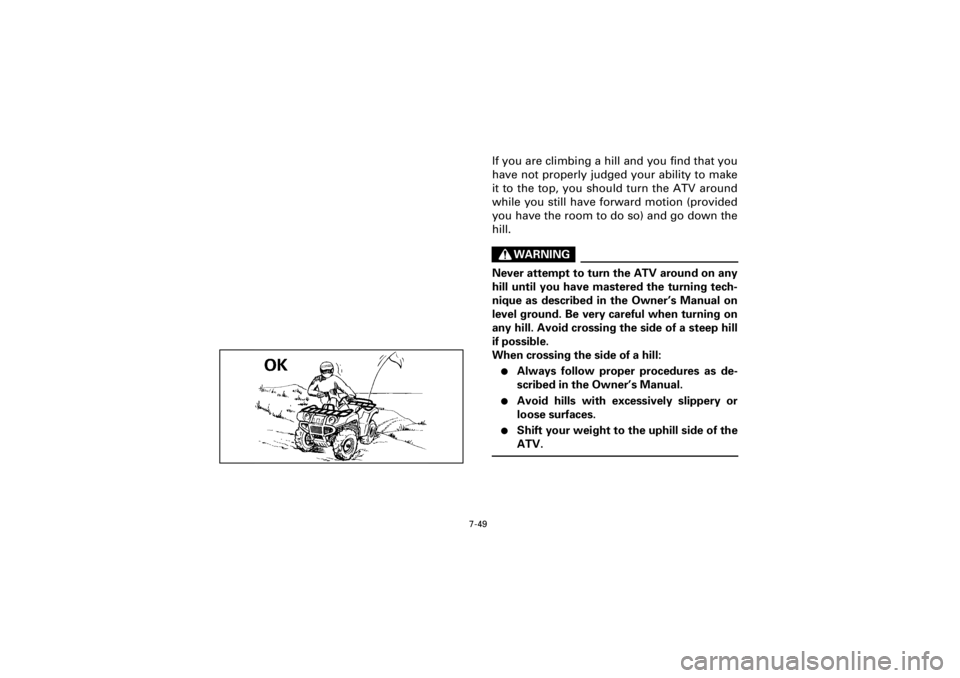
When crossing the side of a hill:l
Always follow proper procedures as de-
scribed in the Owner’s Manual.
l
Avoid hills with excessively slippery or
loose surfaces.
l
Shift your weight to the uphill side of theATV.
Page 230 of 426
7-53
Yuki_Data:Yuki_data:Yuki:Yuki_1:ATV:HM00B061_YFM400FWA-61:YFM600-7.frame
EL
WARNING
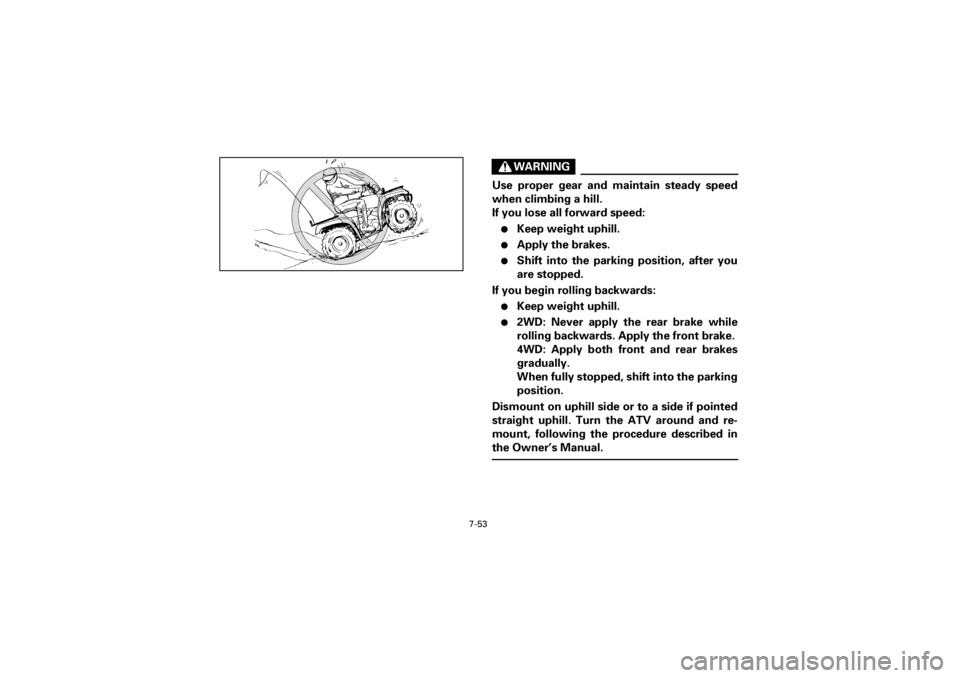
Use proper gear and maintain steady speed
when climbing a hill.
If you lose all forward speed:l
Keep weight uphill.
l
Apply the brakes.
l
Shift into the parking position, after you
are stopped.
If you begin rolling backwards:
l
Keep weight uphill.
l
2WD: Never apply the rear brake while
rolling backwards. Apply the front brake.
4WD: Apply both front and rear brakes
gradually.
When fully stopped, shift into the parking
position.
Dismount on uphill side or to a side if pointed
straight uphill. Turn the ATV around and re-
mount, following the procedure described in
the Owner’s Manual.
Page 232 of 426

7-55
Yuki_Data:Yuki_data:Yuki:Yuki_1:ATV:HM00B061_YFM400FWA-61:YFM600-7.frame
EL
RIDING DOWNHILL
When riding your ATV downhill, shift your
weight as far to the rear and uphill side of the
ATV as possible. Move back on the seat and sit
with your arms straight. Engine compression
will do most of the braking for you. For maxi-
mum engine compression braking effect, se-
lect low range and change to 4WD before
beginning to descend the hill. Improper brak-
ing may cause a loss of traction.
Use caution while descending a hill with loose
or slippery surfaces. Braking ability and trac-
tion may be adversely affected by these surfac-
es. Improper braking may also cause a loss of
traction.
When this ATV is in 4WD, all wheels (front and
rear) are interconnected by the drive train. This
means that applying either the front brake or
the rear brake will brake all wheels. When de-
scending hills, using either brake lever or the
brake pedal will brake the wheels on the down-
hill side. Avoid sudden application of either the
front or rear brake because the wheels on the
uphill side could come off the ground. Apply
both the front and rear brakes gradually.
Page 234 of 426
7-57
Yuki_Data:Yuki_data:Yuki:Yuki_1:ATV:HM00B061_YFM400FWA-61:YFM600-7.frame
EL
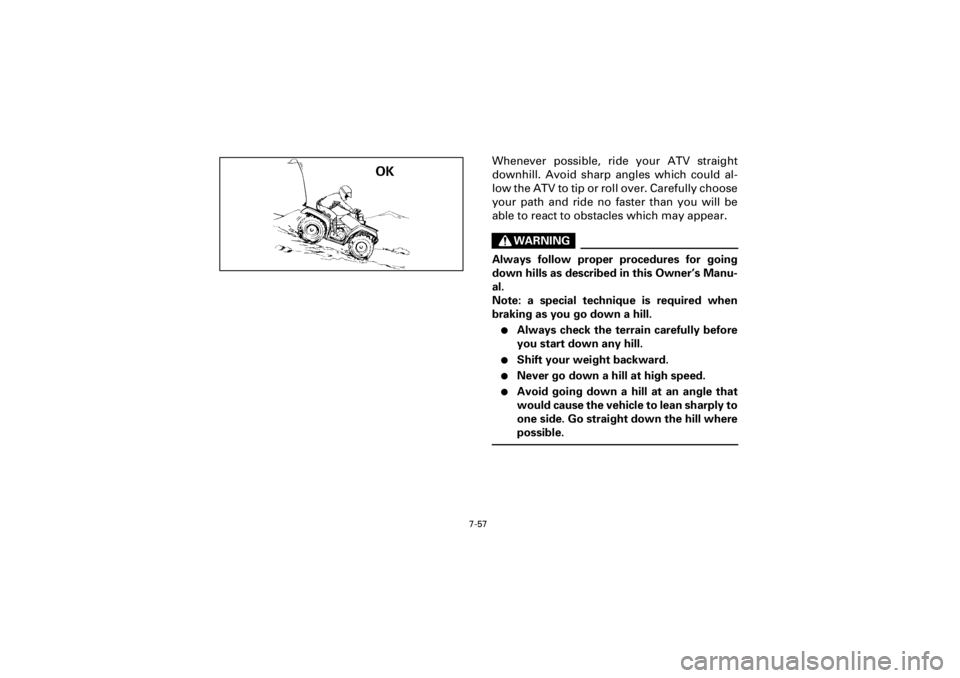
Whenever possible, ride your ATV straight
downhill. Avoid sharp angles which could al-
low the ATV to tip or roll over. Carefully choose
your path and ride no faster than you will be
able to react to obstacles which may appear.
WARNING
Always follow proper procedures for going
down hills as described in this Owner’s Manu-
al.
Note: a special technique is required when
braking as you go down a hill.l
Always check the terrain carefully before
you start down any hill.
l
Shift your weight backward.
l
Never go down a hill at high speed.
l
Avoid going down a hill at an angle that
would cause the vehicle to lean sharply to
one side. Go straight down the hill wherepossible.
Page 236 of 426

7-59
Yuki_Data:Yuki_data:Yuki:Yuki_1:ATV:HM00B061_YFM400FWA-61:YFM600-7.frame
EL
CROSSING A SLOPE
Traversing a sloping surface on your ATV re-
quires you to properly position your weight to
maintain proper balance. Be sure that you
have learned the basic riding skills on flat
ground before attempting to cross a sloping
surface. Avoid slopes with slippery surfaces or
rough terrain that may upset your balance.
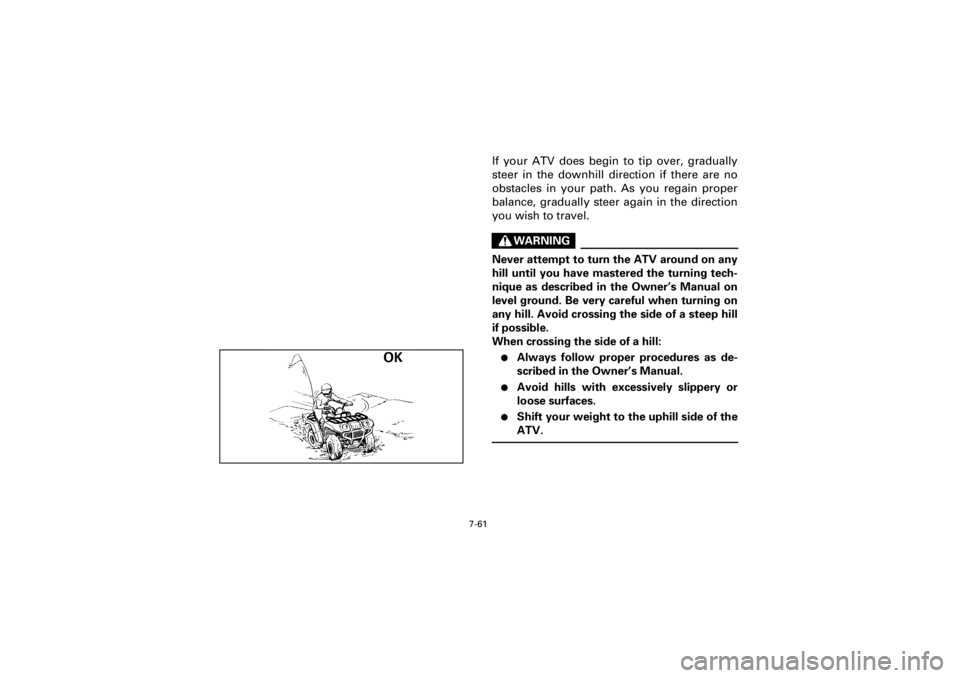
As you travel across a slope, lean your body in
the uphill direction. It may be necessary to cor-
rect the steering when riding on loose surfaces
by pointing the front wheels slightly uphill.
When riding on slopes be sure not to make
sharp turns either up or down hill.
Page 238 of 426
7-61
Yuki_Data:Yuki_data:Yuki:Yuki_1:ATV:HM00B061_YFM400FWA-61:YFM600-7.frame
EL
If your ATV does begin to tip over, gradually
steer in the downhill direction if there are no
obstacles in your path. As you regain proper
balance, gradually steer again in the direction
you wish to travel.
WARNING
Never attempt to turn the ATV around on any
hill until you have mastered the turning tech-
nique as described in the Owner’s Manual on
level ground. Be very careful when turning on
any hill. Avoid crossing the side of a steep hill
if possible.
When crossing the side of a hill:l
Always follow proper procedures as de-
scribed in the Owner’s Manual.
l
Avoid hills with excessively slippery or
loose surfaces.
l
Shift your weight to the uphill side of theATV.
Page 248 of 426
7-71
Yuki_Data:Yuki_data:Yuki:Yuki_1:ATV:HM00B061_YFM400FWA-61:YFM600-7.frame
EL
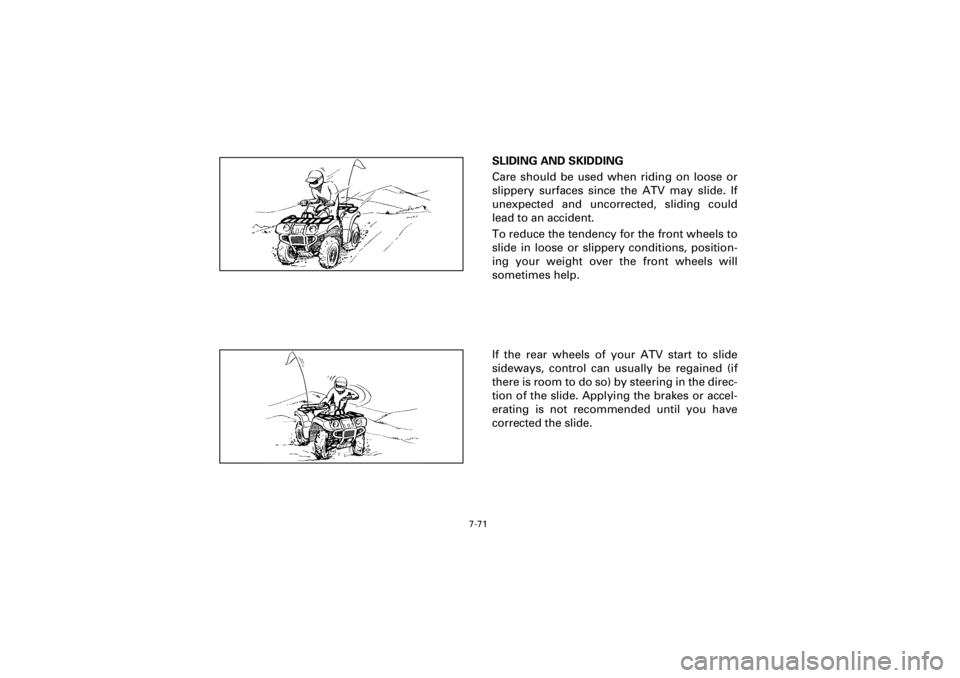
SLIDING AND SKIDDING
Care should be used when riding on loose or
slippery surfaces since the ATV may slide. If
unexpected and uncorrected, sliding could
lead to an accident.
To reduce the tendency for the front wheels to
slide in loose or slippery conditions, position-
ing your weight over the front wheels will
sometimes help.
If the rear wheels of your ATV start to slide
sideways, control can usually be regained (if
there is room to do so) by steering in the direc-
tion of the slide. Applying the brakes or accel-
erating is not recommended until you have
corrected the slide.
Page 252 of 426

7-75
Yuki_Data:Yuki_data:Yuki:Yuki_1:ATV:HM00B061_YFM400FWA-61:YFM600-7.frame
EL
WHAT TO DO IF...
This section is designed to be a reference
guide only. Be sure to read each section on
riding techniques completely.
WHAT TO DO...l
If your ATV doesn’t turn when you want it
to:
Bring the ATV to a stop and practice the
turning maneuvers again. Be sure you are
putting your weight on the footboard to the
outside of the turn. Position your weight
over the front wheels for better control.
(See pages 7-39 ~ 7-43.)
l
If your ATV begins to tip while turning:
Lean more into the turn to regain balance. If
necessary, gradually let off the throttle
and/or steer to the outside of the turn. (See
pages 7-39 ~ 7-43.)
l
If your ATV starts to slide sideways:
Steer in the direction of the slide if you have
the room. Applying the brakes or accelerat-
ing is not recommended until you have cor-
rected the slide. (See pages 7-71 ~ 7-73.)