brake YAMAHA YFM50S 2004 User Guide
[x] Cancel search | Manufacturer: YAMAHA, Model Year: 2004, Model line: YFM50S, Model: YAMAHA YFM50S 2004Pages: 350, PDF Size: 5.87 MB
Page 134 of 350

6-3
EBU14410
Starting a cold engine
w
Always make sure all control cables work
smoothly before you begin riding in cold
weather. If the control cables are froze or do
not work smoothly, you could be unable to
control the ATV, which could lead to an acci-
dent or collision.
1. Set the parking brake.
2. Turn the fuel cock to “ON”.
3. Turn the main switch to “ON” and the
engine stop switch to “RUN”.
4. Shift the transmission into neutral.
5YF-9-60 6 4/24/03 6:36 PM Page 2
Page 136 of 350

6-5
NOTE:
This model is equipped with an ignition circuit
cut-off system.
The engine can be started under the following
conditions.
a. When the transmission is in neutral. At this
time the neutral indicator light should come
on. If the light does not come on, ask a
Yamaha dealer to inspect it.
b. When the transmission is in the drive posi-
tion and the rear brake lever is applied.
However, it is recommended to shift into
neutral before starting the engine.
5. Use the choke lever in reference to the fig-
ure:
Position 1: Cold engine start–
ambient temperature below 30° C.
Position 2: Warming up position.
Position 3: Cold engine start–
ambient temperature above 25° C
and warm engine start position.
CHOKE
ONOFF
0°10°20°30°
°C
a
3 1
1
23
1. Fully open “ON”2. Half open (warming up position)
3. Closed “OFF”a. Choke lever
1. Pleine course “ON”2. Mi-course (position de chauffe)3. Fermé “OFF”a. Levier de choke
1. Abierto completamente “ON”
2. Semiabierto (posición de calentamiento)
3. Cerrado “OFF”a. Palanca del starter AMBIENT TEMP. / CHOKE LEVER POSITION
POSITION DE LEVIER DE STARTER / TEMP. AMBIANTEPOSICION DEL MANDO DEL STARTER / TEMP. AMBIENTE
5YF-9-60 6 4/24/03 6:36 PM Page 4
Page 144 of 350
6-13
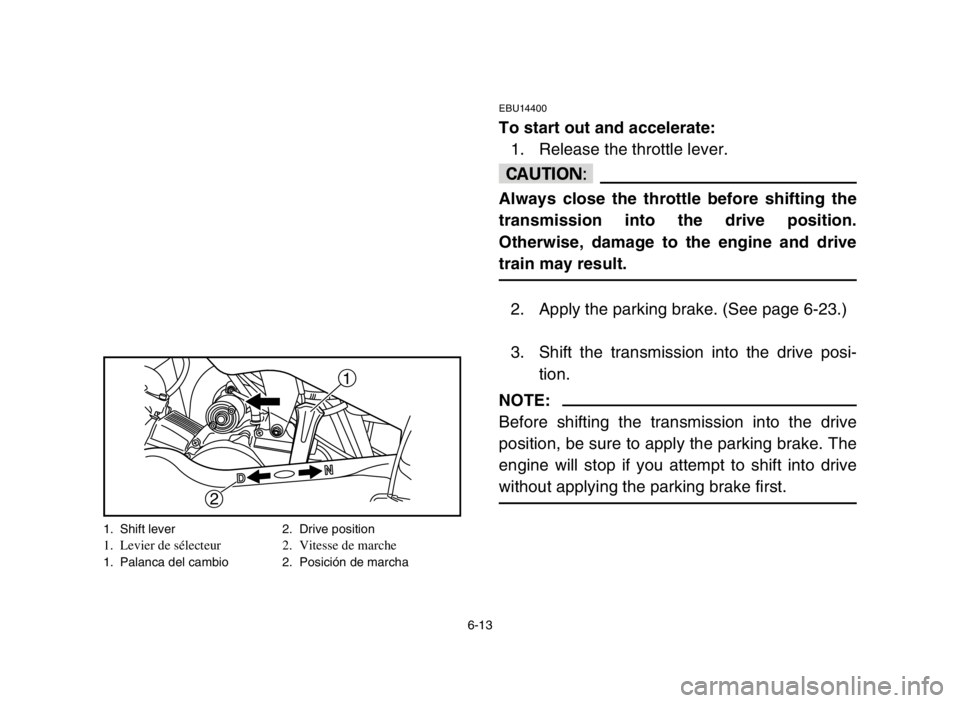
1
2
1. Shift lever 2. Drive position1. Levier de sélecteur 2. Vitesse de marche1. Palanca del cambio 2. Posición de marcha
EBU14400
To start out and accelerate:
1. Release the throttle lever.
cC
Always close the throttle before shifting the
transmission into the drive position.
Otherwise, damage to the engine and drive
train may result.
2. Apply the parking brake. (See page 6-23.)
3. Shift the transmission into the drive posi-
tion.
NOTE:
Before shifting the transmission into the drive
position, be sure to apply the parking brake. The
engine will stop if you attempt to shift into drive
without applying the parking brake first.
5YF-9-60 6 4/24/03 6:36 PM Page 12
Page 146 of 350

6-15
4. Squeeze the rear brake lever to release
the parking brake.
5. Gradually open the throttle lever while
slowly releasing the rear brake lever.
w
Always open the throttle gradually. Opening
the throttle abruptly would increase the
chance of an accident. It could make the
machine wheelie or overturn.
5YF-9-60 6 4/24/03 6:36 PM Page 14
Page 148 of 350

6-17
EBU00208
To decelerate:
When slowing down or stopping, release the
throttle and apply the brakes smoothly and
evenly. As you slow down, shift to a lower gear.
Be sure that the engine has sufficiently slowed
before engaging a lower gear. Improper use of
the brakes or shifting can cause the tires to lose
traction, reducing control and increasing the
possibility of an accident.
w
Make sure the engine has sufficiently slowed
before shifting to a lower gear. Engaging a
lower gear when the engine speed is too
high could make the wheels stop rotating.
This could cause loss of control, an accident
and injury. It could also cause engine or
drive train damage.
5YF-9-60 6 4/24/03 6:36 PM Page 16
Page 154 of 350
6-23
EBU00211
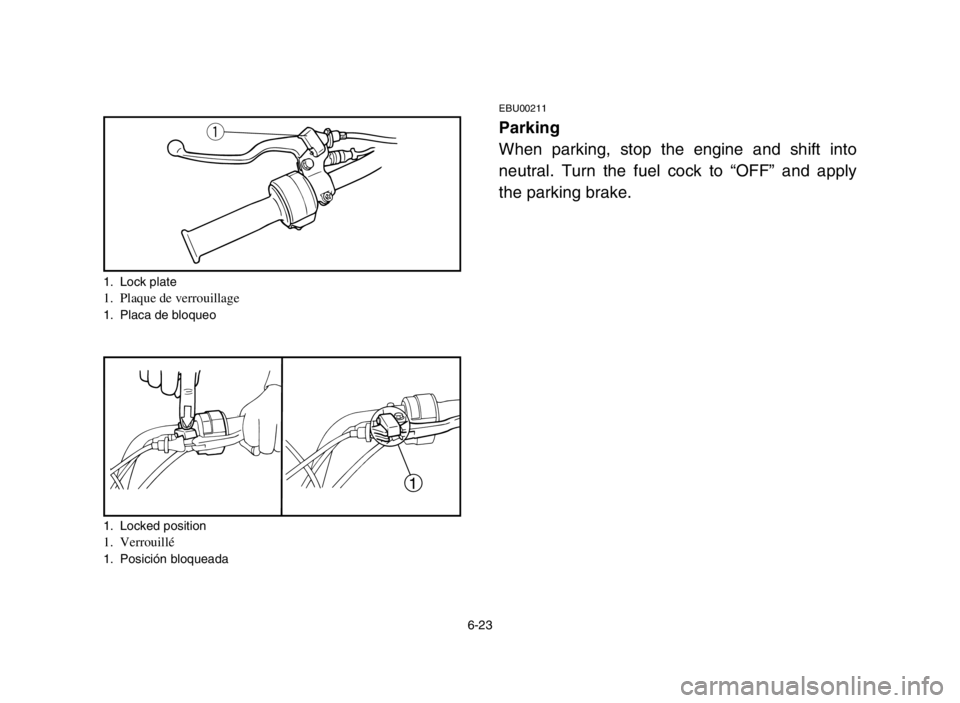
Parking
When parking, stop the engine and shift into
neutral. Turn the fuel cock to “OFF” and apply
the parking brake.q
1
1. Lock plate1. Plaque de verrouillage1. Placa de bloqueo
1. Locked position
1. Verrouillé1. Posición bloqueada
5YF-9-60 6 4/24/03 6:36 PM Page 22
Page 156 of 350
6-25
EBU14340
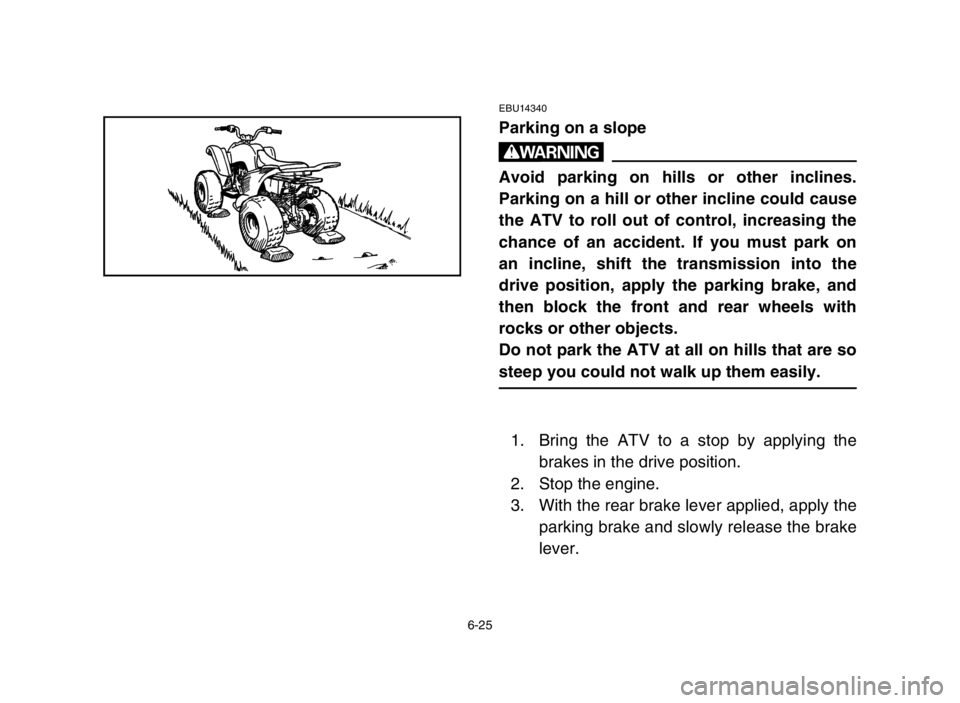
Parking on a slope
w
Avoid parking on hills or other inclines.
Parking on a hill or other incline could cause
the ATV to roll out of control, increasing the
chance of an accident. If you must park on
an incline, shift the transmission into the
drive position, apply the parking brake, and
then block the front and rear wheels with
rocks or other objects.
Do not park the ATV at all on hills that are so
steep you could not walk up them easily.
1. Bring the ATV to a stop by applying the
brakes in the drive position.
2. Stop the engine.
3. With the rear brake lever applied, apply the
parking brake and slowly release the brake
lever.
5YF-9-60 6 4/24/03 6:36 PM Page 24
Page 202 of 350

7-35
Select a large, flat area off-road to become
familiar with your ATV. Make sure that this area
is free of obstacles and other riders. You should
practice control of the throttle, brakes, shifting
procedures, and turning techniques in this area
before trying more difficult terrain. Always avoid
riding on paved surfaces: the ATV is designed
for off-road use only, and handling maneuvers
are more difficult to perform on pavement.
Set the parking brake and follow the instruction
on page 6-3 to start the engine. Once it has
warmed up you are ready to begin riding your
ATV. Remember that the engine and exhaust
pipe will be hot when riding and afterwards; do
not allow skin or clothing to come in contact with
these components.
5YF-9-60 7 4/24/03 6:35 PM Page 178
Page 204 of 350

7-37
With the engine idling, shift the transmission into
the drive position and then release the parking
brake. Apply the throttle slowly and smoothly.
The centrifugal clutch will engage and you will
start to accelerate. If the throttle is applied too
abruptly, the front wheels may lift off the ground
resulting in a loss of directional control. Avoid
higher speeds until you are thoroughly familiar
with the operation of your ATV.
When slowing down or stopping, release the
throttle and apply the brakes smoothly and
evenly. Improper use of the brakes can cause
the tires to lose traction, reducing control and
increasing the possibility of an accident.
5YF-9-60 7 4/24/03 6:35 PM Page 180
Page 218 of 350

7-51
If your ATV has stalled or stopped and you
believe you can continue up the hill, restart care-
fully to make sure you do not lift the front wheels
which could cause you to lose control. If you are
unable to continue up the hill, dismount the ATV
on the uphill side. Physically turn the ATV
around and then descend the hill.
If you start to roll backwards, DO NOT use the
rear brake to stop or try to put the ATV in gear.
The ATV could easily tip over backwards.
Instead, apply the front brake gradually, or dis-
mount the ATV immediately on the uphill side.
5YF-9-60 7 4/24/03 6:35 PM Page 194