light YAMAHA YFM700R 2006 Notices Demploi (in French)
[x] Cancel search | Manufacturer: YAMAHA, Model Year: 2006, Model line: YFM700R, Model: YAMAHA YFM700R 2006Pages: 424, PDF Size: 3.86 MB
Page 67 of 424
4-10
FBU00530
Contacteurs au guidon
FBU11560
Contacteur d’éclairage “ LIGHTS “
Placer le contacteur à la position “LO” pour
allumer les feux de croisement et le feu arrière.
Placer le contacteur à la position “HI” pour allu-
mer les feux de route et le feu arrière.
Placer le contacteur sur “ OFF “ pour éteindre
tous les feux.
fF
Ne jamais laisser les phares allumés pendant
plus d’une demi-heure après avoir coupé le
moteur. La batterie risque de se décharger au
point d’empêcher la mise en marche du
moteur. Si cela devait se produire, déposer et
recharger la batterie.
SBU00530
Interruptores del manillar
SBU11560
Interruptor de luces “LIGHTS”
Ponga el interruptor en la posición “LO” para
encender la luz de cruce y la luz de cola.
Ponga el interruptor en la posición “HI” para
encender la luz de carretera y la luz de cola.
Ponta el interruptor en la posición “OFF” para
apagar todas las luces.
yY
No mantenga las luces del faro encendidas
durante más de treinta minutos con el motor
parado. La batería podría descargarse hasta
el extremo de que el motor de arranque no
funcione debidamente. Si sucediese esto,
desmonte la batería y recárguela.
1S3-9-60 4 6/7/05 9:37 AM Page 4-10
Page 68 of 424
4-11
EBU11580
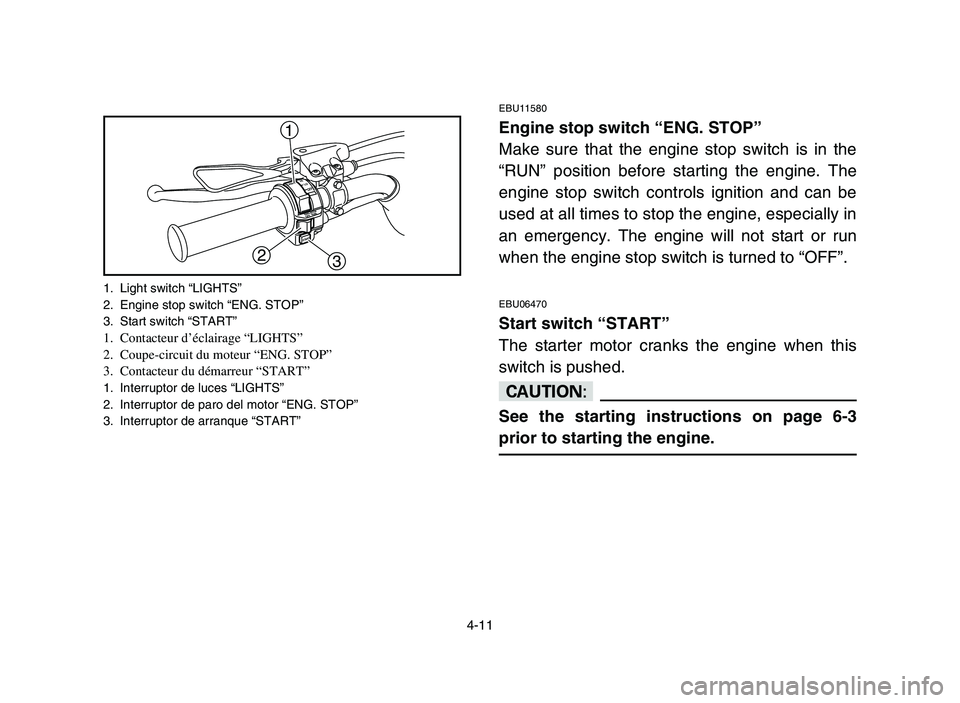
Engine stop switch “ENG. STOP”
Make sure that the engine stop switch is in the
“RUN” position before starting the engine. The
engine stop switch controls ignition and can be
used at all times to stop the engine, especially in
an emergency. The engine will not start or run
when the engine stop switch is turned to “OFF”.
EBU06470
Start switch “START”
The starter motor cranks the engine when this
switch is pushed.
cC
See the starting instructions on page 6-3
prior to starting the engine.
1
2
3
1. Light switch “LIGHTS”
2. Engine stop switch “ENG. STOP”
3. Start switch “START”
1. Contacteur d’éclairage “LIGHTS”
2. Coupe-circuit du moteur “ENG. STOP”
3. Contacteur du démarreur “START”
1. Interruptor de luces “LIGHTS”
2. Interruptor de paro del motor “ENG. STOP”
3. Interruptor de arranque “START”
1S3-9-60 4 6/7/05 9:37 AM Page 4-11
Page 100 of 424
5-1
EBU01130
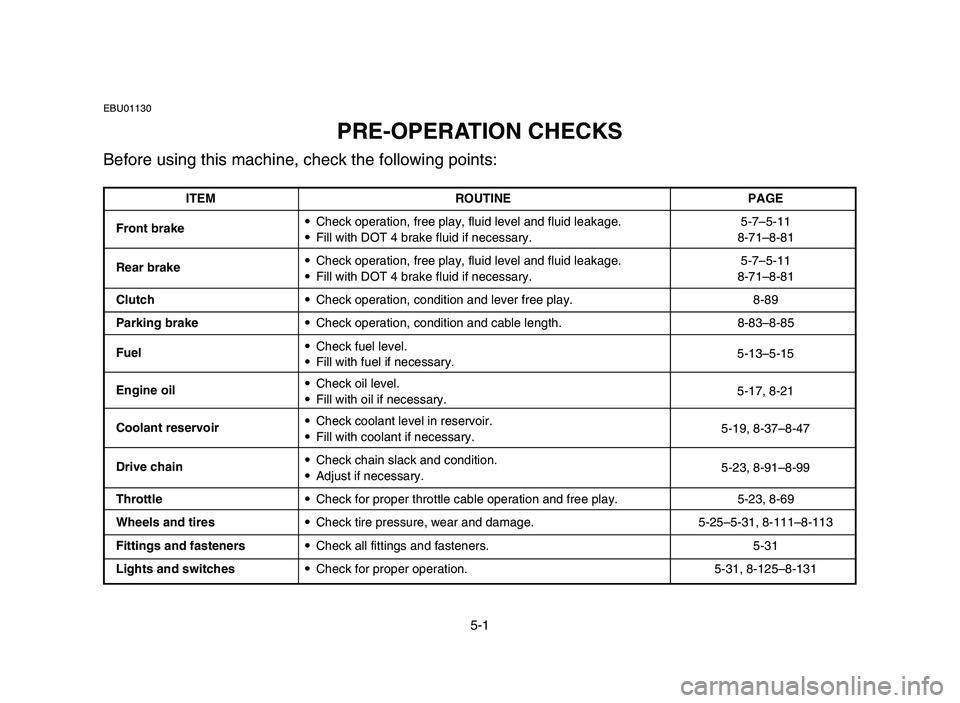
PRE-OPERATION CHECKS
Before using this machine, check the following points:
ITEM ROUTINE PAGE
Front brake9Check operation, free play, fluid level and fluid leakage. 5-7–5-11
9Fill with DOT 4 brake fluid if necessary. 8-71–8-81
Rear brake9Check operation, free play, fluid level and fluid leakage. 5-7–5-11
9Fill with DOT 4 brake fluid if necessary. 8-71–8-81
Clutch9Check operation, condition and lever free play. 8-89
Parking brake9Check operation, condition and cable length. 8-83–8-85
Fuel 9Check fuel level.
9Fill with fuel if necessary.5-13–5-15
Engine oil9Check oil level.
9Fill with oil if necessary.5-17, 8-21
Coolant reservoir 9Check coolant level in reservoir.
9Fill with coolant if necessary.5-19, 8-37–8-47
Drive chain9Check chain slack and condition.
9Adjust if necessary.5-23, 8-91–8-99
Throttle9Check for proper throttle cable operation and free play. 5-23, 8-69
Wheels and tires9Check tire pressure, wear and damage. 5-25–5-31, 8-111–8-113
Fittings and fasteners9Check all fittings and fasteners. 5-31
Lights and switches9Check for proper operation. 5-31, 8-125–8-131
1S3-9-60 5-6 6/7/05 10:22 AM Page 5-1
Page 130 of 424
5-31
EBU01600
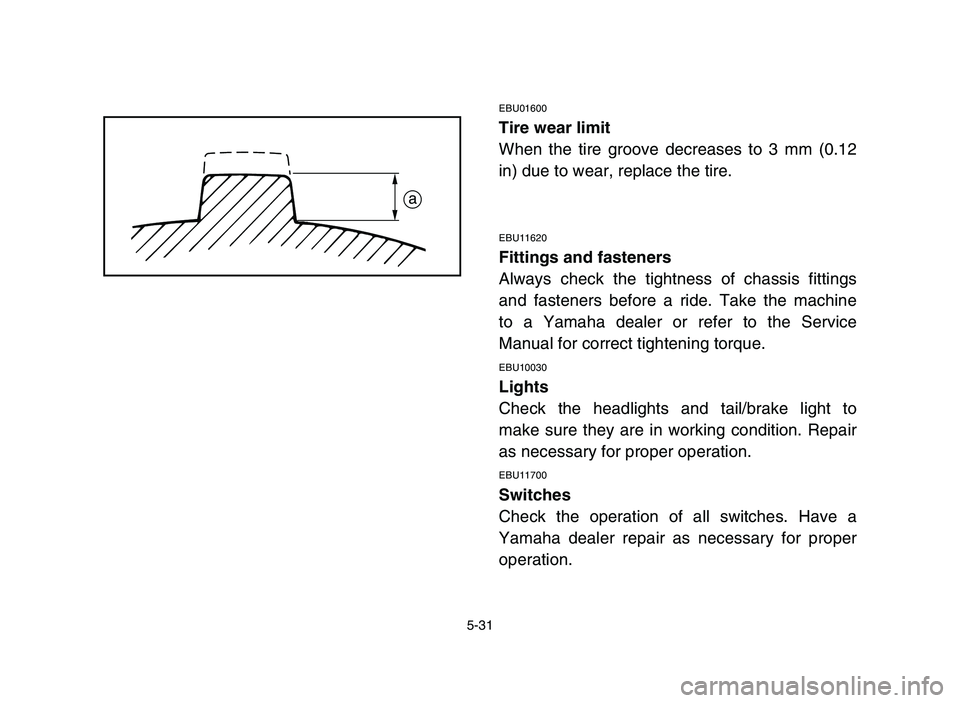
Tire wear limit
When the tire groove decreases to 3 mm (0.12
in) due to wear, replace the tire.
EBU11620
Fittings and fasteners
Always check the tightness of chassis fittings
and fasteners before a ride. Take the machine
to a Yamaha dealer or refer to the Service
Manual for correct tightening torque.
EBU10030
Lights
Check the headlights and tail/brake light to
make sure they are in working condition. Repair
as necessary for proper operation.
EBU11700
Switches
Check the operation of all switches. Have a
Yamaha dealer repair as necessary for proper
operation.
a
1S3-9-60 5-6 6/7/05 10:22 AM Page 5-31
Page 134 of 424
6-3
EBU15901
Starting the engine
w
Always make sure all control cables work
smoothly before you begin riding in cold
weather. If the control cables are frozen or
do not work smoothly, you could be unable
to control the ATV, which could lead to an
accident or collision.
1. Set the parking brake.
2. Turn the main switch to “ON” and the
engine stop switch to “RUN”.
cC
The engine trouble warning light and the fuel
level warning light should come on, and then
go off.
If a warning light does not go off, see page
4-7 for the corresponding warning light cir-
cuit check.
3. Shift the transmission into neutral.
1S3-9-60 5-6 6/7/05 10:22 AM Page 6-3
Page 136 of 424
6-5
NOTE:
This model is equipped with an ignition circuit
cut-off system.
The engine can be started under the following
conditions.
8When the transmission is in neutral.
The neutral indicator light should come on. If
the light does not come on, ask a Yamaha
dealer to inspect it.
8When the clutch is disengaged with the trans-
mission in any position. However, it is recom-
mended to shift into neutral before starting the
engine.
1S3-9-60 5-6 6/7/05 10:22 AM Page 6-5
Page 140 of 424
6-9
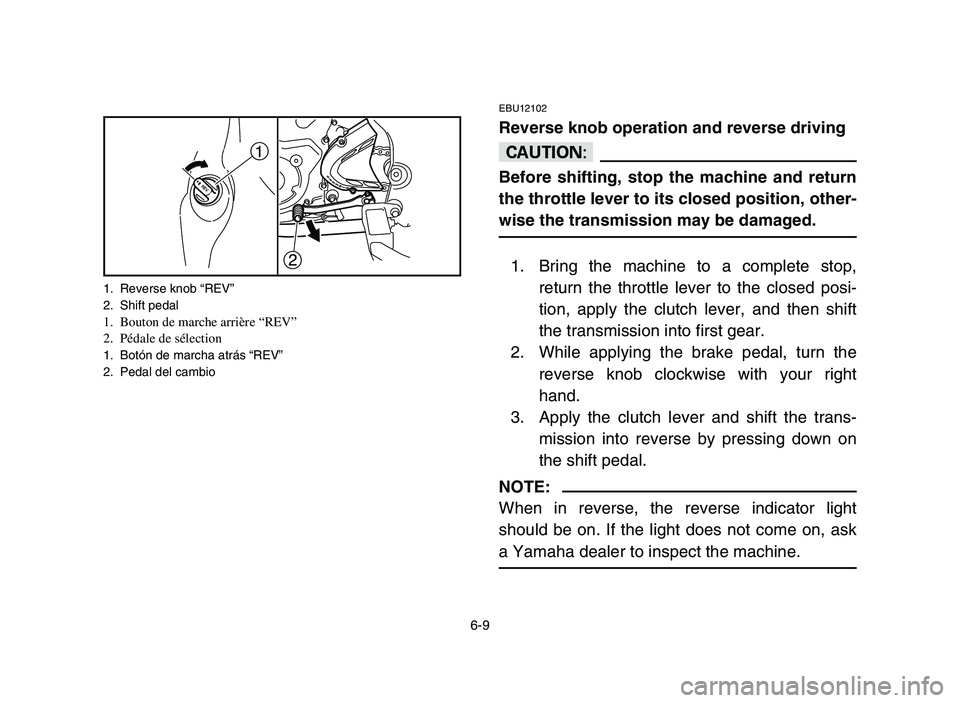
2
1
1. Reverse knob “REV”
2. Shift pedal
1. Bouton de marche arrière “REV”
2. Pédale de sélection
1. Botón de marcha atrás “REV”
2. Pedal del cambio
EBU12102
Reverse knob operation and reverse driving
cC
Before shifting, stop the machine and return
the throttle lever to its closed position, other-
wise the transmission may be damaged.
1. Bring the machine to a complete stop,
return the throttle lever to the closed posi-
tion, apply the clutch lever, and then shift
the transmission into first gear.
2. While applying the brake pedal, turn the
reverse knob clockwise with your right
hand.
3. Apply the clutch lever and shift the trans-
mission into reverse by pressing down on
the shift pedal.
NOTE:
When in reverse, the reverse indicator light
should be on. If the light does not come on, ask
a Yamaha dealer to inspect the machine.
1S3-9-60 5-6 6/7/05 10:22 AM Page 6-9
Page 144 of 424

6-13
1
2 3 4 5N1R
1. Shift pedal N. Neutral position
R. Reverse position
1. Pédale de sélection N. Point mort
R. Marche arrière
1. Pedal del cambio N. Punto muerto
R. Posición de marcha atrás
EBU11730
Shifting
This model has a 5-speed forward and 1-speed
reverse transmission. The transmission allows
you to control the amount of power you have
available at a given speed or for starting, accel-
erating, climbing hills, etc. To shift into neutral,
return the throttle lever to the closed position,
apply the clutch and repeatedly depress the shift
pedal until it stops. When it stops, it will be in
first gear. Raise the pedal slightly to neutral.
cC
8Do not coast for long periods with the
engine off, and do not tow the machine a
long distance. Even in neutral position, the
transmission is only properly lubricated
when the engine is running. Inadequate
lubrication may cause damage.
8Always use the clutch when changing
gears. The engine, transmission and drive
train are not designed to withstand the
shock of forced shifting and can be dam-
aged by shifting without the clutch.
1S3-9-60 5-6 6/7/05 10:22 AM Page 6-13
Page 160 of 424
6-29
4. With the front and rear brakes applied, pull
the clutch lever, shift into 1st gear, and
then slowly release the clutch lever, brake
lever and brake pedal.
NOTE:
Make sure that the neutral indicator light goes
off.
5. Turn the key to “OFF”.
1S3-9-60 5-6 6/7/05 10:23 AM Page 6-29
Page 212 of 424
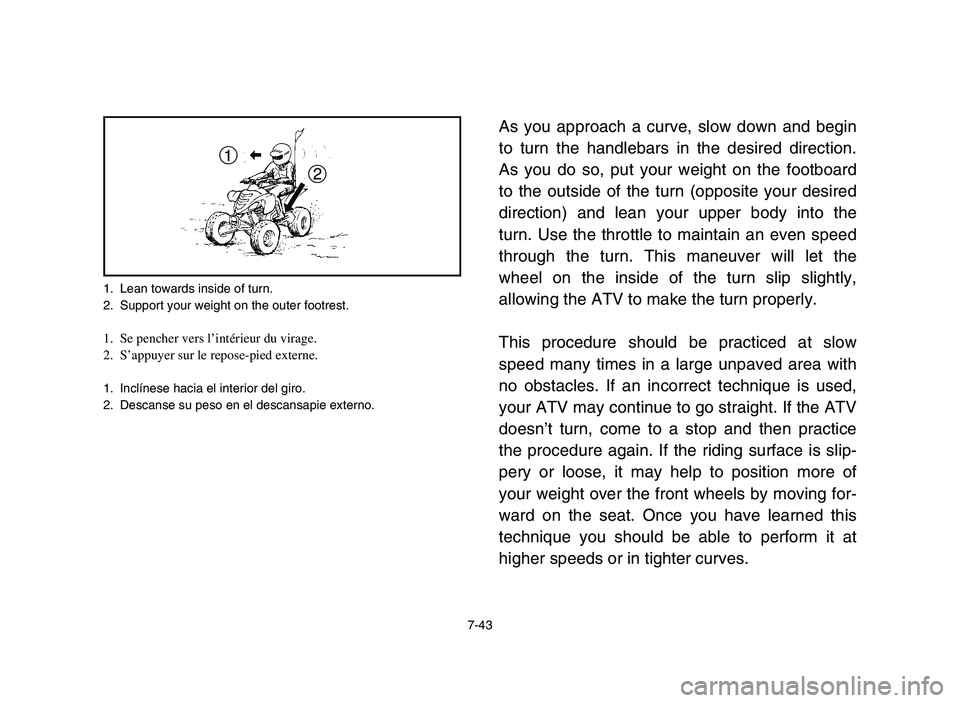
1. Lean towards inside of turn.
2. Support your weight on the outer footrest.
1. Se pencher vers l’intérieur du virage.
2. S’appuyer sur le repose-pied externe.
1. Inclínese hacia el interior del giro.
2. Descanse su peso en el descansapie externo.
7-43
As you approach a curve, slow down and begin
to turn the handlebars in the desired direction.
As you do so, put your weight on the footboard
to the outside of the turn (opposite your desired
direction) and lean your upper body into the
turn. Use the throttle to maintain an even speed
through the turn. This maneuver will let the
wheel on the inside of the turn slip slightly,
allowing the ATV to make the turn properly.
This procedure should be practiced at slow
speed many times in a large unpaved area with
no obstacles. If an incorrect technique is used,
your ATV may continue to go straight. If the ATV
doesn’t turn, come to a stop and then practice
the procedure again. If the riding surface is slip-
pery or loose, it may help to position more of
your weight over the front wheels by moving for-
ward on the seat. Once you have learned this
technique you should be able to perform it at
higher speeds or in tighter curves.
1
2
1S3-9-60 7 4/26/05 6:27 PM Page 186