weight YAMAHA YFM700R 2006 Owners Manual
[x] Cancel search | Manufacturer: YAMAHA, Model Year: 2006, Model line: YFM700R, Model: YAMAHA YFM700R 2006Pages: 424, PDF Size: 3.86 MB
Page 26 of 424
1-3
q
q
GB
D
E
FI
NL
P
S Set with tires cold.
Bei kalten Reifen.
Ajuste con los
neum ticos en fr o.
Pneus froid.Impostare a pneumatici
freddi.
Wanneer de banden
koud zijn.
Regular com pneus
frios.
St ll in med kalla d ck. 27.5 kPa
0.275 kgf/cm
2
4.0 psi27.5 kPa
0.275 kgf/cm
2
4.0 psi
5LP-21696-M0
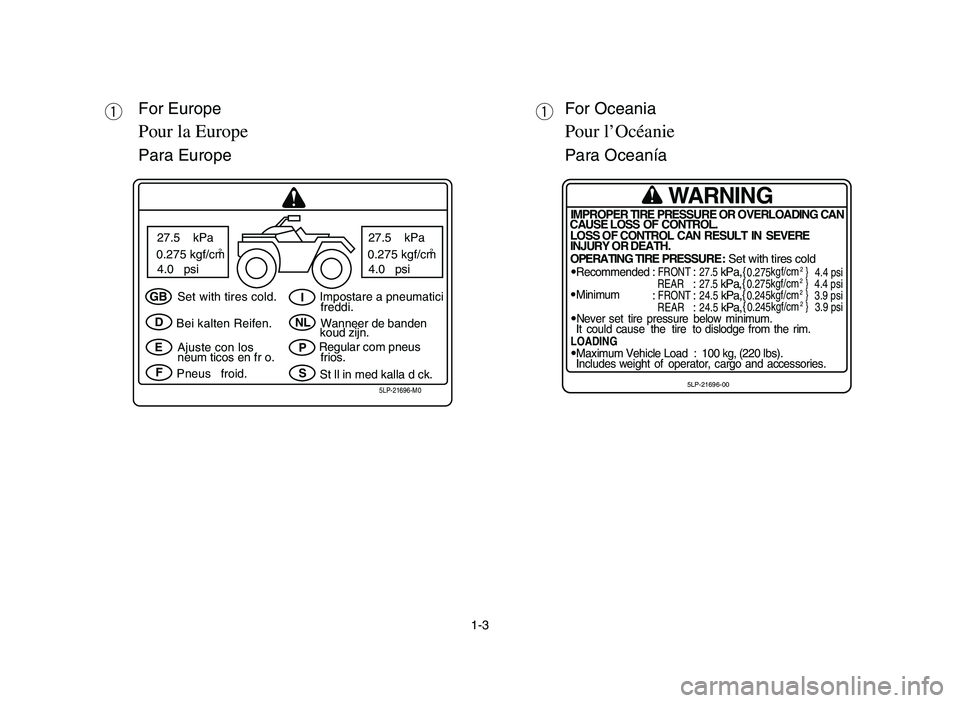
qWARNINGIMPROPER TIRE PRESSURE OR OVERLOADING CAN
CAUSE LOSS OF CONTROL.
LOSS OF CONTROL CAN RESULT IN SEVERE
INJURY OR DEATH.
OPERATING TIRE PRESSURE : Set with tires cold
9
Recommended : FRONT : 27.5 kPa,{0.275kgf/cm2}
4.4 psi
REAR: 27.5 kPa,{0.275kgf/cm2}
4.4 psi9Minimum: FRONT : 24.5 kPa,{0.245kgf/cm2}
3.9 psi
REAR: 24.5 kPa,{0.245kgf/cm2}
3.9 psi9Never set tire pressure below minimum.
It could cause the tire to dislodge from the rim.
LOADING9Maximum Vehicle Load:
100 kg,(220 lbs).
Includes weight of operator, cargo and accessories.
5LP-21696-00
qFor Europe
Pour la Europe
Para EuropeFor Oceania
Pour l’Océanie
Para Oceanía
1S3-9-60 1-3 4/27/05 3:11 PM Page 24
Page 38 of 424
2-9
8Always follow proper procedures for climbing
hills as described in this manual. Check the
terrain carefully before you start up any hill.
Never climb hills with excessively slippery or
loose surfaces. Shift your weight forward.
Never open the throttle suddenly or make
sudden gear changes. Never go over the top
of a hill at high speed.
8Always follow proper procedures for going
down hills and for braking on hills as
described in this manual. Check the terrain
carefully before you start down any hill. Shift
your weight backward. Never go down a hill at
high speed. Avoid going down a hill at an
angle that would cause the vehicle to lean
sharply to one side. Go straight down the hill
where possible.
1S3-9-60 1-3 4/27/05 3:11 PM Page 2-9
Page 40 of 424
2-11
8Always follow proper procedures for crossing
the side of a hill as described in this manual.
Avoid hills with excessively slippery or loose
surfaces. Shift your weight to the uphill side of
the ATV. Never attempt to turn the ATV
around on any hill until you have mastered
the turning technique described in this manual
on level ground. Avoid crossing the side of a
steep hill if possible.
8Always use proper procedures if you stall or
roll backwards when climbing a hill. To avoid
stalling, use the proper gear and maintain a
steady speed when climbing a hill. If you stall
or roll backwards, follow the special proce-
dure for braking described in this manual.
Dismount on the uphill side or to a side if
pointed straight uphill. Turn the ATV around
and remount, following the procedure
described in this manual.
1S3-9-60 1-3 4/27/05 3:11 PM Page 2-11
Page 88 of 424
4-31
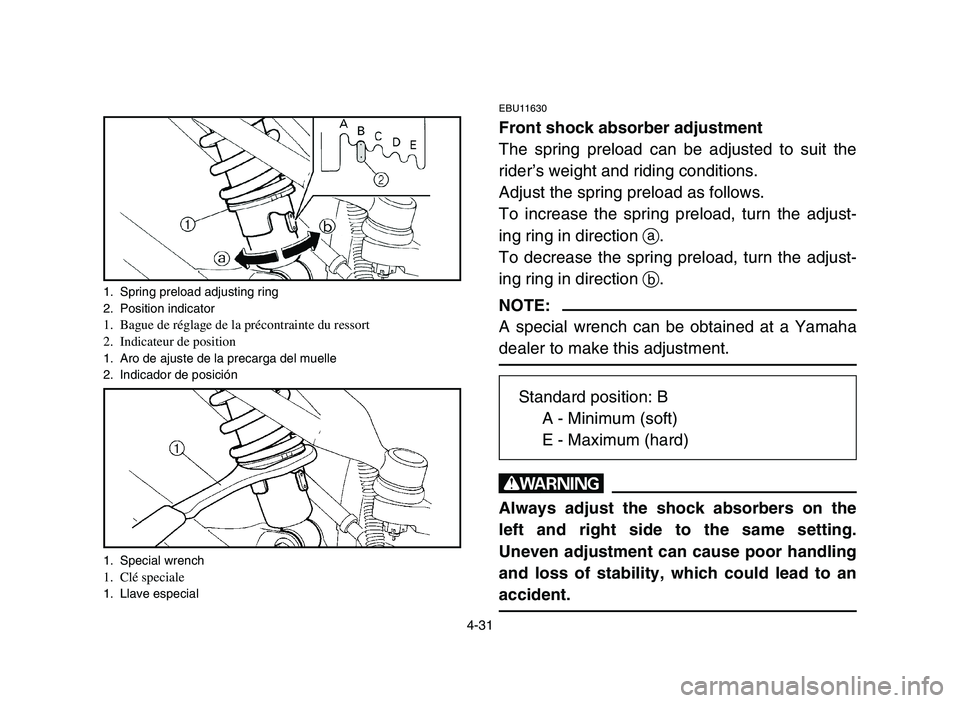
1. Spring preload adjusting ring
2. Position indicator
1. Bague de réglage de la précontrainte du ressort
2. Indicateur de position
1. Aro de ajuste de la precarga del muelle
2. Indicador de posición
1. Special wrench
1. Clé speciale1. Llave especial
EBU11630
Front shock absorber adjustment
The spring preload can be adjusted to suit the
rider’s weight and riding conditions.
Adjust the spring preload as follows.
To increase the spring preload, turn the adjust-
ing ring in direction a.
To decrease the spring preload, turn the adjust-
ing ring in direction b.
NOTE:
A special wrench can be obtained at a Yamaha
dealer to make this adjustment.
w
Always adjust the shock absorbers on the
left and right side to the same setting.
Uneven adjustment can cause poor handling
and loss of stability, which could lead to an
accident.
Standard position: B
A - Minimum (soft)
E - Maximum (hard)
1S3-9-60 4 6/7/05 9:37 AM Page 4-31
Page 90 of 424
4-33
EBU16041
Adjusting the rear shock absorber
The spring preload, rebound damping and com-
pression damping forces of the rear shock
absorber can be adjusted to suit the rider’s
weight and the riding conditions.
w
This shock absorber contains highly pres-
surized nitrogen gas. Read and understand
the following information before handling the
shock absorber.
8Do not tamper with or attempt to open the
cylinder assembly.
8Do not subject the shock absorber to an
open flame or other high heat source. This
may cause the unit to explode due to
excessive gas pressure.
8Do not deform or damage the cylinder in
any way. Cylinder damage will result in
poor damping performance.
8Take the shock absorber to a Yamaha
dealer for any service.
1S3-9-60 4 6/7/05 9:37 AM Page 4-33
Page 164 of 424
6-33
8Do not mount an accessory where it could
interfere with your ability to control the ATV.
Examples include (but are not limited to) a
heavy or bulky object attached to the handle-
bars which could make steering difficult, an
accessory that limits your ability to move
around on the seat, or one that limits your
view.
8Use extra caution when riding an ATV with
accessories. The ATV may handle differently
than it does without accessories.
EBU02240
Loading
As originally equipped, this ATV is not designed
to carry cargo or tow a trailer. If you choose to
add accessories so that you can carry cargo or
tow a trailer, you must use common sense and
good judgement. Keep the following points in
mind:
8Never exceed the weight limits shown. An
overloaded ATV can be unstable.
1S3-9-60 5-6 6/7/05 10:23 AM Page 6-33
Page 166 of 424
6-35
8Load cargo on the carriers as close to the
center of the vehicle as possible. Put cargo at
the rear of the front carrier and at the front of
the rear carrier. Center the load from side to
side.
8Tie down cargo securely to the carriers. Make
sure cargo in the trailer cannot move around.
A shifting load can cause an accident.
8Make sure the load does not interfere with
controls or your ability to see where you are
going.
8Ride more slowly than you would without a
load. The more weight you carry, the slower
you should go. Although conditions vary, it is
good practice not to exceed 2nd gear when-
ever you are carrying heavier loads or when
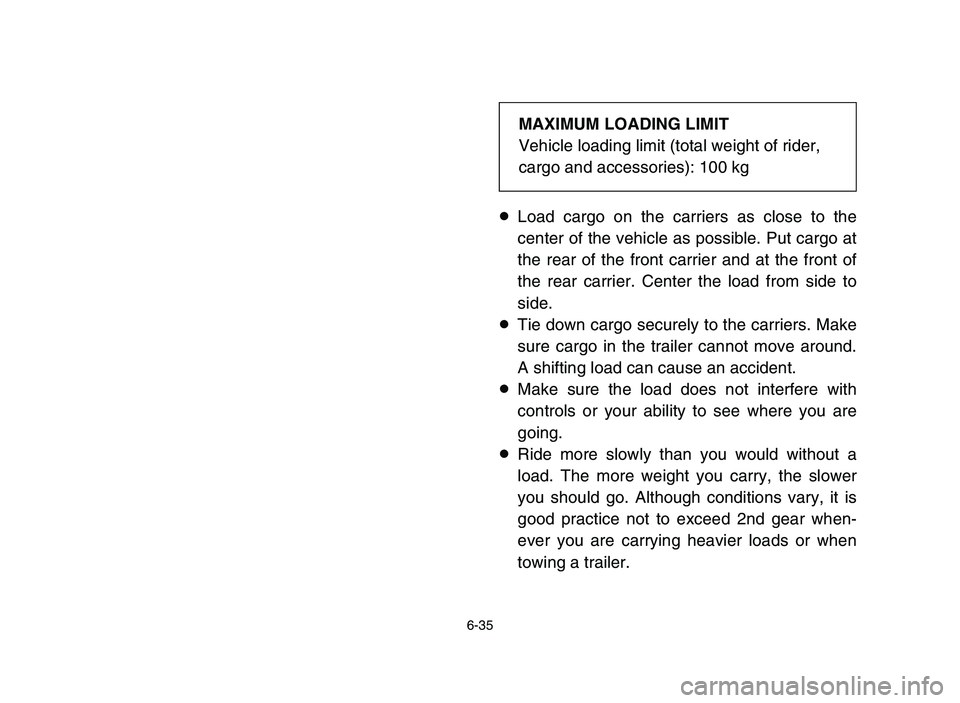
towing a trailer.MAXIMUM LOADING LIMIT
Vehicle loading limit (total weight of rider,
cargo and accessories): 100 kg
1S3-9-60 5-6 6/7/05 10:23 AM Page 6-35
Page 168 of 424

6-37
8Allow more braking distance. A heavier vehi-
cle takes longer to stop.
8Avoid making sharp turns unless at very slow
speeds.
8Avoid hills and rough terrain. Choose terrain
carefully. Added weight affects the stability
and handling of the ATV.
w
Never exceed the stated load capacity for
this ATV. Overloading this ATV or carrying
or towing cargo improperly could cause
changes in vehicle handling which could
lead to an accident.
Cargo should be properly distributed and
securely attached. Reduce speed when car-
rying cargo or pulling a trailer. Allow greater
distance for braking.
1S3-9-60 5-6 6/7/05 10:23 AM Page 6-37
Page 188 of 424

7-19
w
8Never exceed the stated load capacity for
this ATV.
8Cargo should be properly distributed and
securely attached.
8Reduce speed when carrying cargo or
pulling a trailer. Allow greater distance for
braking.
8Always follow the instructions in your
Owner’s Manual for carrying cargo or
pulling a trailer.
MAXIMUM LOADING LIMIT
Vehicle loading limit (total weight of rider,
cargo and accessories):
100 kg
1S3-9-60 7 4/26/05 6:27 PM Page 162
Page 212 of 424
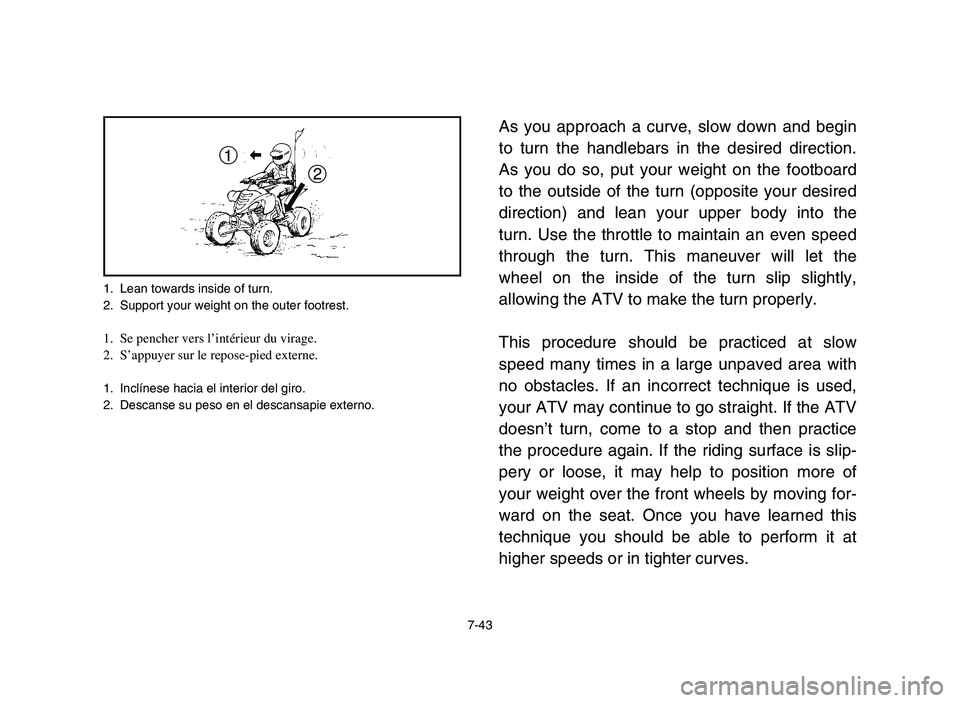
1. Lean towards inside of turn.
2. Support your weight on the outer footrest.
1. Se pencher vers l’intérieur du virage.
2. S’appuyer sur le repose-pied externe.
1. Inclínese hacia el interior del giro.
2. Descanse su peso en el descansapie externo.
7-43
As you approach a curve, slow down and begin
to turn the handlebars in the desired direction.
As you do so, put your weight on the footboard
to the outside of the turn (opposite your desired
direction) and lean your upper body into the
turn. Use the throttle to maintain an even speed
through the turn. This maneuver will let the
wheel on the inside of the turn slip slightly,
allowing the ATV to make the turn properly.
This procedure should be practiced at slow
speed many times in a large unpaved area with
no obstacles. If an incorrect technique is used,
your ATV may continue to go straight. If the ATV
doesn’t turn, come to a stop and then practice
the procedure again. If the riding surface is slip-
pery or loose, it may help to position more of
your weight over the front wheels by moving for-
ward on the seat. Once you have learned this
technique you should be able to perform it at
higher speeds or in tighter curves.
1
2
1S3-9-60 7 4/26/05 6:27 PM Page 186