lock YAMAHA YFM700R 2014 User Guide
[x] Cancel search | Manufacturer: YAMAHA, Model Year: 2014, Model line: YFM700R, Model: YAMAHA YFM700R 2014Pages: 162, PDF Size: 3.81 MB
Page 45 of 162
![YAMAHA YFM700R 2014 User Guide 4-17
4
3. Tighten the locknut to the specified torque. NOTICE: Always tighten the locknut
against the adjusting nut, and then tighten
it to the specified torque.
[ECB00081]
Rebound damping force
Tur](/img/51/53762/w960_53762-44.png "YAMAHA YFM700R 2014 User Guide 4-17
4
3. Tighten the locknut to the specified torque. NOTICE: Always tighten the locknut
against the adjusting nut, and then tighten
it to the specified torque.
[ECB00081]
Rebound damping force
Tur")
4-17
4
3. Tighten the locknut to the specified torque. NOTICE: Always tighten the locknut
against the adjusting nut, and then tighten
it to the specified torque.
[ECB00081]
Rebound damping force
Turn the rebound damping force adjusting screw in
direction (a) to increase the rebound damping
force and thereby harden the damping, and in di-
rection (b) to decrease the rebound damping force
and thereby soften the damping.
1. Distance ATightening torque: Locknut:42 Nm (4.2 m·kgf, 30 ft·lbf)
1
1. Rebound damping force adjusting screw
1(a)
(b)
U1PE61E0.book Page 17 Thursday, April 4, 2013 6:18 PM
Page 48 of 162
4-20
4
●Do not dispose of a damaged or worn out
shock absorber assembly yourself. Take the
shock absorber assembly to a Yamaha deal-
er for any service.EBU19044Adjusting the rear shock absorber as-
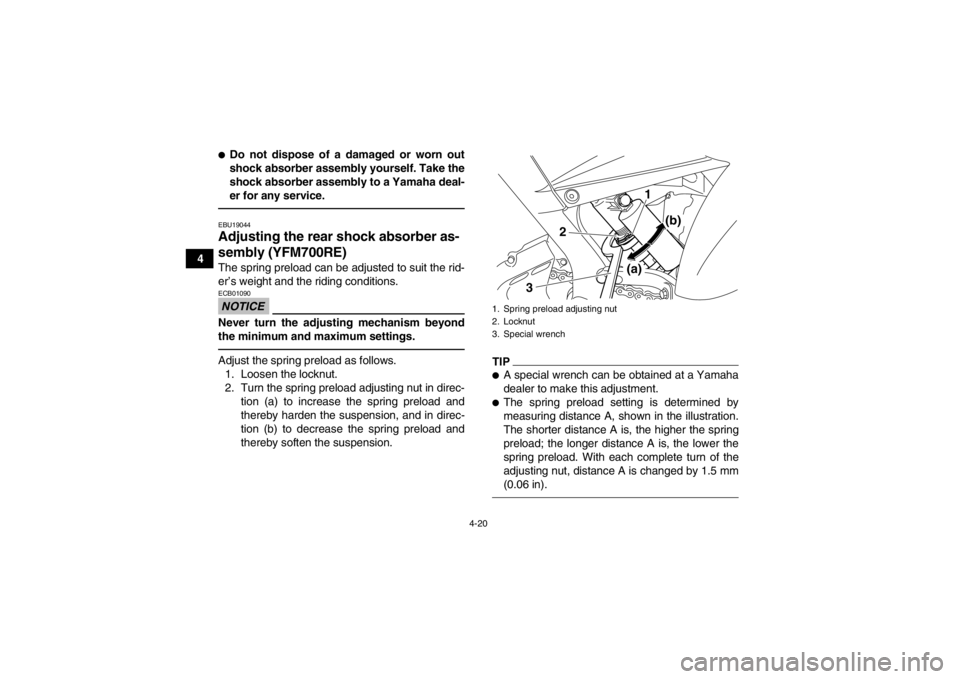
sembly (YFM700RE)The spring preload can be adjusted to suit the rid-
er’s weight and the riding conditions.NOTICEECB01090Never turn the adjusting mechanism beyond
the minimum and maximum settings.Adjust the spring preload as follows.1. Loosen the locknut.
2. Turn the spring preload adjusting nut in direc- tion (a) to increase the spring preload and
thereby harden the suspension, and in direc-
tion (b) to decrease the spring preload and
thereby soften the suspension.
TIP●A special wrench can be obtained at a Yamaha
dealer to make this adjustment.●The spring preload setting is determined by
measuring distance A, shown in the illustration.
The shorter distance A is, the higher the spring
preload; the longer distance A is, the lower the
spring preload. With each complete turn of the
adjusting nut, distance A is changed by 1.5 mm
(0.06 in).1. Spring preload adjusting nut
2. Locknut
3. Special wrench
1
(b)
(a)
2
3
U1PE61E0.book Page 20 Thursday, April 4, 2013 6:18 PM
Page 49 of 162
![YAMAHA YFM700R 2014 User Guide 4-21
4
3. Tighten the locknut to the specified torque. NOTICE: Always tighten the locknut
against the adjusting nut, and then tighten
it to the specified torque.
[ECB00081]
WARNING
EWB00450This shoc](/img/51/53762/w960_53762-48.png "YAMAHA YFM700R 2014 User Guide 4-21
4
3. Tighten the locknut to the specified torque. NOTICE: Always tighten the locknut
against the adjusting nut, and then tighten
it to the specified torque.
[ECB00081]
WARNING
EWB00450This shoc")
4-21
4
3. Tighten the locknut to the specified torque. NOTICE: Always tighten the locknut
against the adjusting nut, and then tighten
it to the specified torque.
[ECB00081]
WARNING
EWB00450This shock absorber assembly contains highly
pressurized nitrogen gas. If the shock absorb-
er assembly is damaged, it could explode
causing injury or property damage. Shock ab-
sorber cylinder damage could also result in
poor handling which could cause an accident.●Do not tamper with or attempt to open the
cylinder assembly.●Do not subject the shock absorber assembly
to an open flame or other high heat.●Do not deform or damage the cylinder in any
way.●Do not dispose of a damaged or worn out
shock absorber assembly yourself. Take the
shock absorber assembly to a Yamaha deal-
er for any service.
Spring preload setting: Minimum (soft):Distance A = 243.0 mm (9.57 in)
Standard: Distance A = 233.0 mm (9.17 in)
Maximum (hard): Distance A = 228.0 mm (8.98 in)1. Distance A
1
Tightening torque: Locknut:42 Nm (4.2 m·kgf, 30 ft·lbf)
U1PE61E0.book Page 21 Thursday, April 4, 2013 6:18 PM
Page 50 of 162
4-22
4
EBU30041Adjusting the rear shock absorber as-
sembly (YFM700RSE)This shock absorber assembly is equipped with a
spring preload adjusting nut, a rebound damping
force adjusting screw, with a compression damp-
ing force adjusting bolt (for fast compression
damping), and a compression damping force ad-
justing screw (for slow compression damping).
WARNING
EWB02680Suspension components become hot during
operation. Never touch the compression
damping force adjusting bolt and screw, the re-
bound damping force adjusting screw or the
oil reservoir with your bare hand or skin until
the suspension components have cooled.NOTICEECB00090Never turn an adjusting mechanism beyond
the minimum and maximum settings.
TIPAlthough the total number of clicks or turns of a
damping force adjusting mechanism may not ex-
actly match the following specifications due to
small differences in production, the actual number
of clicks or turns always represents the entire ad-
justing range. To obtain a precise adjustment, it
would be advisable to check the number of clicks
or turns of each damping force adjusting mecha-
nism and to modify the specifications as neces-
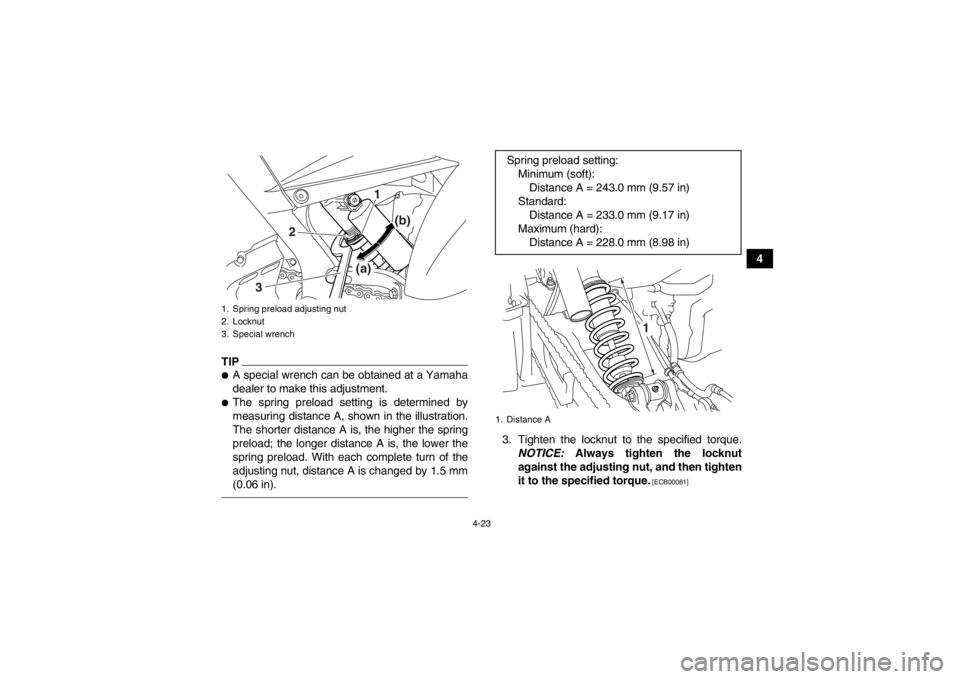
sary.Spring preload1. Loosen the locknut.
2. Turn the spring preload adjusting nut in direc- tion (a) to increase the spring preload and
thereby harden the suspension, and in direc-
tion (b) to decrease the spring preload and
thereby soften the suspension.
U1PE61E0.book Page 22 Thursday, April 4, 2013 6:18 PM
Page 51 of 162
4-23
4
TIP●A special wrench can be obtained at a Yamaha
dealer to make this adjustment.●The spring preload setting is determined by
measuring distance A, shown in the illustration.
The shorter distance A is, the higher the spring
preload; the longer distance A is, the lower the
spring preload. With each complete turn of the
adjusting nut, distance A is changed by 1.5 mm
(0.06 in).
3. Tighten the locknut to the specified torque.NOTICE: Always tighten the locknut
against the adjusting nut, and then tighten
it to the specified torque.
[ECB00081]
1. Spring preload adjusting nut
2. Locknut
3. Special wrench
1
(b)
(a)
2
3
Spring preload setting: Minimum (soft):Distance A = 243.0 mm (9.57 in)
Standard: Distance A = 233.0 mm (9.17 in)
Maximum (hard): Distance A = 228.0 mm (8.98 in)1. Distance A
1
U1PE61E0.book Page 23 Thursday, April 4, 2013 6:18 PM
Page 52 of 162
4-24
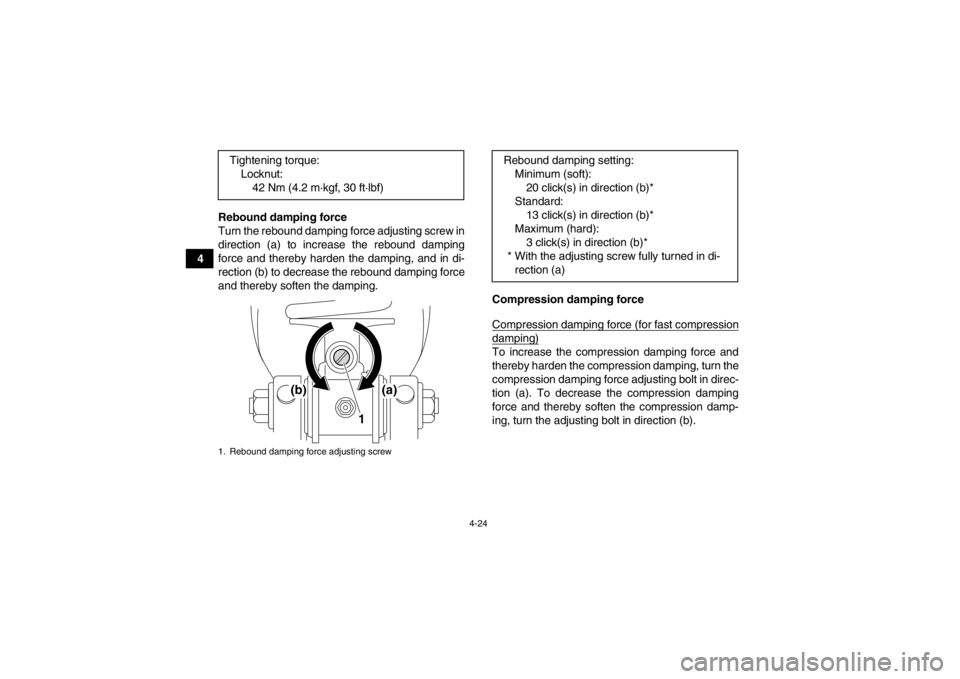
4Rebound damping force
Turn the rebound damping force adjusting screw in
direction (a) to increase the rebound damping
force and thereby harden the damping, and in di-
rection (b) to decrease the rebound damping force
and thereby soften the damping.
Compression damping force
Compression damping force (for fast compression
damping)To increase the compression damping force and
thereby harden the compression damping, turn the
compression damping force adjusting bolt in direc-
tion (a). To decrease the compression damping
force and thereby soften the compression damp-
ing, turn the adjusting bolt in direction (b).
Tightening torque:
Locknut:42 Nm (4.2 m·kgf, 30 ft·lbf)
1. Rebound damping force adjusting screw
1
(b) (a)
Rebound damping setting:
Minimum (soft):20 click(s) in direction (b)*
Standard: 13 click(s) in direction (b)*
Maximum (hard): 3 click(s) in direction (b)*
* With the adjusting screw fully turned in di- rection (a)
U1PE61E0.book Page 24 Thursday, April 4, 2013 6:18 PM
Page 65 of 162
6-4
6
erly lubricated only when the engine is run-
ning. Inadequate lubrication may damage
the transmission.
●Always use the clutch when changing gears.
The engine, transmission and drive train are
not designed to withstand the shock of
forced shifting and can be damaged by shift-
ing without using the clutch.EBU20501Operating the revers
e knob and driving
in reverse
WARNING
EWB00720Improper operation in reverse could make you
hit an obstacle or even a person behind you,
resulting in serious injury. When you shift into
reverse, make sure there are no people or ob-
stacles behind you. When it is safe to proceed,
go slowly.NOTICEECB00170Before shifting, stop the ATV, otherwise the
transmission may be damaged.
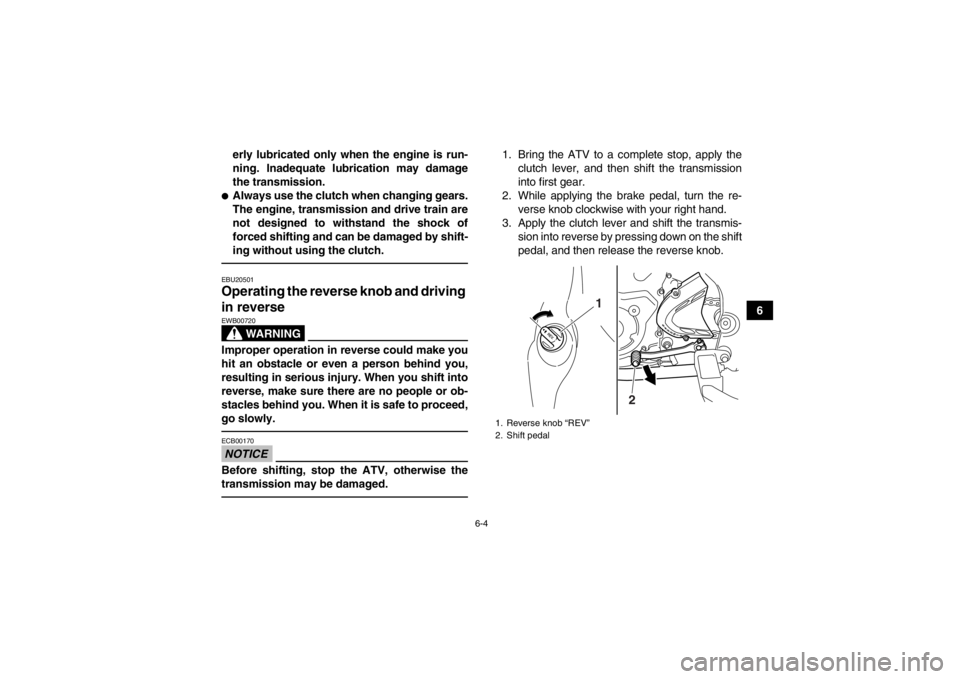
1. Bring the ATV to a complete stop, apply the
clutch lever, and then shift the transmission
into first gear.
2. While applying the brake pedal, turn the re- verse knob clockwise with your right hand.
3. Apply the clutch lever and shift the transmis- sion into reverse by pressing down on the shift
pedal, and then release the reverse knob.1. Reverse knob “REV”
2. Shift pedal
2
1
U1PE61E0.book Page 4 Thursday, April 4, 2013 6:18 PM
Page 67 of 162
6-6
6
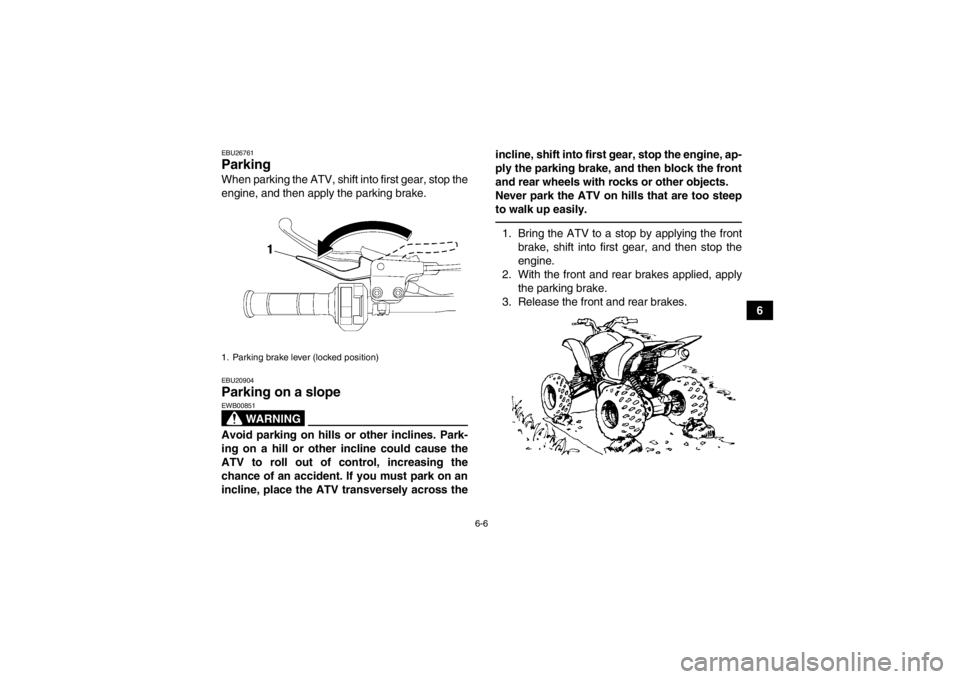
EBU26761Parking When parking the ATV, shift into first gear, stop the
engine, and then apply the parking brake.EBU20904Parking on a slope
WARNING
EWB00851Avoid parking on hills or other inclines. Park-
ing on a hill or other incline could cause the
ATV to roll out of control, increasing the
chance of an accident. If you must park on an
incline, place the ATV transversely across theincline, shift into first gear, stop the engine, ap-
ply the parking brake, and then block the front
and rear wheels with rocks or other objects.
Never park the ATV on hills that are too steep
to walk up easily.
1. Bring the ATV to a stop by applying the front
brake, shift into first gear, and then stop the
engine.
2. With the front and rear brakes applied, apply the parking brake.
3. Release the front and rear brakes.
1. Parking brake lever (locked position)U1PE61E0.book Page 6 Thursday, April 4, 2013 6:18 PM
Page 75 of 162
7-6
7
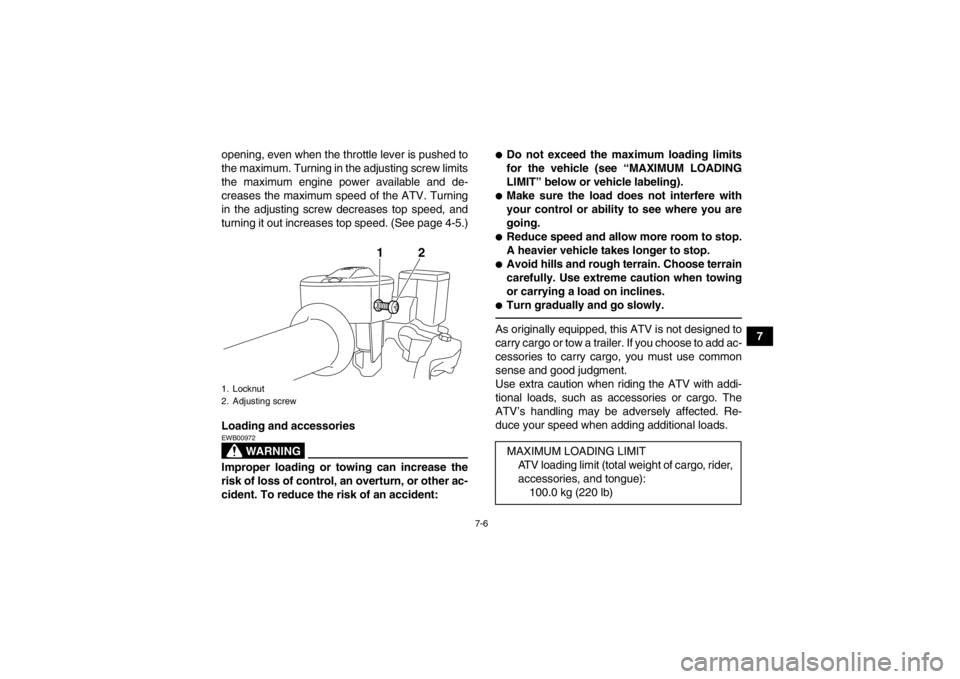
opening, even when the throttle lever is pushed to
the maximum. Turning in the adjusting screw limits
the maximum engine power available and de-
creases the maximum speed of the ATV. Turning
in the adjusting screw decreases top speed, and
turning it out increases top speed. (See page 4-5.)
Loading and accessories
WARNING
EWB00972Improper loading or towing can increase the
risk of loss of control, an overturn, or other ac-
cident. To reduce the risk of an accident:
●Do not exceed the maximum loading limits
for the vehicle (see “MAXIMUM LOADING
LIMIT” below or vehicle labeling).●Make sure the load does not interfere with
your control or ability to see where you are
going.●Reduce speed and allow more room to stop.
A heavier vehicle takes longer to stop.●Avoid hills and rough terrain. Choose terrain
carefully. Use extreme caution when towing
or carrying a load on inclines.●Turn gradually and go slowly.As originally equipped, this ATV is not designed to
carry cargo or tow a trailer. If you choose to add ac-
cessories to carry cargo, you must use common
sense and good judgment.
Use extra caution when riding the ATV with addi-
tional loads, such as accessories or cargo. The
ATV’s handling may be adversely affected. Re-
duce your speed when adding additional loads.
1. Locknut
2. Adjusting screw
12
MAXIMUM LOADING LIMIT
ATV loading limit (total weight of cargo, rider,
accessories, and tongue):100.0 kg (220 lb)
U1PE61E0.book Page 6 Thursday, April 4, 2013 6:18 PM
Page 85 of 162
7-16
7
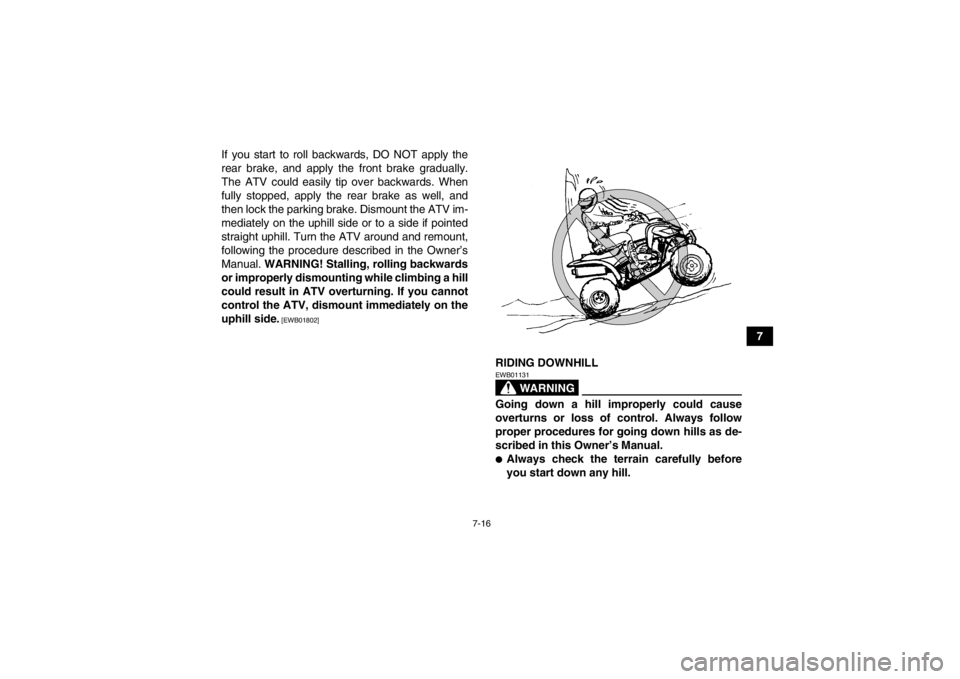
If you start to roll backwards, DO NOT apply the
rear brake, and apply the front brake gradually.
The ATV could easily tip over backwards. When
fully stopped, apply the rear brake as well, and
then lock the parking brake. Dismount the ATV im-
mediately on the uphill side or to a side if pointed
straight uphill. Turn the ATV around and remount,
following the procedure described in the Owner’s
Manual.
WARNING! Stalling, rolling backwards
or improperly dismounting while climbing a hill
could result in ATV overturning. If you cannot
control the ATV, dismount immediately on the
uphill side.
[EWB01802]
RIDING DOWNHILL
WARNING
EWB01131Going down a hill improperly could cause
overturns or loss of control. Always follow
proper procedures for going down hills as de-
scribed in this Owner’s Manual.●Always check the terrain carefully before
you start down any hill.
U1PE61E0.book Page 16 Thursday, April 4, 2013 6:18 PM