clutch YAMAHA YFM700R 2016 User Guide
[x] Cancel search | Manufacturer: YAMAHA, Model Year: 2016, Model line: YFM700R, Model: YAMAHA YFM700R 2016Pages: 160, PDF Size: 3.75 MB
Page 65 of 160
![YAMAHA YFM700R 2016 User Guide 6-3
6
3. Shift into first gear, and then release the
brake. NOTICE: Always close the throttle
before shifting gears, otherwise damage
to the engine and drive train may result.
[ECB01220]
4. Open the](/img/51/53756/w960_53756-64.png "YAMAHA YFM700R 2016 User Guide 6-3
6
3. Shift into first gear, and then release the
brake. NOTICE: Always close the throttle
before shifting gears, otherwise damage
to the engine and drive train may result.
[ECB01220]
4. Open the")
6-3
6
3. Shift into first gear, and then release the
brake. NOTICE: Always close the throttle
before shifting gears, otherwise damage
to the engine and drive train may result.
[ECB01220]
4. Open the throttle gradually and at the same time, release the clutch lever slowly.
WARNING! Opening the throttle abruptly or releasing the clutch lever too quickly
could make the ATV wheelie, which would
increase the chance of an accident, in-
cluding an overturn.
[EWB00732]
5. Once the ATV has attained adequate speed, release the throttle, and at the same time,
quickly pull in the clutch lever.
6. Shift the transmission into second gear. (Make sure not to shift the transmission into
neutral.)
7. Open the throttle part way and gradually re- lease the clutch lever.
8. Follow the same procedure when shifting to the next higher gear.
EBU20652To decelerate
When slowing down or stopping, release the
throttle and apply the brakes smoothly and evenly.
As you slow down, shift to a lower gear. Be sure
that the engine has sufficiently slowed before en-
gaging a lower gear. Improper use of the brakes or
shifting can cause the tires to lose traction, reduc-
ing control and increasing the possibility of an ac-
cident.
WARNING
EWB00711Make sure the engine has sufficiently slowed
before shifting to a lower gear. Engaging a low-
er gear when the engine speed is too high
could make the wheels stop rotating and lose
traction. This could cause loss of control, an
accident and injury. It could also cause engine
or drive train damage. NOTICEECB00181Even with the transmission in the neutral po-
sition, do not coast for long periods of time
with the engine off, and do not tow the ATV
for long distances. The transmission is prop-
U2LS61E0.book Page 3 Friday, April 17, 2015 8:25 AM
Page 66 of 160
6-4
6erly lubricated only when the engine is run-
ning. Inadequate lubrication may damage
the transmission.
Always use the clutch when changing gears.
The engine, transmission and drive train are
not designed to withstand the shock of
forced shifting and can be damaged by shift-
ing without using the clutch.
EBU20503Operating the reverse knob and driving
in reverse
WARNING
EWB00721Improper operation in reverse could make you
hit an obstacle or even a person behind you,
resulting in serious injury. When you shift into
reverse, make sure there are no people or ob-
stacles behind you. When it is safe to proceed,
go slowly. NOTICEECB00171Before shifting, stop the ATV, otherwise the
transmission may be damaged.
1. Bring the ATV to a complete stop, apply the
clutch lever, and then shift the transmission
into first gear.
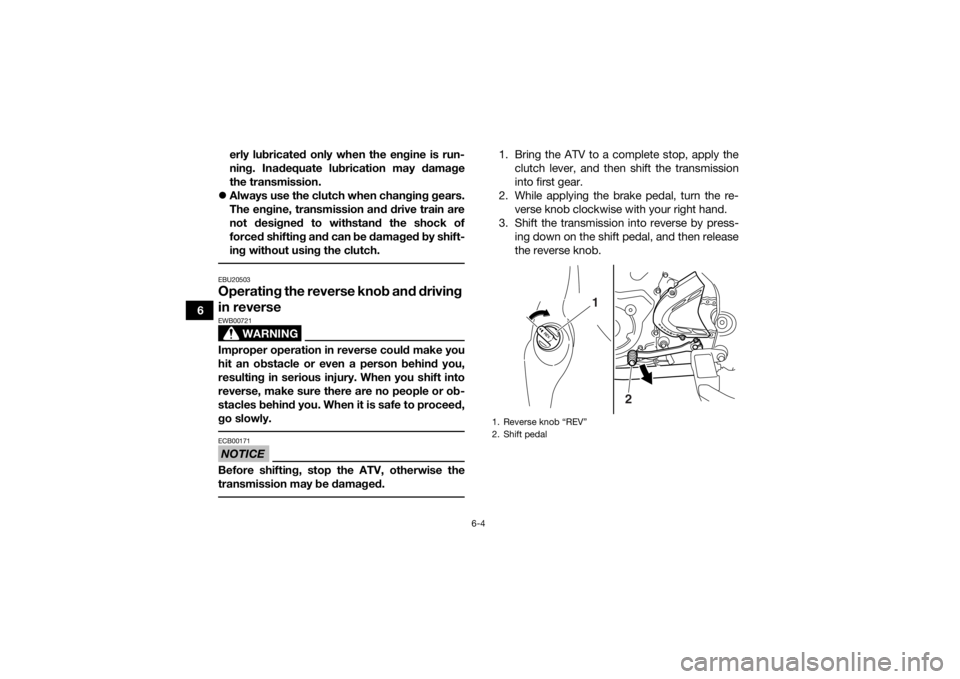
2. While applying the brake pedal, turn the re- verse knob clockwise with your right hand.
3. Shift the transmission into reverse by press- ing down on the shift pedal, and then release
the reverse knob.1. Reverse knob “REV”
2. Shift pedal
2
1
U2LS61E0.book Page 4 Friday, April 17, 2015 8:25 AM
Page 67 of 160
6-5
6
TIPWhen in reverse, the reverse indicator light should
come on. If the indicator light does not come on,
have a Yamaha dealer check the electrical circuit. 4. Check behind you for people or obstacles,and then release the brake pedal.
5. Open the throttle lever gradually and release the clutch lever slowly. Continue to watch to
the rear while backing.EBU20673Engine break-inTIPFor ATVs equipped with an odometer or an hour
meter, follow the figures given in km (mi) or the
figures given in hours.
For ATVs not equipped with an odometer or
hour meter, follow the figures given in hours. There is never a more important period in the life
of your engine than the first 320 km (200 mi) or 20
hours of riding. For this reason, you should read
the following material carefully. Since the engine is brand new, do not put an ex-
cessive load on it for the first 320 km (200 mi) or
20 hours. The various parts in the engine wear and
polish themselves to the correct operating clear-
ances. During this period, prolonged full-throttle
operation or any condition that might result in en-
gine overheating must be avoided.
0–160 km (0–100 mi) or 0–10 hours
Avoid prolonged operation above 1/2 throttle.
Vary the speed of the ATV regularly. Do not oper-
ate it at one set throttle position.
160–320 km (100–200 mi) or 10–20 hours
Avoid prolonged operation above 3/4 throttle. Rev
the engine through the gears freely, but do not use
full throttle at any time.
320 km (200 mi) or 20 hours and beyond
The ATV can now be operated normally.
NOTICEECB00221If any engine trouble should occur during the
engine break-in period, immediately have a
Yamaha dealer check the ATV.
U2LS61E0.book Page 5 Friday, April 17, 2015 8:25 AM
Page 81 of 160

7-11
7
Select a large, flat, unpaved area to become famil-
iar with your ATV. Make sure that this area is free
of obstacles and other riders. You should practice
control of the throttle, brakes, shifting procedures,
and turning techniques in this area before trying
more difficult terrain.
Set the parking brake and follow the instruction on
page 6-1 to start the engine. Once it has warmed
up you are ready to begin riding your ATV. As you
get on the ATV, be sure not to accidentally move
the shift pedal. With the engine idling, pull the
clutch lever to disengage the clutch and shift into
1st gear, and then release the parking brake.
Open the throttle gradually, and at the same time,
release the clutch lever slowly. Once the ATV has
attained adequate speed, release the throttle lever
and at the same time, quickly pull in the clutch le-
ver and shift into 2nd gear. Open the throttle part
way and gradually release the clutch.
WARNING!
If the throttle is applied too abruptly or if the
throttle is not released during shifting, or if the
shift pedal is not released before applying the
throttle, the front wheels may lift off the
ground, resulting in a loss of directional con- trol.
[EWB02632]
NOTICE: Do not shift gears without
releasing the throttle. Damage to the engine or
drive train may occur.
[ECB01072]
Use this same procedure as you move into the
higher gears. Be sure to coordinate the use of the
throttle and shift pedal properly.
Avoid higher speeds until you are thoroughly fa-
miliar with the operation of your ATV.
When slowing down or stopping, release the
throttle and apply the brakes smoothly and evenly.
As you slow down, shift to a lower gear. Be sure
that the engine has sufficiently slowed before en-
gaging a lower gear. Improper use of the brakes or
shifting can cause the tires to lose traction, reduc-
ing control and increasing the possibility of an ac-
cident.
TURNING YOUR ATV
WARNING
EWB01772Always follow proper procedures for turning as
described in this Owner’s Manual. Practice
turning at low speeds before attempting to turn
at faster speeds. Do not turn at speeds too fast
for your skills or the conditions. ATV could go
out of control, causing a collision or overturn.
U2LS61E0.book Page 11 Friday, April 17, 2015 8:25 AM
Page 97 of 160
8-5
8
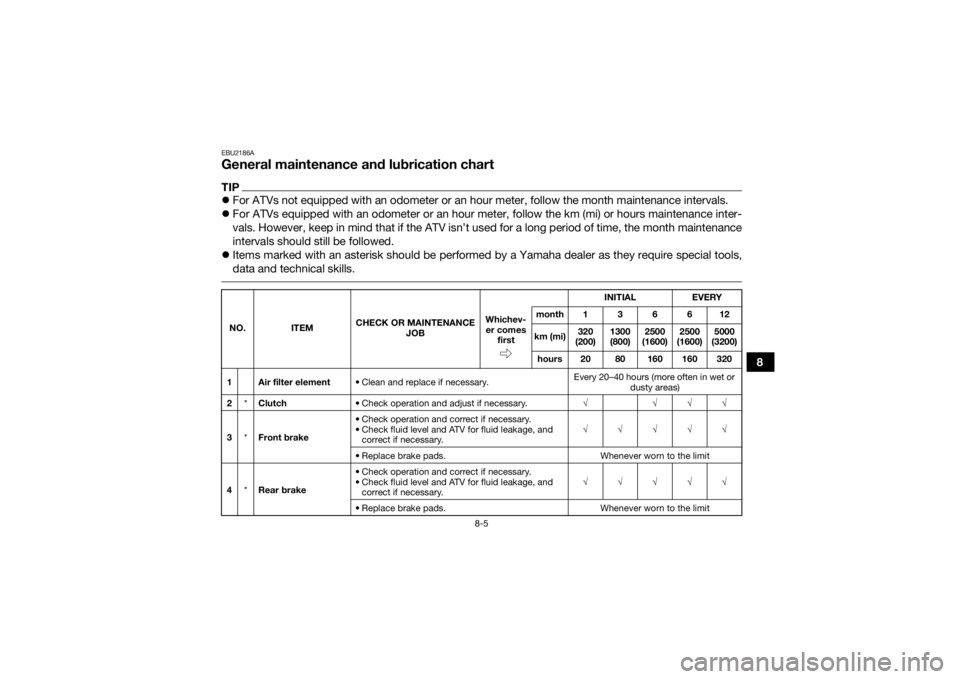
EBU2186AGeneral maintenance and lubrication chartTIPFor ATVs not equipped with an odometer or an hour meter, follow the month maintenance intervals.
For ATVs equipped with an odometer or an hour meter, follow the km (mi) or hours maintenance inter-
vals. However, keep in mind that if the ATV isn’t used for a long period of time, the month maintenance
intervals should still be followed.
Items marked with an asterisk should be performed by a Yamaha dealer as they require special tools,
data and technical skills. NO. ITEM CHECK OR MAINTENANCE
JOB INITIAL
EVERY
Whichev- er comes first month136612
km (mi) 320
(200) 1300
(800) 2500
(1600) 2500
(1600) 5000
(3200)
hours 20 80 160 160 320
1 Air filter element • Clean and replace if necessary. Every 20–40 hours (more often in wet or
dusty areas)
2 *Clutch • Check operation and adjust if necessary. √ √√√
3 *Front brake • Check operation and correct if necessary.
• Check fluid level and ATV for fluid leakage, and
correct if necessary. √√√√√
• Replace brake pads. Whenever worn to the limit
4 *Rear brake • Check operation and correct if necessary.
• Check fluid level and ATV for fluid leakage, and
correct if necessary. √√√√√
• Replace brake pads. Whenever worn to the limit
U2LS61E0.book Page 5 Friday, April 17, 2015 8:25 AM
Page 109 of 160
8-17
8
14. Remove the engine oil tank filler cap, and
then gradually fill the oil tank with the remain-
ing oil quantity while regularly checking the oil
level on the dipstick.
15. Install and tighten the engine oil tank filler cap.
TIPBe sure to wipe off spilled oil on any parts after the
engine and exhaust system have cooled down. NOTICEECB00301In order to prevent clutch slippage (since the
engine oil also lubricates the clutch), do not
mix any chemical additives. Do not use oils
with a diesel specification of “CD” or oils of a higher quality than specified. In addition,
do not use oils labeled “ENERGY CONSERV-
ING II” or higher.
Make sure that no foreign material enters the
crankcase.
16. Start the engine, and then let it idle for several
minutes while checking it for oil leakage. If oil
is leaking, immediately turn the engine off and
check for the cause.
17. Turn the engine off, and then check the oil level and correct it if necessary.EBU23471CoolantThe coolant level should be checked before each
ride. In addition, the coolant must be changed at
the intervals specified in the periodic maintenance
and lubrication chart.EBU27945To check the coolant level1. Place the ATV on a level surface.
Recommended oil:
See page 10-1.
Oil quantity: Without oil filter element replacement:1.75 L (1.85 US qt, 1.54 Imp.qt)
With oil filter element replacement: 1.85 L (1.96 US qt, 1.63 Imp.qt)
U2LS61E0.book Page 17 Friday, April 17, 2015 8:25 AM
Page 128 of 160
![YAMAHA YFM700R 2016 User Guide 8-36
8hold the adjusting bolt with a wrench so
that it does not turn together with the lock-
nut.
[ECB00522]
WARNING
EWB02091Operating with improperly serviced or adjust-
ed brakes could cause the br](/img/51/53756/w960_53756-127.png "YAMAHA YFM700R 2016 User Guide 8-36
8hold the adjusting bolt with a wrench so
that it does not turn together with the lock-
nut.
[ECB00522]
WARNING
EWB02091Operating with improperly serviced or adjust-
ed brakes could cause the br")
8-36
8hold the adjusting bolt with a wrench so
that it does not turn together with the lock-
nut.
[ECB00522]
WARNING
EWB02091Operating with improperly serviced or adjust-
ed brakes could cause the brakes to malfunc-
tion, resulting in reduced braking
performance. This could increase the chance
of a collision or accident. After adjusting the
parking brake free play, block the rear of the
ATV off the ground and spin the rear wheels.
Check to make sure there is no brake drag. If
brake drag is noticed, perform the adjustment
again. EBU24744Brake light switchesThe brake light, which is activated by the brake
pedal and brake lever, should come on just before
braking takes effect. The brake light switch for the brake pedal can be
adjusted as follows, but the front brake light
switch should be adjusted by a Yamaha dealer.
Turn the rear brake light switch adjusting nut while
holding the brake light switch in place. To make
the brake light come on earlier, turn the adjusting
nut in direction (a). To make the brake light come
on later, turn the adjusting nut in direction (b).
EBU29752Adjusting the clutch lever free playThe clutch lever free play must be checked and, if
necessary, adjusted at the intervals specified in
the periodic maintenance and lubrication chart.
Tightening torque:
Locknut (rear brake caliper):16 Nm (1.6 m·kgf, 12 ft·lbf)1. Rear brake light switch
2. Rear brake light switch adjusting nut
1
2
(a)
(b)
U2LS61E0.book Page 36 Friday, April 17, 2015 8:25 AM
Page 129 of 160
8-37
8
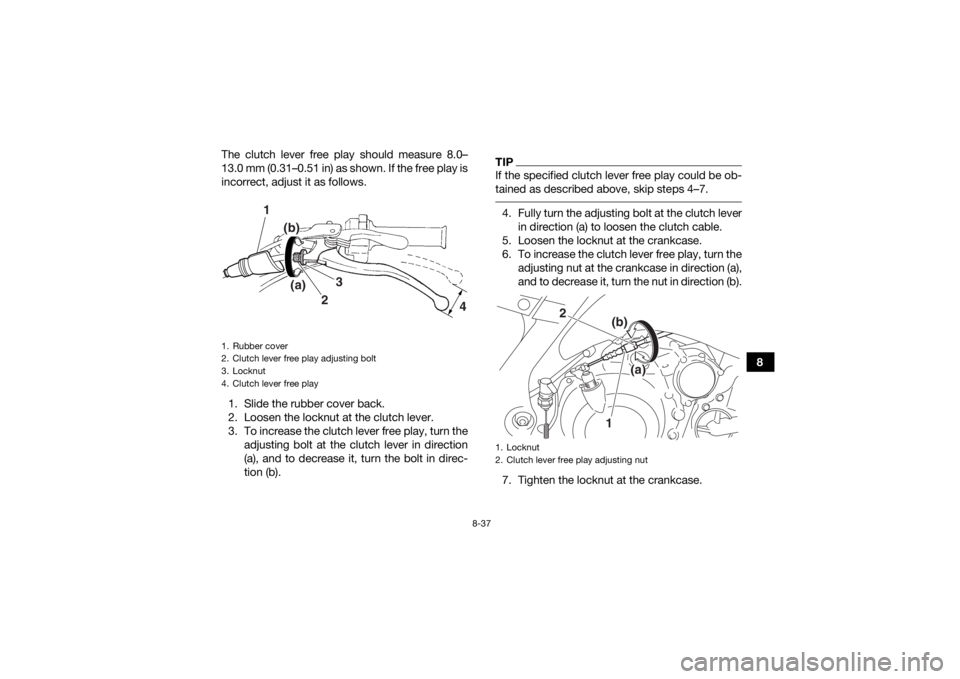
The clutch lever free play should measure 8.0–
13.0 mm (0.31–0.51 in) as shown. If the free play is
incorrect, adjust it as follows.
1. Slide the rubber cover back.
2. Loosen the locknut at the clutch lever.
3. To increase the clutch lever free play, turn the adjusting bolt at the clutch lever in direction
(a), and to decrease it, turn the bolt in direc-
tion (b).
TIPIf the specified clutch lever free play could be ob-
tained as described above, skip steps 4–7. 4. Fully turn the adjusting bolt at the clutch leverin direction (a) to loosen the clutch cable.
5. Loosen the locknut at the crankcase.
6. To increase the clutch lever free play, turn the adjusting nut at the crankcase in direction (a),
and to decrease it, turn the nut in direction (b).
7. Tighten the locknut at the crankcase.
1. Rubber cover
2. Clutch lever free play adjusting bolt
3. Locknut
4. Clutch lever free play
3
1
2
(a)
(b)
4
1. Locknut
2. Clutch lever free play adjusting nut
1
2
(a)
(b)
U2LS61E0.book Page 37 Friday, April 17, 2015 8:25 AM
Page 130 of 160
8-38
88. Tighten the locknut at the clutch lever, and
then slide the rubber cover to its original po-
sition.
TIPIf the specified free play cannot be obtained as de-
scribed above or if the clutch does not operate
correctly, have a Yamaha dealer check the internal
clutch mechanism. EBU26865Drive chain slackThe drive chain slack should be checked before
each ride and adjusted if necessary.
To check the drive chain slack1. Place the ATV on a level surface.TIPWhen checking and adjusting the drive chain
slack, there should be no weight on the ATV and
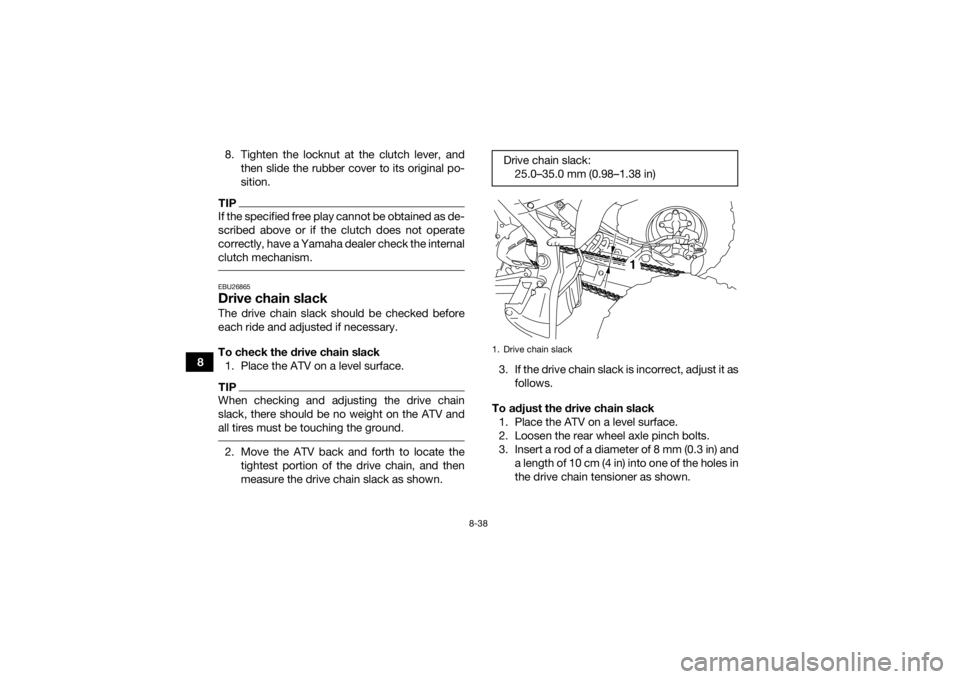
all tires must be touching the ground. 2. Move the ATV back and forth to locate the tightest portion of the drive chain, and then
measure the drive chain slack as shown. 3. If the drive chain slack is incorrect, adjust it as
follows.
To adjust the drive chain slack 1. Place the ATV on a level surface.
2. Loosen the rear wheel axle pinch bolts.
3. Insert a rod of a diameter of 8 mm (0.3 in) and a length of 10 cm (4 in) into one of the holes in
the drive chain tensioner as shown.
Drive chain slack:
25.0–35.0 mm (0.98–1.38 in)
1. Drive chain slack
1
U2LS61E0.book Page 38 Friday, April 17, 2015 8:25 AM
Page 133 of 160
8-41
8
essary. If a cable is damaged or does not move
smoothly, have a Yamaha dealer check or replace
it.
WARNING
EWB02582
Inspect cables frequently and replace if
damaged. Corrosion can result when the ca-
ble sheaths become damaged, and cables
can also become frayed or kinked, which
could restrict the operation of controls and
lead to an accident or injury.
Always make sure all control cables work
smoothly before you begin riding in cold
weather. If the control cables are frozen or
do not work smoothly, you could be unable
to control the ATV, which could lead to an
accident or collision.
EBU24923Checking and lubricating the brake
and clutch leversThe operation of the brake and clutch levers
should be checked before each ride, and the lever
pivots should be lubricated if necessary.EBUM0171Checking the shift pedalThe operation of the shift pedal should be
checked before each ride. If operation is not
smooth, have a Yamaha dealer check the vehicle.EBU28872Checking and lubricating the brake
pedalThe operation of the brake pedal should be
checked before each ride, and the pedal pivot
should be lubricated if necessary.
Recommended lubricant:
Yamaha cable lubricant or other suitable cable lubricantRecommended lubricants: Brake lever:Silicone grease
Clutch lever: Lithium-soap-based grease
U2LS61E0.book Page 41 Friday, April 17, 2015 8:25 AM