weight YAMAHA YFM80 2002 User Guide
[x] Cancel search | Manufacturer: YAMAHA, Model Year: 2002, Model line: YFM80, Model: YAMAHA YFM80 2002Pages: 336, PDF Size: 3.94 MB
Page 207 of 336
7-55
w
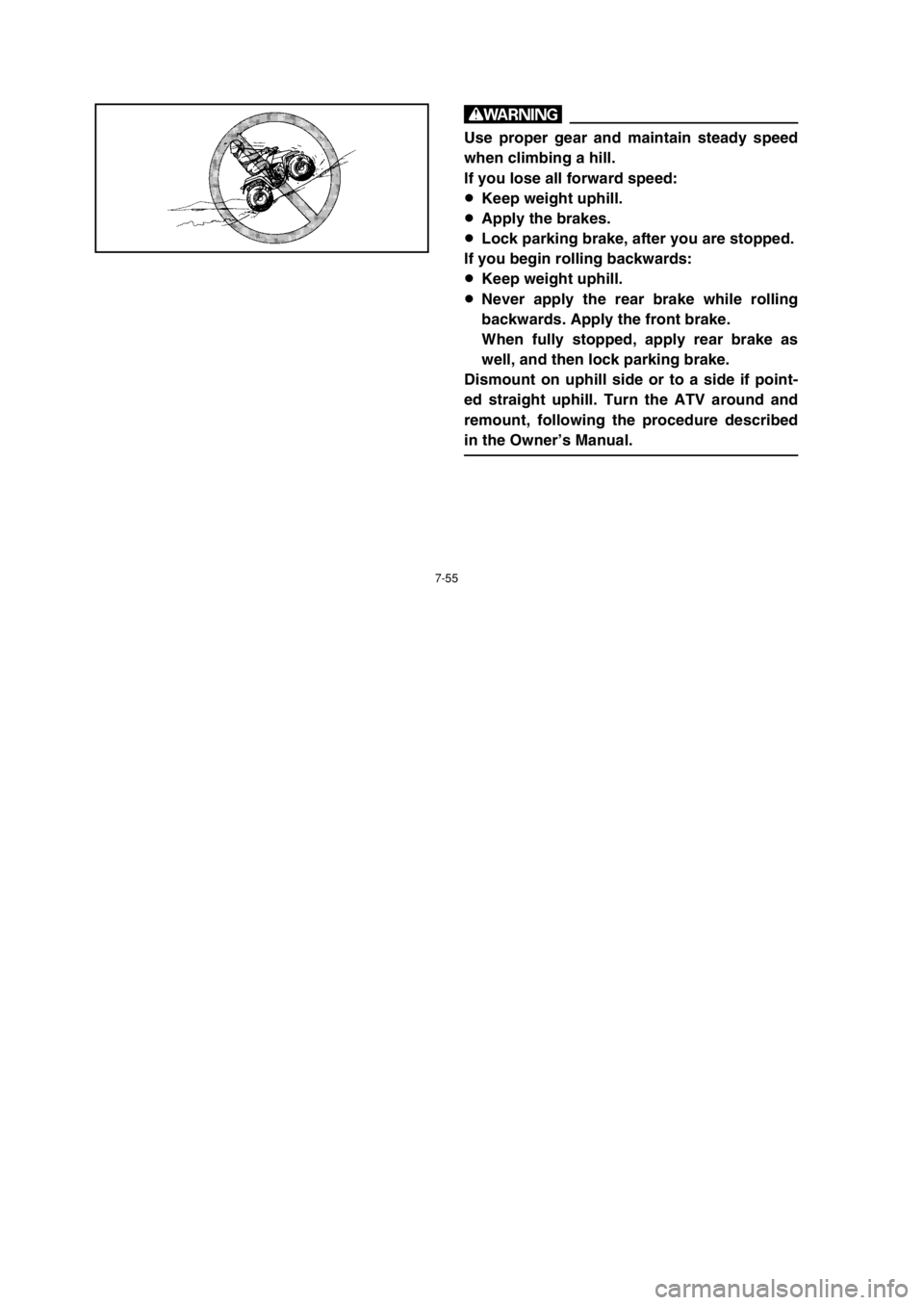
Use proper gear and maintain steady speed
when climbing a hill.
If you lose all forward speed:
8Keep weight uphill.
8Apply the brakes.
8Lock parking brake, after you are stopped.
If you begin rolling backwards:
8Keep weight uphill.
8Never apply the rear brake while rolling
backwards. Apply the front brake.
When fully stopped, apply rear brake as
well, and then lock parking brake.
Dismount on uphill side or to a side if point-
ed straight uphill. Turn the ATV around and
remount, following the procedure described
in the Owner’s Manual.
5NE-9-61 7 4/26/01 1:27 PM Page 198
Page 209 of 336

7-57
RIDING DOWNHILL
When riding your ATV downhill, shift your weight
as far to the rear and uphill side of the ATV as
possible. Move back on the seat and sit with
your arms straight. Choose a low gear which will
allow the engine compression to do most of the
braking for you. Improper braking may cause a
loss of traction.
Use caution while descending a hill with loose or
slippery surfaces. Braking ability and traction
may be adversely affected by these surfaces.
Improper braking may also cause a loss of trac-
tion.
Whenever possible, ride your ATV straight
downhill. Avoid sharp angles which could allow
the ATV to tip or roll over. Carefully choose your
path and ride no faster than you will be able to
react to obstacles which may appear.
5NE-9-61 7 4/26/01 1:27 PM Page 200
Page 211 of 336
7-59
w
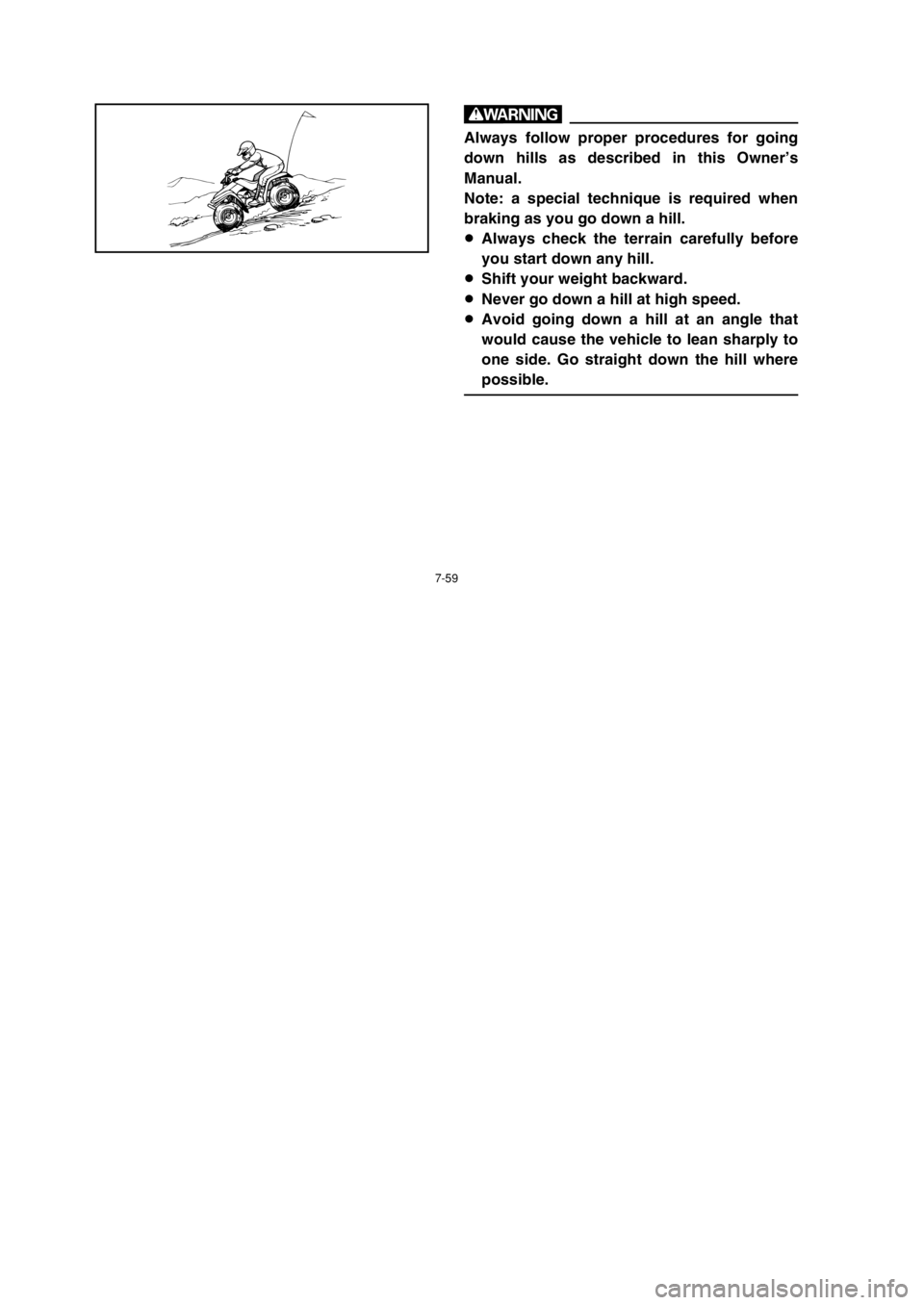
Always follow proper procedures for going
down hills as described in this Owner’s
Manual.
Note: a special technique is required when
braking as you go down a hill.
8Always check the terrain carefully before
you start down any hill.
8Shift your weight backward.
8Never go down a hill at high speed.
8Avoid going down a hill at an angle that
would cause the vehicle to lean sharply to
one side. Go straight down the hill where
possible.OK
5NE-9-61 7 4/26/01 1:27 PM Page 202
Page 213 of 336

7-61
CROSSING A SLOPE
Traversing a sloping surface on your ATV
requires you to properly position your weight to
maintain proper balance. Be sure that you have
learned the basic riding skills on flat ground
before attempting to cross a sloping surface.
Avoid slopes with slippery surfaces or rough ter-
rain that may upset your balance.
As you travel across a slope, lean your body in
the uphill direction. It may be necessary to cor-
rect the steering when riding on loose surfaces
by pointing the front wheels slightly uphill. When
riding on slopes be sure not to make sharp turns
either up or down hill.
5NE-9-61 7 4/26/01 1:27 PM Page 204
Page 215 of 336
7-63
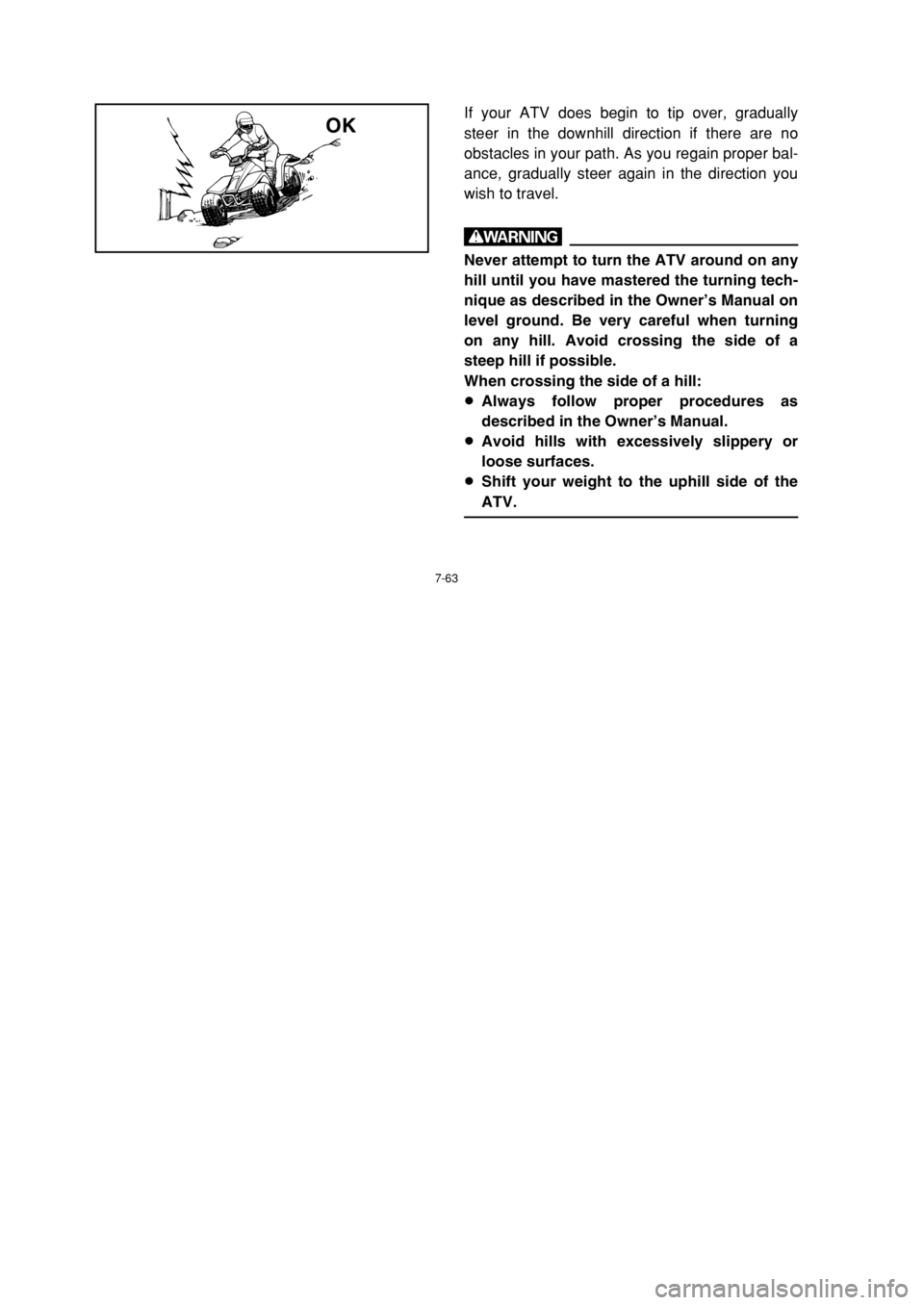
If your ATV does begin to tip over, gradually
steer in the downhill direction if there are no
obstacles in your path. As you regain proper bal-
ance, gradually steer again in the direction you
wish to travel.
w
Never attempt to turn the ATV around on any
hill until you have mastered the turning tech-
nique as described in the Owner’s Manual on
level ground. Be very careful when turning
on any hill. Avoid crossing the side of a
steep hill if possible.
When crossing the side of a hill:
8Always follow proper procedures as
described in the Owner’s Manual.
8Avoid hills with excessively slippery or
loose surfaces.
8Shift your weight to the uphill side of the
ATV.
OKOK
5NE-9-61 7 4/26/01 1:27 PM Page 206
Page 223 of 336
7-71
SLIDING AND SKIDDING
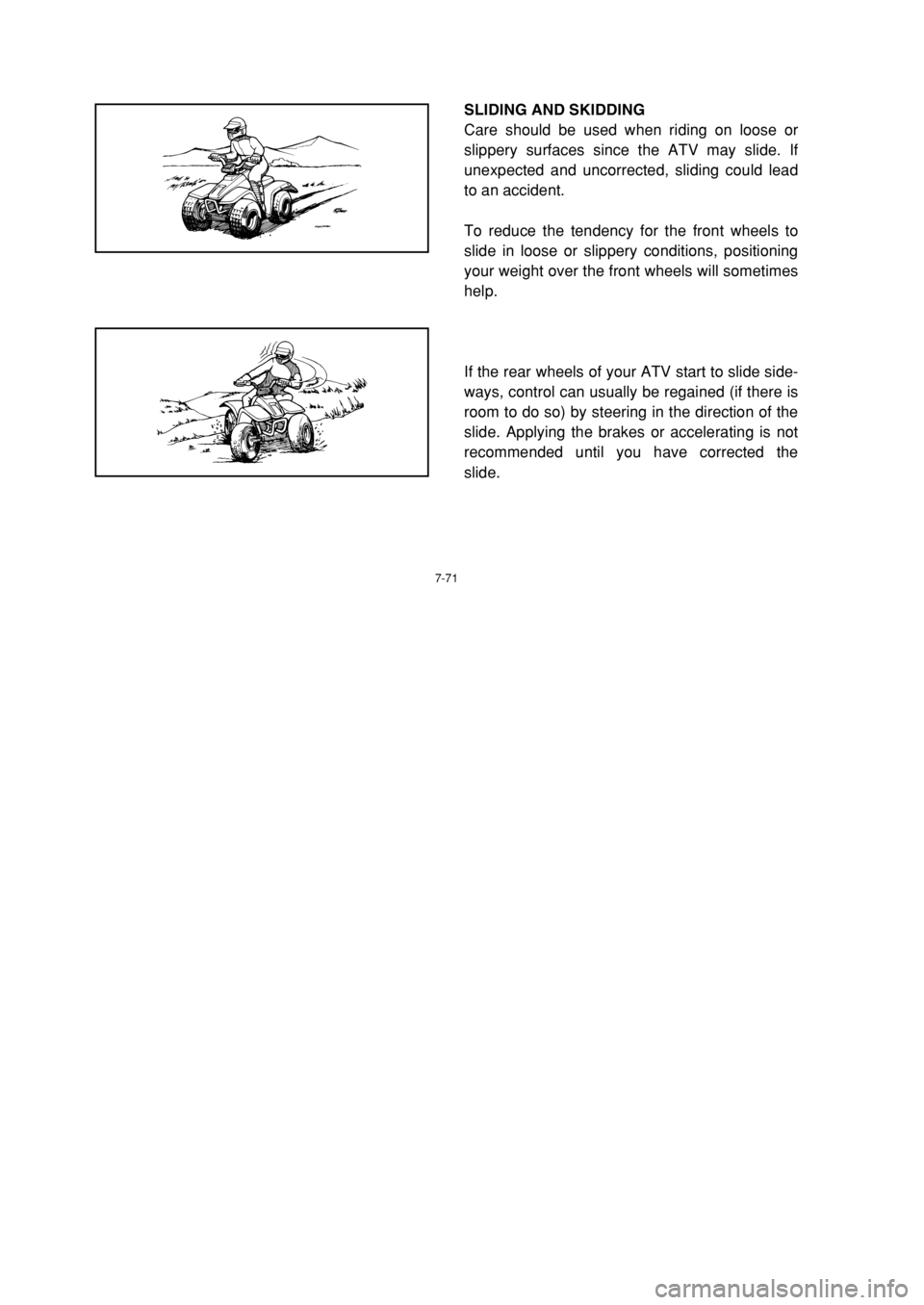
Care should be used when riding on loose or
slippery surfaces since the ATV may slide. If
unexpected and uncorrected, sliding could lead
to an accident.
To reduce the tendency for the front wheels to
slide in loose or slippery conditions, positioning
your weight over the front wheels will sometimes
help.
If the rear wheels of your ATV start to slide side-
ways, control can usually be regained (if there is
room to do so) by steering in the direction of the
slide. Applying the brakes or accelerating is not
recommended until you have corrected the
slide.
5NE-9-61 7 4/26/01 1:28 PM Page 214
Page 227 of 336

7-75
WHAT TO DO IF ...
This section is designed to be a reference guide
only. Be sure to read each section on riding
techniques completely.
WHAT TO DO ...
8If your ATV doesn’t turn when you want it to:
Bring the ATV to a stop and practice the turn-
ing maneuvers again. Be sure you are putting
your weight on the footboard to the outside of
the turn. Position your weight over the front
wheels for better control. (See pages 7-41 ~
7-45.)
8If your ATV begins to tip while turning:
Lean more into the turn to regain balance. If
necessary, gradually let off the throttle and/or
steer to the outside of the turn. (See pages
7-41 ~ 7-45.)
5NE-9-61 7 4/26/01 1:28 PM Page 218
Page 231 of 336

7-79
8If your ATV is traversing a sloping surface:
Be sure to ride with your weight positioned
towards the uphill side of the ATV to maintain
proper balance. If the ATV starts to tip, steer
down the hill (if there are no obstacles in your
way) to regain balance. If you discover that
the ATV is going to tip over, dismount on the
uphill side. (See pages 7-61 ~ 7-63.)
8If your ATV encounters shallow water:
Ride slowly and carefully through slow moving
water, watching for obstacles. Be sure to let
water drain from the ATV and CHECK YOUR
BRAKES FOR PROPER OPERATION when
you come out of the water. Do not continue to
ride your ATV until you have regained ade-
quate braking ability. (See pages 7-65 ~ 7-67.)
5NE-9-61 7 4/26/01 1:28 PM Page 222
Page 317 of 336
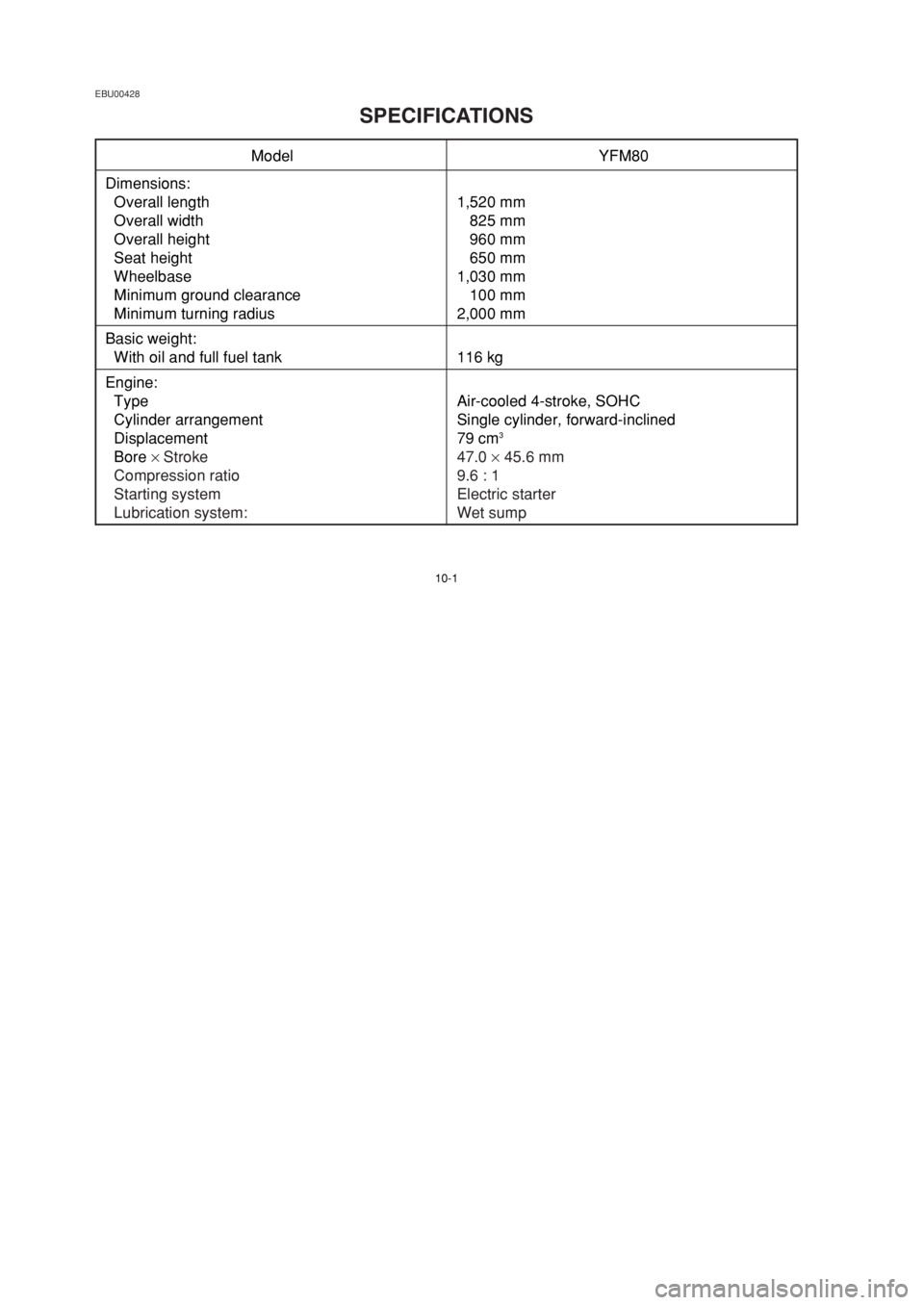
10-1
Model YFM80
Dimensions:
Overall length 1,520 mm
Overall width 825 mm
Overall height 960 mm
Seat height 650 mm
Wheelbase 1,030 mm
Minimum ground clearance 100 mm
Minimum turning radius 2,000 mm
Basic weight:
With oil and full fuel tank 116 kg
Engine:
Type Air-cooled 4-stroke, SOHC
Cylinder arrangement Single cylinder, forward-inclined
Displacement 79 cm
3
Bore × Stroke 47.0 ×45.6 mm
Compression ratio 9.6 : 1
Starting system Electric starter
Lubrication system: Wet sump
EBU00428
SPECIFICATIONS
5NE-9-61 9~ 4/26/01 1:30 PM Page 308
Page 333 of 336

11-1
EBU00429
HOW TO USE THE CONVERSION TABLE
All specification data in this manual are listed in
SI and METRIC UNITS.
Use this table to convert METRIC unit data to
IMPERIAL unit data.
Ex.
METRIC MULTIPLIER IMPERIAL
** mm×0.03937 = ** in
2 mm×0.03937 = 0.08 in
CONVERSION TABLE
METRIC TO IMPERIAL
Metric unit Multiplier Imperial unit
m•kg 7.233 ft•lb
m•kg 86.794 in•lb
Torque
cm•kg 0.0723 ft•lb
cm•kg 0.8679 in•lb
kg 2.205 lb
Weight
g 0.03527 oz
Speed km/hr 0.6214 mph
km 0.6214 mi
m 3.281 ft
Distance m 1.094 yd
cm 0.3937 in
mm 0.03937 in
cc (cm
3) 0.03527 oz (IMP liq.)
Volume/ cc (cm3) 0.06102 cu•in
Capacity lt (liter) 0.8799 qt (IMP liq.)
lt (liter) 0.2199 gal (IMP liq.)
kg/mm 55.997 lb/in
Misc. kg/cm
214.2234 psi (lb/in2)
Centigrade (°C)9/5 + 32 Fahrenheit (°F)
5NE-9-61 9~ 4/26/01 1:30 PM Page 324