light YAMAHA YFM90 2016 User Guide
[x] Cancel search | Manufacturer: YAMAHA, Model Year: 2016, Model line: YFM90, Model: YAMAHA YFM90 2016Pages: 128, PDF Size: 5.34 MB
Page 53 of 128
6-4
6
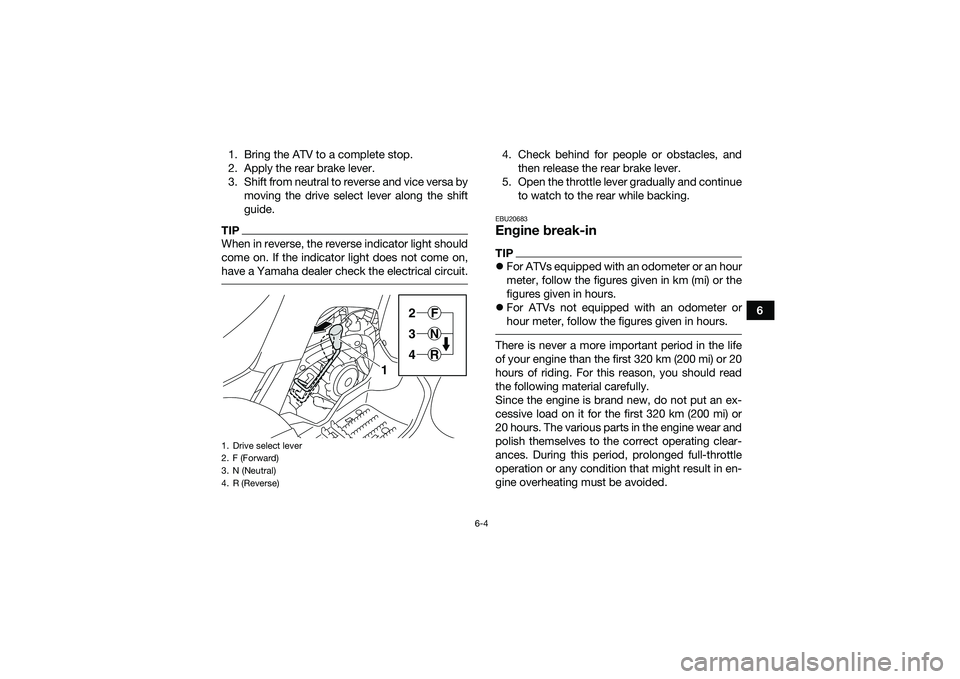
1. Bring the ATV to a complete stop.
2. Apply the rear brake lever.
3. Shift from neutral to reverse and vice versa by
moving the drive select lever along the shift
guide.
TIPWhen in reverse, the reverse indicator light should
come on. If the indicator light does not come on,
have a Yamaha dealer check the electrical circuit.
4. Check behind for people or obstacles, andthen release the rear brake lever.
5. Open the throttle lever gradually and continue to watch to the rear while backing.EBU20683Engine break-inTIPFor ATVs equipped with an odometer or an hour
meter, follow the figures given in km (mi) or the
figures given in hours.
For ATVs not equipped with an odometer or
hour meter, follow the figures given in hours. There is never a more important period in the life
of your engine than the first 320 km (200 mi) or 20
hours of riding. For this reason, you should read
the following material carefully.
Since the engine is brand new, do not put an ex-
cessive load on it for the first 320 km (200 mi) or
20 hours. The various parts in the engine wear and
polish themselves to the correct operating clear-
ances. During this period, prolonged full-throttle
operation or any condition that might result in en-
gine overheating must be avoided.
1. Drive select lever
2. F (Forward)
3. N (Neutral)
4. R (Reverse)
FNR
234
1
UBD360E0.book Page 4 Wednesd ay, February 25, 2015 2:41 PM
Page 69 of 128
7-12
7
abruptly, the vehicle may lurch forward or the front
wheels may lift off the ground, resulting in a loss of
directional control. Avoid higher speeds until you
are thoroughly familiar with the operation of your
ATV.
When slowing down or stopping, release the
throttle and apply the brakes smoothly and evenly.
Improper use of the brakes can cause the tires to
lose traction, reducing control and increasing the
possibility of an accident.
TURNING YOUR ATV
WARNING
EWB01772Always follow proper procedures for turning as
described in this Owner’s Manual. Practice
turning at low speeds before attempting to turn
at faster speeds. Do not turn at speeds too fast
for your skills or the conditions. ATV could go
out of control, causing a collision or overturn. To achieve maximum traction on unpaved surfac-
es, the two rear wheels turn together at the same
speed. Therefore, unless the wheel on the inside
of the turn is allowed to slip or lose some traction,
the ATV will resist turning. A special turning tech- nique must be used to allow the ATV to make
turns quickly and easily. It is essential that this skill
be learned first at low speed.
As you approach a curve, slow down and begin to
turn the handlebars in the desired direction. As
you do so, put your weight on the footboard to the
outside of the turn (opposite your desired direc-
tion) and lean your upper body into the turn. Use
the throttle to maintain an even speed through the
turn. This maneuver will let the wheel on the inside
of the turn slip slightly, allowing the ATV to make
the turn properly.UBD360E0.book Page 12 Wednesd
ay, February 25, 2015 2:41 PM
Page 75 of 128
7-18
7
Never attempt to turn the ATV around on any
hill until you have mastered the turning tech-
nique as described in the Owner’s Manual on
level ground. Be very careful when turning
on any hill.
Traversing a sloping surface on your ATV requires
you to properly position your weight to maintain
proper balance. Be sure that you have learned the
basic riding skills on flat ground before attempting
to cross a sloping surface. Avoid slopes with slip-
pery surfaces or rough terrain that may upset your
balance.
As you travel across a slope, lean your body in the
uphill direction. It may be necessary to correct the
steering when riding on loose surfaces by pointing
the front wheels slightly uphill. When riding on
slopes, be sure not to make sharp turns either up
or down hill.
If your ATV does begin to tip over, gradually steer
in the downhill direction if there are no obstacles
in your path. As you regain proper balance, grad-
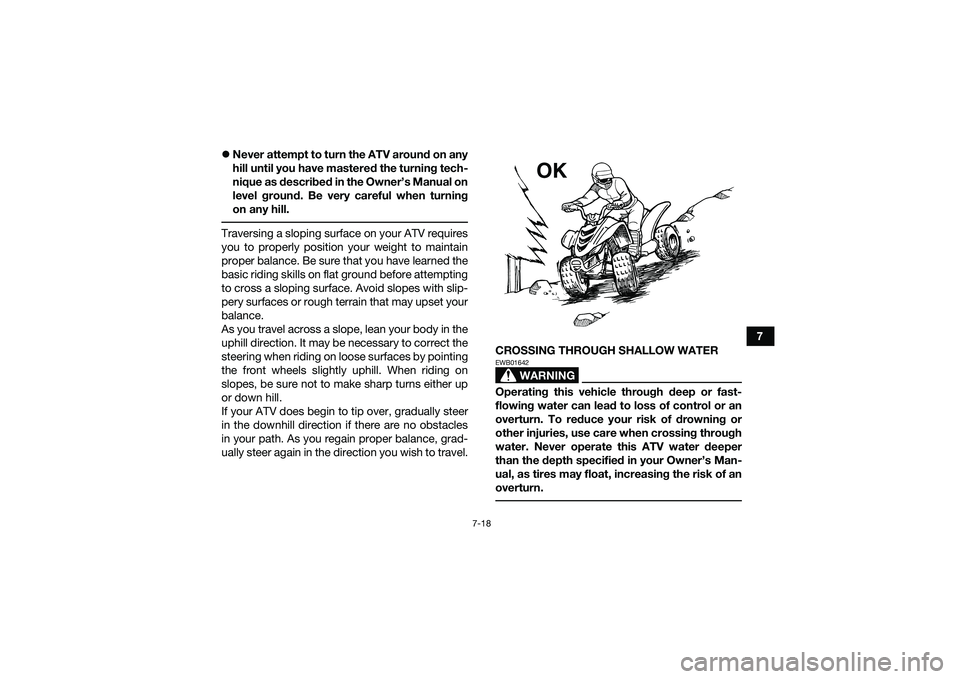
ually steer again in the direction you wish to travel. CROSSING THROUGH SHALLOW WATER
WARNING
EWB01642Operating this vehicle through deep or fast-
flowing water can lead to loss of control or an
overturn. To reduce your risk of drowning or
other injuries, use care when crossing through
water. Never operate this ATV water deeper
than the depth specified in your Owner’s Man-
ual, as tires may float, increasing the risk of an
overturn.
OK
UBD360E0.book Page 18 Wednesd
ay, February 25, 2015 2:41 PM
Page 88 of 128
8-9
8
EBU23214Checking the spark plugThe spark plug is an important engine component,
which is easy to check. Since heat and deposits
will cause any spark plug to slowly erode, the
spark plug should be removed and checked in ac-
cordance with the periodic maintenance and lubri-
cation chart. In addition, the condition of the spark
plug can reveal the condition of the engine.
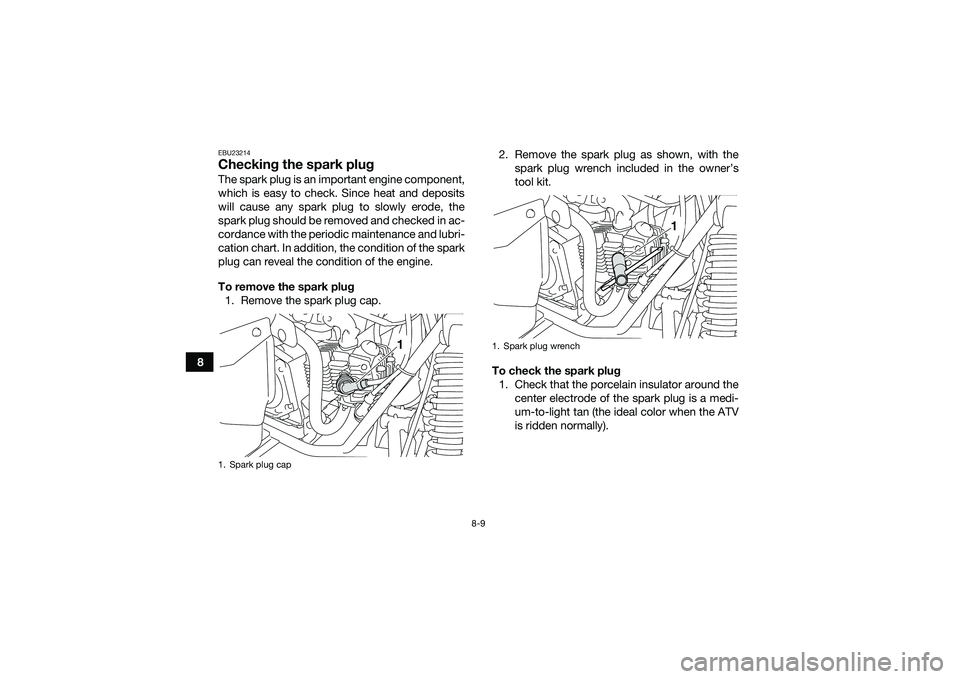
To remove the spark plug1. Remove the spark plug cap. 2. Remove the spark plug as shown, with the
spark plug wrench included in the owner’s
tool kit.
To check the spark plug 1. Check that the porcelain insulator around the center electrode of the spark plug is a medi-
um-to-light tan (the ideal color when the ATV
is ridden normally).1. Spark plug cap
1
1. Spark plug wrench
1
UBD360E0.book Page 9 Wednesd ay, February 25, 2015 2:41 PM
Page 98 of 128
8-19
83. Tap the spark arrester lightly, and then use a
wire brush to remove any carbon deposits.
4. Insert the spark arrester into the muffler and align the bolt hole.
5. Install the tailpipe bolt and nut, and then tight- en the nut to the specified torque.
WARNING
EWB02341Do not start the engine when cleaning the
spark arrester, otherwise it could cause injury
to the eyes, burns, carbon monoxide poison-
ing, possibly leading to death, and start a fire.
Always let the exhaust system cool prior to
touching exhaust components. EBU23941Adjusting the carburetorThe carburetor should be checked and, if neces-
sary, adjusted at the intervals specified in the pe-
riodic maintenance and lubrication chart. The
carburetor is an important part of the engine and
requires very sophisticated adjustment. There- fore, most carburetor adjustments should be left
to a Yamaha dealer, who has the necessary pro-
fessional knowledge and experience. The adjust-
ment described in the following section, however,
may be performed by the owner as part of routine
maintenance.
NOTICEECB00481The carburetor has been set and extensively
tested at the Yamaha factory. Changing these
settings without sufficient technical knowl-
edge may result in poor performance of or
damage to the engine. EBU24001Adjusting the engine idling speedThe engine idling speed must be checked and, if
necessary, adjusted as follows at the intervals
specified in the periodic maintenance and lubrica-
tion chart.TIPA diagnostic tachometer is needed to make this
adjustment. 1. Start the engine and warm it up.
Tightening torque:
Tailpipe nut:10 Nm (1.0 m·kgf, 7.2 ft·lbf)
UBD360E0.book Page 19 Wednesd ay, February 25, 2015 2:41 PM
Page 114 of 128
8-35
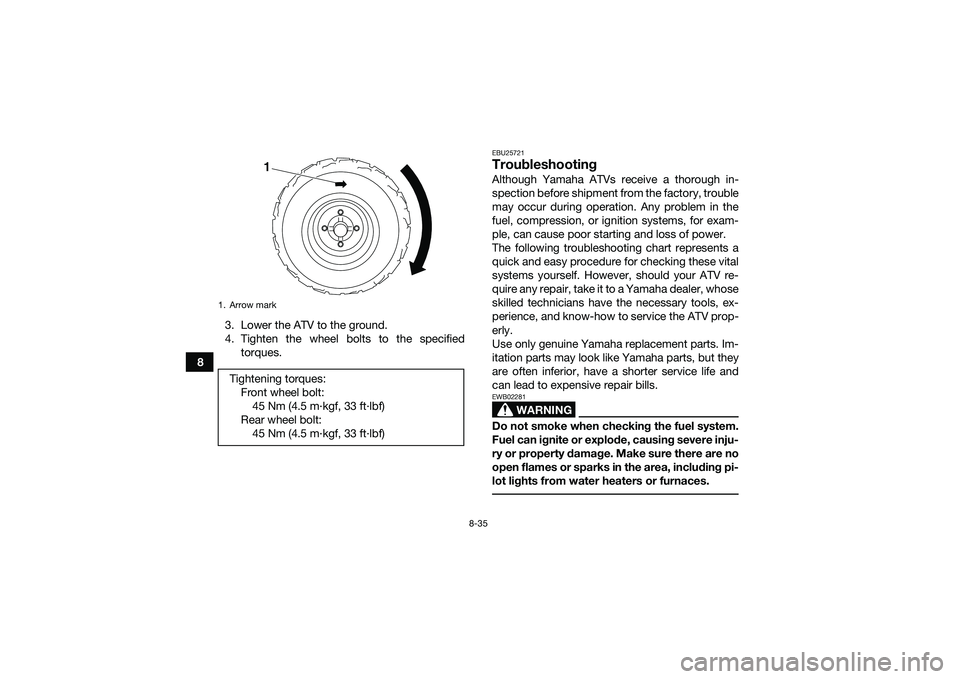
83. Lower the ATV to the ground.
4. Tighten the wheel bolts to the specified
torques.
EBU25721TroubleshootingAlthough Yamaha ATVs receive a thorough in-
spection before shipment from the factory, trouble
may occur during operation. Any problem in the
fuel, compression, or ignition systems, for exam-
ple, can cause poor starting and loss of power.
The following troubleshooting chart represents a
quick and easy procedure for checking these vital
systems yourself. However, should your ATV re-
quire any repair, take it to a Yamaha dealer, whose
skilled technicians have the necessary tools, ex-
perience, and know-how to service the ATV prop-
erly.
Use only genuine Yamaha replacement parts. Im-
itation parts may look like Yamaha parts, but they
are often inferior, have a shorter service life and
can lead to expensive repair bills.
WARNING
EWB02281Do not smoke when checking the fuel system.
Fuel can ignite or explode, causing severe inju-
ry or property damage. Make sure there are no
open flames or sparks in the area, including pi-
lot lights from water heaters or furnaces.
1. Arrow markTightening torques:Front wheel bolt:45 Nm (4.5 m·kgf, 33 ft·lbf)
Rear wheel bolt: 45 Nm (4.5 m·kgf, 33 ft·lbf)
1
UBD360E0.book Page 35 Wednesd ay, February 25, 2015 2:41 PM
Page 122 of 128
10-4
10
Bulb voltage, wattage × quantity:Neutral indicator light:
12 V, 3.5 W × 1
Reverse indicator light:
12 V, 3.5 W × 1Fuse:Fuse:
7.5 AEBU30402For Europe only
The figures quoted are emission levels and are not
necessarily safe working levels. Whilst there is a
correlation between the emission and exposure
levels, this cannot be used reliably to determine
whether or not further precautions are required.
Factors that influence the actual level of exposure
of work-force include the characteristics of the
work room, the other sources of noise, etc. i.e. the
number of machines and other adjacent process-
es, and the length of time for which an operator is
exposed to the noise. Also the permissible expo-
sure level can vary from country. This information,
however, will enable the user of the machine to
make a better evaluation of the hazard and risk.UBD360E0.book Page 4 Wednesd ay, February 25, 2015 2:41 PM
Page 125 of 128
12-1
12
INDEX
AAccessories and loading ................................................ 6-6
Air filter element, cleaning ........................................... 8-15BBattery ......................................................................... 8-31
Brake lever free play, adjusting the front ..................... 8-22
Brake lever free play (rear), adjusting .......................... 8-24
Brake lever, front ........................................................... 4-4
Brake lever, rear ............................................................. 4-5
Brake levers, checking and lubricating ........................ 8-29
Brakes .......................................................................... 8-21
Brakes, front and rear .................................................... 5-3CCables, checking and lubricating ................................ 8-28
Carburetor, adjusting ................................................... 8-19
Chassis fasteners .......................................................... 5-6
Cleaning ......................................................................... 9-1DDrive chain ..................................................................... 5-3
Drive chain, lubricating ................................................ 8-27
Drive chain slack .......................................................... 8-25
Drive select lever ........................................................... 4-6
Drive select lever and driving in reverse ........................ 6-3EEngine break-in .............................................................. 6-4
Engine, cold start ........................................................... 6-1
Engine idling speed ..................................................... 8-19
Engine oil ..............................................................5-3, 8-11
Engine, starting a warm ................................................. 6-3Engine stop switch ........................................................ 4-2
FFront and rear brake shoes, checking ......................... 8-21
Front knuckle pivots, lubricating ................................. 8-30
Fuel ......................................................................... 4-8, 5-3
Fuel cock ..................................................................... 4-10
Fuel tank cap ................................................................. 4-8
Fuse, replacing ............................................................ 8-33HHandlebar switches ....................................................... 4-2IIdentification numbers ................................................. 11-1
Indicator lights ............................................................... 4-1
Instruments and switches .............................................. 5-6KKickstarter ...................................................................... 4-7LLabel locations ............................................................... 1-1MMain switch .................................................................... 4-1
Maintenance and lubrication chart ................................ 8-5
Maintenance chart, emission control system ................ 8-3
Model label .................................................................. 11-1NNeutral indicator light .................................................... 4-1OOwner’s manual and tool kit .......................................... 8-2PParking ........................................................................... 6-5
UBD360E0.book Page 1 Wednesd
ay, February 25, 2015 2:41 PM
Page 126 of 128
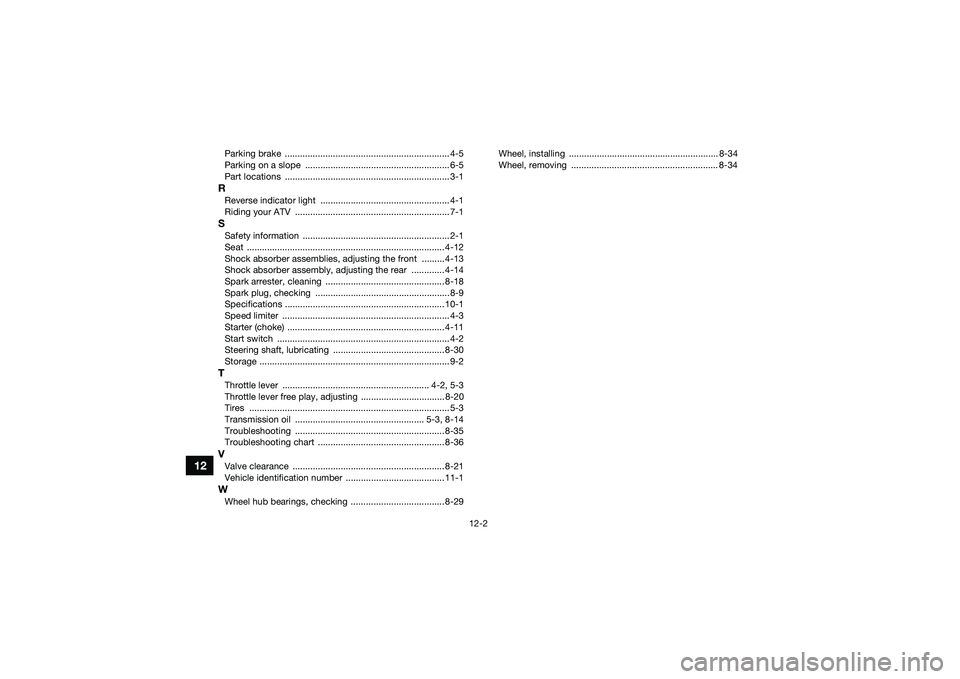
12-2
12
Parking brake ................................................................. 4-5
Parking on a slope ......................................................... 6-5
Part locations ................................................................. 3-1RReverse indicator light ................................................... 4-1
Riding your ATV ............................................................. 7-1SSafety information .......................................................... 2-1
Seat .............................................................................. 4-12
Shock absorber assemblies, adjusting the front .........4-13
Shock absorber assembly, adjusting the rear ............. 4-14
Spark arrester, cleaning ............................................... 8-18
Spark plug, checking .....................................................8-9
Specifications ............................................................... 10-1
Speed limiter .................................................................. 4-3
Starter (choke) .............................................................. 4-11
Start switch .................................................................... 4-2
Steering shaft, lubricating ............................................ 8-30
Storage ........................................................................... 9-2TThrottle lever .......................................................... 4-2, 5-3
Throttle lever free play, adjusting ................................. 8-20
Tires ............................................................................... 5-3
Transmission oil ................................................... 5-3, 8-14
Troubleshooting ........................................................... 8-35
Troubleshooting chart .................................................. 8-36VValve clearance ............................................................ 8-21
Vehicle identification number ....................................... 11-1WWheel hub bearings, checking ..................................... 8-29Wheel, installing ........................................................... 8-34
Wheel, removing .......................................................... 8-34UBD360E0.book Page 2 Wednesd
ay, February 25, 2015 2:41 PM