lock YAMAHA YFM90 2017 User Guide
[x] Cancel search | Manufacturer: YAMAHA, Model Year: 2017, Model line: YFM90, Model: YAMAHA YFM90 2017Pages: 130, PDF Size: 4.85 MB
Page 75 of 130
7-15
7
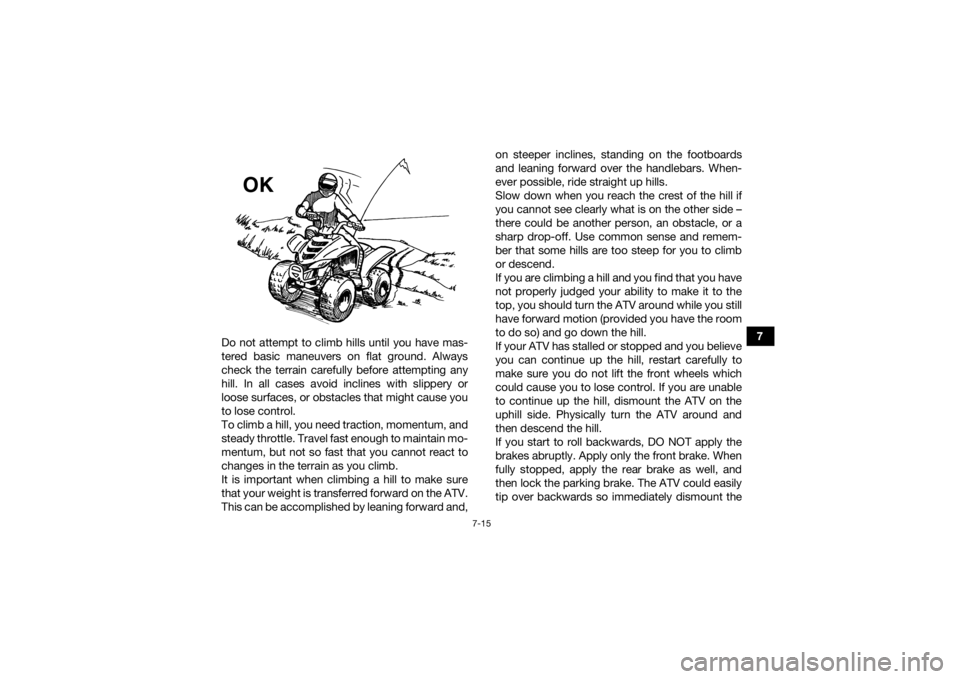
Do not attempt to climb hills until you have mas-
tered basic maneuvers on flat ground. Always
check the terrain carefully before attempting any
hill. In all cases avoid inclines with slippery or
loose surfaces, or obstacles that might cause you
to lose control.
To climb a hill, you need traction, momentum, and
steady throttle. Travel fast enough to maintain mo-
mentum, but not so fast that you cannot react to
changes in the terrain as you climb.
It is important when climbing a hill to make sure
that your weight is transferred forward on the ATV.
This can be accomplished by leaning forward and, on steeper inclines, standing on the footboards
and leaning forward over the handlebars. When-
ever possible, ride straight up hills.
Slow down when you reach the crest of the hill if
you cannot see clearly what is on the other side –
there could be another person, an obstacle, or a
sharp drop-off. Use common sense and remem-
ber that some hills are too steep for you to climb
or descend.
If you are climbing a hill and you find that you have
not properly judged your ability to make it to the
top, you should turn the ATV around while you still
have forward motion (provided you have the room
to do so) and go down the hill.
If your ATV has stalled or stopped and you believe
you can continue up the hill, restart carefully to
make sure you do not lift the front wheels which
could cause you to lose control. If you are unable
to continue up the hill, dismount the ATV on the
uphill side. Physically turn the ATV around and
then descend the hill.
If you start to roll backwards, DO NOT apply the
brakes abruptly. Apply only the front brake. When
fully stopped, apply the rear brake as well, and
then lock the parking brake. The ATV could easily
tip over backwards so immediately dismount the
OK
UBD361E0.book Page 15 Monday, January 25, 2016 10:53 AM
Page 102 of 130
8-20
8
TIPThe engine is warm when it quickly responds to
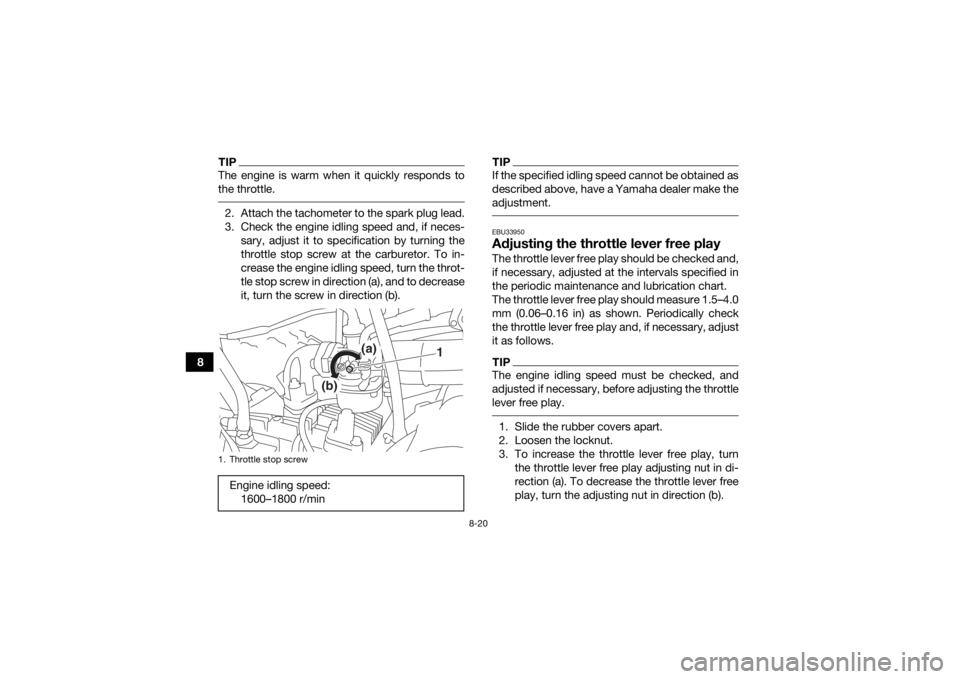
the throttle. 2. Attach the tachometer to the spark plug lead.
3. Check the engine idling speed and, if neces-sary, adjust it to specification by turning the
throttle stop screw at the carburetor. To in-
crease the engine idling speed, turn the throt-
tle stop screw in direction (a), and to decrease
it, turn the screw in direction (b).
TIPIf the specified idling speed cannot be obtained as
described above, have a Yamaha dealer make the
adjustment. EBU33950Adjusting the throttle lever free playThe throttle lever free play should be checked and,
if necessary, adjusted at the intervals specified in
the periodic maintenance and lubrication chart.
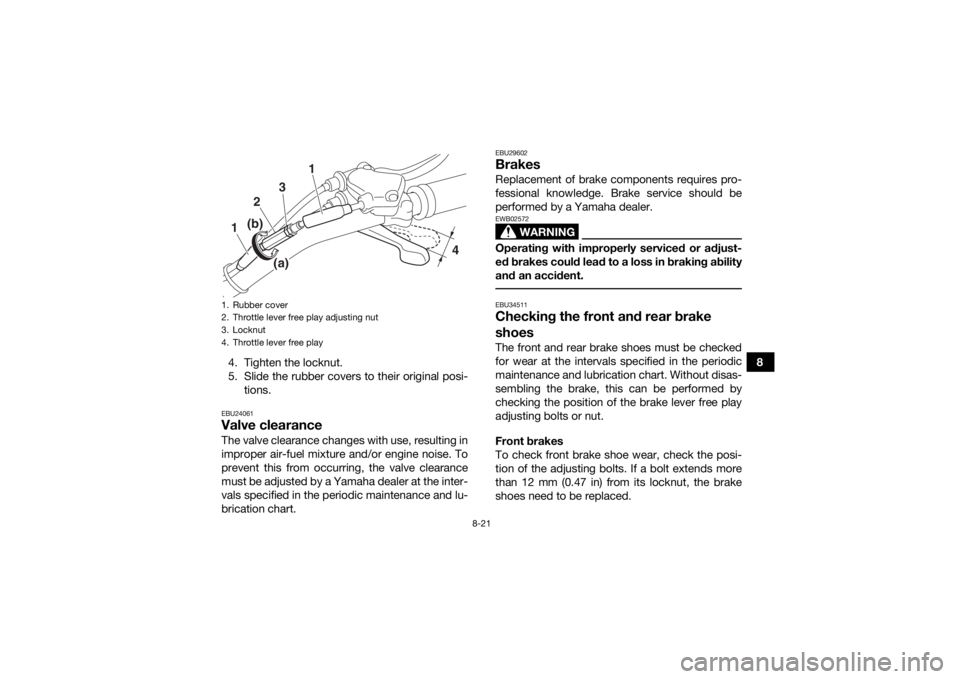
The throttle lever free play should measure 1.5–4.0
mm (0.06–0.16 in) as shown. Periodically check
the throttle lever free play and, if necessary, adjust
it as follows.TIPThe engine idling speed must be checked, and
adjusted if necessary, before adjusting the throttle
lever free play. 1. Slide the rubber covers apart.
2. Loosen the locknut.
3. To increase the throttle lever free play, turnthe throttle lever free play adjusting nut in di-
rection (a). To decrease the throttle lever free
play, turn the adjusting nut in direction (b).
1. Throttle stop screwEngine idling speed:1600–1800 r/min
(a)
(b)
1
UBD361E0.book Page 20 Monday, January 25, 2016 10:53 AM
Page 103 of 130
8-21
8
4. Tighten the locknut.
5. Slide the rubber covers to their original posi-
tions.
EBU24061Valve clearanceThe valve clearance changes with use, resulting in
improper air-fuel mixture and/or engine noise. To
prevent this from occurring, the valve clearance
must be adjusted by a Yamaha dealer at the inter-
vals specified in the periodic maintenance and lu-
brication chart.
EBU29602BrakesReplacement of brake components requires pro-
fessional knowledge. Brake service should be
performed by a Yamaha dealer.
WARNING
EWB02572Operating with improperly serviced or adjust-
ed brakes could lead to a loss in braking ability
and an accident. EBU34511Checking the front and rear brake
shoesThe front and rear brake shoes must be checked
for wear at the intervals specified in the periodic
maintenance and lubrication chart. Without disas-
sembling the brake, this can be performed by
checking the position of the brake lever free play
adjusting bolts or nut.
Front brakes
To check front brake shoe wear, check the posi-
tion of the adjusting bolts. If a bolt extends more
than 12 mm (0.47 in) from its locknut, the brake
shoes need to be replaced.
1. Rubber cover
2. Throttle lever free play adjusting nut
3. Locknut
4. Throttle lever free play
1
3
2
1
4
(b)
(a)
UBD361E0.book Page 21 Monday, January 25, 2016 10:53 AM
Page 105 of 130
8-23
8
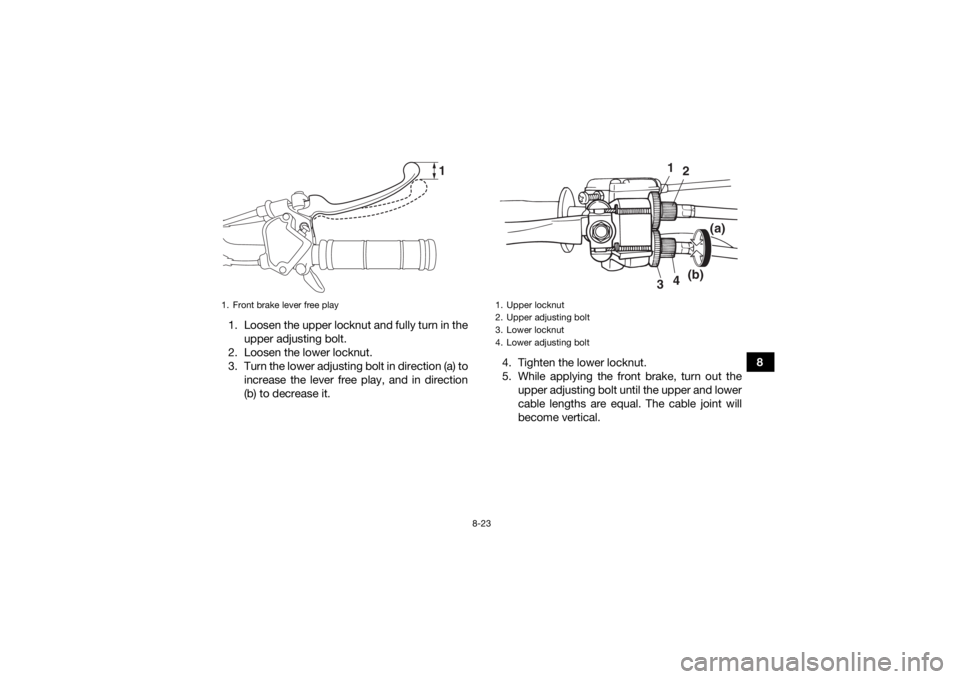
1. Loosen the upper locknut and fully turn in the
upper adjusting bolt.
2. Loosen the lower locknut.
3. Turn the lower adjusting bolt in direction (a) to increase the lever free play, and in direction
(b) to decrease it. 4. Tighten the lower locknut.
5. While applying the front brake, turn out the
upper adjusting bolt until the upper and lower
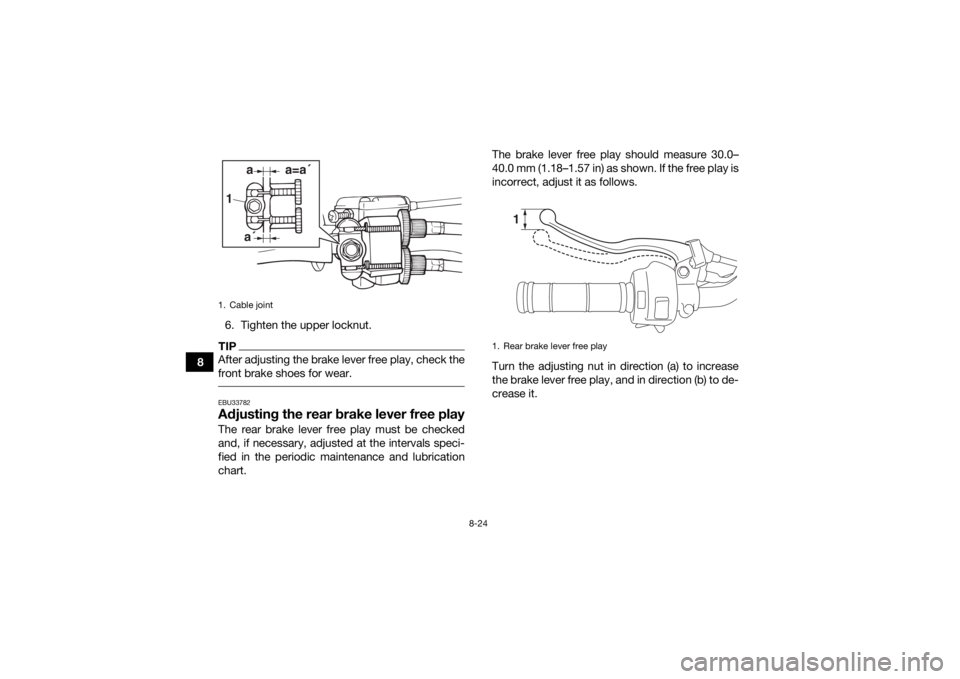
cable lengths are equal. The cable joint will
become vertical.
1. Front brake lever free play
1
1. Upper locknut
2. Upper adjusting bolt
3. Lower locknut
4. Lower adjusting bolt
12
4
3 (a)
(b)
UBD361E0.book Page 23 Monday, January 25, 2016 10:53 AM
Page 106 of 130
8-24
86. Tighten the upper locknut.
TIPAfter adjusting the brake lever free play, check the
front brake shoes for wear. EBU33782Adjusting the rear brake lever free playThe rear brake lever free play must be checked
and, if necessary, adjusted at the intervals speci-
fied in the periodic maintenance and lubrication
chart. The brake lever free play should measure 30.0–
40.0 mm (1.18–1.57 in) as shown. If the free play is
incorrect, adjust it as follows.
Turn the adjusting nut in direction (a) to increase
the brake lever free play, and in direction (b) to de-
crease it.1. Cable joint1
aa´
a=a´
1. Rear brake lever free play
1
UBD361E0.book Page 24 Monday, January 25, 2016 10:53 AM
Page 108 of 130

8-26
8To adjust the drive chain slack
1. Loosen the bolts and nuts. 2. Loosen the rear brake lever free play adjust-
ing nut.
3. Loosen the locknut.
1. Bolt
1. Nut
1
1
1. Rear brake lever free play adjusting nut
1
UBD361E0.book Page 26 Monday, January 25, 2016 10:53 AM
Page 109 of 130
8-27
8
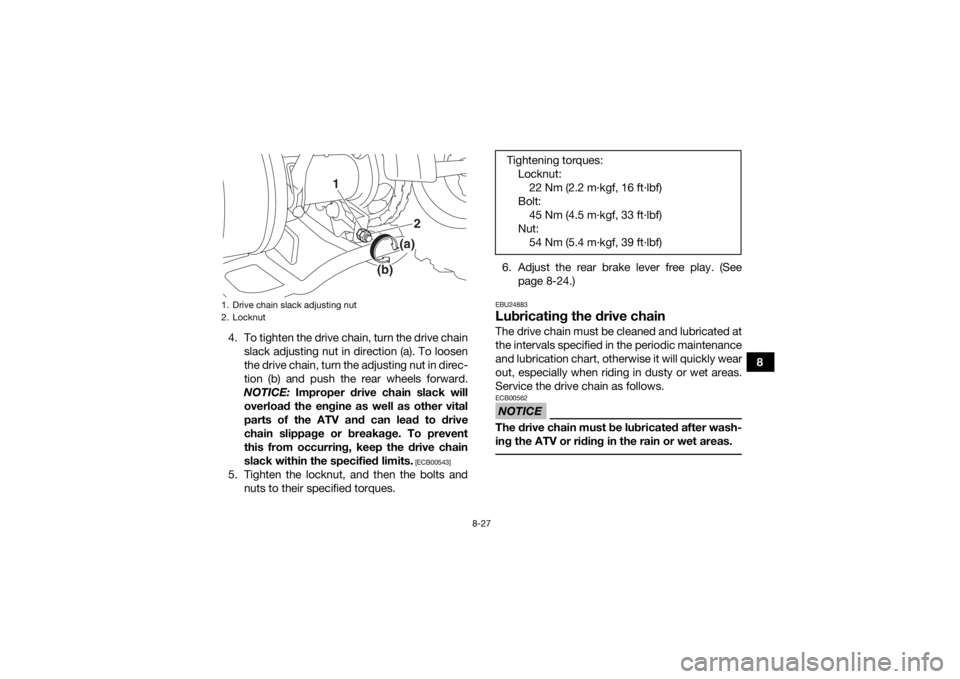
4. To tighten the drive chain, turn the drive chain
slack adjusting nut in direction (a). To loosen
the drive chain, turn the adjusting nut in direc-
tion (b) and push the rear wheels forward.
NOTICE: Improper drive chain slack will
overload the engine as well as other vital
parts of the ATV and can lead to drive
chain slippage or breakage. To prevent
this from occurring, keep the drive chain
slack within the specified limits.
[ECB00543]
5. Tighten the locknut, and then the bolts and nuts to their specified torques. 6. Adjust the rear brake lever free play. (See
page 8-24.)
EBU24883Lubricating the drive chainThe drive chain must be cleaned and lubricated at
the intervals specified in the periodic maintenance
and lubrication chart, otherwise it will quickly wear
out, especially when riding in dusty or wet areas.
Service the drive chain as follows.NOTICEECB00562The drive chain must be lubricated after wash-
ing the ATV or riding in the rain or wet areas.
1. Drive chain slack adjusting nut
2. Locknut
1
2
(a)
(b)
Tightening torques:Locknut:22 Nm (2.2 m·kgf, 16 ft·lbf)
Bolt: 45 Nm (4.5 m·kgf, 33 ft·lbf)
Nut: 54 Nm (5.4 m·kgf, 39 ft·lbf)
UBD361E0.book Page 27 Monday, January 25, 2016 10:53 AM
Page 119 of 130

9-1
9
EBU25861
CLEANING AND STORAGE
EBU25903CleaningFrequent, thorough cleaning of your ATV will not
only enhance its appearance but will improve its
general performance and extend the useful life of
many components.1. Before cleaning the ATV: a. Block off the end of the exhaust pipe toprevent water entry. A plastic bag and
strong rubber band may be used.
b. Make sure the spark plug and all filler caps are properly installed.
2. If the engine case is excessively greasy, apply degreaser with a paint brush. Do not apply
degreaser to the chain, sprockets or wheel
axles.
3. Rinse the dirt and degreaser off with a garden hose. Use only enough pressure to do the
job. WARNING! Wet brakes may have re-
duced stopping ability, increasing the
chance of an accident. Test the brakes af-
ter washing. Apply the brakes several
times at slow speeds to let friction dry out
the linings.
[EWB02312]
NOTICE: Excessive wa- ter pressure may cause water seepage
and deterioration of wheel bearings,
brakes, transmission seals and electrical
devices. Many expensive repair bills have
resulted from improper high-pressure de-
tergent applications such as those avail-
able in coin-operated car washers.
[ECB00712]
4. Once most of the dirt has been hosed off,
wash all surfaces with warm water and mild,
detergent-type soap. An old toothbrush or
bottle brush is handy for hard-to-reach pla-
ces.
5. Rinse the ATV off immediately with clean wa- ter and dry all surfaces with a chamois, clean
towel or soft absorbing cloth.
6. Dry the chain and lubricate it to prevent it from rusting.
7. Clean the seat with a vinyl upholstery cleaner to keep the cover pliable and glossy.
8. Automotive type wax may be applied to all painted and chrome plated surfaces. Avoid
combination cleaner-waxes. Many contain
UBD361E0.book Page 1 Monday, January 25, 2016 10:53 AM
Page 121 of 130
9-3
9
7. Check and, if necessary, correct the tire air
pressure, and then block up the ATV so that
all of its wheels are off the ground. Alterna-
tively, turn the wheels a little every month in
order to prevent the tires from becoming de-
graded in one spot.
8. Cover the muffler outlet with a plastic bag to prevent moisture from entering it.
9. Remove the battery and fully charge it. Store it in a cool, dry place and charge it once a
month. Do not store the battery in an exces-
sively cold or warm place [less than 0 °C (30
°F) or more than 30 °C (90 °F)]. For more infor-
mation on storing the battery, see page 8-31.
TIPMake any necessary repairs before storing the
ATV. UBD361E0.book Page 3 Monday, January 25, 2016 10:53 AM