brake YAMAHA YFZ450 2006 User Guide
[x] Cancel search | Manufacturer: YAMAHA, Model Year: 2006, Model line: YFZ450, Model: YAMAHA YFZ450 2006Pages: 444, PDF Size: 5.69 MB
Page 140 of 444
5-29
EBU01600
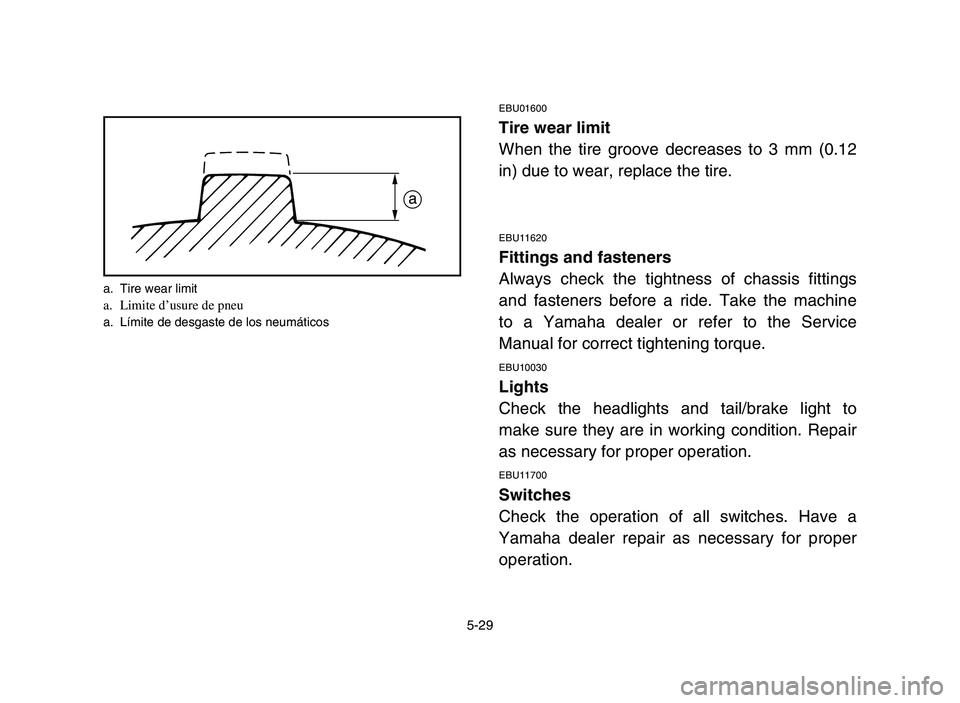
Tire wear limit
When the tire groove decreases to 3 mm (0.12
in) due to wear, replace the tire.
EBU11620
Fittings and fasteners
Always check the tightness of chassis fittings
and fasteners before a ride. Take the machine
to a Yamaha dealer or refer to the Service
Manual for correct tightening torque.
EBU10030
Lights
Check the headlights and tail/brake light to
make sure they are in working condition. Repair
as necessary for proper operation.
EBU11700
Switches
Check the operation of all switches. Have a
Yamaha dealer repair as necessary for proper
operation.
a
a. Tire wear limita. Limite d’usure de pneua. Límite de desgaste de los neumáticos
5TG-9-62 5-6 5/13/05 1:45 PM Page 5-29
Page 144 of 444
6-3
EBU14120
Starting a cold engine
w
Always make sure all control cables work
smoothly before you begin riding in cold
weather. If the control cables are frozen or
do not work smoothly, you could be unable
to control the ATV, which could lead to an
accident or collision.
1. Apply the parking brake.
2. Turn the fuel cock to “ON”.
3. Turn the main switch to “ON” and the
engine stop switch to “RUN”.
4. Shift the transmission into neutral.
5TG-9-62 5-6 5/13/05 1:45 PM Page 6-3
Page 154 of 444
6-13
EBU14260
To start out and accelerate:
1. Release the throttle lever, and then release
the parking brake.
cC
Always close the throttle while shifting
gears. Otherwise, damage to the engine and
drive train may result.
2. Pull the clutch lever to disengage the
clutch.
3. Shift into first gear.
4. Open the throttle gradually and at the
same time, release the clutch lever slowly.
5. Once the machine has attained adequate
speed, release the throttle, and at the
same time, quickly pull in the clutch lever.
5TG-9-62 5-6 5/13/05 1:45 PM Page 6-13
Page 158 of 444
6-17
EBU02080
To decelerate:
When slowing down or stopping, release the
throttle and apply the brakes smoothly and
evenly. As you slow down, shift to a lower gear.
Be sure that the engine has sufficiently slowed
before engaging a lower gear. Improper use of
the brakes or shifting can cause the tires to lose
traction, reducing control and increasing the
possibility of an accident.
w
Make sure the engine has sufficiently slowed
before shifting to a lower gear. Engaging a
lower gear when the engine speed is too
high could make the wheels stop rotating.
This could cause loss of control, an accident
and injury. It could also cause engine or
drive train damage.
5TG-9-62 5-6 5/13/05 1:45 PM Page 6-17
Page 164 of 444
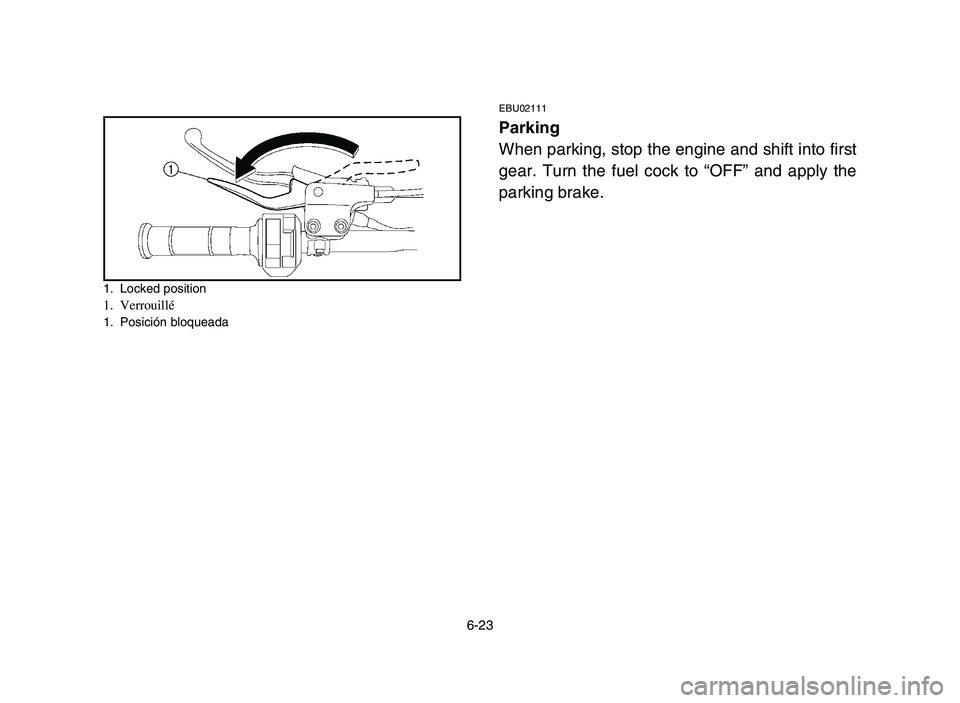
6-23
1. Locked position1. Verrouillé1. Posición bloqueada
EBU02111
Parking
When parking, stop the engine and shift into first
gear. Turn the fuel cock to “OFF” and apply the
parking brake.
5TG-9-62 5-6 5/13/05 1:45 PM Page 6-23
Page 166 of 444
6-25
EBU14270
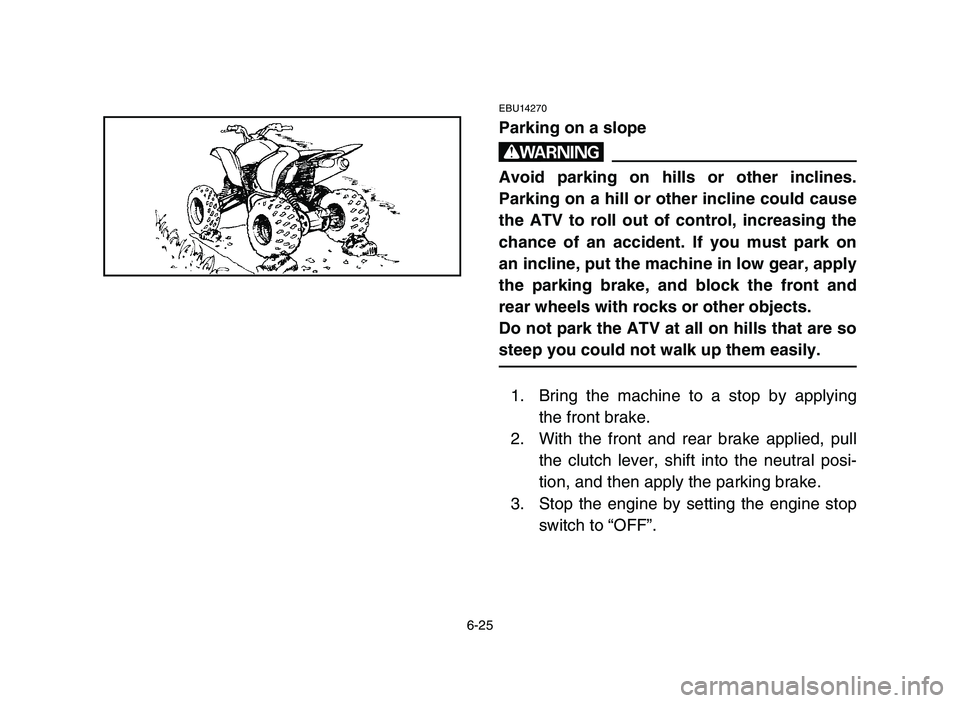
Parking on a slope
w
Avoid parking on hills or other inclines.
Parking on a hill or other incline could cause
the ATV to roll out of control, increasing the
chance of an accident. If you must park on
an incline, put the machine in low gear, apply
the parking brake, and block the front and
rear wheels with rocks or other objects.
Do not park the ATV at all on hills that are so
steep you could not walk up them easily.
1. Bring the machine to a stop by applying
the front brake.
2. With the front and rear brake applied, pull
the clutch lever, shift into the neutral posi-
tion, and then apply the parking brake.
3. Stop the engine by setting the engine stop
switch to “OFF”.
5TG-9-62 5-6 5/13/05 1:45 PM Page 6-25
Page 168 of 444
6-27
4. With the front and rear brakes applied, pull
the clutch lever, shift into 1st gear, and
then slowly release the clutch lever, brake
lever and brake pedal.
NOTE:
Make sure that the neutral indicator light goes
off.
5. Turn the key to “OFF”.
5TG-9-62 5-6 5/13/05 1:45 PM Page 6-27
Page 212 of 444
7-35
Select a large, flat, unpaved area to become
familiar with your ATV. Make sure that this area
is free of obstacles and other riders. You should
practice control of the throttle, brakes, shifting
procedures, and turning techniques in this area
before trying more difficult terrain. Always avoid
riding on paved surfaces: the ATV is designed
for use on unpaved surfaces only, and handling
maneuvers are more difficult to perform on
pavement.
Set the parking brake and follow the instruction
on page 6-3 to start the engine. Once it has
warmed up you are ready to begin riding your
ATV. As you get on the ATV, be sure not to
accidentally move the shift pedal. Remember
that the engine and exhaust pipe will be hot
when riding and afterwards; do not allow skin or
clothing to come in contact with these compo-
nents.
5TG-9-62 7 5/12/05 4:28 PM Page 178
Page 214 of 444
7-37
With the engine idling, pull the clutch lever to
disengage the clutch and shift into 1st gear, and
then release the parking brake. Open the throttle
gradually, and at the same time, release the
clutch lever slowly. Once the ATV has attained
adequate speed, release the throttle lever and at
the same time, quickly pull in the clutch lever
and shift into 2nd gear. Open the throttle part
way and gradually release the clutch. Use this
same procedure as you move into the higher
gears. Be sure to coordinate the use of the throt-
tle and shift pedal properly. If the throttle is
applied too abruptly or if the throttle is not
released during shifting, or if the shift pedal is
not released before applying the throttle, the
front wheels may lift off the ground resulting in a
loss of directional control. Avoid higher speeds
until you are thoroughly familiar with the opera-
tion of your ATV.
w
Always open the throttle gradually and
release the clutch lever slowly. Otherwise,
the ATV could wheelie which would increase
the chance of an accident.
5TG-9-62 7 5/12/05 4:28 PM Page 180
Page 216 of 444
7-39
cC
Do not shift gears without releasing the
throttle. Damage to the engine or drive train
may occur.
When slowing down or stopping, release the
throttle and apply the brakes smoothly and
evenly. As you slow down, shift to a lower gear.
Be sure that the engine has sufficiently slowed
before engaging a lower gear. Improper use of
the brakes or shifting can cause the tires to lose
traction, reducing control and increasing the
possibility of an accident.
w
Make sure the engine has sufficiently slowed
before shifting to a lower gear. Engaging a
lower gear when the engine speed is too
high could cause the wheels to stop rotating.
5TG-9-62 7 5/12/05 4:28 PM Page 182