fuel YAMAHA YFZ450 2013 User Guide
[x] Cancel search | Manufacturer: YAMAHA, Model Year: 2013, Model line: YFZ450, Model: YAMAHA YFZ450 2013Pages: 154, PDF Size: 3.77 MB
Page 45 of 154
5-1
5
EBU19201
PRE-OPERATION CHECKS
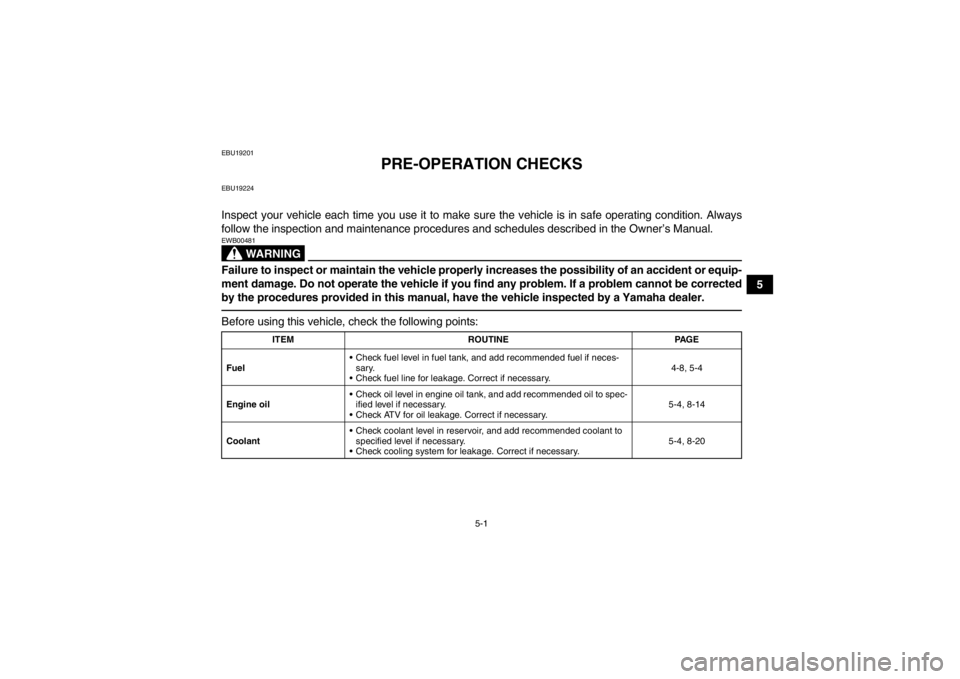
EBU19224Inspect your vehicle each time you use it to make sure the vehicle is in safe operating condition. Always
follow the inspection and maintenance procedures and schedules described in the Owner’s Manual.
WARNING
EWB00481Failure to inspect or maintain the vehicle properly increases the possibility of an accident or equip-
ment damage. Do not operate the vehicle if you find any problem. If a problem cannot be corrected
by the procedures provided in this manual, have the vehicle inspected by a Yamaha dealer.Before using this vehicle, check the following points:
ITEMROUTINE PAGE
Fuel Check fuel level in fuel tank, and add recommended fuel if neces-
sary.
Check fuel line for leakage. Correct if necessary. 4-8, 5-4
Engine oil Check oil level in engine oil tank, and add recommended oil to spec-
ified level if necessary.
Check ATV for oil leakage. Correct if necessary. 5-4, 8-14
Coolant Check coolant level in reservoir, and add recommended coolant to
specified level if necessary.
Check cooling system for leakage. Correct if necessary. 5-4, 8-20
U1PD61E0.book Page 1 Tuesday, February 14, 2012 10:06 AM
Page 48 of 154
5-4
5
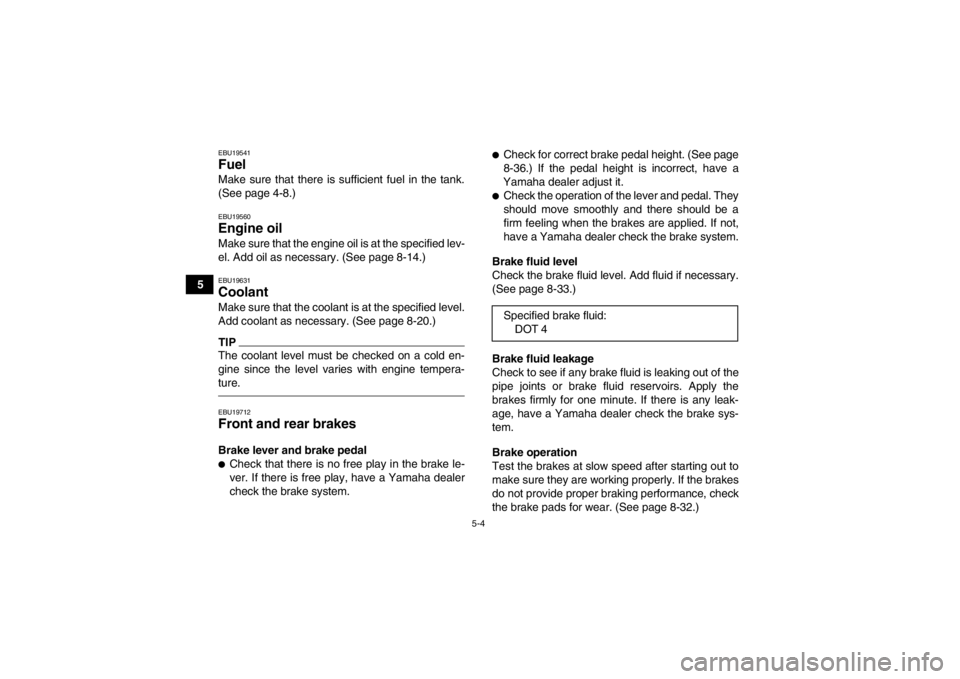
EBU19541Fuel Make sure that there is sufficient fuel in the tank.
(See page 4-8.)EBU19560Engine oil Make sure that the engine oil is at the specified lev-
el. Add oil as necessary. (See page 8-14.)EBU19631Coolant Make sure that the coolant is at the specified level.
Add coolant as necessary. (See page 8-20.)TIPThe coolant level must be checked on a cold en-
gine since the level varies with engine tempera-
ture.EBU19712Front and rear brakes Brake lever and brake pedal●Check that there is no free play in the brake le-
ver. If there is free play, have a Yamaha dealer
check the brake system.
●Check for correct brake pedal height. (See page
8-36.) If the pedal height is incorrect, have a
Yamaha dealer adjust it.●Check the operation of the lever and pedal. They
should move smoothly and there should be a
firm feeling when the brakes are applied. If not,
have a Yamaha dealer check the brake system.
Brake fluid level
Check the brake fluid level. Add fluid if necessary.
(See page 8-33.)
Brake fluid leakage
Check to see if any brake fluid is leaking out of the
pipe joints or brake fluid reservoirs. Apply the
brakes firmly for one minute. If there is any leak-
age, have a Yamaha dealer check the brake sys-
tem.
Brake operation
Test the brakes at slow speed after starting out to
make sure they are working properly. If the brakes
do not provide proper braking performance, check
the brake pads for wear. (See page 8-32.) Specified brake fluid:
DOT 4
U1PD61E0.book Page 4 Tuesday, February 14, 2012 10:06 AM
Page 52 of 154
6-1
6
EBU19881
OPERATION
EBU19901Read the Owner’s Manual carefully before riding
the ATV. If there is a control or function you do not
understand, ask your Yamaha dealer.
WARNING
EWB00631Read the Owner’s Manual carefully to become
familiar with all controls in order to help pre-
vent any loss of control, which could cause an
accident or injury.EBU20184Starting a cold engine NOTICEECB00150See the “Engine break-in” section on page 6-5
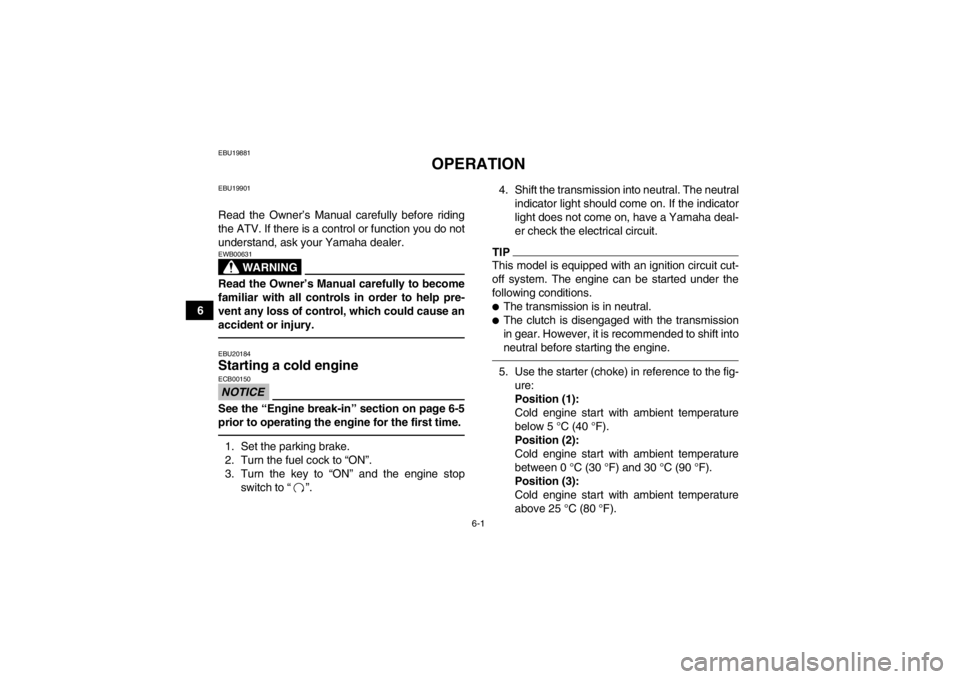
prior to operating the engine for the first time.1. Set the parking brake.
2. Turn the fuel cock to “ON”.
3. Turn the key to “ON” and the engine stopswitch to “ ”. 4. Shift the transmission into neutral. The neutral
indicator light should come on. If the indicator
light does not come on, have a Yamaha deal-
er check the electrical circuit.
TIPThis model is equipped with an ignition circuit cut-
off system. The engine can be started under the
following conditions.●The transmission is in neutral.●The clutch is disengaged with the transmission
in gear. However, it is recommended to shift into
neutral before starting the engine.5. Use the starter (choke) in reference to the fig-ure:
Position (1):
Cold engine start with ambient temperature
below 5 °C (40 °F).
Position (2):
Cold engine start with ambient temperature
between 0 °C (30 °F) and 30 °C (90 °F).
Position (3):
Cold engine start with ambient temperature
above 25 °C (80 °F).
U1PD61E0.book Page 1 Tuesday, February 14, 2012 10:06 AM
Page 56 of 154
6-5
6
●Always use the clutch when changing gears.
The engine, transmission and drive train are
not designed to withstand the shock of
forced shifting and can be damaged by shift-
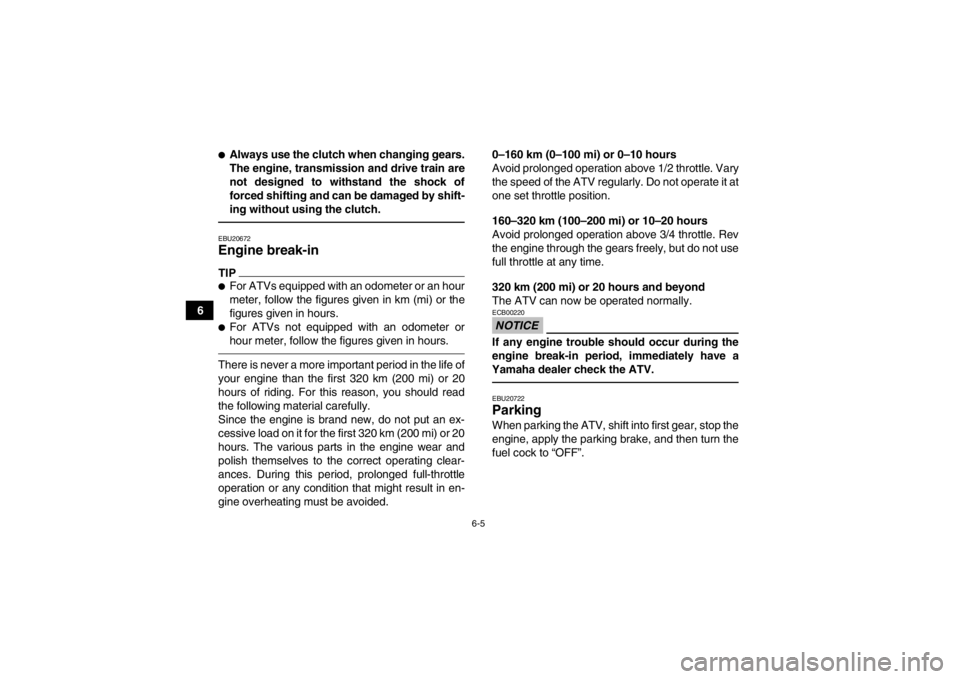
ing without using the clutch.EBU20672Engine break-in TIP●For ATVs equipped with an odometer or an hour
meter, follow the figures given in km (mi) or the
figures given in hours.●For ATVs not equipped with an odometer or
hour meter, follow the figures given in hours.There is never a more important period in the life of
your engine than the first 320 km (200 mi) or 20
hours of riding. For this reason, you should read
the following material carefully.
Since the engine is brand new, do not put an ex-
cessive load on it for the first 320 km (200 mi) or 20
hours. The various parts in the engine wear and
polish themselves to the correct operating clear-
ances. During this period, prolonged full-throttle
operation or any condition that might result in en-
gine overheating must be avoided.0–160 km (0–100 mi) or 0–10 hours
Avoid prolonged operation above 1/2 throttle. Vary
the speed of the ATV regularly. Do not operate it at
one set throttle position.
160–320 km (100–200 mi) or 10–20 hours
Avoid prolonged operation above 3/4 throttle. Rev
the engine through the gears freely, but do not use
full throttle at any time.
320 km (200 mi) or 20 hours and beyond
The ATV can now be operated normally.
NOTICEECB00220If any engine trouble should occur during the
engine break-in period, immediately have a
Yamaha dealer check the ATV.EBU20722Parking When parking the ATV, shift into first gear, stop the
engine, apply the parking brake, and then turn the
fuel cock to “OFF”.
U1PD61E0.book Page 5 Tuesday, February 14, 2012 10:06 AM
Page 57 of 154
6-6
6
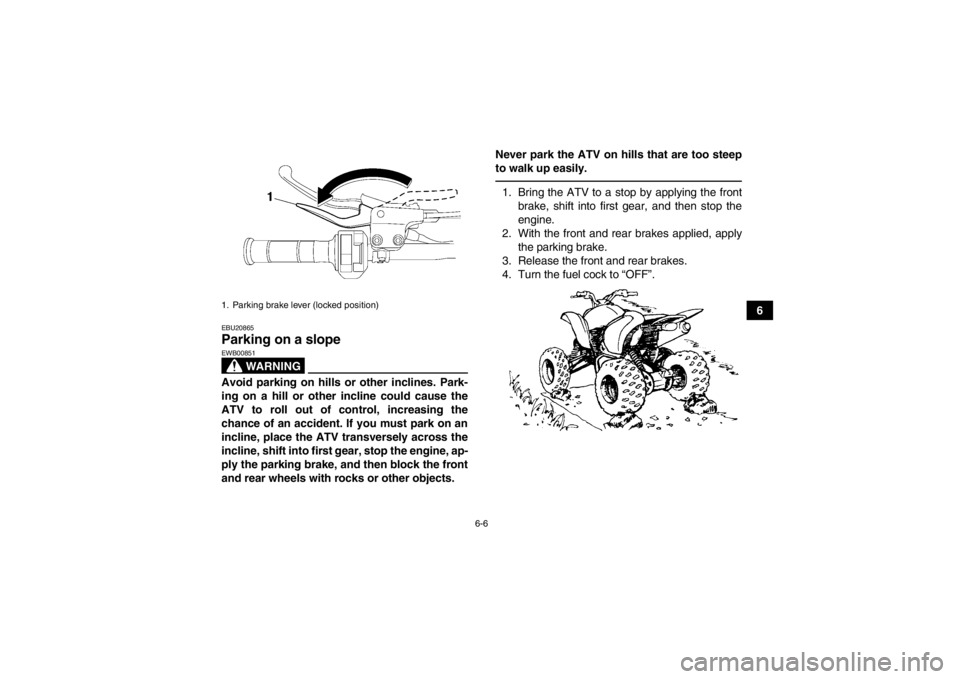
EBU20865Parking on a slope
WARNING
EWB00851Avoid parking on hills or other inclines. Park-
ing on a hill or other incline could cause the
ATV to roll out of control, increasing the
chance of an accident. If you must park on an
incline, place the ATV transversely across the
incline, shift into first gear, stop the engine, ap-
ply the parking brake, and then block the front
and rear wheels with rocks or other objects.Never park the ATV on hills that are too steep
to walk up easily.
1. Bring the ATV to a stop by applying the front
brake, shift into first gear, and then stop the
engine.
2. With the front and rear brakes applied, apply the parking brake.
3. Release the front and rear brakes.
4. Turn the fuel cock to “OFF”.
1. Parking brake lever (locked position)U1PD61E0.book Page 6 Tuesday, February 14, 2012 10:06 AM
Page 85 of 154
8-3
8
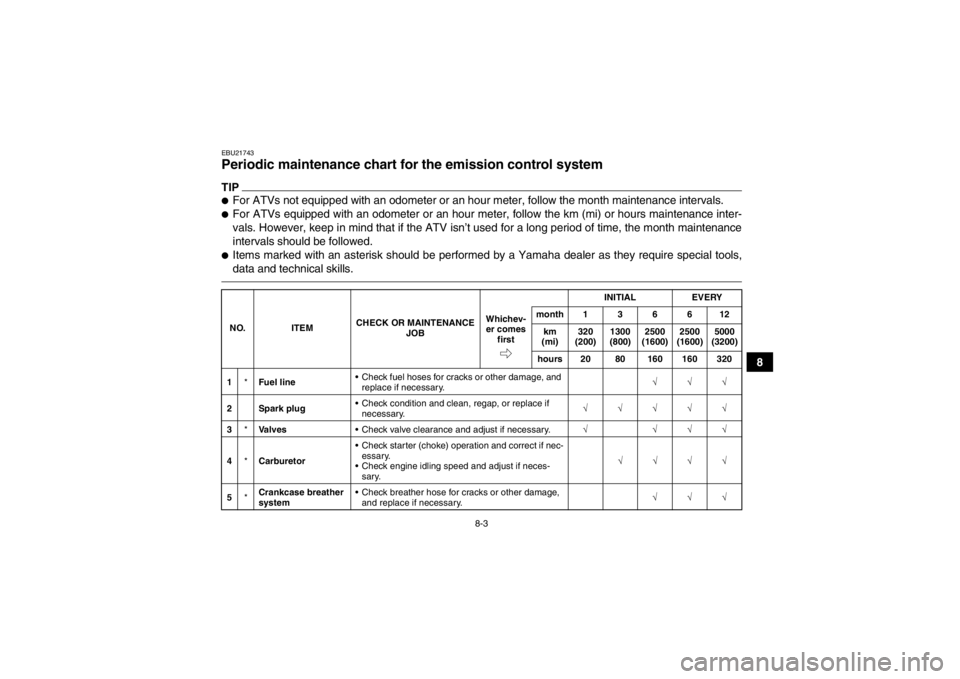
EBU21743Periodic maintenance chart for the emission control system TIP●For ATVs not equipped with an odometer or an hour meter, follow the month maintenance intervals.●For ATVs equipped with an odometer or an hour meter, follow the km (mi) or hours maintenance inter-
vals. However, keep in mind that if the ATV isn’t used for a long period of time, the month maintenance
intervals should be followed.●Items marked with an asterisk should be performed by a Yamaha dealer as they require special tools,
data and technical skills.NO.ITEM CHECK OR MAINTENANCE
JOB INITIAL
EVERY
Whichev- er comes first month136612
km
(mi) 320
(200) 1300
(800) 2500
(1600) 2500
(1600) 5000
(3200)
hours 20 80 160 160 320
1 *Fuel line Check fuel hoses for cracks or other damage, and
replace if necessary. √√√
2 Spark plug Check condition and clean, regap, or replace if
necessary. √√√√√
3 *Valves Check valve clearance and adjust if necessary. √ √√√
4 *Carburetor Check starter (choke) operation and correct if nec-
essary.
Check engine idling speed and adjust if neces- sary. √√√√
5 *Crankcase breather
system Check breather hose for cracks or other damage,
and replace if necessary. √√√
U1PD61E0.book Page 3 Tuesday, February 14, 2012 10:06 AM
Page 93 of 154
8-11
8
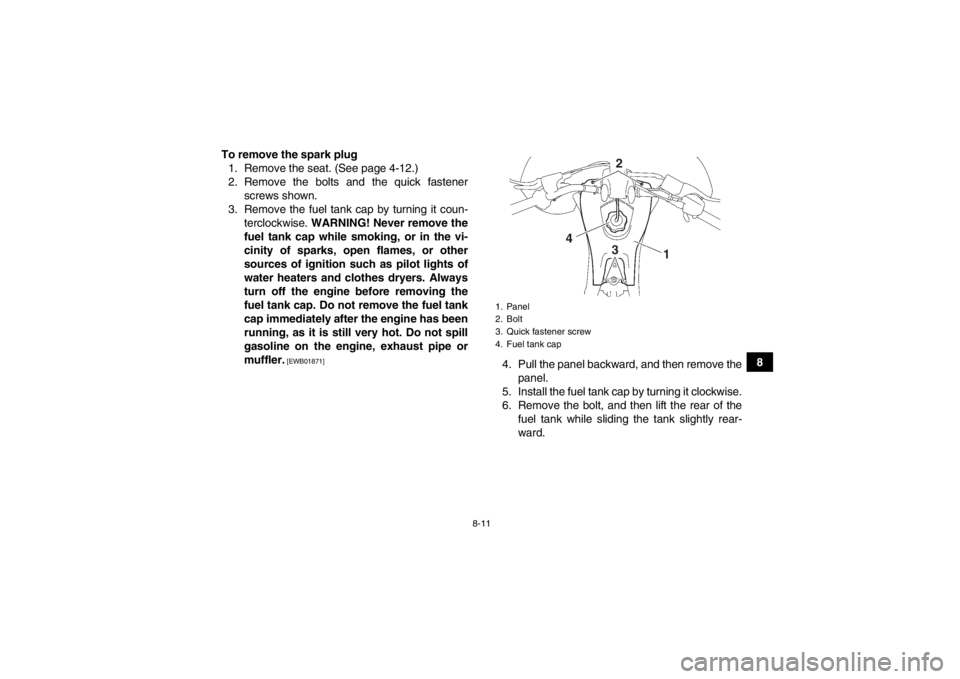
To remove the spark plug
1. Remove the seat. (See page 4-12.)
2. Remove the bolts and the quick fastener screws shown.
3. Remove the fuel tank cap by turning it coun- terclockwise. WARNING! Never remove the
fuel tank cap while smoking, or in the vi-
cinity of sparks, open flames, or other
sources of ignition such as pilot lights of
water heaters and clothes dryers. Always
turn off the engine before removing the
fuel tank cap. Do not remove the fuel tank
cap immediately after the engine has been
running, as it is still very hot. Do not spill
gasoline on the engine, exhaust pipe or
muffler.
[EWB01871]
4. Pull the panel backward, and then remove the panel.
5. Install the fuel tank cap by turning it clockwise.
6. Remove the bolt, and then lift the rear of the fuel tank while sliding the tank slightly rear-
ward.1. Panel
2. Bolt
3. Quick fastener screw
4. Fuel tank cap
2
4 3 1
U1PD61E0.book Page 11 Tuesday, February 14, 2012 10:06 AM
Page 96 of 154
8-14
8To install the spark plug
1. Clean the surface of the spark plug gasket and its mating surface, and then wipe off any
grime from the spark plug threads.
2. Install the spark plug with the spark plug wrench, and then tighten it to the specified
torque.
TIPIf a torque wrench is not available when installing
the spark plug, a good estimate of the correct
torque is 1/4–1/2 turn past finger tight. However,
the spark plug should be tightened to the specified
torque as soon as possible.3. Install the spark plug cap.
4. Place the fuel tank in the original position, andthen install the bolt.
5. Remove the fuel tank cap by turning it coun- terclockwise.
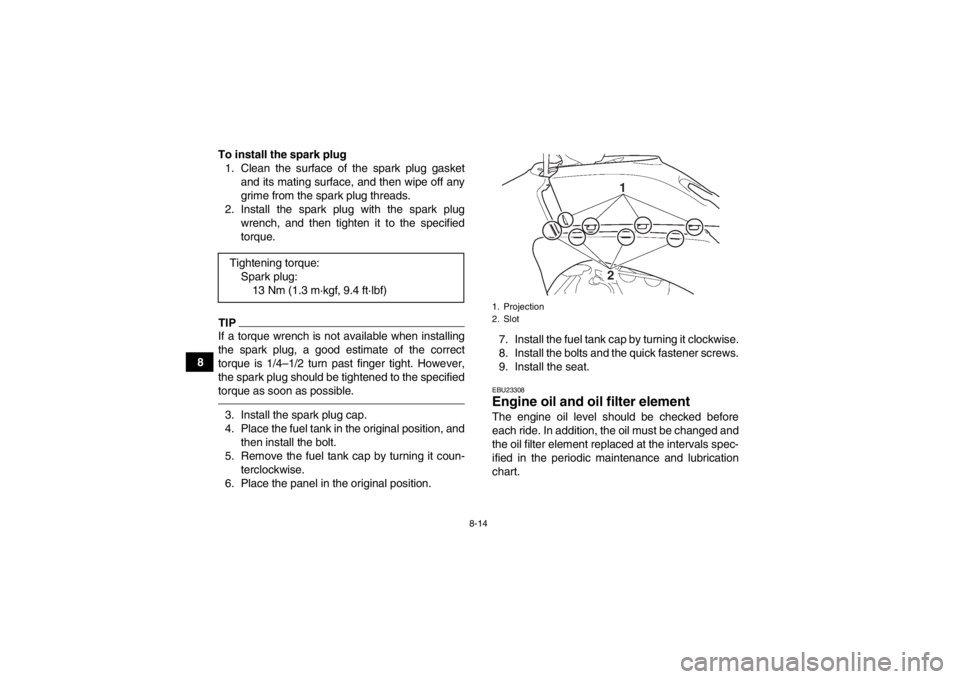
6. Place the panel in the original position. 7. Install the fuel tank cap by turning it clockwise.
8. Install the bolts and the quick fastener screws.
9. Install the seat.
EBU23308Engine oil and oil filter element The engine oil level should be checked before
each ride. In addition, the oil must be changed and
the oil filter element replaced at the intervals spec-
ified in the periodic maintenance and lubrication
chart.
Tightening torque:
Spark plug:13 Nm (1.3 m·kgf, 9.4 ft·lbf)1. Projection
2. Slot
21
U1PD61E0.book Page 14 Tuesday, February 14, 2012 10:06 AM
Page 113 of 154
8-31
8
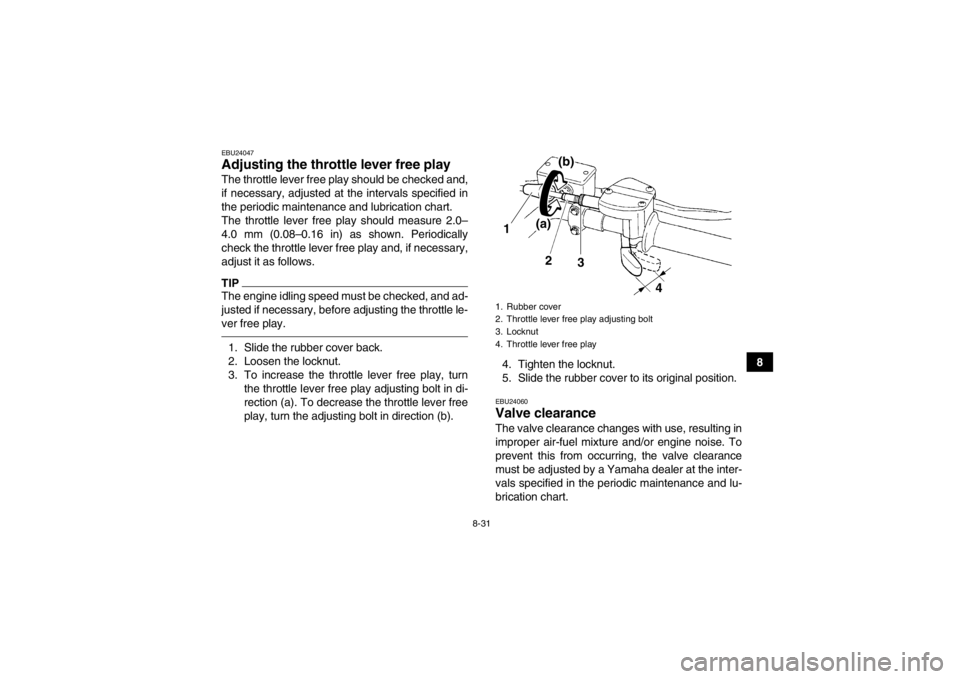
EBU24047Adjusting the throttle lever free play The throttle lever free play should be checked and,
if necessary, adjusted at the intervals specified in
the periodic maintenance and lubrication chart.
The throttle lever free play should measure 2.0–
4.0 mm (0.08–0.16 in) as shown. Periodically
check the throttle lever free play and, if necessary,
adjust it as follows.TIPThe engine idling speed must be checked, and ad-
justed if necessary, before adjusting the throttle le-
ver free play.1. Slide the rubber cover back.
2. Loosen the locknut.
3. To increase the throttle lever free play, turnthe throttle lever free play adjusting bolt in di-
rection (a). To decrease the throttle lever free
play, turn the adjusting bolt in direction (b). 4. Tighten the locknut.
5. Slide the rubber cover to its original position.
EBU24060Valve clearance The valve clearance changes with use, resulting in
improper air-fuel mixture and/or engine noise. To
prevent this from occurring, the valve clearance
must be adjusted by a Yamaha dealer at the inter-
vals specified in the periodic maintenance and lu-
brication chart.1. Rubber cover
2. Throttle lever free play adjusting bolt
3. Locknut
4. Throttle lever free play
4
2
1
3
(a)
(b)
U1PD61E0.book Page 31 Tuesday, February 14, 2012 10:06 AM
Page 138 of 154
8-56
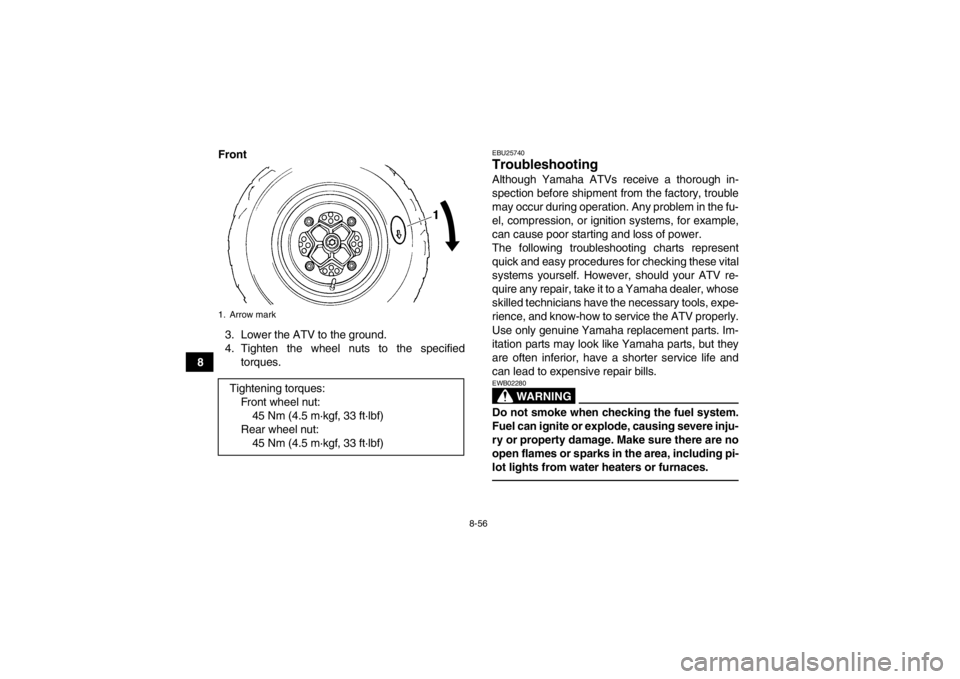
8Front
3. Lower the ATV to the ground.
4. Tighten the wheel nuts to the specified torques.
EBU25740Troubleshooting Although Yamaha ATVs receive a thorough in-
spection before shipment from the factory, trouble
may occur during operation. Any problem in the fu-
el, compression, or ignition systems, for example,
can cause poor starting and loss of power.
The following troubleshooting charts represent
quick and easy procedures for checking these vital
systems yourself. However, should your ATV re-
quire any repair, take it to a Yamaha dealer, whose
skilled technicians have the necessary tools, expe-
rience, and know-how to service the ATV properly.
Use only genuine Yamaha replacement parts. Im-
itation parts may look like Yamaha parts, but they
are often inferior, have a shorter service life and
can lead to expensive repair bills.
WARNING
EWB02280Do not smoke when checking the fuel system.
Fuel can ignite or explode, causing severe inju-
ry or property damage. Make sure there are no
open flames or sparks in the area, including pi-
lot lights from water heaters or furnaces.
1. Arrow markTightening torques:Front wheel nut:45 Nm (4.5 m·kgf, 33 ft·lbf)
Rear wheel nut: 45 Nm (4.5 m·kgf, 33 ft·lbf)
U1PD61E0.book Page 56 Tuesday, February 14, 2012 10:06 AM