engine YAMAHA YFZ450 2013 Workshop Manual
[x] Cancel search | Manufacturer: YAMAHA, Model Year: 2013, Model line: YFZ450, Model: YAMAHA YFZ450 2013Pages: 154, PDF Size: 3.77 MB
Page 111 of 154
8-29
8
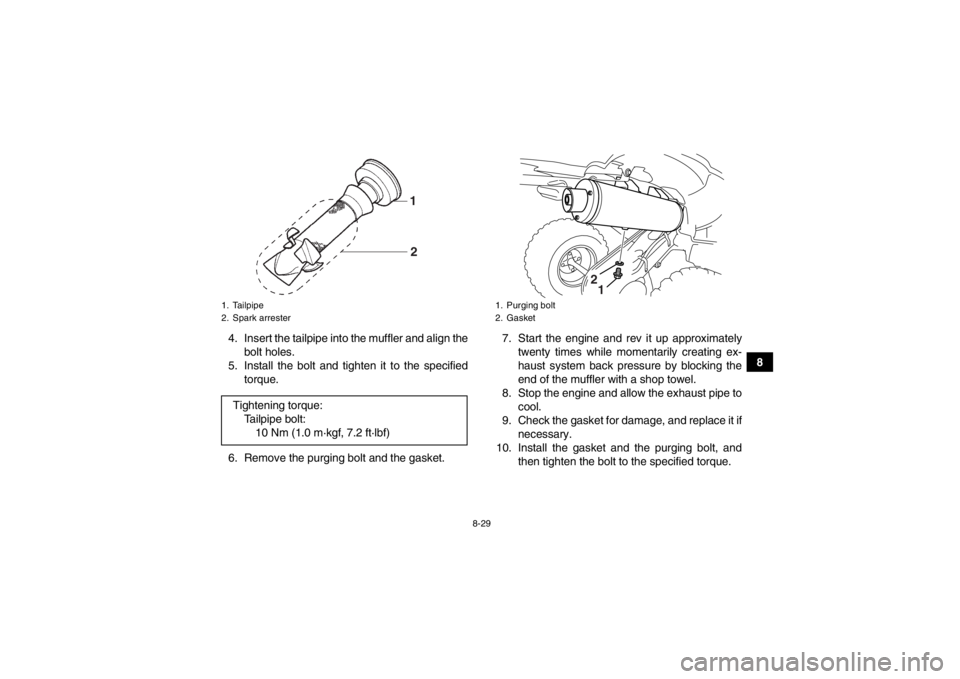
4. Insert the tailpipe into the muffler and align the
bolt holes.
5. Install the bolt and tighten it to the specified torque.
6. Remove the purging bolt and the gasket. 7. Start the engine and rev it up approximately
twenty times while momentarily creating ex-
haust system back pressure by blocking the
end of the muffler with a shop towel.
8. Stop the engine and allow the exhaust pipe to cool.
9. Check the gasket for damage, and replace it if necessary.
10. Install the gasket and the purging bolt, and then tighten the bolt to the specified torque.
1. Tailpipe
2. Spark arresterTightening torque:Tailpipe bolt:10 Nm (1.0 m·kgf, 7.2 ft·lbf)
1
2
1. Purging bolt
2. Gasket
1
2
U1PD61E0.book Page 29 Tuesday, February 14, 2012 10:06 AM
Page 112 of 154
8-30
8
WARNING
EWB02380Never run the engine in an enclosed area when
purging the spark arrester, otherwise it could
cause injury to the eyes, burns, carbon monox-
ide poisoning, possibly leading to death, and
start a fire.●Always let the exhaust system cool prior to
touching exhaust components.●Always wear eye protection, and make sure
no one is behind the ATV.●Make sure there are no combustible materi-
als in the area.EBU23940Adjusting the carburetor The carburetor should be checked and, if neces-
sary, adjusted at the intervals specified in the peri-
odic maintenance and lubrication chart. The
carburetor is an important part of the engine and
requires very sophisticated adjustment. Therefore,
most carburetor adjustments should be left to aYamaha dealer, who has the necessary profes-
sional knowledge and experience. The adjustment
described in the following section, however, may
be performed by the owner as part of routine main-
tenance.
NOTICEECB00480The carburetor has been set and extensively
tested at the Yamaha factory. Changing these
settings without sufficient technical knowl-
edge may result in poor performance of or
damage to the engine.EBU24030Checking the engine idling speed A special tester is needed to check the engine
idling speed on this model.
Therefore, take the ATV to a Yamaha dealer to
have the engine idling speed checked and adjust-
ed.
Tightening torque:
Purging bolt:27 Nm (2.7 m·kgf, 20 ft·lbf)Engine idling speed:1750–1850 r/min
U1PD61E0.book Page 30 Tuesday, February 14, 2012 10:06 AM
Page 113 of 154
8-31
8
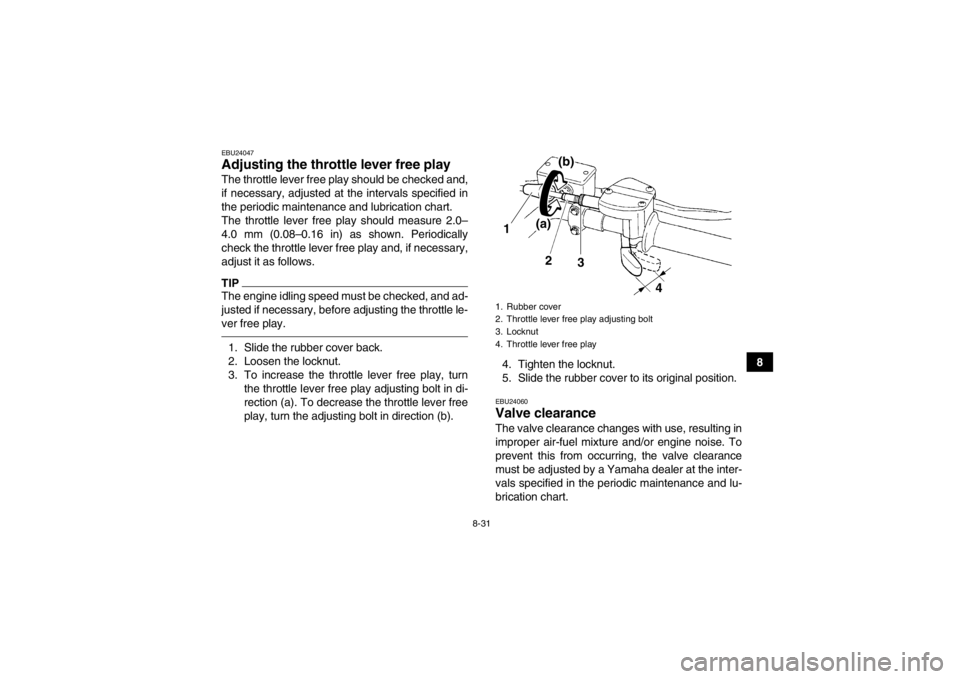
EBU24047Adjusting the throttle lever free play The throttle lever free play should be checked and,
if necessary, adjusted at the intervals specified in
the periodic maintenance and lubrication chart.
The throttle lever free play should measure 2.0–
4.0 mm (0.08–0.16 in) as shown. Periodically
check the throttle lever free play and, if necessary,
adjust it as follows.TIPThe engine idling speed must be checked, and ad-
justed if necessary, before adjusting the throttle le-
ver free play.1. Slide the rubber cover back.
2. Loosen the locknut.
3. To increase the throttle lever free play, turnthe throttle lever free play adjusting bolt in di-
rection (a). To decrease the throttle lever free
play, turn the adjusting bolt in direction (b). 4. Tighten the locknut.
5. Slide the rubber cover to its original position.
EBU24060Valve clearance The valve clearance changes with use, resulting in
improper air-fuel mixture and/or engine noise. To
prevent this from occurring, the valve clearance
must be adjusted by a Yamaha dealer at the inter-
vals specified in the periodic maintenance and lu-
brication chart.1. Rubber cover
2. Throttle lever free play adjusting bolt
3. Locknut
4. Throttle lever free play
4
2
1
3
(a)
(b)
U1PD61E0.book Page 31 Tuesday, February 14, 2012 10:06 AM
Page 124 of 154
8-42
8
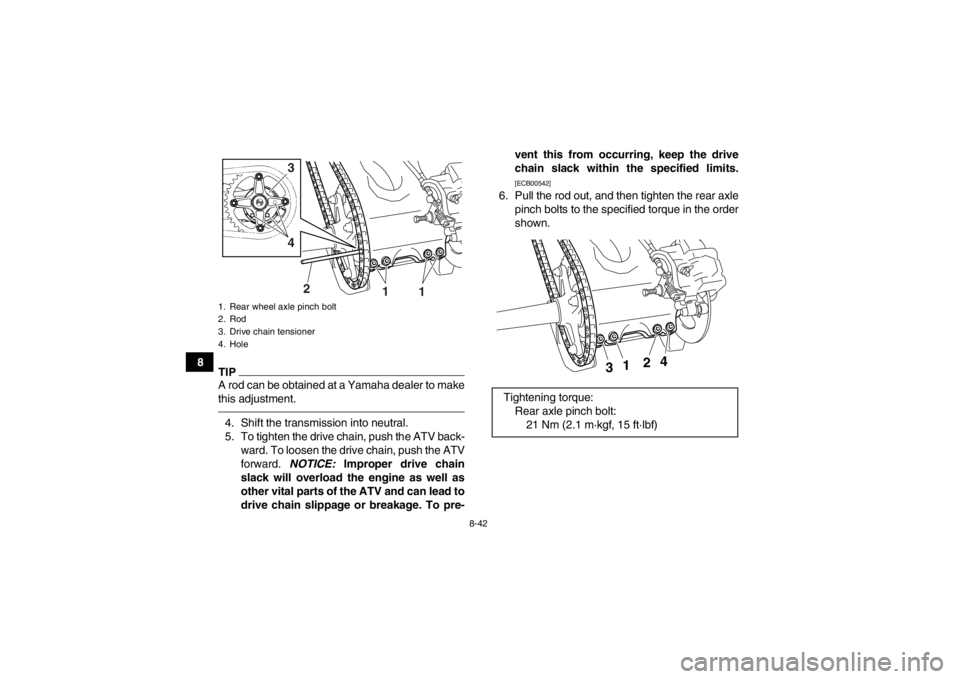
TIPA rod can be obtained at a Yamaha dealer to make
this adjustment.4. Shift the transmission into neutral.
5. To tighten the drive chain, push the ATV back-ward. To loosen the drive chain, push the ATV
forward. NOTICE: Improper drive chain
slack will overload the engine as well as
other vital parts of the ATV and can lead to
drive chain slippage or breakage. To pre- vent this from occurring, keep the drive
chain slack within the specified limits.
[ECB00542]
6. Pull the rod out, and then tighten the rear axle
pinch bolts to the specified torque in the order
shown.
1. Rear wheel axle pinch bolt
2. Rod
3. Drive chain tensioner
4. Hole
3
4
2 11
Tightening torque:
Rear axle pinch bolt:21 Nm (2.1 m·kgf, 15 ft·lbf)
3 1 2
4
U1PD61E0.book Page 42 Tuesday, February 14, 2012 10:06 AM
Page 125 of 154
8-43
8
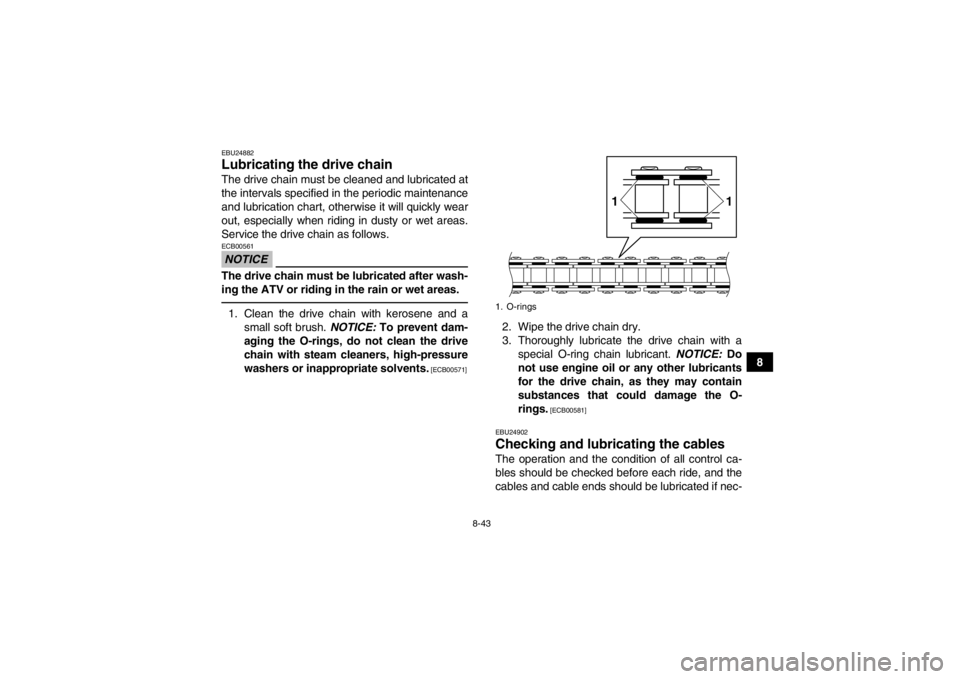
EBU24882Lubricating the drive chain The drive chain must be cleaned and lubricated at
the intervals specified in the periodic maintenance
and lubrication chart, otherwise it will quickly wear
out, especially when riding in dusty or wet areas.
Service the drive chain as follows.NOTICEECB00561The drive chain must be lubricated after wash-
ing the ATV or riding in the rain or wet areas.1. Clean the drive chain with kerosene and asmall soft brush. NOTICE: To prevent dam-
aging the O-rings, do not clean the drive
chain with steam cleaners, high-pressure
washers or inappropriate solvents.
[ECB00571]
2. Wipe the drive chain dry.
3. Thoroughly lubricate the drive chain with a special O-ring chain lubricant. NOTICE: Do
not use engine oil or any other lubricants
for the drive chain, as they may contain
substances that could damage the O-
rings.
[ECB00581]
EBU24902
Checking and lubri cating the cables The operation and the condition of all control ca-
bles should be checked before each ride, and the
cables and cable ends should be lubricated if nec-1. O-rings
1
1
U1PD61E0.book Page 43 Tuesday, February 14, 2012 10:06 AM
Page 126 of 154
8-44
8essary. If a cable is damaged or does not move
smoothly, have a Yamaha dealer check or replace
it.
WARNING
EWB02581●Inspect cables frequently and replace if dam-
aged. Corrosion can result when the cable
sheaths become damaged, and cables can
also become frayed or kinked, which could
restrict the operation of controls and lead to
an accident or injury.●Always make sure all control cables work
smoothly before you begin riding in cold
weather. If the control cables are frozen or do
not work smoothly, you could be unable to
control the ATV, which could lead to an acci-
dent or collision.
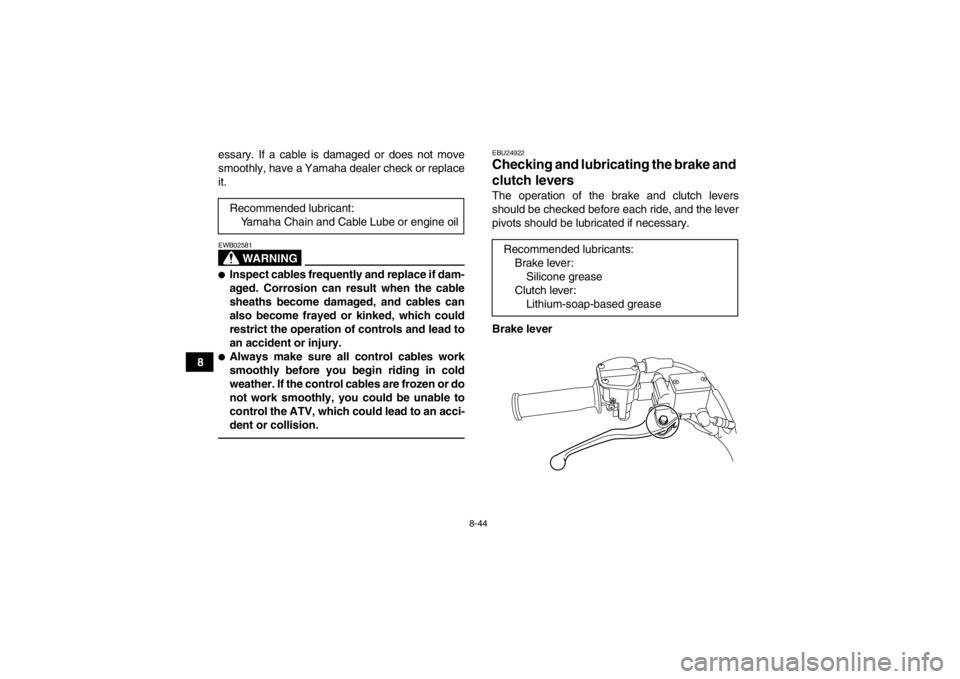
EBU24922Checking and lubricating the brake and
clutch levers The operation of the brake and clutch levers
should be checked before each ride, and the lever
pivots should be lubricated if necessary.
Brake lever
Recommended lubricant:
Yamaha Chain and Cable Lube or engine oilRecommended lubricants: Brake lever:Silicone grease
Clutch lever: Lithium-soap-based grease
U1PD61E0.book Page 44 Tuesday, February 14, 2012 10:06 AM
Page 139 of 154
8-57
8
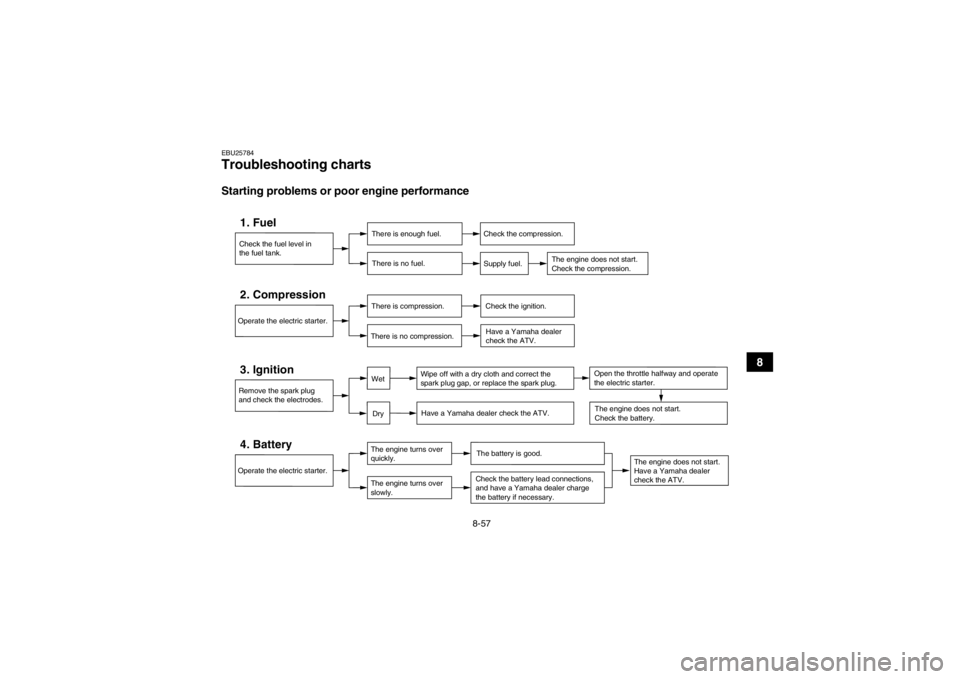
EBU25784Troubleshooting charts Starting problems or poor engine performance
Check the fuel level in
the fuel tank.1. Fuel
There is enough fuel.
There is no fuel.
Check the compression.
Supply fuel.
The engine does not start.
Check the compression.
Operate the electric starter.2. Compression
There is compression.
There is no compression.
Check the ignition. Have a Yamaha dealer
check the ATV.
Remove the spark plug
and check the electrodes.3. Ignition
Wipe off with a dry cloth and correct the
spark plug gap, or replace the spark plug.
Have a Yamaha dealer check the ATV.
The engine does not start.
Have a Yamaha dealer
check the ATV.
The engine does not start.
Check the battery.
Operate the electric starter.4. Battery
The engine turns over
quickly.
The engine turns over
slowly.
The battery is good.Check the battery lead connections,
and have a Yamaha dealer charge
the battery if necessary.
DryWet
Open the throttle halfway and operate
the electric starter.
U1PD61E0.book Page 57 Tuesday, February 14, 2012 10:06 AM
Page 140 of 154
8-58
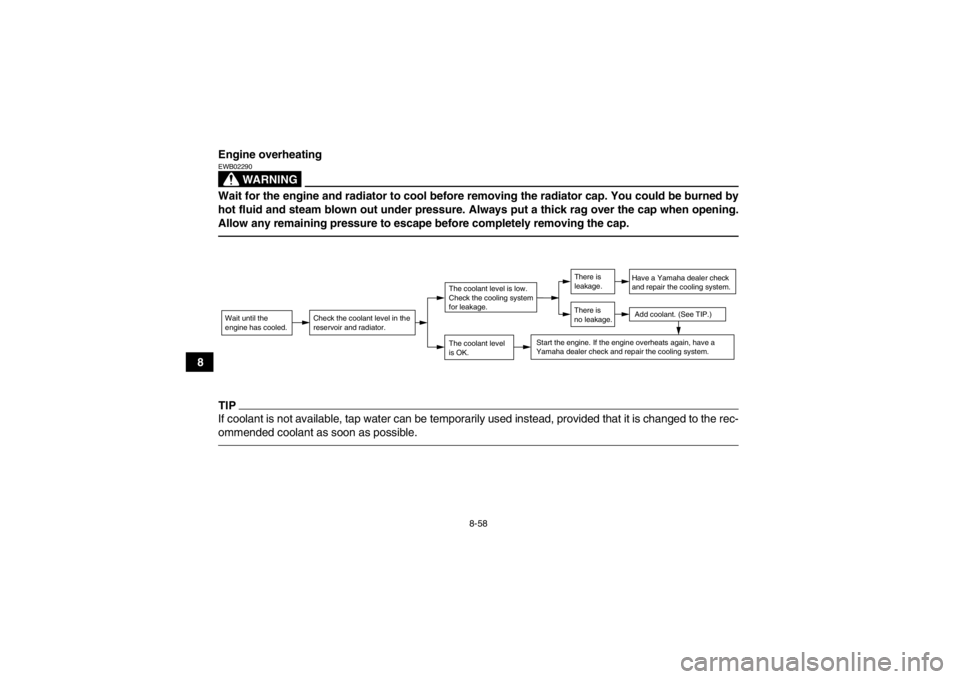
8Engine overheating
WARNING
EWB02290Wait for the engine and radiator to cool before
removing the radiator cap. You could be burned by
hot fluid and steam blown out under pressure. Always put a thick rag over the cap when opening.
Allow any remaining pressure to escape before completely removing the cap.TIPIf coolant is not available, tap water can be temporarily used instead, provided that it is changed to the rec-
ommended coolant as soon as possible.Wait until the
engine has cooled.
Check the coolant level in the
reservoir and radiator.
The coolant level
is OK.The coolant level is low.
Check the cooling system
for leakage.
Have a Yamaha dealer check
and repair the cooling system.Add coolant. (See TIP.)
Start the engine. If the engine overheats again, have a
Yamaha dealer check and repair the cooling system.
There is
leakage.
There is
no leakage.
U1PD61E0.book Page 58 Tuesday, February 14, 2012 10:06 AM
Page 141 of 154

9-1
9
EBU25860
CLEANING AND STORAGE
EBU25902Cleaning Frequent, thorough cleaning of your ATV will not
only enhance its appearance but will improve its
general performance and extend the useful life of
many components.1. Before cleaning the ATV: a. Block off the end of the exhaust pipe toprevent water entry. A plastic bag and
strong rubber band may be used.
b. Make sure the spark plug and all filler caps are properly installed.
2. If the engine case is excessively greasy, apply degreaser with a paint brush. Do not apply de-
greaser to the chain, sprockets or wheel ax-
les.
3. Rinse the dirt and degreaser off with a garden hose. Use only enough pressure to do the job.
WARNING! Wet brakes may have reduced stopping ability, increasing the chance of
an accident. Test the brakes after washing.
Apply the brakes several times at slow
speeds to let friction dry out the linings.
[EWB02311]
NOTICE: Excessive water pressure may cause water seepage and deteriora-
tion of wheel bearings, brakes, transmis-
sion seals and electrical devices. Many
expensive repair bills have resulted from
improper high-pressure detergent applica-
tions such as those available in coin-oper-
ated car washers.
[ECB00711]
4. Once most of the dirt has been hosed off,
wash all surfaces with warm water and mild,
detergent-type soap. An old toothbrush or bot-
tle brush is handy for hard-to-reach places.
5. Rinse the ATV off immediately with clean wa- ter and dry all surfaces with a chamois, clean
towel or soft absorbing cloth.
6. Dry the chain and lubricate it to prevent it from rusting.
7. Clean the seat with a vinyl upholstery cleaner to keep the cover pliable and glossy.
8. Automotive type wax may be applied to all painted and chrome plated surfaces. Avoid
combination cleaner-waxes. Many contain
abrasives which may mar the paint or protec-
tive finish. When finished cleaning, start the
engine and let it idle for several minutes.
U1PD61E0.book Page 1 Tuesday, February 14, 2012 10:06 AM
Page 142 of 154

9-2
9
EBU25933Storage Short-term
Always store your ATV in a cool, dry place and, if
necessary, protect it against dust with a porous
cover. NOTICE: Storing the ATV in a poorly ven-
tilated room or covering it with a tarp while it is
still wet, will allow water and humidity to seep
in and cause rust. To prevent corrosion, avoid
damp cellars, stables (because of the presence
of ammonia) and areas where strong chemi-
cals are stored.
[ECB00721]
Long-term
Before storing your ATV for several months: 1. Follow all the instructions in the “Cleaning” section of this chapter.
2. Turn the fuel cock lever to “OFF”.
3. Drain the carburetor float chamber by loosen- ing the drain bolt; this will prevent fuel deposits
from building up. Pour the drained fuel into the
fuel tank.
4. Fill up the fuel tank and add fuel stabilizer (if available) to prevent the fuel from deteriorat-
ing. 5. Perform the following steps to protect the cyl-
inder, piston rings, etc. from corrosion.a. Remove the spark plug cap and spark plug.
b. Pour a teaspoonful of engine oil into the spark plug bore.
c. Install the spark plug cap onto the spark plug, and then place the spark plug on the
cylinder head so that the electrodes are
grounded. (This will limit sparking during
the next step.)
d. Turn the engine over several times with the starter. (This will coat the cylinder wall with
oil.)
e. Remove the spark plug cap from the spark plug, and then install the spark plug and
the spark plug cap.
6. Lubricate all control cables and the pivoting points of all levers and pedals.
7. Check and, if necessary, correct the tire air pressure, and then block up the ATV so that
all of its wheels are off the ground. Alternative-
Specified amount:
7.5 ml of stabilizer to each liter of fuel (or 1
oz of stabilizer to each gallon of fuel)U1PD61E0.book Page 2 Tuesday, February 14, 2012 10:06 AM