wheel YAMAHA YFZ450R 2014 Owner's Manual
[x] Cancel search | Manufacturer: YAMAHA, Model Year: 2014, Model line: YFZ450R, Model: YAMAHA YFZ450R 2014Pages: 154, PDF Size: 3.83 MB
Page 129 of 154
8-40
8
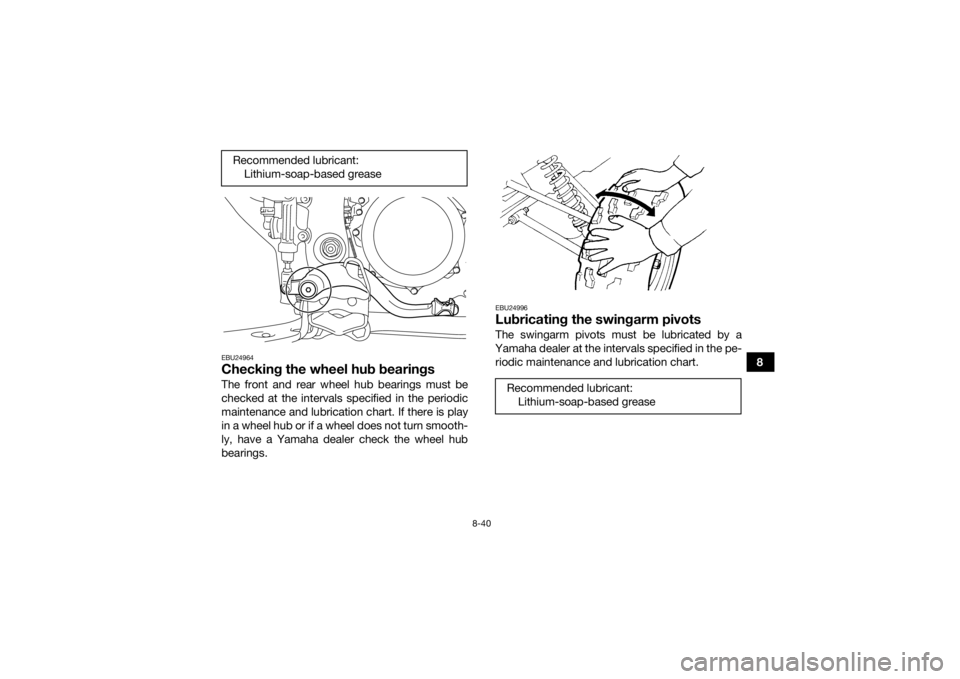
EBU24964Checking the wheel hub bearingsThe front and rear wheel hub bearings must be
checked at the intervals specified in the periodic
maintenance and lubrication chart. If there is play
in a wheel hub or if a wheel does not turn smooth-
ly, have a Yamaha dealer check the wheel hub
bearings.
EBU24996Lubricating the swingarm pivotsThe swingarm pivots must be lubricated by a
Yamaha dealer at the intervals specified in the pe- riodic maintenance and lubrication chart.
Recommended lubricant:
Lithium-soap-based greaseRecommended lubricant:Lithium-soap-based grease
U1TD6AE0.book Page 40 Wednesday, January 8, 2014 8:46 AM
Page 137 of 154
8-48
8
8. Adjust the headlight beam if necessary.
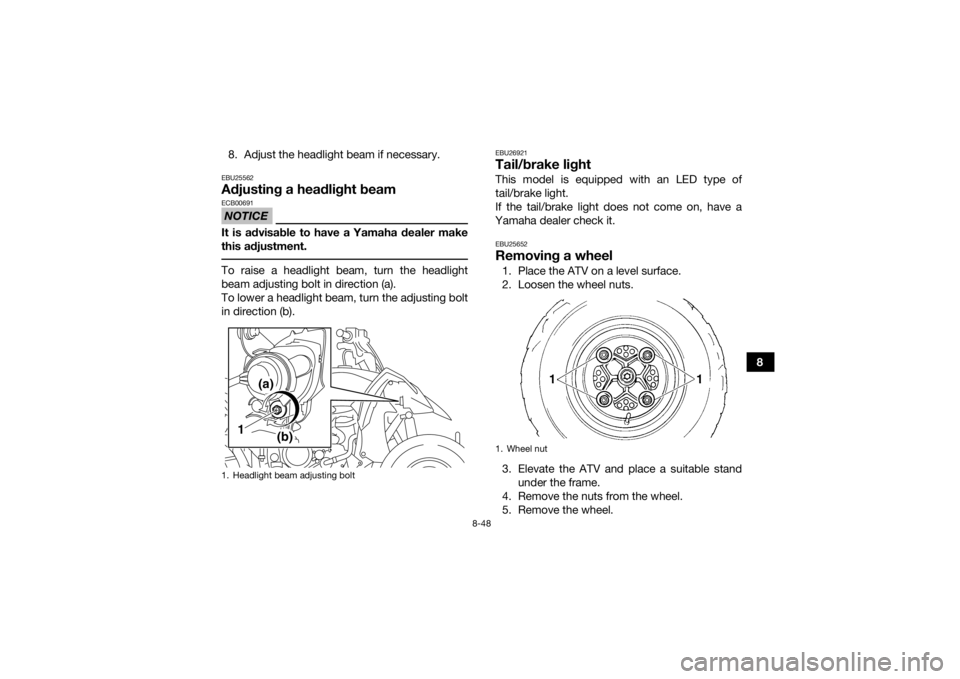
EBU25562Adjusting a headlight beamNOTICEECB00691It is advisable to have a Yamaha dealer make
this adjustment. To raise a headlight beam, turn the headlight
beam adjusting bolt in direction (a).
To lower a headlight beam, turn the adjusting bolt
in direction (b).
EBU26921Tail/brake lightThis model is equipped with an LED type of
tail/brake light.
If the tail/brake light does not come on, have a
Yamaha dealer check it.EBU25652Removing a wheel1. Place the ATV on a level surface.
2. Loosen the wheel nuts.
3. Elevate the ATV and place a suitable stand under the frame.
4. Remove the nuts from the wheel.
5. Remove the wheel.
1. Headlight beam adjusting bolt
1
(a)
(b)
1. Wheel nut
U1TD6AE0.book Page 48 Wednesday, January 8, 2014 8:46 AM
Page 138 of 154
8-49
8
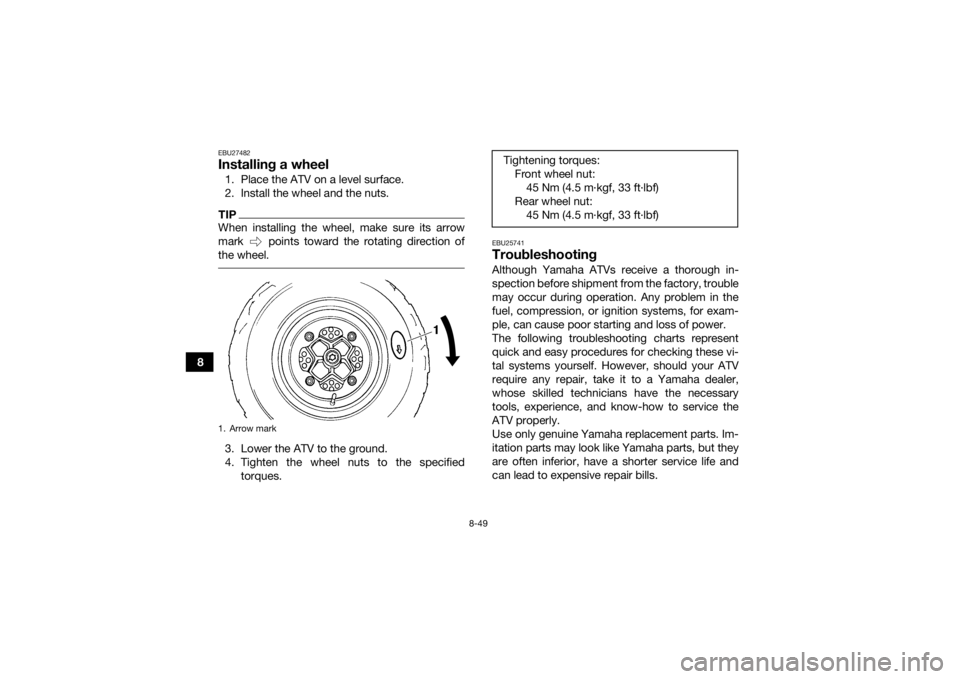
EBU27482Installing a wheel1. Place the ATV on a level surface.
2. Install the wheel and the nuts.TIPWhen installing the wheel, make sure its arrow
mark points toward the rotating direction of
the wheel. 3. Lower the ATV to the ground.
4. Tighten the wheel nuts to the specifiedtorques.
EBU25741TroubleshootingAlthough Yamaha ATVs receive a thorough in-
spection before shipment from the factory, trouble
may occur during operation. Any problem in the
fuel, compression, or ignition systems, for exam-
ple, can cause poor starting and loss of power.
The following troubleshooting charts represent
quick and easy procedures for checking these vi-
tal systems yourself. However, should your ATV
require any repair, take it to a Yamaha dealer,
whose skilled technicians have the necessary
tools, experience, and know-how to service the
ATV properly.
Use only genuine Yamaha replacement parts. Im-
itation parts may look like Yamaha parts, but they
are often inferior, have a shorter service life and
can lead to expensive repair bills.
1. Arrow mark
Tightening torques:Front wheel nut:45 Nm (4.5 m·kgf, 33 ft·lbf)
Rear wheel nut: 45 Nm (4.5 m·kgf, 33 ft·lbf)
U1TD6AE0.book Page 49 Wednesday, January 8, 2014 8:46 AM
Page 142 of 154

9-1
9
EBU25861
CLEANING AND STORAGE
EBU25903CleaningFrequent, thorough cleaning of your ATV will not
only enhance its appearance but will improve its
general performance and extend the useful life of
many components.1. Before cleaning the ATV: a. Block off the end of the exhaust pipe toprevent water entry. A plastic bag and
strong rubber band may be used.
b. Make sure the spark plug and all filler caps are properly installed.
2. If the engine case is excessively greasy, apply degreaser with a paint brush. Do not apply
degreaser to the chain, sprockets or wheel
axles.
3. Rinse the dirt and degreaser off with a garden hose. Use only enough pressure to do the
job. WARNING! Wet brakes may have re-
duced stopping ability, increasing the
chance of an accident. Test the brakes af-
ter washing. Apply the brakes several
times at slow speeds to let friction dry out
the linings.
[EWB02312]
NOTICE: Excessive wa- ter pressure may cause water seepage
and deterioration of wheel bearings,
brakes, transmission seals and electrical
devices. Many expensive repair bills have
resulted from improper high-pressure de-
tergent applications such as those avail-
able in coin-operated car washers.
[ECB00712]
4. Once most of the dirt has been hosed off,
wash all surfaces with warm water and mild,
detergent-type soap. An old toothbrush or
bottle brush is handy for hard-to-reach pla-
ces.
5. Rinse the ATV off immediately with clean wa- ter and dry all surfaces with a chamois, clean
towel or soft absorbing cloth.
6. Dry the chain and lubricate it to prevent it from rusting.
7. Clean the seat with a vinyl upholstery cleaner to keep the cover pliable and glossy.
8. Automotive type wax may be applied to all painted and chrome plated surfaces. Avoid
combination cleaner-waxes. Many contain
U1TD6AE0.book Page 1 Wednesday, January 8, 2014 8:46 AM
Page 143 of 154

9-2
9
abrasives which may mar the paint or protec-
tive finish. When finished cleaning, start the
engine and let it idle for several minutes.
EBU27262StorageShort-term
Always store your ATV in a cool, dry place and, if
necessary, protect it against dust with a porous
cover.
NOTICE: Storing the ATV in a poorly ven-
tilated room or covering it with a tarp while it is
still wet, will allow water and humidity to seep
in and cause rust. To prevent corrosion, avoid
damp cellars, stables (because of the presence
of ammonia) and areas where strong chemi-
cals are stored.
[ECB00722]
Long-term
Before storing your ATV for several months: 1. Follow all the instructions in the “Cleaning” section of this chapter.
2. Fill up the fuel tank and add fuel stabilizer (if available) to prevent the fuel from deteriorat-
ing. 3. Perform the following steps to protect the cyl-
inder, piston rings, etc. from corrosion.a. Remove the spark plug cap and spark plug.
b. Pour a teaspoonful of engine oil into the spark plug bore.
c. Install the spark plug cap onto the spark plug, and then place the spark plug on the
cylinder head so that the electrodes are
grounded. (This will limit sparking during
the next step.)
d. Turn the engine over several times with the starter. (This will coat the cylinder wall
with oil.)
e. Remove the spark plug cap from the spark plug, and then install the spark plug and
the spark plug cap.
4. Lubricate all control cables and the pivoting points of all levers and pedals.
5. Check and, if necessary, correct the tire air pressure, and then block up the ATV so that
all of its wheels are off the ground. Alterna-
Specified amount:
7.5 ml of stabilizer to each liter of fuel (or 1
oz of stabilizer to each gallon of fuel)U1TD6AE0.book Page 2 Wednesday, January 8, 2014 8:46 AM
Page 144 of 154
9-3
9tively, turn the wheels a little every month in
order to prevent the tires from becoming de-
graded in one spot.
6. Cover the muffler outlet with a plastic bag to prevent moisture from entering it.
7. Remove the battery and fully charge it. Store it in a cool, dry place and charge it once a
month. Do not store the battery in an exces-
sively cold or warm place [less than 0 °C (30
°F) or more than 30 °C (90 °F)]. For more infor-
mation on storing the battery, see page 8-42.
TIPMake any necessary repairs before storing the
ATV. U1TD6AE0.book Page 3 Wednesday, January 8, 2014 8:46 AM
Page 145 of 154

10-1
10
EBU25962
SPECIFICATIONS
Dimensions:Overall length:1795 mm (70.7 in)
Overall width: 1240 mm (48.8 in)
Overall height:
1065 mm (41.9 in)
Seat height: 810 mm (31.9 in)
Wheelbase: 1270 mm (50.0 in)
Ground clearance:
235 mm (9.3 in)
Minimum turning radius: 3600 mm (142 in)Weight:Curb weight:
184.0 kg (406 lb)Noise and vibration level:Noise level (77/311/EEC):85.9 dB(A)@3750 r/min (EUR)(FRA)(GBR)
A-weighted sound power level:
99.0 dB(A)@3750 r/min (EUR)(FRA)(GBR)
Vibration on seat (EN1032, ISO5008): Will not exceed 0.5 m/s² (EUR)(FRA)(GBR)
Vibration on handle (EN1032, ISO5008): Will not exceed 2.5 m/s² (EUR)(FRA)(GBR)
Engine:Engine type:Liquid cooled 4-stroke, DOHC
Cylinder arrangement: Single cylinder
Displacement:
449 cm³
Bore × stroke:
95.0 × 63.4 mm (3.74 × 2.50 in)
Compression ratio: 11.8 : 1
Starting system:
Electric starter
Lubrication system: Dry sumpEngine oil:Recommended brand:
YAMALUBE
U1TD6AE0.book Page 1 Wednesday, January 8, 2014 8:46 AM
Page 147 of 154

10-3
10
Operation:Left foot operation
Gear ratio: 1st:35/14 (2.500)
2nd: 30/15 (2.000)
3rd:
31/19 (1.632)
4th: 28/21 (1.333)
5th: 23/21 (1.095)Chassis:Frame type:Aluminum die-cast and steel tube frame
Caster angle: 5.0 °
Trail:
21.0 mm (0.83 in)Front tire:Type:Tubeless
Size:
AT21 x 7R10
Manufacturer/model: MAXXIS/MS21Rear tire:Type:
Tubeless
Size: AT20 x 10R9 Manufacturer/model:
MAXXIS/MS22
Loading:Maximum loading limit:
100.0 kg (220 lb)
(Total weight of rider, cargo, accessories, and tongue)Tire air pressure (measured on cold tires):Recommended:Front:
35.0 kPa (0.350 kgf/cm², 5.0 psi)
Rear: 35.0 kPa (0.350 kgf/cm², 5.0 psi)
Minimum: Front:32.0 kPa (0.320 kgf/cm², 4.6 psi)
Rear: 32.0 kPa (0.320 kgf/cm², 4.6 psi)Front wheel:Wheel type:Panel wheel
Rim size: 10 x 5.5ATRear wheel:Wheel type:Panel wheel
Rim size: 9 x 8.0ATFront brake:Type:Disc brake
U1TD6AE0.book Page 3 Wednesday, January 8, 2014 8:46 AM
Page 148 of 154

10-4
10
Operation:Right hand operation
Specified brake fluid: DOT 4Rear brake:Type:Disc brake
Operation: Right foot operation
Specified brake fluid:
DOT 4Front suspension:Type:Double wishbone
Spring/shock absorber type:
Coil spring/gas-oil damper
Wheel travel: 250 mm (9.9 in)Rear suspension:Type:
Swingarm (link suspension)
Spring/shock absorber type: Coil spring/gas-oil damper
Wheel travel: 280 mm (11.0 in)Electrical system:Ignition system:TCI
Charging system: AC magneto
Battery:Model:YTZ7S
Voltage, capacity:
12 V, 6.0 AhHeadlight:Bulb type:Krypton bulbBulb voltage, wattage × quantity:Headlight:
12 V, 30.0/30.0 W × 2
Tail/brake light: LED
Neutral indicator light:
LED
Fuel level warning light: LED
Coolant temperature warning light: LED
Engine trouble warning light:
LEDFuse:Fuse:20.0 A
U1TD6AE0.book Page 4 Wednesday, January 8, 2014 8:46 AM
Page 153 of 154

12-2
12
Model label .................................................................. 11-1NNeutral indicator light ..................................................... 4-2OOwner’s manual and tool kit .......................................... 8-2PParking ........................................................................... 6-4
Parking brake free play, adjusting ............................... 8-32
Parking brake lever ........................................................ 4-7
Parking on a slope ......................................................... 6-5
Part locations ................................................................. 3-1RRiding your ATV ............................................................. 7-1SSafety information .......................................................... 2-1
Seat .............................................................................. 4-10
Shifting ........................................................................... 6-2
Shift pedal ...................................................................... 4-8
Shift pedal, checking ................................................... 8-39
Shock absorber assemblies, adjusting the front ......... 4-11
Shock absorber assembly, adjusting the rear ............. 4-16
Spark arrester, cleaning ............................................... 8-25
Spark plug, checking ................................................... 8-13
Specifications .............................................................. 10-1
Speed limiter .................................................................. 4-5
Start switch .................................................................... 4-4
Steering shaft, lubricating ............................................ 8-42
Storage .......................................................................... 9-2
Suspension, lubricating the upper and lower arm pivots ......................................................................... 8-41
Swingarm pivots, lubricating ....................................... 8-40
TTail/brake light ............................................................. 8-48
Throttle lever ........................................................... 4-4, 5-5
Throttle lever free play, adjusting ................................ 8-27
Tires ............................................................................... 5-5
Troubleshooting ........................................................... 8-49
Troubleshooting charts ................................................ 8-51VValve clearance ............................................................ 8-28
Vehicle identification number ...................................... 11-1WWheel hub bearings, checking .................................... 8-40
Wheel, installing ........................................................... 8-49
Wheel, removing .......................................................... 8-48
U1TD6AE0.book Page 2 Wednesday, January 8, 2014 8:46 AM