warning YAMAHA YFZ50 2021 User Guide
[x] Cancel search | Manufacturer: YAMAHA, Model Year: 2021, Model line: YFZ50, Model: YAMAHA YFZ50 2021Pages: 126, PDF Size: 4.89 MB
Page 38 of 126
5-9
5of sparks, open flames, or other sources of
ignition such as the pilot lights of water heat-
ers and clothes dryers.
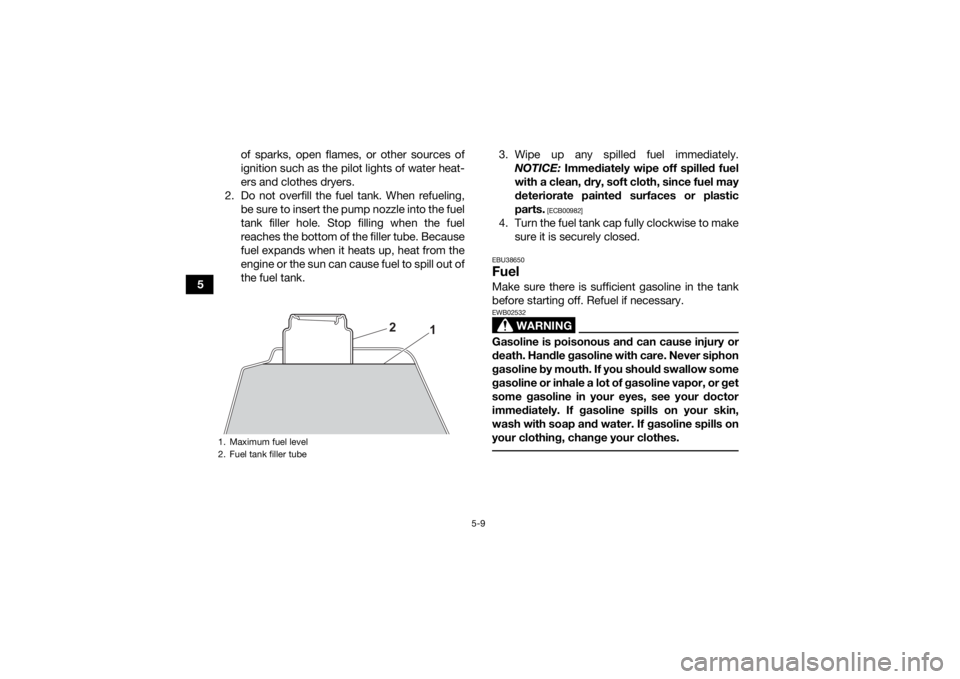
2. Do not overfill the fuel tank. When refueling, be sure to insert the pump nozzle into the fuel
tank filler hole. Stop filling when the fuel
reaches the bottom of the filler tube. Because
fuel expands when it heats up, heat from the
engine or the sun can cause fuel to spill out of
the fuel tank. 3. Wipe up any spilled fuel immediately.
NOTICE: Immediately wipe off spilled fuel
with a clean, dry, soft cloth, since fuel may
deteriorate painted surfaces or plastic
parts.
[ECB00982]
4. Turn the fuel tank cap fully clockwise to make sure it is securely closed.EBU38650FuelMake sure there is sufficient gasoline in the tank
before starting off. Refuel if necessary.
WARNING
EWB02532Gasoline is poisonous and can cause injury or
death. Handle gasoline with care. Never siphon
gasoline by mouth. If you should swallow some
gasoline or inhale a lot of gasoline vapor, or get
some gasoline in your eyes, see your doctor
immediately. If gasoline spills on your skin,
wash with soap and water. If gasoline spills on
your clothing, change your clothes.
1. Maximum fuel level
2. Fuel tank filler tube
2 1
UBW464E0.book Page 9 Thursday, January 23, 2020 2:42 PM
Page 44 of 126

6-1
6
EBU19203
PRE-OPERATION CHECKS
EBU19227Inspect your vehicle each time you use it to make sure the vehicle is in safe operating condition. Always
follow the inspection and maintenance procedures and schedules described in the Owner’s Manual.
WARNING
EWB00482Failure to inspect or maintain the vehicle properly increases the possibility of an accident or equip-
ment damage. Do not operate the vehicle if you find any problem. If a problem cannot be corrected
by the procedures provided in this manual, have the vehicle inspected by a Yamaha dealer. Before using this vehicle, check the following points:
ITEMROUTINE PAGE
Fuel • Check fuel level in fuel tank,
and add recommended fuel if neces-
sary.
• Check fuel line for leakage. Correct if necessary. 5-9, 6-3
Engine oil • Check oil level in engine, and add recommended oil to specified
level if necessary.
• Check ATV for oil leakage. Correct if necessary. 6-3, 9-11
Transmission oil • Check ATV for oil leakage. Correct if necessary. 6-3, 9-15
Front brake • Check operation, and correct if necessary.
• Lubricate cable if necessary.
• Check lever free play, and adjust if necessary. 6-3, 9-23, 9-24
Rear brake • Check operation, and correct if necessary.
• Lubricate cable if necessary.
• Check lever free play, and adjust if necessary. 6-3, 9-23, 9-26
UBW464E0.book Page 1 Thursday, January 23, 2020 2:42 PM
Page 47 of 126
6-4
6
Tire pressure
Use a tire pressure gauge to check and adjust tire
air pressure when the tires are cold. The tire air
pressure must be equal on both sides.
WARNING! Operation of this vehicle with im- proper tire pressure may cause severe injury or
death from loss of control or rollover. Tire
pressure below the minimum specified could
also cause the tire to dislodge from the rim un-
der severe riding conditions.
[EWB02542]
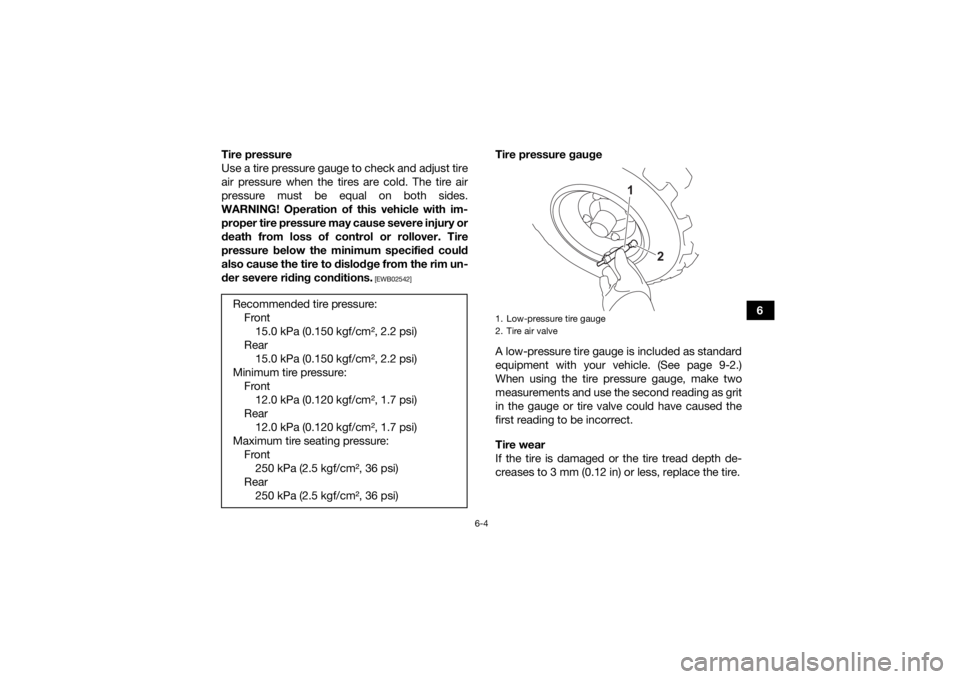
Tire pressure gauge
A low-pressure tire gauge is included as standard
equipment with your vehicle. (See page 9-2.)
When using the tire pressure gauge, make two
measurements and use the second reading as grit
in the gauge or tire valve could have caused the
first reading to be incorrect.
Tire wear
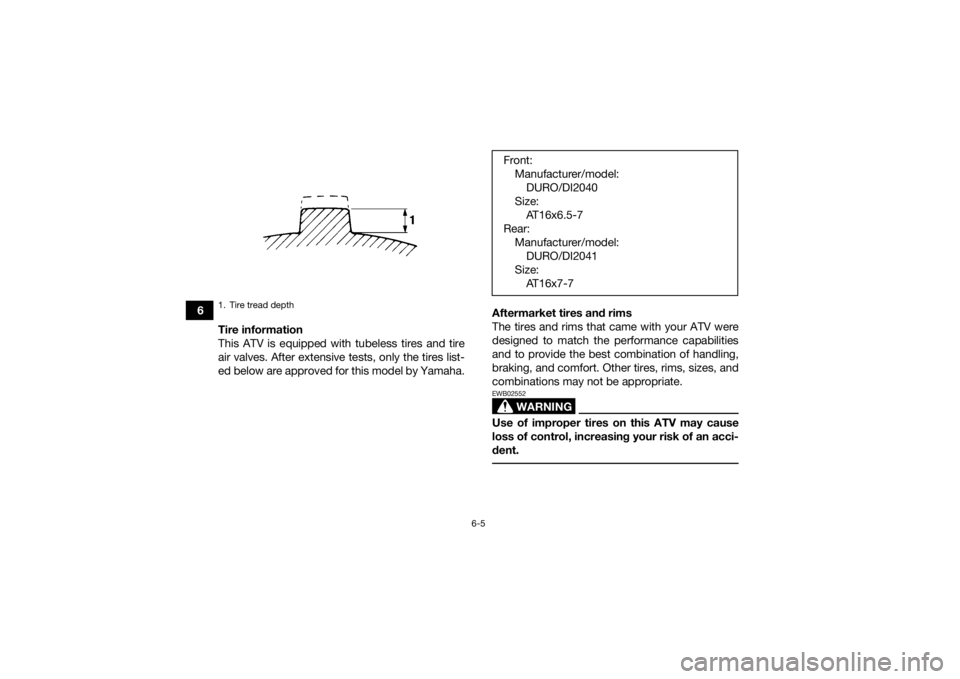
If the tire is damaged or the tire tread depth de-
creases to 3 mm (0.12 in) or less, replace the tire.
Recommended tire pressure:
Front15.0 kPa (0.150 kgf/cm², 2.2 psi)
Rear 15.0 kPa (0.150 kgf/cm², 2.2 psi)
Minimum tire pressure: Front12.0 kPa (0.120 kgf/cm², 1.7 psi)
Rear 12.0 kPa (0.120 kgf/cm², 1.7 psi)
Maximum tire seating pressure: Front250 kPa (2.5 kgf/cm², 36 psi)
Rear 250 kPa (2.5 kgf/cm², 36 psi)1. Low-pressure tire gauge
2. Tire air valve
1
2
UBW464E0.book Page 4 Thursday, January 23, 2020 2:42 PM
Page 48 of 126
6-5
6Tire information
This ATV is equipped with tubeless tires and tire
air valves. After extensive tests, only the tires list-
ed below are approved for this model by Yamaha. Aftermarket tires and rims
The tires and rims that came with your ATV were
designed to match the performance capabilities
and to provide the best combination of handling,
braking, and comfort. Other tires, rims, sizes, and
combinations may not be appropriate.
WARNING
EWB02552Use of improper tires on this ATV may cause
loss of control, increasing your risk of an acci-
dent.
1. Tire tread depth
Front:
Manufacturer/model:DURO/DI2040
Size: AT 1 6 x 6 . 5 - 7
Rear: Manufacturer/model:DURO/DI2041
Size: AT 1 6 x 7 - 7
UBW464E0.book Page 5 Thursday, January 23, 2020 2:42 PM
Page 50 of 126
7-1
7
EBU19882
OPERATION
EBU19902Read the Owner’s Manual carefully before riding
the ATV. If there is a control or function you do not
understand, ask your Yamaha dealer.
WARNING
EWB00632Read the Owner’s Manual carefully to become
familiar with all controls in order to help pre-
vent any loss of control, which could cause an
accident or injury. EBU36361Starting a cold engineNOTICEECB00151See the “Engine break-in” section on page 7-3
prior to operating the engine for the first time. 1. Set the parking brake. (The engine can bestarted only when the rear brake lever is ap-
plied.)
2. Turn the fuel cock to “ON”. 3. Turn the key to “ON” and set the engine stop
switch to “ ”.
4. Position the starter (choke) lever according to the ambient temperature.
Position (1):
Cold engine start with ambient temperature
below 5 °C (40 °F).
Position (2):
Cold engine start with ambient temperature
between 0 °C (30 °F) and 30 °C (90 °F).
Position (3):
Cold engine start with ambient temperature
above 25 °C (80 °F).
UBW464E0.book Page 1 Thursday, January 23, 2020 2:42 PM
Page 53 of 126
7-4
7
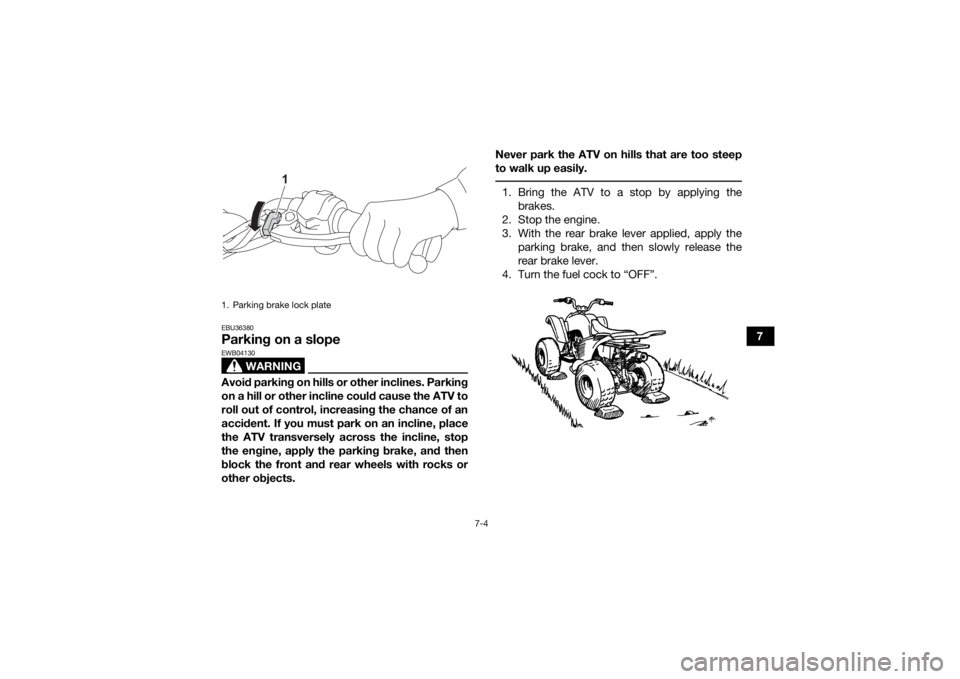
EBU36380Parking on a slope
WARNING
EWB04130Avoid parking on hills or other inclines. Parking
on a hill or other incline could cause the ATV to
roll out of control, increasing the chance of an
accident. If you must park on an incline, place
the ATV transversely across the incline, stop
the engine, apply the parking brake, and then
block the front and rear wheels with rocks or
other objects.Never park the ATV on hills that are too steep
to walk up easily.
1. Bring the ATV to a stop by applying the
brakes.
2. Stop the engine.
3. With the rear brake lever applied, apply the parking brake, and then slowly release the
rear brake lever.
4. Turn the fuel cock to “OFF”.
1. Parking brake lock plate
1
UBW464E0.book Page 4 Thursday, January 23, 2020 2:42 PM
Page 55 of 126
7-6
7
EBU33880Loading
WARNING
EWB00821Never exceed the stated load capacity for this
ATV. Overloading this ATV or carrying or tow-
ing cargo improperly could cause changes in
ATV handling which could lead to an accident.
Cargo should be properly distributed and se-
curely attached. Reduce speed when carrying
cargo or pulling a trailer. Allow greater dis-
tance for braking. As originally equipped, this ATV is not designed to
carry cargo or tow a trailer. If you choose to add
accessories so that you can carry cargo or tow a
trailer, you must use common sense and good
judgment as the stability and handling of an ATV
can be changed. When adding accessories, keep
the following points in mind:
Never exceed the weight limits shown. An over-
loaded ATV can be unstable.
If you are carrying cargo and towing a trailer, in-
clude the tongue weight in the maximum ATV
load limit.
Load cargo on the carriers as close to the center
of the ATV as possible. Put cargo at the rear of
the front carrier, at the front of the rear carrier,
and center it.
Tie down cargo securely to the carriers. Make
sure cargo in the trailer cannot move around. A
shifting load can cause an accident.
Make sure the load does not interfere with con-
trols or your ability to see where you are going.
Ride more slowly than you would without a
load. The more weight you carry, the slower you
should go.
Allow more braking distance. A heavier ATV
takes longer to stop.
Avoid making sharp turns unless at very slow
speeds.
Avoid hills and rough terrain. Choose terrain
carefully. Added weight affects the stability and
handling of the ATV.
MAXIMUM LOADING LIMIT ATV loading limit (total weight of rider, car-
go, accessories, and tongue weight):41.0 kg (90 lb)UBW464E0.book Page 6 Thursday, January 23, 2020 2:42 PM
Page 57 of 126
8-2
8
EBU21525GETTING TO KNOW YOUR ATV
This ATV is intended for recreational use by young
operators under adult supervision. This section,
“Riding your ATV”, provides general riding instruc-
tions which are appropriate for all types of riding.
Riding your ATV requires special skills acquired
through practice over a period of time. Take the
time to learn the basic techniques well before at-
tempting more difficult maneuvers.
Riding your new ATV can be a very enjoyable ac-
tivity, providing you with hours of pleasure. But it
is essential to familiarize yourself with the opera-
tion of the ATV to achieve the skill necessary to
enjoy riding safely. Before you begin to ride, be
sure you have read this manual completely and
understand how to operate all of the ATV’s con-
trols. Pay particular attention to the safety infor-
mation on pages 3-1 to 3-8 and all notice and
warning labels on the vehicle.RIDE WITH CARE AND GOOD JUDGMENT
Beginning riders should get training from a
certified instructor.
WARNING
EWB01382
Do not operate this ATV or allow anyone else
to operate it without proper instruction. The
risk of an accident is greatly increased if the
operator does not know how to operate the
ATV properly in different situations and on
different types of terrain.
Do not operate this ATV at speeds too fast
for your skills or the conditions, as this in-
creases your chances of losing control of the
ATV and an accident. Always go at a speed
that is proper for the terrain, visibility and op-
erating conditions, and your experience. Riding your ATV requires skills acquired
through practice over a period of time.
Become familiar with riding this ATV by riding at
slow speeds first, even if you have experience rid-
ing other ATVs. Do not attempt to operate it at
higher performance levels until you are familiar
with this ATV’s handling and performance charac-
UBW464E0.book Page 2 Thursday, January 23, 2020 2:42 PM
Page 58 of 126
8-3
8teristics. Take the time to learn the basic techni-
ques well before attempting more difficult
maneuvers.
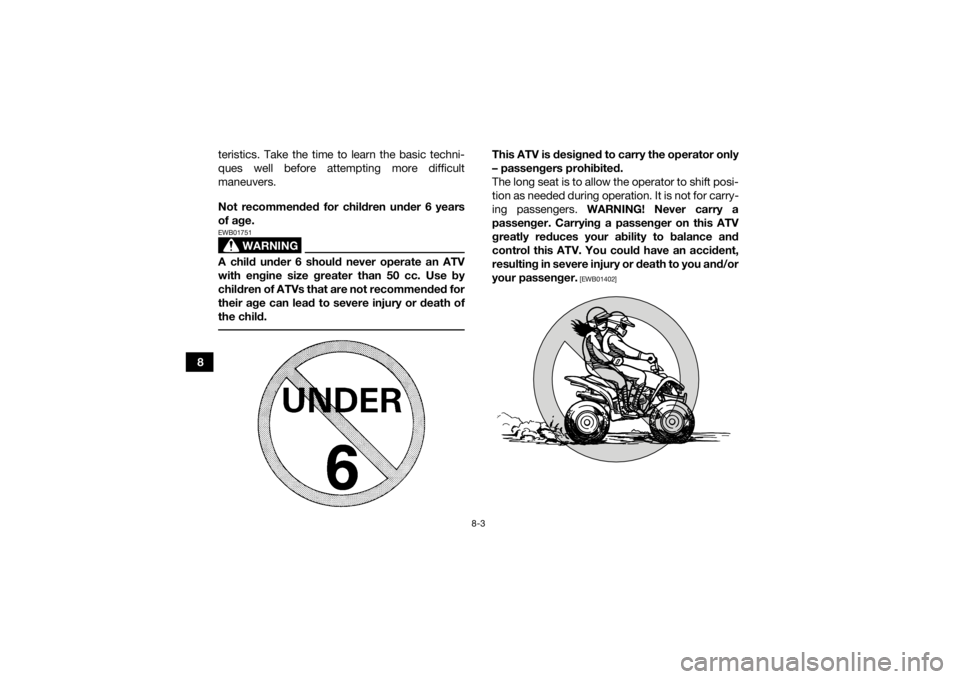
Not recommended for children under 6 years
of age.
WARNING
EWB01751A child under 6 should never operate an ATV
with engine size greater than 50 cc. Use by
children of ATVs that are not recommended for
their age can lead to severe injury or death of
the child.
This ATV is designed to carry the operator only
– passengers prohibited.
The long seat is to allow the operator to shift posi-
tion as needed during operation. It is not for carry-
ing passengers.
WARNING! Never carry a
passenger. Carrying a passenger on this ATV
greatly reduces your ability to balance and
control this ATV. You could have an accident,
resulting in severe injury or death to you and/or
your passenger.
[EWB01402]
UBW464E0.book Page 3 Thursday, January 23, 2020 2:42 PM
Page 59 of 126
8-4
8
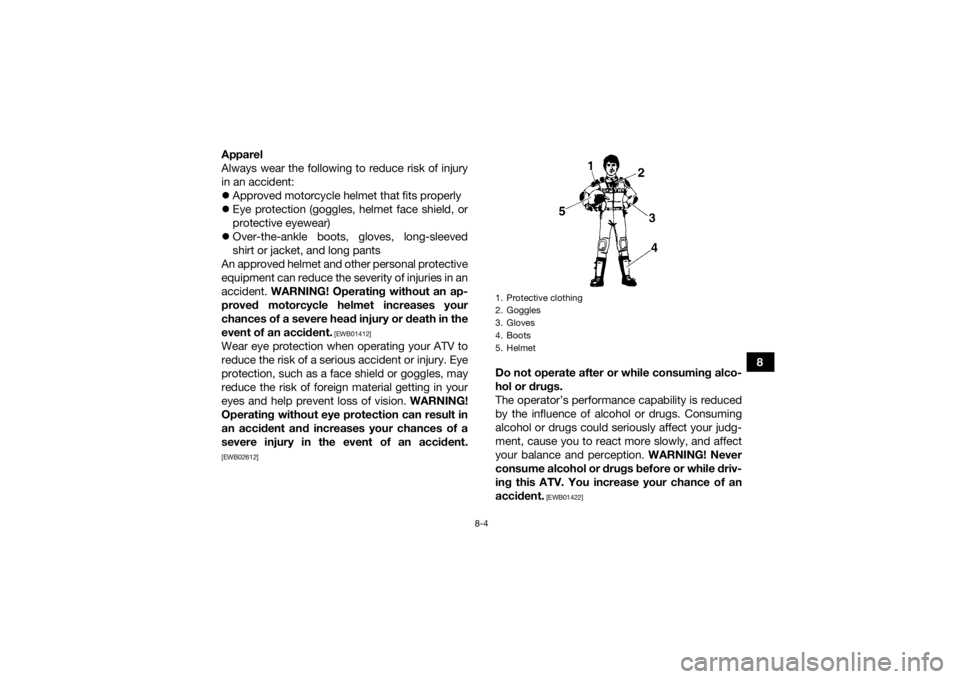
Apparel
Always wear the following to reduce risk of injury
in an accident:
Approved motorcycle helmet that fits properly
Eye protection (goggles, helmet face shield, or
protective eyewear)
Over-the-ankle boots, gloves, long-sleeved
shirt or jacket, and long pants
An approved helmet and other personal protective
equipment can reduce the severity of injuries in an
accident. WARNING! Operating without an ap-
proved motorcycle helmet increases your
chances of a severe head injury or death in the
event of an accident.
[EWB01412]
Wear eye protection when operating your ATV to
reduce the risk of a serious accident or injury. Eye
protection, such as a face shield or goggles, may
reduce the risk of foreign material getting in your
eyes and help prevent loss of vision. WARNING!
Operating without eye protection can result in
an accident and increases your chances of a
severe injury in the event of an accident.[EWB02612]
Do not operate after or while consuming alco-
hol or drugs.
The operator’s performance capability is reduced
by the influence of alcohol or drugs. Consuming
alcohol or drugs could seriously affect your judg-
ment, cause you to react more slowly, and affect
your balance and perception. WARNING! Never
consume alcohol or drugs before or while driv-
ing this ATV. You increase your chance of an
accident.
[EWB01422]
1. Protective clothing
2. Goggles
3. Gloves
4. Boots
5. Helmet
UBW464E0.book Page 4 Thursday, January 23, 2020 2:42 PM