weight YAMAHA YFZ50 2021 User Guide
[x] Cancel search | Manufacturer: YAMAHA, Model Year: 2021, Model line: YFZ50, Model: YAMAHA YFZ50 2021Pages: 126, PDF Size: 4.89 MB
Page 71 of 126
8-16
8
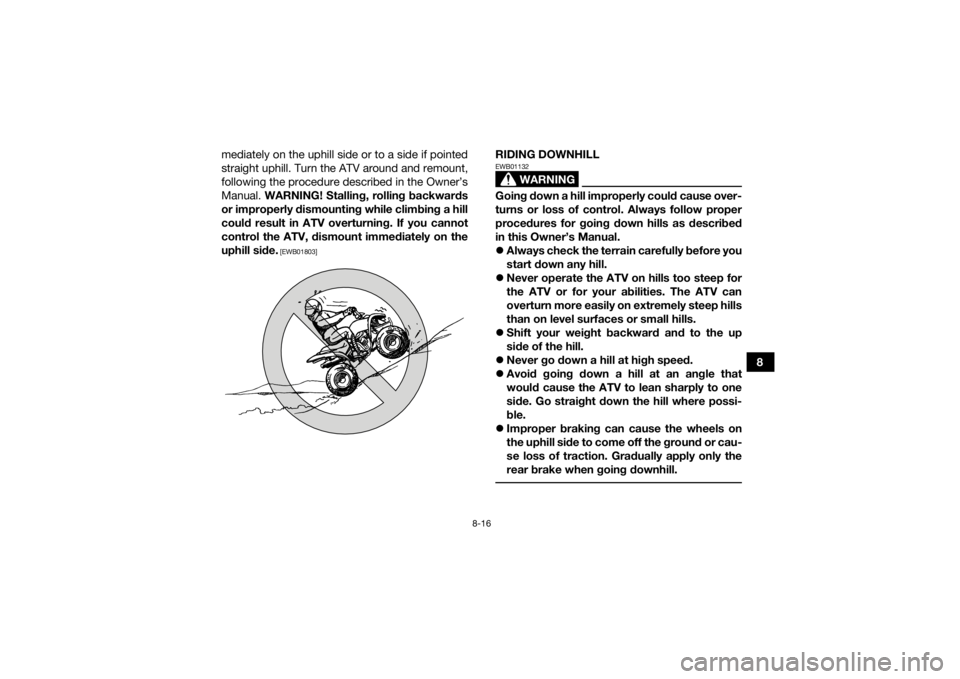
mediately on the uphill side or to a side if pointed
straight uphill. Turn the ATV around and remount,
following the procedure described in the Owner’s
Manual.
WARNING! Stalling, rolling backwards
or improperly dismounting while climbing a hill
could result in ATV overturning. If you cannot
control the ATV, dismount immediately on the
uphill side.
[EWB01803]
RIDING DOWNHILL
WARNING
EWB01132Going down a hill improperly could cause over-
turns or loss of control. Always follow proper
procedures for going down hills as described
in this Owner’s Manual.
Always check the terrain carefully before you
start down any hill.
Never operate the ATV on hills too steep for
the ATV or for your abilities. The ATV can
overturn more easily on extremely steep hills
than on level surfaces or small hills.
Shift your weight backward and to the up
side of the hill.
Never go down a hill at high speed.
Avoid going down a hill at an angle that
would cause the ATV to lean sharply to one
side. Go straight down the hill where possi-
ble.
Improper braking can cause the wheels on
the uphill side to come off the ground or cau-
se loss of traction. Gradually apply only the
rear brake when going downhill.
UBW464E0.book Page 16 Thursday, January 23, 2020 2:42 PM
Page 72 of 126
8-17
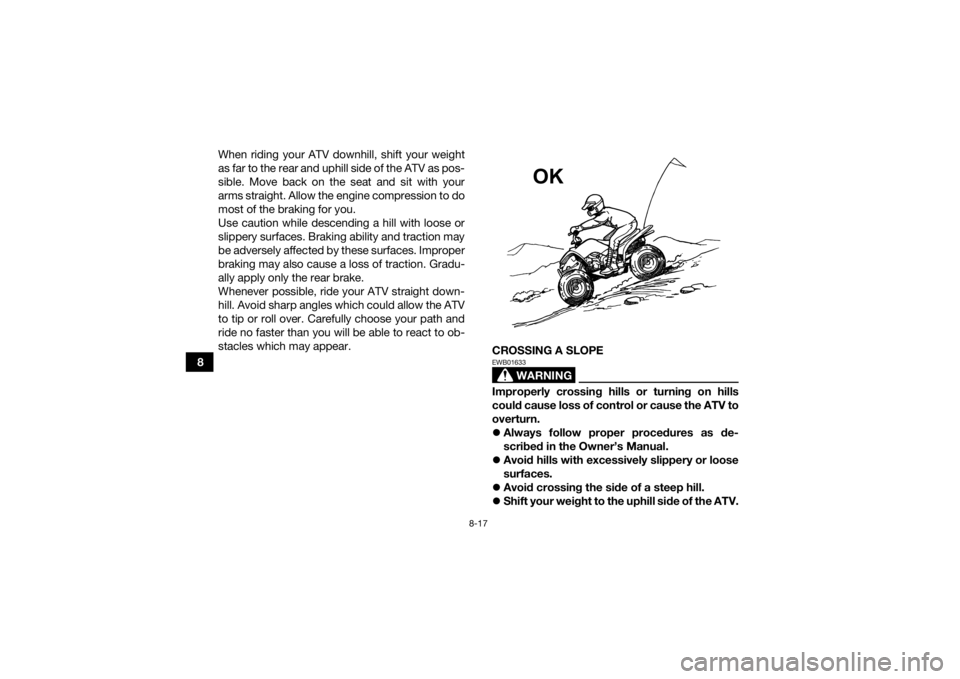
8When riding your ATV downhill, shift your weight
as far to the rear and uphill side of the ATV as pos-
sible. Move back on the seat and sit with your
arms straight. Allow the engine compression to do
most of the braking for you.
Use caution while descending a hill with loose or
slippery surfaces. Braking ability and traction may
be adversely affected by these surfaces. Improper
braking may also cause a loss of traction. Gradu-
ally apply only the rear brake.
Whenever possible, ride your ATV straight down-
hill. Avoid sharp angles which could allow the ATV
to tip or roll over. Carefully choose your path and
ride no faster than you will be able to react to ob-
stacles which may appear.
CROSSING A SLOPE
WARNING
EWB01633Improperly crossing hills or turning on hills
could cause loss of control or cause the ATV to
overturn.
Always follow proper procedures as de-
scribed in the Owner’s Manual.
Avoid hills with excessively slippery or loose
surfaces.
Avoid crossing the side of a steep hill.
Shift your weight to the uphill side of the ATV.
OK
UBW464E0.book Page 17 Thursday, January 23, 2020 2:42 PM
Page 73 of 126
8-18
8
Never attempt to turn the ATV around on any
hill until you have mastered the turning tech-
nique as described in the Owner’s Manual on
level ground. Be very careful when turning
on any hill.
Traversing a sloping surface on your ATV requires
you to properly position your weight to maintain
proper balance. Be sure that you have learned the
basic riding skills on flat ground before attempting
to cross a sloping surface. Avoid slopes with slip-
pery surfaces or rough terrain that may upset your
balance.
As you travel across a slope, lean your body in the
uphill direction. It may be necessary to correct the
steering when riding on loose surfaces by pointing
the front wheels slightly uphill. When riding on
slopes, be sure not to make sharp turns either up
or down hill.
If your ATV does begin to tip over, gradually steer
in the downhill direction if there are no obstacles
in your path. As you regain proper balance, grad-
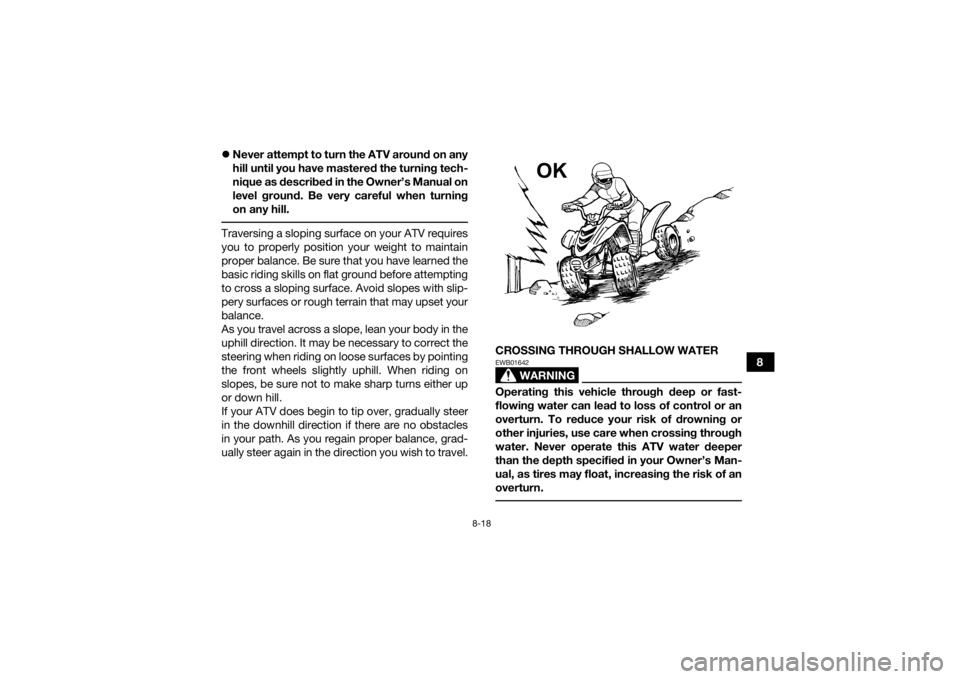
ually steer again in the direction you wish to travel. CROSSING THROUGH SHALLOW WATER
WARNING
EWB01642Operating this vehicle through deep or fast-
flowing water can lead to loss of control or an
overturn. To reduce your risk of drowning or
other injuries, use care when crossing through
water. Never operate this ATV water deeper
than the depth specified in your Owner’s Man-
ual, as tires may float, increasing the risk of an
overturn.
OK
UBW464E0.book Page 18 Thursday, January 23, 2020 2:42 PM
Page 76 of 126
8-21
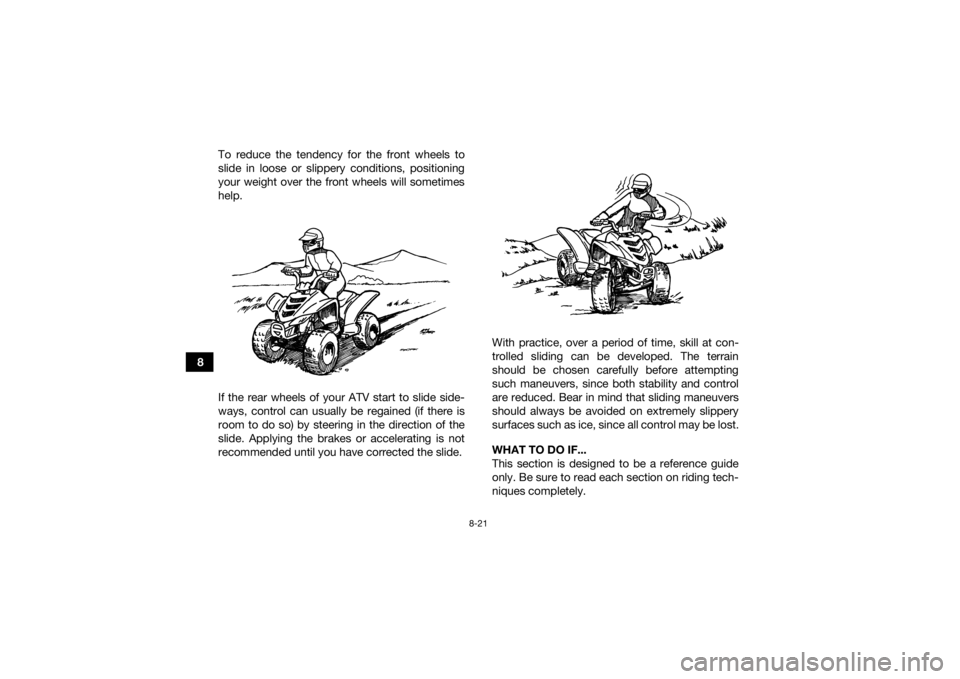
8To reduce the tendency for the front wheels to
slide in loose or slippery conditions, positioning
your weight over the front wheels will sometimes
help.
If the rear wheels of your ATV start to slide side-
ways, control can usually be regained (if there is
room to do so) by steering in the direction of the
slide. Applying the brakes or accelerating is not
recommended until you have corrected the slide.
With practice, over a period of time, skill at con-
trolled sliding can be developed. The terrain
should be chosen carefully before attempting
such maneuvers, since both stability and control
are reduced. Bear in mind that sliding maneuvers
should always be avoided on extremely slippery
surfaces such as ice, since all control may be lost.
WHAT TO DO IF...
This section is designed to be a reference guide
only. Be sure to read each section on riding tech-
niques completely.
UBW464E0.book Page 21 Thursday, January 23, 2020 2:42 PM
Page 77 of 126

8-22
8
WHAT TO DO...
If your ATV doesn’t turn when you want it to:
Bring the ATV to a stop and practice the turning
maneuvers again. Be sure you are putting your
weight on the footboard to the outside of the
turn. Position your weight over the front wheels
for better control. (See page 8-12.)
If your ATV begins to tip while turning:
Lean more into the turn to regain balance. If
necessary, gradually let off the throttle and/or
steer to the outside of the turn. (See page 8-12.)
If your ATV starts to slide sideways:
Steer in the direction of the slide if you have the
room. Applying the brakes or accelerating is not
recommended until you have corrected the
slide. (See page 8-20.)
If your ATV can’t make it up a hill you are trying
to climb:
Turn the ATV around if you still have forward
speed. If not, stop, dismount on the uphill side
of the ATV and physically turn the ATV around.
If the ATV starts to slip backwards, DO NOT
USE THE REAR BRAKE – the ATV may tip over
on top of you. Dismount the ATV on the uphill
side. (See page 8-13.)
If your ATV is traversing a sloping surface:
Be sure to ride with your weight positioned to-
wards the uphill side of the ATV to maintain
proper balance. If the ATV starts to tip, steer
down the hill (if there are no obstacles in your
way) to regain balance. If you discover that the
ATV is going to tip over, dismount on the uphill
side. (See page 8-17.)
If your ATV encounters shallow water:
Ride slowly and carefully through slow moving
water, watching for obstacles. Be sure to let wa-
ter drain from the ATV and CHECK YOUR
BRAKES FOR PROPER OPERATION when you
come out of the water. Do not continue to ride
your ATV until you have regained adequate
braking ability. (See page 8-18.)
UBW464E0.book Page 22 Thursday, January 23, 2020 2:42 PM
Page 103 of 126
9-26
9
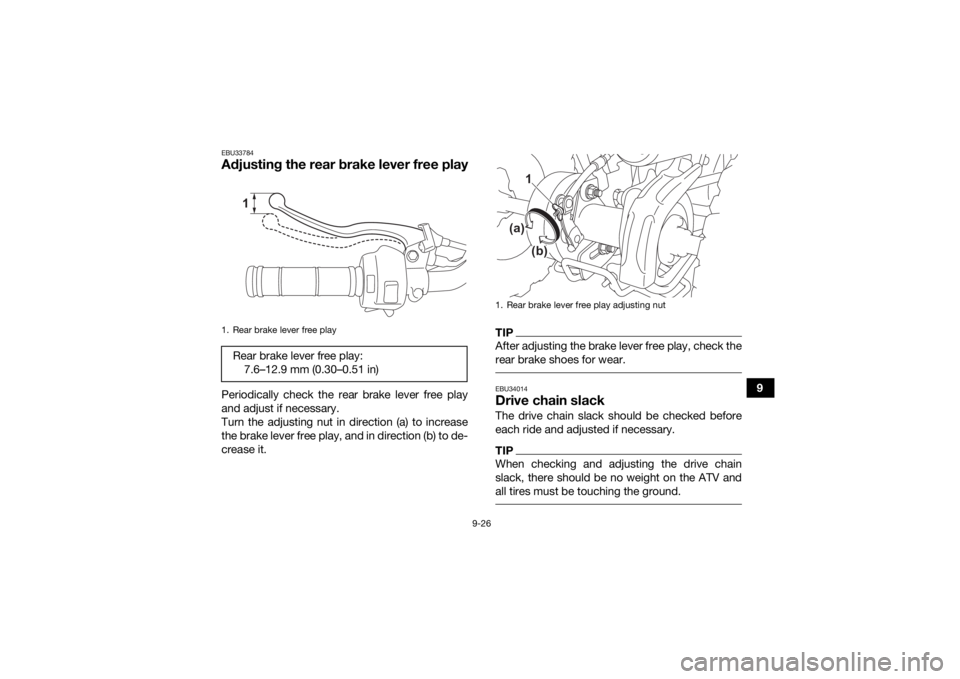
EBU33784Adjusting the rear brake lever free playPeriodically check the rear brake lever free play
and adjust if necessary.
Turn the adjusting nut in direction (a) to increase
the brake lever free play, and in direction (b) to de-
crease it.
TIPAfter adjusting the brake lever free play, check the
rear brake shoes for wear. EBU34014Drive chain slackThe drive chain slack should be checked before
each ride and adjusted if necessary.TIPWhen checking and adjusting the drive chain
slack, there should be no weight on the ATV and
all tires must be touching the ground.
1. Rear brake lever free playRear brake lever free play:7.6–12.9 mm (0.30–0.51 in)1
1. Rear brake lever free play adjusting nut
1
(a)
(b)
UBW464E0.book Page 26 Thursday, January 23, 2020 2:42 PM
Page 119 of 126

11-1
11
EBU25964
SPECIFICATIONS
Dimensions:Overall length:1250 mm (49.2 in)
Overall width: 820 mm (32.3 in)
Overall height:
770 mm (30.3 in)
Seat height: 585 mm (23.0 in)
Wheelbase: 830 mm (32.7 in)
Ground clearance:
125 mm (4.9 in)
Minimum turning radius: 2.3 m (7.55 ft)
Maximum water depth: 11 cm (4 in)Weight:Curb weight:100.0 kg (220 lb)Loading:Maximum load:
41.0 kg (90 lb)
(Total weight of rider, cargo, accessories, and tongue)Noise and vibration level:Noise level (77/311/EEC):74.0 dB(A) at 3625 r/min Uncertainty of measurement:
0.3 dB(A)
Vibration on seat (EN1032, ISO5008): Will not exceed 0.5 m/s²
Uncertainty of measurement: 0.1 m/s²
Vibration on handle (EN1032, ISO5008):
4.6 m/s²
Uncertainty of measurement: 0.4 m/s²
Engine:Combustion cycle:
4-stroke
Cooling system: Air cooled
Valve train: SOHC
Number of cylinders:
Single cylinder
Displacement: 49 cm³
Bore × stroke:
39.0 × 41.4 mm (1.54 × 1.63 in)
Compression ratio:
8.5 : 1
Starting system: Electric starter and kickstarter
Lubrication system: Wet sump
UBW464E0.book Page 1 Thursday, January 23, 2020 2:42 PM