brake YAMAHA YXZ1000R 2017 User Guide
[x] Cancel search | Manufacturer: YAMAHA, Model Year: 2017, Model line: YXZ1000R, Model: YAMAHA YXZ1000R 2017Pages: 218, PDF Size: 5.08 MB
Page 95 of 218

5-2
5
Drivetrain• Check front differential, transmission case, and rear final
gear for leakage. 5-6, 5-6, 5-6, 8-26,
8-29, 8-31
Coolant • Check coolant level in reservoir.
• Fill with coolant if necessary. 5-6, 8-33
Accelerator pedal • Check free play and for proper operation. 5-6
Seat belts • Check for proper operation and belt wear. 5-7
Passenger handhold • Check for stability and proper fastening. 5-7, 7-8
Steering • Check for proper operation. 5-7
Drive select lever and
shift paddles • Check for proper operation. 5-7
YCC-S clutch • Check operation.
• Check fluid level in reservoir.
• If necessary, add specified brake fluid to specified level.
• Check hydraulic system for leakage.
5-8
Fittings and fasteners • Check all fittings and fasteners. 5-8
Instruments, lights and
switches • Check operation, and correct if necessary. 5-8, 8-63, 8-63
Wheels and tires • Check tire pressure and for wear and damage. 5-8, 8-54, 8-56
Axle boots • Check for damage. 8-35
ITEM ROUTINE PAGE
UB577AE0.book Page 2 Wednesday, June 8, 2016 9:35 AM
Page 96 of 218

5-3
5
EBU31731Front and rear brakesBrake pedal
Check that there is no free play in the brake
pedal. If there is free play, have a Yamaha
dealer check the brake system. (See page
8-48.)
Check the operation of the brake pedal. It
should move smoothly and there should be
a firm feeling when the brakes are applied.
If not, have the vehicle inspected by a
Yamaha dealer.
Brake fluid level
Check the brake fluid level. Add fluid if neces-
sary. (See page 8-45.) Brake fluid leakage
Check to see if any brake fluid is leaking out
of the pipe joints or the brake fluid reservoir.
Apply the brakes firmly for one minute. If there
is any leakage, have the vehicle inspected by
a Yamaha dealer.
Brake operation
Check the operation of the brakes at the start
of every drive. Test the brakes at slow speed
after starting out to make sure they are work-
ing properly. If the brakes do not provide
proper braking performance, inspect the
brake system. (See page 8-44.)
EBU33200FuelMake sure there is sufficient fuel in the tank.
Specified brake fluid: DOT 4
UB577AE0.book Page 3 Wednesday, June 8, 2016 9:35 AM
Page 105 of 218
6-2
6
10–20 hours:
Avoid prolonged operation above 6300 r/min.
After break-in:
The vehicle may now be operated normally.EBU36560Starting the engine1. Turn the key to “ ” (on).NOTICEECB03340The coolant temperature warning light,
YCC-S system warning light, and engine
trouble warning light should come on, then
go off.
The EPS warning light should come on,
then go off when the engine is started.
To avoid possible damage, do not operate
the vehicle if a warning light does not work
as described above. 2. Press the brake pedal.
3. Shift the transmission into neutral.
When the transmission is in the neutral
position, the transmission gear display
shows “N” and the neutral indicator
light should come on.
The engine can be started in any gear if
the brake pedal is applied. However, it
is recommended to shift into neutral
before starting the engine.
4. With your foot off the accelerator pedal, start the engine by turning the key to “ ”
(start).
If the engine fails to start, release the key, and
then try starting it again. Wait a few seconds
before the next attempt. Each attempt should
be as short as possible, to preserve battery
energy. NOTICE: Do not crank the engine
more than 5 seconds on each attempt, or
starter damage could occur. Wait at least
5 seconds between each operation of the
electric starter to let it cool.
[ECB02140]
Do not turn the key to the “ ” (start) position
with the engine running; otherwise, damage
to the electric starter may result.
UB577AE0.book Page 2 Wednesday, June 8, 2016 9:35 AM
Page 107 of 218
![YAMAHA YXZ1000R 2017 User Guide 6-4
6
TIPTo use the drive select lever, you must be
pressing the brake pedal and be stopped
(be traveling less than 5 km/h [3 mph]), and
the engine should be at idle speed.
You can shift betwee](/img/51/53892/w960_53892-106.png "YAMAHA YXZ1000R 2017 User Guide 6-4
6
TIPTo use the drive select lever, you must be
pressing the brake pedal and be stopped
(be traveling less than 5 km/h [3 mph]), and
the engine should be at idle speed.
You can shift betwee")
6-4
6
TIPTo use the drive select lever, you must be
pressing the brake pedal and be stopped
(be traveling less than 5 km/h [3 mph]), and
the engine should be at idle speed.
You can shift between forward (first gear)
and reverse gear directly - it is not neces-
sary to shift into neutral.
When using the shift paddles, YCC-S may
not complete the upshift if engine or vehicle
speed is too low, nor complete the down-
shift if engine or vehicle speed is too high.
When AUTO DOWNSHIFT is downshifting
gears, do not operate the shift paddles or
accelerator pedal.
During an emergency stop or sudden brak-
ing, AUTO DOWNSHIFT will not downshift
the transmission to first gear. Use the shift
paddle “ ” to downshift, and then apply
the accelerator pedal to resume normal op-
eration.
NOTICEECB03370Even with the transmission in the neutral
position, do not coast for long periods of
time with the engine off. The transmission
is properly lubricated only when the engine
is running. Inadequate lubrication may
damage the transmission. To start out and accelerate
1. Take your foot off the accelerator pedal
and apply the brake pedal. NOTICE: Al-
ways take your foot off the accelerator
pedal before operating the drive select
lever, otherwise damage to the engine
and drivetrain may result.
[ECB03360]
2. Release the parking brake (if applied).
3. Shift into first gear using the drive select lever (the transmission gear display
should show “1”).
4. Release the brake pedal and press the accelerator pedal gradually.
UB577AE0.book Page 4 Wednesday, June 8, 2016 9:35 AM
Page 108 of 218
6-5
6
5. When vehicle speed has sufficiently in-creased, use the shift paddle “ ” to shift
into second gear (“2”).
6. Follow the same procedure when shifting to the next higher gear.
To decelerate
When slowing down, release the accelerator
pedal and apply the brake pedal smoothly. As
you slow down, shift to a lower gear. Be sure
that the engine has sufficiently slowed before
engaging a lower gear. Improper use of the
brake pedal or shift paddles can cause the
tires to lose traction, reducing control and in-
creasing the possibility of an accident.
WARNING
EWB00712Make sure the engine has sufficiently
slowed before shifting to a lower gear. En-
gaging a lower gear when the engine
speed is too high could make the wheels
stop rotating and lose traction. This could cause loss of control, an accident and inju-
ry. It could also cause engine or drivetrain
damage.
Recommended shift points
The recommended shift points during accel-
eration and deceleration are shown in the fol-
lowing table.TIPWhen coming to a stop under normal condi-
tions, AUTO DOWNSHIFT will shift the trans-
mission into first gear automatically. Shift up points:
1st → 2nd: 19 km/h (12 mi/h)
2nd → 3rd: 33 km/h (21 mi/h)
3rd → 4th: 44 km/h (27 mi/h)
4th → 5th: 53 km/h (33 mi/h)
Shift down points: 5th → 4th: 30 km/h (19 mi/h)
4th → 3rd: 17 km/h (11 mi/h)
UB577AE0.book Page 5 Wednesday, June 8, 2016 9:35 AM
Page 109 of 218
6-6
6
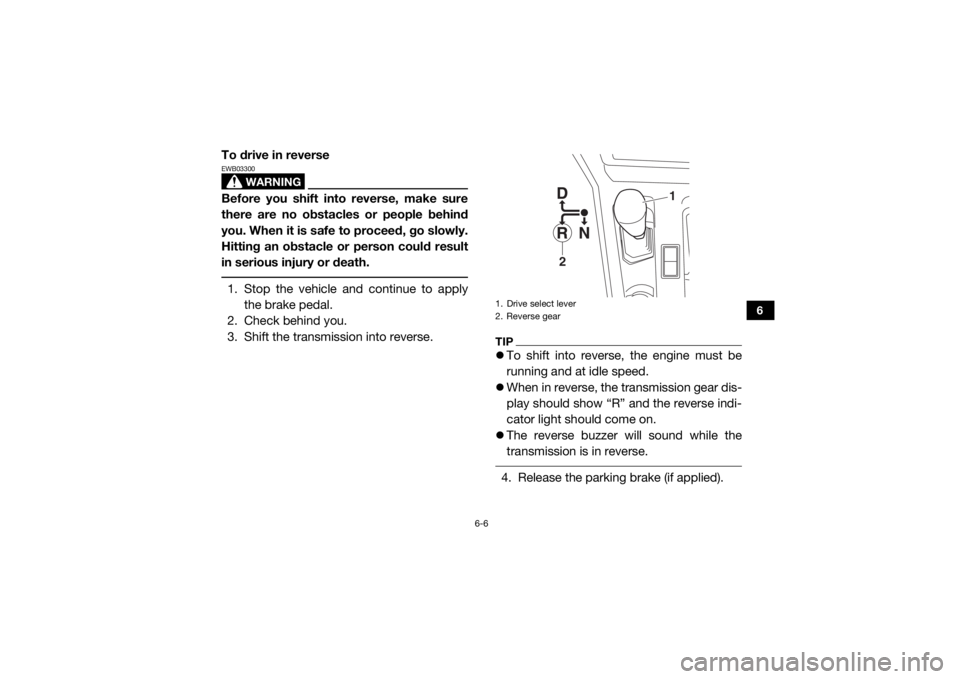
To drive in reverse
WARNING
EWB03300Before you shift into reverse, make sure
there are no obstacles or people behind
you. When it is safe to proceed, go slowly.
Hitting an obstacle or person could result
in serious injury or death. 1. Stop the vehicle and continue to applythe brake pedal.
2. Check behind you.
3. Shift the transmission into reverse.
TIP To shift into reverse, the engine must be
running and at idle speed.
When in reverse, the transmission gear dis-
play should show “R” and the reverse indi-
cator light should come on.
The reverse buzzer will sound while the
transmission is in reverse. 4. Release the parking brake (if applied).1. Drive select lever
2. Reverse gear
1
2
UB577AE0.book Page 6 Wednesday, June 8, 2016 9:35 AM
Page 110 of 218
6-7
6
5. Check behind you, then release the brakepedal and press the accelerator pedal
gradually.
6. Continue to watch to the rear while driv- ing in reverse.EBU36733Launch system operationThe launch system allows you to start off at a
higher engine speed, and thus have a higher
initial acceleration rate than normal operation.
Only use the launch system on level ground
with a clear and safe path ahead of you.TIPThe launch system will be prevented from op-
erating if any of the following conditions are
present:
the engine is not warmed up or is overheat-
ing.
the driver seat belt is not latched.
the differential gear is locked (“DIFF LOCK”
is selected) or the differential gear lock indi-
cator is flashing.
the parking brake is applied.
an engine or system malfunction is detect-
ed (a warning light is on).
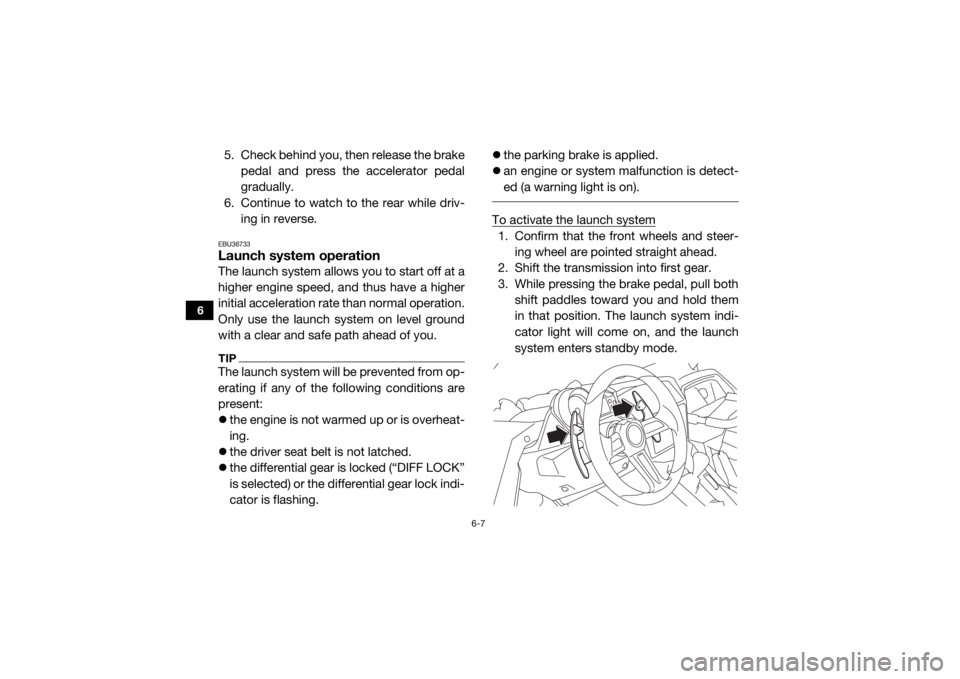
To activate the launch system1. Confirm that the front wheels and steer-
ing wheel are pointed straight ahead.
2. Shift the transmission into first gear.
3. While pressing the brake pedal, pull both
shift paddles toward you and hold them
in that position. The launch system indi-
cator light will come on, and the launch
system enters standby mode.
UB577AE0.book Page 7 Wednesday, June 8, 2016 9:35 AM
Page 111 of 218

6-8
6
4. While checking in front of you for obsta-cles or anything that may cross your
path, release the brake pedal, and then
press the accelerator pedal to rev the en-
gine to the desired launch engine speed.TIPThe engine speed at launch must be be-
tween 5000–10000 r/min.
If you release one shift paddle, or if a sys-
tem restriction is detected during standby
mode, the launch system indicator light will
begin to flash and the launch will be can-
celled.
If the indicator light is flashing, release the
accelerator pedal and let the engine return
to idle speed. When the indicator light goes
off, you may start off normally or retry acti-
vating the launch system. 5. When ready, release both shift paddles at
the same time and further press the ac-
celerator pedal to launch the vehicle.
TIPWhen the clutch has completely engaged, the
launch system and the launch system indica-
tor light will turn off. NOTICEECB03430Do not make consecutive launches with-
out allowing the clutch to cool down. Oth-
erwise, the clutch system may be
damaged.
UB577AE0.book Page 8 Wednesday, June 8, 2016 9:35 AM
Page 114 of 218

6-11
6
EBU35441ParkingWhen parking, shift into first or reverse gear,
stop the engine, and then apply the parking
brake. See page 7-16 for when parking on a
slope.EBU35351LoadingTake extra precautions when driving with a
load. Turn gradually and drive more slowly
than you would without a load. The more
weight you carry, the slower you should go.
Although conditions vary, it is good practice
to keep the vehicle in a low gear when you are
carrying a heavy load. Follow these instruc-
tions and always use common sense and
good judgment when carrying a load.
WARNING
EWB03921Improper loading or any pulling or towing
will increase the risk of loss of control, an
overturn, or other accident:
Do not pull objects, other vehicles, or
tow a trailer—this vehicle is not de-
signed for such operation.
Keep weight in the cargo bed centered
side to side, and as low and as far for-
ward as possible. Top-heavy loads in-
crease the risk of overturn.
Make sure that cargo is securely fas-
tened down—a loose load could change
handling unexpectedly or strike occu-
pants.
Do not exceed the maximum loading
limit for the cargo bed: 136.0 kg (300 lb).
Do not exceed the maximum loading
limit for the vehicle: 317.0 kg (699 lb).
Cargo bed
Use the hooks equipped on the cargo bed to
tie down loads. Make sure the load is securely
fastened down, centered in the cargo bed,
and not top-heavy. Never allow anyone to
ride in the cargo bed.
UB577AE0.book Page 11 Wednesday, June 8, 2016 9:35 AM
Page 127 of 218

7-13
7
Eye protection (goggles, helmet face shield,
or protective eyewear)
Over-the-ankle boots, gloves, long-sleeved
shirt or jacket, and long pants
An approved helmet and other personal pro-
tective equipment can help in a variety of
ways, including:
Reduce the severity of injuries if any part of
you is outside the vehicle or protective
structure during a rollover.
Help protect you if outside objects intrude
inside the vehicle during operation.
Help protect you in the event of impact with
an obstacle or other vehicle.
Wear eye protection when operating or riding
in the vehicle to reduce the risk of a serious
accident or injury. Eye protection, such as a
face shield or goggles, may reduce the risk of
foreign material getting in your eyes and help
prevent loss of vision. Practice for new Yamaha YXZ1000R users
Become familiar with the performance char-
acteristics of the vehicle in a large, flat area
that is free of obstacles and other vehicles.
Practice controlling the accelerator pedal,
brakes, steering, and shift paddles. Drive at
slow speeds with gradual acceleration and
smooth turns. Practice applying the accelera-
tor pedal smoothly. Practice slowing down
before turning. Practice maintaining a steady
amount of throttle (accelerator pedal position)
through the turn. Avoid higher speeds until
you are thoroughly famili
ar with the operation
and handling of the vehicle. Remember, driv-
ing aggressively or making abrupt maneuvers
even on flat, open areas can cause side roll-
overs.UB577AE0.book Page 13 Wednesday, June 8, 2016 9:35 AM