transmission YAMAHA YXZ1000R 2017 User Guide
[x] Cancel search | Manufacturer: YAMAHA, Model Year: 2017, Model line: YXZ1000R, Model: YAMAHA YXZ1000R 2017Pages: 218, PDF Size: 5.08 MB
Page 99 of 218

5-6
5
EBU35322TransmissionMake sure there is no oil leaking from the
transmission case.EBU31760CoolantCheck the coolant level in the coolant reser-
voir when the engine is cold (the coolant level
will vary with engine temperature).
The coolant level is satisfactory if it is be-
tween the minimum and maximum level
marks on the coolant reservoir. If the coolant
level is at or below the minimum level mark,
add additional coolant to bring the level up to
maximum level mark. If coolant is not avail-
able, add distilled water. Change the coolant
every two years. (See page 8-33.)NOTICEECB02120Hard water or salt water is harmful to the
engine. You may use soft water if you can-
not get distilled water.
EBU36020Final gearMake sure there is no oil leaking from the final
gear case.EBU36030Differential gearMake sure there is no oil leaking from the dif-
ferential gear case.EBU31790Accelerator pedalCheck to see that the accelerator pedal oper-
ates correctly. It must operate smoothly and
spring back to the idle position fully when re-
leased. Have a Yamaha dealer repair as nec-
essary for proper operation.Coolant reservoir capacity (up to the maxi-
mum level mark): 0.31 L (0.33 US qt, 0.28 Imp.qt)
UB577AE0.book Page 6 Wednesday, June 8, 2016 9:35 AM
Page 105 of 218
6-2
6
10–20 hours:
Avoid prolonged operation above 6300 r/min.
After break-in:
The vehicle may now be operated normally.EBU36560Starting the engine1. Turn the key to “ ” (on).NOTICEECB03340The coolant temperature warning light,
YCC-S system warning light, and engine
trouble warning light should come on, then
go off.
The EPS warning light should come on,
then go off when the engine is started.
To avoid possible damage, do not operate
the vehicle if a warning light does not work
as described above. 2. Press the brake pedal.
3. Shift the transmission into neutral.
When the transmission is in the neutral
position, the transmission gear display
shows “N” and the neutral indicator
light should come on.
The engine can be started in any gear if
the brake pedal is applied. However, it
is recommended to shift into neutral
before starting the engine.
4. With your foot off the accelerator pedal, start the engine by turning the key to “ ”
(start).
If the engine fails to start, release the key, and
then try starting it again. Wait a few seconds
before the next attempt. Each attempt should
be as short as possible, to preserve battery
energy. NOTICE: Do not crank the engine
more than 5 seconds on each attempt, or
starter damage could occur. Wait at least
5 seconds between each operation of the
electric starter to let it cool.
[ECB02140]
Do not turn the key to the “ ” (start) position
with the engine running; otherwise, damage
to the electric starter may result.
UB577AE0.book Page 2 Wednesday, June 8, 2016 9:35 AM
Page 106 of 218
6-3
6
TIPFor maximum engine life, never accelerate
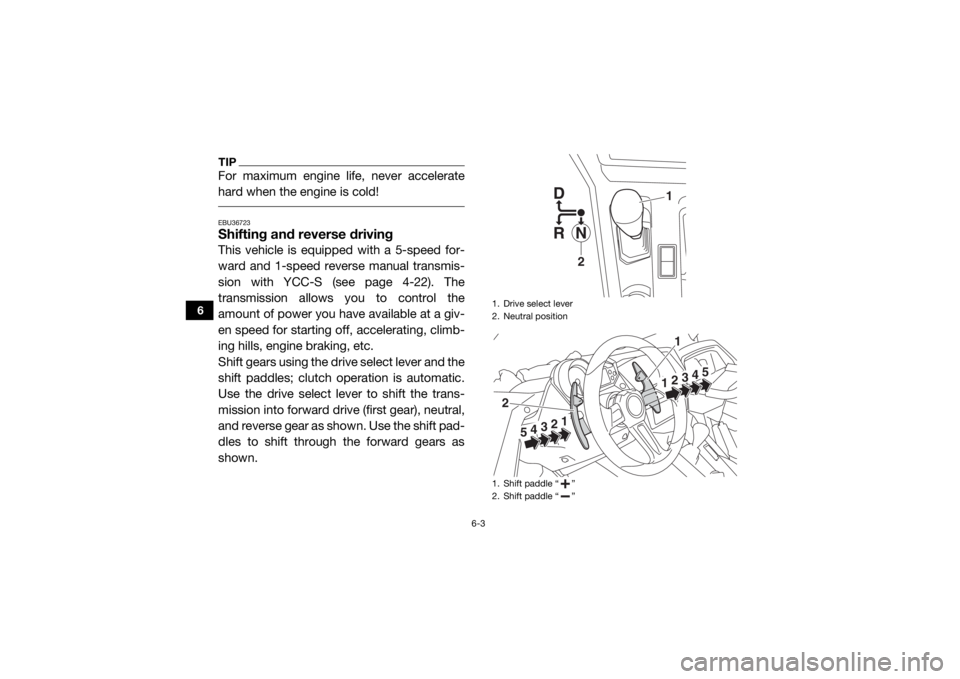
hard when the engine is cold! EBU36723Shifting and reverse drivingThis vehicle is equipped with a 5-speed for-
ward and 1-speed reverse manual transmis-
sion with YCC-S (see page 4-22). The
transmission allows you to control the
amount of power you have available at a giv-
en speed for starting off, accelerating, climb-
ing hills, engine braking, etc.
Shift gears using the drive select lever and the
shift paddles; clutch operation is automatic.
Use the drive select lever to shift the trans-
mission into forward drive (first gear), neutral,
and reverse gear as shown. Use the shift pad-
dles to shift through the forward gears as
shown.
1. Drive select lever
2. Neutral position
1. Shift paddle “ ”
2. Shift paddle “ ”
1
2
2
1
1
2
3
4
5
5
4
3
2
1
UB577AE0.book Page 3 Wednesday, June 8, 2016 9:35 AM
Page 107 of 218
![YAMAHA YXZ1000R 2017 User Guide 6-4
6
TIPTo use the drive select lever, you must be
pressing the brake pedal and be stopped
(be traveling less than 5 km/h [3 mph]), and
the engine should be at idle speed.
You can shift betwee](/img/51/53892/w960_53892-106.png "YAMAHA YXZ1000R 2017 User Guide 6-4
6
TIPTo use the drive select lever, you must be
pressing the brake pedal and be stopped
(be traveling less than 5 km/h [3 mph]), and
the engine should be at idle speed.
You can shift betwee")
6-4
6
TIPTo use the drive select lever, you must be
pressing the brake pedal and be stopped
(be traveling less than 5 km/h [3 mph]), and
the engine should be at idle speed.
You can shift between forward (first gear)
and reverse gear directly - it is not neces-
sary to shift into neutral.
When using the shift paddles, YCC-S may
not complete the upshift if engine or vehicle
speed is too low, nor complete the down-
shift if engine or vehicle speed is too high.
When AUTO DOWNSHIFT is downshifting
gears, do not operate the shift paddles or
accelerator pedal.
During an emergency stop or sudden brak-
ing, AUTO DOWNSHIFT will not downshift
the transmission to first gear. Use the shift
paddle “ ” to downshift, and then apply
the accelerator pedal to resume normal op-
eration.
NOTICEECB03370Even with the transmission in the neutral
position, do not coast for long periods of
time with the engine off. The transmission
is properly lubricated only when the engine
is running. Inadequate lubrication may
damage the transmission. To start out and accelerate
1. Take your foot off the accelerator pedal
and apply the brake pedal. NOTICE: Al-
ways take your foot off the accelerator
pedal before operating the drive select
lever, otherwise damage to the engine
and drivetrain may result.
[ECB03360]
2. Release the parking brake (if applied).
3. Shift into first gear using the drive select lever (the transmission gear display
should show “1”).
4. Release the brake pedal and press the accelerator pedal gradually.
UB577AE0.book Page 4 Wednesday, June 8, 2016 9:35 AM
Page 109 of 218
6-6
6
To drive in reverse
WARNING
EWB03300Before you shift into reverse, make sure
there are no obstacles or people behind
you. When it is safe to proceed, go slowly.
Hitting an obstacle or person could result
in serious injury or death. 1. Stop the vehicle and continue to applythe brake pedal.
2. Check behind you.
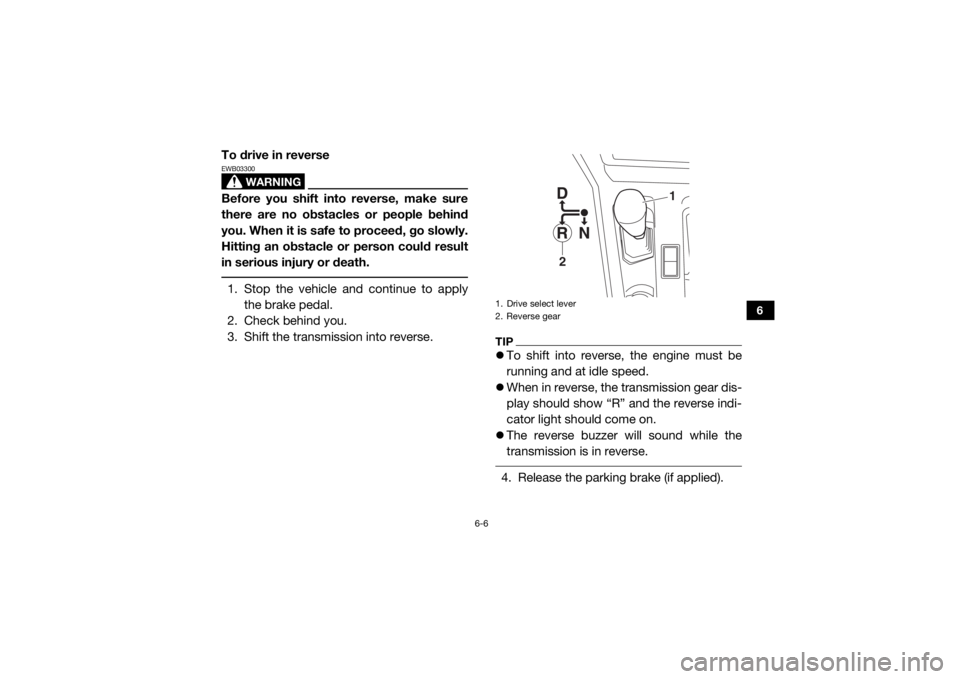
3. Shift the transmission into reverse.
TIP To shift into reverse, the engine must be
running and at idle speed.
When in reverse, the transmission gear dis-
play should show “R” and the reverse indi-
cator light should come on.
The reverse buzzer will sound while the
transmission is in reverse. 4. Release the parking brake (if applied).1. Drive select lever
2. Reverse gear
1
2
UB577AE0.book Page 6 Wednesday, June 8, 2016 9:35 AM
Page 110 of 218
6-7
6
5. Check behind you, then release the brakepedal and press the accelerator pedal
gradually.
6. Continue to watch to the rear while driv- ing in reverse.EBU36733Launch system operationThe launch system allows you to start off at a
higher engine speed, and thus have a higher
initial acceleration rate than normal operation.
Only use the launch system on level ground
with a clear and safe path ahead of you.TIPThe launch system will be prevented from op-
erating if any of the following conditions are
present:
the engine is not warmed up or is overheat-
ing.
the driver seat belt is not latched.
the differential gear is locked (“DIFF LOCK”
is selected) or the differential gear lock indi-
cator is flashing.
the parking brake is applied.
an engine or system malfunction is detect-
ed (a warning light is on).
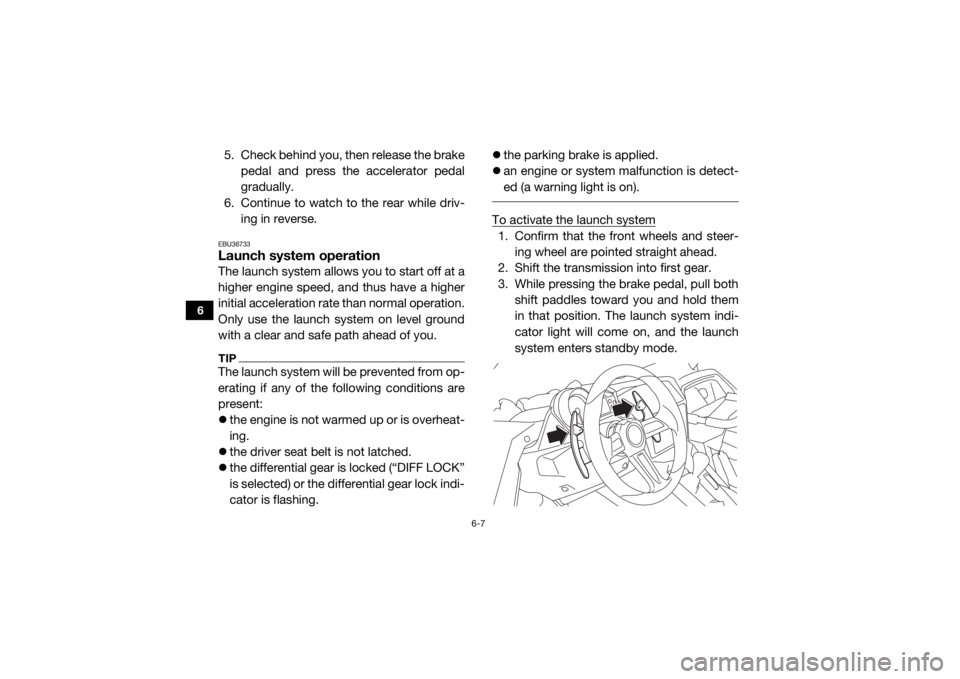
To activate the launch system1. Confirm that the front wheels and steer-
ing wheel are pointed straight ahead.
2. Shift the transmission into first gear.
3. While pressing the brake pedal, pull both
shift paddles toward you and hold them
in that position. The launch system indi-
cator light will come on, and the launch
system enters standby mode.
UB577AE0.book Page 7 Wednesday, June 8, 2016 9:35 AM
Page 129 of 218

7-15
7
If you think or feel that the vehicle may tip or
roll, keep your body completely inside the
protective structure of the vehicle:
Brace yourself by pressing your feet firmly
on the floorboard and keep a firm grip on
the steering wheel or passenger handhold.
Do not put your hands or feet outside of the
vehicle for any reason. Do not try to stop a
tipover using your arm or leg.
Accelerating
Avoid higher speeds and sudden or hard ac-
celeration until you are thoroughly familiar
with the operation of your vehicle. Avoid sud-
den or hard acceleration in any turn. Never
drive faster than is safe for current conditions.
Shifting
Follow the instructions on pages 6-2 and 6-3
for shifting, downshifting, and shifting into re-
verse until you are thoroughly familiar with
each operation. Braking
When slowing down or stopping, take your
foot off the accelerator pedal and press the
brake pedal smoothly. Abrupt or improper
use of the brakes can cause the tires to lose
traction, reducing control of the vehicle and
increasing the possibility of an accident.
Braking ability is affected by type of terrain. In
most cases, gradual application of the brakes
is more effective than
abrupt braking, partic-
ularly on loose surfaces, such as gravel. Al-
ways allow for greater braking distance on
rough, loose, or slippery surfaces.
Engine compression braking will also help
slow the vehicle down. With the transmission
still in gear, take your foot off the accelerator
and allow the drivetrain and engine to absorb
vehicle speed. Downshift as necessary. Ap-
plication of the brakes provides additional
stopping power.UB577AE0.book Page 15 Wednesday, June 8, 2016 9:35 AM
Page 130 of 218

7-16
7
Leaving the vehicle
Do not get out of the vehicle while the engine
is running. Take the key with when you leave
the vehicle. There is a serious risk of injury or
death because:
Children or other unauthorized persons
may attempt to operate the vehicle.
Objects tossed into the vehicle may strike
the shift lever and accidently engage the
transmission.
The parking brake may not keep the vehicle
from moving.
Parking on a flat area
Even when parking on a seemingly flat area, it
is good practice to leave the transmission in
gear to prevent the vehicle from rolling.
Therefore, shift into first or reverse gear, stop
the engine and always apply the parking
brake. Parking on a slope
The parking brake is loca
ted on the rear drive
shaft. When the drivetrain is in “2WD” mode,
only the rear wheels will be locked. Therefore,
switch the drive mode to “DIFF LOCK” before
stopping the engine to lock all four wheels
when parking. In addition to the parking
brake, leave the transmi ssion in gear to help
prevent the vehicle from rolling.
If you park on a hill that is too steep, the vehi-
cle may roll out of control. Never park on hills
that are so steep you cannot walk up them
easily. If you must park on an incline, follow
these instructions: 1. First, bring the vehicle to a stop and con- tinue to apply the brake pedal.
2. Switch the drive mode to “DIFF LOCK”
and shift into first gear when parking up-
hill, or reverse gear when parking down-
hill.UB577AE0.book Page 16 Wednesday, June 8, 2016 9:35 AM
Page 133 of 218

7-19
7
over. Practice first on gentle slopes before at-
tempting steeper hills. Always check the
terrain carefully before attempting any hill.
To climb a hill, you need traction, momentum,
and steady throttle. For more traction and
control for climbing steeper and/or rougher
slopes, shift into low gear and select “4WD”
or “DIFF LOCK”. Travel fast enough to main-
tain momentum, but not so fast that you can-
not react to changes in the terrain as you
climb.
Slow down when you reach the crest of the
hill if you cannot see clearly what is on the
other side – there could be another person, an
obstacle, or a sharp drop-off.
If you start to lose traction or momentum
when climbing, and decide you will be unable
to continue, use the brakes to stop. Do not at-
tempt to turn the vehicle around. With your
foot on the brake pedal, look behind you and
plan your descent. Shift the transmission into
reverse so you can use engine braking to
slow your descent. Release the brake, and then begin to coast down the hill. Use engine
braking as much as possible, gently applying
the brakes when necessary.
Downhill
Check the terrain carefully before going
downhill. When possible, choose a path that
lets you drive your vehicle straight downhill.
Choose your path carefully and drive slowly
enough to be able to react to obstacles that
you encounter.
For more traction and control, before going
down steeper and/or rougher slopes, shift
into low gear and select “4WD” or “DIFF
LOCK”. Engine braking will help you go
downhill slowly. Go as slowly as possible. If
you begin to go too fast, apply the brakes
gently. Avoid hard application of the brakes,
which could cause the vehicle to slide.UB577AE0.book Page 19 Wednesday, June 8, 2016 9:35 AM
Page 142 of 218

8-6
8
EBU35800General maintenance and lubrication chartNO. ITEMROUTINE INITIAL
EVERY
Whichev- er comes
first month136612
km
(mi) 320
(200) 1300
(800) 2500
(1600) 2500
(1600) 5000
(3200)
hours 20 80 160 160 320
1 *Cooling system • Check coolant leakage.
• Repair if necessary.
√√√√√
• Change coolant. Every 2 years
2 Primary air filter
(foam)
•Clean.
• Replace if necessary. Every 300–600 km (200–400 mi)
(more often in wet or dusty condi- tions)
* Secondary air fil-
ter (paper) • Replace. Every 2000–5000 km (1200–3000
mi)
(more often in wet or dusty condi- tions)
3Engine oil • Change (warm engine before draining). √ √√√
4 Engine oil filter
cartridge
• Replace.
√√√
5 Transmission oil • Check oil level and for leakage.
√√√√√
•Change. √ √√√
6 Final gear oil/Dif-
ferential gear oil • Check oil level and for leakage.
√√√√√
•Change. √√
UB577AE0.book Page 6 Wednesday, June 8, 2016 9:35 AM