tires YAMAHA YXZ1000R 2017 Owners Manual
[x] Cancel search | Manufacturer: YAMAHA, Model Year: 2017, Model line: YXZ1000R, Model: YAMAHA YXZ1000R 2017Pages: 218, PDF Size: 5.08 MB
Page 7 of 218

Fuel ....................................................... 5-3
Engine oil .............................................. 5-5
Transmission ........................................ 5-6
Coolant ................................................. 5-6
Final gear .............................................. 5-6
Differential gear .................................... 5-6
Accelerator pedal ................................. 5-6
Seat belts ............................................. 5-7
Passenger handhold ............................ 5-7
Steering ................................................ 5-7
Drive select lever and shift paddles ..... 5-7
YCC-S clutch ....................................... 5-8
Fittings and fasteners ........................... 5-8
Instruments, lights and switches .......... 5-8
Control cables ...................................... 5-8
Tires ...................................................... 5-8
OPERATION ............................................ 6-1 Engine break-in .................................... 6-1
Starting the engine ............................... 6-2
Shifting and reverse driving.................. 6-3
Launch system operation ..................... 6-7
Selecting the drive mode ..................... 6-9 Parking ................................................6-11
Loading ...............................................6-11
BASIC GUIDE FOR SAFE USE ...............7-1 KNOW YOUR VEHICLE ........................7-1
LEARNING TO OPERATE YOUR VEHICLE ...........................................7-12
PERIODIC MAINTENANCE AND
ADJUSTMENT .........................................8-1 Owner’s manual and tool kit .................8-2
Periodic maintenance chart for the emission control system .....................8-4
General maintenance and lubrication chart ....................................................8-6
Hood ...................................................8-10
Panels .................................................8-10
Engine oil and oil filter.........................8-15
Transmission oil ..................................8-26
Final gear oil .......................................8-29
Differential gear oil ..............................8-31
Coolant ...............................................8-33
Axle boots ...........................................8-35
UB577AE0.book Page 2 Wednesday, June 8, 2016 9:35 AM
Page 16 of 218
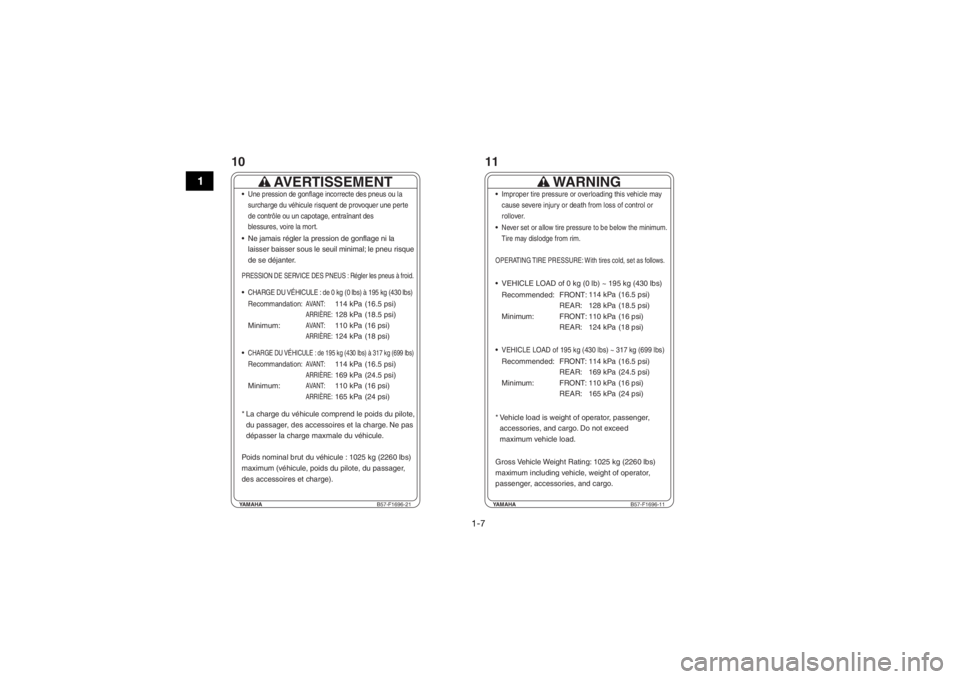
1-7
1
YAMAHAB57-F1696-21
AVERTISSEMENT
Une pression de gonflage incorrecte des pneus ou la
surcharge du véhicule risquent de provoquer une perte
de contrôle ou un capotage, entraînant des
blessures, voire la mort. Ne jamais régler la pression de gonflage ni la
laisser baisser sous le seuil minimal; le pneu risque
de se déjanter.
CHARGE DU VÉHICULE : de 0 kg (0 lbs) à 195 kg (430 lbs)Recommandation:
AVANT:
ARRIÈRE:
Minimum:
AVANT:
ARRIÈRE:
114 kPa
128 kPa
110 kPa
124 kPa (16.5 psi)
(18.5 psi)
(16 psi)
(18 psi)
CHARGE DU VÉHICULE : de 195 kg (430 lbs) à 317 kg (699 lbs)Recommandation:
AVANT:
ARRIÈRE:
Minimum:
AVANT:
ARRIÈRE:
114 kPa
169 kPa (16.5 psi)
(24.5 psi)
(16 psi)
(24 psi)
110 kPa
165 kPa
* La charge du véhicule comprend le poids du pilote, du passager, des accessoires et la charge. Ne pas
dépasser la charge maxmale du véhicule.
Poids nominal brut du véhicule : 1025 kg (2260 lbs)
maximum (véhicule, poids du pilote, du passager,
des accessoires et charge).
PRESSION DE SERVICE DES PNEUS : Régler les pneus à froid.
YAMAHA B57-F1696-11
WARNING
Improper tire pressure or overloading this vehicle may
cause severe injury or death from loss of control or
rollover.Never set or allow tire pressure to be below the minimum.
Tire may dislodge from rim. VEHICLE LOAD of 0 kg (0 lb) ~ 195 kg (430 lbs)
Recommended: FRONT: REAR:
Minimum: FRONT: REAR:114 kPa
128 kPa
110 kPa
124 kPa
VEHICLE LOAD of 195 kg (430 lbs) ~ 317 kg (699 lbs)Recommended: FRONT: REAR:
Minimum: FRONT: REAR:114 kPa
169 kPa
110 kPa
165 kPa (16.5 psi)
(18.5 psi)
(16 psi)
(18 psi)
(16.5 psi)
(24.5 psi)
(16 psi)
(24 psi)
* Vehicle load is weight of operator, passenger, accessories, and cargo. Do not exceed
maximum vehicle load.
Gross Vehicle Weight Rating: 1025 kg (2260 lbs)
maximum including vehicle, weight of operator,
passenger, accessories, and cargo.OPERATING TIRE PRESSURE: With tires cold, set as follows.11
10
UB577AE0.book Page 7 Wednesday, June 8, 2016 9:35 AM
Page 25 of 218

1-16
1
YAMAHA1XD-K8483-00
WARNING
Do not rest hands or arms on door or shoulder bolster.
To avoid Injury, keep hands and arms completely
Inside the vehicle by holding the steering wheel or handhold.
WARNING
Storage should not exceed 10 lbs (4.5 kg)Fuel vapors can be a fire or explosion hazard.
To avoid injury or death, never store fuel or
flammable liquids in this storage compartment.
1XP-F151F-00
YAMAHA B57-F1696-11
WARNING
Improper tire pressure or overloading this vehicle may
cause severe injury or death from loss of control or
rollover.Never set or allow tire pressure to be below the minimum.
Tire may dislodge from rim. VEHICLE LOAD of 0 kg (0 lb) ~ 195 kg (430 lbs)
Recommended: FRONT: REAR:
Minimum: FRONT: REAR:114 kPa
128 kPa
110 kPa
124 kPa
VEHICLE LOAD of 195 kg (430 lbs) ~ 317 kg (699 lbs)Recommended: FRONT: REAR:
Minimum: FRONT: REAR:114 kPa
169 kPa
110 kPa
165 kPa (16.5 psi)
(18.5 psi)
(16 psi)
(18 psi)
(16.5 psi)
(24.5 psi)
(16 psi)
(24 psi)
* Vehicle load is weight of operator, passenger, accessories, and cargo. Do not exceed
maximum vehicle load.
Gross Vehicle Weight Rating: 1025 kg (2260 lbs)
maximum including vehicle, weight of operator,
passenger, accessories, and cargo.OPERATING TIRE PRESSURE: With tires cold, set as follows.
3
4 5
UB577AE0.book Page 16 Wednesday, June 8, 2016 9:35 AM
Page 35 of 218

2-8
2
Aftermarket tires and rims
The tires and rims that came with your YXZ1000R were designed to match the performance ca-
pabilities and to provide the best combination of handling, braking, and comfort. Other tires,
rims, sizes, and combinations may not be appropriate. Refer to page 8-55 for tire specifications
and more information on replacing your tires.UB577AE0.book Page 8 Wednesday, June 8, 2016 9:35 AM
Page 95 of 218

5-2
5
Drivetrain• Check front differential, transmission case, and rear final
gear for leakage. 5-6, 5-6, 5-6, 8-26,
8-29, 8-31
Coolant • Check coolant level in reservoir.
• Fill with coolant if necessary. 5-6, 8-33
Accelerator pedal • Check free play and for proper operation. 5-6
Seat belts • Check for proper operation and belt wear. 5-7
Passenger handhold • Check for stability and proper fastening. 5-7, 7-8
Steering • Check for proper operation. 5-7
Drive select lever and
shift paddles • Check for proper operation. 5-7
YCC-S clutch • Check operation.
• Check fluid level in reservoir.
• If necessary, add specified brake fluid to specified level.
• Check hydraulic system for leakage.
5-8
Fittings and fasteners • Check all fittings and fasteners. 5-8
Instruments, lights and
switches • Check operation, and correct if necessary. 5-8, 8-63, 8-63
Wheels and tires • Check tire pressure and for wear and damage. 5-8, 8-54, 8-56
Axle boots • Check for damage. 8-35
ITEM ROUTINE PAGE
UB577AE0.book Page 2 Wednesday, June 8, 2016 9:35 AM
Page 101 of 218

5-8
5
EBU36672YCC-S clutchCheck the YCC-S clutch fluid level and cor-
rect if necessary. (See page 8-45.)
Check the operation of the drive select lever
and shift paddles at the start of each drive.TIPIf the YCC-S clutch fluid level was low, be
sure to check the clutch system for leak-
age.
If any leakage is found, or if shifting is not
smooth, have a Yamaha dealer service the
vehicle. EBU35700Fittings and fastenersAlways check the tightness of chassis and
wheel fittings and fasteners before starting
off. Take the vehicle to a Yamaha dealer or re-
fer to the Service Manual for correct tighten-
ing torque.
EBU31840Instruments, lights and switchesCheck that all instrument s, lights and switch-
es are working properly. Correct if necessary.EBU31851Control cablesWhen driving in cold weather, always make
sure all control cables work smoothly before
starting off. WARNING! Control cables can
freeze in cold weather and you could be
unable to control the vehicle.
[EWB03280]
EBU35331
TiresCheck tire pressure regularly to make sure it
is at the recommended specifications. Also
check for wear and damage.
Tire pressure
Use the tire pressure gauge to check and ad-
just tire pressures when the tires are cold. Tire
pressures must be equal on both sides.
WARNING! Operation of this vehicle with improper tire pressure may cause severe
UB577AE0.book Page 8 Wednesday, June 8, 2016 9:35 AM
Page 108 of 218
6-5
6
5. When vehicle speed has sufficiently in-creased, use the shift paddle “ ” to shift
into second gear (“2”).
6. Follow the same procedure when shifting to the next higher gear.
To decelerate
When slowing down, release the accelerator
pedal and apply the brake pedal smoothly. As
you slow down, shift to a lower gear. Be sure
that the engine has sufficiently slowed before
engaging a lower gear. Improper use of the
brake pedal or shift paddles can cause the
tires to lose traction, reducing control and in-
creasing the possibility of an accident.
WARNING
EWB00712Make sure the engine has sufficiently
slowed before shifting to a lower gear. En-
gaging a lower gear when the engine
speed is too high could make the wheels
stop rotating and lose traction. This could cause loss of control, an accident and inju-
ry. It could also cause engine or drivetrain
damage.
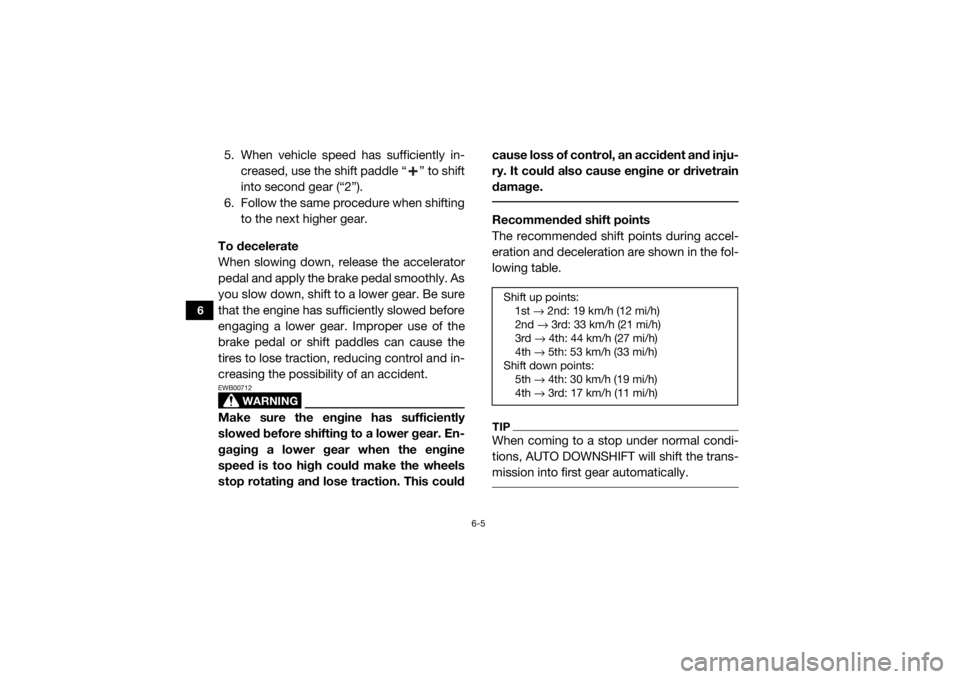
Recommended shift points
The recommended shift points during accel-
eration and deceleration are shown in the fol-
lowing table.TIPWhen coming to a stop under normal condi-
tions, AUTO DOWNSHIFT will shift the trans-
mission into first gear automatically. Shift up points:
1st → 2nd: 19 km/h (12 mi/h)
2nd → 3rd: 33 km/h (21 mi/h)
3rd → 4th: 44 km/h (27 mi/h)
4th → 5th: 53 km/h (33 mi/h)
Shift down points: 5th → 4th: 30 km/h (19 mi/h)
4th → 3rd: 17 km/h (11 mi/h)
UB577AE0.book Page 5 Wednesday, June 8, 2016 9:35 AM
Page 125 of 218
7-11
7
Floorboard
The floorboard allows you to brace your feet,
which helps you keep your body in the vehicle
in the event of an accident or rollover. Keep
your feet on the floorboard during operation.
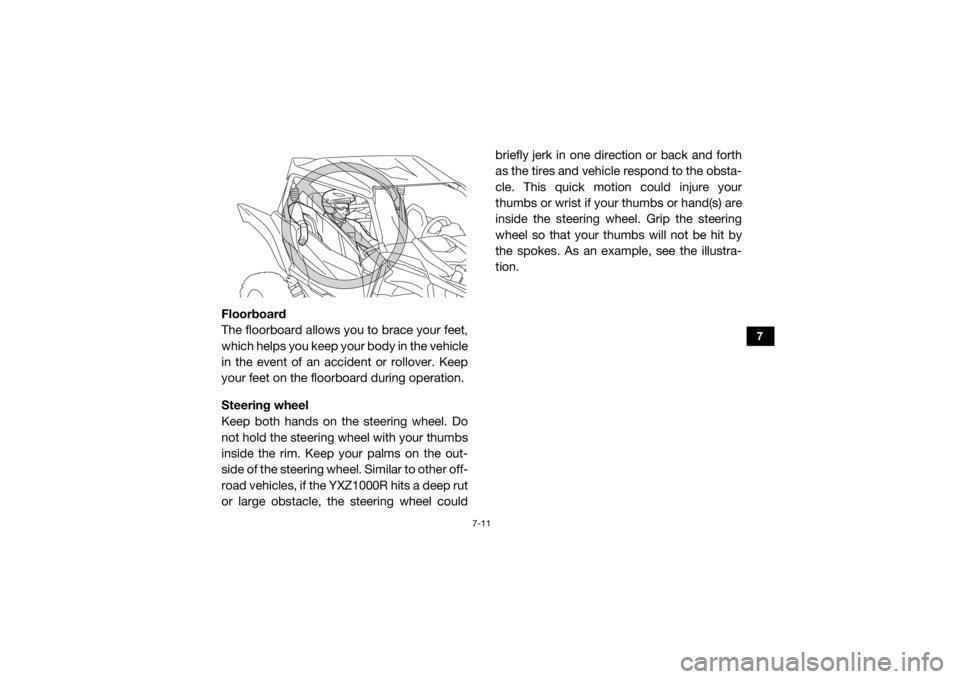
Steering wheel
Keep both hands on the steering wheel. Do
not hold the steering wheel with your thumbs
inside the rim. Keep your palms on the out-
side of the steering wheel. Similar to other off-
road vehicles, if the YXZ1000R hits a deep rut
or large obstacle, the steering wheel couldbriefly jerk in one direction or back and forth
as the tires and vehicle respond to the obsta-
cle. This quick motion could injure your
thumbs or wrist if your thumbs or hand(s) are
inside the steering wh
eel. Grip the steering
wheel so that your thumbs will not be hit by
the spokes. As an example, see the illustra-
tion.UB577AE0.book Page 11 Wednesday, June 8, 2016 9:35 AM
Page 129 of 218

7-15
7
If you think or feel that the vehicle may tip or
roll, keep your body completely inside the
protective structure of the vehicle:
Brace yourself by pressing your feet firmly
on the floorboard and keep a firm grip on
the steering wheel or passenger handhold.
Do not put your hands or feet outside of the
vehicle for any reason. Do not try to stop a
tipover using your arm or leg.
Accelerating
Avoid higher speeds and sudden or hard ac-
celeration until you are thoroughly familiar
with the operation of your vehicle. Avoid sud-
den or hard acceleration in any turn. Never
drive faster than is safe for current conditions.
Shifting
Follow the instructions on pages 6-2 and 6-3
for shifting, downshifting, and shifting into re-
verse until you are thoroughly familiar with
each operation. Braking
When slowing down or stopping, take your
foot off the accelerator pedal and press the
brake pedal smoothly. Abrupt or improper
use of the brakes can cause the tires to lose
traction, reducing control of the vehicle and
increasing the possibility of an accident.
Braking ability is affected by type of terrain. In
most cases, gradual application of the brakes
is more effective than
abrupt braking, partic-
ularly on loose surfaces, such as gravel. Al-
ways allow for greater braking distance on
rough, loose, or slippery surfaces.
Engine compression braking will also help
slow the vehicle down. With the transmission
still in gear, take your foot off the accelerator
and allow the drivetrain and engine to absorb
vehicle speed. Downshift as necessary. Ap-
plication of the brakes provides additional
stopping power.UB577AE0.book Page 15 Wednesday, June 8, 2016 9:35 AM
Page 190 of 218
8-54
8
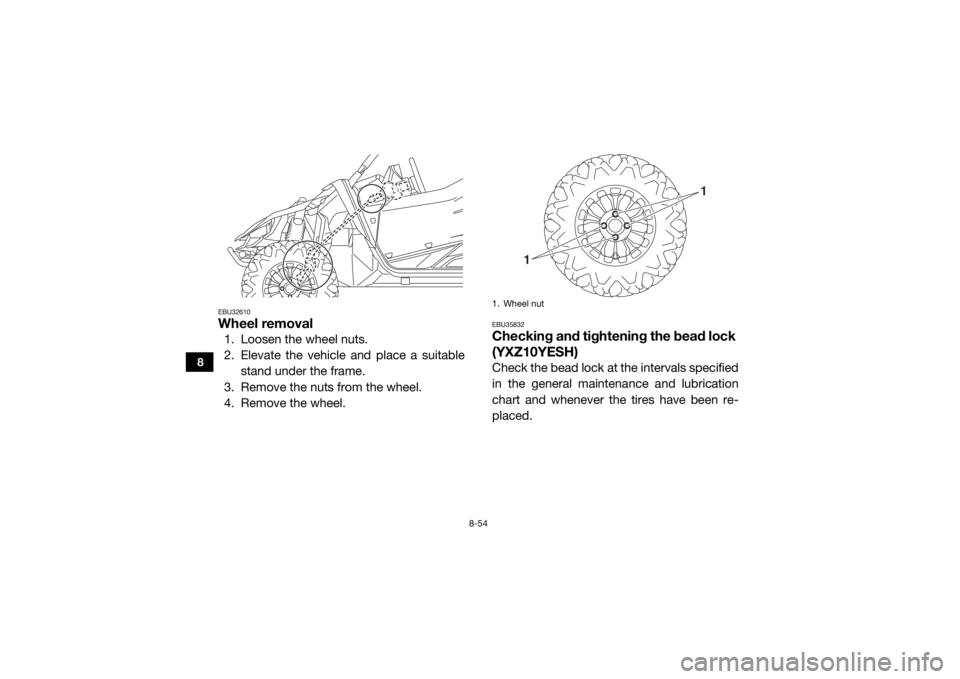
EBU32610Wheel removal1. Loosen the wheel nuts.
2. Elevate the vehicle and place a suitablestand under the frame.
3. Remove the nuts from the wheel.
4. Remove the wheel.
EBU35832Checking and tightening the bead lock
(YXZ10YESH)Check the bead lock at the intervals specified
in the general maintenance and lubrication
chart and whenever the tires have been re-
placed.1. Wheel nut
1 1
UB577AE0.book Page 54 Wednesday, June 8, 2016 9:35 AM