maintenance YAMAHA YXZ1000R 2019 User Guide
[x] Cancel search | Manufacturer: YAMAHA, Model Year: 2019, Model line: YXZ1000R, Model: YAMAHA YXZ1000R 2019Pages: 218, PDF Size: 9.48 MB
Page 149 of 218
8-18
8
2. Turn the panel lock 1/4 turn counter-clockwise, and then push the tab on the
p a n e l l o c k d o w n s o t h a t i t i s p o i n t i n g r e a r -
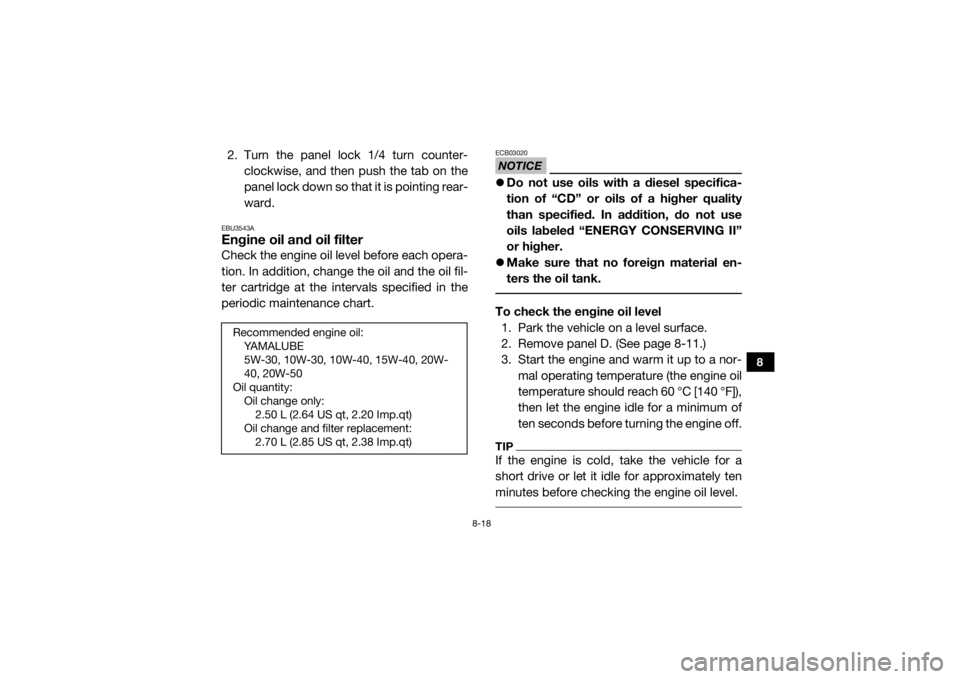
ward.EBU3543AEngine oil and oil filterCheck the engine oil level before each opera-
tion. In addition, change the oil and the oil fil-
ter cartridge at the intervals specified in the
periodic maintenance chart.
NOTICEECB03020 Do not use oils with a diesel specifica-
tion of “CD” or oils of a higher quality
than specified. In addition, do not use
oils labeled “ENERGY CONSERVING II”
or higher.
Make sure that no foreign material en-
ters the oil tank. To check the engine oil level
1. Park the vehicle on a level surface.
2. Remove panel D. (See page 8-11.)
3. Start the engine and warm it up to a nor- mal operating temperature (the engine oil
temperature should reach 60 °C [140 °F]),
then let the engine idle for a minimum of
ten seconds before turning the engine off.TIPIf the engine is cold, take the vehicle for a
short drive or let it idle for approximately ten
minutes before checking the engine oil level.
Recommended engine oil:YA M A L U B E5W-30, 10W-30, 10W-40, 15W-40, 20W-
40, 20W-50
Oil quantity: Oil change only:2.50 L (2.64 US qt, 2.20 Imp.qt)
Oil change and filter replacement: 2.70 L (2.85 US qt, 2.38 Imp.qt)
UB5H7AE0.book Page 18 Wednesday, July 4, 2018 1:37 PM
Page 159 of 218
8-28
8
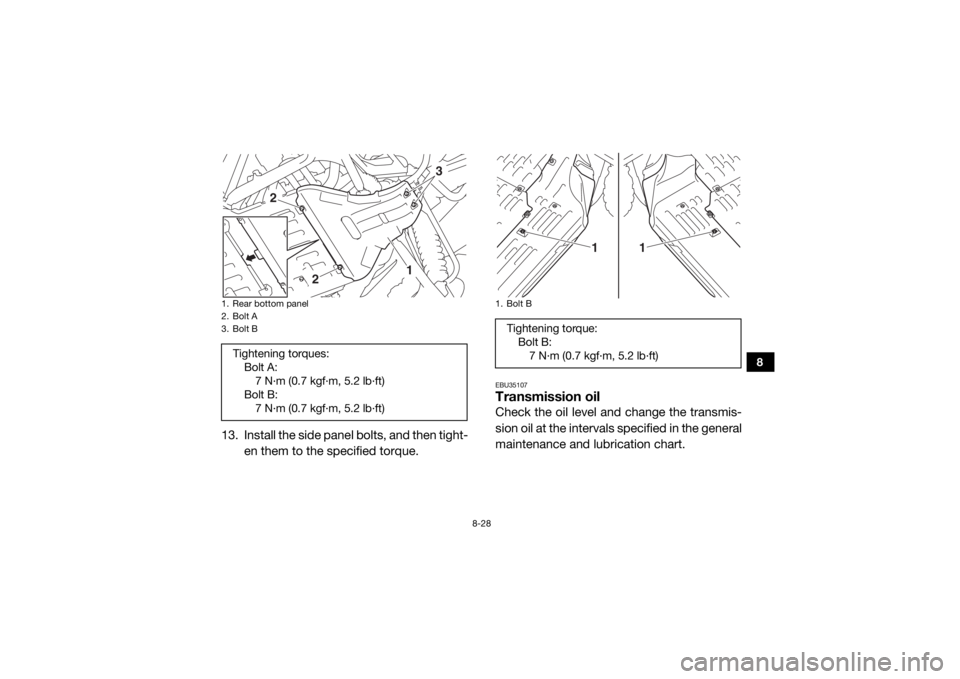
13. Install the side panel bolts, and then tight-en them to the specified torque.
EBU35107Transmission oilCheck the oil level and change the transmis-
sion oil at the intervals specified in the general
maintenance and lubrication chart.
1. Rear bottom panel
2. Bolt A
3. Bolt BTightening torques:Bolt A:7 N·m (0.7 kgf·m, 5.2 lb·ft)
Bolt B: 7 N·m (0.7 kgf·m, 5.2 lb·ft)
3
1
2
2
1. Bolt BTightening torque: Bolt B:7 N·m (0.7 kgf·m, 5.2 lb·ft)
1
1
UB5H7AE0.book Page 28 Wednesday, July 4, 2018 1:37 PM
Page 162 of 218

8-31
8
6. Check the O-ring for damage, and re-place it if necessary.
7. Refill the transmission with the specified amount of the recommended oil.
8. Install the transmission oil filler cap.
9. Start the engine and let it idle while checking for oil leakage.
10. Stop the engine and check the oil level one last time.EBU36053Final gear oilCheck the oil level and change the final gear
oil at the intervals specified in the general
maintenance and lubrication chart.
NOTICEECB03590When checking or changing the final gear
oil, make sure that no foreign material en-
ters the final gear case. If necessary, clean
the final gear oil filler bolt and surrounding
area. TIPIf the recommended gear oil is not available,
SAE 80W-90 API GL-4 or GL-5 hypoid gear
oil may be used instead. Checking the final gear oil level1. Park the vehicle on a level surface.
Tightening torque: Transmission oil drain bolt:20 N·m (2.0 kgf·m, 15 lb·ft)
Recommended oil:SAE 80 API GL-4 Hypoid gear oil
Oil quantity: 0.47 L (0.50 US qt, 0.41 Imp.qt)
UB5H7AE0.book Page 31 Wednesday, July 4, 2018 1:37 PM
Page 164 of 218

8-33
8
4. Install the drain bolt and its new gasket,and then tighten the bolt to the specified
torque.
5. Refill with the recommended final gear oil up to the brim of the filler hole.
6. Check the oil filler bolt gasket for dam- age, and replace it if necessary. 7. Install the oil filler bolt and its gasket, and
then tighten the bolt to the specified
torque.
8. Check for oil leakage. If oil leakage is found, check for the cause.
EBU36063Differential gear oilCheck the oil level and change the differential
gear oil at the intervals specified in the gener-
al maintenance and lubrication chart.NOTICEECB03600When checking or changing the differen-
tial gear oil, make sure that no foreign ma-
terial enters the differential gear case. If
necessary, clean the differential gear oil
filler bolt and surrounding area.
1. Final gear oil drain bolt
2. GasketTightening torque:Final gear oil drain bolt:23 N·m (2.3 kgf·m, 17 lb·ft)
21
Tightening torque:Final gear oil filler bolt:23 N·m (2.3 kgf·m, 17 lb·ft)
UB5H7AE0.book Page 33 Wednesday, July 4, 2018 1:37 PM
Page 169 of 218
8-38
8
To change the coolant
The coolant must be changed at the intervals
specified in the periodic maintenance chart.
Have a Yamaha dealer change the coolant.
WARNING! Never attempt to remove the
radiator cap when the engine is hot.
[EWB04250]
EBU32400
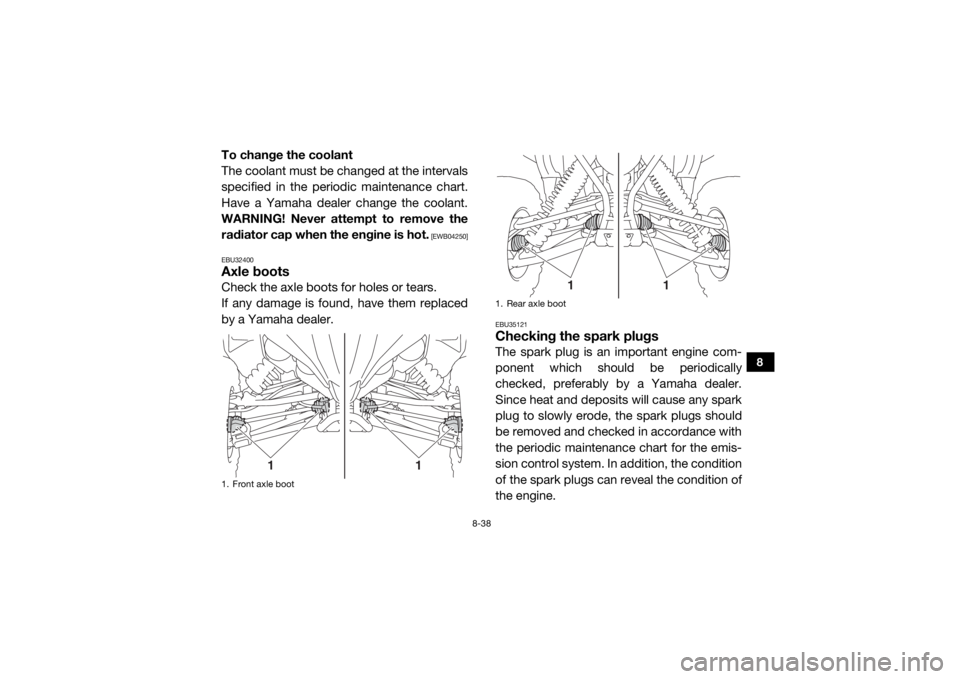
Axle bootsCheck the axle boots for holes or tears.
If any damage is found, have them replaced
by a Yamaha dealer.
EBU35121Checking the spark plugsThe spark plug is an important engine com-
ponent which should be periodically
checked, preferably by a Yamaha dealer.
Since heat and deposits will cause any spark
plug to slowly erode, the spark plugs should
be removed and checked in accordance with
the periodic maintenance chart for the emis-
sion control system. In addition, the condition
of the spark plugs can reveal the condition of
the engine.
1. Front axle boot
1
1
1. Rear axle boot
1
1
UB5H7AE0.book Page 38 Wednesday, July 4, 2018 1:37 PM
Page 171 of 218

8-40
8
TIPIf a torque wrench is not available when in-
stalling the spark plug, a good estimate of the
correct torque is 1/4–1/2 turn past finger tight.
However, the spark plug should be tightened
to the specified torque as soon as possible. NOTICEECB02900Do not use any tools to remove or install
the spark plug cap, otherwise the ignition
coil coupler may be damaged. The spark
plug cap may be difficult to remove be-
cause the rubber seal on the end of the cap
fits tightly. To remove the spark plug cap,
simply twist it back and forth while pulling
it out; to install it, twist it back and forth
while pushing it in.
EBU38320Air filter maintenanceThis model is equipped with two air filter ele-
ments, a primary foam-type air filter and a
secondary paper-type air filter.
The primary air filter is easily accessed and
should be cleaned and oiled every 300–600
km (200–400 mi).
The secondary air filter is more difficult to ac-
cess, cannot be cleaned, and should be re-
placed by a Yamaha dealer every 2000–5000
km (1200–3000 mi).1. Primary air filter
2. Secondary air filter
1
2
UB5H7AE0.book Page 40 Wednesday, July 4, 2018 1:37 PM
Page 172 of 218
8-41
8
TIPService the air filters more frequently when
operating in wet or dusty environments. Whenever air filter maintenance is performed:
check the air inlet for obstructions and the
air filter case for dirt and foreign matter.
check the air filter case check hoses for dirt
or water and clean as necessary.
check the air filter cas e joints and the rub-
ber joints to and from the throttle body for
proper fit and sealing.
tighten all fittings securely to avoid the pos-
sibility of unfiltered air entering the engine.NOTICEECB02270Never operate the engine with the air filter
element removed. Doing so would allow
unfiltered air to enter, causing rapid en-
gine wear and possible engine damage. Additionally, the fuel injection system
would be affected, resulting in poor engine
performance and possible overheating.
Clean the primary air filter as follows.
1. Remove the air filter case cover by turn- ing the air filter case cover lock counter-
clockwise.TIPMake sure that the match mark on the cover
lock is aligned with the open match mark on
the air filter case cover.
UB5H7AE0.book Page 41 Wednesday, July 4, 2018 1:37 PM
Page 180 of 218

8-49
8
TIPThe brake and YCC-S clutch fluid reser-
voirs are located under the hood (page
8-11).
For an accurate reading, make sure the ve-
hicle is parked on a level surface.
WARNING
EWB04160Improper maintenance can result in loss of
braking ability or YCC-S clutch operation.
Observe these precautions:
Insufficient brake or YCC-S clutch fluid
may allow air to enter the brake or
YCC-S clutch system, reducing braking
or YCC-S clutch performance.
Clean the filler caps before removing.
Use only DOT 4 brake fluid from a sealed
container.
Use only the specified brake fluid; other-
wise, the rubber seals may deteriorate,
causing leakage.
Refill with the same type of brake fluid.
Adding a brake fluid other than DOT 4
may result in a harmful chemical reac-
tion.
1. Brake fluid reservoir
2. YCC-S clutch fluid reservoir
3. Minimum level markSpecified fluid for brake and YCC-S clutch
systems:
DOT 4 brake fluid
3
3 12
UB5H7AE0.book Page 49 Wednesday, July 4, 2018 1:37 PM
Page 181 of 218

8-50
8
Be careful that water or dust does not
enter the brake or YCC-S clutch fluid
reservoir when refilling. Water will signif-
icantly lower the boiling point of the fluid
and may result in vapor lock. NOTICEECB01161Brake fluid may damage painted surfaces
or plastic parts. Always clean up spilled
fluid immediately. As the brake pads wear, it is normal for the
brake fluid level to gradually go down. A low
brake fluid level may indicate worn brake
pads or brake system l eakage; therefore, be
sure to check the brake pads for wear and the
brake system for leakage. A low YCC-S
clutch fluid level may indicate YCC-S clutch
system leakage; therefore, be sure to check
the YCC-S clutch system for leakage. If the
brake or YCC-S clutch fluid level goes down suddenly, have a Yamaha dealer check and
repair the vehicle before any further opera-
tion.
EBU36550Brake and YCC-S clutch fluid replace-
mentComplete fluid replacement should be done
only by trained Yamaha service personnel.
Have a Yamaha dealer replace the following
components during periodic maintenance or
when they are damaged or leaking.
Replace the oil seals every two years.
Replace the brake and YCC-S clutch hoses
every four years.EBU36540YCC-S clutchThis model is equipped with a hydraulic
clutch, therefore, it is necessary to check the
YCC-S clutch fluid level and check the hy-
draulic system for leakage before each drive.
If the YCC-S clutch plates wear out, shifting
becomes rough or clutch slippage will occur,
UB5H7AE0.book Page 50 Wednesday, July 4, 2018 1:37 PM
Page 185 of 218

8-54
8
Lubricate the cable ends. If the cables do not
operate smoothly, ask a Yamaha dealer to re-
place them.EBU36760Pedal lubricationThe pivoting parts of the brake and accelera-
tor pedals should be lubricated periodically to
prevent rust and ensure smooth operation.
EBU32582Checking the stabilizer bushesThe stabilizer bushes must be checked for
cracks or damage at the intervals specified in
the periodic maintenance and lubrication
chart.
Have a Yamaha dealer replace the stabilizer
bushes if necessary.
Front
Recommended lubricant: Yamalube LubezAll (synthetic lubricant spray with PTFE)
Recommended lubricant: Lithium-soap-based grease
UB5H7AE0.book Page 54 Wednesday, July 4, 2018 1:37 PM