ABS YAMAHA YXZ1000R 2020 Owners Manual
[x] Cancel search | Manufacturer: YAMAHA, Model Year: 2020, Model line: YXZ1000R, Model: YAMAHA YXZ1000R 2020Pages: 198, PDF Size: 8.22 MB
Page 6 of 198

EBU31120
CONTENTS
VEHICLE IDENTIFICATION ..................... 1-1Identification numbers .......................... 1-1
LOCATION OF THE WARNING AND
SPECIFICATION LABELS ....................... 2-1
SAFETY INFORMATION ......................... 3-1
DESCRIPTION......................................... 4-1 Left view ............................................... 4-1
Right view ............................................. 4-2
Controls and instruments ..................... 4-3
INSTRUMENT AND CONTROL
FUNCTIONS............................................ 5-1 Main switch .......................................... 5-1
Indicator lights and warning lights ....... 5-2
Multi-function meter unit ...................... 5-7
Light switch ........................................ 5-16
On–Command drive knob “2WD/4WD/DIFF LOCK” .................. 5-17 Accelerator pedal ............................... 5-18
Clutch pedal ....................................... 5-18
Brake pedal ........................................ 5-19
Parking brake lever ............................ 5-19
Shift lever ........................................... 5-20
Reverse gear lock lever “REV.” .......... 5-20
Fuel tank cap...................................... 5-21
Doors .................................................. 5-21
Seats .................................................. 5-21
Adjusting the driver seat position....... 5-23
Adjusting the steering wheel
position ............................................. 5-23
Seat belts ........................................... 5-24
Glove compartment ........................... 5-25
Storage compartments ...................... 5-25
Cup holders ........................................ 5-26
Cargo bed .......................................... 5-27
Flag pole bracket ............................... 5-28
Front shock absorbers ....................... 5-28
Rear shock absorbers ........................ 5-33
Auxiliary DC jack ................................ 5-38UB5J7BE0.book Page 1 Tuesday, June 18, 2019 10:07 AM
Page 30 of 198

4-1
4
EBU31170
DESCRIPTION
EBU31180Left view
1 2,3 4 5 6
9
12
137
810
11
1. Front shock absorber
2. Brake fluid reservoir
3. Clutch fluid reservoir
4. Door
5. Shoulder bolster
6. Driver seat belt
7. Coolant reservoir
8. Air filter
9. Cargo bed
10.Muffler 11.Exhaust pipe
12.Engine
13.TransmissionUB5J7BE0.book Page 1 Tuesday, June 18, 2019 10:07 AM
Page 31 of 198

4-2
4
EBU31190Right view
3
4,5
6
1
7
2
1. Rear shock absorber
2. Engine oil tank
3. Passenger seat belt
4. Battery
5. Fuses
6. Headlight
7. Fuel tank capUB5J7BE0.book Page 2 Tuesday, June 18, 2019 10:07 AM
Page 60 of 198

5-28
5
EBU35660Flag pole bracketThis model is equipped with a flag pole brack-
et.NOTICEECB03010Do not use the flag pole bracket as a cargo
hook.
EBU35035Front shock absorbersThe shock absorber assemblies are equipped
with a spring preload adjusting nut, a rebound
damping force adjusting screw, a fast com-
pression damping force adjusting bolt, and a
slow compression damping force adjusting
screw.
WARNING
EWB02492Suspension components become hot
during operation. Never touch the com-
pression damping force adjusting bolt
and screw, the rebound damping force
adjusting screw or the oil reservoir with
your bare hand or skin until suspension
components have cooled.
Always adjust the shock absorber as-
semblies on the left and right side to the
same setting. Uneven adjustment can
cause poor handling and loss of stability,
which could lead to an accident.
1. Flag pole bracket
1
1
UB5J7BE0.book Page 28 Tuesday, June 18, 2019 10:07 AM
Page 65 of 198
5-33
5
WARNING
EWB00411These shock absorber assemblies contain
highly pressurized nitrogen gas. Read and
understand the following information be-
fore handling the shock absorber assem-
blies.
Do not tamper with or attempt to open
the cylinder assemblies.
Do not subject the shock absorber as-
semblies to an open flame or other high
heat source. This may cause the unit to
explode due to excessive gas pressure.
Do not deform or damage the cylinders
in any way. Cylinder damage will result in
poor damping performance.
Do not dispose of a damaged or worn
out shock absorber assembly yourself.
Take the shock absorber assembly to a
Yamaha dealer for any service.
EBU35045Rear shock absorbersThe rear shock absorber assemblies are
equipped with a spring preload adjusting nut,
a rebound damping force adjusting screw, a
fast compression damping force adjusting
bolt, and a slow compression damping force
adjusting screw.
WARNING
EWB02492 Suspension components become hot
during operation. Never touch the com-
pression damping force adjusting bolt
and screw, the rebound damping force
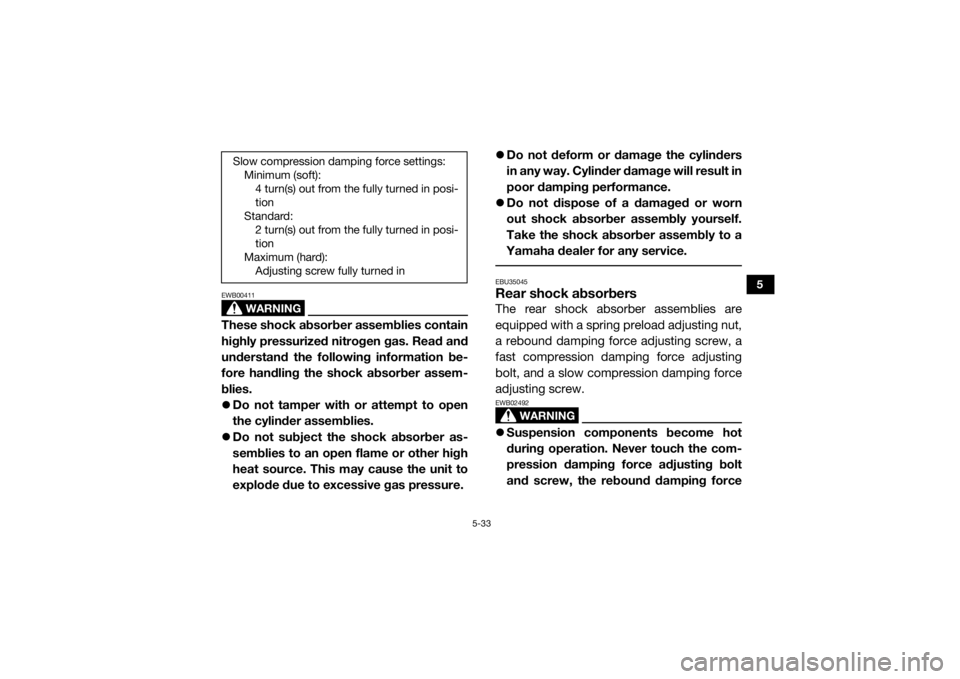
Slow compression damping force settings:
Minimum (soft):4 turn(s) out from the fully turned in posi-
tion
Standard: 2 turn(s) out from the fully turned in posi-
tion
Maximum (hard): Adjusting screw fully turned in
UB5J7BE0.book Page 33 Tuesday, June 18, 2019 10:07 AM
Page 66 of 198
5-34
5
adjusting screw or the oil reservoir with
your bare hand or skin until suspension
components have cooled.
Always adjust the shock absorber as-
semblies on the left and right side to the
same setting. Uneven adjustment can
cause poor handling and loss of stability,
which could lead to an accident. NOTICEECB00091Never turn an adjusting mechanism be-
yond the minimum and maximum settings. TIPAlthough the total number of clicks or turns of
a damping force adjusting mechanism may
not exactly match the following specifications
due to small differences in production, the ac-
tual number of clicks or turns always repre-
sents the entire adjusting range. To obtain a
precise adjustment, it would be advisable to check the number of clicks or turns of each
damping force adjusting mechanism and to
modify the specifications as necessary.
Spring preload
1. Elevate the vehicle and place a suitable stand under the frame.
2. Loosen the locknut.
3. Turn the spring preload adjusting nut in
direction (a) to increase the spring pre-
load and thereby harden the suspension,
and in direction (b) to decrease the spring
preload and thereby soften the suspen-
sion.
UB5J7BE0.book Page 34 Tuesday, June 18, 2019 10:07 AM
Page 70 of 198
5-38
5
WARNING
EWB03500These shock absorber assemblies contain
highly pressurized nitrogen gas. Read and
understand the following information be-
fore handling the shock absorber assem-
blies.
Do not tamper with or attempt to open
the cylinder assemblies.
Do not subject the shock absorber as-
sembly to an open flame or other high
heat source. This may cause the unit to
explode due to excessive gas pressure.
Do not deform or damage the cylinders
in any way. Cylinder damage will result in
poor damping performance.
Do not dispose of a damaged or worn
out shock absorber assembly yourself.
Take the shock absorber assembly to a
Yamaha dealer for any service.
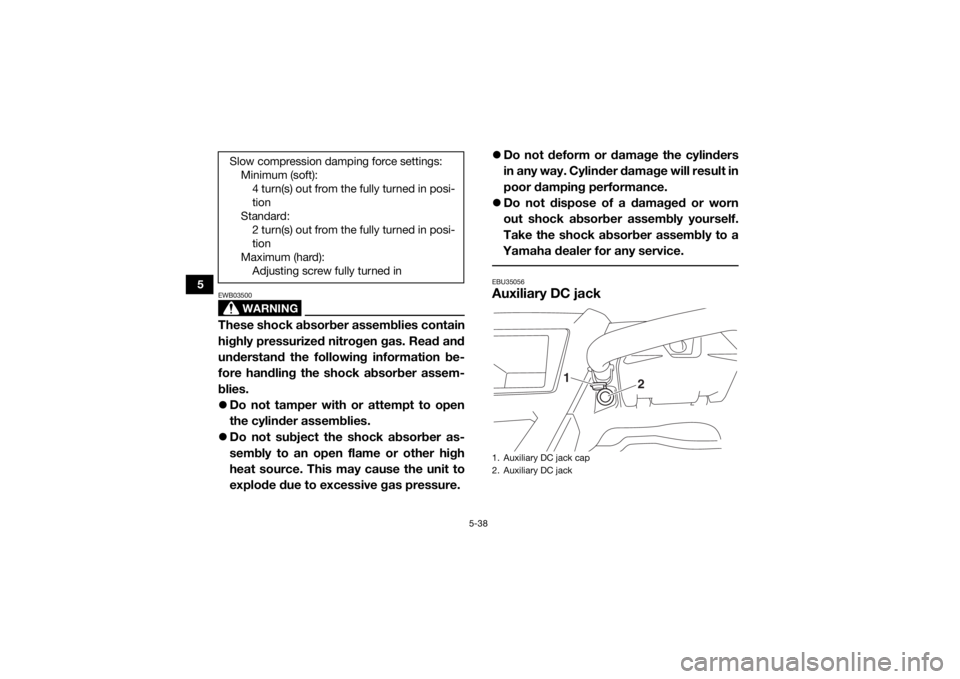
EBU35056Auxiliary DC jack
Slow compression damping force settings: Minimum (soft):4 turn(s) out from the fully turned in posi-
tion
Standard: 2 turn(s) out from the fully turned in posi-
tion
Maximum (hard): Adjusting screw fully turned in
1. Auxiliary DC jack cap
2. Auxiliary DC jack
2
1
UB5J7BE0.book Page 38 Tuesday, June 18, 2019 10:07 AM
Page 106 of 198

8-15
8
Braking
When slowing down or stopping, take your
foot off the accelerator pedal and press the
brake pedal smoothly. Abrupt or improper
use of the brakes can cause the tires to lose
traction, reducing control of the vehicle and
increasing the possibility of an accident.
Braking ability is affected by type of terrain. In
most cases, gradual application of the brakes
is more effective than abrupt braking, partic-
ularly on loose surfaces, such as gravel. Al-
ways allow for greater braking distance on
rough, loose, or slippery surfaces.
Engine compression braking will also help
slow the vehicle down. With the transmission
still in gear, take your foot off the accelerator
and allow the drivetrain and engine to absorb
vehicle speed. Downshift as necessary. Ap-
plication of the brakes provides additional
stopping power. Leaving the vehicle
Do not get out of the vehicle while the engine
is running. Take the key with when you leave
the vehicle. There is a serious risk of injury or
death because:
Children or other unauthorized persons
may attempt to operate the vehicle.
Objects tossed into the vehicle may strike
the shift lever and accidently engage the
transmission.
The parking brake may not keep the vehicle
from moving.
Parking on a flat area
Even when parking on a seemingly flat area, it
is good practice to leave the transmission in
gear to prevent the vehicle from rolling.
Therefore, shift into first or reverse gear, stop
the engine and always apply the parking
brake.UB5J7BE0.book Page 15 Tuesday, June 18, 2019 10:07 AM
Page 183 of 198

10-1
10
EBU32720
CLEANING AND STORAGE
EBU35920CleaningFrequent, thorough cleaning of your vehicle
will not only enhance its appearance but will
improve its general performance and extend
the useful life of many components.1. Before cleaning the vehicle: a. Block off the end of the exhaust pipeto prevent water entry. A plastic bag
and strong rubber band may be used.
b. Make sure the spark plugs and all filler caps are properly installed.
2. If the engine case is excessively greasy, apply degreaser with a paint brush. Do
not apply degreaser to the wheel axles.
3. Rinse the dirt and degreaser off with a garden hose. Use only enough pressure
to do the job. WARNING! Test the
brakes after washing. Apply the
brakes several times at slow speeds to
let friction dry the brakes. Wet brakes may have reduced stopping ability, in-
creasing the chance of an accident.
[EWB03471]
NOTICE: Excessive water pres-
sure may cause water seepage and
deterioration of wheel bearings,
brakes, transmission seals and electri-
cal devices. Many expensive repair
bills have resulted from improper high-
pressure detergent applications such
as those available in coin-operated car
washers.
[ECB00712]
4. Once the majority of the dirt has been hosed off, wash all surfaces with warm
water and mild, detergent-type soap. An
old toothbrush or bottle brush is handy
for hard-to-get-at places.
5. Rinse the vehicle off immediately with
clean water and dry all surfaces with a
clean chamois towel or soft, absorbent
cloth.
6. Clean the seats with a vinyl upholstery cleaner to keep the covers pliable and
glossy.
UB5J7BE0.book Page 1 Tuesday, June 18, 2019 10:07 AM
Page 189 of 198

11-4
11
Front tire:Size:29 x 9.00R-14NHS
Manufacturer/model:
MAXXIS/M917 / BIGHORNRear tire:Size:29 x 11.00R-14NHS
Manufacturer/model:
MAXXIS/M918 / BIGHORNTire air pressure (measured on cold tires):Vehicle load:0.0–195.0 kg (0–430 lb)
Recommended:
Front:114.0 kPa (1.140 kgf/cm², 16.5 psi)
Rear:
128.0 kPa (1.280 kgf/cm², 18.5 psi)
Minimum: Front:
110.0 kPa (1.100 kgf/cm², 16.0 psi)
Rear: 124.0 kPa (1.240 kgf/cm², 18.0 psi)
Vehicle load: 195.0–328.0 kg (430–723 lb)
Recommended:
Front:114.0 kPa (1.140 kgf/cm², 16.5 psi)
Rear:
169.0 kPa (1.690 kgf/cm², 24.5 psi) Minimum:
Front:
110.0 kPa (1.100 kgf/cm², 16.0 psi)
Rear: 165.0 kPa (1.650 kgf/cm², 24.0 psi)
Front wheel:Rim size:
14 x 6.5 ATRear wheel:Rim size:14 x 8.0 ATFront brake:Type:Hydraulic disc brakeRear brake:Type:
Hydraulic disc brakeBrake fluid:Specified brake fluid:DOT 4Front suspension:Type:Double wishbone
Spring: Coil spring
Shock absorber:
Gas-hydraulic damper
Wheel travel: 412 mm (16.3 in)
UB5J7BE0.book Page 4 Tuesday, June 18, 2019 10:07 AM