checking oil YAMAHA YZ125LC 2010 User Guide
[x] Cancel search | Manufacturer: YAMAHA, Model Year: 2010, Model line: YZ125LC, Model: YAMAHA YZ125LC 2010Pages: 166, PDF Size: 8.09 MB
Page 91 of 166
4-31
WATER PUMP
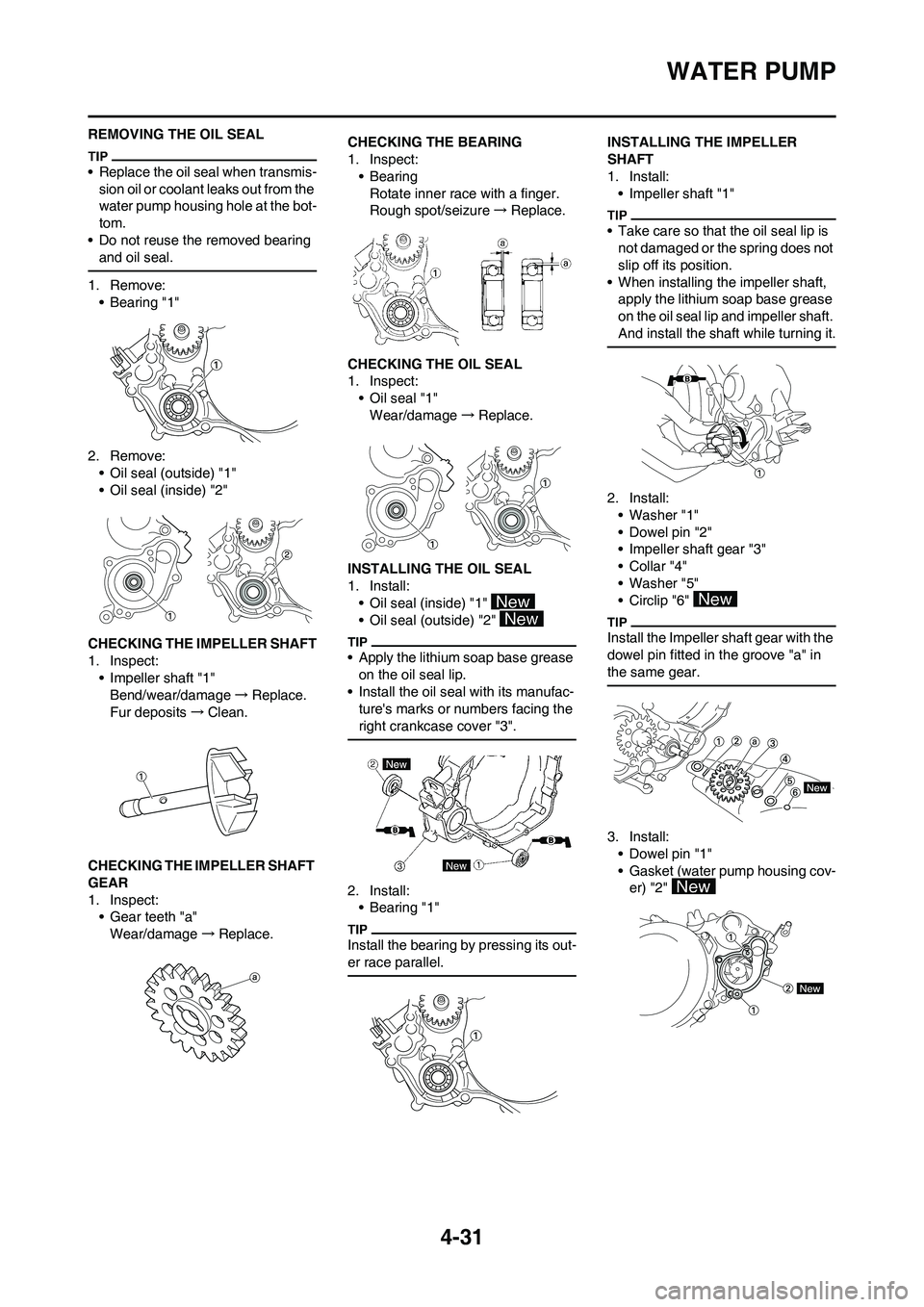
REMOVING THE OIL SEAL
• Replace the oil seal when transmis-
sion oil or coolant leaks out from the
water pump housing hole at the bot-
tom.
• Do not reuse the removed bearing
and oil seal.
1. Remove:
• Bearing "1"
2. Remove:
• Oil seal (outside) "1"
• Oil seal (inside) "2"
CHECKING THE IMPELLER SHAFT
1. Inspect:
• Impeller shaft "1"
Bend/wear/damage→Replace.
Fur deposits→Clean.
CHECKING THE IMPELLER SHAFT
GEAR
1. Inspect:
• Gear teeth "a"
Wear/damage→Replace.CHECKING THE BEARING
1. Inspect:
•Bearing
Rotate inner race with a finger.
Rough spot/seizure→Replace.
CHECKING THE OIL SEAL
1. Inspect:
• Oil seal "1"
Wear/damage→Replace.
INSTALLING THE OIL SEAL
1. Install:
• Oil seal (inside) "1"
• Oil seal (outside) "2"
• Apply the lithium soap base grease
on the oil seal lip.
• Install the oil seal with its manufac-
ture's marks or numbers facing the
right crankcase cover "3".
2. Install:
•Bearing "1"
Install the bearing by pressing its out-
er race parallel.
INSTALLING THE IMPELLER
SHAFT
1. Install:
• Impeller shaft "1"
• Take care so that the oil seal lip is
not damaged or the spring does not
slip off its position.
• When installing the impeller shaft,
apply the lithium soap base grease
on the oil seal lip and impeller shaft.
And install the shaft while turning it.
2. Install:
• Washer "1"
• Dowel pin "2"
• Impeller shaft gear "3"
•Collar "4"
• Washer "5"
• Circlip "6"
Install the Impeller shaft gear with the
dowel pin fitted in the groove "a" in
the same gear.
3. Install:
• Dowel pin "1"
• Gasket (water pump housing cov-
er) "2"
Page 101 of 166
4-41
CRANKCASE AND CRANKSHAFT
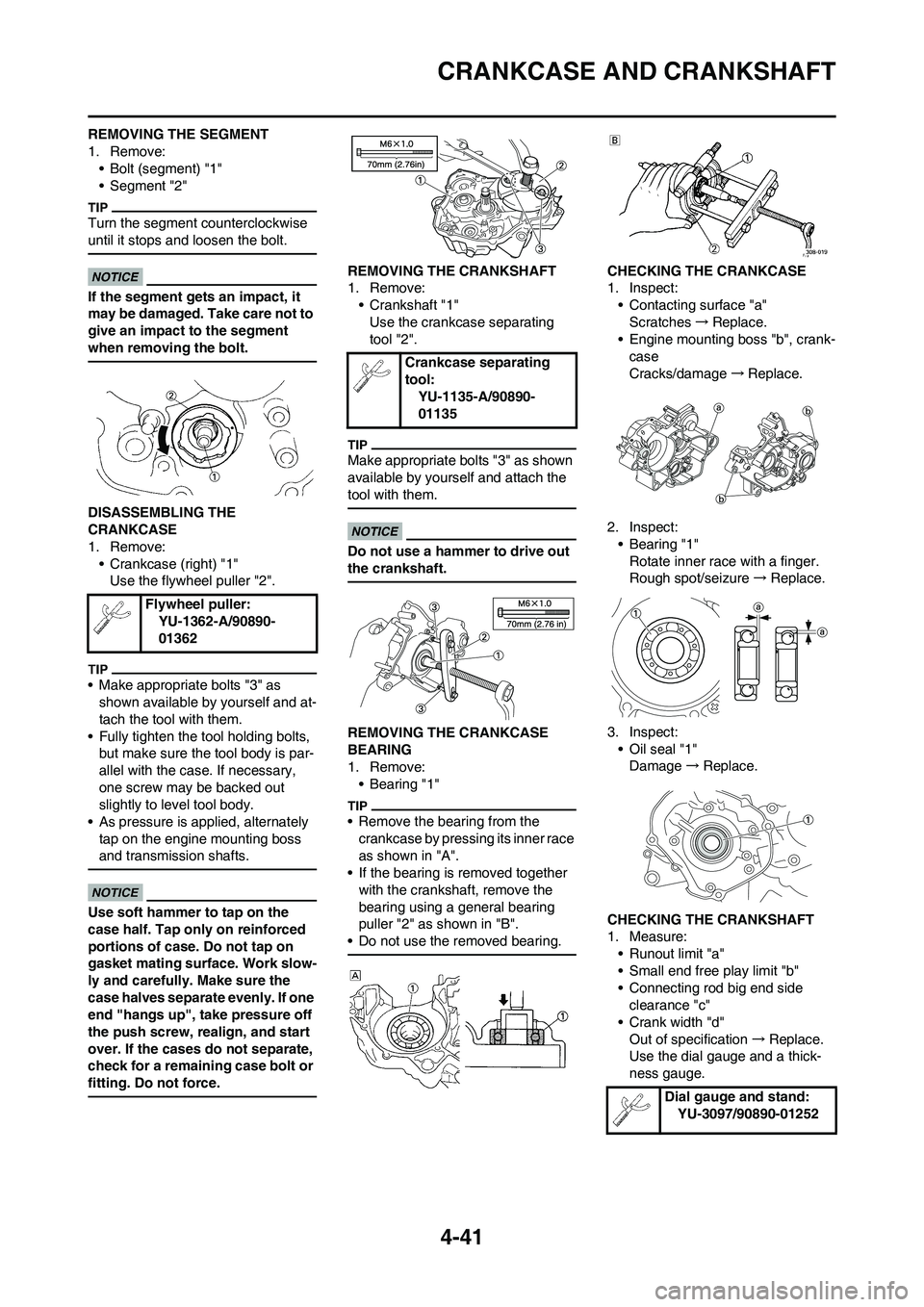
REMOVING THE SEGMENT
1. Remove:
• Bolt (segment) "1"
• Segment "2"
Turn the segment counterclockwise
until it stops and loosen the bolt.
If the segment gets an impact, it
may be damaged. Take care not to
give an impact to the segment
when removing the bolt.
DISASSEMBLING THE
CRANKCASE
1. Remove:
• Crankcase (right) "1"
Use the flywheel puller "2".
• Make appropriate bolts "3" as
shown available by yourself and at-
tach the tool with them.
• Fully tighten the tool holding bolts,
but make sure the tool body is par-
allel with the case. If necessary,
one screw may be backed out
slightly to level tool body.
• As pressure is applied, alternately
tap on the engine mounting boss
and transmission shafts.
Use soft hammer to tap on the
case half. Tap only on reinforced
portions of case. Do not tap on
gasket mating surface. Work slow-
ly and carefully. Make sure the
case halves separate evenly. If one
end "hangs up", take pressure off
the push screw, realign, and start
over. If the cases do not separate,
check for a remaining case bolt or
fitting. Do not force.
REMOVING THE CRANKSHAFT
1. Remove:
• Crankshaft "1"
Use the crankcase separating
tool "2".
Make appropriate bolts "3" as shown
available by yourself and attach the
tool with them.
Do not use a hammer to drive out
the crankshaft.
REMOVING THE CRANKCASE
BEARING
1. Remove:
•Bearing "1"
• Remove the bearing from the
crankcase by pressing its inner race
as shown in "A".
• If the bearing is removed together
with the crankshaft, remove the
bearing using a general bearing
puller "2" as shown in "B".
• Do not use the removed bearing.
CHECKING THE CRANKCASE
1. Inspect:
• Contacting surface "a"
Scratches→Replace.
• Engine mounting boss "b", crank-
case
Cracks/damage→Replace.
2. Inspect:
• Bearing "1"
Rotate inner race with a finger.
Rough spot/seizure→Replace.
3. Inspect:
• Oil seal "1"
Damage→Replace.
CHECKING THE CRANKSHAFT
1. Measure:
• Runout limit "a"
• Small end free play limit "b"
• Connecting rod big end side
clearance "c"
• Crank width "d"
Out of specification→Replace.
Use the dial gauge and a thick-
ness gauge. Flywheel puller:
YU-1362-A/90890-
01362
Crankcase separating
tool:
YU-1135-A/90890-
01135
Dial gauge and stand:
YU-3097/90890-01252
Page 103 of 166
4-43
CRANKCASE AND CRANKSHAFT
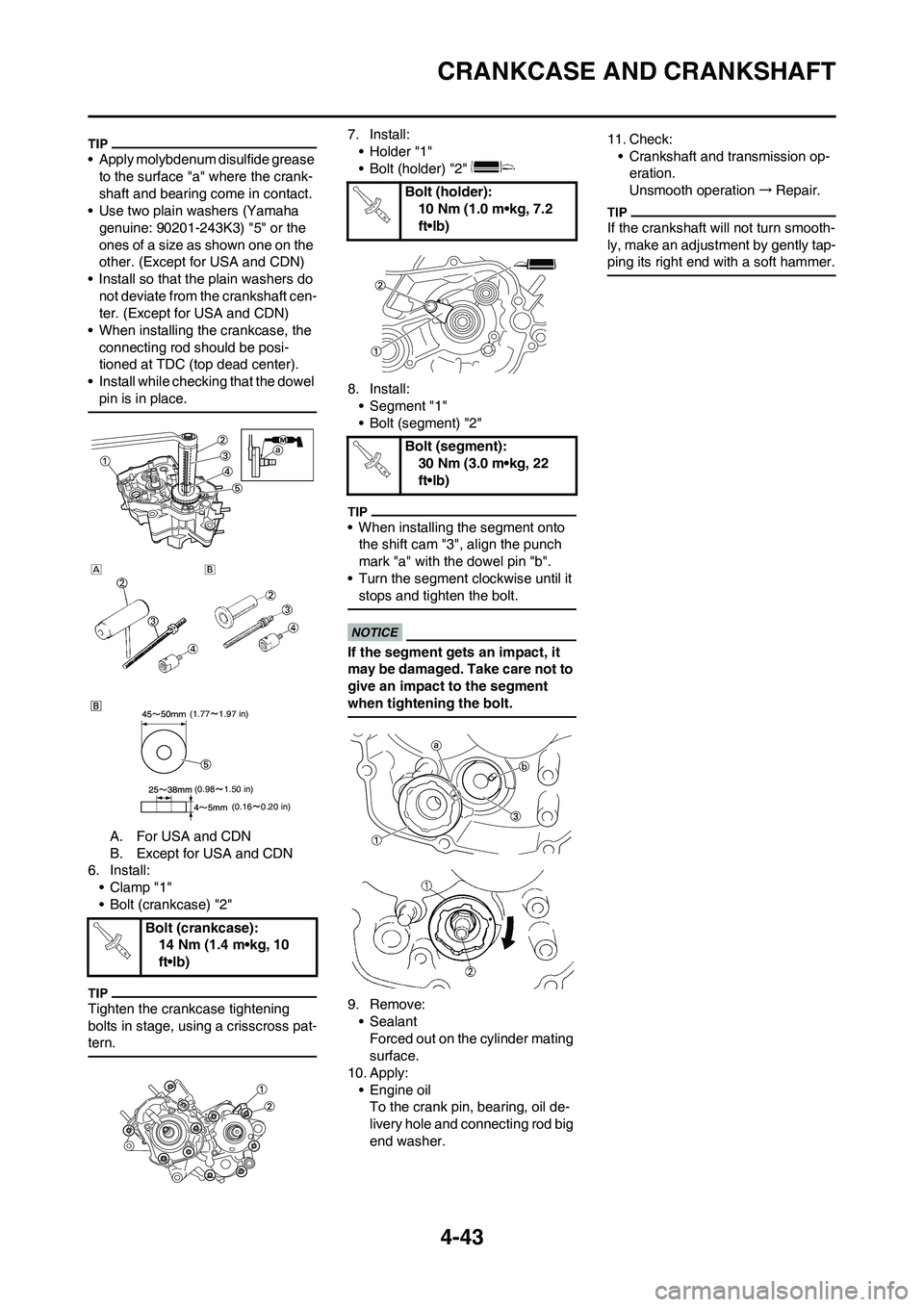
• Apply molybdenum disulfide grease
to the surface "a" where the crank-
shaft and bearing come in contact.
• Use two plain washers (Yamaha
genuine: 90201-243K3) "5" or the
ones of a size as shown one on the
other. (Except for USA and CDN)
• Install so that the plain washers do
not deviate from the crankshaft cen-
ter. (Except for USA and CDN)
• When installing the crankcase, the
connecting rod should be posi-
tioned at TDC (top dead center).
• Install while checking that the dowel
pin is in place.
A. For USA and CDN
B. Except for USA and CDN
6. Install:
• Clamp "1"
• Bolt (crankcase) "2"
Tighten the crankcase tightening
bolts in stage, using a crisscross pat-
tern.
7. Install:
• Holder "1"
• Bolt (holder) "2"
8. Install:
• Segment "1"
• Bolt (segment) "2"
• When installing the segment onto
the shift cam "3", align the punch
mark "a" with the dowel pin "b".
• Turn the segment clockwise until it
stops and tighten the bolt.
If the segment gets an impact, it
may be damaged. Take care not to
give an impact to the segment
when tightening the bolt.
9. Remove:
• Sealant
Forced out on the cylinder mating
surface.
10. Apply:
• Engine oil
To the crank pin, bearing, oil de-
livery hole and connecting rod big
end washer.11. Check:
• Crankshaft and transmission op-
eration.
Unsmooth operation→Repair.
If the crankshaft will not turn smooth-
ly, make an adjustment by gently tap-
ping its right end with a soft hammer.
Bolt (crankcase):
14 Nm (1.4 m•kg, 10
ft•lb)
(1.771.97 in)
(0.98
1.50 in)
(0.16
0.20 in)
Bolt (holder):
10 Nm (1.0 m•kg, 7.2
ft•lb)
Bolt (segment):
30 Nm (3.0 m•kg, 22
ft•lb)
Page 105 of 166
4-45
TRANSMISSION, SHIFT CAM AND SHIFT FORK
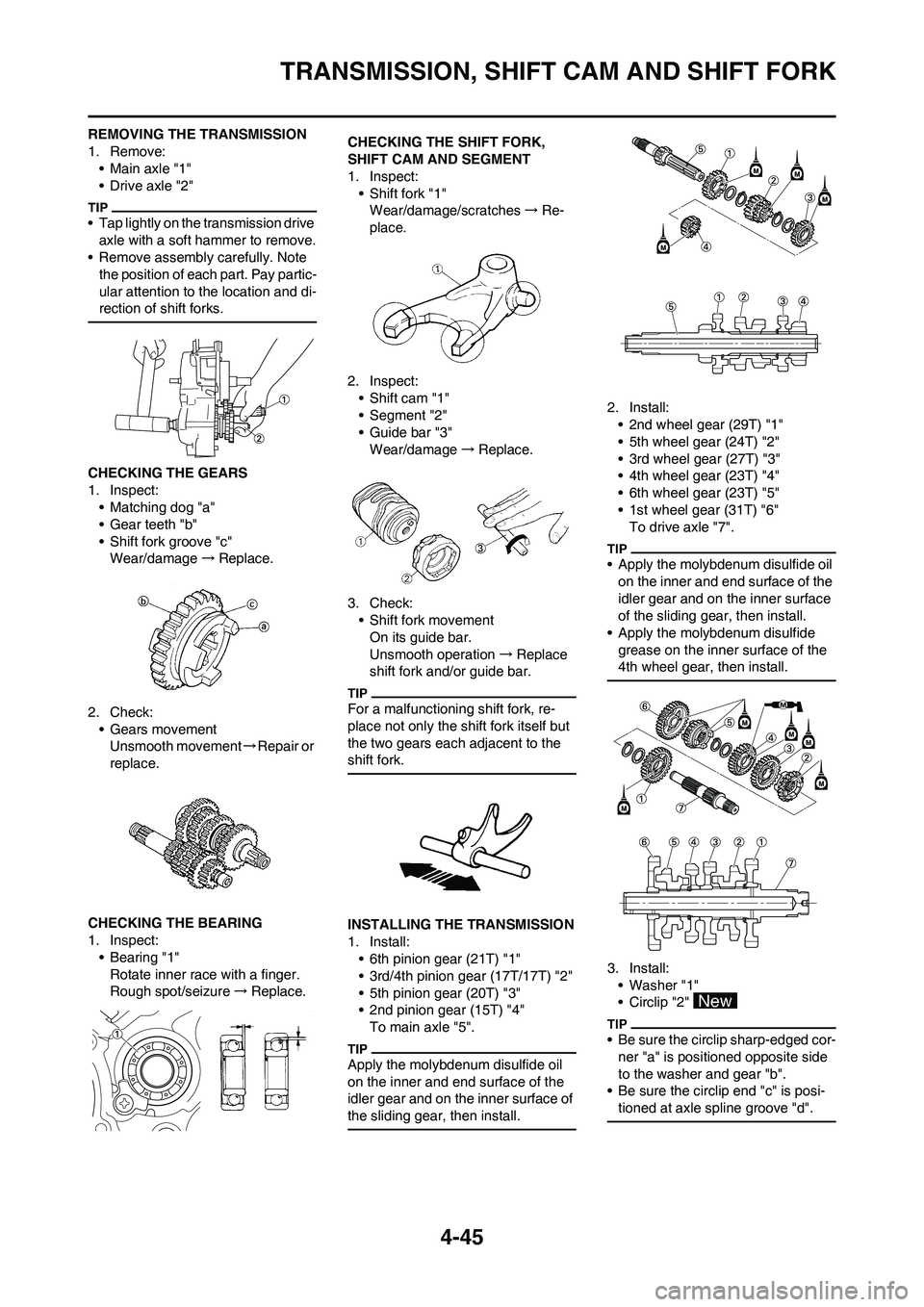
REMOVING THE TRANSMISSION
1. Remove:
• Main axle "1"
• Drive axle "2"
• Tap lightly on the transmission drive
axle with a soft hammer to remove.
• Remove assembly carefully. Note
the position of each part. Pay partic-
ular attention to the location and di-
rection of shift forks.
CHECKING THE GEARS
1. Inspect:
• Matching dog "a"
• Gear teeth "b"
• Shift fork groove "c"
Wear/damage→Replace.
2. Check:
• Gears movement
Unsmooth movement→Repair or
replace.
CHECKING THE BEARING
1. Inspect:
• Bearing "1"
Rotate inner race with a finger.
Rough spot/seizure→Replace.CHECKING THE SHIFT FORK,
SHIFT CAM AND SEGMENT
1. Inspect:
• Shift fork "1"
Wear/damage/scratches→Re-
place.
2. Inspect:
• Shift cam "1"
• Segment "2"
• Guide bar "3"
Wear/damage→Replace.
3. Check:
• Shift fork movement
On its guide bar.
Unsmooth operation→Replace
shift fork and/or guide bar.
For a malfunctioning shift fork, re-
place not only the shift fork itself but
the two gears each adjacent to the
shift fork.
INSTALLING THE TRANSMISSION
1. Install:
• 6th pinion gear (21T) "1"
• 3rd/4th pinion gear (17T/17T) "2"
• 5th pinion gear (20T) "3"
• 2nd pinion gear (15T) "4"
To main axle "5".
Apply the molybdenum disulfide oil
on the inner and end surface of the
idler gear and on the inner surface of
the sliding gear, then install.
2. Install:
• 2nd wheel gear (29T) "1"
• 5th wheel gear (24T) "2"
• 3rd wheel gear (27T) "3"
• 4th wheel gear (23T) "4"
• 6th wheel gear (23T) "5"
• 1st wheel gear (31T) "6"
To drive axle "7".
• Apply the molybdenum disulfide oil
on the inner and end surface of the
idler gear and on the inner surface
of the sliding gear, then install.
• Apply the molybdenum disulfide
grease on the inner surface of the
4th wheel gear, then install.
3. Install:
• Washer "1"
• Circlip "2"
• Be sure the circlip sharp-edged cor-
ner "a" is positioned opposite side
to the washer and gear "b".
• Be sure the circlip end "c" is posi-
tioned at axle spline groove "d".
Page 109 of 166
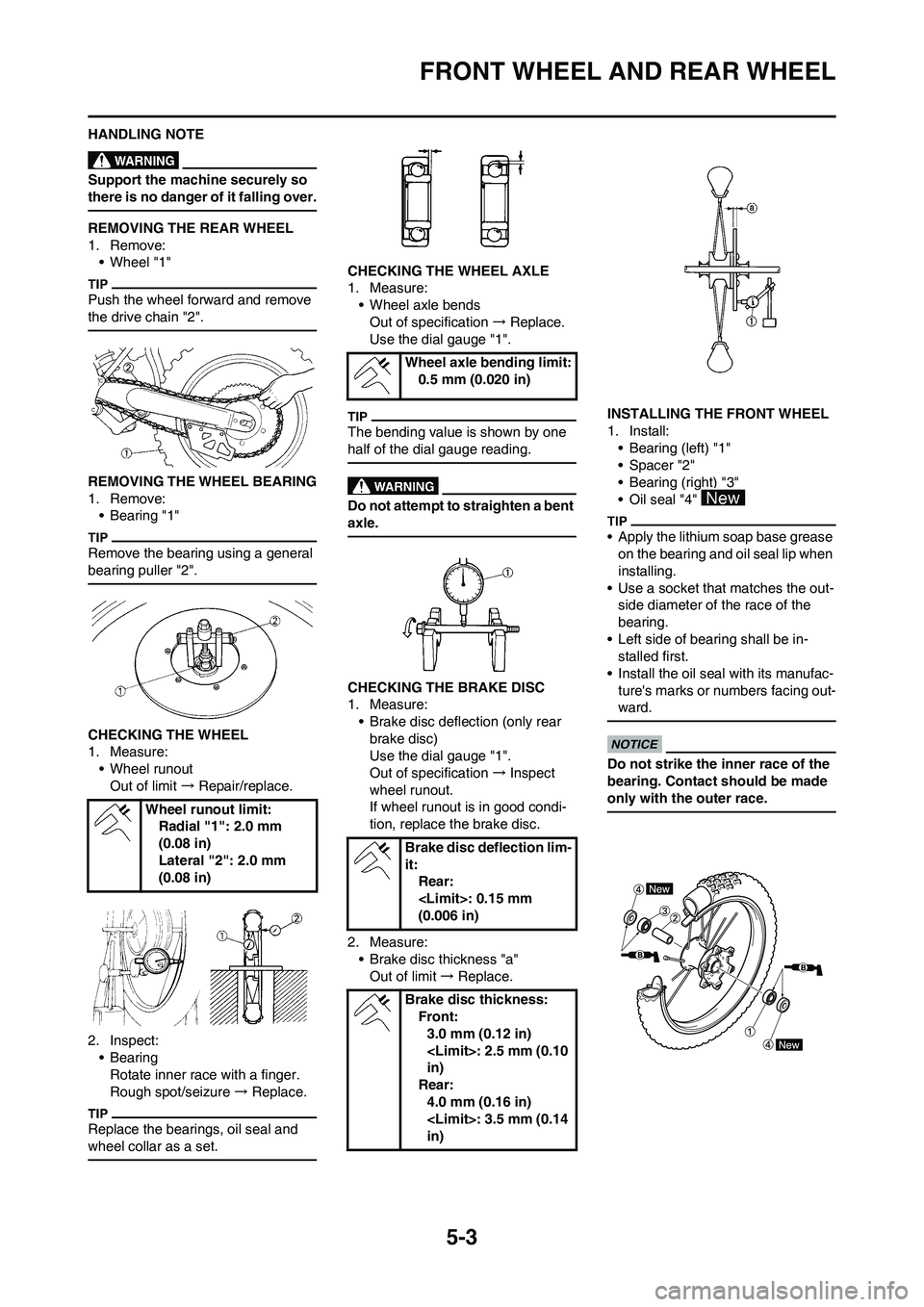
5-3
FRONT WHEEL AND REAR WHEEL
HANDLING NOTE
Support the machine securely so
there is no danger of it falling over.
REMOVING THE REAR WHEEL
1. Remove:
• Wheel "1"
Push the wheel forward and remove
the drive chain "2".
REMOVING THE WHEEL BEARING
1. Remove:
• Bearing "1"
Remove the bearing using a general
bearing puller "2".
CHECKING THE WHEEL
1. Measure:
• Wheel runout
Out of limit → Repair/replace.
2. Inspect:
• Bearing
Rotate inner race with a finger.
Rough spot/seizure → Replace.
Replace the bearings, oil seal and
wheel collar as a set.
CHECKING THE WHEEL AXLE
1. Measure:
• Wheel axle bends
Out of specification → Replace.
Use the dial gauge "1".
The bending value is shown by one
half of the dial gauge reading.
Do not attempt to straighten a bent
axle.
CHECKING THE BRAKE DISC
1. Measure:
• Brake disc deflection (only rear
brake disc)
Use the dial gauge "1".
Out of specification → Inspect
wheel runout.
If wheel runout is in good condi-
tion, replace the brake disc.
2. Measure:
• Brake disc thickness "a"
Out of limit → Replace.INSTALLING THE FRONT WHEEL
1. Install:
• Bearing (left) "1"
• Spacer "2"
• Bearing (right) "3"
• Oil seal "4"
• Apply the lithium soap base grease
on the bearing and oil seal lip when
installing.
• Use a socket that matches the out-
side diameter of the race of the
bearing.
• Left side of bearing shall be in-
stalled first.
• Install the oil seal with its manufac-
ture's marks or numbers facing out-
ward.
Do not strike the inner race of the
bearing. Contact should be made
only with the outer race.
Wheel runout limit:
Radial "1": 2.0 mm
(0.08 in)
Lateral "2": 2.0 mm
(0.08 in)
Wheel axle bending limit:
0.5 mm (0.020 in)
Brake disc deflection lim-
it:
Rear:
(0.006 in)
Brake disc thickness:
Front:
3.0 mm (0.12 in)
in)
Rear:
4.0 mm (0.16 in)
in)
Page 120 of 166
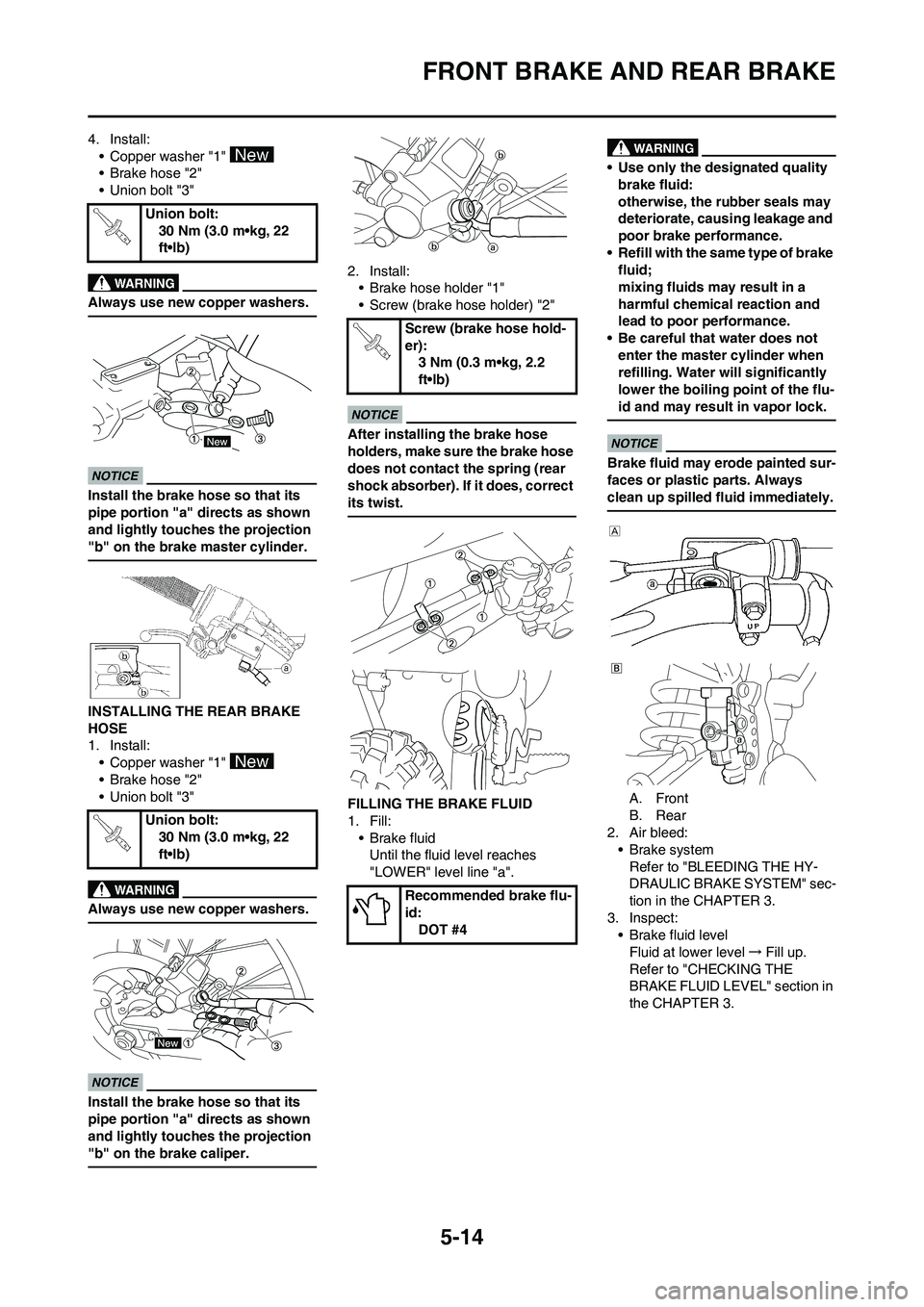
5-14
FRONT BRAKE AND REAR BRAKE
4. Install:
• Copper washer "1"
• Brake hose "2"
• Union bolt "3"
Always use new copper washers.
Install the brake hose so that its
pipe portion "a" directs as shown
and lightly touches the projection
"b" on the brake master cylinder.
INSTALLING THE REAR BRAKE
HOSE
1. Install:
• Copper washer "1"
• Brake hose "2"
• Union bolt "3"
Always use new copper washers.
Install the brake hose so that its
pipe portion "a" directs as shown
and lightly touches the projection
"b" on the brake caliper.
2. Install:
• Brake hose holder "1"
• Screw (brake hose holder) "2"
After installing the brake hose
holders, make sure the brake hose
does not contact the spring (rear
shock absorber). If it does, correct
its twist.
FILLING THE BRAKE FLUID
1. Fill:
•Brake fluid
Until the fluid level reaches
"LOWER" level line "a".
• Use only the designated quality
brake fluid:
otherwise, the rubber seals may
deteriorate, causing leakage and
poor brake performance.
• Refill with the same type of brake
fluid;
mixing fluids may result in a
harmful chemical reaction and
lead to poor performance.
• Be careful that water does not
enter the master cylinder when
refilling. Water will significantly
lower the boiling point of the flu-
id and may result in vapor lock.
Brake fluid may erode painted sur-
faces or plastic parts. Always
clean up spilled fluid immediately.
A. Front
B. Rear
2. Air bleed:
• Brake system
Refer to "BLEEDING THE HY-
DRAULIC BRAKE SYSTEM" sec-
tion in the CHAPTER 3.
3. Inspect:
• Brake fluid level
Fluid at lower level→Fill up.
Refer to "CHECKING THE
BRAKE FLUID LEVEL" section in
the CHAPTER 3. Union bolt:
30 Nm (3.0 m•kg, 22
ft•lb)
Union bolt:
30 Nm (3.0 m•kg, 22
ft•lb)
Screw (brake hose hold-
er):
3 Nm (0.3 m•kg, 2.2
ft•lb)
Recommended brake flu-
id:
DOT #4
Page 124 of 166
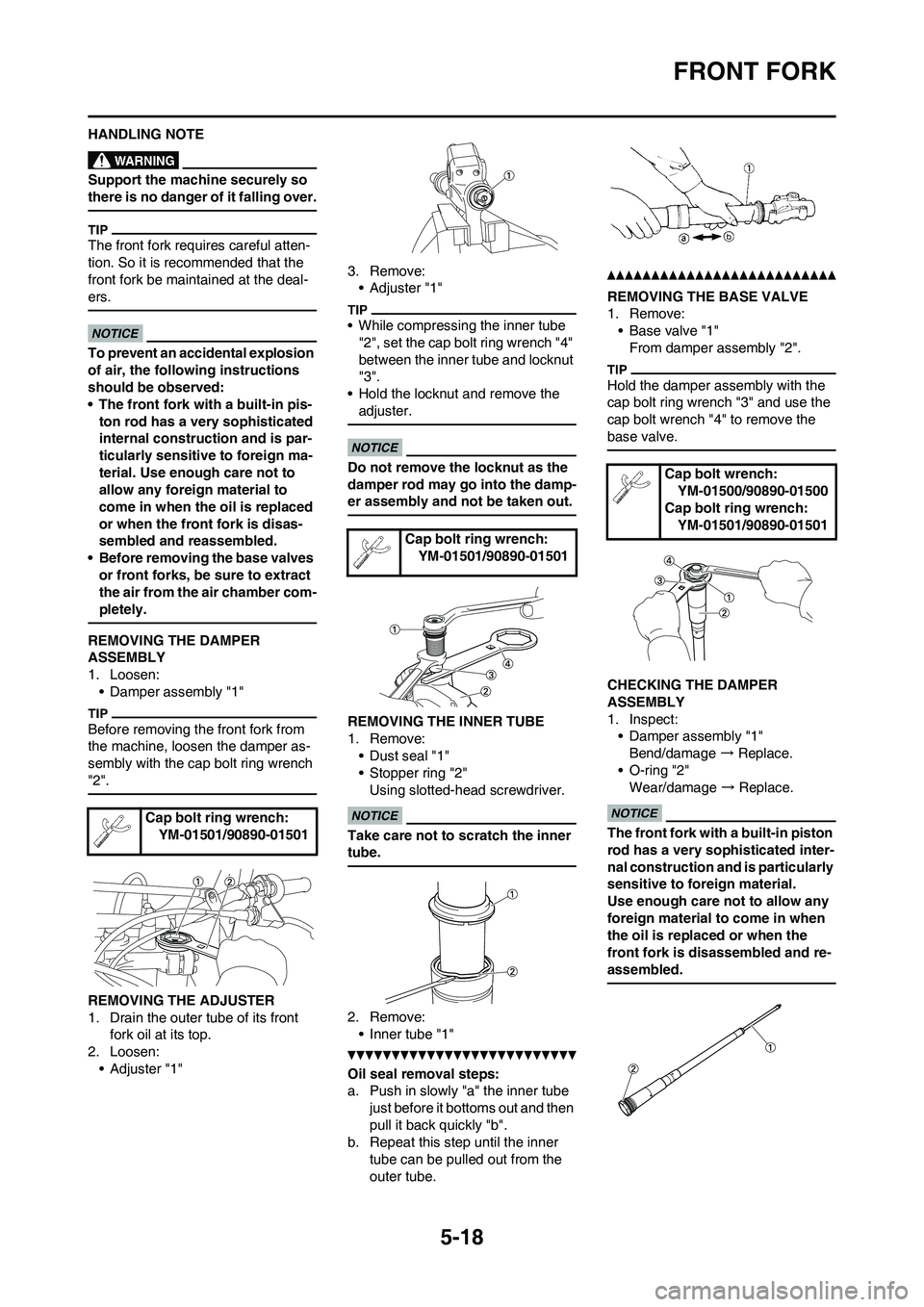
5-18
FRONT FORK
HANDLING NOTE
Support the machine securely so
there is no danger of it falling over.
The front fork requires careful atten-
tion. So it is recommended that the
front fork be maintained at the deal-
ers.
To prevent an accidental explosion
of air, the following instructions
should be observed:
• The front fork with a built-in pis-
ton rod has a very sophisticated
internal construction and is par-
ticularly sensitive to foreign ma-
terial. Use enough care not to
allow any foreign material to
come in when the oil is replaced
or when the front fork is disas-
sembled and reassembled.
• Before removing the base valves
or front forks, be sure to extract
the air from the air chamber com-
pletely.
REMOVING THE DAMPER
ASSEMBLY
1. Loosen:
• Damper assembly "1"
Before removing the front fork from
the machine, loosen the damper as-
sembly with the cap bolt ring wrench
"2".
REMOVING THE ADJUSTER
1. Drain the outer tube of its front
fork oil at its top.
2. Loosen:
•Adjuster "1"3. Remove:
•Adjuster "1"
• While compressing the inner tube
"2", set the cap bolt ring wrench "4"
between the inner tube and locknut
"3".
• Hold the locknut and remove the
adjuster.
Do not remove the locknut as the
damper rod may go into the damp-
er assembly and not be taken out.
REMOVING THE INNER TUBE
1. Remove:
• Dust seal "1"
• Stopper ring "2"
Using slotted-head screwdriver.
Take care not to scratch the inner
tube.
2. Remove:
• Inner tube "1"
Oil seal removal steps:
a. Push in slowly "a" the inner tube
just before it bottoms out and then
pull it back quickly "b".
b. Repeat this step until the inner
tube can be pulled out from the
outer tube.
REMOVING THE BASE VALVE
1. Remove:
• Base valve "1"
From damper assembly "2".
Hold the damper assembly with the
cap bolt ring wrench "3" and use the
cap bolt wrench "4" to remove the
base valve.
CHECKING THE DAMPER
ASSEMBLY
1. Inspect:
• Damper assembly "1"
Bend/damage → Replace.
• O-ring "2"
Wear/damage → Replace.
The front fork with a built-in piston
rod has a very sophisticated inter-
nal construction and is particularly
sensitive to foreign material.
Use enough care not to allow any
foreign material to come in when
the oil is replaced or when the
front fork is disassembled and re-
assembled.Cap bolt ring wrench:
YM-01501/90890-01501
Cap bolt ring wrench:
YM-01501/90890-01501
Cap bolt wrench:
YM-01500/90890-01500
Cap bolt ring wrench:
YM-01501/90890-01501
Page 125 of 166
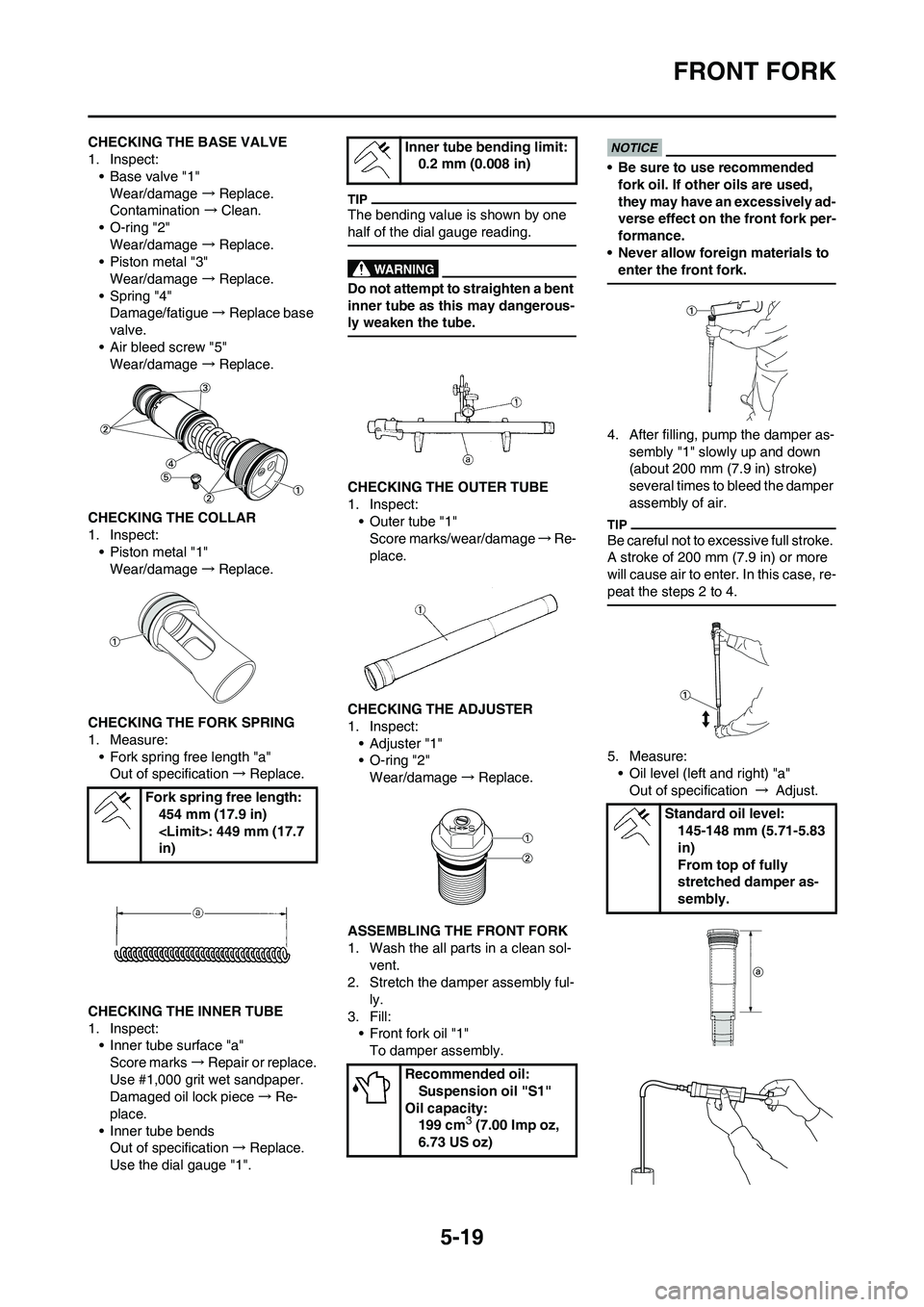
5-19
FRONT FORK
CHECKING THE BASE VALVE
1. Inspect:
• Base valve "1"
Wear/damage →Replace.
Contamination →Clean.
• O-ring "2"
Wear/damage →Replace.
• Piston metal "3"
Wear/damage →Replace.
• Spring "4"
Damage/fatigue →Replace base
valve.
• Air bleed screw "5"
Wear/damage →Replace.
CHECKING THE COLLAR
1. Inspect:
• Piston metal "1"
Wear/damage→Replace.
CHECKING THE FORK SPRING
1. Measure:
• Fork spring free length "a"
Out of specification→Replace.
CHECKING THE INNER TUBE
1. Inspect:
• Inner tube surface "a"
Score marks→Repair or replace.
Use #1,000 grit wet sandpaper.
Damaged oil lock piece→Re-
place.
• Inner tube bends
Out of specification→Replace.
Use the dial gauge "1".
The bending value is shown by one
half of the dial gauge reading.
Do not attempt to straighten a bent
inner tube as this may dangerous-
ly weaken the tube.
CHECKING THE OUTER TUBE
1. Inspect:
• Outer tube "1"
Score marks/wear/damage→Re-
place.
CHECKING THE ADJUSTER
1. Inspect:
•Adjuster "1"
• O-ring "2"
Wear/damage→Replace.
ASSEMBLING THE FRONT FORK
1. Wash the all parts in a clean sol-
vent.
2. Stretch the damper assembly ful-
ly.
3. Fill:
• Front fork oil "1"
To damper assembly.
• Be sure to use recommended
fork oil. If other oils are used,
they may have an excessively ad-
verse effect on the front fork per-
formance.
• Never allow foreign materials to
enter the front fork.
4. After filling, pump the damper as-
sembly "1" slowly up and down
(about 200 mm (7.9 in) stroke)
several times to bleed the damper
assembly of air.
Be careful not to excessive full stroke.
A stroke of 200 mm (7.9 in) or more
will cause air to enter. In this case, re-
peat the steps 2 to 4.
5. Measure:
• Oil level (left and right) "a"
Out of specification → Adjust.
Fork spring free length:
454 mm (17.9 in)
in)
Inner tube bending limit:
0.2 mm (0.008 in)
Recommended oil:
Suspension oil "S1"
Oil capacity:
199 cm
3 (7.00 Imp oz,
6.73 US oz)
Standard oil level:
145-148 mm (5.71-5.83
in)
From top of fully
stretched damper as-
sembly.
Page 132 of 166
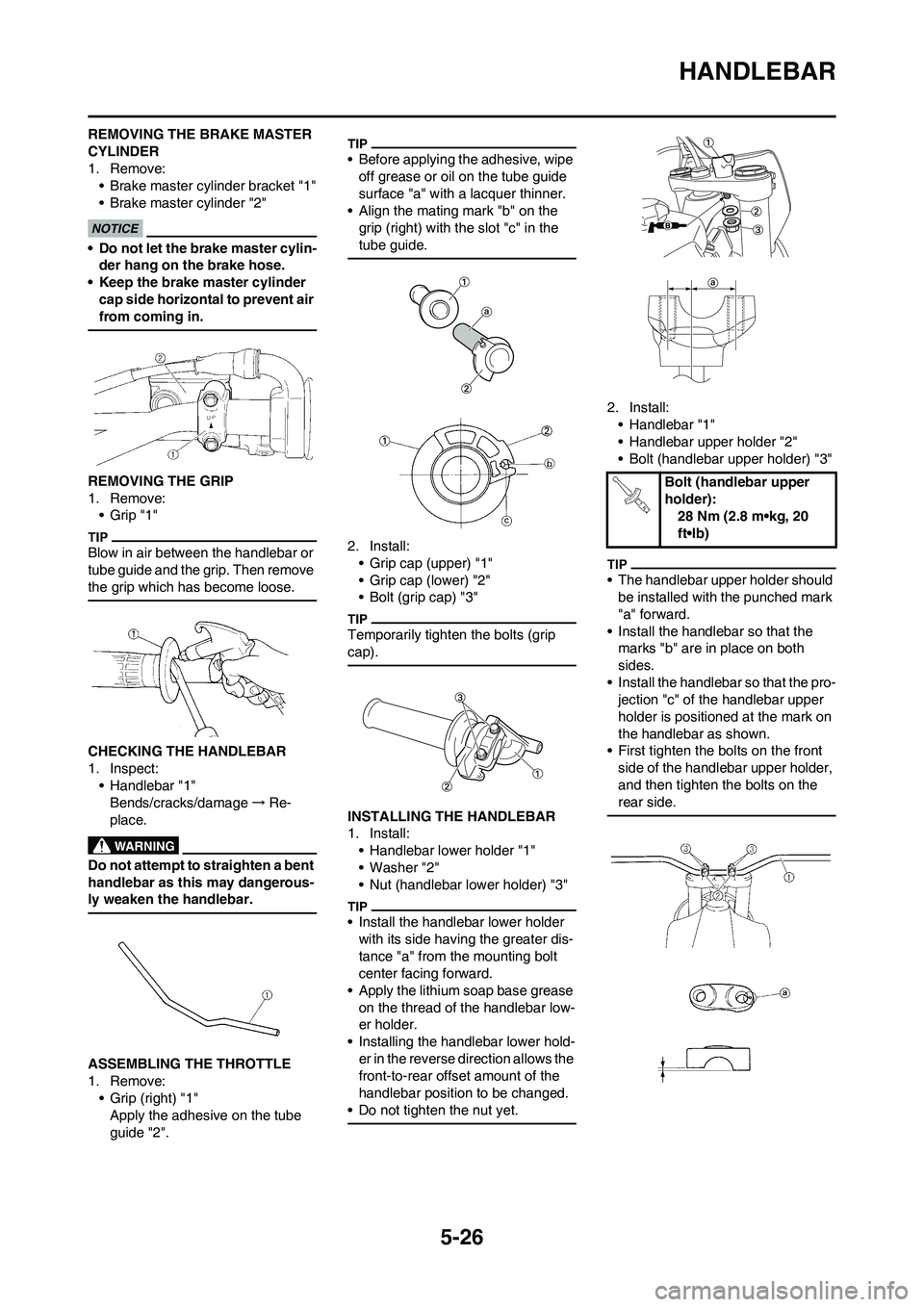
5-26
HANDLEBAR
REMOVING THE BRAKE MASTER
CYLINDER
1. Remove:
• Brake master cylinder bracket "1"
• Brake master cylinder "2"
• Do not let the brake master cylin-
der hang on the brake hose.
• Keep the brake master cylinder
cap side horizontal to prevent air
from coming in.
REMOVING THE GRIP
1. Remove:
•Grip "1"
Blow in air between the handlebar or
tube guide and the grip. Then remove
the grip which has become loose.
CHECKING THE HANDLEBAR
1. Inspect:
• Handlebar "1"
Bends/cracks/damage→Re-
place.
Do not attempt to straighten a bent
handlebar as this may dangerous-
ly weaken the handlebar.
ASSEMBLING THE THROTTLE
1. Remove:
• Grip (right) "1"
Apply the adhesive on the tube
guide "2".
• Before applying the adhesive, wipe
off grease or oil on the tube guide
surface "a" with a lacquer thinner.
• Align the mating mark "b" on the
grip (right) with the slot "c" in the
tube guide.
2. Install:
• Grip cap (upper) "1"
• Grip cap (lower) "2"
• Bolt (grip cap) "3"
Temporarily tighten the bolts (grip
cap).
INSTALLING THE HANDLEBAR
1. Install:
• Handlebar lower holder "1"
• Washer "2"
• Nut (handlebar lower holder) "3"
• Install the handlebar lower holder
with its side having the greater dis-
tance "a" from the mounting bolt
center facing forward.
• Apply the lithium soap base grease
on the thread of the handlebar low-
er holder.
• Installing the handlebar lower hold-
er in the reverse direction allows the
front-to-rear offset amount of the
handlebar position to be changed.
• Do not tighten the nut yet.
2. Install:
• Handlebar "1"
• Handlebar upper holder "2"
• Bolt (handlebar upper holder) "3"
• The handlebar upper holder should
be installed with the punched mark
"a" forward.
• Install the handlebar so that the
marks "b" are in place on both
sides.
• Install the handlebar so that the pro-
jection "c" of the handlebar upper
holder is positioned at the mark on
the handlebar as shown.
• First tighten the bolts on the front
side of the handlebar upper holder,
and then tighten the bolts on the
rear side.
Bolt (handlebar upper
holder):
28 Nm (2.8 m•kg, 20
ft•lb)
Page 141 of 166
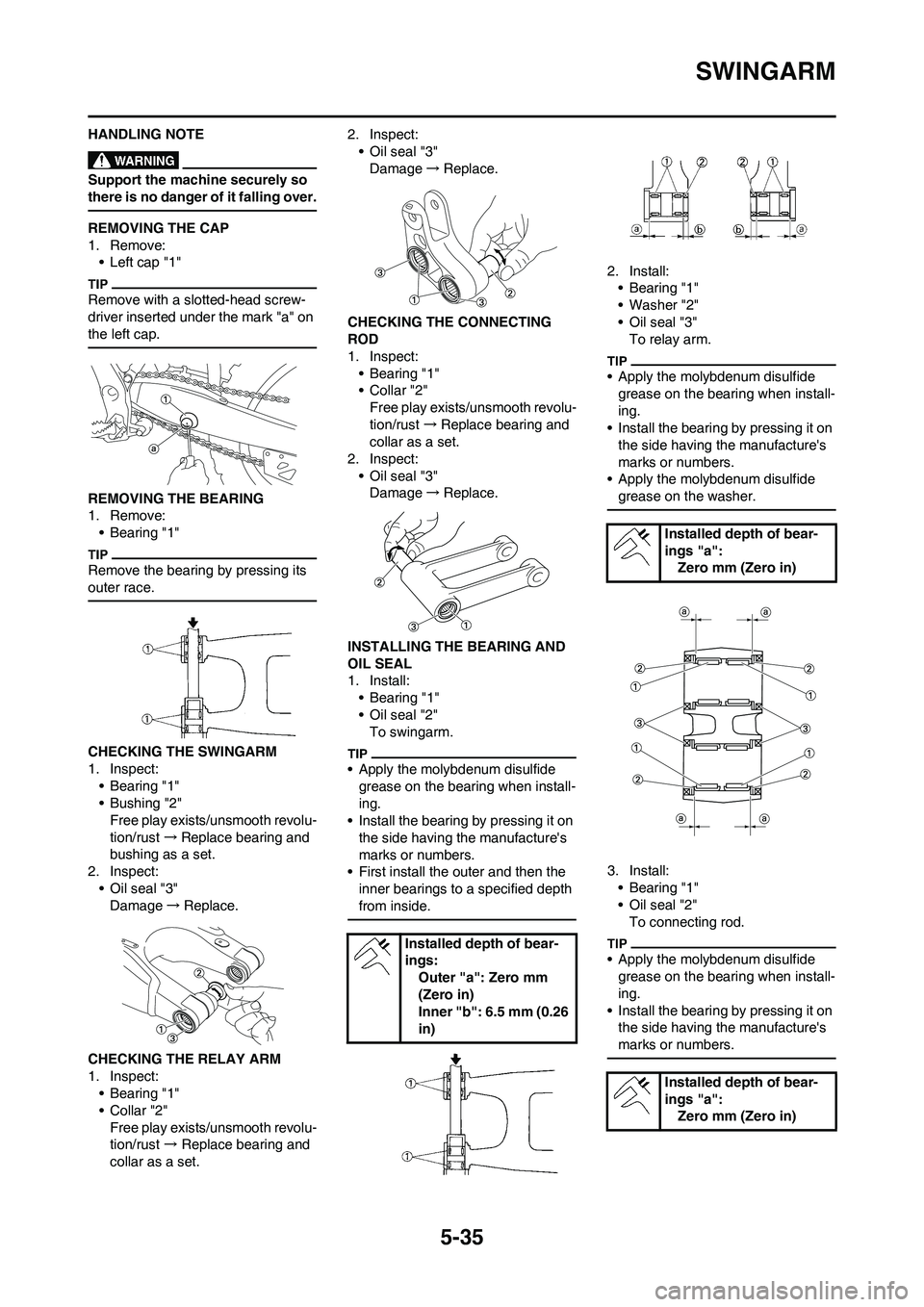
5-35
SWINGARM
HANDLING NOTE
Support the machine securely so
there is no danger of it falling over.
REMOVING THE CAP
1. Remove:
• Left cap "1"
Remove with a slotted-head screw-
driver inserted under the mark "a" on
the left cap.
REMOVING THE BEARING
1. Remove:
• Bearing "1"
Remove the bearing by pressing its
outer race.
CHECKING THE SWINGARM
1. Inspect:
• Bearing "1"
• Bushing "2"
Free play exists/unsmooth revolu-
tion/rust →Replace bearing and
bushing as a set.
2. Inspect:
• Oil seal "3"
Damage→Replace.
CHECKING THE RELAY ARM
1. Inspect:
• Bearing "1"
•Collar "2"
Free play exists/unsmooth revolu-
tion/rust → Replace bearing and
collar as a set.2. Inspect:
• Oil seal "3"
Damage→Replace.
CHECKING THE CONNECTING
ROD
1. Inspect:
•Bearing "1"
• Collar "2"
Free play exists/unsmooth revolu-
tion/rust →Replace bearing and
collar as a set.
2. Inspect:
• Oil seal "3"
Damage→Replace.
INSTALLING THE BEARING AND
OIL SEAL
1. Install:
•Bearing "1"
• Oil seal "2"
To swingarm.
• Apply the molybdenum disulfide
grease on the bearing when install-
ing.
• Install the bearing by pressing it on
the side having the manufacture's
marks or numbers.
• First install the outer and then the
inner bearings to a specified depth
from inside.
2. Install:
• Bearing "1"
• Washer "2"
• Oil seal "3"
To relay arm.
• Apply the molybdenum disulfide
grease on the bearing when install-
ing.
• Install the bearing by pressing it on
the side having the manufacture's
marks or numbers.
• Apply the molybdenum disulfide
grease on the washer.
3. Install:
• Bearing "1"
• Oil seal "2"
To connecting rod.
• Apply the molybdenum disulfide
grease on the bearing when install-
ing.
• Install the bearing by pressing it on
the side having the manufacture's
marks or numbers.
Installed depth of bear-
ings:
Outer "a": Zero mm
(Zero in)
Inner "b": 6.5 mm (0.26
in)
Installed depth of bear-
ings "a":
Zero mm (Zero in)
Installed depth of bear-
ings "a":
Zero mm (Zero in)