oil level YAMAHA YZ125LC 2010 User Guide
[x] Cancel search | Manufacturer: YAMAHA, Model Year: 2010, Model line: YZ125LC, Model: YAMAHA YZ125LC 2010Pages: 166, PDF Size: 8.09 MB
Page 125 of 166
5-19
FRONT FORK
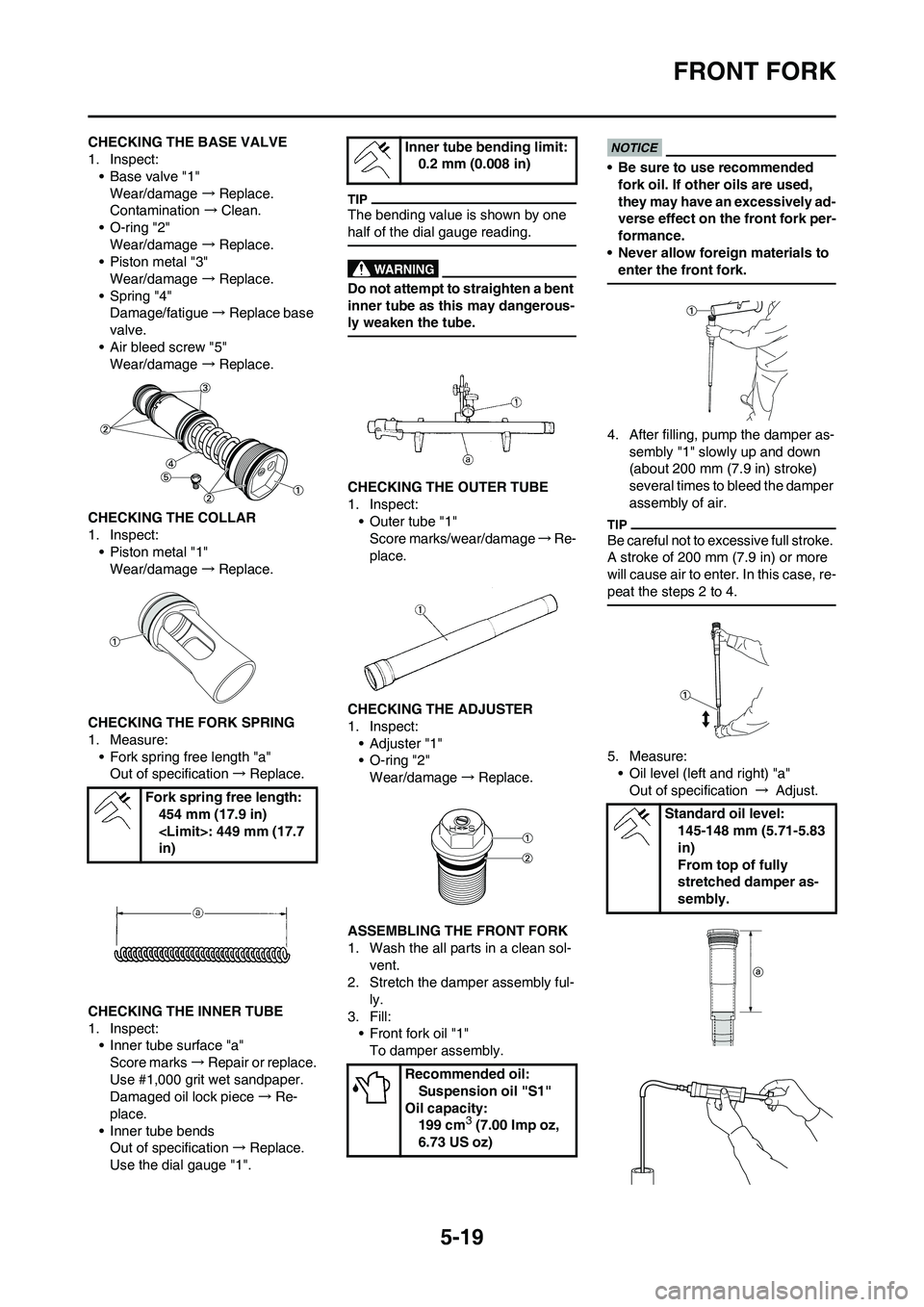
CHECKING THE BASE VALVE
1. Inspect:
• Base valve "1"
Wear/damage →Replace.
Contamination →Clean.
• O-ring "2"
Wear/damage →Replace.
• Piston metal "3"
Wear/damage →Replace.
• Spring "4"
Damage/fatigue →Replace base
valve.
• Air bleed screw "5"
Wear/damage →Replace.
CHECKING THE COLLAR
1. Inspect:
• Piston metal "1"
Wear/damage→Replace.
CHECKING THE FORK SPRING
1. Measure:
• Fork spring free length "a"
Out of specification→Replace.
CHECKING THE INNER TUBE
1. Inspect:
• Inner tube surface "a"
Score marks→Repair or replace.
Use #1,000 grit wet sandpaper.
Damaged oil lock piece→Re-
place.
• Inner tube bends
Out of specification→Replace.
Use the dial gauge "1".
The bending value is shown by one
half of the dial gauge reading.
Do not attempt to straighten a bent
inner tube as this may dangerous-
ly weaken the tube.
CHECKING THE OUTER TUBE
1. Inspect:
• Outer tube "1"
Score marks/wear/damage→Re-
place.
CHECKING THE ADJUSTER
1. Inspect:
•Adjuster "1"
• O-ring "2"
Wear/damage→Replace.
ASSEMBLING THE FRONT FORK
1. Wash the all parts in a clean sol-
vent.
2. Stretch the damper assembly ful-
ly.
3. Fill:
• Front fork oil "1"
To damper assembly.
• Be sure to use recommended
fork oil. If other oils are used,
they may have an excessively ad-
verse effect on the front fork per-
formance.
• Never allow foreign materials to
enter the front fork.
4. After filling, pump the damper as-
sembly "1" slowly up and down
(about 200 mm (7.9 in) stroke)
several times to bleed the damper
assembly of air.
Be careful not to excessive full stroke.
A stroke of 200 mm (7.9 in) or more
will cause air to enter. In this case, re-
peat the steps 2 to 4.
5. Measure:
• Oil level (left and right) "a"
Out of specification → Adjust.
Fork spring free length:
454 mm (17.9 in)
in)
Inner tube bending limit:
0.2 mm (0.008 in)
Recommended oil:
Suspension oil "S1"
Oil capacity:
199 cm
3 (7.00 Imp oz,
6.73 US oz)
Standard oil level:
145-148 mm (5.71-5.83
in)
From top of fully
stretched damper as-
sembly.
Page 159 of 166
7-6
CHASSIS
CHANGE OF THE HEAT RANGE
OF SPARK PLUGS
Judging from the discoloration of
spark plugs, if they are found improp-
er, it can be corrected by the following
two methods; changing carburetor
settings and changing the heat range
of spark plug.
• In principle, it is advisable to first
use spark plugs of standard heat
range, and judging from the discol-
oration of spark plugs, adjust carbu-
retor settings.
• If the calibration No. of the main jet
must be changed by ±30, it is advis-
able to change the heat range of
spark plugs and newly select the
proper main jet.
• When checking the discoloration of
spark plugs, be sure to stop the en-
gine immediately after a run and
check.
• Avoid racing.
• When changing the heat range of
spark plugs, never attempt to
change it more than ±1 rank.
• When using a spark plug other than
standard, check its heat range
against the standard and check that
it is a resistance type.
• Note that even if the discoloration
seems proper, it may slightly vary
with the spark plug maker and oil in
use.
CHASSIS
SELECTION OF THE SECONDARY
REDUCTION RATIO (SPROCKET)
• It is generally said that the second-
ary gear ratio should be reduced for
a longer straight portion of a speed
course and should be increased for
a course with many corners. Actual-
ly, however, as the speed depends
on the ground condition of the day
of the race, be sure to run through
the circuit to set the machine suit-
able for the entire course.
• In actuality, it is very difficult to
achieve settings suitable for the en-
tire course and some settings may
be sacrificed. Thus, the settings
should be matched to the portion of
the course that has the greatest ef-
fect on the race result. In such a
case, run through the entire course
while making notes of lap times to
find the best balance; then, deter-
mine the secondary reduction ratio.
• If a course has a long straight por-
tion where a machine can run at
maximum speed, the machine is
generally set such that it can devel-
op its maximum revolutions toward
the end of the straight line, with care
taken to avoid the engine over-rev-
ving.
Riding technique varies from rider to
rider and the performance of a ma-
chine also vary from machine to ma-
chine. Therefore, do not imitate other
rider's settings from the beginning but
choose your own setting according to
the level of your riding technique.
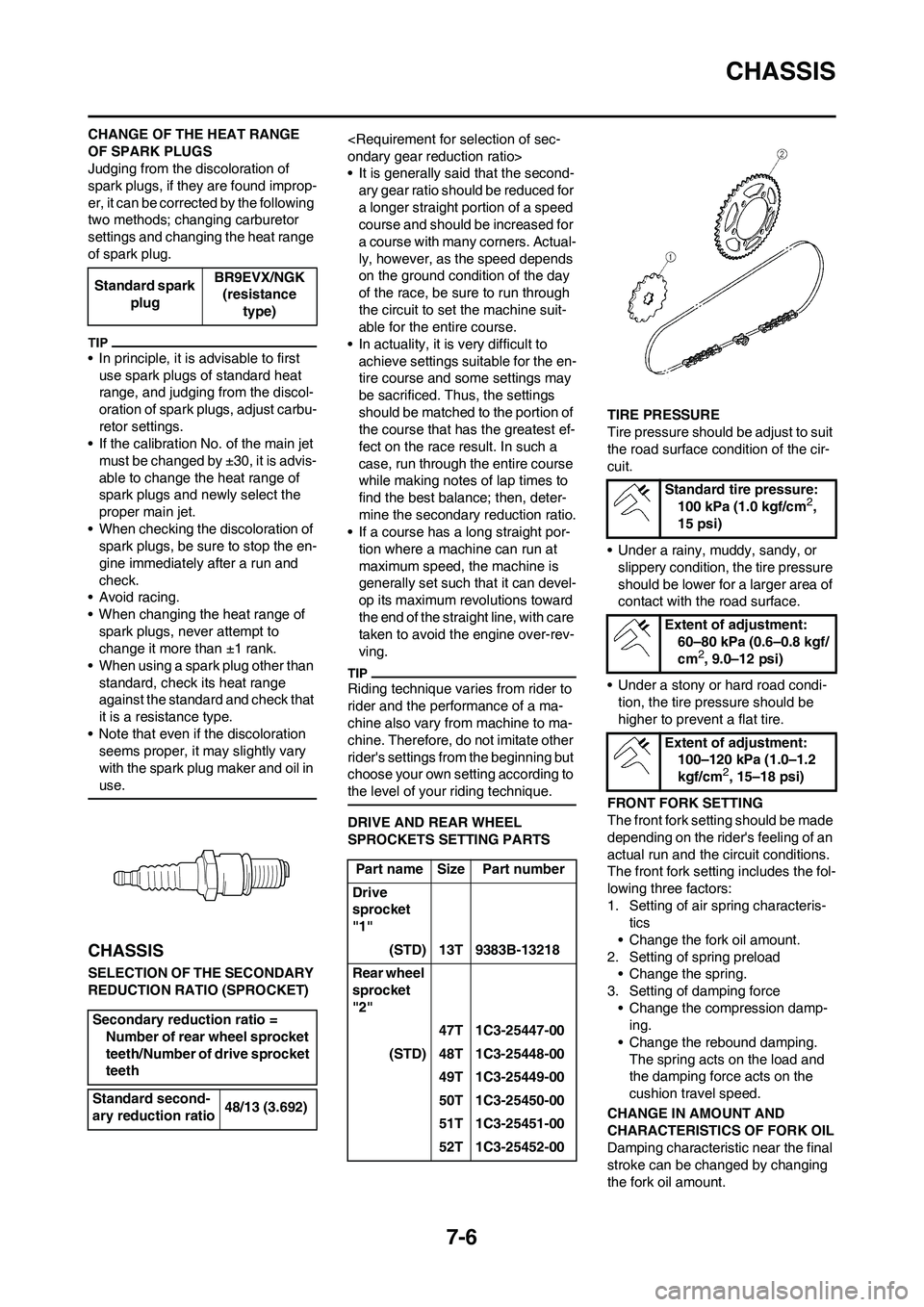
DRIVE AND REAR WHEEL
SPROCKETS SETTING PARTSTIRE PRESSURE
Tire pressure should be adjust to suit
the road surface condition of the cir-
cuit.
• Under a rainy, muddy, sandy, or
slippery condition, the tire pressure
should be lower for a larger area of
contact with the road surface.
• Under a stony or hard road condi-
tion, the tire pressure should be
higher to prevent a flat tire.
FRONT FORK SETTING
The front fork setting should be made
depending on the rider's feeling of an
actual run and the circuit conditions.
The front fork setting includes the fol-
lowing three factors:
1. Setting of air spring characteris-
tics
• Change the fork oil amount.
2. Setting of spring preload
• Change the spring.
3. Setting of damping force
• Change the compression damp-
ing.
• Change the rebound damping.
The spring acts on the load and
the damping force acts on the
cushion travel speed.
CHANGE IN AMOUNT AND
CHARACTERISTICS OF FORK OIL
Damping characteristic near the final
stroke can be changed by changing
the fork oil amount. Standard spark
plugBR9EVX/NGK
(resistance
type)
Secondary reduction ratio =
Number of rear wheel sprocket
teeth/Number of drive sprocket
teeth
Standard second-
ary reduction ratio48/13 (3.692)
Part name Size Part number
Drive
sprocket
"1"
(STD) 13T 9383B-13218
Rear wheel
sprocket
"2"
47T 1C3-25447-00
(STD) 48T 1C3-25448-00
49T 1C3-25449-00
50T 1C3-25450-00
51T 1C3-25451-00
52T 1C3-25452-00
Standard tire pressure:
100 kPa (1.0 kgf/cm2,
15 psi)
Extent of adjustment:
60–80 kPa (0.6–0.8 kgf/
cm
2, 9.0–12 psi)
Extent of adjustment:
100–120 kPa (1.0–1.2
kgf/cm
2, 15–18 psi)