valve YAMAHA YZ250F 2005 Owner's Manual
[x] Cancel search | Manufacturer: YAMAHA, Model Year: 2005, Model line: YZ250F, Model: YAMAHA YZ250F 2005Pages: 668, PDF Size: 15.74 MB
Page 242 of 668
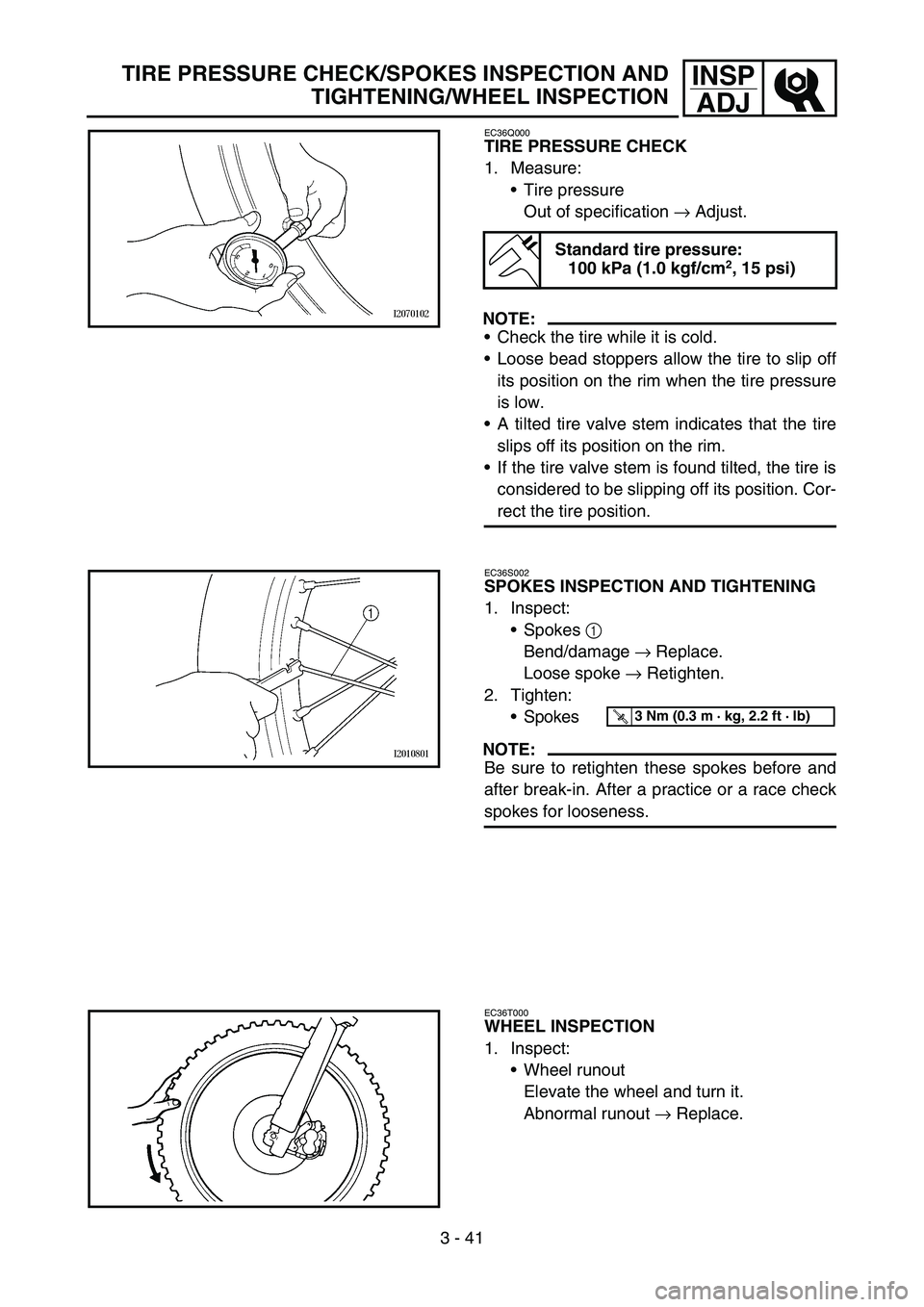
3 - 41
INSP
ADJTIRE PRESSURE CHECK/SPOKES INSPECTION AND
TIGHTENING/WHEEL INSPECTION
EC36Q000
TIRE PRESSURE CHECK
1. Measure:
Tire pressure
Out of specification → Adjust.
NOTE:
Check the tire while it is cold.
Loose bead stoppers allow the tire to slip off
its position on the rim when the tire pressure
is low.
A tilted tire valve stem indicates that the tire
slips off its position on the rim.
If the tire valve stem is found tilted, the tire is
considered to be slipping off its position. Cor-
rect the tire position.
Standard tire pressure:
100 kPa (1.0 kgf/cm2, 15 psi)
EC36S002
SPOKES INSPECTION AND TIGHTENING
1. Inspect:
Spokes 1
Bend/damage → Replace.
Loose spoke → Retighten.
2. Tighten:
Spokes
NOTE:
Be sure to retighten these spokes before and
after break-in. After a practice or a race check
spokes for looseness.
T R..3 Nm (0.3 m · kg, 2.2 ft · lb)
EC36T000
WHEEL INSPECTION
1. Inspect:
Wheel runout
Elevate the wheel and turn it.
Abnormal runout → Replace.
Page 243 of 668
INSP
ADJ
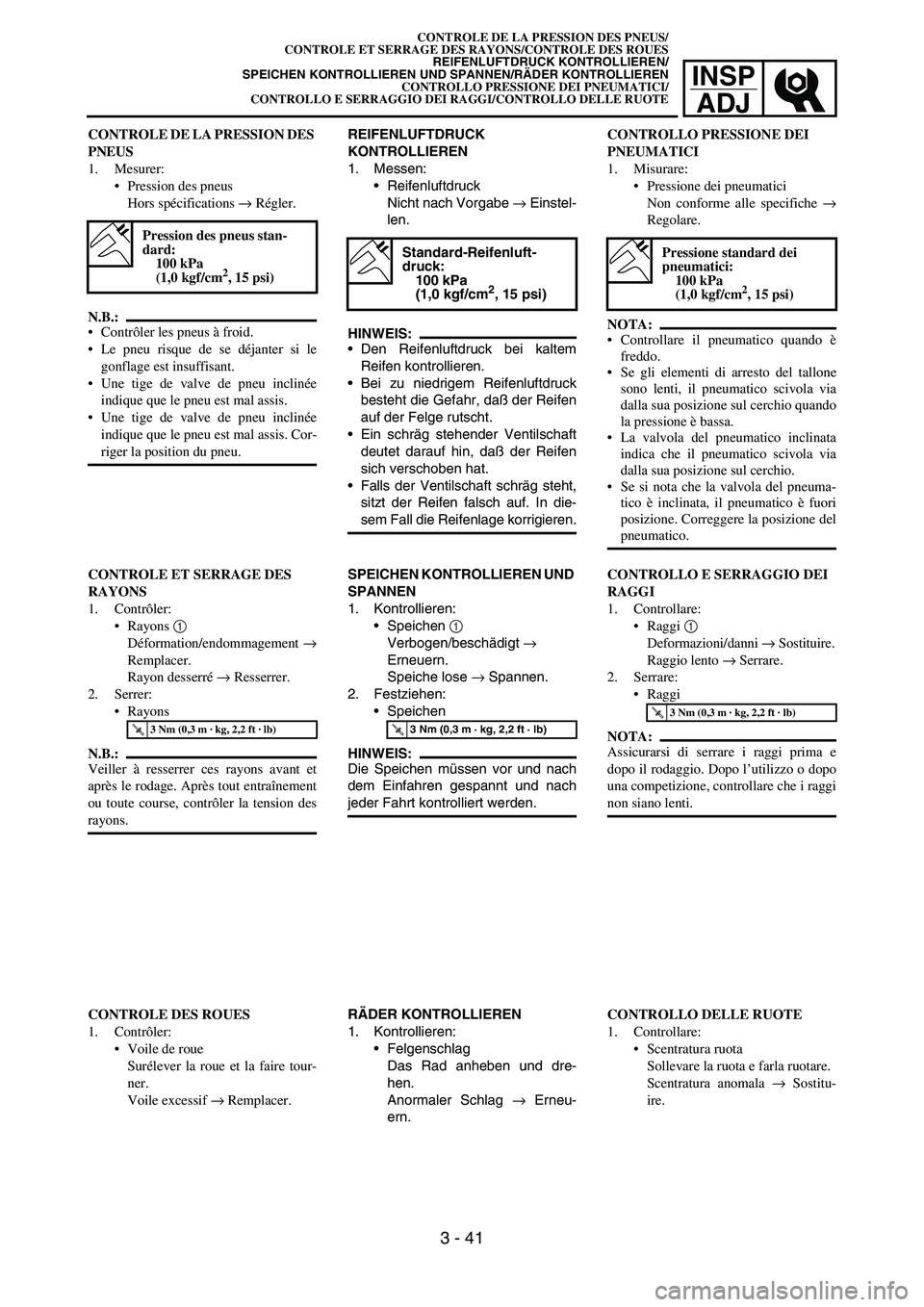
REIFENLUFTDRUCK
KONTROLLIEREN
1. Messen:
Reifenluftdruck
Nicht nach Vorgabe → Einstel-
len.
HINWEIS:
Den Reifenluftdruck bei kaltem
Reifen kontrollieren.
Bei zu niedrigem Reifenluftdruck
besteht die Gefahr, daß der Reifen
auf der Felge rutscht.
Ein schräg stehender Ventilschaft
deutet darauf hin, daß der Reifen
sich verschoben hat.
Falls der Ventilschaft schräg steht,
sitzt der Reifen falsch auf. In die-
sem Fall die Reifenlage korrigieren.
Standard-Reifenluft-
druck:
100 kPa
(1,0 kgf/cm
2, 15 psi)
SPEICHEN KONTROLLIEREN UND
SPANNEN
1. Kontrollieren:
Speichen 1
Verbogen/beschädigt →
Erneuern.
Speiche lose → Spannen.
2. Festziehen:
Speichen
HINWEIS:
Die Speichen müssen vor und nach
dem Einfahren gespannt und nach
jeder Fahrt kontrolliert werden.
T R..3 Nm (0,3 m · kg, 2,2 ft · lb)
RÄDER KONTROLLIEREN
1. Kontrollieren:
Felgenschlag
Das Rad anheben und dre-
hen.
Anormaler Schlag → Erneu-
ern. CONTROLE DE LA PRESSION DES
PNEUS
1. Mesurer:
Pression des pneus
Hors spécifications → Régler.
N.B.:
Contrôler les pneus à froid.
Le pneu risque de se déjanter si le
gonflage est insuffisant.
Une tige de valve de pneu inclinée
indique que le pneu est mal assis.
Une tige de valve de pneu inclinée
indique que le pneu est mal assis. Cor-
riger la position du pneu.
Pression des pneus stan-
dard:
100 kPa
(1,0 kgf/cm
2, 15 psi)
CONTROLE ET SERRAGE DES
RAYONS
1. Contrôler:
Rayons 1
Déformation/endommagement →
Remplacer.
Rayon desserré → Resserrer.
2. Serrer:
Rayons
N.B.:
Veiller à resserrer ces rayons avant et
après le rodage. Après tout entraînement
ou toute course, contrôler la tension des
rayons.
T R..3 Nm (0,3 m · kg, 2,2 ft · lb)
CONTROLE DES ROUES
1. Contrôler:
Voile de roue
Surélever la roue et la faire tour-
ner.
Voile excessif → Remplacer.CONTROLLO PRESSIONE DEI
PNEUMATICI
1. Misurare:
Pressione dei pneumatici
Non conforme alle specifiche →
Regolare.
NOTA:
Controllare il pneumatico quando è
freddo.
Se gli elementi di arresto del tallone
sono lenti, il pneumatico scivola via
dalla sua posizione sul cerchio quando
la pressione è bassa.
La valvola del pneumatico inclinata
indica che il pneumatico scivola via
dalla sua posizione sul cerchio.
Se si nota che la valvola del pneuma-
tico è inclinata, il pneumatico è fuori
posizione. Correggere la posizione del
pneumatico.
Pressione standard dei
pneumatici:
100 kPa
(1,0 kgf/cm
2, 15 psi)
CONTROLLO E SERRAGGIO DEI
RAGGI
1. Controllare:
Raggi 1
Deformazioni/danni → Sostituire.
Raggio lento → Serrare.
2. Serrare:
Raggi
NOTA:
Assicurarsi di serrare i raggi prima e
dopo il rodaggio. Dopo l’utilizzo o dopo
una competizione, controllare che i raggi
non siano lenti.
T R..3 Nm (0,3 m · kg, 2,2 ft · lb)
CONTROLLO DELLE RUOTE
1. Controllare:
Scentratura ruota
Sollevare la ruota e farla ruotare.
Scentratura anomala → Sostitu-
ire.
CONTROLE DE LA PRESSION DES PNEUS/
CONTROLE ET SERRAGE DES RAYONS/CONTROLE DES ROUES
REIFENLUFTDRUCK KONTROLLIEREN/
SPEICHEN KONTROLLIEREN UND SPANNEN/RÄDER KONTROLLIEREN
CONTROLLO PRESSIONE DEI PNEUMATICI/
CONTROLLO E SERRAGGIO DEI RAGGI/CONTROLLO DELLE RUOTE
3 - 41
Page 272 of 668
4 - 9
ENGCARBURETOR
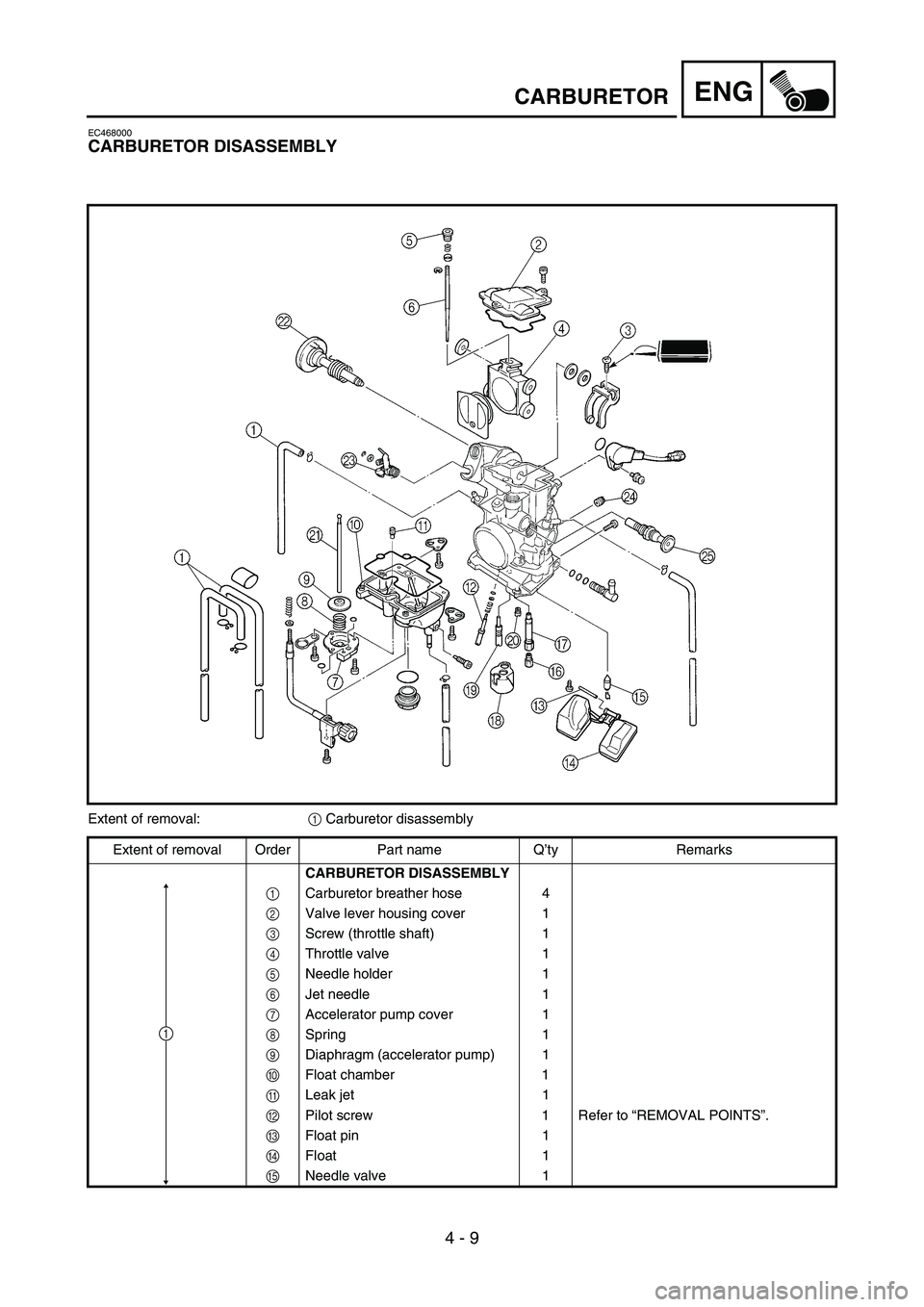
EC468000
CARBURETOR DISASSEMBLY
Extent of removal:
1 Carburetor disassembly
Extent of removal Order Part name Q’ty Remarks
CARBURETOR DISASSEMBLY
1Carburetor breather hose 4
2Valve lever housing cover 1
3Screw (throttle shaft) 1
4Throttle valve 1
5Needle holder 1
6Jet needle 1
7Accelerator pump cover 1
8Spring 1
9Diaphragm (accelerator pump) 1
0Float chamber 1
ALeak jet 1
BPilot screw 1 Refer to “REMOVAL POINTS”.
CFloat pin 1
DFloat 1
ENeedle valve 1
1
Page 278 of 668
4 - 12
ENGCARBURETOR
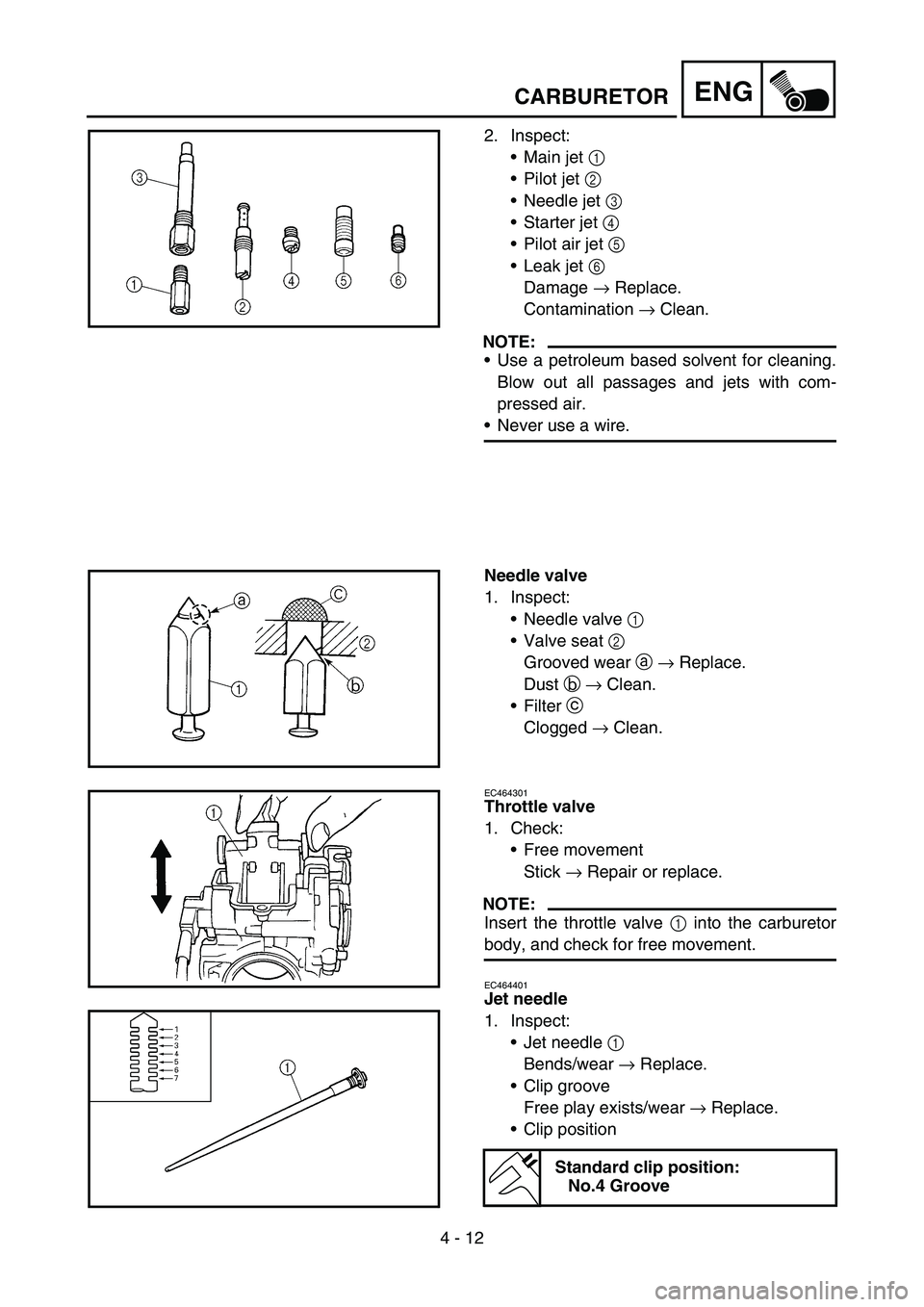
2. Inspect:
Main jet 1
Pilot jet 2
Needle jet 3
Starter jet 4
Pilot air jet 5
Leak jet 6
Damage → Replace.
Contamination → Clean.
NOTE:
Use a petroleum based solvent for cleaning.
Blow out all passages and jets with com-
pressed air.
Never use a wire.
Needle valve
1. Inspect:
Needle valve 1
Valve seat 2
Grooved wear a → Replace.
Dust b → Clean.
Filter c
Clogged → Clean.
EC464301
Throttle valve
1. Check:
Free movement
Stick → Repair or replace.
NOTE:
Insert the throttle valve 1 into the carburetor
body, and check for free movement.
EC464401
Jet needle
1. Inspect:
Jet needle 1
Bends/wear → Replace.
Clip groove
Free play exists/wear → Replace.
Clip position
Standard clip position:
No.4 Groove
Page 280 of 668
4 - 13
ENGCARBURETOR
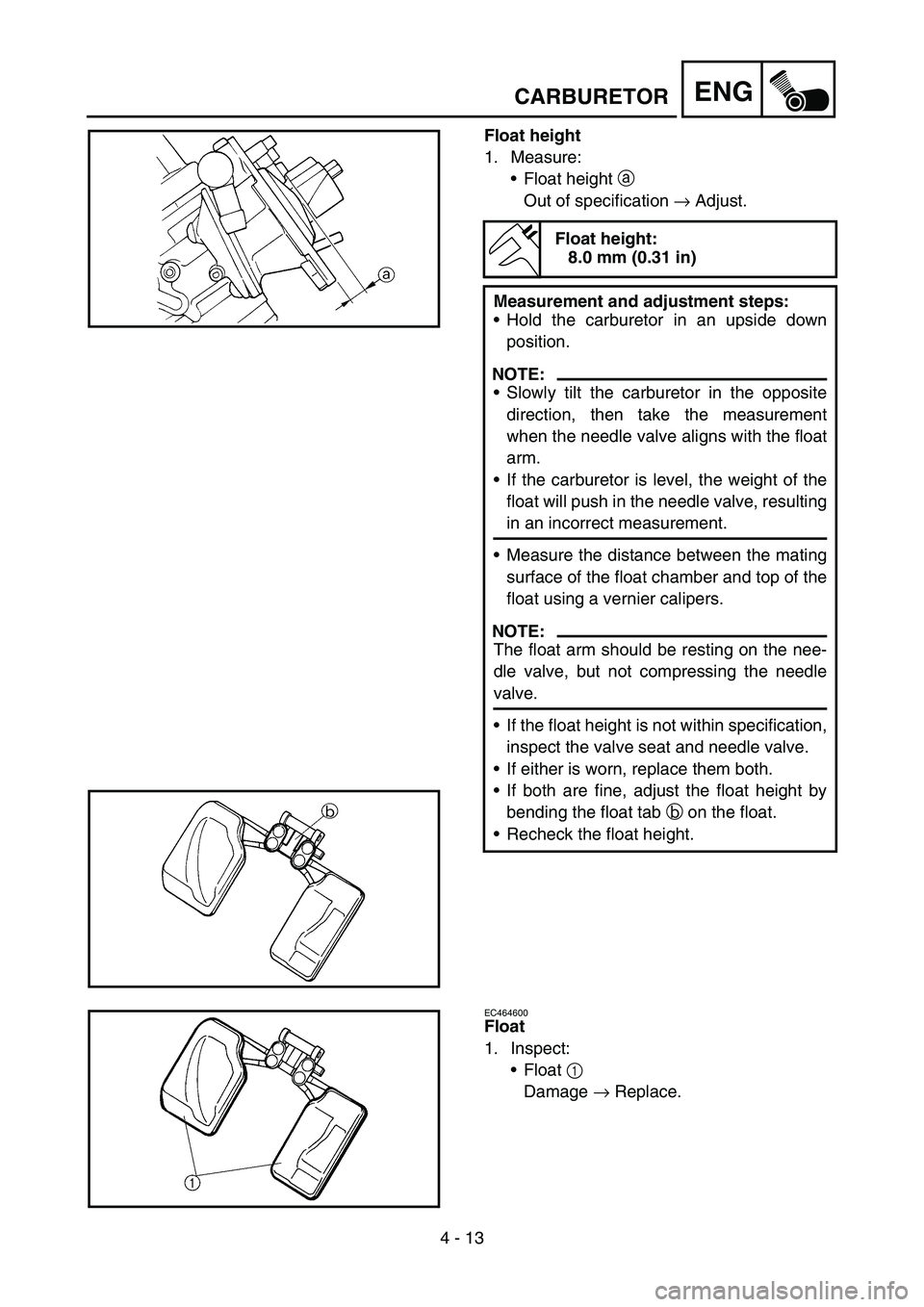
Float height
1. Measure:
Float height a
Out of specification → Adjust.
Float height:
8.0 mm (0.31 in)
Measurement and adjustment steps:
Hold the carburetor in an upside down
position.
NOTE:
Slowly tilt the carburetor in the opposite
direction, then take the measurement
when the needle valve aligns with the float
arm.
If the carburetor is level, the weight of the
float will push in the needle valve, resulting
in an incorrect measurement.
Measure the distance between the mating
surface of the float chamber and top of the
float using a vernier calipers.
NOTE:
The float arm should be resting on the nee-
dle valve, but not compressing the needle
valve.
If the float height is not within specification,
inspect the valve seat and needle valve.
If either is worn, replace them both.
If both are fine, adjust the float height by
bending the float tab b on the float.
Recheck the float height.
EC464600
Float
1. Inspect:
Float 1
Damage → Replace.
Page 286 of 668
4 - 16
ENGCARBURETOR
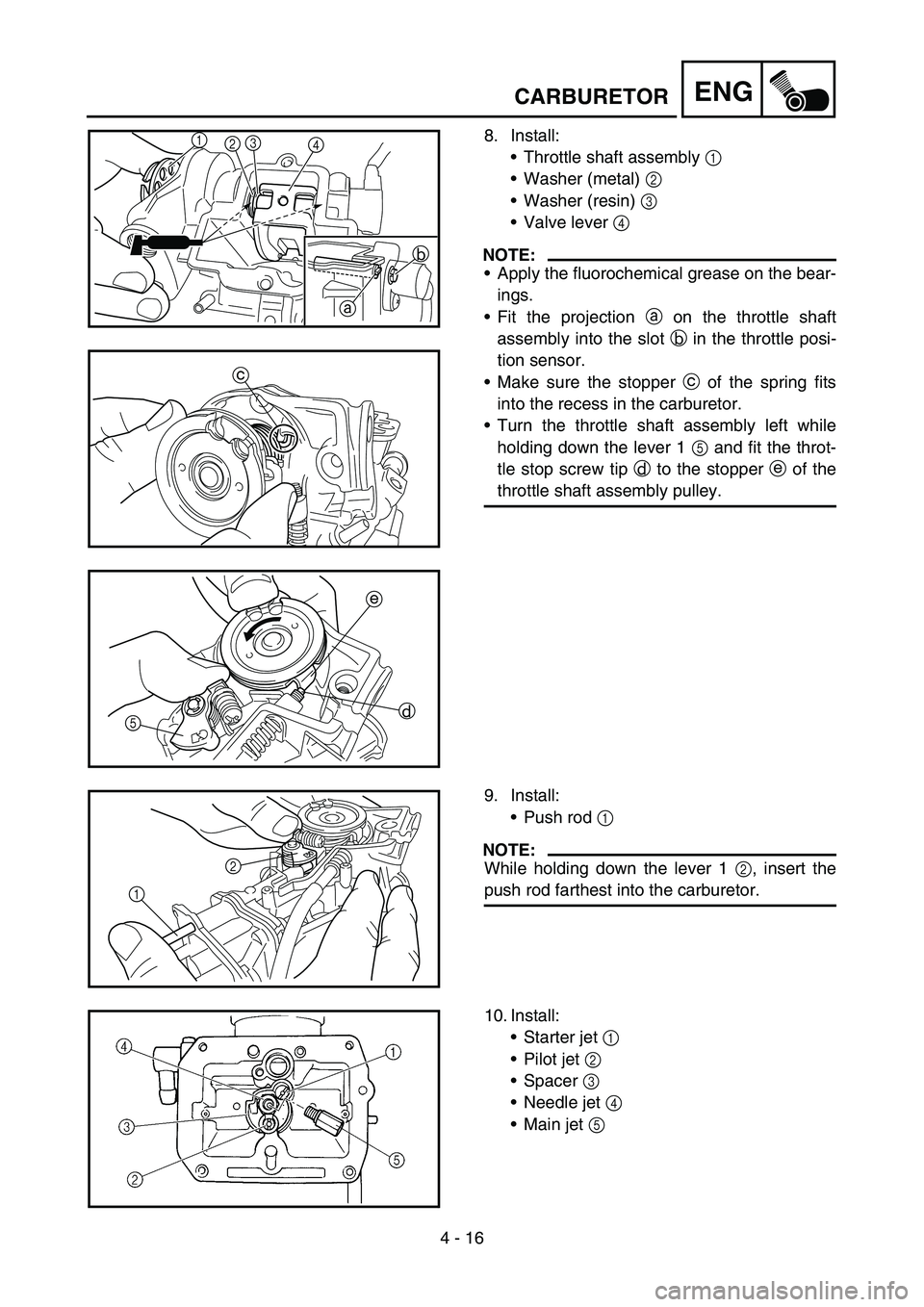
8. Install:
Throttle shaft assembly 1
Washer (metal) 2
Washer (resin) 3
Valve lever 4
NOTE:
Apply the fluorochemical grease on the bear-
ings.
Fit the projection a on the throttle shaft
assembly into the slot b in the throttle posi-
tion sensor.
Make sure the stopper c of the spring fits
into the recess in the carburetor.
Turn the throttle shaft assembly left while
holding down the lever 1 5 and fit the throt-
tle stop screw tip d to the stopper e of the
throttle shaft assembly pulley.
1
23
4
b
a
c
e
d
5
9. Install:
Push rod 1
NOTE:
While holding down the lever 1 2, insert the
push rod farthest into the carburetor.12
10. Install:
Starter jet 1
Pilot jet 2
Spacer 3
Needle jet 4
Main jet 5
Page 288 of 668
4 - 17
ENGCARBURETOR
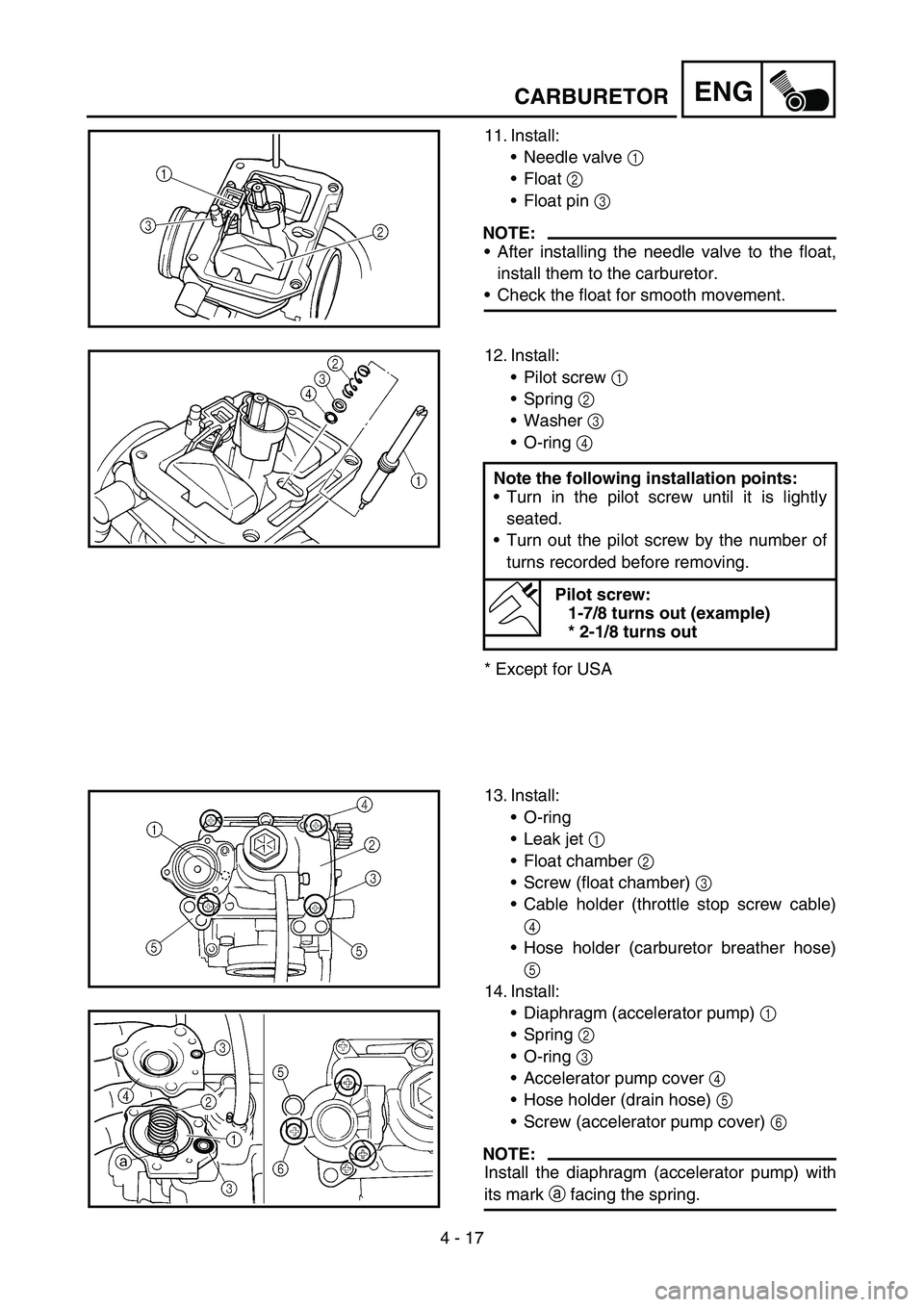
11. Install:
Needle valve 1
Float 2
Float pin 3
NOTE:
After installing the needle valve to the float,
install them to the carburetor.
Check the float for smooth movement.
12. Install:
Pilot screw 1
Spring 2
Washer 3
O-ring 4
* Except for USANote the following installation points:
Turn in the pilot screw until it is lightly
seated.
Turn out the pilot screw by the number of
turns recorded before removing.
Pilot screw:
1-7/8 turns out (example)
* 2-1/8 turns out
13. Install:
O-ring
Leak jet 1
Float chamber 2
Screw (float chamber) 3
Cable holder (throttle stop screw cable)
4
Hose holder (carburetor breather hose)
5
14. Install:
Diaphragm (accelerator pump) 1
Spring 2
O-ring 3
Accelerator pump cover 4
Hose holder (drain hose) 5
Screw (accelerator pump cover) 6
NOTE:
Install the diaphragm (accelerator pump) with
its mark a facing the spring.
Page 290 of 668
4 - 18
ENGCARBURETOR
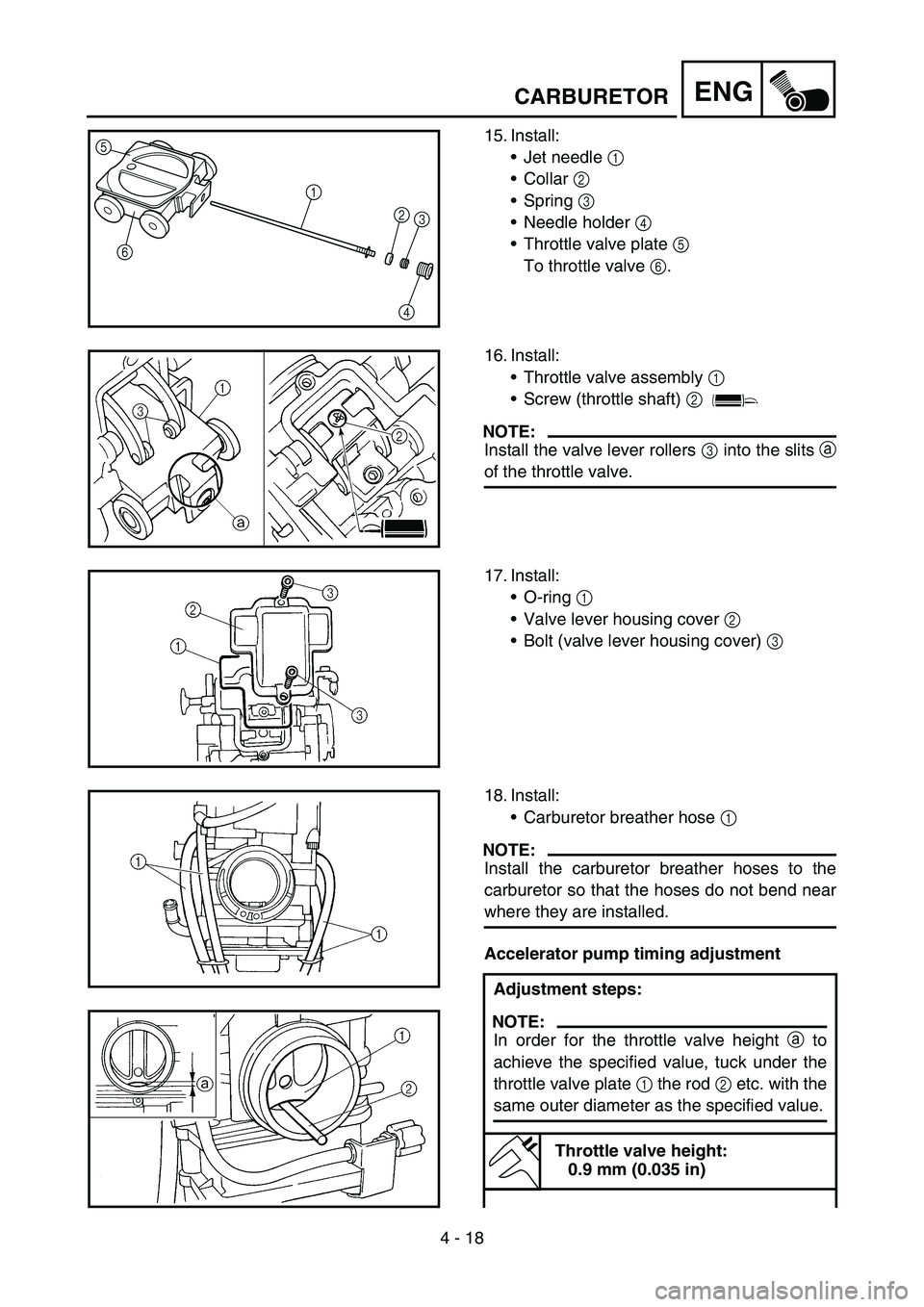
15. Install:
Jet needle 1
Collar 2
Spring 3
Needle holder 4
Throttle valve plate 5
To throttle valve 6.5
6
1
2
3
4
16. Install:
Throttle valve assembly 1
Screw (throttle shaft) 2
NOTE:
Install the valve lever rollers 3 into the slits a
of the throttle valve.
17. Install:
O-ring 1
Valve lever housing cover 2
Bolt (valve lever housing cover) 3
18. Install:
Carburetor breather hose 1
NOTE:
Install the carburetor breather hoses to the
carburetor so that the hoses do not bend near
where they are installed.
Accelerator pump timing adjustment
Adjustment steps:
NOTE:
In order for the throttle valve height a to
achieve the specified value, tuck under the
throttle valve plate 1 the rod 2 etc. with the
same outer diameter as the specified value.
Throttle valve height:
0.9 mm (0.035 in)
Page 308 of 668
4 - 27
ENGCAMSHAFTS
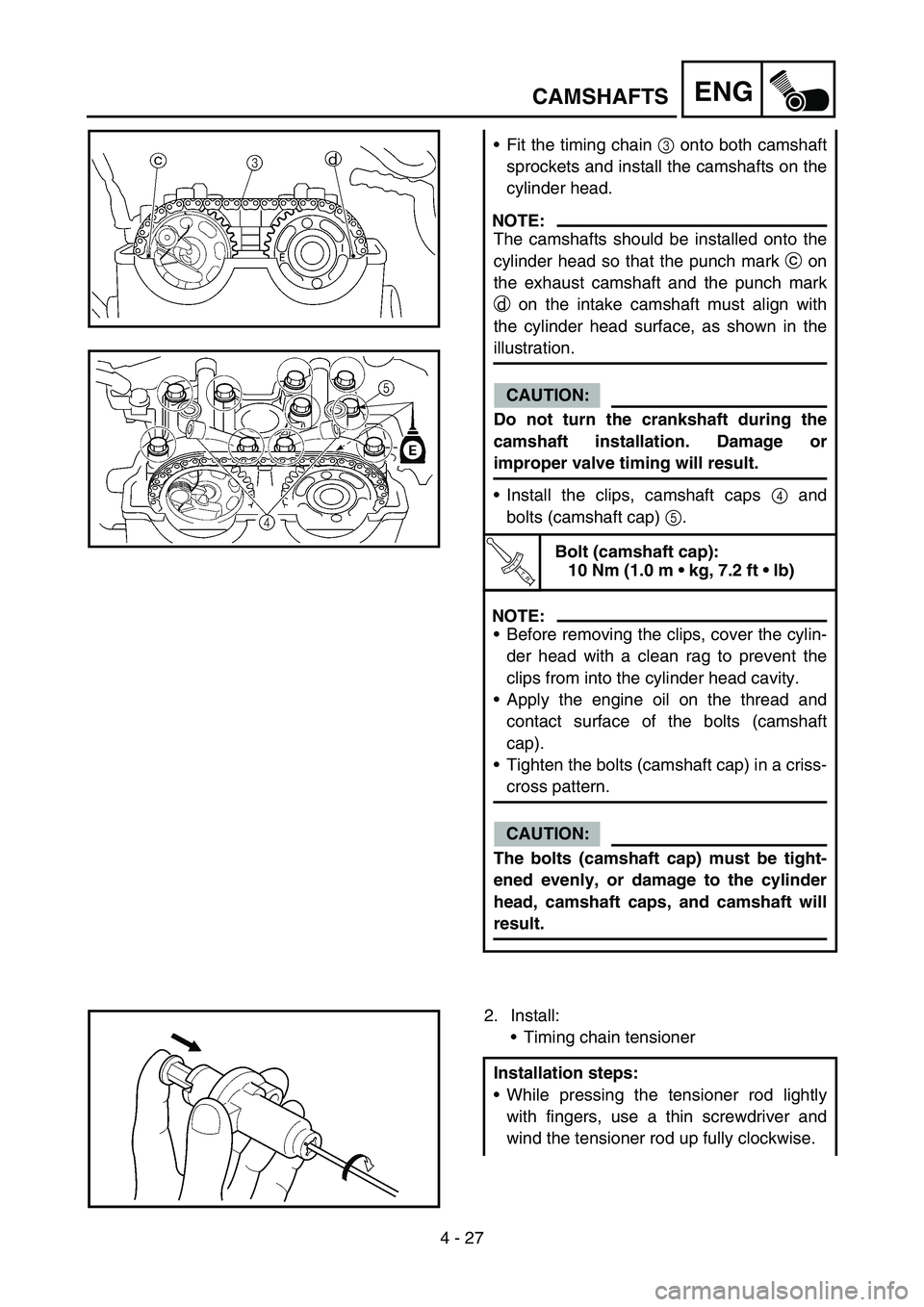
Fit the timing chain 3 onto both camshaft
sprockets and install the camshafts on the
cylinder head.
NOTE:
The camshafts should be installed onto the
cylinder head so that the punch mark c on
the exhaust camshaft and the punch mark
d on the intake camshaft must align with
the cylinder head surface, as shown in the
illustration.
CAUTION:
Do not turn the crankshaft during the
camshaft installation. Damage or
improper valve timing will result.
Install the clips, camshaft caps 4 and
bolts (camshaft cap) 5.
T R..
Bolt (camshaft cap):
10 Nm (1.0 m kg, 7.2 ft lb)
NOTE:
Before removing the clips, cover the cylin-
der head with a clean rag to prevent the
clips from into the cylinder head cavity.
Apply the engine oil on the thread and
contact surface of the bolts (camshaft
cap).
Tighten the bolts (camshaft cap) in a criss-
cross pattern.
CAUTION:
The bolts (camshaft cap) must be tight-
ened evenly, or damage to the cylinder
head, camshaft caps, and camshaft will
result.
2. Install:
Timing chain tensioner
Installation steps:
While pressing the tensioner rod lightly
with fingers, use a thin screwdriver and
wind the tensioner rod up fully clockwise.
Page 316 of 668
4 - 31
ENGCYLINDER HEAD
INSPECTION
Cylinder head
1. Eliminate:
Carbon deposits (from the combustion
chambers)
Use a rounded scraper.
NOTE:
Do not use a sharp instrument to avoid damag-
ing or scratching:
Spark plug threads
Valve seats
2. Inspect:
Cylinder head
Scratches/damage → Replace.
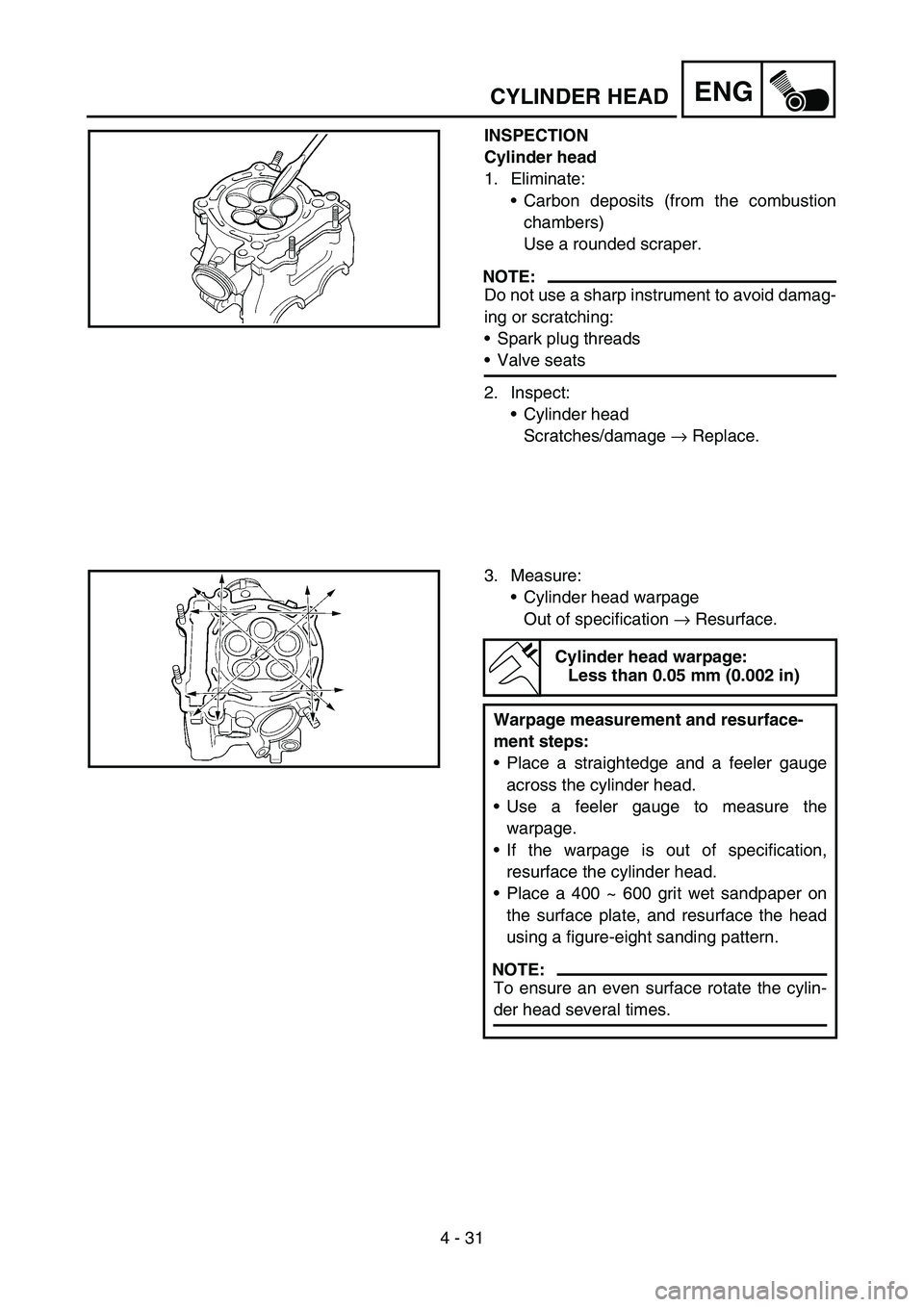
3. Measure:
Cylinder head warpage
Out of specification → Resurface.
Cylinder head warpage:
Less than 0.05 mm (0.002 in)
Warpage measurement and resurface-
ment steps:
Place a straightedge and a feeler gauge
across the cylinder head.
Use a feeler gauge to measure the
warpage.
If the warpage is out of specification,
resurface the cylinder head.
Place a 400 ~ 600 grit wet sandpaper on
the surface plate, and resurface the head
using a figure-eight sanding pattern.
NOTE:
To ensure an even surface rotate the cylin-
der head several times.