mix YAMAHA YZ250F 2005 Owners Manual
[x] Cancel search | Manufacturer: YAMAHA, Model Year: 2005, Model line: YZ250F, Model: YAMAHA YZ250F 2005Pages: 668, PDF Size: 15.74 MB
Page 52 of 668
1 - 11
GEN
INFO
CONTROL FUNCTIONS
EC156000
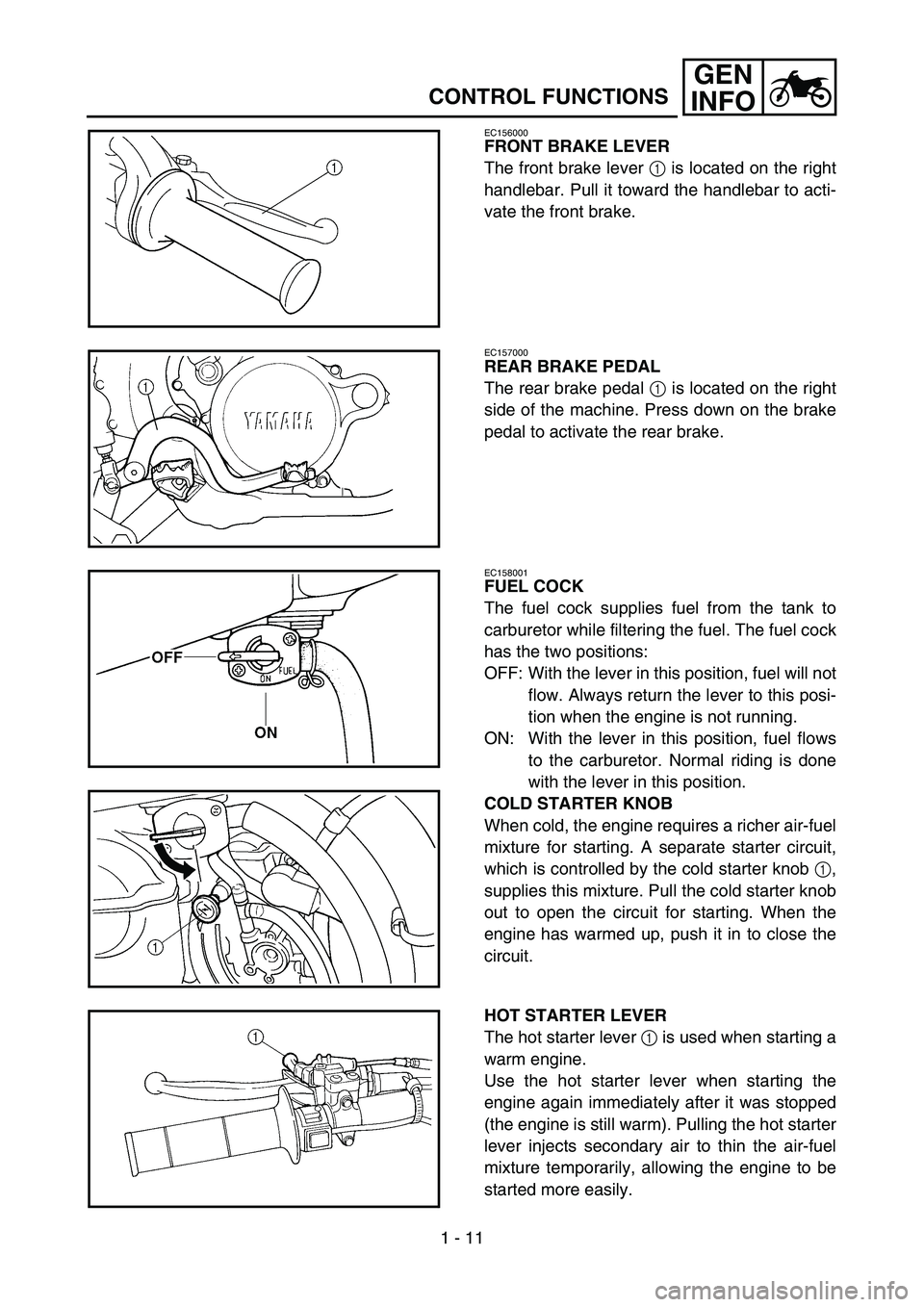
FRONT BRAKE LEVER
The front brake lever 1 is located on the right
handlebar. Pull it toward the handlebar to acti-
vate the front brake.
EC157000
REAR BRAKE PEDAL
The rear brake pedal 1 is located on the right
side of the machine. Press down on the brake
pedal to activate the rear brake.
EC158001
FUEL COCK
The fuel cock supplies fuel from the tank to
carburetor while filtering the fuel. The fuel cock
has the two positions:
OFF: With the lever in this position, fuel will not
flow. Always return the lever to this posi-
tion when the engine is not running.
ON: With the lever in this position, fuel flows
to the carburetor. Normal riding is done
with the lever in this position.
COLD STARTER KNOB
When cold, the engine requires a richer air-fuel
mixture for starting. A separate starter circuit,
which is controlled by the cold starter knob 1,
supplies this mixture. Pull the cold starter knob
out to open the circuit for starting. When the
engine has warmed up, push it in to close the
circuit.
HOT STARTER LEVER
The hot starter lever 1 is used when starting a
warm engine.
Use the hot starter lever when starting the
engine again immediately after it was stopped
(the engine is still warm). Pulling the hot starter
lever injects secondary air to thin the air-fuel
mixture temporarily, allowing the engine to be
started more easily.
Page 58 of 668
1 - 14
GEN
INFO
STARTING AND BREAK-IN
WARNING
Never start or run the engine in a closed
area. The exhaust fumes are poisonous;
they can cause loss of consciousness and
death in a very short time. Always operate
the machine in a well-ventilated area.
CAUTION:
The carburetor on this machine has a
built-in accelerator pump. Therefore,
when starting the engine, do not operate
the throttle or the spark plug will foul.
Unlike a two-stroke engine, this engine
cannot be kick started when the throttle is
open because the kick starter may kick
back. Also, if the throttle is open the air/
fuel mixture may be too lean for the
engine to start.
Before starting the machine, perform the
checks in the pre-operation check list.
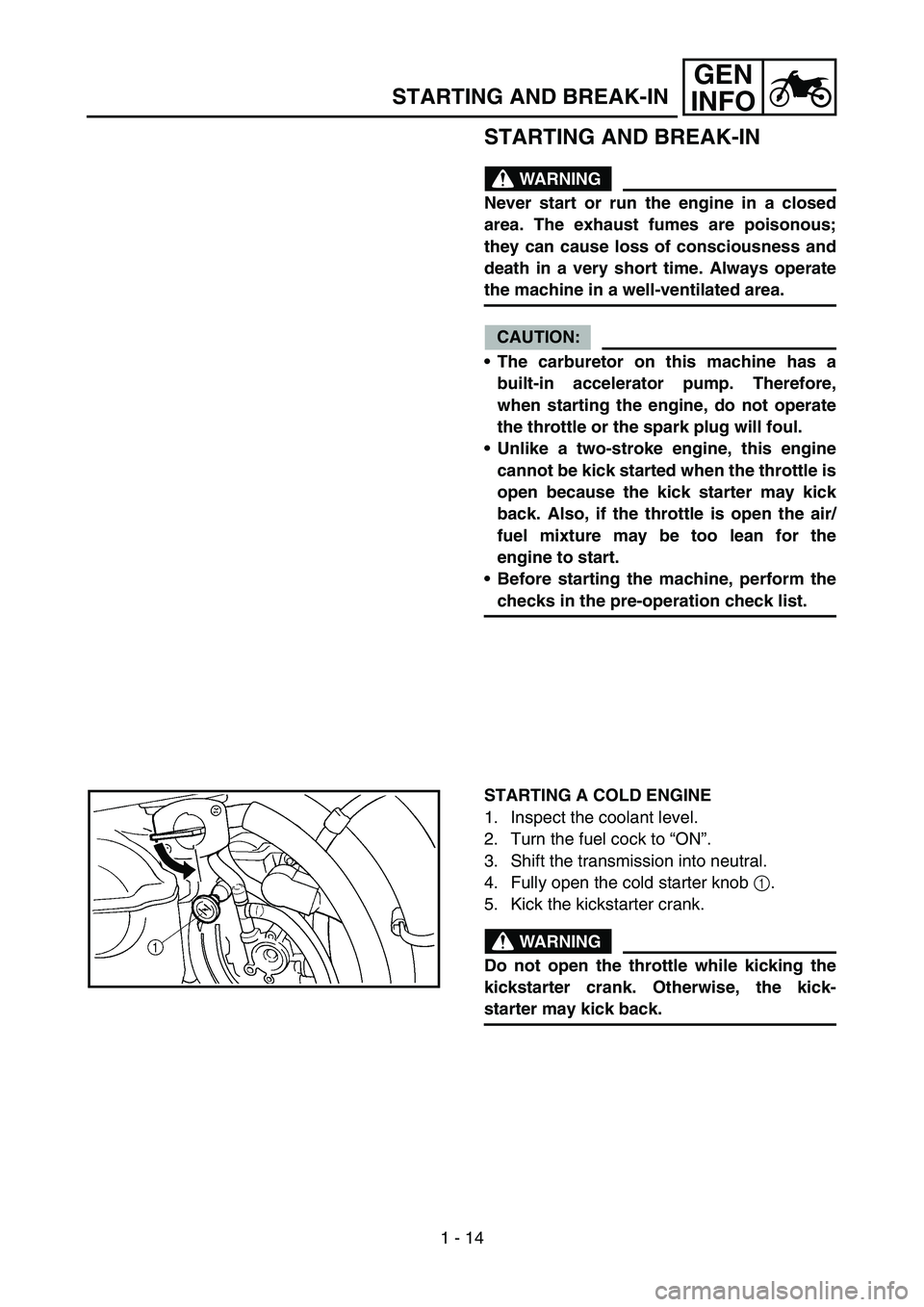
STARTING A COLD ENGINE
1. Inspect the coolant level.
2. Turn the fuel cock to “ON”.
3. Shift the transmission into neutral.
4. Fully open the cold starter knob 1.
5. Kick the kickstarter crank.
WARNING
Do not open the throttle while kicking the
kickstarter crank. Otherwise, the kick-
starter may kick back.
STARTING AND BREAK-IN
Page 60 of 668
1 - 15
GEN
INFO
STARTING AND BREAK-IN
6. Return the cold starter knob to its original
position and run the engine at 3,000 ~
5,000 r/min for 1 or 2 minutes.
NOTE:
Since this model is equipped with an accelera-
tor pump, if the engine is raced (the throttle
opened and closed), the air/fuel mixture will be
too rich and the engine may stall. Also unlike a
two-stroke engine, this model can idle.
CAUTION:
Do not warm up the engine for extended
periods of time.
Page 170 of 668

3 - 6
INSP
ADJ
COOLANT REPLACEMENT
COOLANT REPLACEMENT
WARNING
Do not remove the radiator cap when the
engine is hot.
CAUTION:
Take care so that coolant does not splash
on painted surfaces. If it splashes, wash it
away with water.
1. Place a container under the engine.
2. Remove:
Coolant drain bolt 1
3. Remove:
Radiator cap
Drain the coolant completely.
4. Clean:
Cooling system
Thoroughly flush the cooling system with
clean tap water.
5. Install:
Copper washer
Coolant drain bolt
T R..10 Nm (1.0 m · kg, 7.2 ft · lb)
6. Fill:
Radiator
Engine
To specified level.
Recommended coolant:
High quality ethylene glycol
anti-freeze containing anti-
corrosion for aluminum engine
Coolant
1 and water (soft water)
2 mixing ratio:
50 %/50 %
Coolant capacity:
0.9 L (0.79 Imp qt, 0.95 US qt)
Page 172 of 668

3 - 7
INSP
ADJ
RADIATOR CAP INSPECTION
CAUTION:
Do not mix more than one type of ethyl-
ene glycol antifreeze containing corro-
sion inhibitors for aluminum engine.
Do not use water containing impurities or
oil.
7. Install:
Radiator cap
Start the engine and warm it up for a sev-
eral minutes.
8. Check:
Coolant level
Coolant level low → Add coolant. Handling notes of coolant:
The coolant is harmful so it should be han-
dled with special care.
WARNING
When coolant splashes to your eye.
Thoroughly wash your eye with water
and see your doctor.
When coolant splashes to your clothes.
Quickly wash it away with water and
then with soap.
When coolant is swallowed.
Quickly make him vomit and take him
to a doctor.
EC355000
RADIATOR CAP INSPECTION
1. Inspect:
Seal (radiator cap) 1
Valve and valve seat 2
Crack/damage → Replace.
Exist fur deposits 3 → Clean or replace.
Page 220 of 668
3 - 30
INSP
ADJREAR BRAKE PAD INSULATOR INSPECTION/
BRAKE FLUID LEVEL INSPECTION
3. Inspect:
Brake fluid level
Refer to “BRAKE FLUID LEVEL INSPEC-
TION” section.
4. Check:
Brake pedal operation
A softy or spongy feeling → Bleed brake
system.
Refer to “BRAKE SYSTEM AIR BLEED-
ING” section.
EC36b000
REAR BRAKE PAD INSULATOR
INSPECTION
1. Remove:
Brake pad
Refer to “REAR BRAKE PAD INSPEC-
TION AND REPLACEMENT” section.
2. Inspect:
Rear brake pad insulator 1
Damage → Replace.
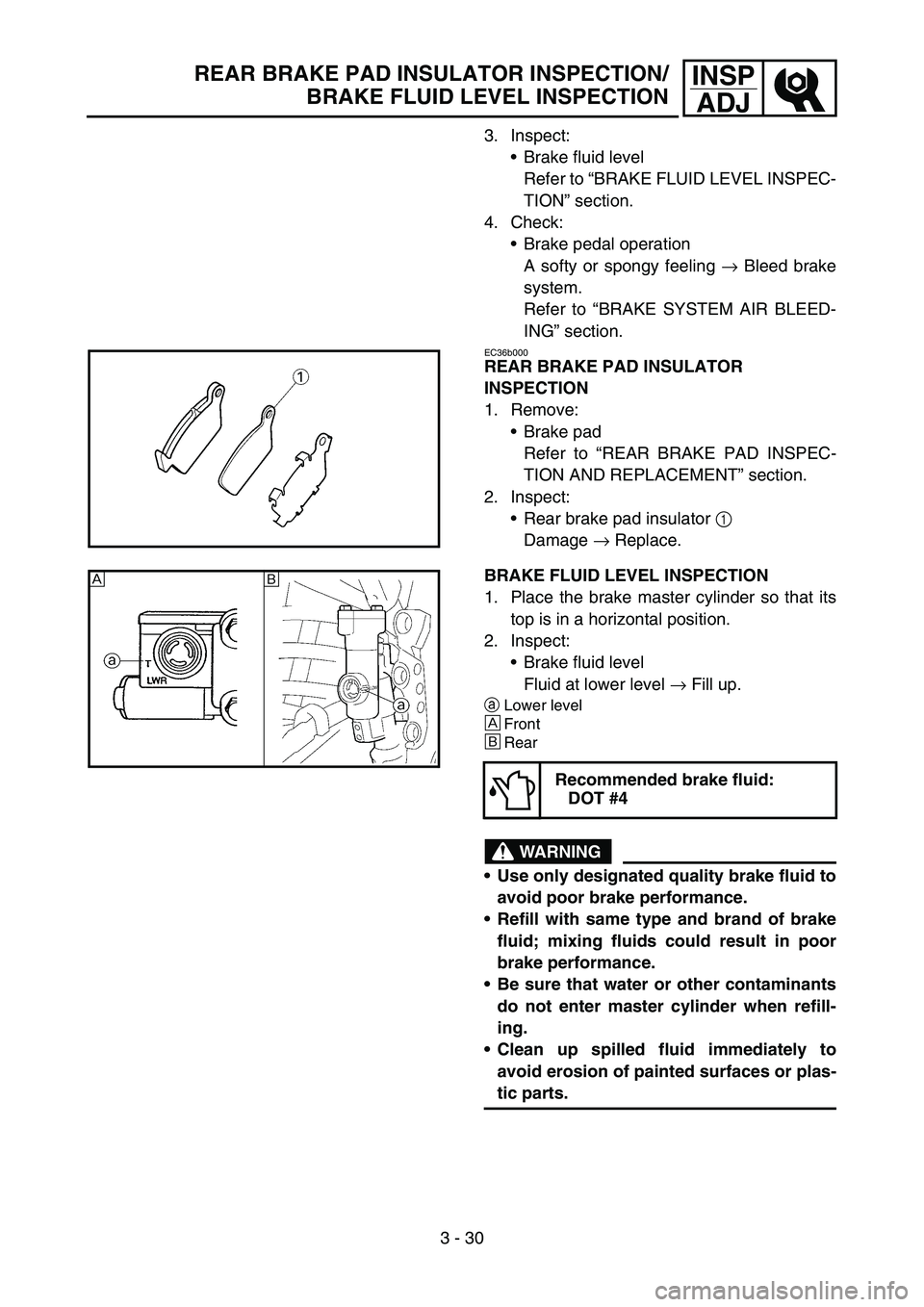
BRAKE FLUID LEVEL INSPECTION
1. Place the brake master cylinder so that its
top is in a horizontal position.
2. Inspect:
Brake fluid level
Fluid at lower level → Fill up.
aLower level
ÈFront
ÉRear
WARNING
Use only designated quality brake fluid to
avoid poor brake performance.
Refill with same type and brand of brake
fluid; mixing fluids could result in poor
brake performance.
Be sure that water or other contaminants
do not enter master cylinder when refill-
ing.
Clean up spilled fluid immediately to
avoid erosion of painted surfaces or plas-
tic parts.
Recommended brake fluid:
DOT #4
ÈÉ
Page 502 of 668
5 - 24
CHASFRONT BRAKE AND REAR BRAKE
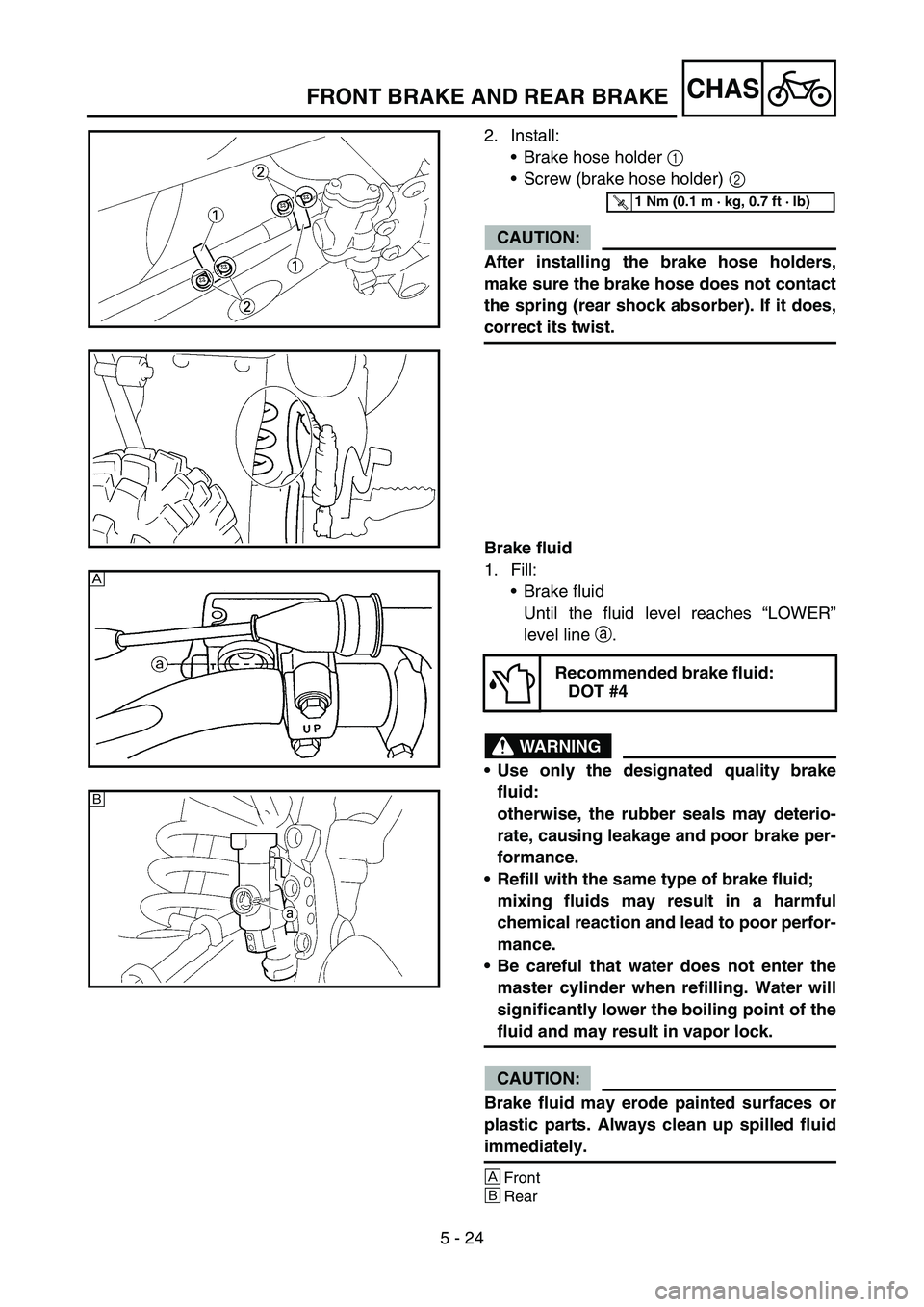
2. Install:
Brake hose holder 1
Screw (brake hose holder) 2
CAUTION:
After installing the brake hose holders,
make sure the brake hose does not contact
the spring (rear shock absorber). If it does,
correct its twist.
Brake fluid
1. Fill:
Brake fluid
Until the fluid level reaches “LOWER”
level line a.
WARNING
Use only the designated quality brake
fluid:
otherwise, the rubber seals may deterio-
rate, causing leakage and poor brake per-
formance.
Refill with the same type of brake fluid;
mixing fluids may result in a harmful
chemical reaction and lead to poor perfor-
mance.
Be careful that water does not enter the
master cylinder when refilling. Water will
significantly lower the boiling point of the
fluid and may result in vapor lock.
CAUTION:
Brake fluid may erode painted surfaces or
plastic parts. Always clean up spilled fluid
immediately.
È
Front
ÉRear
Recommended brake fluid:
DOT #4
T R..1 Nm (0.1 m · kg, 0.7 ft · lb)
È
É
Page 618 of 668
7 - 1
TUN
EC700000
TUNING
EC710000
ENGINE
Carburetor setting
The air/fuel mixture will vary depending on
atmospheric conditions. Therefore, it is nec-
essary to take into consideration the air pres-
sure, ambient temperature, humidity, etc.,
when adjusting the carburetor.
Perform a test run to check for proper engine
performance (e.g., throttle response) and
spark plug(-s) discoloration or fouling. Use
these readings to determine the best possi-
ble carburetor setting.
NOTE:
It is recommended to keep a record of all car-
buretor settings and external conditions (e.g.,
atmospheric conditions, track/surface condi-
tions, lap times) to make future carburetor set-
ting easier.
WARNING
The carburetor is a part of the fuel line.
Therefore, be sure to install it in a well-
ventilated area, away from flammable
objects and any sources of fire.
Never look into the carburetor intake.
Flames may shoot out from the pipe if the
engine backfires while it is being started.
Gasoline may be discharged from the
accelerator pump nozzle when the carbu-
retor has been removed.
SETTING
Page 620 of 668

7 - 2
TUN
CAUTION:
The carburetor is extremely sensitive to
foreign matter (dirt, sand, water, etc.).
During installation, do not allow foreign
matter to get into the carburetor.
Always handle the carburetor and its
components carefully. Even slight
scratches, bends or damage to carburetor
parts may prevent the carburetor from
functioning correctly. Carefully perform
all servicing with the appropriate tools
and without applying excessive force.
When the engine is stopped or when
riding at no load, do not open and close
the throttle unnecessarily. Otherwise, too
much fuel may be discharged, starting
may become difficult or the engine may
not run well.
After installing the carburetor, check that
the throttle operates correctly and opens
and closes smoothly.
Atmospheric conditions and carburetor
settings
The air density (i.e., concentration of oxygen
in the air) determines the richness or lean-
ness of the air/fuel mixture. Therefore, refer
to the above table for mixture settings.
That is:
Higher temperature expands the air with its
resultant reduced density.
Higher humidity reduces the amount of oxy-
gen in the air by so much of the water vapor
in the same air.
Lower atmospheric pressure (at a high alti-
tude) reduces the density of the air.
Air temp. HumidityAir
pressure
(altitude)Mixture Setting
High High Low (high) Richer Leaner
Low Low High (low) Leaner Richer
SETTING
Page 624 of 668
7 - 4
TUNSETTING
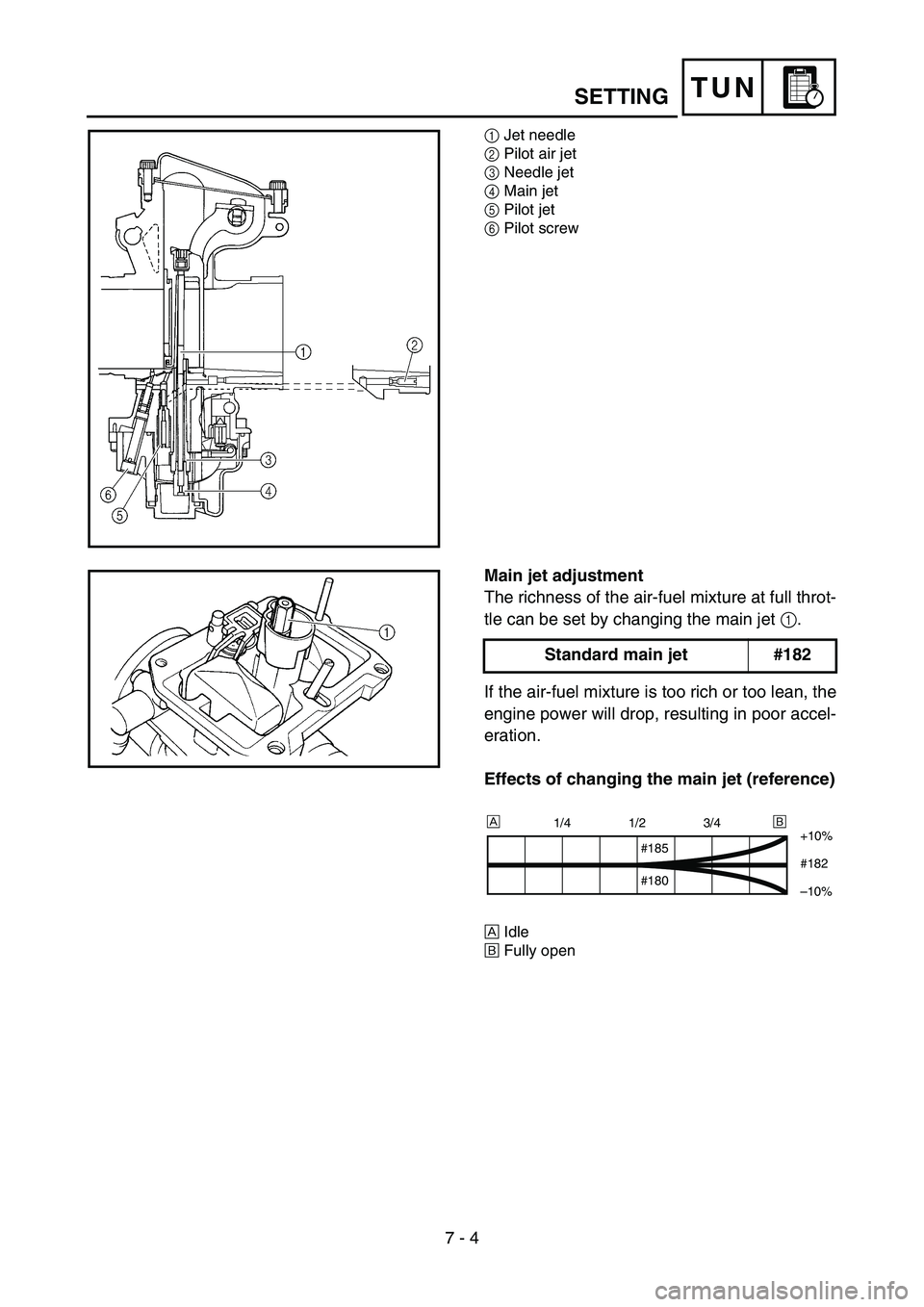
1Jet needle
2Pilot air jet
3Needle jet
4Main jet
5Pilot jet
6Pilot screw
Main jet adjustment
The richness of the air-fuel mixture at full throt-
tle can be set by changing the main jet 1
.
If the air-fuel mixture is too rich or too lean, the
engine power will drop, resulting in poor accel-
eration.
Effects of changing the main jet (reference)
ÈIdle
ÉFully open
Standard main jet #182
1/4 1/2 3/4
+10%
#182
–10%
#185
#180
ÈÉ