light YAMAHA YZ250F 2006 Owner's Manual
[x] Cancel search | Manufacturer: YAMAHA, Model Year: 2006, Model line: YZ250F, Model: YAMAHA YZ250F 2006Pages: 674, PDF Size: 21.07 MB
Page 452 of 674
4 - 99
ENGTRANSMISSION, SHIFT CAM AND SHIFT FORK
EC4H3000
REMOVAL POINTS
EC4H3230
Transmission
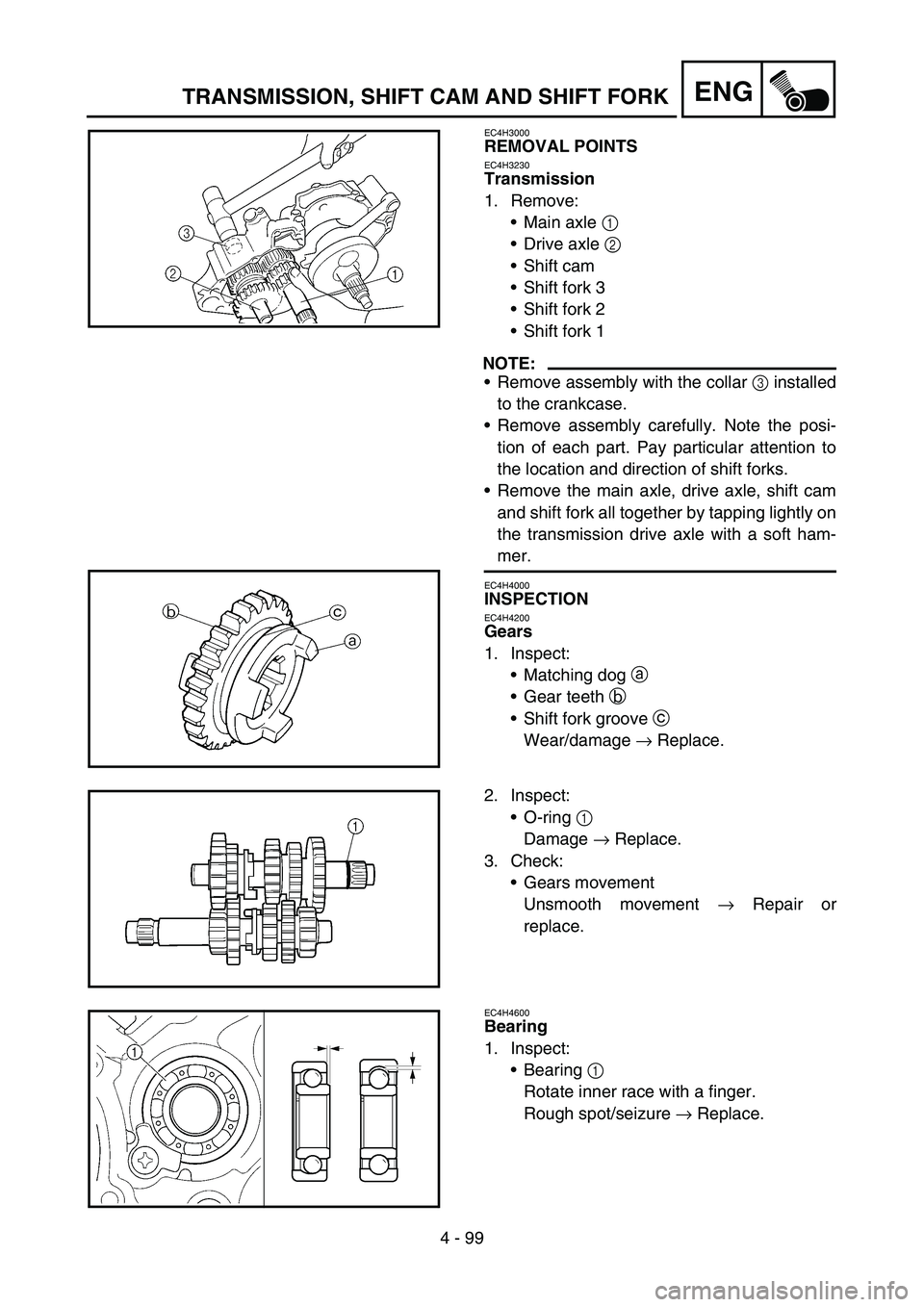
1. Remove:
Main axle 1
Drive axle 2
Shift cam
Shift fork 3
Shift fork 2
Shift fork 1
NOTE:
Remove assembly with the collar 3 installed
to the crankcase.
Remove assembly carefully. Note the posi-
tion of each part. Pay particular attention to
the location and direction of shift forks.
Remove the main axle, drive axle, shift cam
and shift fork all together by tapping lightly on
the transmission drive axle with a soft ham-
mer.
EC4H4000
INSPECTION
EC4H4200
Gears
1. Inspect:
Matching dog a
Gear teeth b
Shift fork groove c
Wear/damage → Replace.
2. Inspect:
O-ring 1
Damage → Replace.
3. Check:
Gears movement
Unsmooth movement → Repair or
replace.
EC4H4600
Bearing
1. Inspect:
Bearing 1
Rotate inner race with a finger.
Rough spot/seizure → Replace.
Page 500 of 674
5 - 21
CHASFRONT BRAKE AND REAR BRAKE
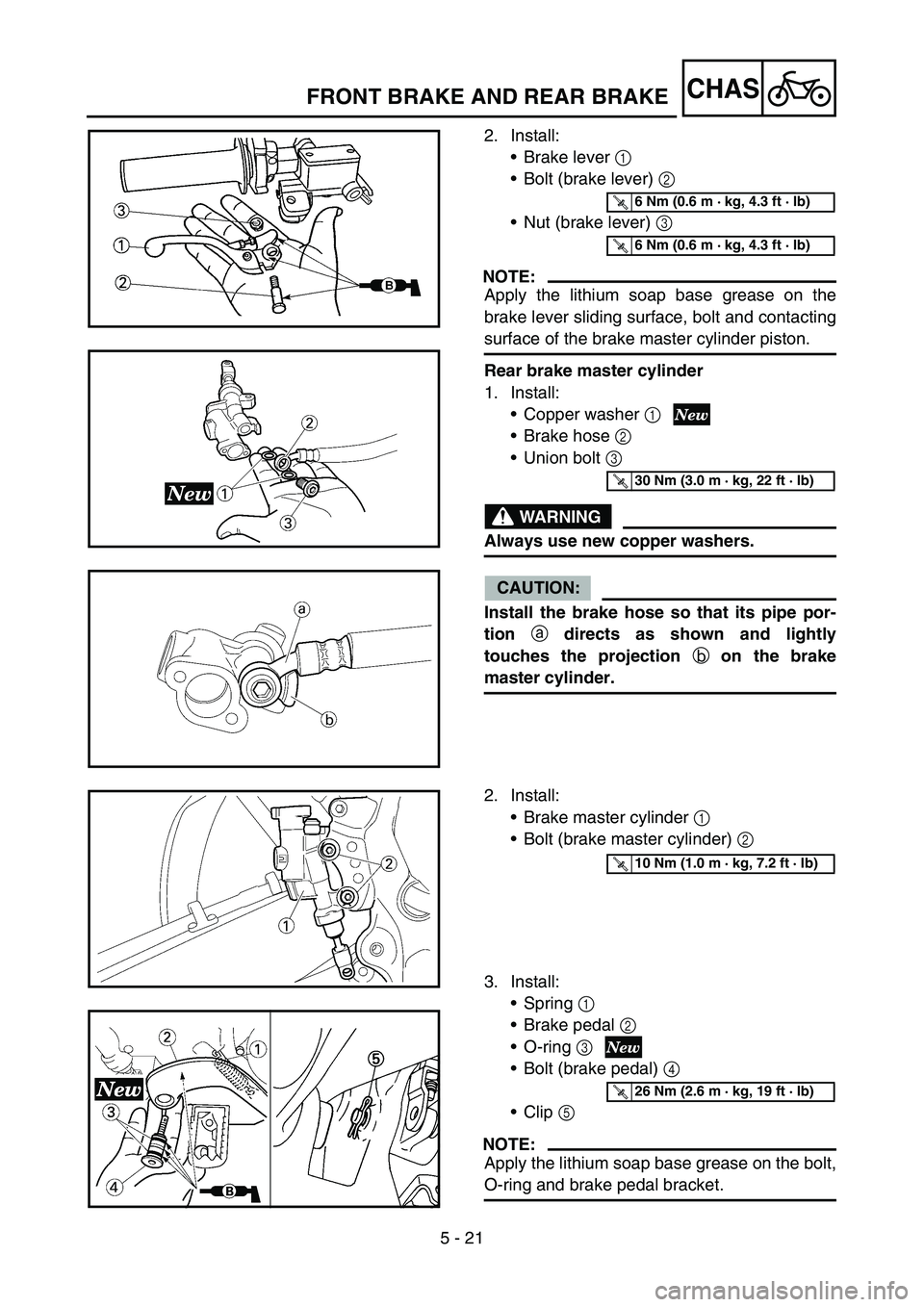
2. Install:
Brake lever 1
Bolt (brake lever) 2
Nut (brake lever) 3
NOTE:
Apply the lithium soap base grease on the
brake lever sliding surface, bolt and contacting
surface of the brake master cylinder piston.
Rear brake master cylinder
1. Install:
Copper washer 1
Brake hose 2
Union bolt 3
WARNING
Always use new copper washers.
CAUTION:
Install the brake hose so that its pipe por-
tion
a directs as shown and lightly
touches the projection
b on the brake
master cylinder.
T R..6 Nm (0.6 m · kg, 4.3 ft · lb)
T R..6 Nm (0.6 m · kg, 4.3 ft · lb)
T R..30 Nm (3.0 m · kg, 22 ft · lb)
2. Install:
Brake master cylinder 1
Bolt (brake master cylinder) 2
3. Install:
Spring 1
Brake pedal 2
O-ring 3
Bolt (brake pedal) 4
Clip 5
NOTE:
Apply the lithium soap base grease on the bolt,
O-ring and brake pedal bracket.
T R..10 Nm (1.0 m · kg, 7.2 ft · lb)
T R..26 Nm (2.6 m · kg, 19 ft · lb)
Page 502 of 674
5 - 22
CHASFRONT BRAKE AND REAR BRAKE
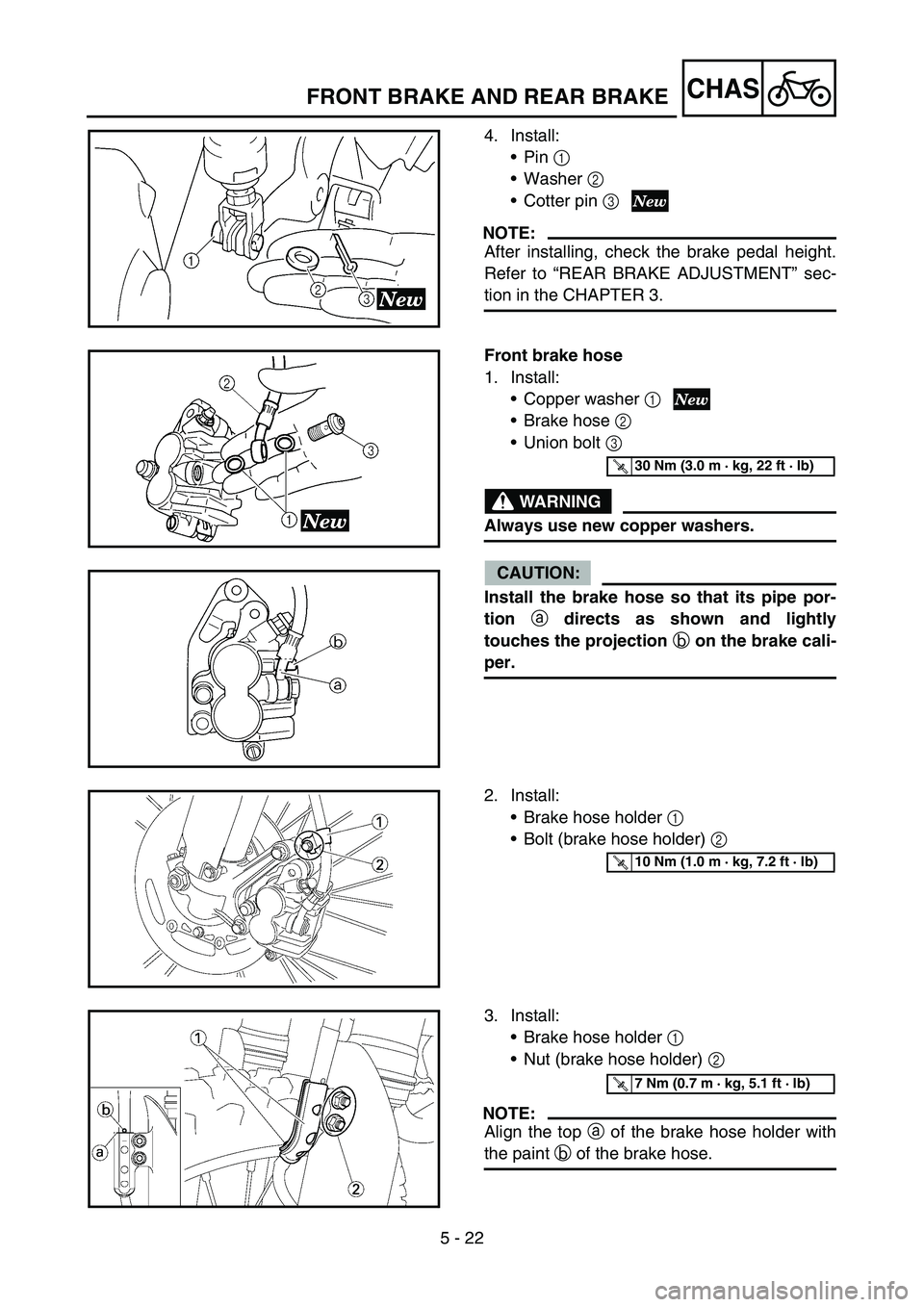
4. Install:
Pin 1
Washer 2
Cotter pin 3
NOTE:
After installing, check the brake pedal height.
Refer to “REAR BRAKE ADJUSTMENT” sec-
tion in the CHAPTER 3.
Front brake hose
1. Install:
Copper washer 1
Brake hose 2
Union bolt 3
WARNING
Always use new copper washers.
CAUTION:
Install the brake hose so that its pipe por-
tion
a directs as shown and lightly
touches the projection
b on the brake cali-
per.
T R..30 Nm (3.0 m · kg, 22 ft · lb)
2. Install:
Brake hose holder 1
Bolt (brake hose holder) 2
T R..10 Nm (1.0 m · kg, 7.2 ft · lb)
3. Install:
Brake hose holder 1
Nut (brake hose holder) 2
NOTE:
Align the top a of the brake hose holder with
the paint b of the brake hose.
T R..7 Nm (0.7 m · kg, 5.1 ft · lb)
Page 504 of 674
5 - 23
CHASFRONT BRAKE AND REAR BRAKE
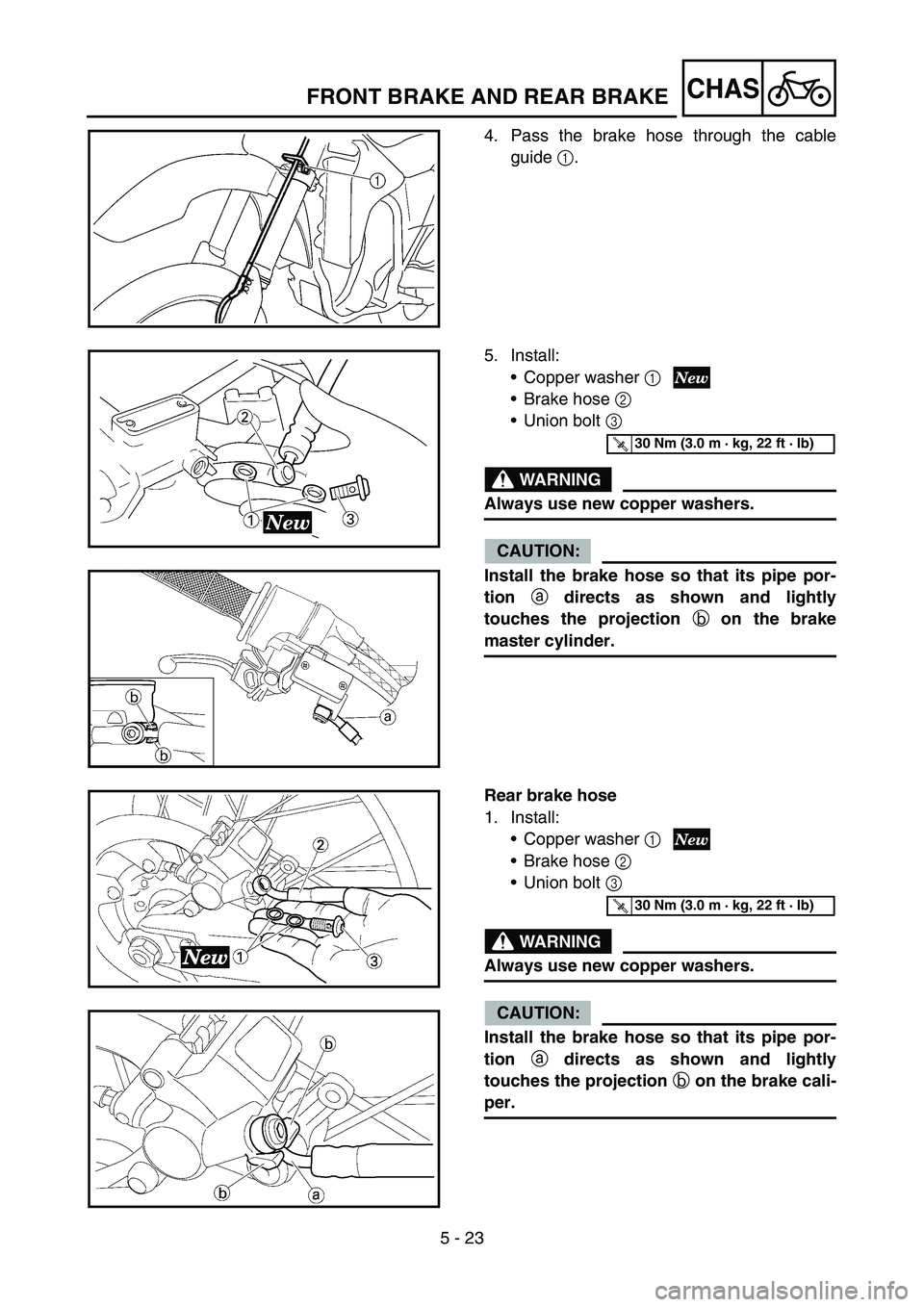
4. Pass the brake hose through the cable
guide 1.
5. Install:
Copper washer 1
Brake hose 2
Union bolt 3
WARNING
Always use new copper washers.
CAUTION:
Install the brake hose so that its pipe por-
tion
a directs as shown and lightly
touches the projection
b on the brake
master cylinder.
T R..30 Nm (3.0 m · kg, 22 ft · lb)
Rear brake hose
1. Install:
Copper washer 1
Brake hose 2
Union bolt 3
WARNING
Always use new copper washers.
CAUTION:
Install the brake hose so that its pipe por-
tion
a directs as shown and lightly
touches the projection
b on the brake cali-
per.
T R..30 Nm (3.0 m · kg, 22 ft · lb)
Page 626 of 674

7 - 2
TUN
CAUTION:
The carburetor is extremely sensitive to
foreign matter (dirt, sand, water, etc.).
During installation, do not allow foreign
matter to get into the carburetor.
Always handle the carburetor and its
components carefully. Even slight
scratches, bends or damage to carburetor
parts may prevent the carburetor from
functioning correctly. Carefully perform
all servicing with the appropriate tools
and without applying excessive force.
When the engine is stopped or when
riding at no load, do not open and close
the throttle unnecessarily. Otherwise, too
much fuel may be discharged, starting
may become difficult or the engine may
not run well.
After installing the carburetor, check that
the throttle operates correctly and opens
and closes smoothly.
Atmospheric conditions and carburetor
settings
The air density (i.e., concentration of oxygen
in the air) determines the richness or lean-
ness of the air/fuel mixture. Therefore, refer
to the above table for mixture settings.
That is:
•Higher temperature expands the air with its
resultant reduced density.
•Higher humidity reduces the amount of oxy-
gen in the air by so much of the water vapor
in the same air.
•Lower atmospheric pressure (at a high alti-
tude) reduces the density of the air.
Air temp. HumidityAir
pressure
(altitude)Mixture Setting
High High Low (high) Richer Leaner
Low Low High (low) Leaner Richer
SETTING