fuel YAMAHA YZ250F 2012 Owner's Guide
[x] Cancel search | Manufacturer: YAMAHA, Model Year: 2012, Model line: YZ250F, Model: YAMAHA YZ250F 2012Pages: 198, PDF Size: 11.78 MB
Page 167 of 198
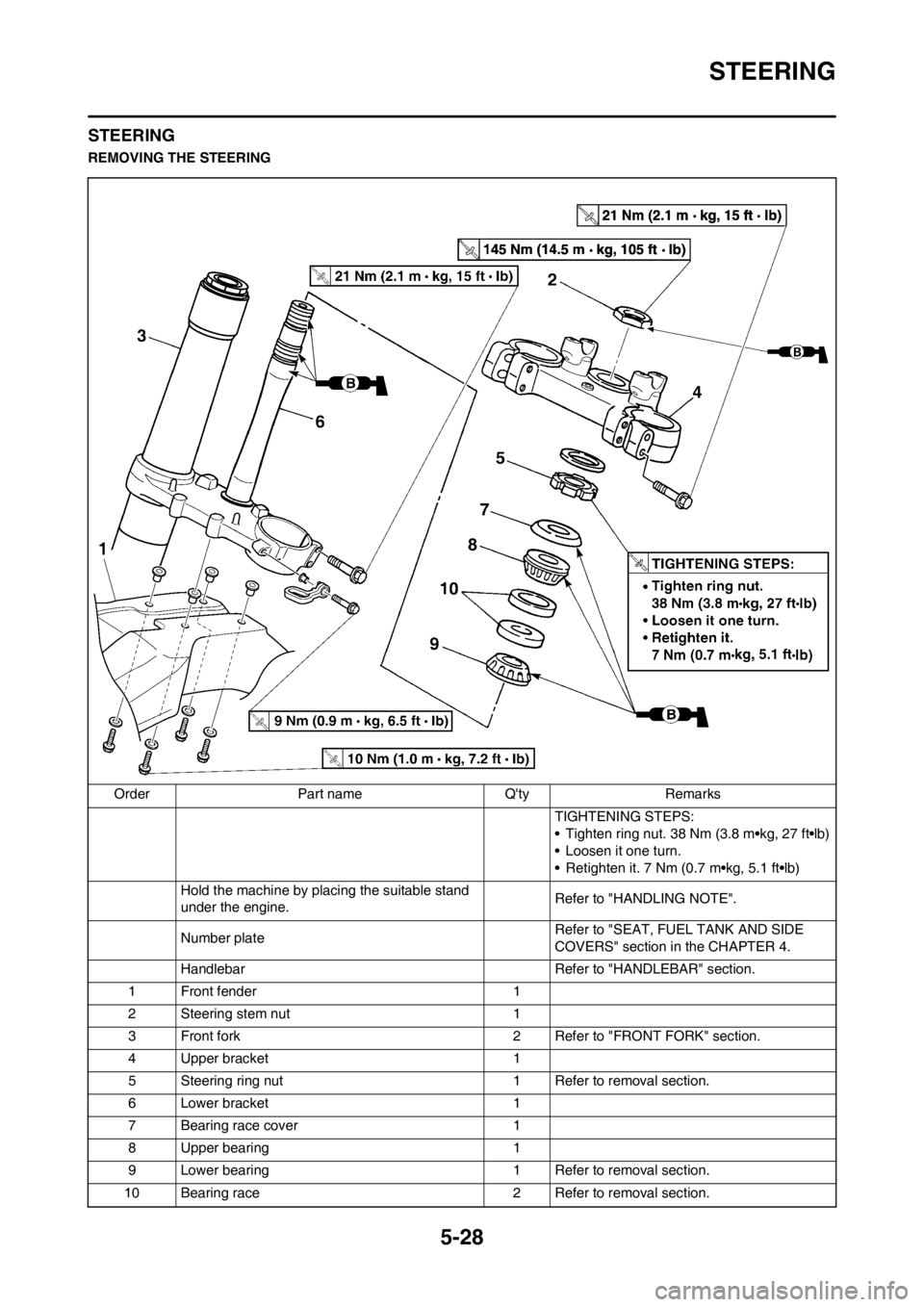
5-28
STEERING
STEERING
REMOVING THE STEERING
Order Part name Q'ty Remarks
TIGHTENING STEPS:
• Tighten ring nut. 38 Nm (3.8 m•kg, 27 ft•lb)
• Loosen it one turn.
• Retighten it. 7 Nm (0.7 m•kg, 5.1 ft•lb)
Hold the machine by placing the suitable stand
under the engine.Refer to "HANDLING NOTE".
Number plateRefer to "SEAT, FUEL TANK AND SIDE
COVERS" section in the CHAPTER 4.
Handlebar Refer to "HANDLEBAR" section.
1 Front fender 1
2 Steering stem nut 1
3 Front fork 2 Refer to "FRONT FORK" section.
4 Upper bracket 1
5 Steering ring nut 1 Refer to removal section.
6 Lower bracket 1
7 Bearing race cover 1
8 Upper bearing 1
9 Lower bearing 1 Refer to removal section.
10 Bearing race 2 Refer to removal section.
Page 175 of 198
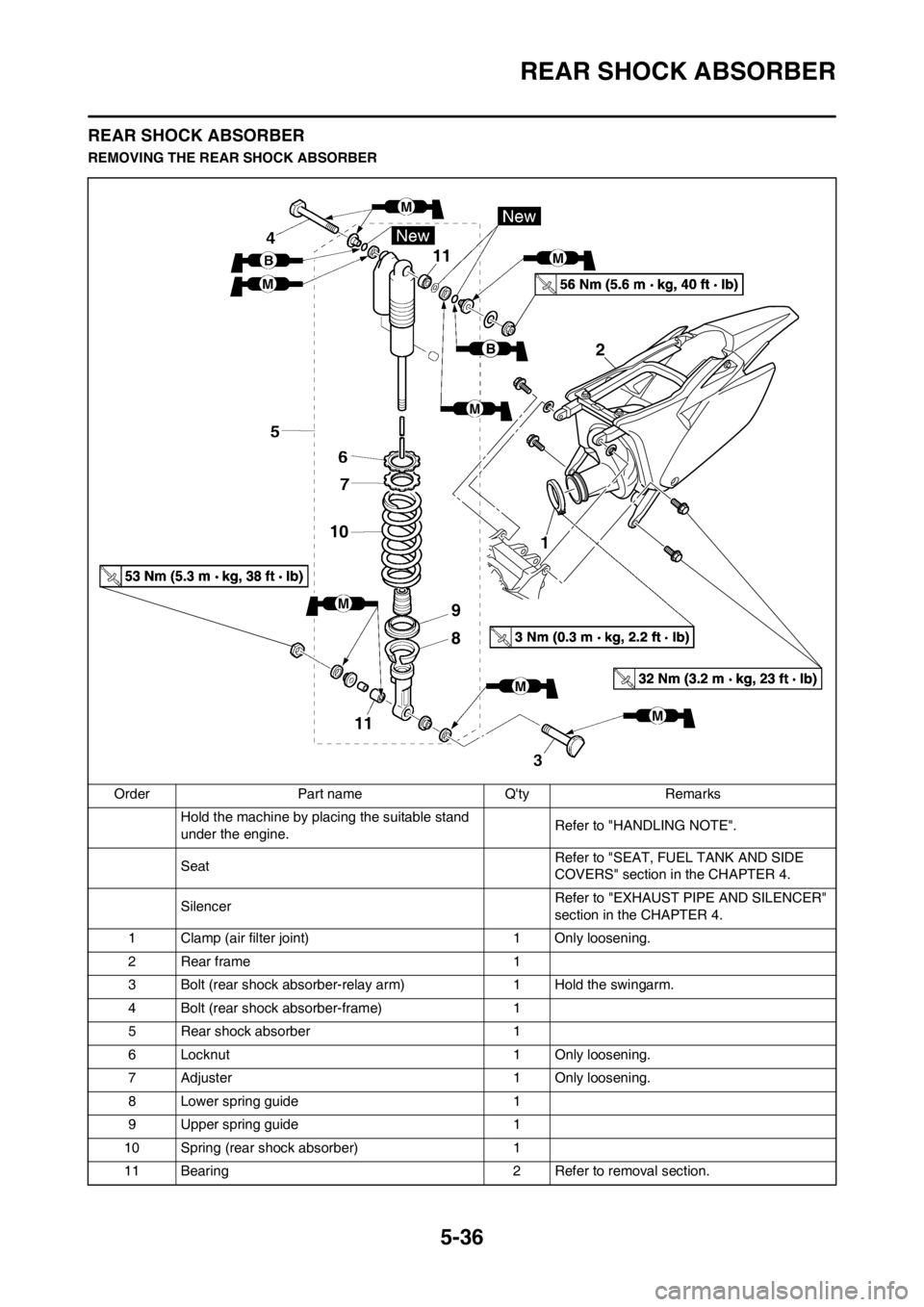
5-36
REAR SHOCK ABSORBER
REAR SHOCK ABSORBER
REMOVING THE REAR SHOCK ABSORBER
Order Part name Q'ty Remarks
Hold the machine by placing the suitable stand
under the engine.Refer to "HANDLING NOTE".
Seat Refer to "SEAT, FUEL TANK AND SIDE
COVERS" section in the CHAPTER 4.
Silencer Refer to "EXHAUST PIPE AND SILENCER"
section in the CHAPTER 4.
1 Clamp (air filter joint) 1 Only loosening.
2Rear frame 1
3 Bolt (rear shock absorber-relay arm) 1 Hold the swingarm.
4 Bolt (rear shock absorber-frame) 1
5 Rear shock absorber 1
6 Locknut 1 Only loosening.
7 Adjuster 1 Only loosening.
8 Lower spring guide 1
9 Upper spring guide 1
10 Spring (rear shock absorber) 1
11 Bearing 2 Refer to removal section.
B2
9
8 10
11
11
Page 181 of 198
6-3
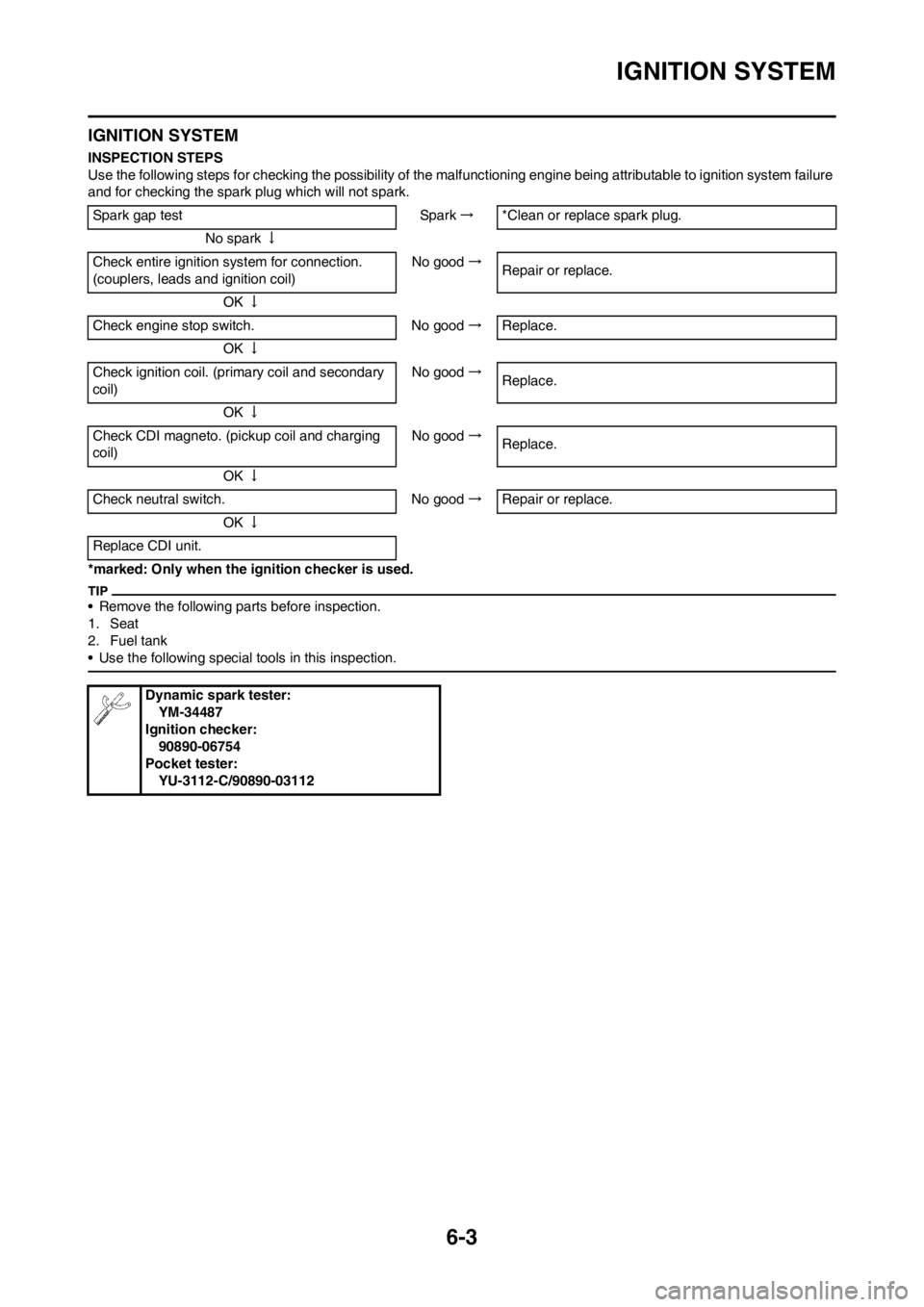
IGNITION SYSTEM
IGNITION SYSTEM
INSPECTION STEPS
Use the following steps for checking the possibility of the malfunctioning engine being attributable to ignition system failure
and for checking the spark plug which will not spark.
*marked: Only when the ignition checker is used.
• Remove the following parts before inspection.
1. Seat
2. Fuel tank
• Use the following special tools in this inspection.
Spark gap test Spark→*Clean or replace spark plug.
No spark↓
Check entire ignition system for connection.
(couplers, leads and ignition coil)No good→
Repair or replace.
OK↓
Check engine stop switch. No good→Replace.
OK↓
Check ignition coil. (primary coil and secondary
coil)No good→
Replace.
OK↓
Check CDI magneto. (pickup coil and charging
coil)No good→
Replace.
OK↓
Check neutral switch. No good→Repair or replace.
OK↓
Replace CDI unit.
Dynamic spark tester:
YM-34487
Ignition checker:
90890-06754
Pocket tester:
YU-3112-C/90890-03112
Page 187 of 198
7-1
ENGINE
TUNING
ENGINE
CARBURETOR SETTING
• The air/fuel mixture will vary de-
pending on atmospheric conditions.
Therefore, it is necessary to take
into consideration the air pressure,
ambient temperature, humidity,
etc., when adjusting the carburetor.
• Perform a test run to check for prop-
er engine performance (e.g., throt-
tle response) and spark plug(-s)
discoloration or fouling. Use these
readings to determine the best pos-
sible carburetor setting.
It is recommended to keep a record of
all carburetor settings and external
conditions (e.g., atmospheric condi-
tions, track/surface conditions, lap
times) to make future carburetor set-
ting easier.
• The carburetor is a part of the
fuel line. Therefore, be sure to in-
stall it in a wellventilated area,
away from flammable objects
and any sources of fire.
• Never look into the carburetor in-
take. Flames may shoot out from
the pipe if the engine backfires
while it is being started. Gasoline
may be discharged from the ac-
celerator pump nozzle when the
carburetor has been removed.
• The carburetor is extremely sen-
sitive to foreign matter (dirt,
sand, water, etc.). During instal-
lation, do not allow foreign mat-
ter to get into the carburetor.
• Always handle the carburetor
and its components carefully.
Even slight scratches, bends or
damage to carburetor parts may
prevent the carburetor from
functioning correctly. Carefully
perform all servicing with the ap-
propriate tools and without ap-
plying excessive force.
• When the engine is stopped or
when riding at no load, do not
open and close the throttle un-
necessarily. Otherwise, too
much fuel may be discharged,
starting may become difficult or
the engine may not run well.• After installing the carburetor,
check that the throttle operates
correctly and opens and closes
smoothly.
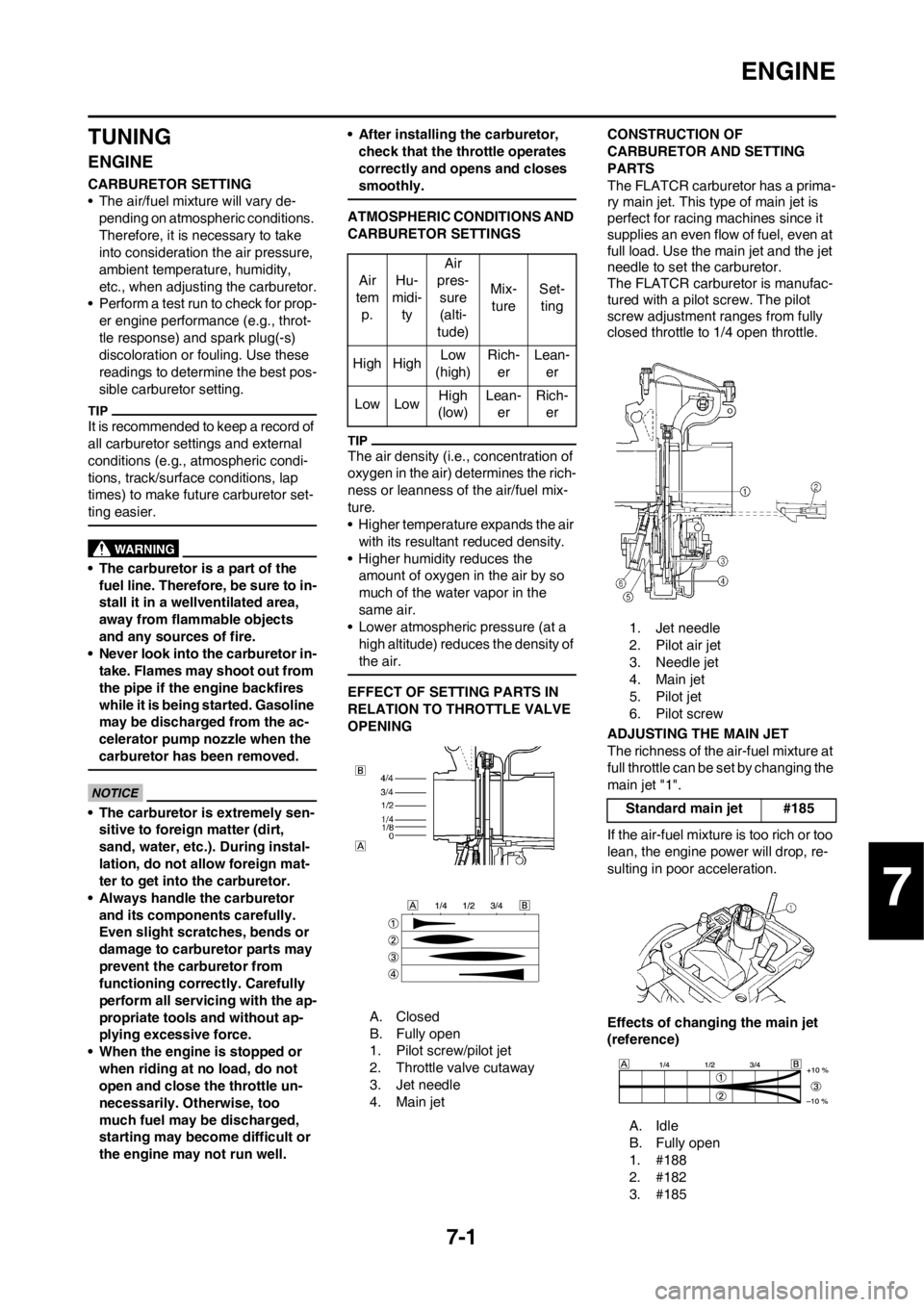
ATMOSPHERIC CONDITIONS AND
CARBURETOR SETTINGS
The air density (i.e., concentration of
oxygen in the air) determines the rich-
ness or leanness of the air/fuel mix-
ture.
• Higher temperature expands the air
with its resultant reduced density.
• Higher humidity reduces the
amount of oxygen in the air by so
much of the water vapor in the
same air.
• Lower atmospheric pressure (at a
high altitude) reduces the density of
the air.
EFFECT OF SETTING PARTS IN
RELATION TO THROTTLE VALVE
OPENING
A. Closed
B. Fully open
1. Pilot screw/pilot jet
2. Throttle valve cutaway
3. Jet needle
4. Main jetCONSTRUCTION OF
CARBURETOR AND SETTING
PARTS
The FLATCR carburetor has a prima-
ry main jet. This type of main jet is
perfect for racing machines since it
supplies an even flow of fuel, even at
full load. Use the main jet and the jet
needle to set the carburetor.
The FLATCR carburetor is manufac-
tured with a pilot screw. The pilot
screw adjustment ranges from fully
closed throttle to 1/4 open throttle.
1. Jet needle
2. Pilot air jet
3. Needle jet
4. Main jet
5. Pilot jet
6. Pilot screw
ADJUSTING THE MAIN JET
The richness of the air-fuel mixture at
full throttle can be set by changing the
main jet "1".
If the air-fuel mixture is too rich or too
lean, the engine power will drop, re-
sulting in poor acceleration.
Effects of changing the main jet
(reference)
A. Idle
B. Fully open
1. #188
2. #182
3. #185 Air
tem
p.Hu-
midi-
tyAir
pres-
sure
(alti-
tude)Mix-
tureSet-
ting
High HighLow
(high)Rich-
erLean-
er
Low LowHigh
(low)Lean-
erRich-
er
Standard main jet #185
7
Page 188 of 198
7-2
ENGINE
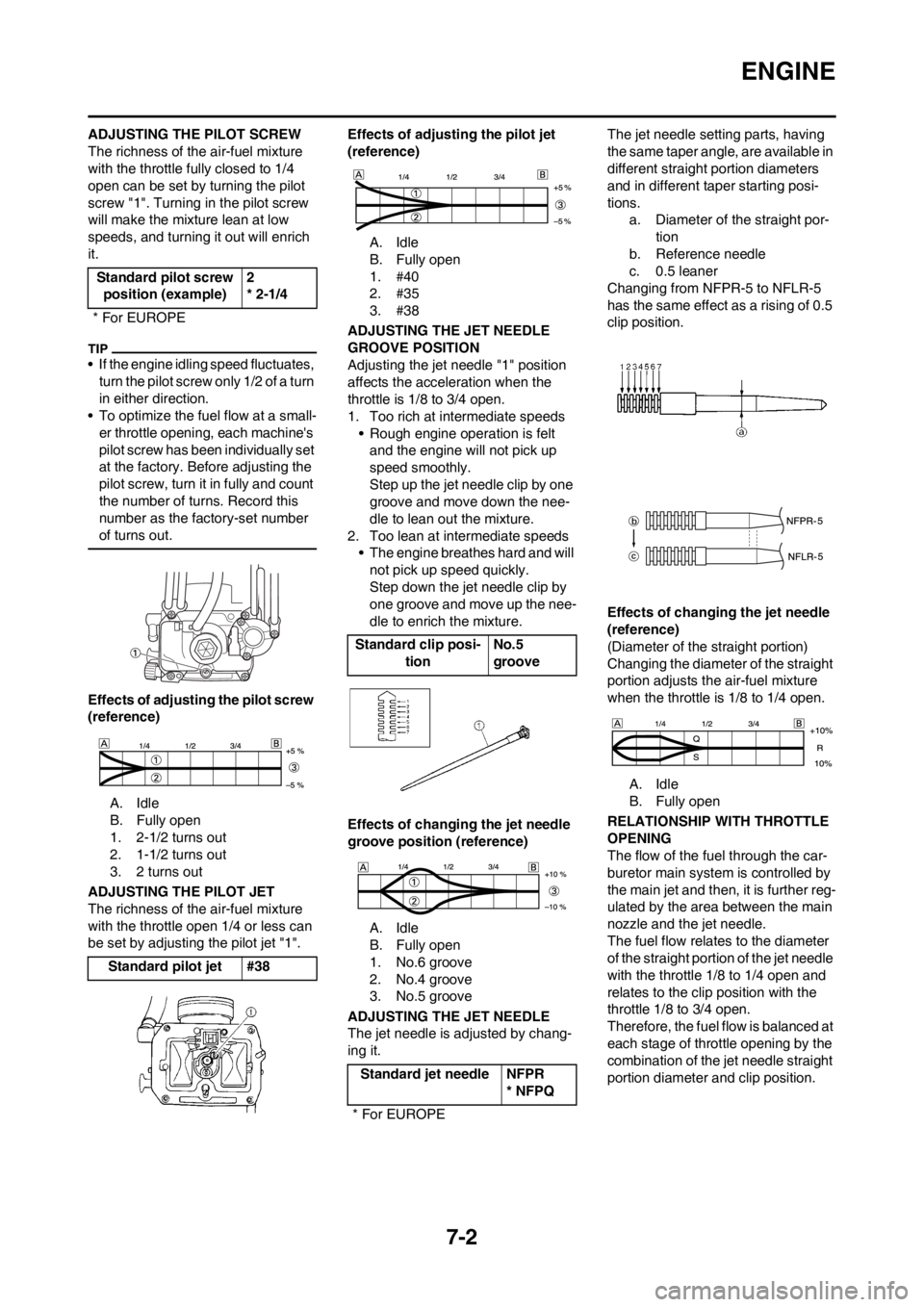
ADJUSTING THE PILOT SCREW
The richness of the air-fuel mixture
with the throttle fully closed to 1/4
open can be set by turning the pilot
screw "1". Turning in the pilot screw
will make the mixture lean at low
speeds, and turning it out will enrich
it.
• If the engine idling speed fluctuates,
turn the pilot screw only 1/2 of a turn
in either direction.
• To optimize the fuel flow at a small-
er throttle opening, each machine's
pilot screw has been individually set
at the factory. Before adjusting the
pilot screw, turn it in fully and count
the number of turns. Record this
number as the factory-set number
of turns out.
Effects of adjusting the pilot screw
(reference)
A. Idle
B. Fully open
1. 2-1/2 turns out
2. 1-1/2 turns out
3. 2 turns out
ADJUSTING THE PILOT JET
The richness of the air-fuel mixture
with the throttle open 1/4 or less can
be set by adjusting the pilot jet "1".Effects of adjusting the pilot jet
(reference)
A. Idle
B. Fully open
1. #40
2. #35
3. #38
ADJUSTING THE JET NEEDLE
GROOVE POSITION
Adjusting the jet needle "1" position
affects the acceleration when the
throttle is 1/8 to 3/4 open.
1. Too rich at intermediate speeds
• Rough engine operation is felt
and the engine will not pick up
speed smoothly.
Step up the jet needle clip by one
groove and move down the nee-
dle to lean out the mixture.
2. Too lean at intermediate speeds
• The engine breathes hard and will
not pick up speed quickly.
Step down the jet needle clip by
one groove and move up the nee-
dle to enrich the mixture.
Effects of changing the jet needle
groove position (reference)
A. Idle
B. Fully open
1. No.6 groove
2. No.4 groove
3. No.5 groove
ADJUSTING THE JET NEEDLE
The jet needle is adjusted by chang-
ing it.The jet needle setting parts, having
the same taper angle, are available in
different straight portion diameters
and in different taper starting posi-
tions.
a. Diameter of the straight por-
tion
b. Reference needle
c. 0.5 leaner
Changing from NFPR-5 to NFLR-5
has the same effect as a rising of 0.5
clip position.
Effects of changing the jet needle
(reference)
(Diameter of the straight portion)
Changing the diameter of the straight
portion adjusts the air-fuel mixture
when the throttle is 1/8 to 1/4 open.
A. Idle
B. Fully open
RELATIONSHIP WITH THROTTLE
OPENING
The flow of the fuel through the car-
buretor main system is controlled by
the main jet and then, it is further reg-
ulated by the area between the main
nozzle and the jet needle.
The fuel flow relates to the diameter
of the straight portion of the jet needle
with the throttle 1/8 to 1/4 open and
relates to the clip position with the
throttle 1/8 to 3/4 open.
Therefore, the fuel flow is balanced at
each stage of throttle opening by the
combination of the jet needle straight
portion diameter and clip position. Standard pilot screw
position (example)2
* 2-1/4
* For EUROPE
Standard pilot jet #38
Standard clip posi-
tionNo.5
groove
Standard jet needle NFPR
* NFPQ
* For EUROPE
Page 189 of 198
7-3
ENGINE
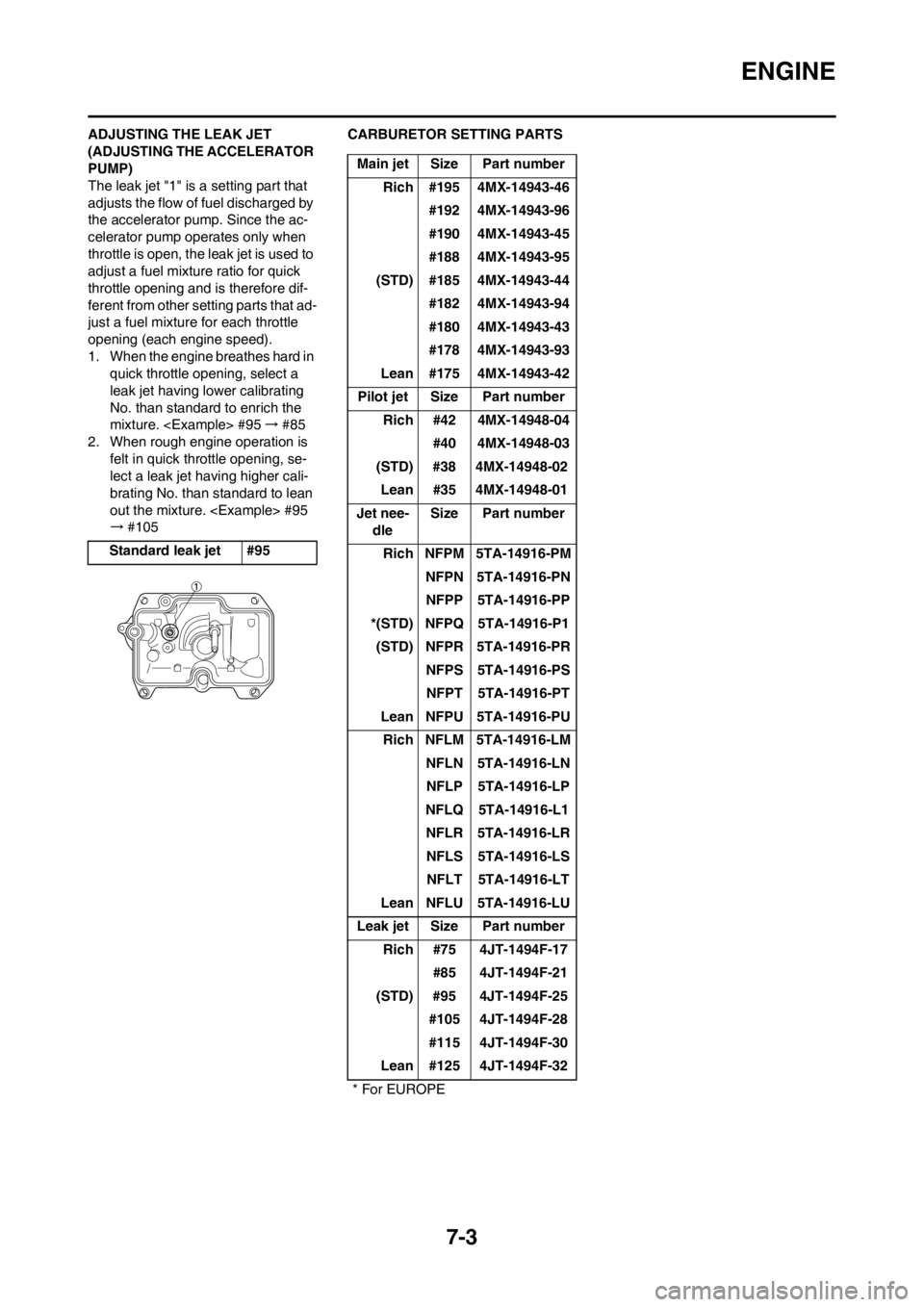
ADJUSTING THE LEAK JET
(ADJUSTING THE ACCELERATOR
PUMP)
The leak jet "1" is a setting part that
adjusts the flow of fuel discharged by
the accelerator pump. Since the ac-
celerator pump operates only when
throttle is open, the leak jet is used to
adjust a fuel mixture ratio for quick
throttle opening and is therefore dif-
ferent from other setting parts that ad-
just a fuel mixture for each throttle
opening (each engine speed).
1. When the engine breathes hard in
quick throttle opening, select a
leak jet having lower calibrating
No. than standard to enrich the
mixture.
2. When rough engine operation is
felt in quick throttle opening, se-
lect a leak jet having higher cali-
brating No. than standard to lean
out the mixture.
→#105CARBURETOR SETTING PARTS
Standard leak jet #95
Main jet Size Part number
Rich #195 4MX-14943-46
#192 4MX-14943-96
#190 4MX-14943-45
#188 4MX-14943-95
(STD) #185 4MX-14943-44
#182 4MX-14943-94
#180 4MX-14943-43
#178 4MX-14943-93
Lean #175 4MX-14943-42
Pilot jet Size Part number
Rich #42 4MX-14948-04
#40 4MX-14948-03
(STD) #38 4MX-14948-02
Lean #35 4MX-14948-01
Jet nee-
dleSize Part number
Rich NFPM 5TA-14916-PM
NFPN 5TA-14916-PN
NFPP 5TA-14916-PP
*(STD) NFPQ 5TA-14916-P1
(STD) NFPR 5TA-14916-PR
NFPS 5TA-14916-PS
NFPT 5TA-14916-PT
Lean NFPU 5TA-14916-PU
Rich NFLM 5TA-14916-LM
NFLN 5TA-14916-LN
NFLP 5TA-14916-LP
NFLQ 5TA-14916-L1
NFLR 5TA-14916-LR
NFLS 5TA-14916-LS
NFLT 5TA-14916-LT
Lean NFLU 5TA-14916-LU
Leak jet Size Part number
Rich #75 4JT-1494F-17
#85 4JT-1494F-21
(STD) #95 4JT-1494F-25
#105 4JT-1494F-28
#115 4JT-1494F-30
Lean #125 4JT-1494F-32
* For EUROPE
Page 190 of 198

7-4
ENGINE
SPECIFICATIONS OF JET NEEDLE
EXAMPLES OF CARBURETOR SETTING DEPENDING ON SYMPTOMFor USA, CDN, AUS, NZ and ZA
Diameter of straight portion
RichLean
NPQRS TU
Rich 1 richer NFPN-6 NFPP-6 NFPQ-6 NFPR-6 NFPS-6 NFPT-6 NFPU-6
0.5 richer NFLN-6 NFLP-6 NFLQ-6 NFLR-6 NFLS-6 NFLT-6 NFLU-6
STD NFPN-5 NFPP-5 NFPQ-5 NFPR-5 NFPS-5 NFPT-5 NFPU-5
0.5 leaner NFLN-5 NFLP-5 NFLQ-5 NFLR-5 NFLS-5 NFLT-5 NFLU-5
Lean 1 leaner NFPN-4 NFPP-4 NFPQ-4 NFPR-4 NFPS-4 NFPT-4 NFPU-4
For EUROPE
Diameter of straight portion
RichLean
MN P QR S T
Rich 1 richer NFPM-6 NFPN-6 NFPP-6 NFPQ-6 NFPR-6 NFPS-6 NFPT-6
0.5 richer NFLM-6 NFLN-6 NFLP-6 NFLQ-6 NFLR-6 NFLS-6 NFLT-6
STD NFPM-5 NFPN-5 NFPP-5 NFPQ-5 NFPR-5 NFPS-5 NFPT-5
0.5 leaner NFLM-5 NFLN-5 NFLP-5 NFLQ-5 NFLR-5 NFLS-5 NFLT-5
Lean 1 leaner NFPM-4 NFPN-4 NFPP-4 NFPQ-4 NFPR-4 NFPS-4 NFPT-4
Symptom Setting Checking
At full throttle
Hard breathing
Shearing noise
Whitish spark plug
↓
Lean mixtureIncrease main jet calibration no. (Gradual-
ly)Discoloration of spark plug→If tan color, it
is in good condition.
If cannot be corrected:
Clogged float valve seat
Clogged fuel hose
Clogged fuel cock
Check that the accelerator pump operates
smoothly.
At full throttle
Speed pick-up stops
Slow speed pick-up
Slow response
Sooty spark plug
↓
Rich mixtureDecrease main jet calibration no. (Gradual-
ly)Discoloration of spark plug→If tan color, it
is in good condition.
If cannot be corrected:
Clogged air filter
Fuel overflow from carburetor
Lean mixture Lower jet needle clip position. (1 groove
down)
The clip position is the jet needle groove on
which the clip is installed.
The positions are numbered from the top.
Check that the accelerator pump operates
smoothly. (except for rich mixture symp-
tom). Rich mixture Raise jet needle clip position. (1 groove up)
1/4–3/4 throttle
Hard breathing
Lack of speedLower jet needle clip position. (1 groove
down)
1/4–1/2 throttle
Slow speed pick-up
Poor accelerationRaise jet needle clip position. (1 groove up)
Jet needleClip
Groove 7 Groove 6
Groove 5
Groove 4
Groove 3
Groove 2
Groove 1
Leaner
(Standard)
Richer