oil YAMAHA YZ250F 2012 Manual Online
[x] Cancel search | Manufacturer: YAMAHA, Model Year: 2012, Model line: YZ250F, Model: YAMAHA YZ250F 2012Pages: 198, PDF Size: 11.78 MB
Page 160 of 198
5-21
FRONT FORK
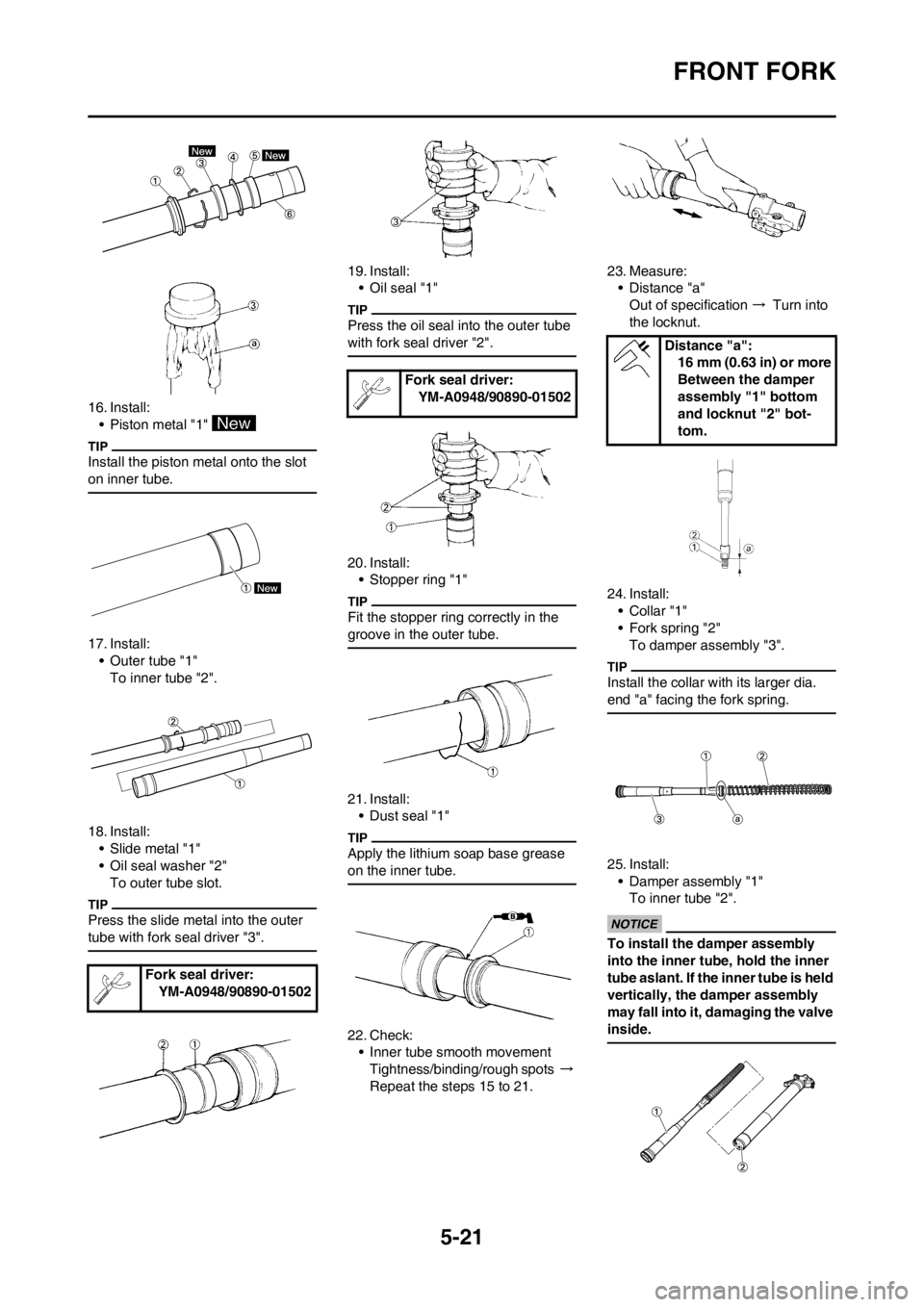
16. Install:
• Piston metal "1"
Install the piston metal onto the slot
on inner tube.
17. Install:
• Outer tube "1"
To inner tube "2".
18. Install:
• Slide metal "1"
• Oil seal washer "2"
To outer tube slot.
Press the slide metal into the outer
tube with fork seal driver "3".
19. Install:
• Oil seal "1"
Press the oil seal into the outer tube
with fork seal driver "2".
20. Install:
• Stopper ring "1"
Fit the stopper ring correctly in the
groove in the outer tube.
21. Install:
• Dust seal "1"
Apply the lithium soap base grease
on the inner tube.
22. Check:
• Inner tube smooth movement
Tightness/binding/rough spots →
Repeat the steps 15 to 21.23. Measure:
• Distance "a"
Out of specification → Turn into
the locknut.
24. Install:
•Collar "1"
• Fork spring "2"
To damper assembly "3".
Install the collar with its larger dia.
end "a" facing the fork spring.
25. Install:
• Damper assembly "1"
To inner tube "2".
To install the damper assembly
into the inner tube, hold the inner
tube aslant. If the inner tube is held
vertically, the damper assembly
may fall into it, damaging the valve
inside.
Fork seal driver:
YM-A0948/90890-01502
Fork seal driver:
YM-A0948/90890-01502
Distance "a":
16 mm (0.63 in) or more
Between the damper
assembly "1" bottom
and locknut "2" bot-
tom.
Page 161 of 198
5-22
FRONT FORK
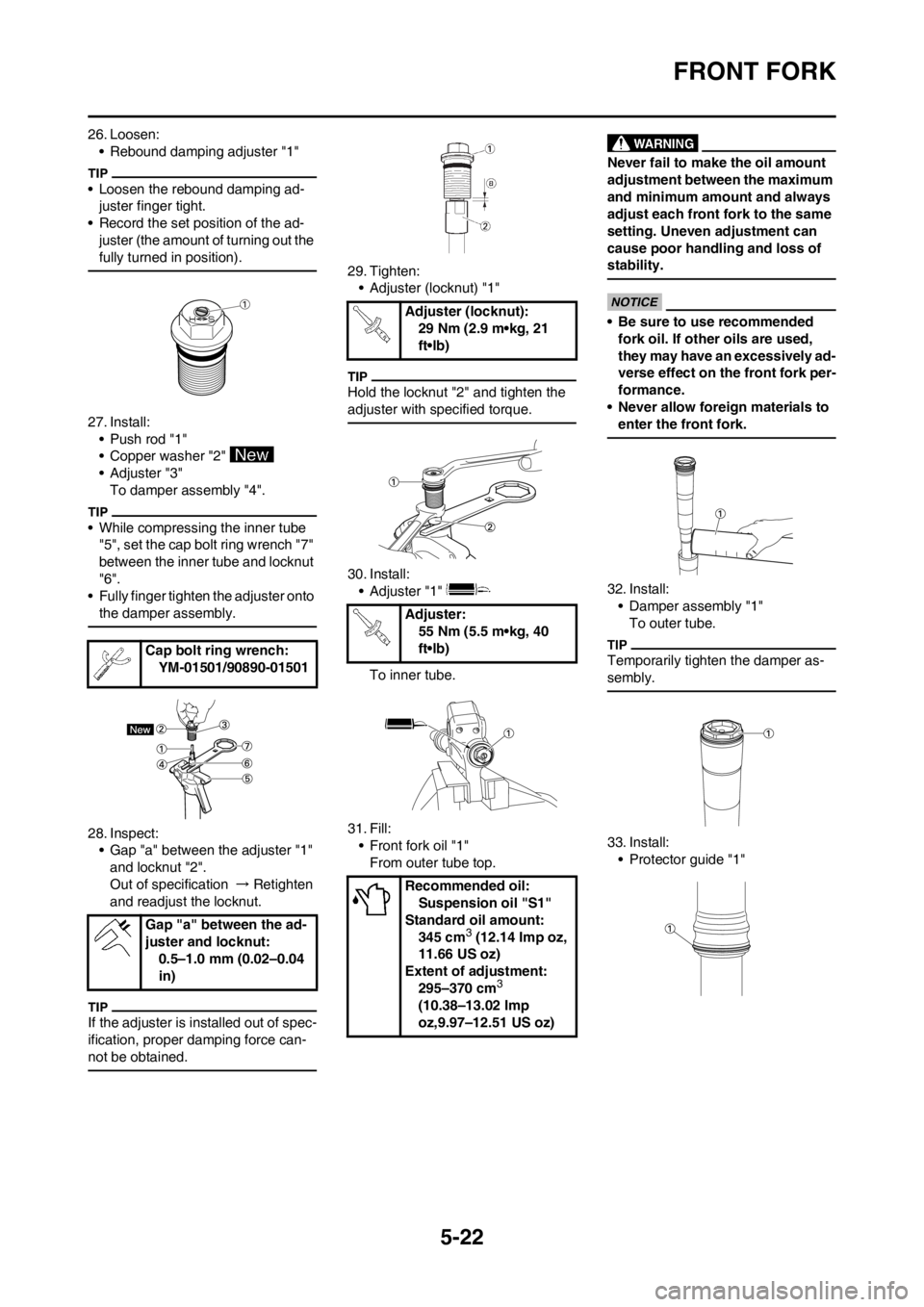
26. Loosen:
• Rebound damping adjuster "1"
• Loosen the rebound damping ad-
juster finger tight.
• Record the set position of the ad-
juster (the amount of turning out the
fully turned in position).
27. Install:
• Push rod "1"
• Copper washer "2"
• Adjuster "3"
To damper assembly "4".
• While compressing the inner tube
"5", set the cap bolt ring wrench "7"
between the inner tube and locknut
"6".
• Fully finger tighten the adjuster onto
the damper assembly.
28. Inspect:
• Gap "a" between the adjuster "1"
and locknut "2".
Out of specification → Retighten
and readjust the locknut.
If the adjuster is installed out of spec-
ification, proper damping force can-
not be obtained.
29. Tighten:
• Adjuster (locknut) "1"
Hold the locknut "2" and tighten the
adjuster with specified torque.
30. Install:
• Adjuster "1"
To inner tube.
31. Fill:
• Front fork oil "1"
From outer tube top.
Never fail to make the oil amount
adjustment between the maximum
and minimum amount and always
adjust each front fork to the same
setting. Uneven adjustment can
cause poor handling and loss of
stability.
• Be sure to use recommended
fork oil. If other oils are used,
they may have an excessively ad-
verse effect on the front fork per-
formance.
• Never allow foreign materials to
enter the front fork.
32. Install:
• Damper assembly "1"
To outer tube.
Temporarily tighten the damper as-
sembly.
33. Install:
• Protector guide "1" Cap bolt ring wrench:
YM-01501/90890-01501
Gap "a" between the ad-
juster and locknut:
0.5–1.0 mm (0.02–0.04
in)
Adjuster (locknut):
29 Nm (2.9 m•kg, 21
ft•lb)
Adjuster:
55 Nm (5.5 m•kg, 40
ft•lb)
Recommended oil:
Suspension oil "S1"
Standard oil amount:
345 cm
3 (12.14 Imp oz,
11.66 US oz)
Extent of adjustment:
295–370 cm
3
(10.38–13.02 Imp
oz,9.97–12.51 US oz)
Page 165 of 198
5-26
HANDLEBAR
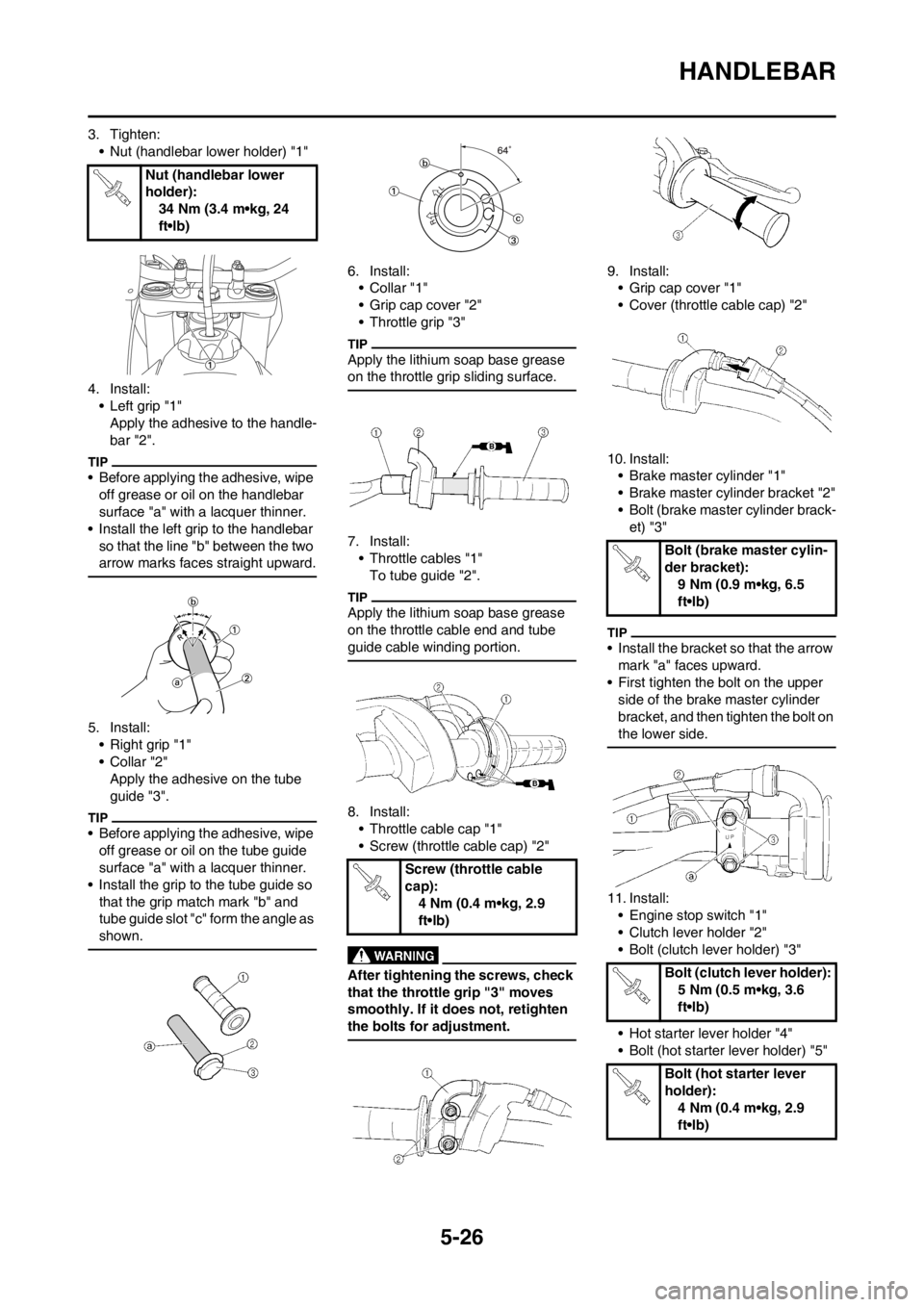
3. Tighten:
• Nut (handlebar lower holder) "1"
4. Install:
• Left grip "1"
Apply the adhesive to the handle-
bar "2".
• Before applying the adhesive, wipe
off grease or oil on the handlebar
surface "a" with a lacquer thinner.
• Install the left grip to the handlebar
so that the line "b" between the two
arrow marks faces straight upward.
5. Install:
• Right grip "1"
•Collar "2"
Apply the adhesive on the tube
guide "3".
• Before applying the adhesive, wipe
off grease or oil on the tube guide
surface "a" with a lacquer thinner.
• Install the grip to the tube guide so
that the grip match mark "b" and
tube guide slot "c" form the angle as
shown.
6. Install:
• Collar "1"
• Grip cap cover "2"
• Throttle grip "3"
Apply the lithium soap base grease
on the throttle grip sliding surface.
7. Install:
• Throttle cables "1"
To tube guide "2".
Apply the lithium soap base grease
on the throttle cable end and tube
guide cable winding portion.
8. Install:
• Throttle cable cap "1"
• Screw (throttle cable cap) "2"
After tightening the screws, check
that the throttle grip "3" moves
smoothly. If it does not, retighten
the bolts for adjustment.
9. Install:
• Grip cap cover "1"
• Cover (throttle cable cap) "2"
10. Install:
• Brake master cylinder "1"
• Brake master cylinder bracket "2"
• Bolt (brake master cylinder brack-
et) "3"
• Install the bracket so that the arrow
mark "a" faces upward.
• First tighten the bolt on the upper
side of the brake master cylinder
bracket, and then tighten the bolt on
the lower side.
11. Install:
• Engine stop switch "1"
• Clutch lever holder "2"
• Bolt (clutch lever holder) "3"
• Hot starter lever holder "4"
• Bolt (hot starter lever holder) "5" Nut (handlebar lower
holder):
34 Nm (3.4 m•kg, 24
ft•lb)
Screw (throttle cable
cap):
4 Nm (0.4 m•kg, 2.9
ft•lb)
Bolt (brake master cylin-
der bracket):
9 Nm (0.9 m•kg, 6.5
ft•lb)
Bolt (clutch lever holder):
5 Nm (0.5 m•kg, 3.6
ft•lb)
Bolt (hot starter lever
holder):
4 Nm (0.4 m•kg, 2.9
ft•lb)
Page 171 of 198
5-32
SWINGARM
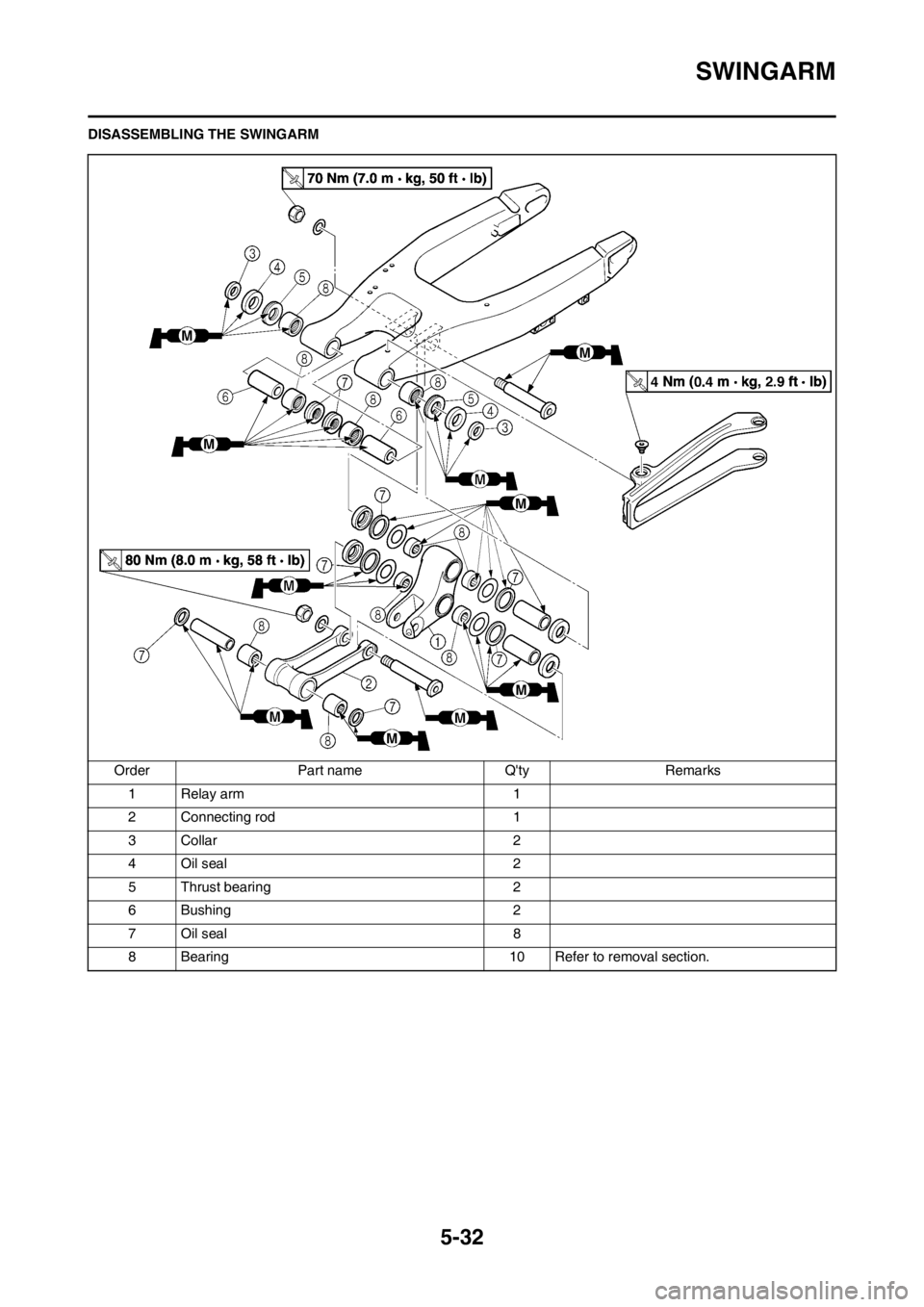
DISASSEMBLING THE SWINGARM
Order Part name Q'ty Remarks
1 Relay arm 1
2 Connecting rod 1
3 Collar 2
4 Oil seal 2
5 Thrust bearing 2
6 Bushing 2
7 Oil seal 8
8 Bearing 10 Refer to removal section.
Page 172 of 198
5-33
SWINGARM
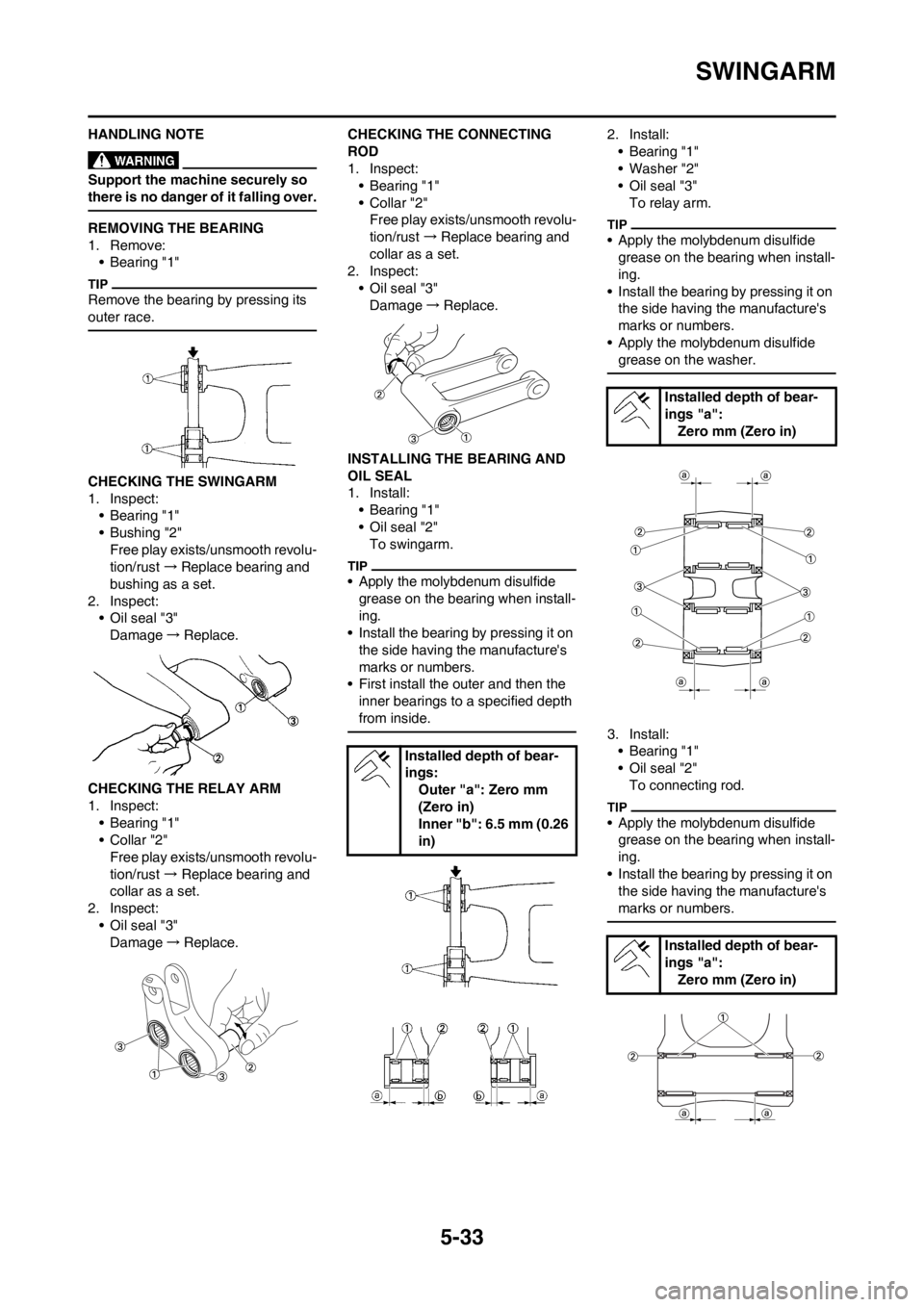
HANDLING NOTE
Support the machine securely so
there is no danger of it falling over.
REMOVING THE BEARING
1. Remove:
• Bearing "1"
Remove the bearing by pressing its
outer race.
CHECKING THE SWINGARM
1. Inspect:
• Bearing "1"
• Bushing "2"
Free play exists/unsmooth revolu-
tion/rust →Replace bearing and
bushing as a set.
2. Inspect:
• Oil seal "3"
Damage→Replace.
CHECKING THE RELAY ARM
1. Inspect:
• Bearing "1"
•Collar "2"
Free play exists/unsmooth revolu-
tion/rust → Replace bearing and
collar as a set.
2. Inspect:
• Oil seal "3"
Damage→Replace.CHECKING THE CONNECTING
ROD
1. Inspect:
•Bearing "1"
• Collar "2"
Free play exists/unsmooth revolu-
tion/rust →Replace bearing and
collar as a set.
2. Inspect:
• Oil seal "3"
Damage→Replace.
INSTALLING THE BEARING AND
OIL SEAL
1. Install:
•Bearing "1"
• Oil seal "2"
To swingarm.
• Apply the molybdenum disulfide
grease on the bearing when install-
ing.
• Install the bearing by pressing it on
the side having the manufacture's
marks or numbers.
• First install the outer and then the
inner bearings to a specified depth
from inside.
2. Install:
• Bearing "1"
• Washer "2"
• Oil seal "3"
To relay arm.
• Apply the molybdenum disulfide
grease on the bearing when install-
ing.
• Install the bearing by pressing it on
the side having the manufacture's
marks or numbers.
• Apply the molybdenum disulfide
grease on the washer.
3. Install:
• Bearing "1"
• Oil seal "2"
To connecting rod.
• Apply the molybdenum disulfide
grease on the bearing when install-
ing.
• Install the bearing by pressing it on
the side having the manufacture's
marks or numbers.
Installed depth of bear-
ings:
Outer "a": Zero mm
(Zero in)
Inner "b": 6.5 mm (0.26
in)
Installed depth of bear-
ings "a":
Zero mm (Zero in)
Installed depth of bear-
ings "a":
Zero mm (Zero in)
Page 173 of 198
5-34
SWINGARM
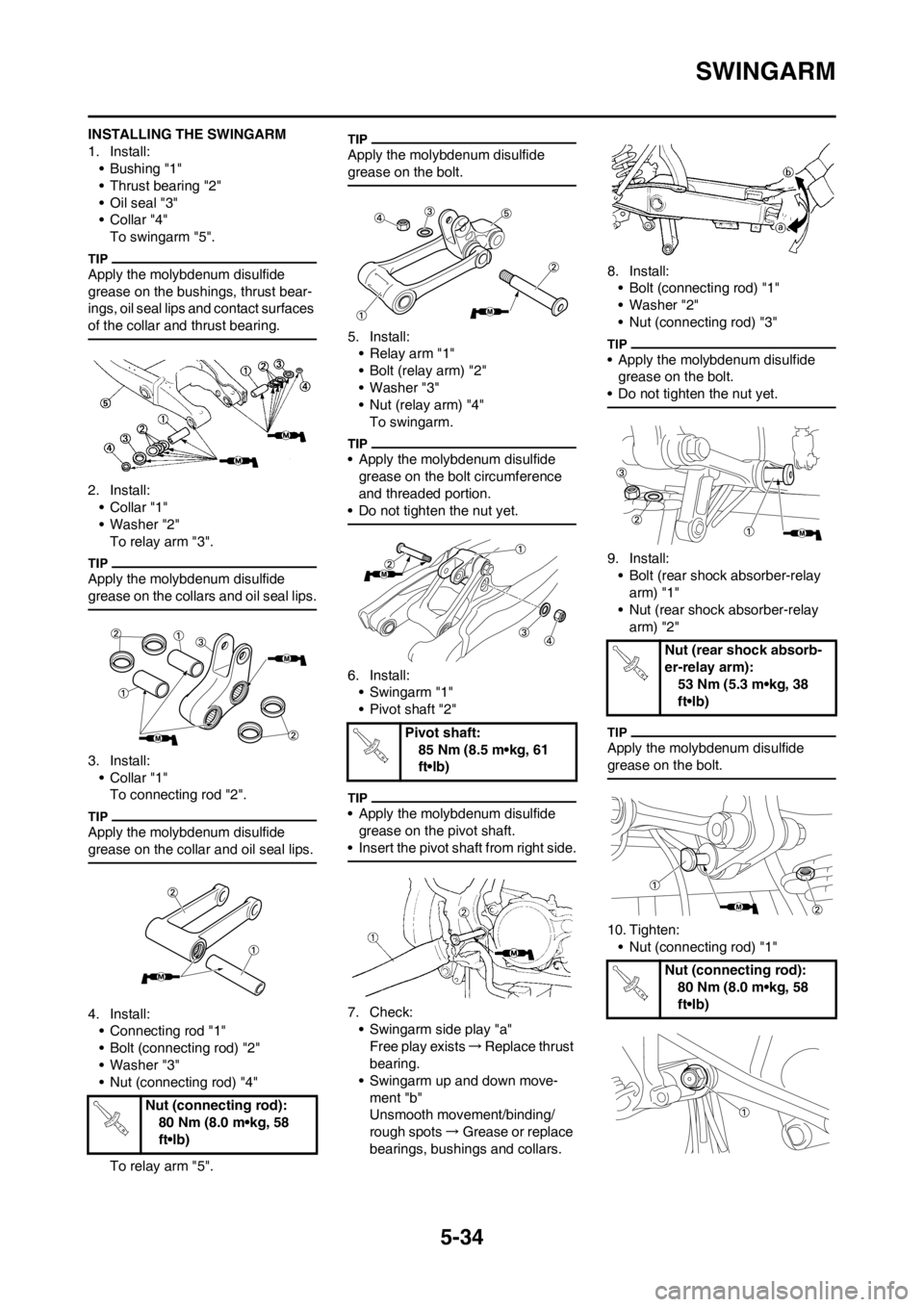
INSTALLING THE SWINGARM
1. Install:
• Bushing "1"
• Thrust bearing "2"
• Oil seal "3"
•Collar "4"
To swingarm "5".
Apply the molybdenum disulfide
grease on the bushings, thrust bear-
ings, oil seal lips and contact surfaces
of the collar and thrust bearing.
2. Install:
•Collar "1"
• Washer "2"
To relay arm "3".
Apply the molybdenum disulfide
grease on the collars and oil seal lips.
3. Install:
•Collar "1"
To connecting rod "2".
Apply the molybdenum disulfide
grease on the collar and oil seal lips.
4. Install:
• Connecting rod "1"
• Bolt (connecting rod) "2"
• Washer "3"
• Nut (connecting rod) "4"
To relay arm "5".
Apply the molybdenum disulfide
grease on the bolt.
5. Install:
• Relay arm "1"
• Bolt (relay arm) "2"
• Washer "3"
• Nut (relay arm) "4"
To swingarm.
• Apply the molybdenum disulfide
grease on the bolt circumference
and threaded portion.
• Do not tighten the nut yet.
6. Install:
• Swingarm "1"
• Pivot shaft "2"
• Apply the molybdenum disulfide
grease on the pivot shaft.
• Insert the pivot shaft from right side.
7. Check:
• Swingarm side play "a"
Free play exists→Replace thrust
bearing.
• Swingarm up and down move-
ment "b"
Unsmooth movement/binding/
rough spots →Grease or replace
bearings, bushings and collars.8. Install:
• Bolt (connecting rod) "1"
• Washer "2"
• Nut (connecting rod) "3"
• Apply the molybdenum disulfide
grease on the bolt.
• Do not tighten the nut yet.
9. Install:
• Bolt (rear shock absorber-relay
arm) "1"
• Nut (rear shock absorber-relay
arm) "2"
Apply the molybdenum disulfide
grease on the bolt.
10. Tighten:
• Nut (connecting rod) "1"
Nut (connecting rod):
80 Nm (8.0 m•kg, 58
ft•lb)
Pivot shaft:
85 Nm (8.5 m•kg, 61
ft•lb)
Nut (rear shock absorb-
er-relay arm):
53 Nm (5.3 m•kg, 38
ft•lb)
Nut (connecting rod):
80 Nm (8.0 m•kg, 58
ft•lb)
Page 176 of 198
5-37
REAR SHOCK ABSORBER
HANDLING NOTE
• Support the machine securely so
there is no danger of it falling
over.
• This rear shock absorber is pro-
vided with a separate type tank
filled with high-pressure nitro-
gen gas. To prevent the danger
of explosion, read and under-
stand the following information
before handling the shock ab-
sorber. The manufacturer can
not be held responsible for prop-
erty damage or personal injury
that may result from improper
handling.
• Never tamper or attempt to dis-
assemble the cylinder or the
tank.
• Never throw the rear shock ab-
sorber into an open flame or
other high heat. The rear shock
absorber may explode as a re-
sult of nitrogen gas expansion
and/ or damage to the hose.
• Be careful not to damage any
part of the gas tank. A damaged
gas tank will impair the damp-
ing performance or cause a
malfunction.
• Take care not to scratch the
contact surface of the piston
rod with the cylinder; or oil
could leak out.
• Never attempt to remove the
plug at the bottom of the nitro-
gen gas tank. It is very danger-
ous to remove the plug.
• When scrapping the rear shock
absorber, follow the instruc-
tions on disposal.
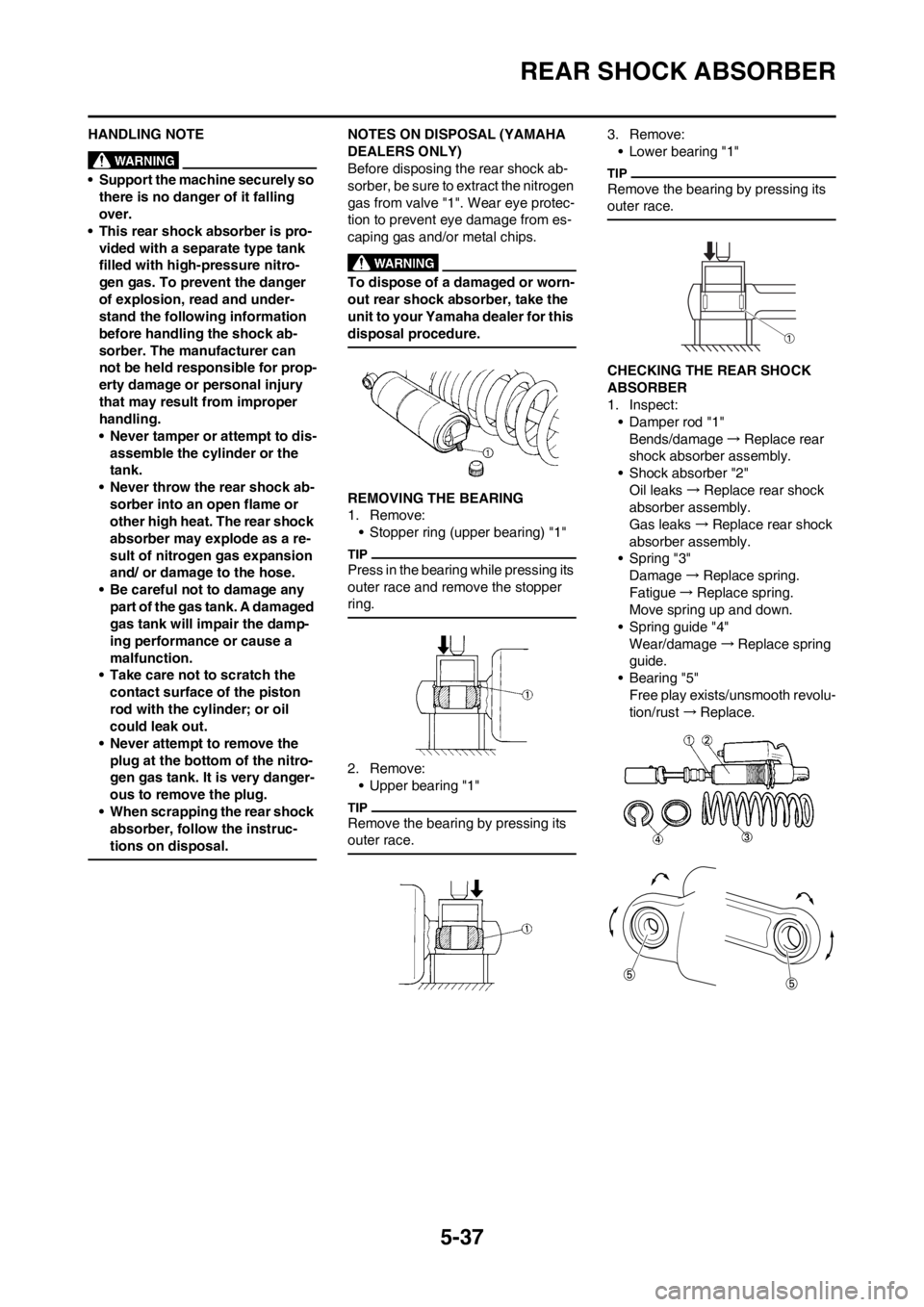
NOTES ON DISPOSAL (YAMAHA
DEALERS ONLY)
Before disposing the rear shock ab-
sorber, be sure to extract the nitrogen
gas from valve "1". Wear eye protec-
tion to prevent eye damage from es-
caping gas and/or metal chips.
To dispose of a damaged or worn-
out rear shock absorber, take the
unit to your Yamaha dealer for this
disposal procedure.
REMOVING THE BEARING
1. Remove:
• Stopper ring (upper bearing) "1"
Press in the bearing while pressing its
outer race and remove the stopper
ring.
2. Remove:
• Upper bearing "1"
Remove the bearing by pressing its
outer race.
3. Remove:
• Lower bearing "1"
Remove the bearing by pressing its
outer race.
CHECKING THE REAR SHOCK
ABSORBER
1. Inspect:
• Damper rod "1"
Bends/damage→Replace rear
shock absorber assembly.
• Shock absorber "2"
Oil leaks→Replace rear shock
absorber assembly.
Gas leaks→Replace rear shock
absorber assembly.
• Spring "3"
Damage→Replace spring.
Fatigue→Replace spring.
Move spring up and down.
• Spring guide "4"
Wear/damage→Replace spring
guide.
• Bearing "5"
Free play exists/unsmooth revolu-
tion/rust →Replace.
Page 180 of 198
6-2
ELECTRICAL COMPONENTS AND WIRING DIAGRAM
ELECTRICAL
COMPONENTS AND
WIRING DIAGRAM
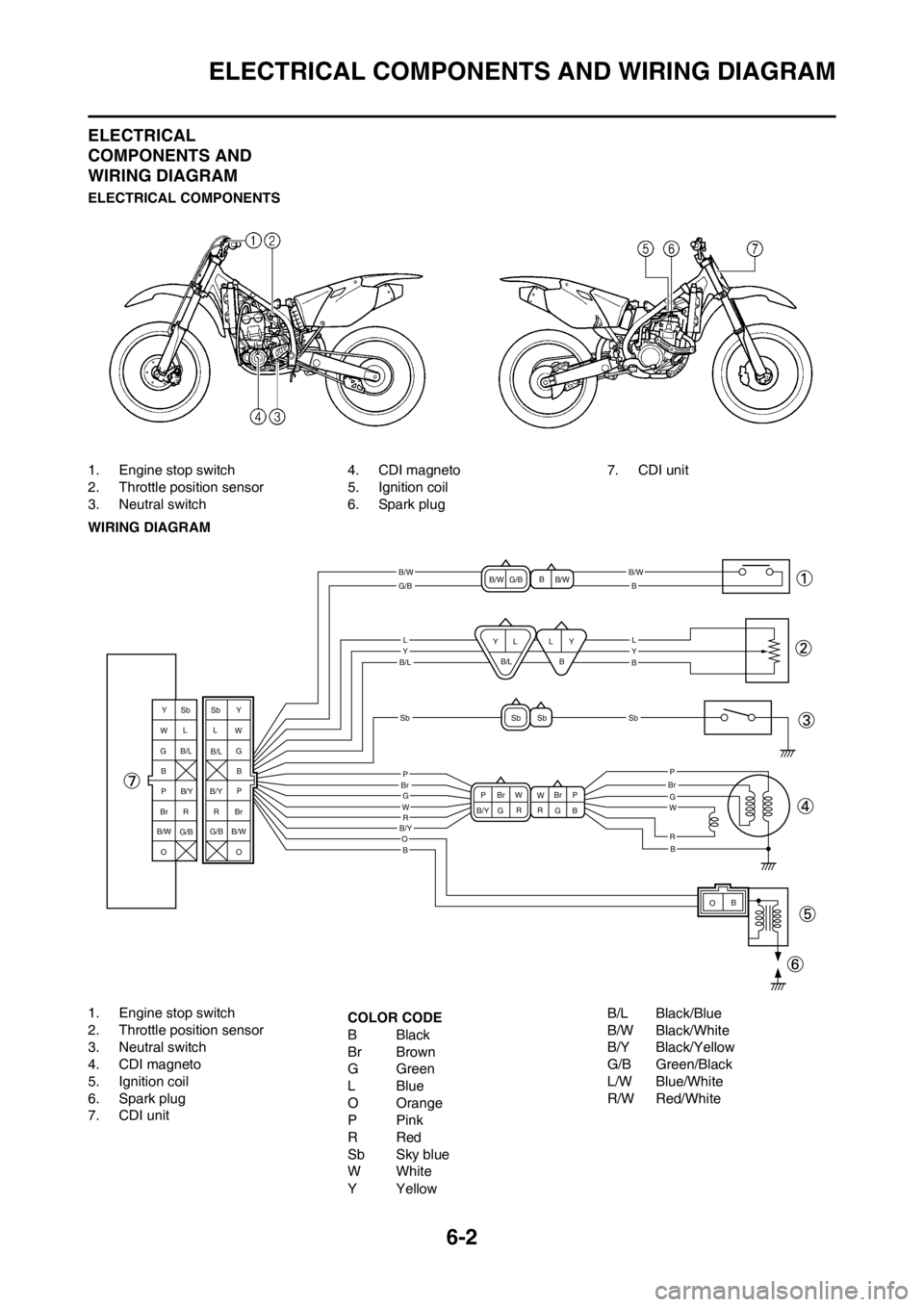
ELECTRICAL COMPONENTS
1. Engine stop switch
2. Throttle position sensor
3. Neutral switch4. CDI magneto
5. Ignition coil
6. Spark plug7. CDI unit
WIRING DIAGRAM
1. Engine stop switch
2. Throttle position sensor
3. Neutral switch
4. CDI magneto
5. Ignition coil
6. Spark plug
7. CDI unit COLOR CODE
BBlack
Br Brown
GGreen
LBlue
O Orange
PPink
RRed
Sb Sky blue
WWhite
YYellowB/L Black/Blue
B/W Black/White
B/Y Black/Yellow
G/B Green/Black
L/W Blue/White
R/W Red/White
B/WB/W
B/L
B/Y
SbSb
G/B
LYLY
P
B
B
B
B
G
O
WR
P
GW
R
P
B
Br W
W
B/Y G Br
G
RR
OB
Sb Sb
Y
Y
W Y
W
GG B
P P
Br BrRR
O L
B
Sb Y
LL
B/L
B/W
B/W
G/B
B
B
B/L
L
Sb
B/L
G/B
G/B B/Y
B/Y
B/W O
B/W
BrBrP
Page 181 of 198
6-3
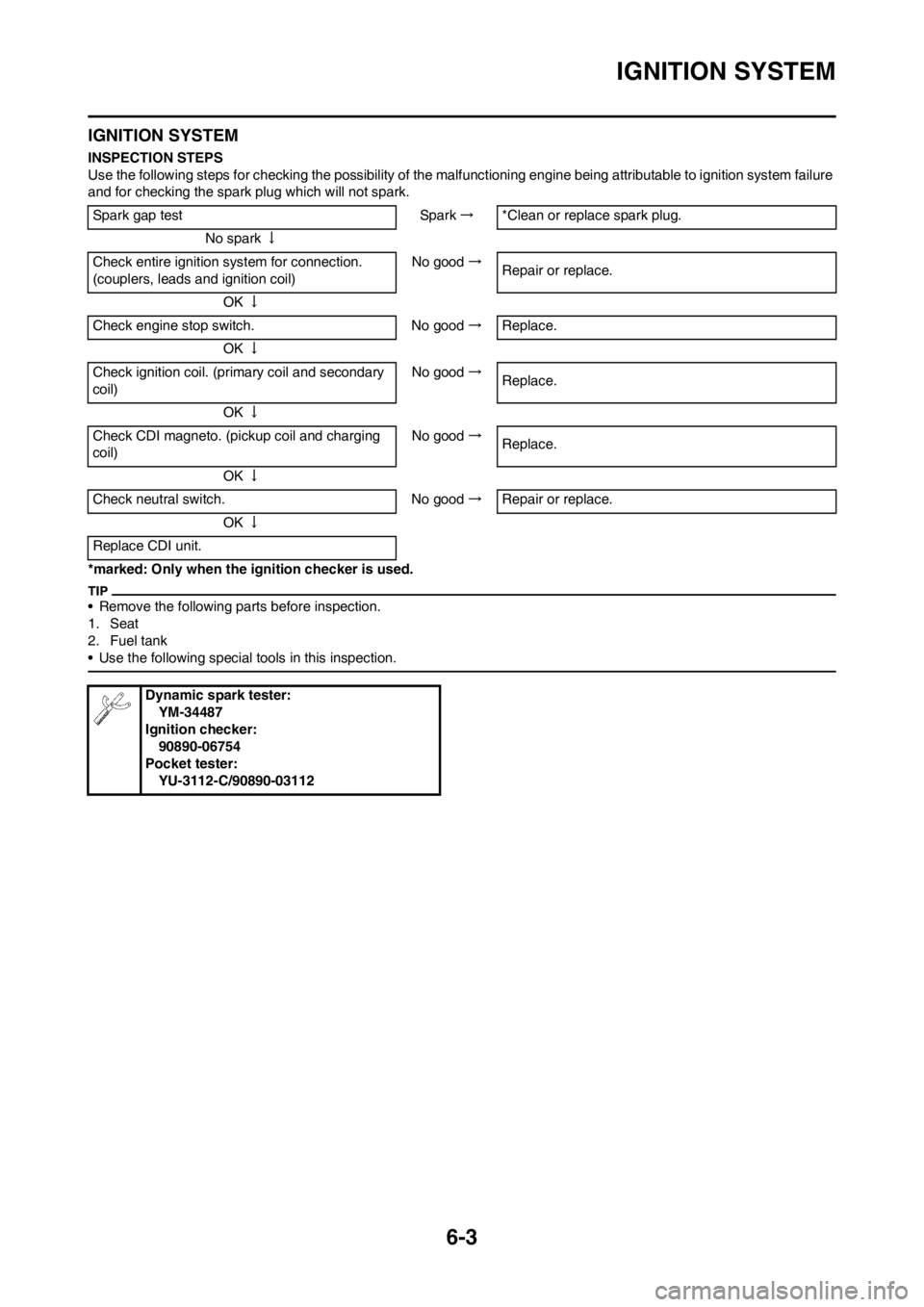
IGNITION SYSTEM
IGNITION SYSTEM
INSPECTION STEPS
Use the following steps for checking the possibility of the malfunctioning engine being attributable to ignition system failure
and for checking the spark plug which will not spark.
*marked: Only when the ignition checker is used.
• Remove the following parts before inspection.
1. Seat
2. Fuel tank
• Use the following special tools in this inspection.
Spark gap test Spark→*Clean or replace spark plug.
No spark↓
Check entire ignition system for connection.
(couplers, leads and ignition coil)No good→
Repair or replace.
OK↓
Check engine stop switch. No good→Replace.
OK↓
Check ignition coil. (primary coil and secondary
coil)No good→
Replace.
OK↓
Check CDI magneto. (pickup coil and charging
coil)No good→
Replace.
OK↓
Check neutral switch. No good→Repair or replace.
OK↓
Replace CDI unit.
Dynamic spark tester:
YM-34487
Ignition checker:
90890-06754
Pocket tester:
YU-3112-C/90890-03112
Page 182 of 198
6-4
IGNITION SYSTEM
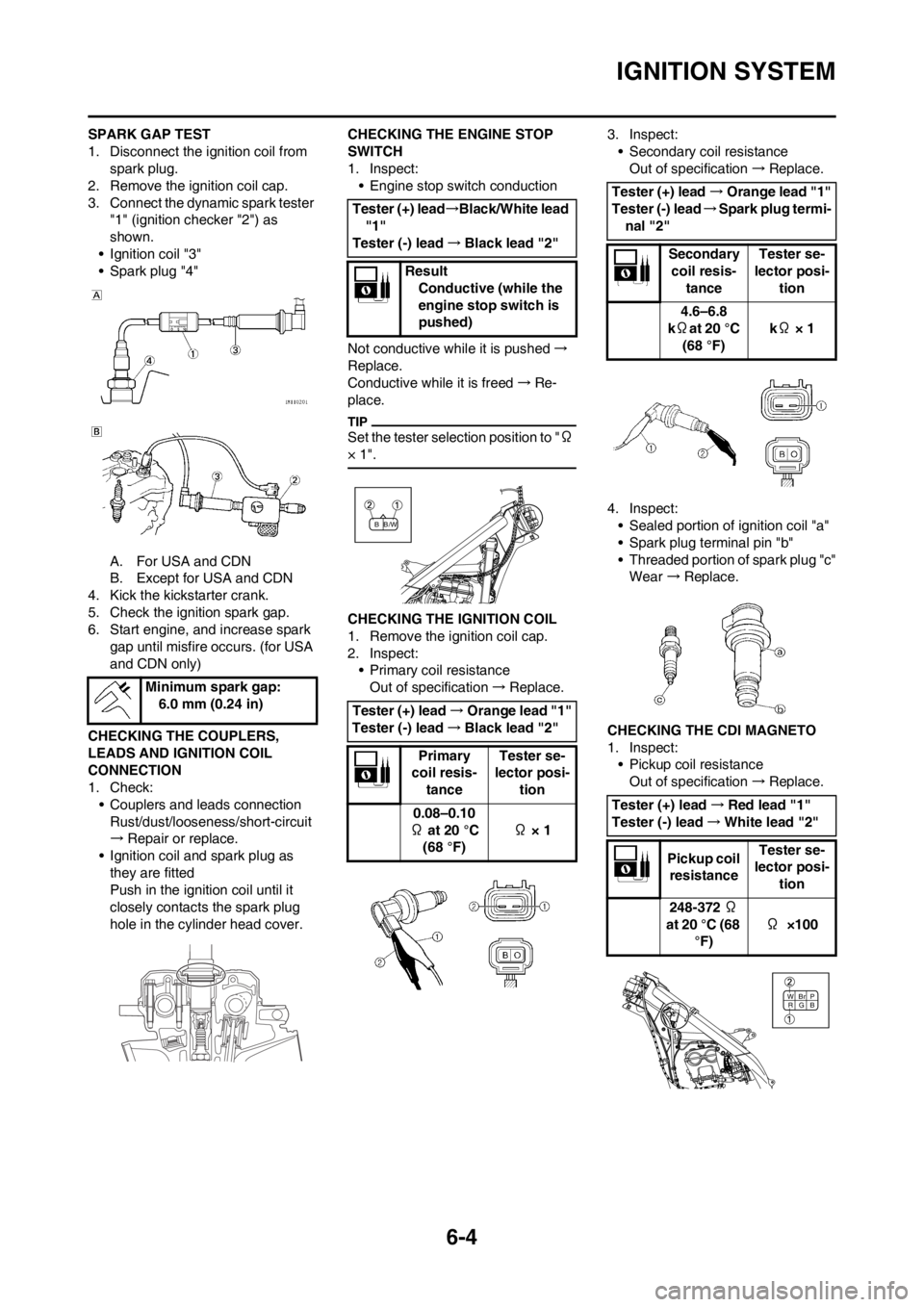
SPARK GAP TEST
1. Disconnect the ignition coil from
spark plug.
2. Remove the ignition coil cap.
3. Connect the dynamic spark tester
"1" (ignition checker "2") as
shown.
• Ignition coil "3"
• Spark plug "4"
A. For USA and CDN
B. Except for USA and CDN
4. Kick the kickstarter crank.
5. Check the ignition spark gap.
6. Start engine, and increase spark
gap until misfire occurs. (for USA
and CDN only)
CHECKING THE COUPLERS,
LEADS AND IGNITION COIL
CONNECTION
1. Check:
• Couplers and leads connection
Rust/dust/looseness/short-circuit
→Repair or replace.
• Ignition coil and spark plug as
they are fitted
Push in the ignition coil until it
closely contacts the spark plug
hole in the cylinder head cover.CHECKING THE ENGINE STOP
SWITCH
1. Inspect:
• Engine stop switch conduction
Not conductive while it is pushed→
Replace.
Conductive while it is freed→Re-
place.
Set the tester selection position to "Ω
× 1".
CHECKING THE IGNITION COIL
1. Remove the ignition coil cap.
2. Inspect:
• Primary coil resistance
Out of specification→Replace.3. Inspect:
• Secondary coil resistance
Out of specification→Replace.
4. Inspect:
• Sealed portion of ignition coil "a"
• Spark plug terminal pin "b"
• Threaded portion of spark plug "c"
Wear →Replace.
CHECKING THE CDI MAGNETO
1. Inspect:
• Pickup coil resistance
Out of specification→Replace. Minimum spark gap:
6.0 mm (0.24 in)
Tester (+) lead→Black/White lead
"1"
Tester (-) lead→Black lead "2"
Result
Conductive (while the
engine stop switch is
pushed)
Tester (+) lead→Orange lead "1"
Tester (-) lead→Black lead "2"
Primary
coil resis-
tanceTester se-
lector posi-
tion
0.08–0.10
Ω at 20 °C
(68 °F) Ω × 1
/W BB
Tester (+) lead→Orange lead "1"
Tester (-) lead→Spark plug termi-
nal "2"
Secondary
coil resis-
tanceTester se-
lector posi-
tion
4.6–6.8
kΩat 20 °C
(68 °F) kΩ × 1
Tester (+) lead→Red lead "1"
Tester (-) lead→White lead "2"
Pickup coil
resistanceTester se-
lector posi-
tion
248-372 Ω
at 20 °C (68
°F)Ω ×100
B WBr
GP
R