lock YAMAHA YZ250F 2014 User Guide
[x] Cancel search | Manufacturer: YAMAHA, Model Year: 2014, Model line: YZ250F, Model: YAMAHA YZ250F 2014Pages: 356, PDF Size: 11.39 MB
Page 60 of 356
TIGHTENING TORQUES
2-17
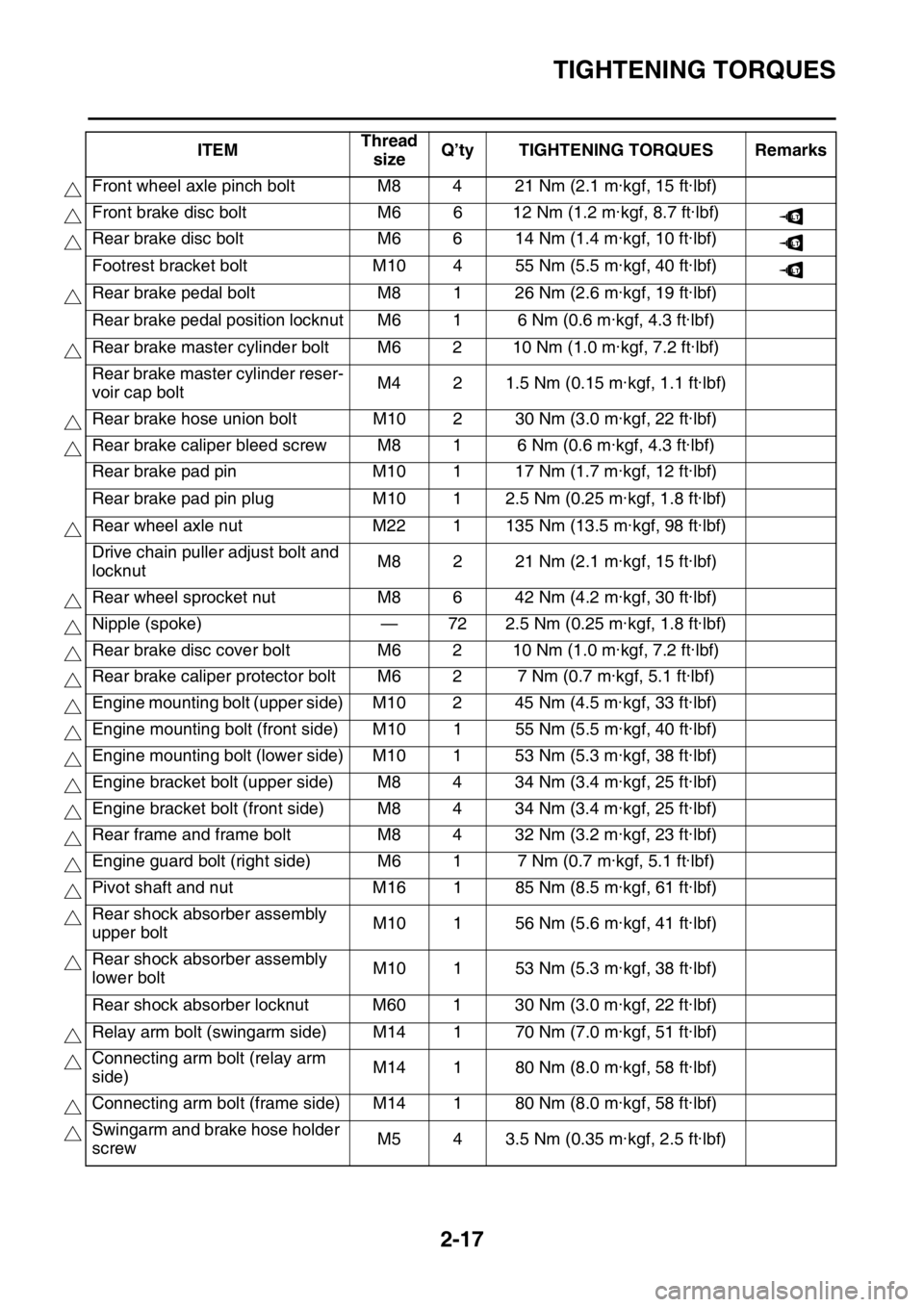
Front wheel axle pinch bolt M8 4 21 Nm (2.1 m·kgf, 15 ft·lbf)
Front brake disc bolt M6 6 12 Nm (1.2 m·kgf, 8.7 ft·lbf)
Rear brake disc bolt M6 6 14 Nm (1.4 m·kgf, 10 ft·lbf)
Footrest bracket bolt M10 4 55 Nm (5.5 m·kgf, 40 ft·lbf)
Rear brake pedal bolt M8 1 26 Nm (2.6 m·kgf, 19 ft·lbf)
Rear brake pedal position locknut M6 1 6 Nm (0.6 m·kgf, 4.3 ft·lbf)
Rear brake master cylinder bolt M6 2 10 Nm (1.0 m·kgf, 7.2 ft·lbf)
Rear brake master cylinder reser-
voir cap boltM4 2 1.5 Nm (0.15 m·kgf, 1.1 ft·lbf)
Rear brake hose union bolt M10 2 30 Nm (3.0 m·kgf, 22 ft·lbf)
Rear brake caliper bleed screw M8 1 6 Nm (0.6 m·kgf, 4.3 ft·lbf)
Rear brake pad pin M10 1 17 Nm (1.7 m·kgf, 12 ft·lbf)
Rear brake pad pin plug M10 1 2.5 Nm (0.25 m·kgf, 1.8 ft·lbf)
Rear wheel axle nut M22 1 135 Nm (13.5 m·kgf, 98 ft·lbf)
Drive chain puller adjust bolt and
locknutM8 2 21 Nm (2.1 m·kgf, 15 ft·lbf)
Rear wheel sprocket nut M8 6 42 Nm (4.2 m·kgf, 30 ft·lbf)
Nipple (spoke) — 72 2.5 Nm (0.25 m·kgf, 1.8 ft·lbf)
Rear brake disc cover bolt M6 2 10 Nm (1.0 m·kgf, 7.2 ft·lbf)
Rear brake caliper protector bolt M6 2 7 Nm (0.7 m·kgf, 5.1 ft·lbf)
Engine mounting bolt (upper side) M10 2 45 Nm (4.5 m·kgf, 33 ft·lbf)
Engine mounting bolt (front side) M10 1 55 Nm (5.5 m·kgf, 40 ft·lbf)
Engine mounting bolt (lower side) M10 1 53 Nm (5.3 m·kgf, 38 ft·lbf)
Engine bracket bolt (upper side) M8 4 34 Nm (3.4 m·kgf, 25 ft·lbf)
Engine bracket bolt (front side) M8 4 34 Nm (3.4 m·kgf, 25 ft·lbf)
Rear frame and frame bolt M8 4 32 Nm (3.2 m·kgf, 23 ft·lbf)
Engine guard bolt (right side) M6 1 7 Nm (0.7 m·kgf, 5.1 ft·lbf)
Pivot shaft and nut M16 1 85 Nm (8.5 m·kgf, 61 ft·lbf)
Rear shock absorber assembly
upper boltM10 1 56 Nm (5.6 m·kgf, 41 ft·lbf)
Rear shock absorber assembly
lower boltM10 1 53 Nm (5.3 m·kgf, 38 ft·lbf)
Rear shock absorber locknut M60 1 30 Nm (3.0 m·kgf, 22 ft·lbf)
Relay arm bolt (swingarm side) M14 1 70 Nm (7.0 m·kgf, 51 ft·lbf)
Connecting arm bolt (relay arm
side)M14 1 80 Nm (8.0 m·kgf, 58 ft·lbf)
Connecting arm bolt (frame side) M14 1 80 Nm (8.0 m·kgf, 58 ft·lbf)
Swingarm and brake hose holder
screwM5 4 3.5 Nm (0.35 m·kgf, 2.5 ft·lbf) ITEMThread
sizeQ’ty TIGHTENING TORQUES Remarks
LT
LT
LT
Page 75 of 356

CABLE ROUTING DIAGRAM
2-32
1. Clutch cable
2. Throttle cable (pull)
3. Throttle cable (return)
4. Cable holder
5. Engine stop switch lead
6. Frame
7. Coupler for connecting optional part
8. Bracket
9. Engine stop switch coupler
10. Rectifier/regulator coupler
11. Starter knob/idle screw
12. Neutral switch lead
13. Crankcase cover
14. AC magneto lead
15. Front engine bracket
16. Radiator hose
17. Coupler cover
18. Rectifier/regulator lead
19. Tension arm
20. Main harness
21. Tank rail
22. Radiator
23. Cylinder head breather hose
24. Radiator breather hose
25. Down tube
26. Crankcase
A. Pass the engine stop switch lead between the
frame and the cable holder.
B. Pass the engine stop switch lead between the
coupler for connecting optional part and the
frame, where the main harness should face the
outside of the vehicle.
C. Insert the coupler for connecting optional part into
the connector, and fix it to the bracket.
D. Insert and fix the engine stop switch coupler to
the bracket.
E. Insert and fix the rectifier/regulator coupler to the
bracket.
F. Pass the AC magneto lead to the front of the ve-
hicle beyond the starter knob/idle screw and to
the rear of the vehicle beyond the radiator. No
pinch is allowed between the radiator and the
tension arm.
G. 70 mm (2.76 in)
H. Bring the neutral switch lead into line with the
crankcase cover with no sag allowed.
I. Bring the AC magneto lead into line with the
clutch cable with no sag allowed.
J. Pass the neutral switch lead to the inside of the
front engine bracket (the side of the vehicle).
K. Clamp the clutch cable and the AC magneto lead
by the plastic locking tie. Regardless of the orien-
tation of the lock on the plastic locking tie, cut the
end.
L. Pass the clutch cable with no downward sag al-
lowed.
M. Bring the grommet of the clutch cable into contact
with the radiator hose, and pass it to the outside
of the neutral switch lead and the AC magneto
lead (the outside of the vehicle).
N. 40 mm (1.57 in)
O. Clamp the clutch cable, the AC magneto lead,
and the neutral switch lead by the plastic locking
tie. Make sure that they are clamped at the posi-
tioning tape in the clutch cable. Make the lock on
the plastic locking tie face the front of the vehicle,
and cut the end.
P. After connecting the neutral switch coupler, at-
tach the coupler cover.
Q. After connecting the AC magneto coupler, attach
the coupler cover.R. Pass the rectifier/regulator lead to the inside of
the tension arm (the side of the vehicle).
S. Pass the main harness to the front of the radiator
hose (the front of the vehicle), and to the inside of
the clutch cable (the side of the vehicle).
T. Pass the engine stop switch lead between the
coupler for connecting optional part and the tank
rail, with the lead on the main harness side facing
the top of the vehicle.
U. Pass the radiator breather hose between the
down tubes.
V. Clamp the radiator breather hose, above the en-
gine bracket (front). Clamp the lock on the plastic
tie with it located outside the vehicle, and face the
end toward the front of the vehicle.
W. Clamp the clutch cable at the front of the lead (the
front of the vehicle).
X. Make the lock on the plastic locking tie face the
front of the vehicle, and insert the projection into
the hole in the frame. Cut the end of the plastic
locking tie.
Page 77 of 356

CABLE ROUTING DIAGRAM
2-34
1. Bracket
2. Condenser
3. Coolant temperature sensor
4. Coupler cover
5. Intake air temperature sensor coupler
6. Intake air temperature sensor coupler
7. Radiator hoses
8. Radiator breather hose
9. Joint coupler
10. Plate
11. Tension arm
12. Throttle position sensor lead
13. Ground lead
14. Throttle position sensor coupler
15. Radiator breather hose
16. Cylinder head breather hose
17. Engine guard
18. Crankcase
19. Fuel pump coupler
20. Fuel hose
21. Condenser lead
22. Fuel pump lead
23. Condenser coupler
24. Ground lead terminal
25. Fuel tank
26. Damper
27. Rear frame
28. Main harness
A. Insert the condenser into the bracket as far as it
will go.
B. Attach the coupler cover to the coolant tempera-
ture sensor coupler.
C. Pass the radiator breather hose to the inside of
the radiator hose (the side of the vehicle).
D. Insert and fix the joint coupler to the plate. After
fixing it, attach the cover.
E. Pass the throttle position sensor lead to the out-
side of the tension arm (the outside of the vehi-
cle).
F. After connecting the throttle position sensor cou-
pler, attach the cover.
G. Pass the radiator breather hose to the outside of
the tension arm and the throttle position sensor
lead (the outside of the vehicle), and to the inside
of the radiator hose (the side of the vehicle).
H. Pass the protector of the cylinder head breather
hose until it touches the holder.
I. Pass the cylinder head breather hose between
the engine guard and the crankcase.
J. Install the end of the cylinder head breather hose
with it facing downward.
K. After connecting the fuel pump coupler, attach
the coupler cover.
L. 55 mm (2.17 in) (seat load receiver)
M. Clamp the fuel hose and the fuel pump lead by
the holder. Make sure that the painted part on the
fuel hose is clamped, and face the lock on the
clamp toward the rear top of the vehicle.
N. Do not install the plastic locking tie to the seat
load receiver.
O. Make the lock on the plastic locking tie face the
front of the vehicle, and make the end face the
bottom of the vehicle. Do not cut the end.
P. Install the ground lead terminal between the plate
and the bolt.
Q. Detent
R. Fix the ground lead terminal to the detent in the
plate. For the ground lead terminal, either side
will do.
S. Insert the projection on the plastic locking tie into
the hole in the rear frame. T. Clamp the painted part on the fuel hose by the
plastic clamp. Make the lock on the plastic clamp
face the bottom of the vehicle, and cut the end.
Page 96 of 356
ENGINE
3-10
EAS1SM1075CHECKING THE COOLANT CIRCULATORY
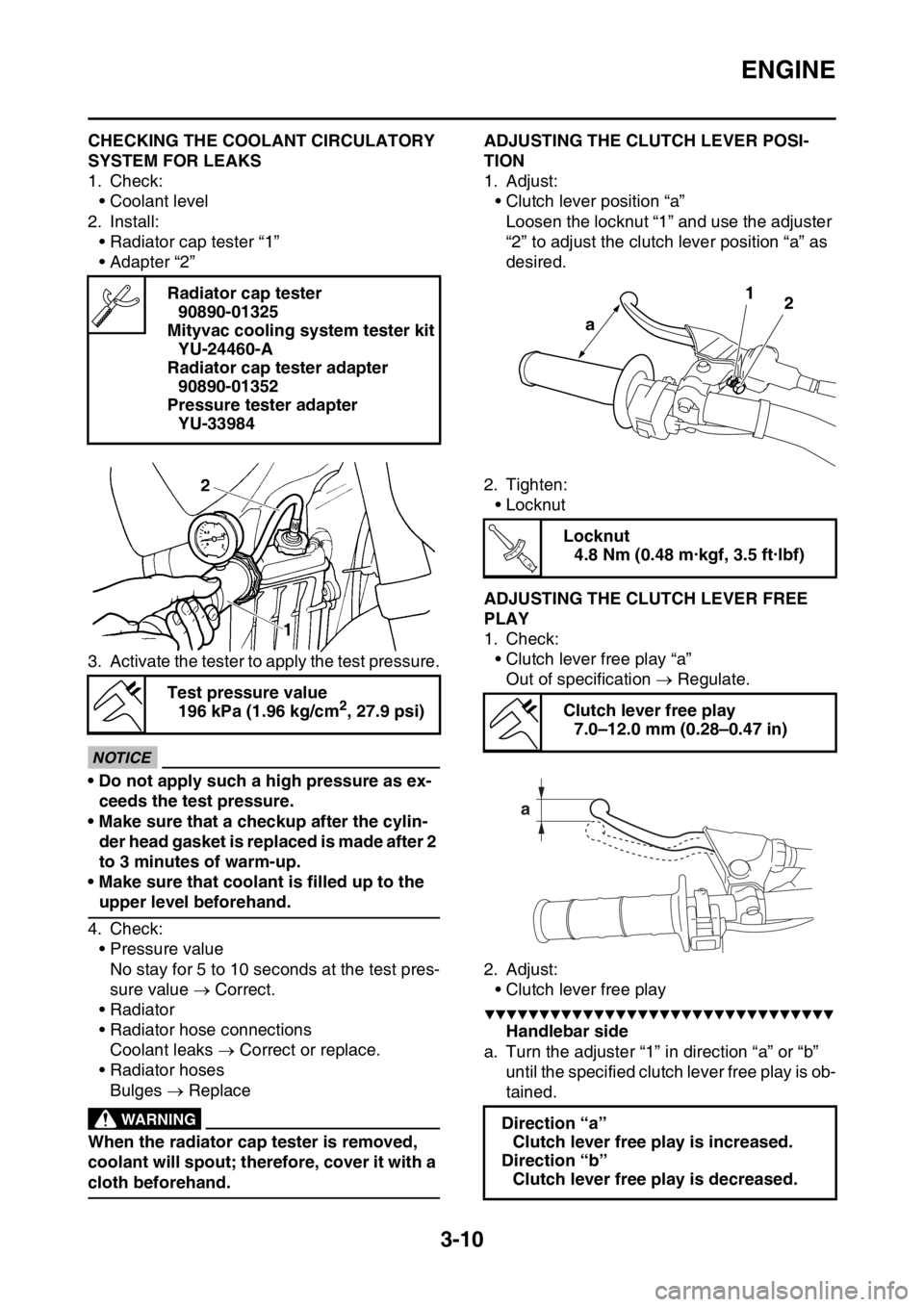
SYSTEM FOR LEAKS
1. Check:
• Coolant level
2. Install:
• Radiator cap tester “1”
• Adapter “2”
3. Activate the tester to apply the test pressure.
ECA@
NOTICE
• Do not apply such a high pressure as ex-
ceeds the test pressure.
• Make sure that a checkup after the cylin-
der head gasket is replaced is made after 2
to 3 minutes of warm-up.
• Make sure that coolant is filled up to the
upper level beforehand.
4. Check:
• Pressure value
No stay for 5 to 10 seconds at the test pres-
sure value Correct.
• Radiator
• Radiator hose connections
Coolant leaks Correct or replace.
• Radiator hoses
Bulges Replace
EWA@
WARNING
When the radiator cap tester is removed,
coolant will spout; therefore, cover it with a
cloth beforehand.
EAS1SM1076ADJUSTING THE CLUTCH LEVER POSI-
TION
1. Adjust:
• Clutch lever position “a”
Loosen the locknut “1” and use the adjuster
“2” to adjust the clutch lever position “a” as
desired.
2. Tighten:
• Locknut
EAS1SM1077ADJUSTING THE CLUTCH LEVER FREE
PLAY
1. Check:
• Clutch lever free play “a”
Out of specification Regulate.
2. Adjust:
• Clutch lever free play
▼▼▼▼▼▼▼▼▼▼▼▼▼▼▼▼▼▼▼▼▼▼▼▼▼▼▼▼▼▼▼▼
Handlebar side
a. Turn the adjuster “1” in direction “a” or “b”
until the specified clutch lever free play is ob-
tained. Radiator cap tester
90890-01325
Mityvac cooling system tester kit
YU-24460-A
Radiator cap tester adapter
90890-01352
Pressure tester adapter
YU-33984
Test pressure value
196 kPa (1.96 kg/cm
2, 27.9 psi)
Locknut
4.8 Nm (0.48 m·kgf, 3.5 ft·lbf)
Clutch lever free play
7.0–12.0 mm (0.28–0.47 in)
Direction “a”
Clutch lever free play is increased.
Direction “b”
Clutch lever free play is decreased.
1
2
a
T R..
Page 97 of 356
ENGINE
3-11
TIP
If the clutch lever free play cannot be obtained
on the handlebar side, use the adjuster on the
clutch cable side.
▲▲▲▲▲▲▲▲▲▲▲▲▲▲▲▲▲▲▲▲▲▲▲▲▲▲▲▲▲▲▲▲
▼▼▼▼▼▼▼▼▼▼▼▼▼▼▼▼▼▼▼▼▼▼▼▼▼▼▼▼▼▼▼▼
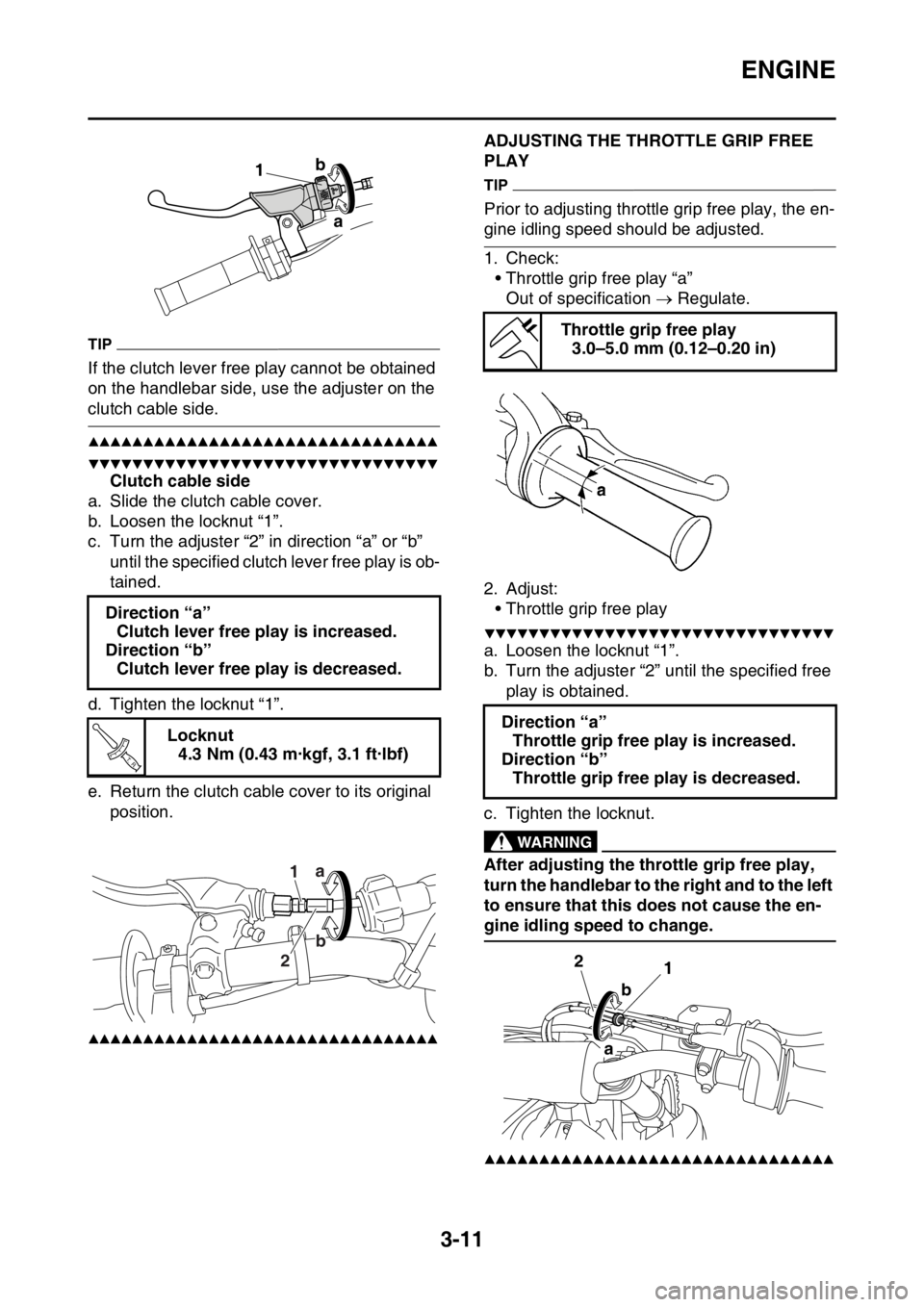
Clutch cable side
a. Slide the clutch cable cover.
b. Loosen the locknut “1”.
c. Turn the adjuster “2” in direction “a” or “b”
until the specified clutch lever free play is ob-
tained.
d. Tighten the locknut “1”.
e. Return the clutch cable cover to its original
position.
▲▲▲▲▲▲▲▲▲▲▲▲▲▲▲▲▲▲▲▲▲▲▲▲▲▲▲▲▲▲▲▲
EAS1SM1078ADJUSTING THE THROTTLE GRIP FREE
PLAY
TIP
Prior to adjusting throttle grip free play, the en-
gine idling speed should be adjusted.
1. Check:
• Throttle grip free play “a”
Out of specification Regulate.
2. Adjust:
• Throttle grip free play
▼▼▼▼▼▼▼▼▼▼▼▼▼▼▼▼▼▼▼▼▼▼▼▼▼▼▼▼▼▼▼▼
a. Loosen the locknut “1”.
b. Turn the adjuster “2” until the specified free
play is obtained.
c. Tighten the locknut.
EWA33DD008
WARNING
After adjusting the throttle grip free play,
turn the handlebar to the right and to the left
to ensure that this does not cause the en-
gine idling speed to change.
▲▲▲▲▲▲▲▲▲▲▲▲▲▲▲▲▲▲▲▲▲▲▲▲▲▲▲▲▲▲▲▲
Direction “a”
Clutch lever free play is increased.
Direction “b”
Clutch lever free play is decreased.
Locknut
4.3 Nm (0.43 m·kgf, 3.1 ft·lbf)
a b
1
T R..
1a
b
2
b
Throttle grip free play
3.0–5.0 mm (0.12–0.20 in)
Direction “a”
Throttle grip free play is increased.
Direction “b”
Throttle grip free play is decreased.
1 2
b
a
Page 102 of 356
ENGINE
3-16
7. Pour the specified amount of engine oil into
the oil filler cap hole.
8. Install:
• Oil filler cap
9. Check:
• Oil level
Refer to “CHECKING THE ENGINE OIL
LEVEL” on page 3-14.
10.Check:
• Engine oil pressure
▼▼▼▼▼▼▼▼▼▼▼▼▼▼▼▼▼▼▼▼▼▼▼▼▼▼▼▼▼▼▼▼
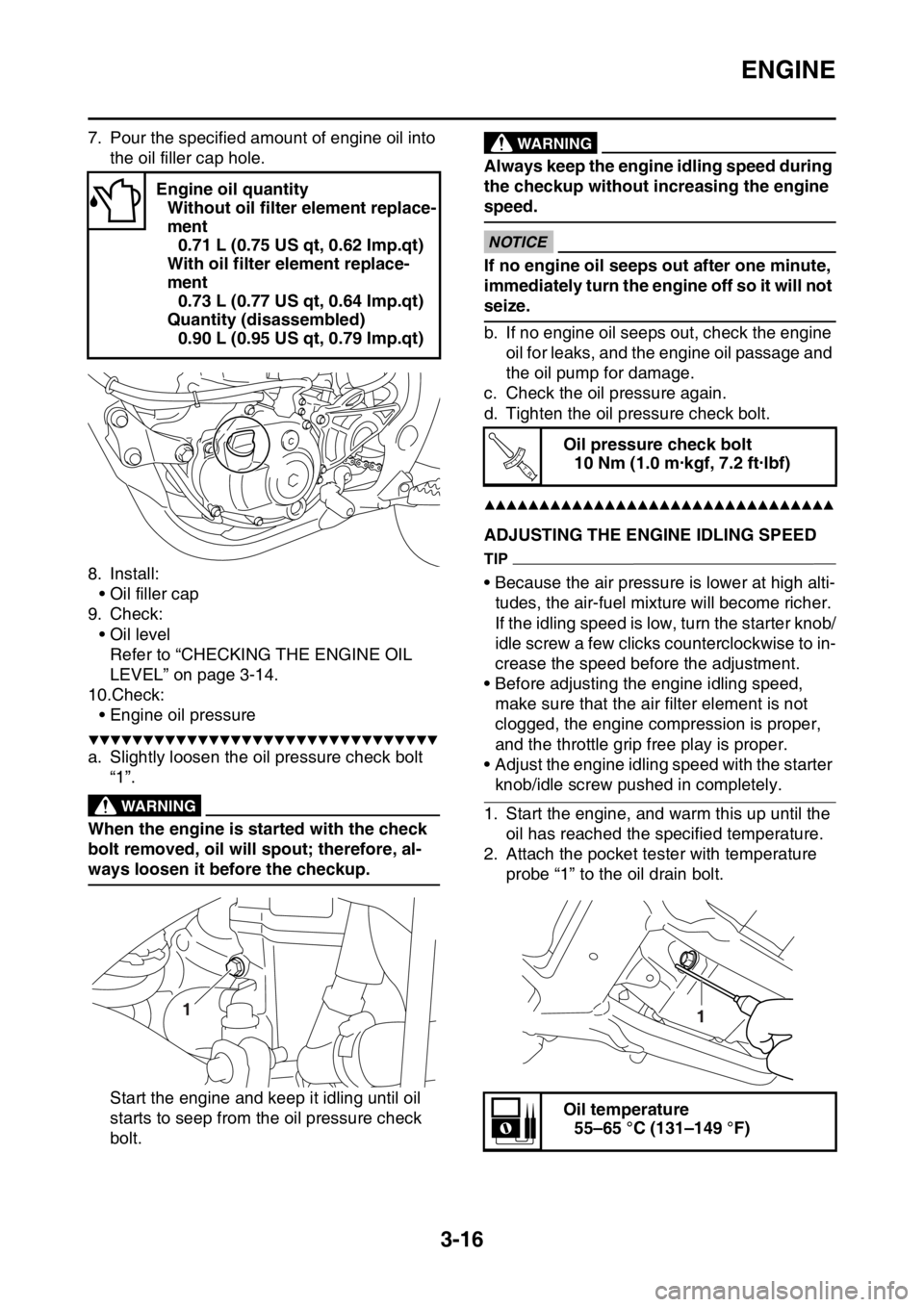
a. Slightly loosen the oil pressure check bolt
“1”.
EWA
WARNING
When the engine is started with the check
bolt removed, oil will spout; therefore, al-
ways loosen it before the checkup.
Start the engine and keep it idling until oil
starts to seep from the oil pressure check
bolt.
EWA
WARNING
Always keep the engine idling speed during
the checkup without increasing the engine
speed.
ECA
NOTICE
If no engine oil seeps out after one minute,
immediately turn the engine off so it will not
seize.
b. If no engine oil seeps out, check the engine
oil for leaks, and the engine oil passage and
the oil pump for damage.
c. Check the oil pressure again.
d. Tighten the oil pressure check bolt.
▲▲▲▲▲▲▲▲▲▲▲▲▲▲▲▲▲▲▲▲▲▲▲▲▲▲▲▲▲▲▲▲
EAS1SM1087ADJUSTING THE ENGINE IDLING SPEED
TIP
• Because the air pressure is lower at high alti-
tudes, the air-fuel mixture will become richer.
If the idling speed is low, turn the starter knob/
idle screw a few clicks counterclockwise to in-
crease the speed before the adjustment.
• Before adjusting the engine idling speed,
make sure that the air filter element is not
clogged, the engine compression is proper,
and the throttle grip free play is proper.
• Adjust the engine idling speed with the starter
knob/idle screw pushed in completely.
1. Start the engine, and warm this up until the
oil has reached the specified temperature.
2. Attach the pocket tester with temperature
probe “1” to the oil drain bolt. Engine oil quantity
Without oil filter element replace-
ment
0.71 L (0.75 US qt, 0.62 Imp.qt)
With oil filter element replace-
ment
0.73 L (0.77 US qt, 0.64 Imp.qt)
Quantity (disassembled)
0.90 L (0.95 US qt, 0.79 Imp.qt)
1
Oil pressure check bolt
10 Nm (1.0 m·kgf, 7.2 ft·lbf)
Oil temperature
55–65 °C (131–149 °F)
T R..
1
Page 104 of 356
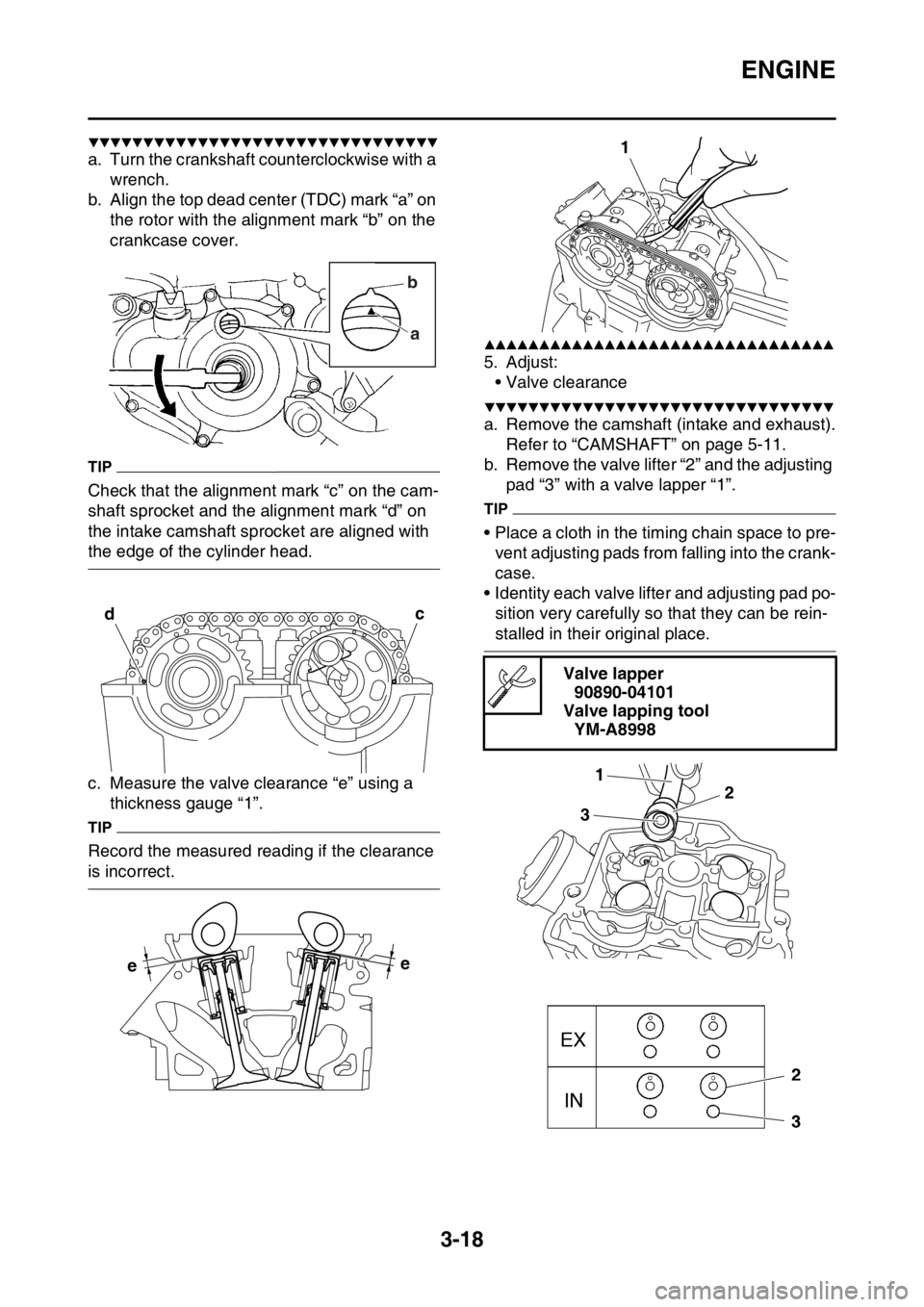
ENGINE
3-18
▼▼▼▼▼▼▼▼▼▼▼▼▼▼▼▼▼▼▼▼▼▼▼▼▼▼▼▼▼▼▼▼
a. Turn the crankshaft counterclockwise with a
wrench.
b. Align the top dead center (TDC) mark “a” on
the rotor with the alignment mark “b” on the
crankcase cover.
TIP
Check that the alignment mark “c” on the cam-
shaft sprocket and the alignment mark “d” on
the intake camshaft sprocket are aligned with
the edge of the cylinder head.
c. Measure the valve clearance “e” using a
thickness gauge “1”.
TIP
Record the measured reading if the clearance
is incorrect.
▲▲▲▲▲▲▲▲▲▲▲▲▲▲▲▲▲▲▲▲▲▲▲▲▲▲▲▲▲▲▲▲
5. Adjust:
• Valve clearance
▼▼▼▼▼▼▼▼▼▼▼▼▼▼▼▼▼▼▼▼▼▼▼▼▼▼▼▼▼▼▼▼
a. Remove the camshaft (intake and exhaust).
Refer to “CAMSHAFT” on page 5-11.
b. Remove the valve lifter “2” and the adjusting
pad “3” with a valve lapper “1”.
TIP
• Place a cloth in the timing chain space to pre-
vent adjusting pads from falling into the crank-
case.
• Identity each valve lifter and adjusting pad po-
sition very carefully so that they can be rein-
stalled in their original place.
b
a
dc
ee
Valve lapper
90890-04101
Valve lapping tool
YM-A8998
1
1
32
Page 108 of 356
CHASSIS
3-22
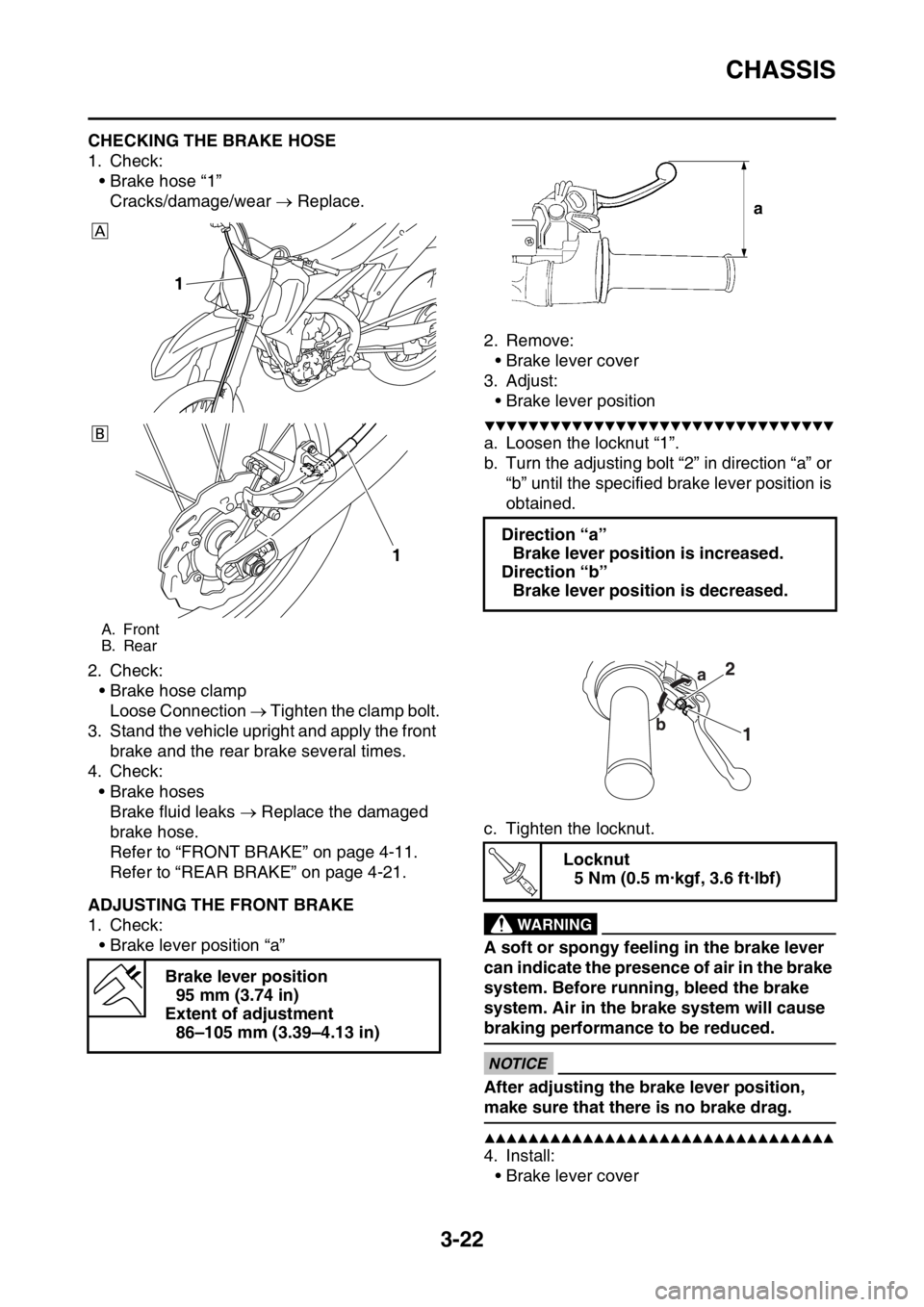
EAS1SM1091CHECKING THE BRAKE HOSE
1. Check:
• Brake hose “1”
Cracks/damage/wear Replace.
2. Check:
• Brake hose clamp
Loose Connection Tighten the clamp bolt.
3. Stand the vehicle upright and apply the front
brake and the rear brake several times.
4. Check:
• Brake hoses
Brake fluid leaks Replace the damaged
brake hose.
Refer to “FRONT BRAKE” on page 4-11.
Refer to “REAR BRAKE” on page 4-21.
EAS1SM1092ADJUSTING THE FRONT BRAKE
1. Check:
• Brake lever position “a”2. Remove:
• Brake lever cover
3. Adjust:
• Brake lever position
▼▼▼▼▼▼▼▼▼▼▼▼▼▼▼▼▼▼▼▼▼▼▼▼▼▼▼▼▼▼▼▼
a. Loosen the locknut “1”.
b. Turn the adjusting bolt “2” in direction “a” or
“b” until the specified brake lever position is
obtained.
c. Tighten the locknut.
EWA13050
WARNING
A soft or spongy feeling in the brake lever
can indicate the presence of air in the brake
system. Before running, bleed the brake
system. Air in the brake system will cause
braking performance to be reduced.
ECA13490
NOTICE
After adjusting the brake lever position,
make sure that there is no brake drag.
▲▲▲▲▲▲▲▲▲▲▲▲▲▲▲▲▲▲▲▲▲▲▲▲▲▲▲▲▲▲▲▲
4. Install:
• Brake lever cover
A. Front
B. Rear
Brake lever position
95 mm (3.74 in)
Extent of adjustment
86–105 mm (3.39–4.13 in)
1
1
Direction “a”
Brake lever position is increased.
Direction “b”
Brake lever position is decreased.
Locknut
5 Nm (0.5 m·kgf, 3.6 ft·lbf)
a
b
T R..
Page 109 of 356
CHASSIS
3-23
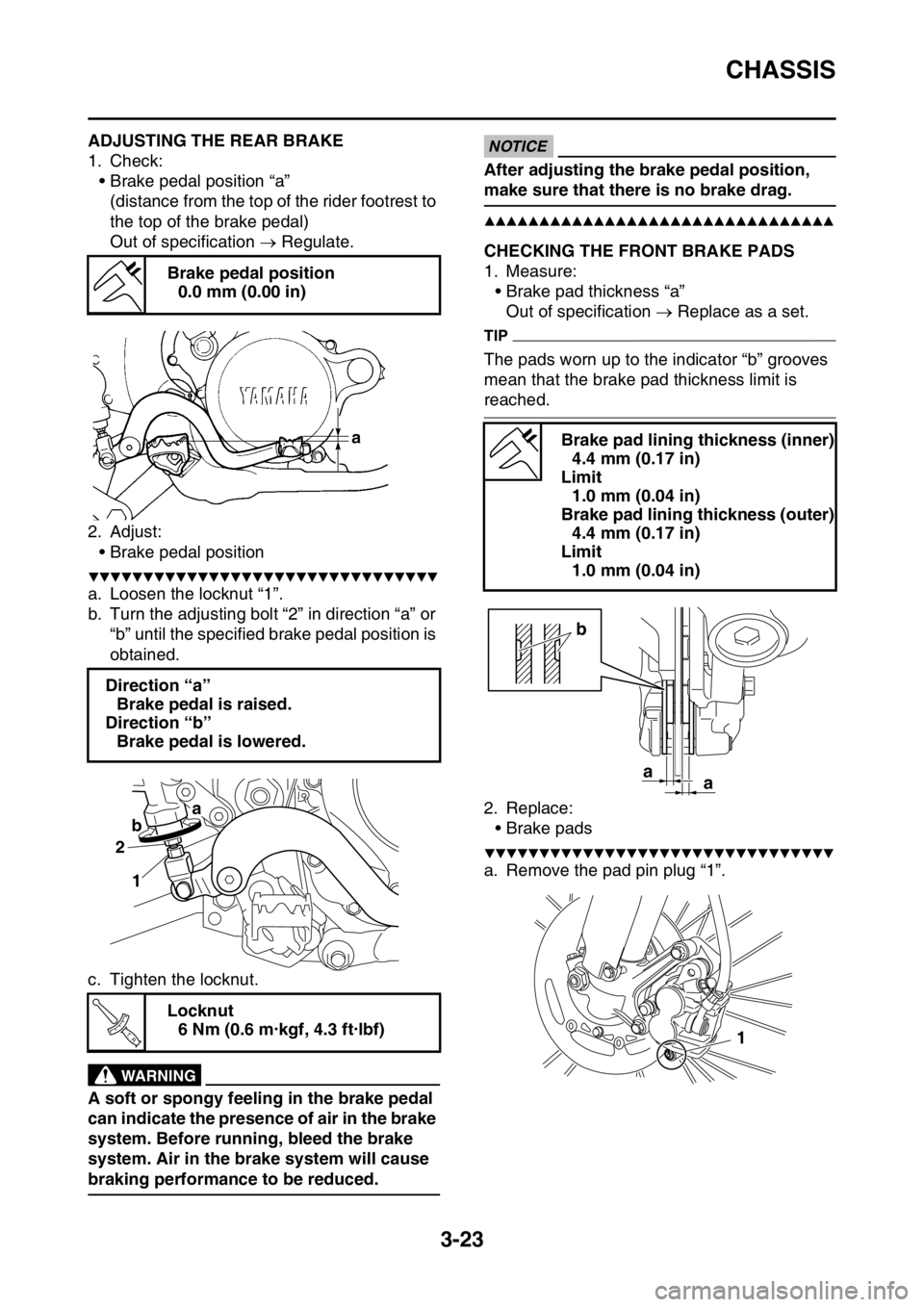
EAS1SM1093ADJUSTING THE REAR BRAKE
1. Check:
• Brake pedal position “a”
(distance from the top of the rider footrest to
the top of the brake pedal)
Out of specification Regulate.
2. Adjust:
• Brake pedal position
▼▼▼▼▼▼▼▼▼▼▼▼▼▼▼▼▼▼▼▼▼▼▼▼▼▼▼▼▼▼▼▼
a. Loosen the locknut “1”.
b. Turn the adjusting bolt “2” in direction “a” or
“b” until the specified brake pedal position is
obtained.
c. Tighten the locknut.
EWA1DX1001
WARNING
A soft or spongy feeling in the brake pedal
can indicate the presence of air in the brake
system. Before running, bleed the brake
system. Air in the brake system will cause
braking performance to be reduced.
ECA13510
NOTICE
After adjusting the brake pedal position,
make sure that there is no brake drag.
▲▲▲▲▲▲▲▲▲▲▲▲▲▲▲▲▲▲▲▲▲▲▲▲▲▲▲▲▲▲▲▲
EAS1SM1094CHECKING THE FRONT BRAKE PADS
1. Measure:
• Brake pad thickness “a”
Out of specification Replace as a set.
TIP
The pads worn up to the indicator “b” grooves
mean that the brake pad thickness limit is
reached.
2. Replace:
• Brake pads
▼▼▼▼▼▼▼▼▼▼▼▼▼▼▼▼▼▼▼▼▼▼▼▼▼▼▼▼▼▼▼▼
a. Remove the pad pin plug “1”. Brake pedal position
0.0 mm (0.00 in)
Direction “a”
Brake pedal is raised.
Direction “b”
Brake pedal is lowered.
Locknut
6 Nm (0.6 m·kgf, 4.3 ft·lbf)1 2
a
b
T R..
Brake pad lining thickness (inner)
4.4 mm (0.17 in)
Limit
1.0 mm (0.04 in)
Brake pad lining thickness (outer)
4.4 mm (0.17 in)
Limit
1.0 mm (0.04 in)
a
b
a
1
Page 113 of 356
CHASSIS
3-27
EWA13090
WARNING
• Use only the designated brake fluid. Other
brake fluids may cause the rubber seals to
deteriorate, causing leakage and poor
brake performance.
• Refill with the same type of brake fluid that
is already in the system. Mixing brake flu-
ids may result in a harmful chemical reac-
tion, leading to poor brake performance.
• When pouring the brake fluid, be careful
that water does not enter the reservoir.
Water will significantly lower the boiling
point of the brake fluid and could cause
vapor lock.
ECA13540
NOTICE
Immediately wipe off the spilled brake fluid
to avoid damage to painted surfaces or
plastic parts.
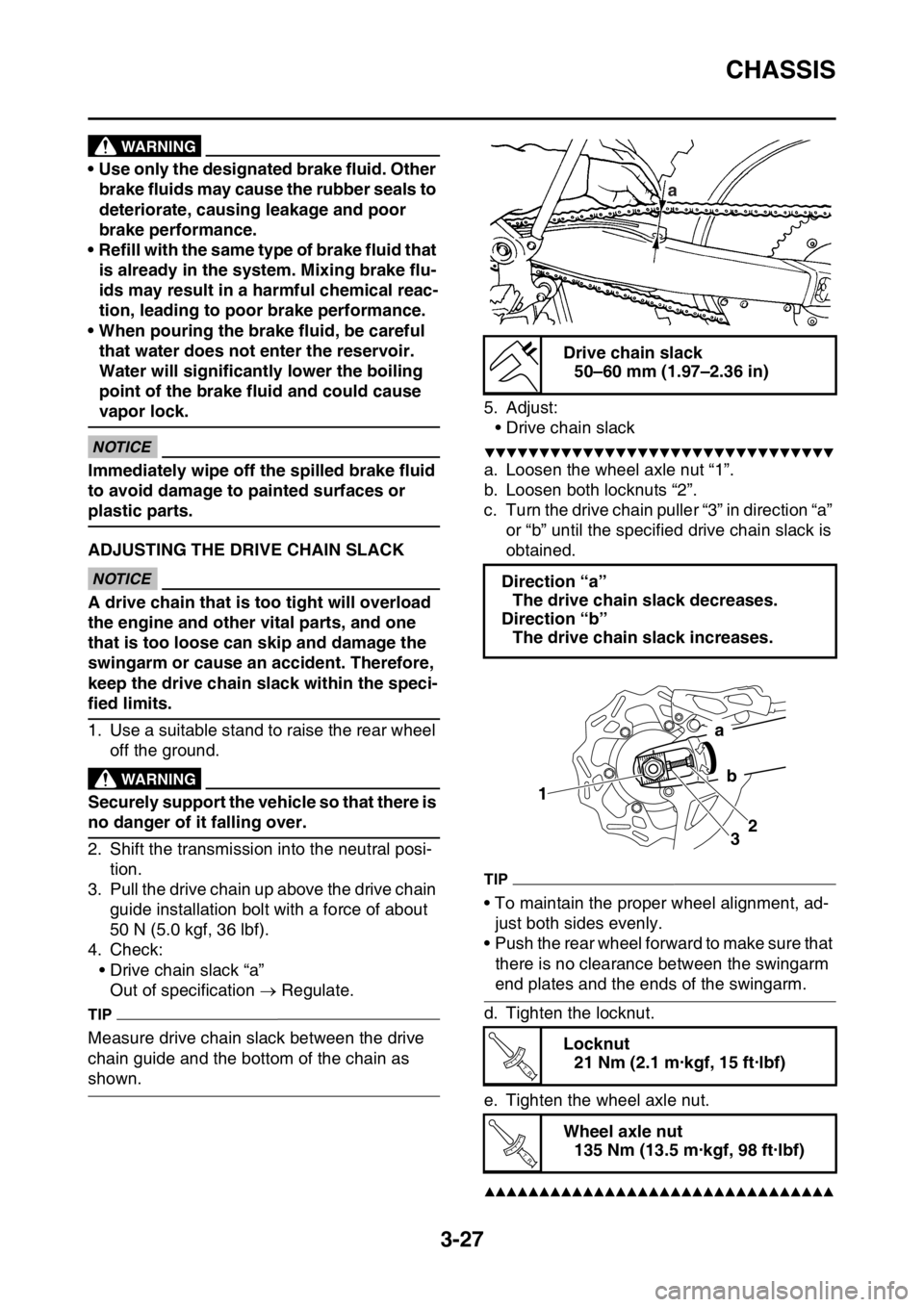
EAS1SM1098ADJUSTING THE DRIVE CHAIN SLACKECA13550
NOTICE
A drive chain that is too tight will overload
the engine and other vital parts, and one
that is too loose can skip and damage the
swingarm or cause an accident. Therefore,
keep the drive chain slack within the speci-
fied limits.
1. Use a suitable stand to raise the rear wheel
off the ground.
EWA13120
WARNING
Securely support the vehicle so that there is
no danger of it falling over.
2. Shift the transmission into the neutral posi-
tion.
3. Pull the drive chain up above the drive chain
guide installation bolt with a force of about
50 N (5.0 kgf, 36 lbf).
4. Check:
• Drive chain slack “a”
Out of specification Regulate.
TIP
Measure drive chain slack between the drive
chain guide and the bottom of the chain as
shown.5. Adjust:
• Drive chain slack
▼▼▼▼▼▼▼▼▼▼▼▼▼▼▼▼▼▼▼▼▼▼▼▼▼▼▼▼▼▼▼▼
a. Loosen the wheel axle nut “1”.
b. Loosen both locknuts “2”.
c. Turn the drive chain puller “3” in direction “a”
or “b” until the specified drive chain slack is
obtained.
TIP
• To maintain the proper wheel alignment, ad-
just both sides evenly.
• Push the rear wheel forward to make sure that
there is no clearance between the swingarm
end plates and the ends of the swingarm.
d. Tighten the locknut.
e. Tighten the wheel axle nut.
▲▲▲▲▲▲▲▲▲▲▲▲▲▲▲▲▲▲▲▲▲▲▲▲▲▲▲▲▲▲▲▲
Drive chain slack
50–60 mm (1.97–2.36 in)
Direction “a”
The drive chain slack decreases.
Direction “b”
The drive chain slack increases.
Locknut
21 Nm (2.1 m·kgf, 15 ft·lbf)
Wheel axle nut
135 Nm (13.5 m·kgf, 98 ft·lbf)
a
1
32
a
b
T R..
T R..