radiator cap YAMAHA YZ250F 2014 User Guide
[x] Cancel search | Manufacturer: YAMAHA, Model Year: 2014, Model line: YZ250F, Model: YAMAHA YZ250F 2014Pages: 356, PDF Size: 11.39 MB
Page 95 of 356
ENGINE
3-9
5. Install:
• Copper washers
• Coolant drain bolt
6. Pour coolant.
EWA13040
WARNING
• If coolant splashes in your eyes, thorough-
ly wash them with water and consult a
doctor.
• If coolant splashes on your clothes, quick-
ly wash it away with water and then with
soap and water.
• If coolant is swallowed, induce vomiting
and get immediate medical attention.
ECA13480
NOTICE
• Adding water instead of coolant lowers the
antifreeze content. If, therefore, water is
used instead of coolant, check, and if nec-
essary, adjust the antifreeze concentra-
tion.
• Use only distilled water. However, if dis-
tilled water is not available, soft water may
be used.
• If coolant comes into contact with painted
surfaces, immediately wash them with wa-
ter.
• Do not mix different types of coolant.
7. Install:
• Radiator cap
8. Start the engine, warm this up for several
minutes, stop it, and then wait for it to cool
down.
9. Check:
• Coolant level
Refer to “CHECKING THE COOLANT LEV-
EL” on page 3-8.
EAS1SM1073CHECKING THE RADIATOR CAP
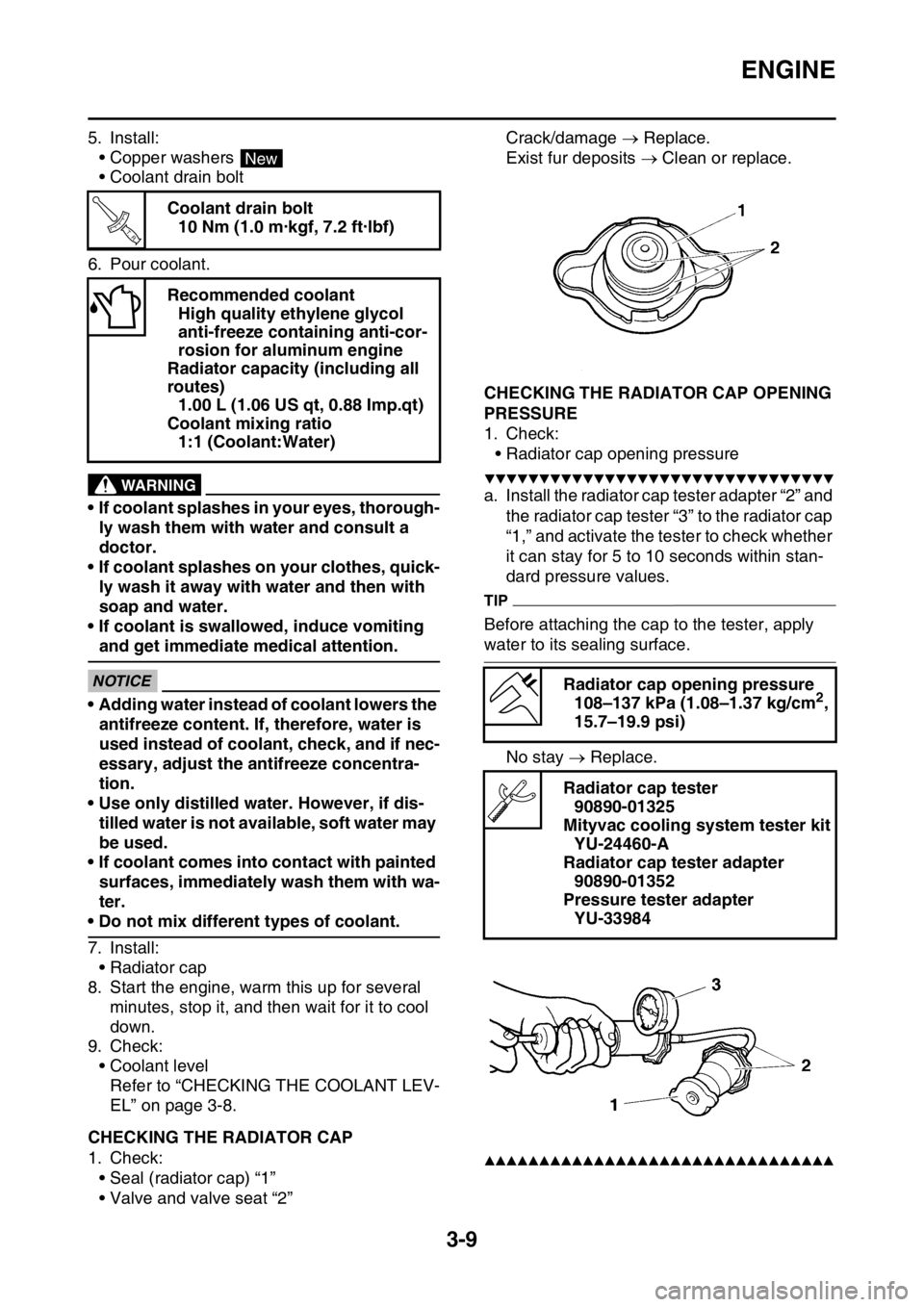
1. Check:
• Seal (radiator cap) “1”
• Valve and valve seat “2”Crack/damage Replace.
Exist fur deposits Clean or replace.
EAS1SM1074CHECKING THE RADIATOR CAP OPENING
PRESSURE
1. Check:
• Radiator cap opening pressure
▼▼▼▼▼▼▼▼▼▼▼▼▼▼▼▼▼▼▼▼▼▼▼▼▼▼▼▼▼▼▼▼
a. Install the radiator cap tester adapter “2” and
the radiator cap tester “3” to the radiator cap
“1,” and activate the tester to check whether
it can stay for 5 to 10 seconds within stan-
dard pressure values.
TIP
Before attaching the cap to the tester, apply
water to its sealing surface.
No stay Replace.
▲▲▲▲▲▲▲▲▲▲▲▲▲▲▲▲▲▲▲▲▲▲▲▲▲▲▲▲▲▲▲▲
Coolant drain bolt
10 Nm (1.0 m·kgf, 7.2 ft·lbf)
Recommended coolant
High quality ethylene glycol
anti-freeze containing anti-cor-
rosion for aluminum engine
Radiator capacity (including all
routes)
1.00 L (1.06 US qt, 0.88 Imp.qt)
Coolant mixing ratio
1:1 (Coolant:Water)
New
T R..
Radiator cap opening pressure
108–137 kPa (1.08–1.37 kg/cm2,
15.7–19.9 psi)
Radiator cap tester
90890-01325
Mityvac cooling system tester kit
YU-24460-A
Radiator cap tester adapter
90890-01352
Pressure tester adapter
YU-33984
Page 96 of 356
ENGINE
3-10
EAS1SM1075CHECKING THE COOLANT CIRCULATORY
SYSTEM FOR LEAKS
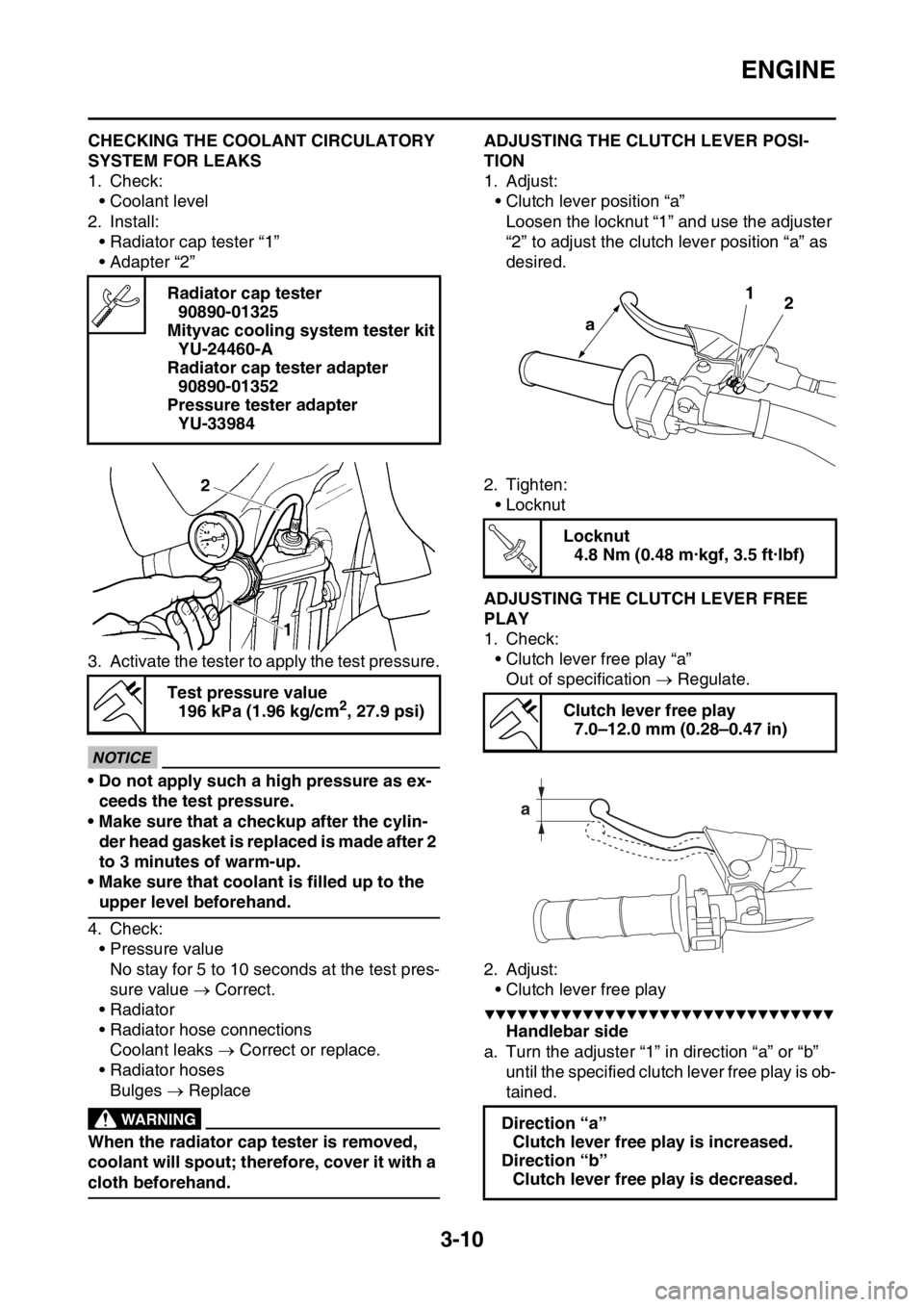
1. Check:
• Coolant level
2. Install:
• Radiator cap tester “1”
• Adapter “2”
3. Activate the tester to apply the test pressure.
ECA@
NOTICE
• Do not apply such a high pressure as ex-
ceeds the test pressure.
• Make sure that a checkup after the cylin-
der head gasket is replaced is made after 2
to 3 minutes of warm-up.
• Make sure that coolant is filled up to the
upper level beforehand.
4. Check:
• Pressure value
No stay for 5 to 10 seconds at the test pres-
sure value Correct.
• Radiator
• Radiator hose connections
Coolant leaks Correct or replace.
• Radiator hoses
Bulges Replace
EWA@
WARNING
When the radiator cap tester is removed,
coolant will spout; therefore, cover it with a
cloth beforehand.
EAS1SM1076ADJUSTING THE CLUTCH LEVER POSI-
TION
1. Adjust:
• Clutch lever position “a”
Loosen the locknut “1” and use the adjuster
“2” to adjust the clutch lever position “a” as
desired.
2. Tighten:
• Locknut
EAS1SM1077ADJUSTING THE CLUTCH LEVER FREE
PLAY
1. Check:
• Clutch lever free play “a”
Out of specification Regulate.
2. Adjust:
• Clutch lever free play
▼▼▼▼▼▼▼▼▼▼▼▼▼▼▼▼▼▼▼▼▼▼▼▼▼▼▼▼▼▼▼▼
Handlebar side
a. Turn the adjuster “1” in direction “a” or “b”
until the specified clutch lever free play is ob-
tained. Radiator cap tester
90890-01325
Mityvac cooling system tester kit
YU-24460-A
Radiator cap tester adapter
90890-01352
Pressure tester adapter
YU-33984
Test pressure value
196 kPa (1.96 kg/cm
2, 27.9 psi)
Locknut
4.8 Nm (0.48 m·kgf, 3.5 ft·lbf)
Clutch lever free play
7.0–12.0 mm (0.28–0.47 in)
Direction “a”
Clutch lever free play is increased.
Direction “b”
Clutch lever free play is decreased.
1
2
a
T R..
Page 270 of 356
RADIATOR
6-3
EAS1SM1297HANDLING NOTEEWA1DX1007
WARNING
If coolant seems hot, do not remove the ra-
diator cap.
EAS1SM1298CHECKING THE RADIATOR
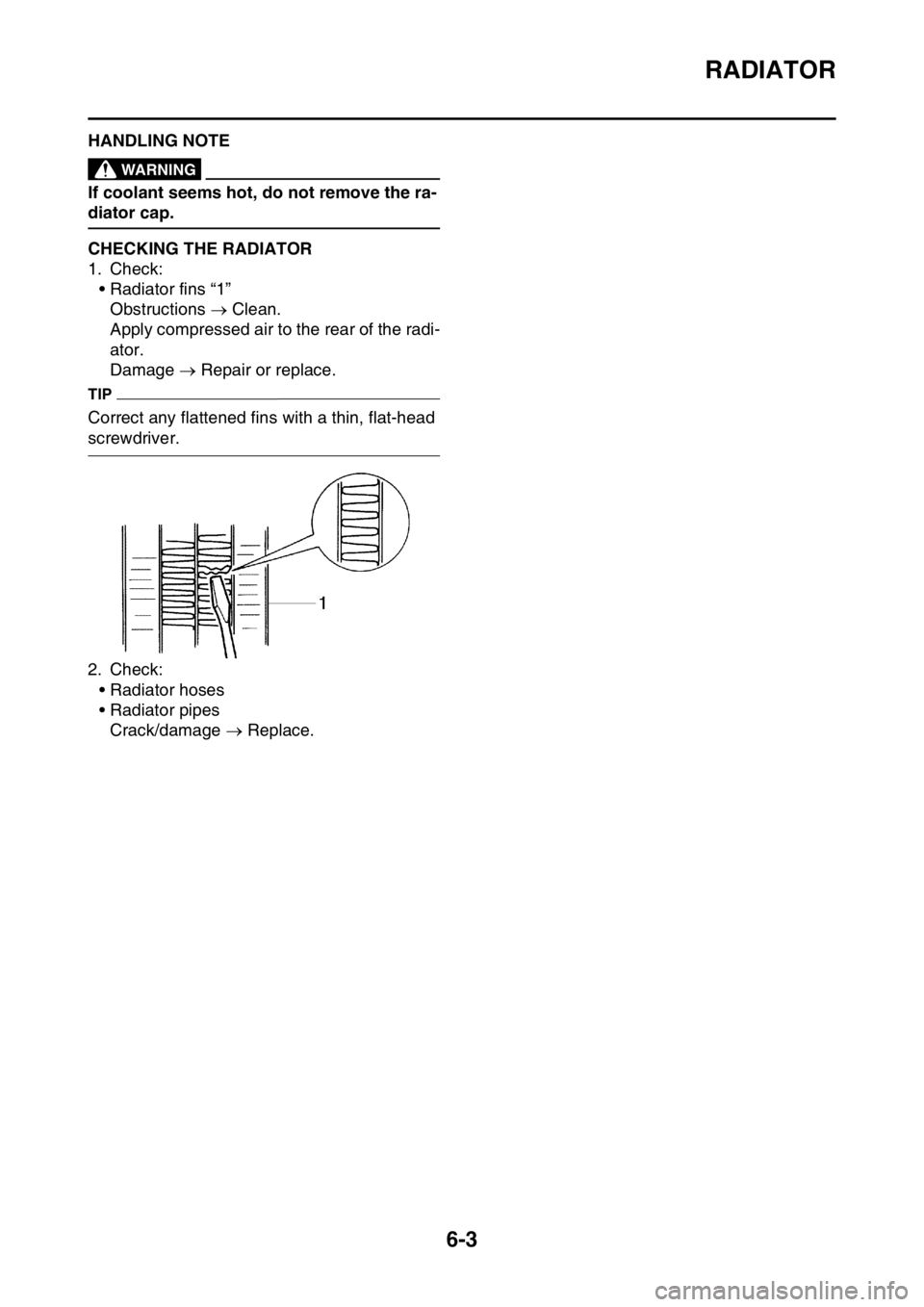
1. Check:
• Radiator fins “1”
Obstructions Clean.
Apply compressed air to the rear of the radi-
ator.
Damage Repair or replace.
TIP
Correct any flattened fins with a thin, flat-head
screwdriver.
2. Check:
• Radiator hoses
• Radiator pipes
Crack/damage Replace.
Page 337 of 356

TROUBLE SHOOTING
9-2
3. Ignition system
• Faulty ECU
• Faulty crankshaft position sensor
• Broken generator rotor woodruff key
EAS1SM1354POOR MEDIUM-AND-HIGH-SPEED PER-
FORMANCE
Refer to “STARTING FAILURES” on page 9-1.
Engine
1. Air filter
• Clogged air filter element
Fuel system
1. Fuel pump
• Faulty fuel pump
2. Throttle body
• Defective throttle body
3. ECU
• Faulty ECU
EAS1SM1355FAULTY GEAR SHIFTING
Shifting is difficult
Refer to “CLUTCH” on page 5-35.
EAS1SM1356SHIFT PEDAL DOES NOT MOVE
Shift shaft
• Bent shift shaft
Shift drum and shift forks
• Foreign object in a shift drum groove
• Seized shift fork
• Bent shift fork guide bar
Transmission
• Seized transmission gear
• Foreign object between transmission gears
• Improperly assembled transmission
EAS1SM1357JUMPS OUT OF GEAR
Shift shaft
• Incorrect shift pedal position
• Improperly returned stopper lever
Shift forks
• Worn shift fork
Shift drum
• Incorrect axial play
• Worn shift drum groove
Transmission
• Worn gear dog
EAS1SM1358FAULTY CLUTCH
Clutch slips
1. Clutch
• Improperly assembled clutch
• Loose or fatigued clutch spring
• Worn friction plate
• Worn clutch plate
2. Engine oil
• Incorrect oil level
• Incorrect oil viscosity (low)
• Deteriorated oil
Clutch drags
1. Clutch
• Unevenly tensioned clutch springs
• Warped pressure plate
• Bent clutch plate
• Swollen friction plate
• Bent clutch push rod
• Damaged clutch boss
• Burnt primary driven gear bushing
2. Engine oil
• Incorrect oil level
• Incorrect oil viscosity (high)
• Deteriorated oil
EAS1SM1359OVERHEATING
Engine
1. Cylinder head and piston
• Heavy carbon buildup
• Clogged coolant passages
2. Engine oil
• Incorrect oil level
• Incorrect oil viscosity
• Inferior oil quality
Cooling system
1. Coolant
• Low coolant level
2. Radiator
• Damaged or leaking radiator
• Faulty radiator cap
• Bent or damaged radiator fin
3. Water pump
• Damaged or faulty water pump
• Damaged hose
• Improperly connected hose
• Damaged pipe
• Improperly connected pipe