piston YAMAHA YZ250F 2016 Owner's Guide
[x] Cancel search | Manufacturer: YAMAHA, Model Year: 2016, Model line: YZ250F, Model: YAMAHA YZ250F 2016Pages: 356, PDF Size: 11.25 MB
Page 225 of 356
CYLINDER AND PISTON
5-32
b. If out of specification, rebore or replace the
cylinder, and replace the piston and the pis-
ton rings as a set.
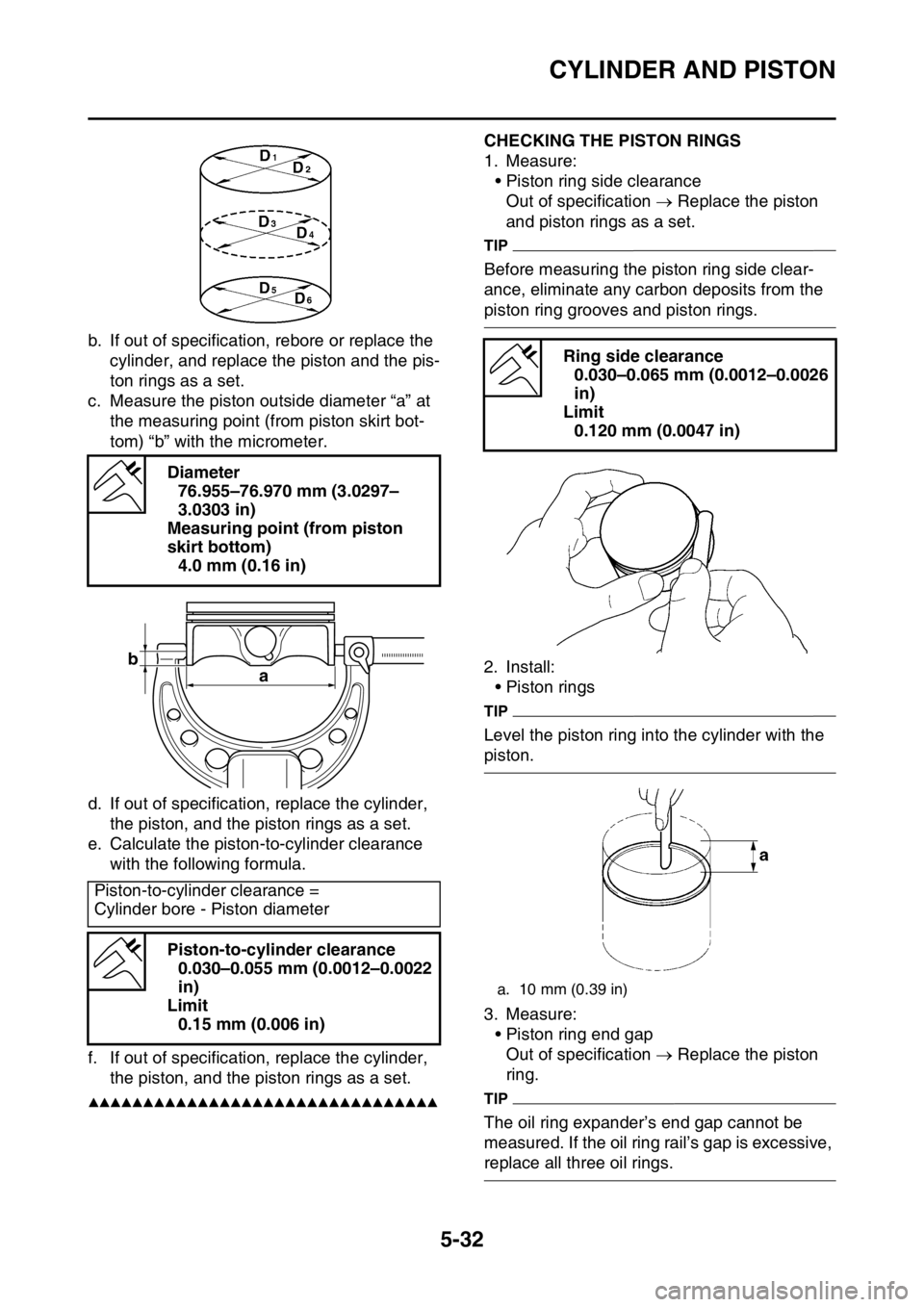
c. Measure the piston outside diameter “a” at
the measuring point (from piston skirt bot-
tom) “b” with the micrometer.
d. If out of specification, replace the cylinder,
the piston, and the piston rings as a set.
e. Calculate the piston-to-cylinder clearance
with the following formula.
f. If out of specification, replace the cylinder,
the piston, and the piston rings as a set.
▲▲▲▲▲▲▲▲▲▲▲▲▲▲▲▲▲▲▲▲▲▲▲▲▲▲▲▲▲▲▲▲
EAS1SM9227CHECKING THE PISTON RINGS
1. Measure:
• Piston ring side clearance
Out of specification Replace the piston
and piston rings as a set.
TIP
Before measuring the piston ring side clear-
ance, eliminate any carbon deposits from the
piston ring grooves and piston rings.
2. Install:
• Piston rings
TIP
Level the piston ring into the cylinder with the
piston.
3. Measure:
• Piston ring end gap
Out of specification Replace the piston
ring.
TIP
The oil ring expander’s end gap cannot be
measured. If the oil ring rail’s gap is excessive,
replace all three oil rings. Diameter
76.955–76.970 mm (3.0297–
3.0303 in)
Measuring point (from piston
skirt bottom)
4.0 mm (0.16 in)
Piston-to-cylinder clearance =
Cylinder bore - Piston diameter
Piston-to-cylinder clearance
0.030–0.055 mm (0.0012–0.0022
in)
Limit
0.15 mm (0.006 in)
b
a
Ring side clearance
0.030–0.065 mm (0.0012–0.0026
in)
Limit
0.120 mm (0.0047 in)
a. 10 mm (0.39 in)
Page 226 of 356
CYLINDER AND PISTON
5-33
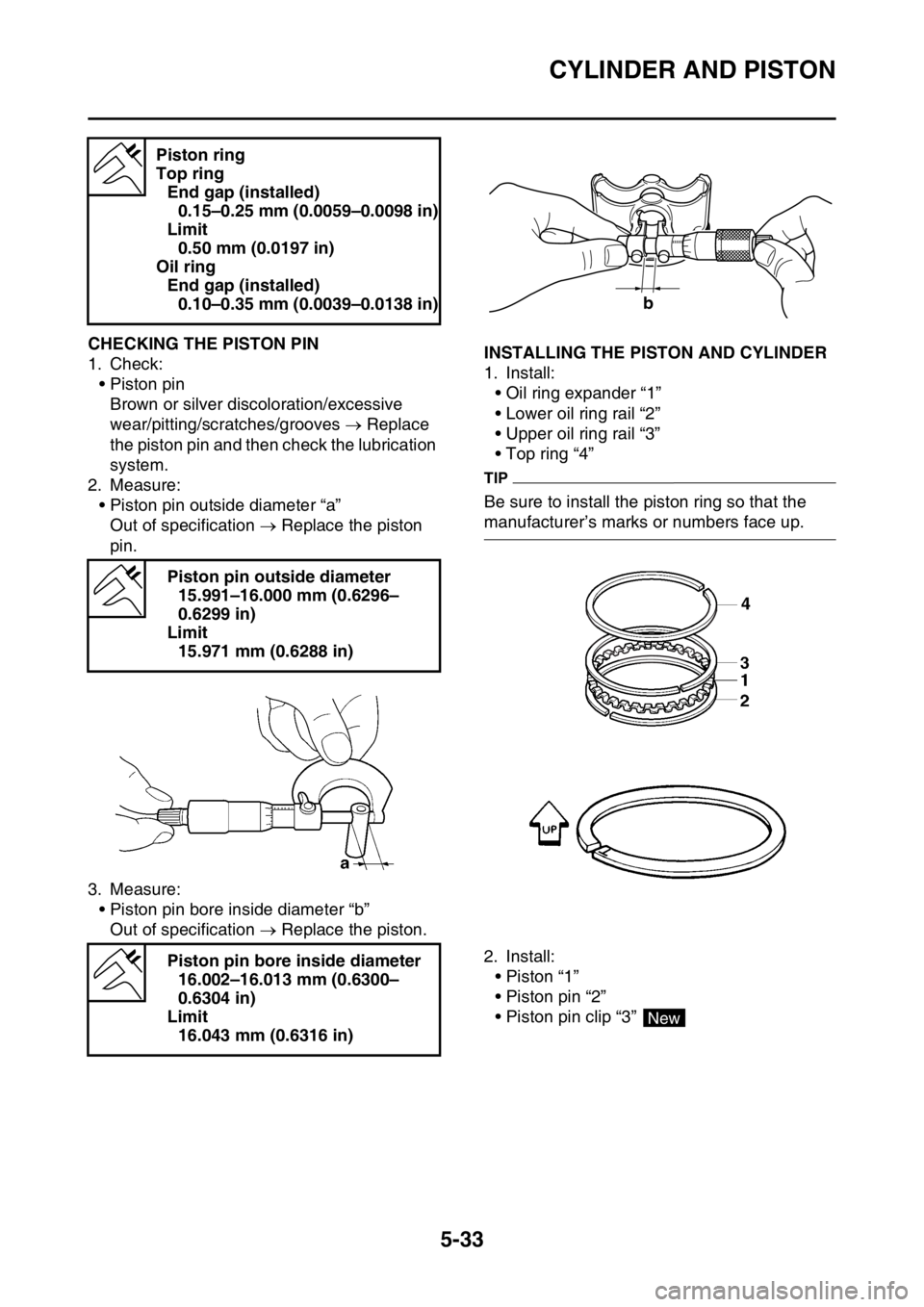
EAS1SM9228CHECKING THE PISTON PIN
1. Check:
• Piston pin
Brown or silver discoloration/excessive
wear/pitting/scratches/grooves Replace
the piston pin and then check the lubrication
system.
2. Measure:
• Piston pin outside diameter “a”
Out of specification Replace the piston
pin.
3. Measure:
• Piston pin bore inside diameter “b”
Out of specification Replace the piston.EAS1SM9229INSTALLING THE PISTON AND CYLINDER
1. Install:
• Oil ring expander “1”
• Lower oil ring rail “2”
• Upper oil ring rail “3”
• Top ring “4”
TIP
Be sure to install the piston ring so that the
manufacturer’s marks or numbers face up.
2. Install:
• Piston “1”
• Piston pin “2”
• Piston pin clip “3” Piston ring
Top ring
End gap (installed)
0.15–0.25 mm (0.0059–0.0098 in)
Limit
0.50 mm (0.0197 in)
Oil ring
End gap (installed)
0.10–0.35 mm (0.0039–0.0138 in)
Piston pin outside diameter
15.991–16.000 mm (0.6296–
0.6299 in)
Limit
15.971 mm (0.6288 in)
Piston pin bore inside diameter
16.002–16.013 mm (0.6300–
0.6304 in)
Limit
16.043 mm (0.6316 in)
b
4
New
Page 227 of 356
CYLINDER AND PISTON
5-34
TIP
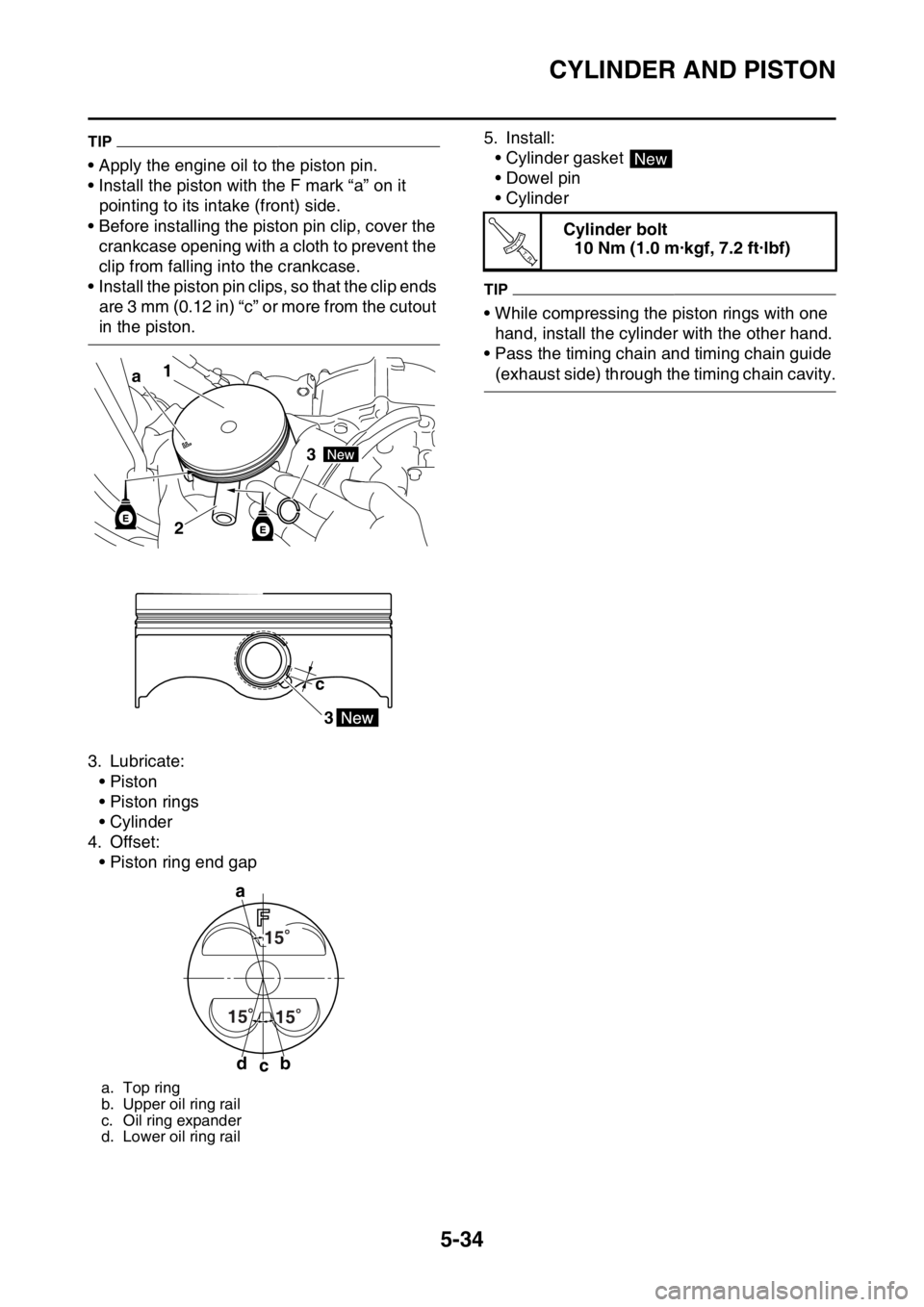
• Apply the engine oil to the piston pin.
• Install the piston with the F mark “a” on it
pointing to its intake (front) side.
• Before installing the piston pin clip, cover the
crankcase opening with a cloth to prevent the
clip from falling into the crankcase.
• Install the piston pin clips, so that the clip ends
are 3 mm (0.12 in) “c” or more from the cutout
in the piston.
3. Lubricate:
•Piston
• Piston rings
• Cylinder
4. Offset:
• Piston ring end gap5. Install:
• Cylinder gasket
• Dowel pin
• Cylinder
TIP
• While compressing the piston rings with one
hand, install the cylinder with the other hand.
• Pass the timing chain and timing chain guide
(exhaust side) through the timing chain cavity.
a. Top ring
b. Upper oil ring rail
c. Oil ring expander
d. Lower oil ring rail
1
3
2 a
3 c
a
db
c15
15
15
Cylinder bolt
10 Nm (1.0 m·kgf, 7.2 ft·lbf)
New
T R..
Page 254 of 356
CRANKCASE
5-61
EAS1SM9275
CRANKCASE
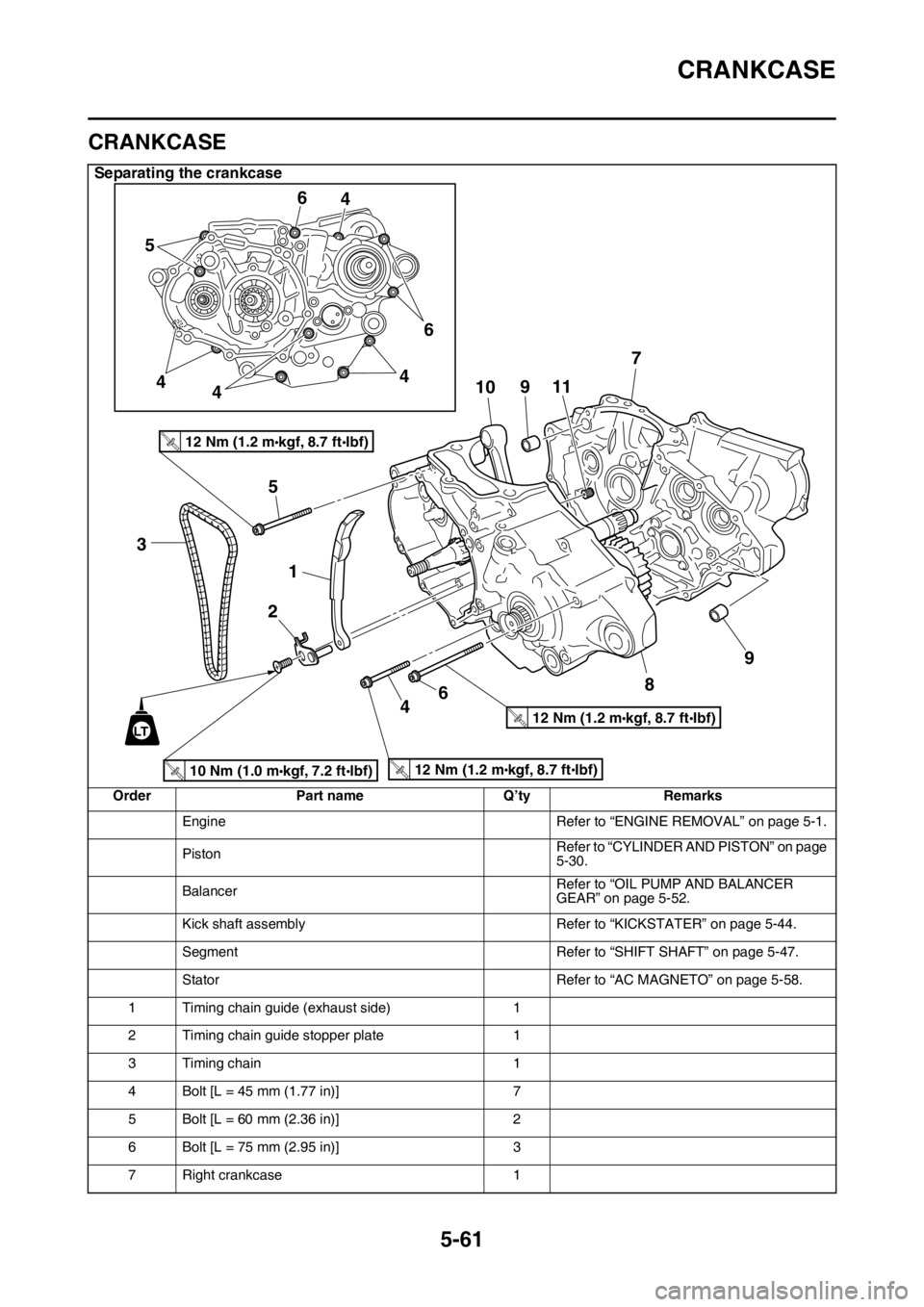
Separating the crankcase
Order Part name Q’ty Remarks
Engine Refer to “ENGINE REMOVAL” on page 5-1.
PistonRefer to “CYLINDER AND PISTON” on page
5-30.
BalancerRefer to “OIL PUMP AND BALANCER
GEAR” on page 5-52.
Kick shaft assembly Refer to “KICKSTATER” on page 5-44.
Segment Refer to “SHIFT SHAFT” on page 5-47.
Stator Refer to “AC MAGNETO” on page 5-58.
1 Timing chain guide (exhaust side) 1
2 Timing chain guide stopper plate 1
3 Timing chain 1
4 Bolt [L = 45 mm (1.77 in)] 7
5 Bolt [L = 60 mm (2.36 in)] 2
6 Bolt [L = 75 mm (2.95 in)] 3
7 Right crankcase 1
10 Nm (1.0 mkgf, 7.2 ftIbf)T.R
.
12 Nm (1.2 mkgf, 8.7 ftIbf)T.R
.
12 Nm (1.2 mkgf, 8.7 ftIbf)T.R
.
12 Nm (1.2 mkgf, 8.7 ftIbf)T.R
.
3
1 5
2
6410 56
4
4
446
9117
8
9
LT
Page 336 of 356
TROUBLESHOOTING
9-1
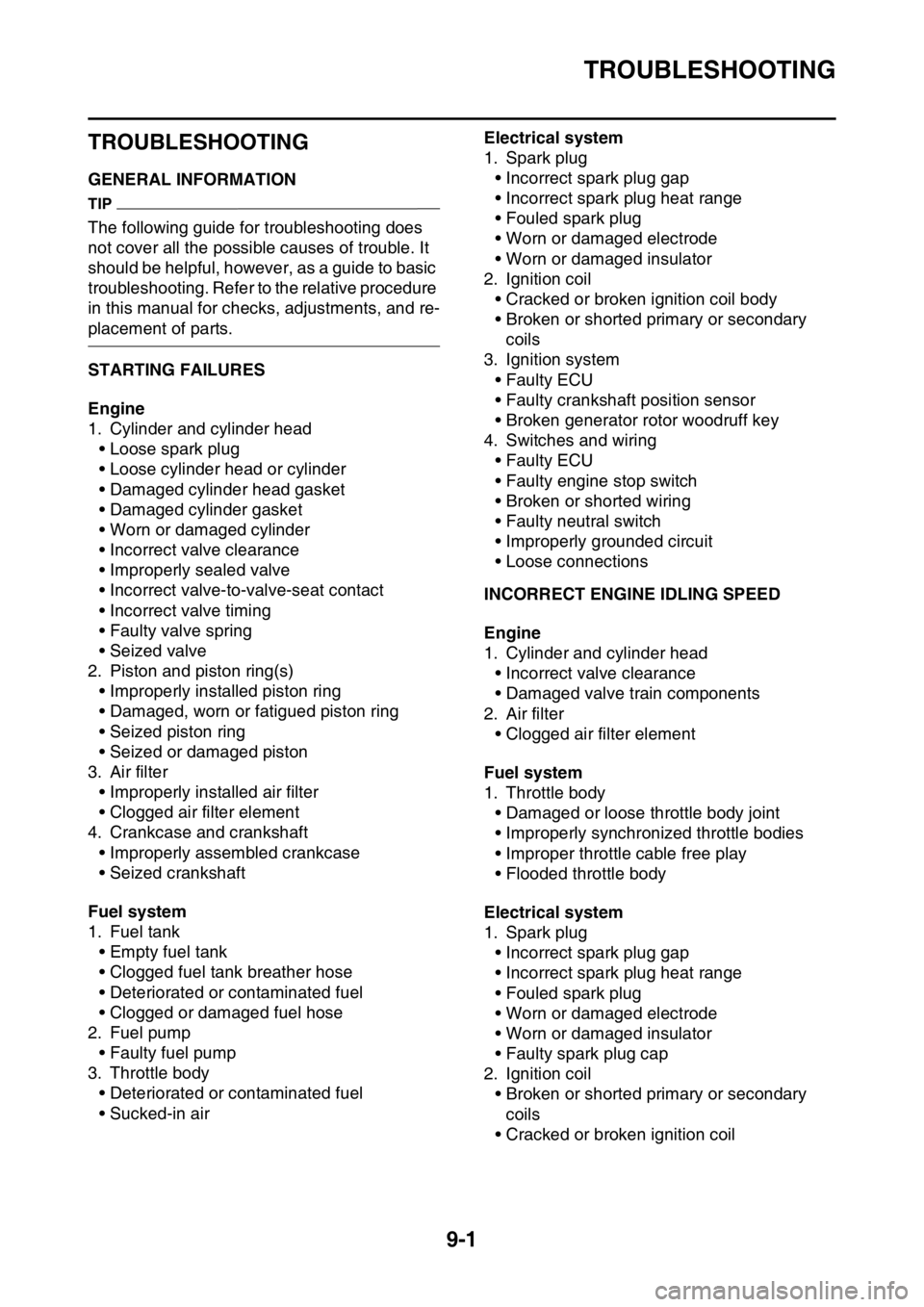
EAS1SM9348
TROUBLESHOOTING
EAS1SM9349GENERAL INFORMATION
TIP
The following guide for troubleshooting does
not cover all the possible causes of trouble. It
should be helpful, however, as a guide to basic
troubleshooting. Refer to the relative procedure
in this manual for checks, adjustments, and re-
placement of parts.
EAS1SM9350STARTING FAILURES
Engine
1. Cylinder and cylinder head
• Loose spark plug
• Loose cylinder head or cylinder
• Damaged cylinder head gasket
• Damaged cylinder gasket
• Worn or damaged cylinder
• Incorrect valve clearance
• Improperly sealed valve
• Incorrect valve-to-valve-seat contact
• Incorrect valve timing
• Faulty valve spring
• Seized valve
2. Piston and piston ring(s)
• Improperly installed piston ring
• Damaged, worn or fatigued piston ring
• Seized piston ring
• Seized or damaged piston
3. Air filter
• Improperly installed air filter
• Clogged air filter element
4. Crankcase and crankshaft
• Improperly assembled crankcase
• Seized crankshaft
Fuel system
1. Fuel tank
• Empty fuel tank
• Clogged fuel tank breather hose
• Deteriorated or contaminated fuel
• Clogged or damaged fuel hose
2. Fuel pump
• Faulty fuel pump
3. Throttle body
• Deteriorated or contaminated fuel
• Sucked-in airElectrical system
1. Spark plug
• Incorrect spark plug gap
• Incorrect spark plug heat range
• Fouled spark plug
• Worn or damaged electrode
• Worn or damaged insulator
2. Ignition coil
• Cracked or broken ignition coil body
• Broken or shorted primary or secondary
coils
3. Ignition system
• Faulty ECU
• Faulty crankshaft position sensor
• Broken generator rotor woodruff key
4. Switches and wiring
• Faulty ECU
• Faulty engine stop switch
• Broken or shorted wiring
• Faulty neutral switch
• Improperly grounded circuit
• Loose connections
EAS1SM9351INCORRECT ENGINE IDLING SPEED
Engine
1. Cylinder and cylinder head
• Incorrect valve clearance
• Damaged valve train components
2. Air filter
• Clogged air filter element
Fuel system
1. Throttle body
• Damaged or loose throttle body joint
• Improperly synchronized throttle bodies
• Improper throttle cable free play
• Flooded throttle body
Electrical system
1. Spark plug
• Incorrect spark plug gap
• Incorrect spark plug heat range
• Fouled spark plug
• Worn or damaged electrode
• Worn or damaged insulator
• Faulty spark plug cap
2. Ignition coil
• Broken or shorted primary or secondary
coils
• Cracked or broken ignition coil
Page 337 of 356
TROUBLESHOOTING
9-2
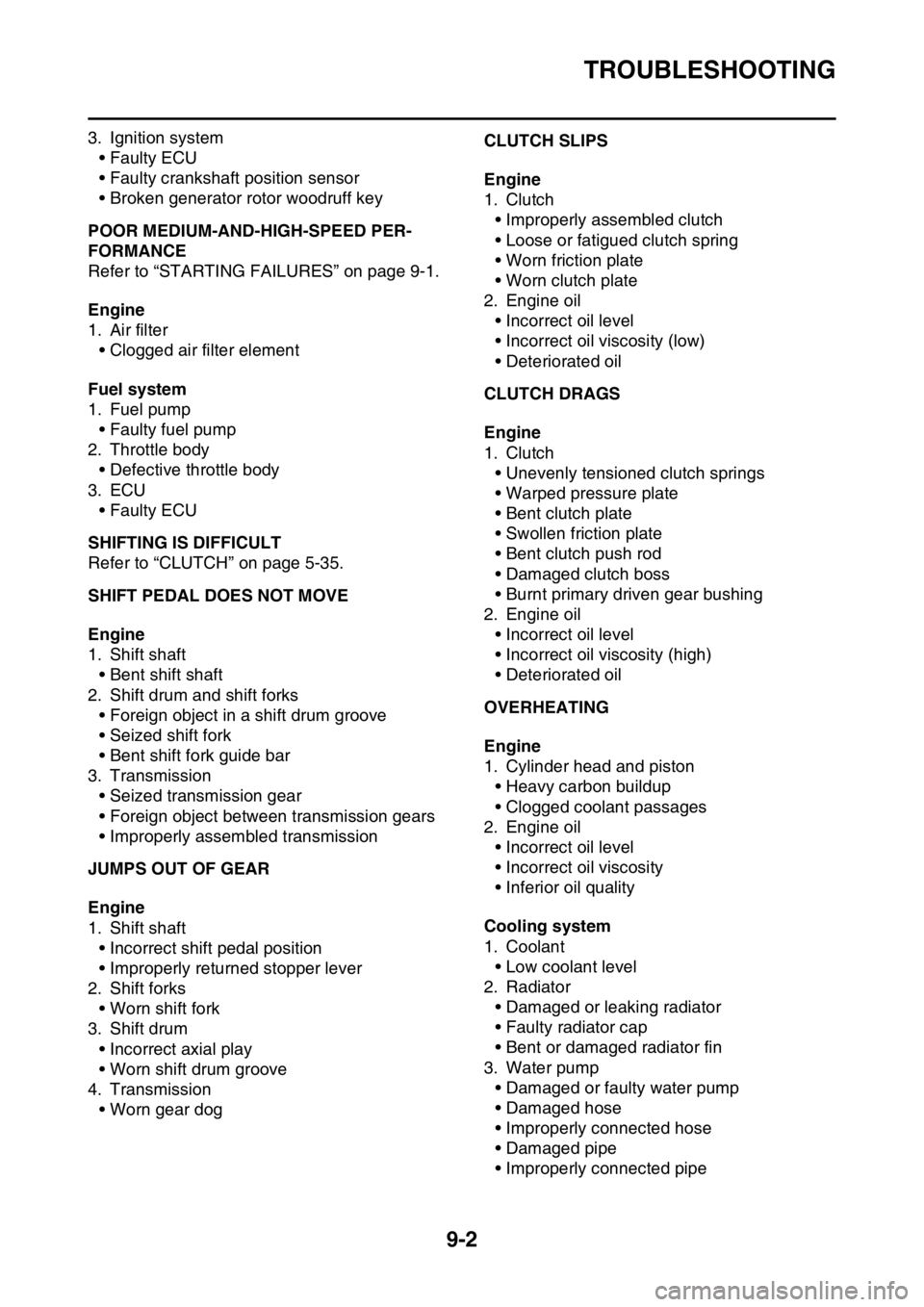
3. Ignition system
• Faulty ECU
• Faulty crankshaft position sensor
• Broken generator rotor woodruff key
EAS1SM9352POOR MEDIUM-AND-HIGH-SPEED PER-
FORMANCE
Refer to “STARTING FAILURES” on page 9-1.
Engine
1. Air filter
• Clogged air filter element
Fuel system
1. Fuel pump
• Faulty fuel pump
2. Throttle body
• Defective throttle body
3. ECU
• Faulty ECU
EAS1SM9353SHIFTING IS DIFFICULT
Refer to “CLUTCH” on page 5-35.
EAS1SM9354SHIFT PEDAL DOES NOT MOVE
Engine
1. Shift shaft
• Bent shift shaft
2. Shift drum and shift forks
• Foreign object in a shift drum groove
• Seized shift fork
• Bent shift fork guide bar
3. Transmission
• Seized transmission gear
• Foreign object between transmission gears
• Improperly assembled transmission
EAS1SM9355JUMPS OUT OF GEAR
Engine
1. Shift shaft
• Incorrect shift pedal position
• Improperly returned stopper lever
2. Shift forks
• Worn shift fork
3. Shift drum
• Incorrect axial play
• Worn shift drum groove
4. Transmission
• Worn gear dog
EAS1SM9356CLUTCH SLIPS
Engine
1. Clutch
• Improperly assembled clutch
• Loose or fatigued clutch spring
• Worn friction plate
• Worn clutch plate
2. Engine oil
• Incorrect oil level
• Incorrect oil viscosity (low)
• Deteriorated oil
EAS1SM9357CLUTCH DRAGS
Engine
1. Clutch
• Unevenly tensioned clutch springs
• Warped pressure plate
• Bent clutch plate
• Swollen friction plate
• Bent clutch push rod
• Damaged clutch boss
• Burnt primary driven gear bushing
2. Engine oil
• Incorrect oil level
• Incorrect oil viscosity (high)
• Deteriorated oil
EAS1SM9358OVERHEATING
Engine
1. Cylinder head and piston
• Heavy carbon buildup
• Clogged coolant passages
2. Engine oil
• Incorrect oil level
• Incorrect oil viscosity
• Inferior oil quality
Cooling system
1. Coolant
• Low coolant level
2. Radiator
• Damaged or leaking radiator
• Faulty radiator cap
• Bent or damaged radiator fin
3. Water pump
• Damaged or faulty water pump
• Damaged hose
• Improperly connected hose
• Damaged pipe
• Improperly connected pipe
Page 349 of 356
CHASSIS
10-6
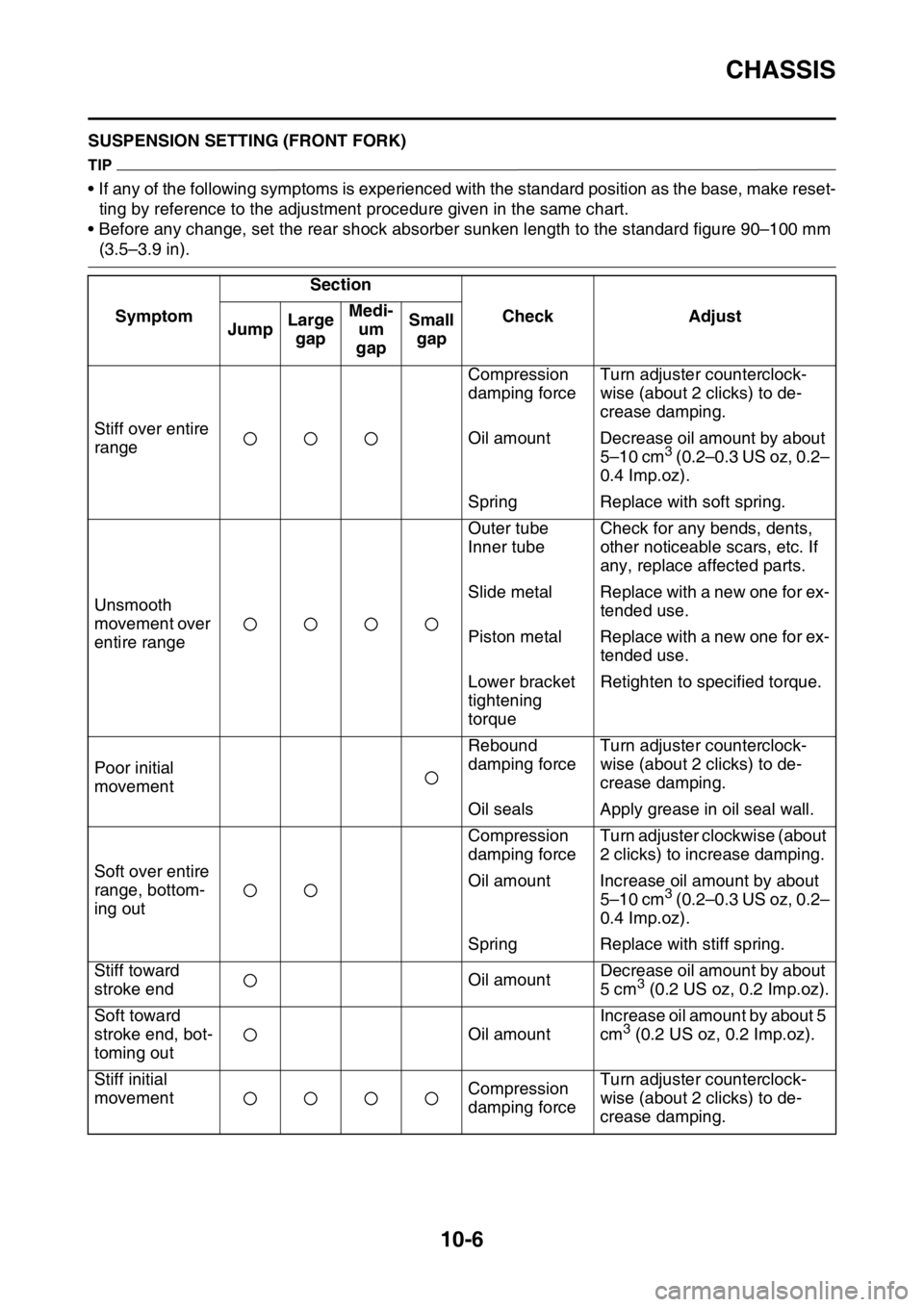
EAS1SM9378SUSPENSION SETTING (FRONT FORK)
TIP
• If any of the following symptoms is experienced with the standard position as the base, make reset-
ting by reference to the adjustment procedure given in the same chart.
• Before any change, set the rear shock absorber sunken length to the standard figure 90–100 mm
(3.5–3.9 in).
SymptomSection
Check Adjust
JumpLarge
gapMedi-
um
gapSmall
gap
Stiff over entire
rangeCompression
damping forceTurn adjuster counterclock-
wise (about 2 clicks) to de-
crease damping.
Oil amount Decrease oil amount by about
5–10 cm
3 (0.2–0.3 US oz, 0.2–
0.4 Imp.oz).
Spring Replace with soft spring.
Unsmooth
movement over
entire rangeOuter tube
Inner tubeCheck for any bends, dents,
other noticeable scars, etc. If
any, replace affected parts.
Slide metal Replace with a new one for ex-
tended use.
Piston metal Replace with a new one for ex-
tended use.
Lower bracket
tightening
torqueRetighten to specified torque.
Poor initial
movementRebound
damping forceTurn adjuster counterclock-
wise (about 2 clicks) to de-
crease damping.
Oil seals Apply grease in oil seal wall.
Soft over entire
range, bottom-
ing outCompression
damping forceTurn adjuster clockwise (about
2 clicks) to increase damping.
Oil amount Increase oil amount by about
5–10 cm
3 (0.2–0.3 US oz, 0.2–
0.4 Imp.oz).
Spring Replace with stiff spring.
Stiff toward
stroke endOil amountDecrease oil amount by about
5 cm
3 (0.2 US oz, 0.2 Imp.oz).
Soft toward
stroke end, bot-
toming outOil amountIncrease oil amount by about 5
cm
3 (0.2 US oz, 0.2 Imp.oz).
Stiff initial
movementCompression
damping forceTurn adjuster counterclock-
wise (about 2 clicks) to de-
crease damping.