ECU YAMAHA YZ250F 2016 Workshop Manual
[x] Cancel search | Manufacturer: YAMAHA, Model Year: 2016, Model line: YZ250F, Model: YAMAHA YZ250F 2016Pages: 356, PDF Size: 11.25 MB
Page 320 of 356

FUEL PUMP SYSTEM
8-34
EAS1SM9330TROUBLESHOOTING
The fuel pump fails to operate.
TIP
Before troubleshooting, remove the following part(s):
1. Seat
2. Side cover (left/right)
3. Air scoop (left/right)
4. Fuel tank
5. Air filter case cover
1. Check the fuel pump system wire
harness connections.NG
Reconnect.
OK
2. Check the engine stop switch.
Refer to “CHECKING THE
SWITCHES” on page 8-38.NG
Replace the engine stop switch.
OK
3. Check fuel pressure.
Refer to “CHECKING THE FUEL
PRESSURE” on page 7-3.NG
Replace the fuel pump.
OK
4. Check the fuel pump system wire
harness.
Refer to “CIRCUIT DIAGRAM” on
page 8-32.NG
Repair or replace the wire harness.
OK
Replace the ECU.
Page 323 of 356

ELECTRICAL COMPONENTS
8-37
1. Rectifier/regulator
2. Intake air pressure sensor
3. Throttle position sensor
4. Injector
5. Intake air temperature sensor
6. ECU (electronic control unit)
7. Intake air pressure sensor
8. Condenser
9. Neutral switch
10.Coolant temperature sensor
Page 329 of 356
ELECTRICAL COMPONENTS
8-43
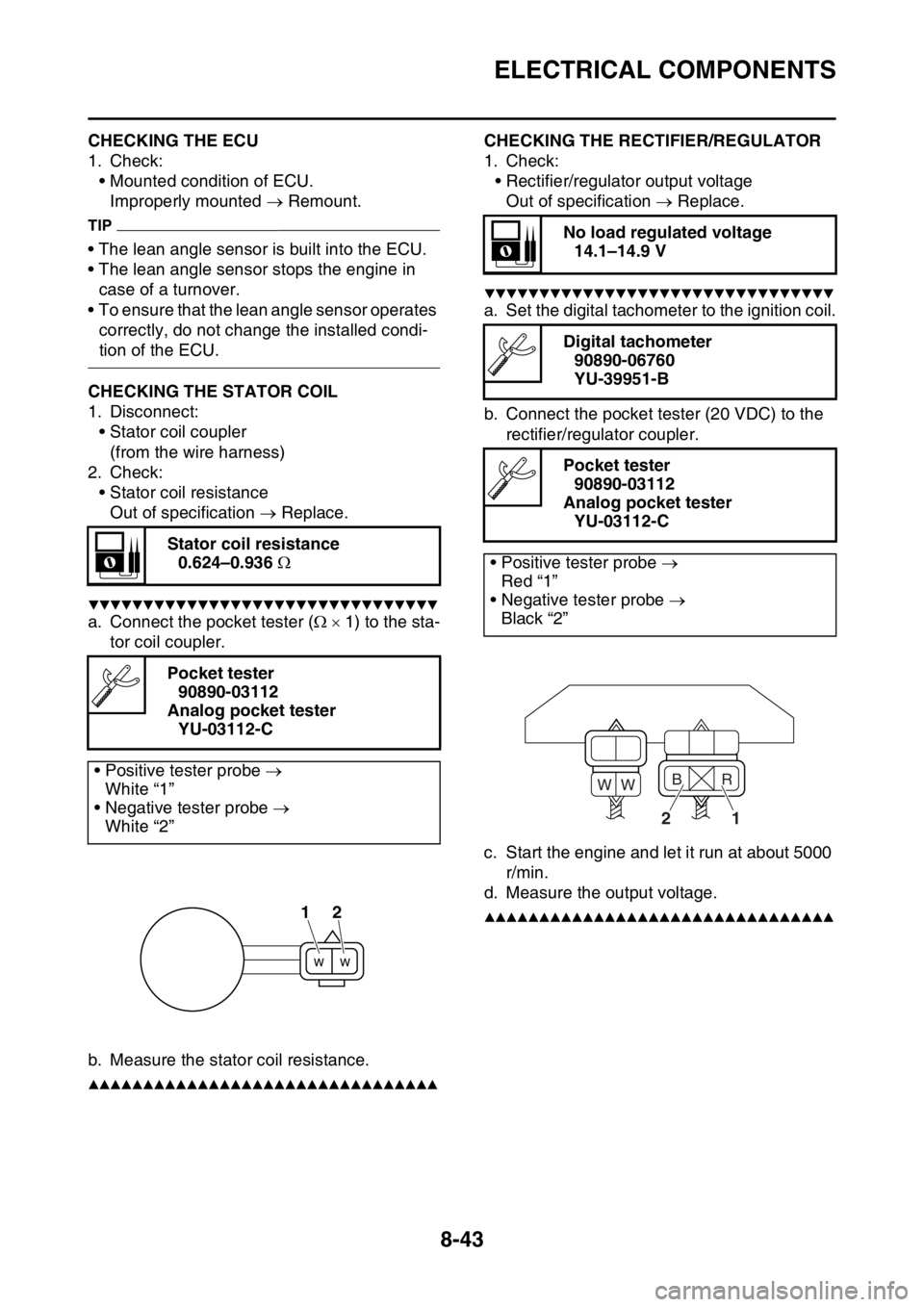
EAS1SM9338CHECKING THE ECU
1. Check:
• Mounted condition of ECU.
Improperly mounted Remount.
TIP
• The lean angle sensor is built into the ECU.
• The lean angle sensor stops the engine in
case of a turnover.
• To ensure that the lean angle sensor operates
correctly, do not change the installed condi-
tion of the ECU.
EAS1SM9339CHECKING THE STATOR COIL
1. Disconnect:
• Stator coil coupler
(from the wire harness)
2. Check:
• Stator coil resistance
Out of specification Replace.
▼▼▼▼▼▼▼▼▼▼▼▼▼▼▼▼▼▼▼▼▼▼▼▼▼▼▼▼▼▼▼▼
a. Connect the pocket tester ( 1) to the sta-
tor coil coupler.
b. Measure the stator coil resistance.
▲▲▲▲▲▲▲▲▲▲▲▲▲▲▲▲▲▲▲▲▲▲▲▲▲▲▲▲▲▲▲▲
EAS1SM9340CHECKING THE RECTIFIER/REGULATOR
1. Check:
• Rectifier/regulator output voltage
Out of specification Replace.
▼▼▼▼▼▼▼▼▼▼▼▼▼▼▼▼▼▼▼▼▼▼▼▼▼▼▼▼▼▼▼▼
a. Set the digital tachometer to the ignition coil.
b. Connect the pocket tester (20 VDC) to the
rectifier/regulator coupler.
c. Start the engine and let it run at about 5000
r/min.
d. Measure the output voltage.
▲▲▲▲▲▲▲▲▲▲▲▲▲▲▲▲▲▲▲▲▲▲▲▲▲▲▲▲▲▲▲▲
Stator coil resistance
0.624–0.936
Pocket tester
90890-03112
Analog pocket tester
YU-03112-C
• Positive tester probe
White “1”
• Negative tester probe
White “2”
12
No load regulated voltage
14.1–14.9 V
Digital tachometer
90890-06760
YU-39951-B
Pocket tester
90890-03112
Analog pocket tester
YU-03112-C
• Positive tester probe
Red “1”
• Negative tester probe
Black “2”
21
B
WWR
Page 331 of 356
ELECTRICAL COMPONENTS
8-45
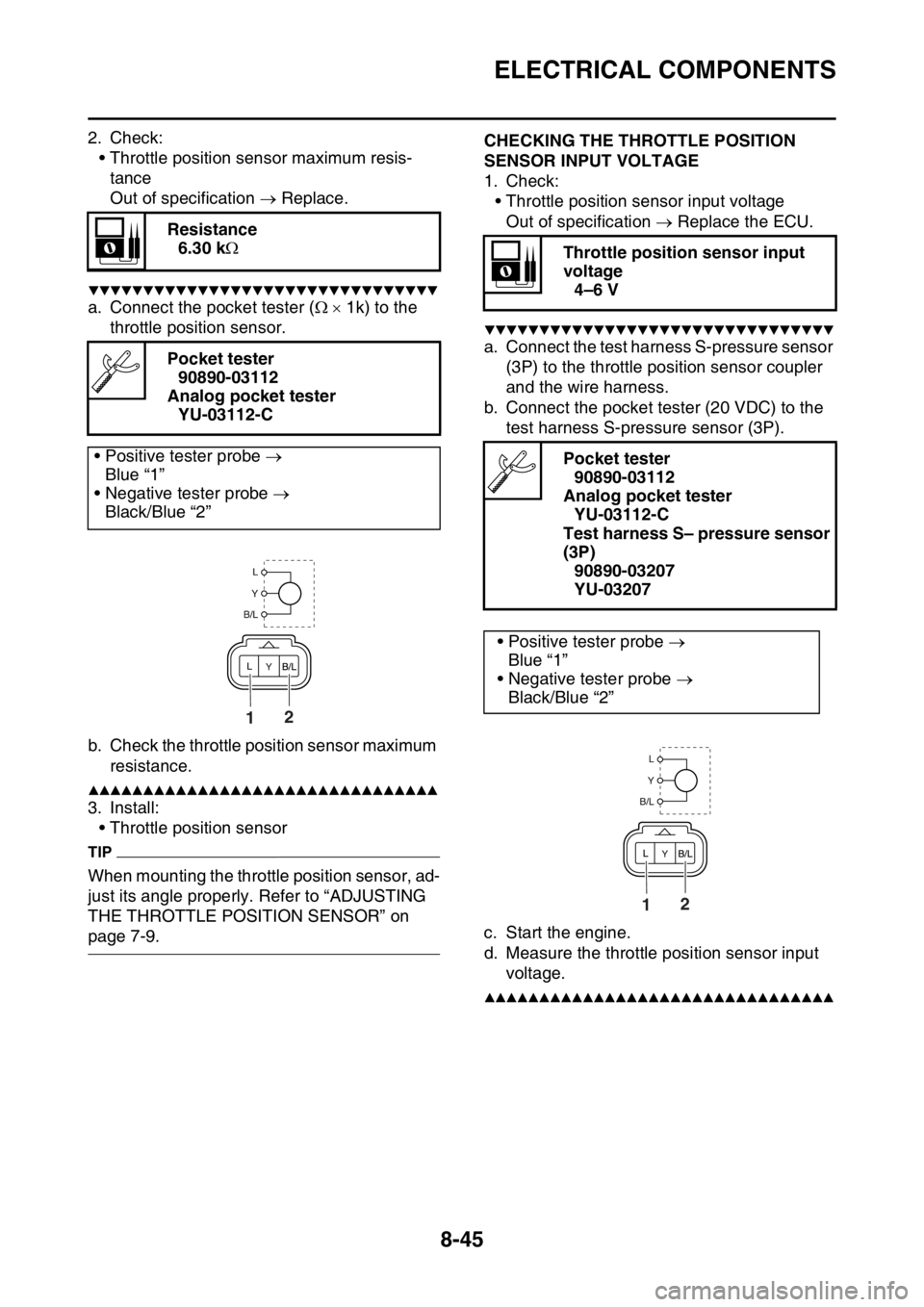
2. Check:
• Throttle position sensor maximum resis-
tance
Out of specification Replace.
▼▼▼▼▼▼▼▼▼▼▼▼▼▼▼▼▼▼▼▼▼▼▼▼▼▼▼▼▼▼▼▼
a. Connect the pocket tester ( 1k) to the
throttle position sensor.
b. Check the throttle position sensor maximum
resistance.
▲▲▲▲▲▲▲▲▲▲▲▲▲▲▲▲▲▲▲▲▲▲▲▲▲▲▲▲▲▲▲▲
3. Install:
• Throttle position sensor
TIP
When mounting the throttle position sensor, ad-
just its angle properly. Refer to “ADJUSTING
THE THROTTLE POSITION SENSOR” on
page 7-9.
EAS1SM9343CHECKING THE THROTTLE POSITION
SENSOR INPUT VOLTAGE
1. Check:
• Throttle position sensor input voltage
Out of specification Replace the ECU.
▼▼▼▼▼▼▼▼▼▼▼▼▼▼▼▼▼▼▼▼▼▼▼▼▼▼▼▼▼▼▼▼
a. Connect the test harness S-pressure sensor
(3P) to the throttle position sensor coupler
and the wire harness.
b. Connect the pocket tester (20 VDC) to the
test harness S-pressure sensor (3P).
c. Start the engine.
d. Measure the throttle position sensor input
voltage.
▲▲▲▲▲▲▲▲▲▲▲▲▲▲▲▲▲▲▲▲▲▲▲▲▲▲▲▲▲▲▲▲
Resistance
6.30 k
Pocket tester
90890-03112
Analog pocket tester
YU-03112-C
• Positive tester probe
Blue “1”
• Negative tester probe
Black/Blue “2”
21
Throttle position sensor input
voltage
4–6 V
Pocket tester
90890-03112
Analog pocket tester
YU-03112-C
Test harness S– pressure sensor
(3P)
90890-03207
YU-03207
• Positive tester probe
Blue “1”
• Negative tester probe
Black/Blue “2”
21
Page 336 of 356
TROUBLESHOOTING
9-1
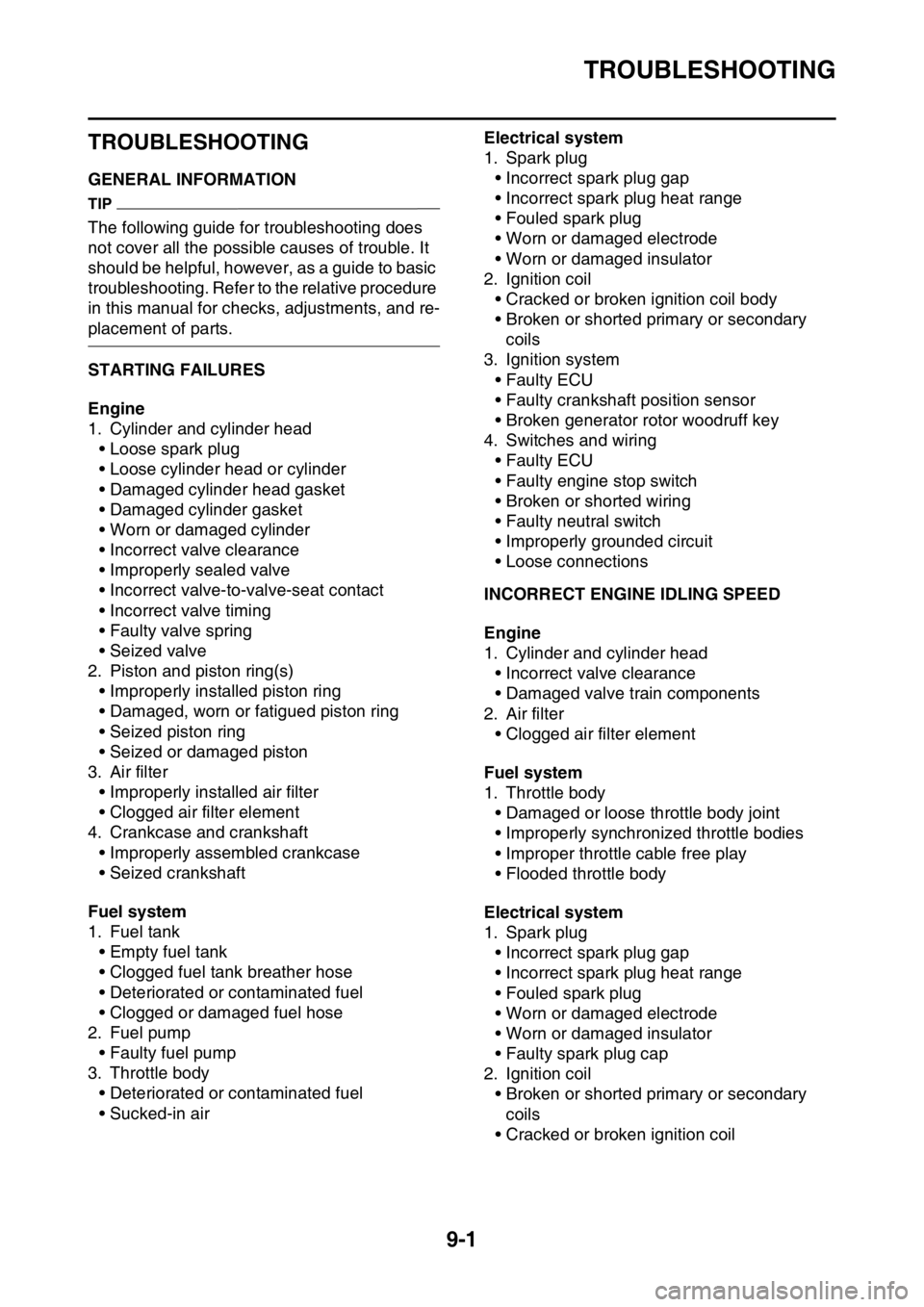
EAS1SM9348
TROUBLESHOOTING
EAS1SM9349GENERAL INFORMATION
TIP
The following guide for troubleshooting does
not cover all the possible causes of trouble. It
should be helpful, however, as a guide to basic
troubleshooting. Refer to the relative procedure
in this manual for checks, adjustments, and re-
placement of parts.
EAS1SM9350STARTING FAILURES
Engine
1. Cylinder and cylinder head
• Loose spark plug
• Loose cylinder head or cylinder
• Damaged cylinder head gasket
• Damaged cylinder gasket
• Worn or damaged cylinder
• Incorrect valve clearance
• Improperly sealed valve
• Incorrect valve-to-valve-seat contact
• Incorrect valve timing
• Faulty valve spring
• Seized valve
2. Piston and piston ring(s)
• Improperly installed piston ring
• Damaged, worn or fatigued piston ring
• Seized piston ring
• Seized or damaged piston
3. Air filter
• Improperly installed air filter
• Clogged air filter element
4. Crankcase and crankshaft
• Improperly assembled crankcase
• Seized crankshaft
Fuel system
1. Fuel tank
• Empty fuel tank
• Clogged fuel tank breather hose
• Deteriorated or contaminated fuel
• Clogged or damaged fuel hose
2. Fuel pump
• Faulty fuel pump
3. Throttle body
• Deteriorated or contaminated fuel
• Sucked-in airElectrical system
1. Spark plug
• Incorrect spark plug gap
• Incorrect spark plug heat range
• Fouled spark plug
• Worn or damaged electrode
• Worn or damaged insulator
2. Ignition coil
• Cracked or broken ignition coil body
• Broken or shorted primary or secondary
coils
3. Ignition system
• Faulty ECU
• Faulty crankshaft position sensor
• Broken generator rotor woodruff key
4. Switches and wiring
• Faulty ECU
• Faulty engine stop switch
• Broken or shorted wiring
• Faulty neutral switch
• Improperly grounded circuit
• Loose connections
EAS1SM9351INCORRECT ENGINE IDLING SPEED
Engine
1. Cylinder and cylinder head
• Incorrect valve clearance
• Damaged valve train components
2. Air filter
• Clogged air filter element
Fuel system
1. Throttle body
• Damaged or loose throttle body joint
• Improperly synchronized throttle bodies
• Improper throttle cable free play
• Flooded throttle body
Electrical system
1. Spark plug
• Incorrect spark plug gap
• Incorrect spark plug heat range
• Fouled spark plug
• Worn or damaged electrode
• Worn or damaged insulator
• Faulty spark plug cap
2. Ignition coil
• Broken or shorted primary or secondary
coils
• Cracked or broken ignition coil
Page 337 of 356

TROUBLESHOOTING
9-2
3. Ignition system
• Faulty ECU
• Faulty crankshaft position sensor
• Broken generator rotor woodruff key
EAS1SM9352POOR MEDIUM-AND-HIGH-SPEED PER-
FORMANCE
Refer to “STARTING FAILURES” on page 9-1.
Engine
1. Air filter
• Clogged air filter element
Fuel system
1. Fuel pump
• Faulty fuel pump
2. Throttle body
• Defective throttle body
3. ECU
• Faulty ECU
EAS1SM9353SHIFTING IS DIFFICULT
Refer to “CLUTCH” on page 5-35.
EAS1SM9354SHIFT PEDAL DOES NOT MOVE
Engine
1. Shift shaft
• Bent shift shaft
2. Shift drum and shift forks
• Foreign object in a shift drum groove
• Seized shift fork
• Bent shift fork guide bar
3. Transmission
• Seized transmission gear
• Foreign object between transmission gears
• Improperly assembled transmission
EAS1SM9355JUMPS OUT OF GEAR
Engine
1. Shift shaft
• Incorrect shift pedal position
• Improperly returned stopper lever
2. Shift forks
• Worn shift fork
3. Shift drum
• Incorrect axial play
• Worn shift drum groove
4. Transmission
• Worn gear dog
EAS1SM9356CLUTCH SLIPS
Engine
1. Clutch
• Improperly assembled clutch
• Loose or fatigued clutch spring
• Worn friction plate
• Worn clutch plate
2. Engine oil
• Incorrect oil level
• Incorrect oil viscosity (low)
• Deteriorated oil
EAS1SM9357CLUTCH DRAGS
Engine
1. Clutch
• Unevenly tensioned clutch springs
• Warped pressure plate
• Bent clutch plate
• Swollen friction plate
• Bent clutch push rod
• Damaged clutch boss
• Burnt primary driven gear bushing
2. Engine oil
• Incorrect oil level
• Incorrect oil viscosity (high)
• Deteriorated oil
EAS1SM9358OVERHEATING
Engine
1. Cylinder head and piston
• Heavy carbon buildup
• Clogged coolant passages
2. Engine oil
• Incorrect oil level
• Incorrect oil viscosity
• Inferior oil quality
Cooling system
1. Coolant
• Low coolant level
2. Radiator
• Damaged or leaking radiator
• Faulty radiator cap
• Bent or damaged radiator fin
3. Water pump
• Damaged or faulty water pump
• Damaged hose
• Improperly connected hose
• Damaged pipe
• Improperly connected pipe
Page 338 of 356

TROUBLESHOOTING
9-3
Fuel system
1. Throttle body
• Damaged or loose throttle body joint
2. Air filter
• Clogged air filter element
Chassis
1. Brake(s)
• Dragging brake
Electrical system
1. Spark plug
• Incorrect spark plug gap
• Incorrect spark plug heat range
2. Ignition system
• Faulty ECU
• Faulty coolant temperature sensor
EAS1SM9359OVERCOOLING
Cooling system
1. Coolant temperature sensor
• Faulty coolant temperature sensor
EAS1SM9360POOR BRAKING PERFORMANCE
Chassis
1. Brake(s)
• Worn brake pad
• Worn brake disc
• Air in hydraulic brake system
• Leaking brake fluid
• Defective master cylinder kit
• Faulty brake caliper kit
• Faulty brake caliper seal
• Loose union bolt
• Damaged brake hose
• Oil or grease on the brake disc
• Oil or grease on the brake pad
• Incorrect brake fluid level
EAS1SM9361FRONT FORK OIL LEAKING
Chassis
1. Front fork
• Bent, damaged, or rusty inner tube
• Cracked or damaged outer tube
• Improperly installed oil seal
• Damaged oil seal lip
• Incorrect oil level (high)
• Loose damper rod assembly bolt
• Damaged damper rod assembly bolt copper
washer
• Cracked or damaged cap bolt O-ring
EAS1SM9362FAULTY FRONT FORK LEGS
Chassis
1. Front fork
• Bent or damaged inner tube
• Bent or damaged outer tube
• Broken fork spring
• Bent or damaged damper rod
• Incorrect oil viscosity
• Incorrect oil level
EAS1SM9363UNSTABLE HANDLING
Chassis
1. Handlebar
• Bent or improperly installed handlebar
2. Steering head components
• Improperly installed upper bracket
• Improperly installed lower bracket
(improperly tightened ring nut)
• Bent steering stem
• Damaged ball bearing or bearing race
3. Front fork leg (s)
• Uneven oil levels (both front fork legs)
• Unevenly tensioned fork spring (both front
fork legs)
• Broken fork spring
• Bent or damaged inner tube
• Bent or damaged outer tube
4. Swingarm
• Worn bearing or bushing
• Bent or damaged swingarm
5. Rear shock absorber assembly (-ies)
• Faulty rear shock absorber spring
• Leaking oil or gas
6. Tire (s)
• Uneven tire pressures (front and rear)
• Incorrect tire pressure
• Uneven tire wear
7. Wheel (s)
• Incorrect wheel balance
• Broken or loose spoke
• Damaged wheel bearing
• Bent or loose wheel axle
• Excessive wheel runout
8. Frame
• Bent frame
• Damaged steering head pipe
• Improperly installed bearing race
Page 339 of 356

LIST OF SELF-DIAGNOSTIC AND FAIL-SAFE ACTIONS
9-4
EAS1SM9364
LIST OF SELF-DIAGNOSTIC AND FAIL-SAFE ACTIONS
LIST OF DIAGNOSTIC CODES
COMMUNICATION ERROR WITH YAMAHA DIAGNOSTIC TOOLFault
codeITEM Page
12 Crankshaft position sensor: no normal signals are received from the
crankshaft position sensor.8-14
13 Intake air pressure sensor: open or short circuit detected. 8-15
14 Intake air pressure sensor: hose system malfunction (clogged or de-
tached hose)8-16
15 Throttle position sensor: open or short circuit detected. 8-17
16 Throttle position sensor: stuck throttle position sensor is detected. 8-19
21 Coolant temperature sensor: open or short circuit detected. 8-20
22 Intake air temperature sensor: open or short circuit detected. 8-21
30 The vehicle has overturned. 8-22
33 Ignition coil: open or short circuit detected in the primary lead of the
ignition coil.8-23
39 Injector: open or short circuit detected. 8-24
41 ECU: built-in lean angle sensor malfunction 8-25
44 EEPROM fault code No.: an error is detected while reading or writing
on EEPROM.8-26
46 Vehicle system power supply: normal voltage is not supplied to the
ECU.8-27
50 ECU: faulty ECU memory 8-28
Fault
codeITEM Page
Waiting
for con-
nectionNo communication signal is received from the ECU.
8-28
Er-2 Signals from the ECU cannot be received within the specified period
of time.8-29
Er-3 Data from the ECU cannot be received correctly. 8-30
Er-4 Registered data cannot be received from the Yamaha diagnostic tool. 8-31
Page 340 of 356

LIST OF SELF-DIAGNOSTIC AND FAIL-SAFE ACTIONS
9-5
SENSOR OPERATION TABLE
Diag-
nostic
code
No.ITEM Display Procedure
01 Throttle angle
• Fully closed position
• Fully opened positionDisplays the throttle angle.
• 11–14
• 109–116• Check with throttle fully
closed.
• Check with throttle fully
opened.
03 Pressure of suction pipe Displays the intake air pres-
sure.The atmospheric pressure
is displayed on the Yamaha
diagnostic tool.
05 Intake air temperature Displays the intake air tem-
perature.Compare the actually mea-
sured intake air tempera-
ture with the Yamaha
diagnostic tool display val-
ue.
06 Coolant temperature Displays the coolant temper-
ature.Compare the actually mea-
sured coolant temperature
with the Yamaha diagnostic
tool display value.
08 Lean angle sensor
• Upright
•OverturnDisplays the output voltage.
• 1.0 (V)
• 4.0 (V)Remove the ECU, and in-
cline it 45 ° or more.
09 Monitor voltage Displays the voltage of the
external battery connected to
the Yamaha diagnostic tool.
• Approximately 12.0 (V)—
21 Neutral switch
• Gear in neutral
• Gear not in neutral•ON
•OFFOperate the shift pedal.
25 Gear position switch
• Gear in 1st or 2nd
• Gear not in 1st or 2nd•ON
•OFFOperate the shift pedal.
60 EEPROM fault code No.
display
• No fault
• CO adjustment valve
• Power Tuner injection cor-
rection setting 0–8, or
Power Tuner ignition tim-
ing correction setting 0–8•00
•01
•07—
61 Malfunction history ( )
code No. display *1
• There is no history.
• There is some history.•00
• Other: Displays the fault
code of ( ).—
Page 352 of 356

EAS1SM9381
WIRING DIAGRAM
YZ250F/YZ250FG 2016
1. Crankshaft position sensor
2. AC magneto
3. Rectifier/regulator
4. Joint connector
5. Condenser
6. Coupler for connecting option-
al part
7. Engine stop switch
8. Neutral switch
9. ECU (electronic control unit)
10. Ignition coil
11. Spark plug
12. Fuel injector
13. Fuel pump
14. Intake air temperature sensor
15. Coolant temperature sensor
16. Throttle position sensor
17. Intake air pressure sensor
18. Ignition coil sub-lead
EAS1SM9382COLOR CODE
BBlack
Gy Gray
LBlue
Lg Light green
O Orange
PPink
RRed
Sb Sky blue
Y Yellow
B/L Black/Blue
B/R Black/Red
B/W Black/White
B/Y Black/Yellow
Br/W Brown/White
G/W Green/White
L/W Blue/White
P/B Pink/Black
R/B Red/Black
Y/B Yellow/Black
Y/W Yellow/White