maintenance YAMAHA YZ450F 2011 User Guide
[x] Cancel search | Manufacturer: YAMAHA, Model Year: 2011, Model line: YZ450F, Model: YAMAHA YZ450F 2011Pages: 230, PDF Size: 14.09 MB
Page 39 of 230
2-9
MAINTENANCE SPECIFICATIONS
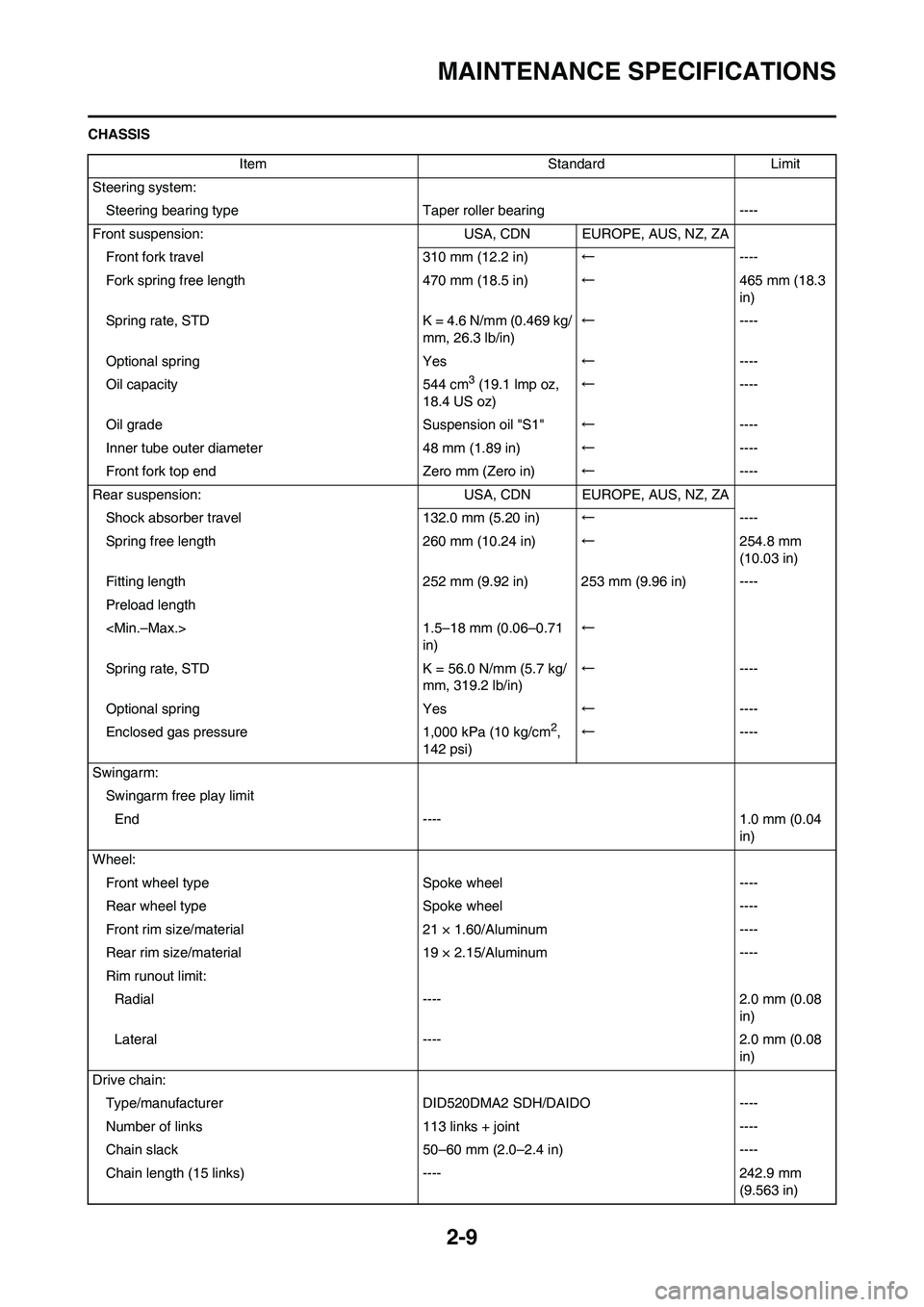
CHASSIS
Item Standard Limit
Steering system:
Steering bearing typeTaper roller bearing ----
Front suspension: USA, CDN EUROPE, AUS, NZ, ZA
Front fork travel 310 mm (12.2 in)←----
Fork spring free length 470 mm (18.5 in)←465 mm (18.3
in)
Spring rate, STD K = 4.6 N/mm (0.469 kg/
mm, 26.3 lb/in)←----
Optional spring Yes←----
Oil capacity 544 cm
3 (19.1 lmp oz,
18.4 US oz)←----
Oil grade Suspension oil "S1"←----
Inner tube outer diameter 48 mm (1.89 in)←----
Front fork top end Zero mm (Zero in)←----
Rear suspension: USA, CDN EUROPE, AUS, NZ, ZA
Shock absorber travel 132.0 mm (5.20 in)←----
Spring free length 260 mm (10.24 in)←254.8 mm
(10.03 in)
Fitting length 252 mm (9.92 in) 253 mm (9.96 in) ----
Preload length
in)←
Spring rate, STD K = 56.0 N/mm (5.7 kg/
mm, 319.2 lb/in)←----
Optional spring Yes←----
Enclosed gas pressure 1,000 kPa (10 kg/cm
2,
142 psi)←----
Swingarm:
Swingarm free play limit
End ---- 1.0 mm (0.04
in)
Wheel:
Front wheel type Spoke wheel ----
Rear wheel typeSpoke wheel ----
Front rim size/material 21 × 1.60/Aluminum ----
Rear rim size/material 19 × 2.15/Aluminum ----
Rim runout limit:
Radial ---- 2.0 mm (0.08
in)
Lateral ---- 2.0 mm (0.08
in)
Drive chain:
Type/manufacturer DID520DMA2 SDH/DAIDO ----
Number of links 113 links + joint ----
Chain slack 50–60 mm (2.0–2.4 in) ----
Chain length (15 links) ---- 242.9 mm
(9.563 in)
Page 40 of 230
2-10
MAINTENANCE SPECIFICATIONS
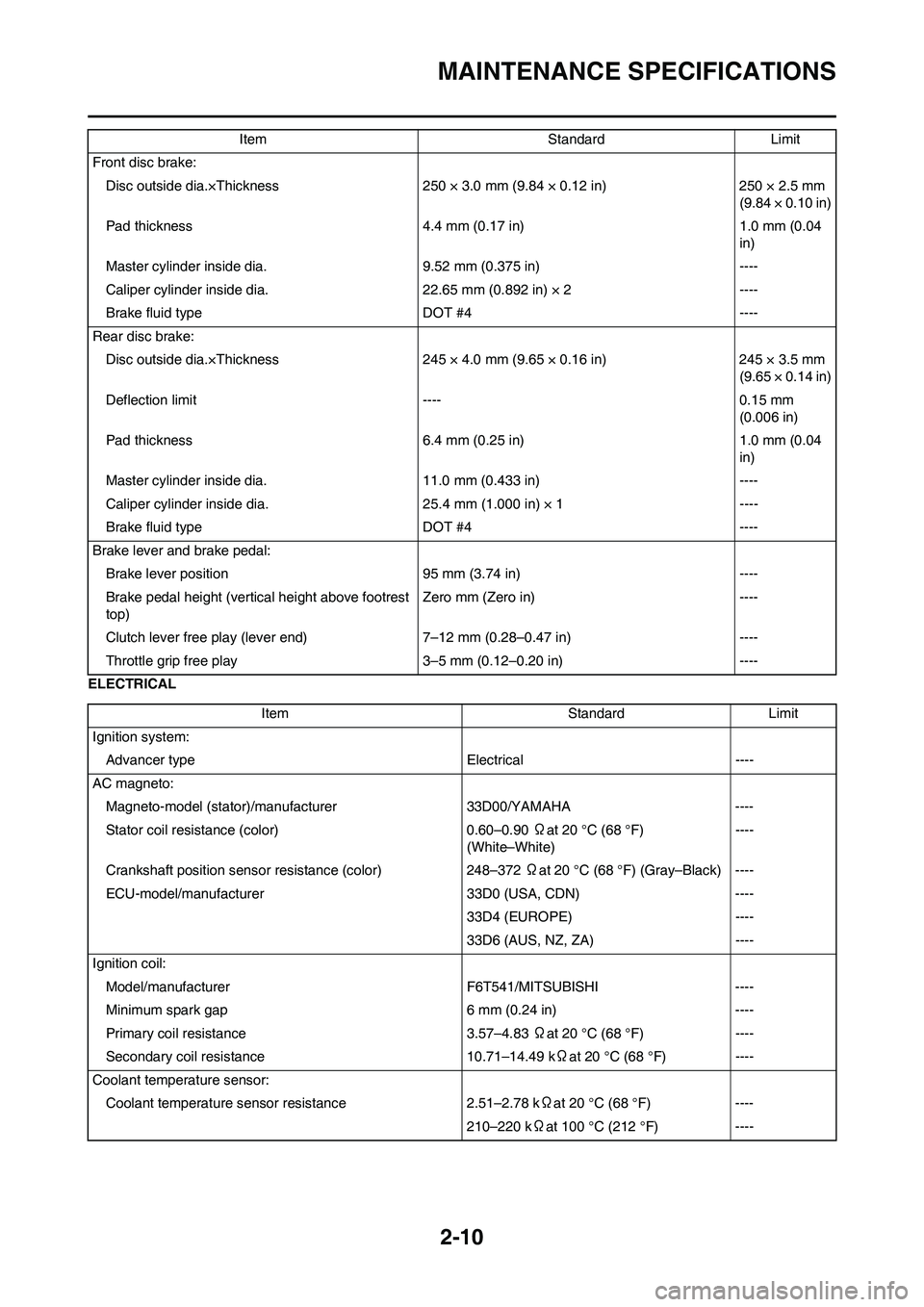
ELECTRICALFront disc brake:
Disc outside dia.×Thickness 250 × 3.0 mm (9.84 × 0.12 in) 250 × 2.5 mm
(9.84 × 0.10 in)
Pad thickness 4.4 mm (0.17 in) 1.0 mm (0.04
in)
Master cylinder inside dia. 9.52 mm (0.375 in) ----
Caliper cylinder inside dia. 22.65 mm (0.892 in) × 2 ----
Brake fluid type DOT #4 ----
Rear disc brake:
Disc outside dia.×Thickness 245 × 4.0 mm (9.65 × 0.16 in) 245 × 3.5 mm
(9.65 × 0.14 in)
Deflection limit ---- 0.15 mm
(0.006 in)
Pad thickness 6.4 mm (0.25 in) 1.0 mm (0.04
in)
Master cylinder inside dia. 11.0 mm (0.433 in) ----
Caliper cylinder inside dia. 25.4 mm (1.000 in) × 1 ----
Brake fluid type DOT #4 ----
Brake lever and brake pedal:
Brake lever position 95 mm (3.74 in) ----
Brake pedal height (vertical height above footrest
top)Zero mm (Zero in) ----
Clutch lever free play (lever end) 7–12 mm (0.28–0.47 in) ----
Throttle grip free play3–5 mm (0.12–0.20 in) ---- Item Standard Limit
Item Standard Limit
Ignition system:
Advancer type Electrical ----
AC magneto:
Magneto-model (stator)/manufacturer 33D00/YAMAHA ----
Stator coil resistance (color) 0.60–0.90 Ωat 20 °C (68 °F)
(White–White)----
Crankshaft position sensor resistance (color) 248–372 Ωat 20 °C (68 °F) (Gray–Black) ----
ECU-model/manufacturer 33D0 (USA, CDN) ----
33D4 (EUROPE) ----
33D6 (AUS, NZ, ZA) ----
Ignition coil:
Model/manufacturer F6T541/MITSUBISHI ----
Minimum spark gap 6 mm (0.24 in) ----
Primary coil resistance 3.57–4.83 Ωat 20 °C (68 °F) ----
Secondary coil resistance 10.71–14.49 kΩat 20 °C (68 °F) ----
Coolant temperature sensor:
Coolant temperature sensor resistance 2.51–2.78 kΩat 20 °C (68 °F) ----
210–220 kΩat 100 °C (212 °F) ----
Page 57 of 230
3-1
MAINTENANCE INTERVALS
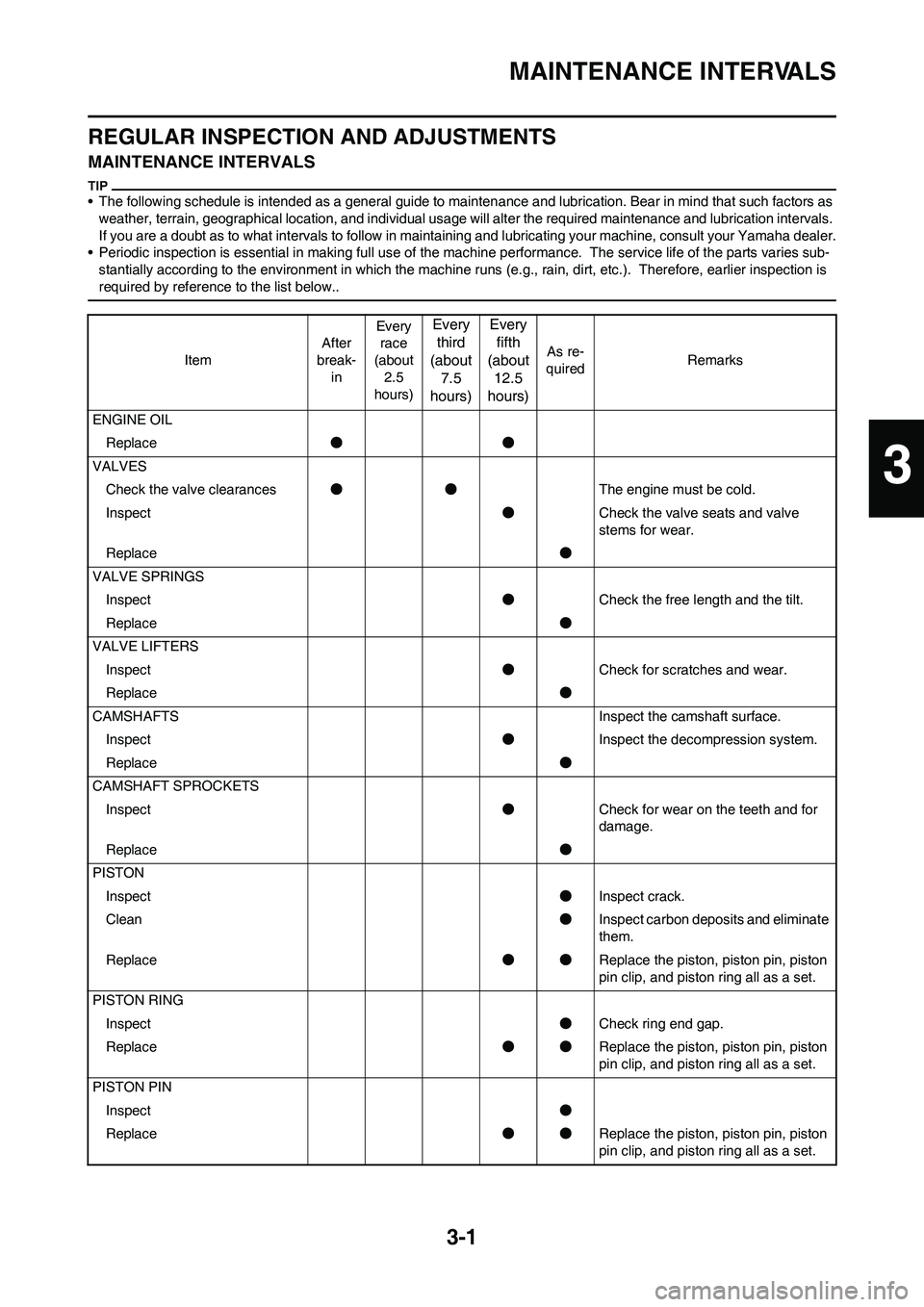
REGULAR INSPECTION AND ADJUSTMENTS
MAINTENANCE INTERVALS
• The following schedule is intended as a general guide to maintenance and lubrication. Bear in mind that such factors as
weather, terrain, geographical location, and individual usage will alter the required maintenance and lubrication intervals.
If you are a doubt as to what intervals to follow in maintaining and lubricating your machine, consult your Yamaha dealer.
• Periodic inspection is essential in making full use of the machine performance. The service life of the parts varies sub-
stantially according to the environment in which the machine runs (e.g., rain, dirt, etc.). Therefore, earlier inspection is
required by reference to the list below..
ItemAfter
break-
inEvery
race
(about
2.5
hours)
Every
third
(about
7.5
hours)Every
fifth
(about
12.5
hours)
As re-
quiredRemarks
ENGINE OIL
Replace●●
VALVES
Check the valve clearances●●The engine must be cold.
Inspect●Check the valve seats and valve
stems for wear.
Replace●
VALVE SPRINGS
Inspect●Check the free length and the tilt.
Replace●
VALVE LIFTERS
Inspect●Check for scratches and wear.
Replace●
CAMSHAFTS Inspect the camshaft surface.
Inspect●Inspect the decompression system.
Replace●
CAMSHAFT SPROCKETS
Inspect●Check for wear on the teeth and for
damage.
Replace●
PISTON
Inspect●Inspect crack.
Clean●Inspect carbon deposits and eliminate
them.
Replace●●Replace the piston, piston pin, piston
pin clip, and piston ring all as a set.
PISTON RING
Inspect●Check ring end gap.
Replace●●Replace the piston, piston pin, piston
pin clip, and piston ring all as a set.
PISTON PIN
Inspect●
Replace●●Replace the piston, piston pin, piston
pin clip, and piston ring all as a set.
3
Page 58 of 230
3-2
MAINTENANCE INTERVALS
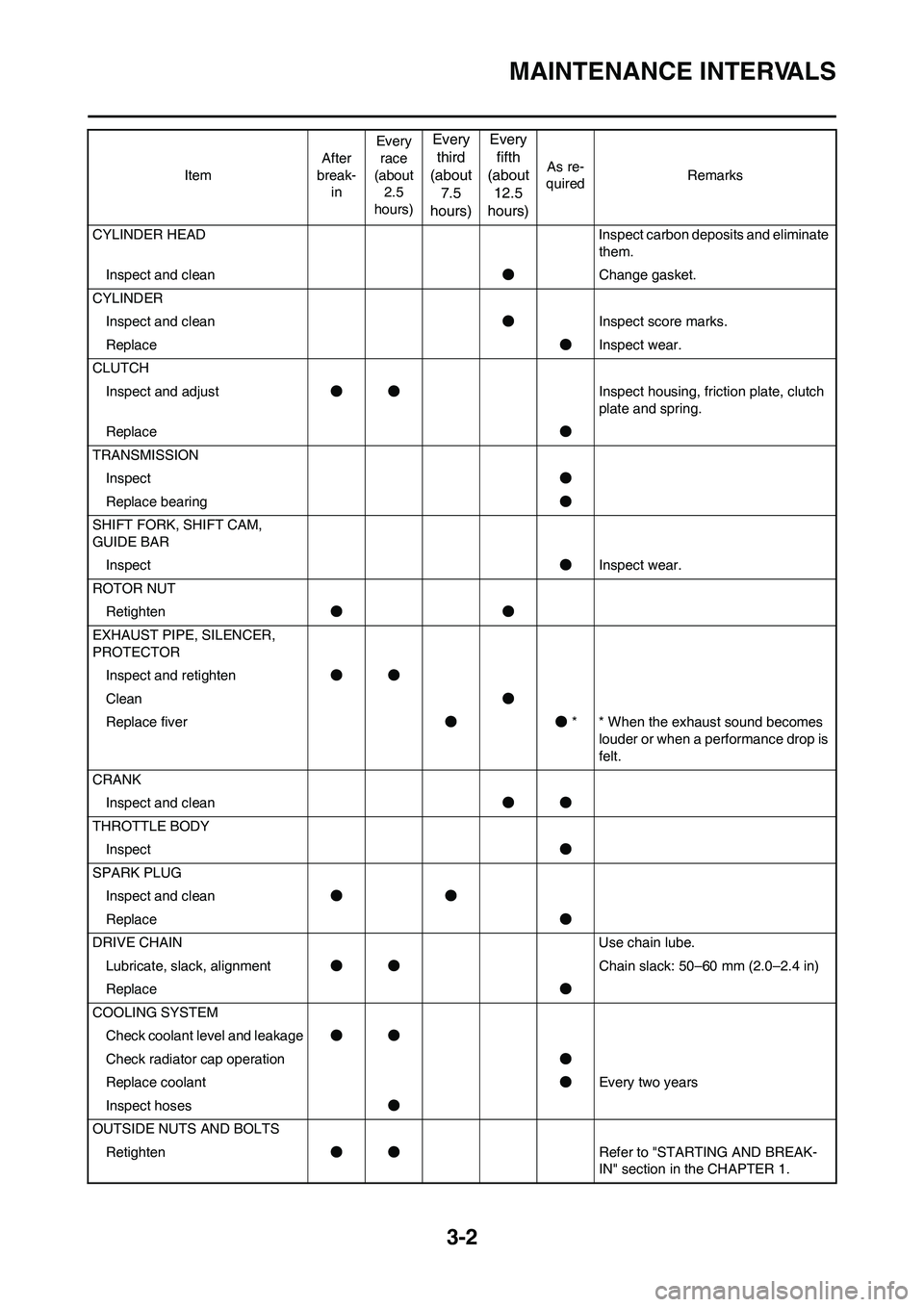
CYLINDER HEAD Inspect carbon deposits and eliminate them.
Inspect and clean ●Change gasket.
CYLINDER Inspect and clean ●Inspect score marks.
Replace ●Inspect wear.
CLUTCH Inspect and adjust ●● Inspect housing, friction plate, clutch
plate and spring.
Replace ●
TRANSMISSION Inspect ●
Replace bearing ●
SHIFT FORK, SHIFT CAM,
GUIDE BAR Inspect ●Inspect wear.
ROTOR NUT Retighten ●●
EXHAUST PIPE, SILENCER,
PROTECTOR Inspect and retighten ●●
Clean ●
Replace fiver ●●* * When the exhaust sound becomes
louder or when a performance drop is
felt.
CRANK Inspect and clean ●●
THROTTLE BODY Inspect ●
SPARK PLUG Inspect and clean ●●
Replace ●
DRIVE CHAIN Use chain lube. Lubricate, slack, alignment ●● Chain slack: 50–60 mm (2.0–2.4 in)
Replace ●
COOLING SYSTEM Check coolant level and leakage ●●
Check radiator cap operation ●
Replace coolant ●Every two years
Inspect hoses ●
OUTSIDE NUTS AND BOLTS Retighten ●● Refer to "STARTING AND BREAK-
IN" section in the CHAPTER 1.
Item
After
break- in Every
race
(about 2.5
hours)
Every third
(about 7.5
hours) Every
fifth
(about 12.5
hours)
As re-
quired Remarks
Page 59 of 230
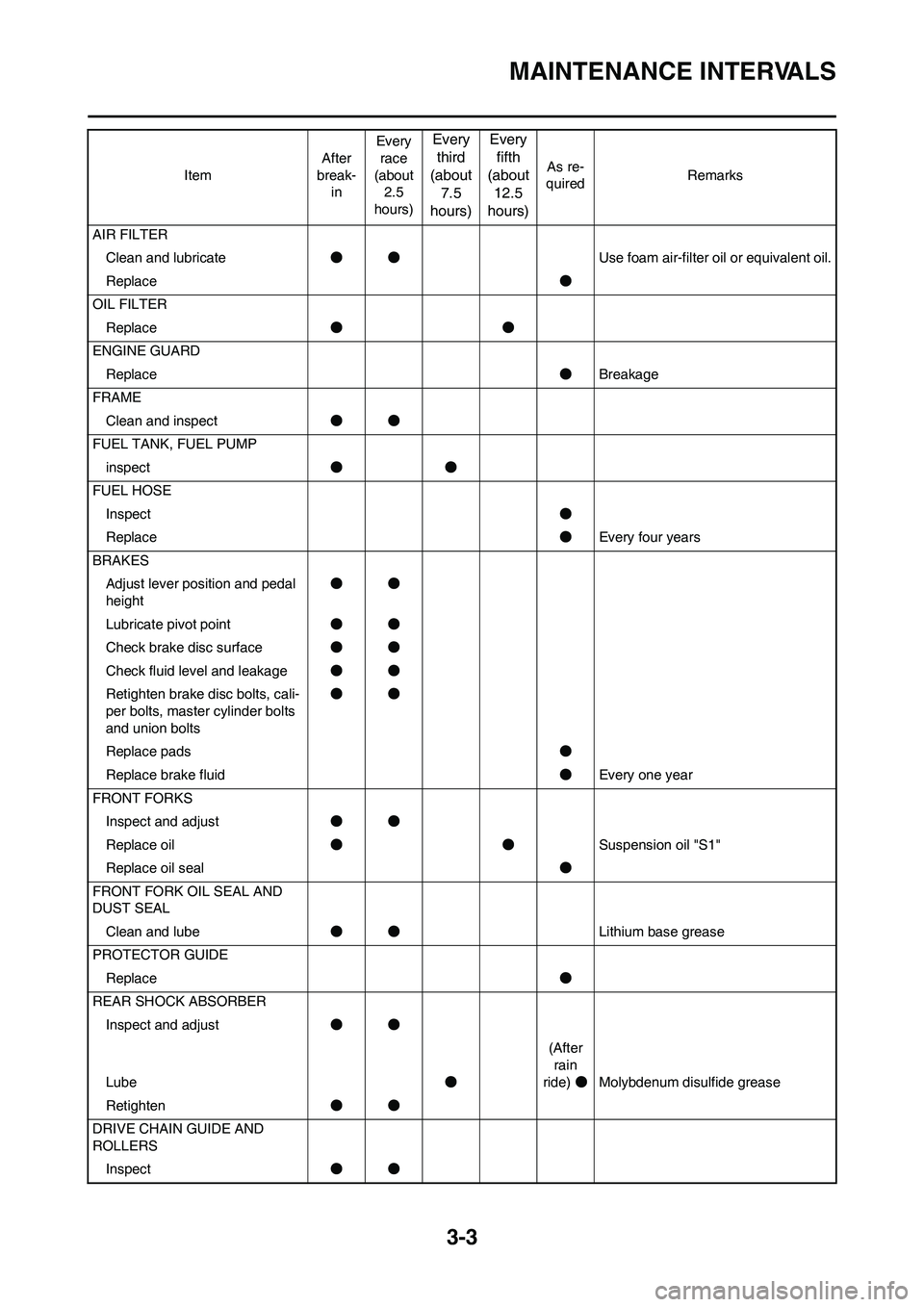
3-3
MAINTENANCE INTERVALS
AIR FILTER
Clean and lubricate●●Use foam air-filter oil or equivalent oil.
Replace●
OIL FILTER
Replace●●
ENGINE GUARD
Replace●Breakage
FRAME
Clean and inspect●●
FUEL TANK, FUEL PUMP
inspect●●
FUEL HOSE
Inspect●
Replace●Every four years
BRAKES
Adjust lever position and pedal
height●●
Lubricate pivot point●●
Check brake disc surface●●
Check fluid level and leakage●●
Retighten brake disc bolts, cali-
per bolts, master cylinder bolts
and union bolts●●
Replace pads●
Replace brake fluid●Every one year
FRONT FORKS
Inspect and adjust●●
Replace oil●●Suspension oil "S1"
Replace oil seal●
FRONT FORK OIL SEAL AND
DUST SEAL
Clean and lube●●Lithium base grease
PROTECTOR GUIDE
Replace●
REAR SHOCK ABSORBER
Inspect and adjust●●
Lube●(After
rain
ride)●Molybdenum disulfide grease
Retighten●●
DRIVE CHAIN GUIDE AND
ROLLERS
Inspect●● ItemAfter
break-
inEvery
race
(about
2.5
hours)
Every
third
(about
7.5
hours)Every
fifth
(about
12.5
hours)
As re-
quiredRemarks
Page 60 of 230
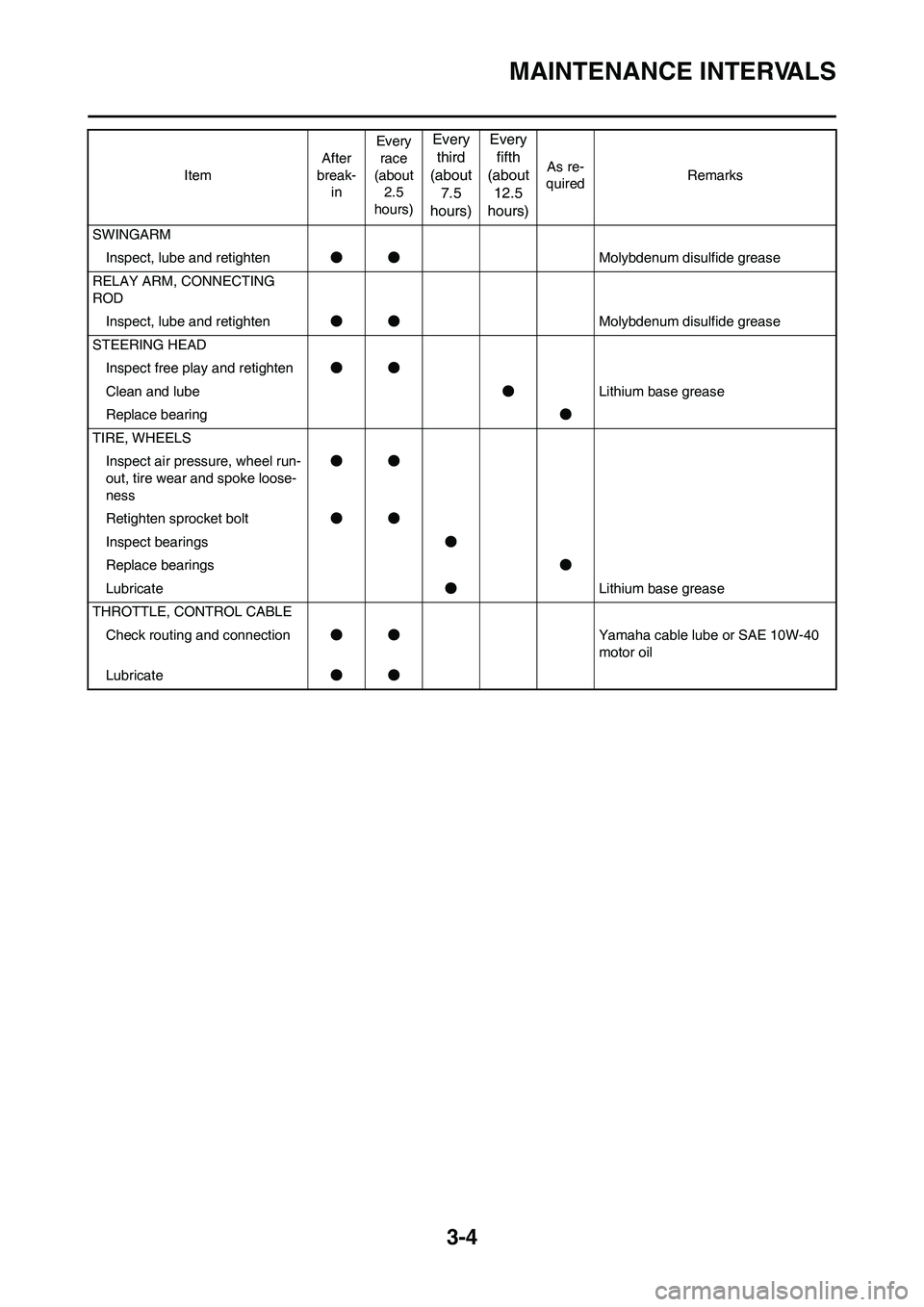
3-4
MAINTENANCE INTERVALS
SWINGARM
Inspect, lube and retighten●●Molybdenum disulfide grease
RELAY ARM, CONNECTING
ROD
Inspect, lube and retighten●●Molybdenum disulfide grease
STEERING HEAD
Inspect free play and retighten●●
Clean and lube●Lithium base grease
Replace bearing●
TIRE, WHEELS
Inspect air pressure, wheel run-
out, tire wear and spoke loose-
ness●●
Retighten sprocket bolt●●
Inspect bearings●
Replace bearings●
Lubricate●Lithium base grease
THROTTLE, CONTROL CABLE
Check routing and connection●●Yamaha cable lube or SAE 10W-40
motor oil
Lubricate●● ItemAfter
break-
inEvery
race
(about
2.5
hours)
Every
third
(about
7.5
hours)Every
fifth
(about
12.5
hours)
As re-
quiredRemarks
Page 61 of 230
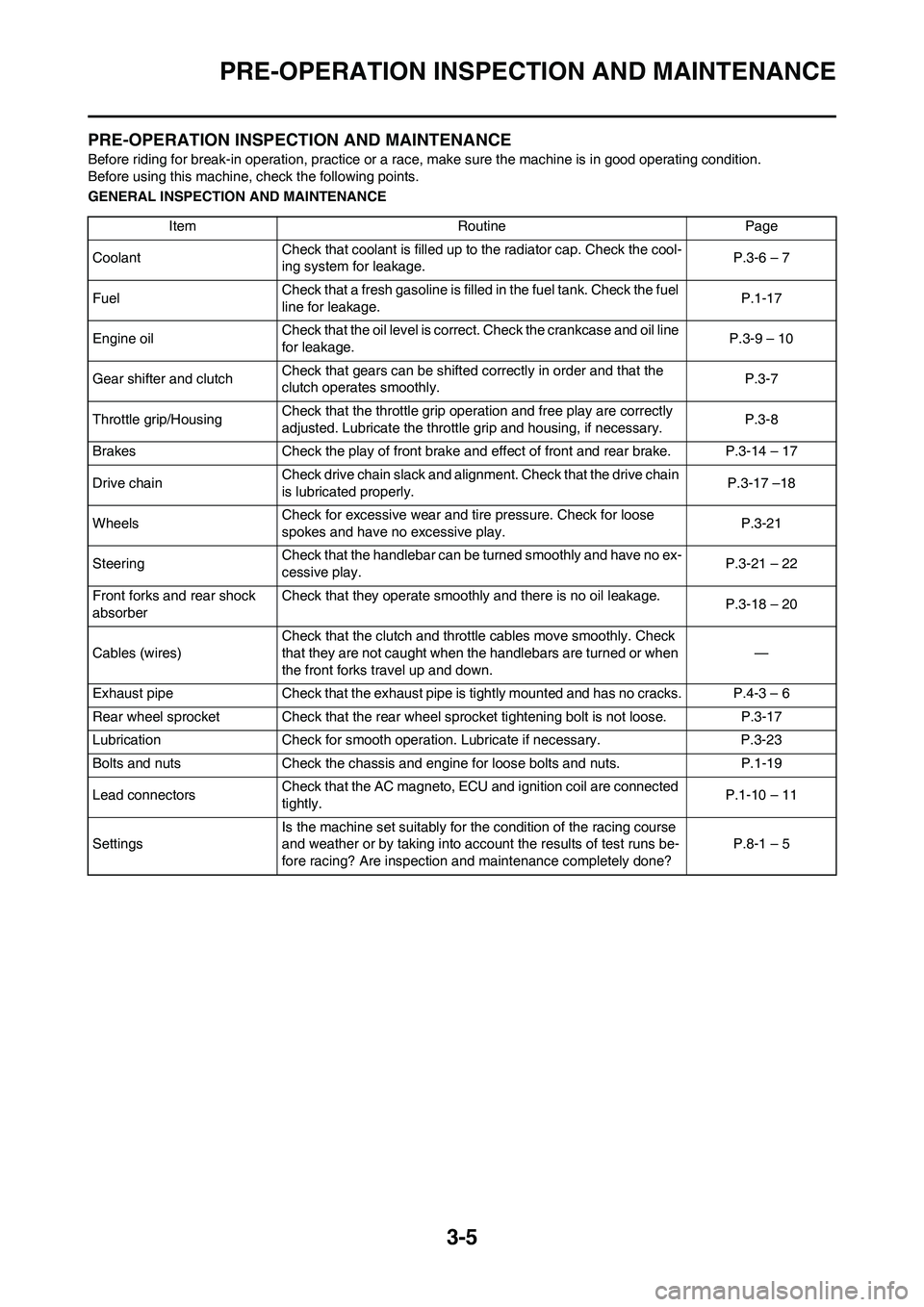
3-5
PRE-OPERATION INSPECTION AND MAINTENANCE
PRE-OPERATION INSPECTION AND MAINTENANCE
Before riding for break-in operation, practice or a race, make sure the machine is in good operating condition.
Before using this machine, check the following points.
GENERAL INSPECTION AND MAINTENANCE
Item Routine Page
CoolantCheck that coolant is filled up to the radiator cap. Check the cool-
ing system for leakage.P.3-6 – 7
FuelCheck that a fresh gasoline is filled in the fuel tank. Check the fuel
line for leakage.P.1-17
Engine oilCheck that the oil level is correct. Check the crankcase and oil line
for leakage.P.3-9 – 10
Gear shifter and clutchCheck that gears can be shifted correctly in order and that the
clutch operates smoothly.P.3-7
Throttle grip/HousingCheck that the throttle grip operation and free play are correctly
adjusted. Lubricate the throttle grip and housing, if necessary.P.3-8
Brakes Check the play of front brake and effect of front and rear brake. P.3-14 – 17
Drive chainCheck drive chain slack and alignment. Check that the drive chain
is lubricated properly.P.3-17 –18
WheelsCheck for excessive wear and tire pressure. Check for loose
spokes and have no excessive play.P.3-21
SteeringCheck that the handlebar can be turned smoothly and have no ex-
cessive play.P.3-21 – 22
Front forks and rear shock
absorberCheck that they operate smoothly and there is no oil leakage.
P.3-18 – 20
Cables (wires)Check that the clutch and throttle cables move smoothly. Check
that they are not caught when the handlebars are turned or when
the front forks travel up and down.—
Exhaust pipe Check that the exhaust pipe is tightly mounted and has no cracks. P.4-3 – 6
Rear wheel sprocket Check that the rear wheel sprocket tightening bolt is not loose. P.3-17
Lubrication Check for smooth operation. Lubricate if necessary. P.3-23
Bolts and nuts Check the chassis and engine for loose bolts and nuts. P.1-19
Lead connectorsCheck that the AC magneto, ECU and ignition coil are connected
tightly.P.1-10 – 11
SettingsIs the machine set suitably for the condition of the racing course
and weather or by taking into account the results of test runs be-
fore racing? Are inspection and maintenance completely done?P.8-1 – 5
Page 81 of 230
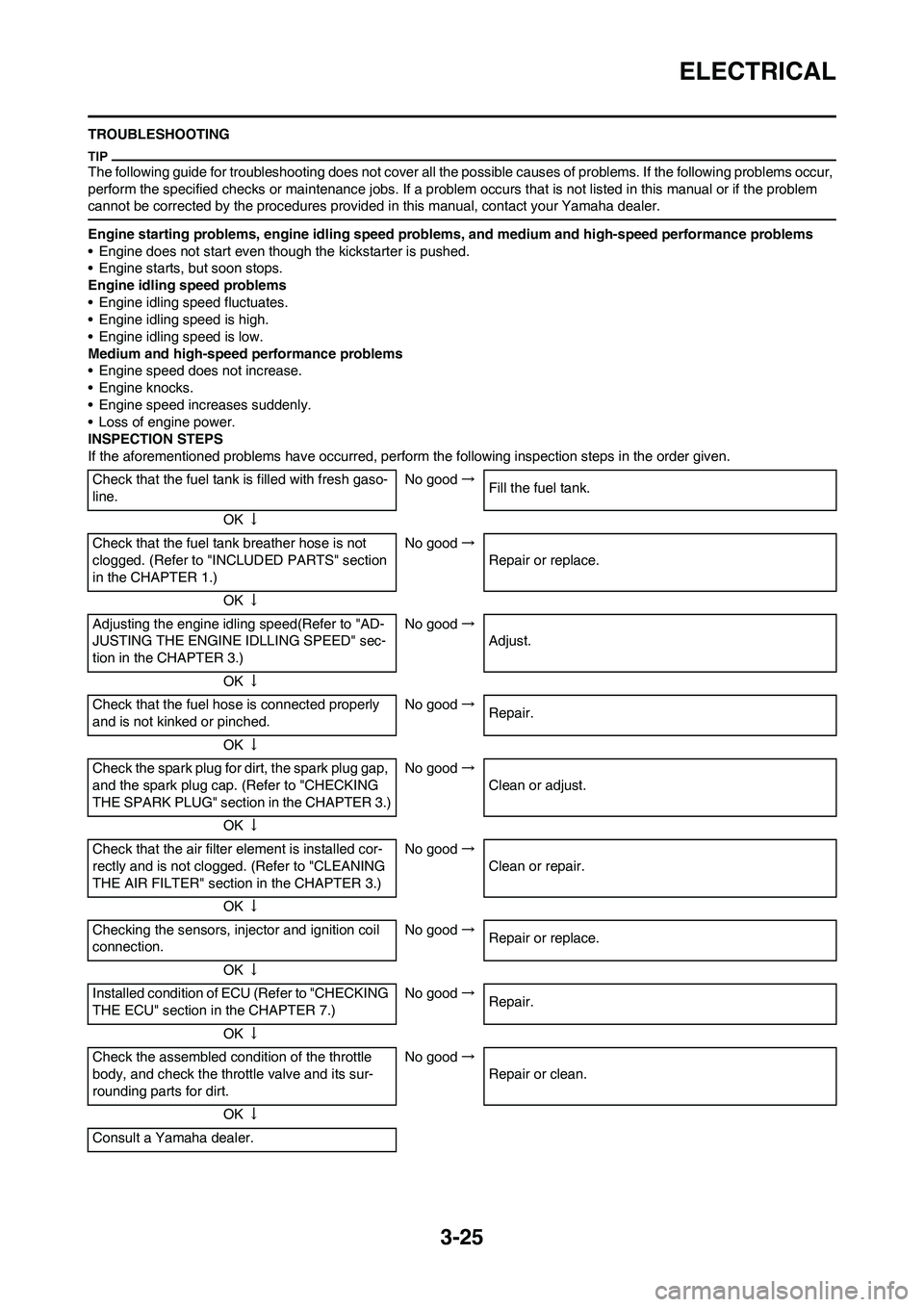
3-25
ELECTRICAL
TROUBLESHOOTING
The following guide for troubleshooting does not cover all the possible causes of problems. If the following problems occur,
perform the specified checks or maintenance jobs. If a problem occurs that is not listed in this manual or if the problem
cannot be corrected by the procedures provided in this manual, contact your Yamaha dealer.
Engine starting problems, engine idling speed problems, and medium and high-speed performance problems
• Engine does not start even though the kickstarter is pushed.
• Engine starts, but soon stops.
Engine idling speed problems
• Engine idling speed fluctuates.
• Engine idling speed is high.
• Engine idling speed is low.
Medium and high-speed performance problems
• Engine speed does not increase.
• Engine knocks.
• Engine speed increases suddenly.
• Loss of engine power.
INSPECTION STEPS
If the aforementioned problems have occurred, perform the following inspection steps in the order given.
Check that the fuel tank is filled with fresh gaso-
line.No good→
Fill the fuel tank.
OK↓
Check that the fuel tank breather hose is not
clogged. (Refer to "INCLUDED PARTS" section
in the CHAPTER 1.)No good→
Repair or replace.
OK↓
Adjusting the engine idling speed(Refer to "AD-
JUSTING THE ENGINE IDLLING SPEED" sec-
tion in the CHAPTER 3.)No good→
Adjust.
OK↓
Check that the fuel hose is connected properly
and is not kinked or pinched.No good→
Repair.
OK↓
Check the spark plug for dirt, the spark plug gap,
and the spark plug cap. (Refer to "CHECKING
THE SPARK PLUG" section in the CHAPTER 3.)No good→
Clean or adjust.
OK↓
Check that the air filter element is installed cor-
rectly and is not clogged. (Refer to "CLEANING
THE AIR FILTER" section in the CHAPTER 3.)No good→
Clean or repair.
OK↓
Checking the sensors, injector and ignition coil
connection.No good→
Repair or replace.
OK↓
Installed condition of ECU (Refer to "CHECKING
THE ECU" section in the CHAPTER 7.)No good→
Repair.
OK↓
Check the assembled condition of the throttle
body, and check the throttle valve and its sur-
rounding parts for dirt.No good→
Repair or clean.
OK↓
Consult a Yamaha dealer.
Page 199 of 230
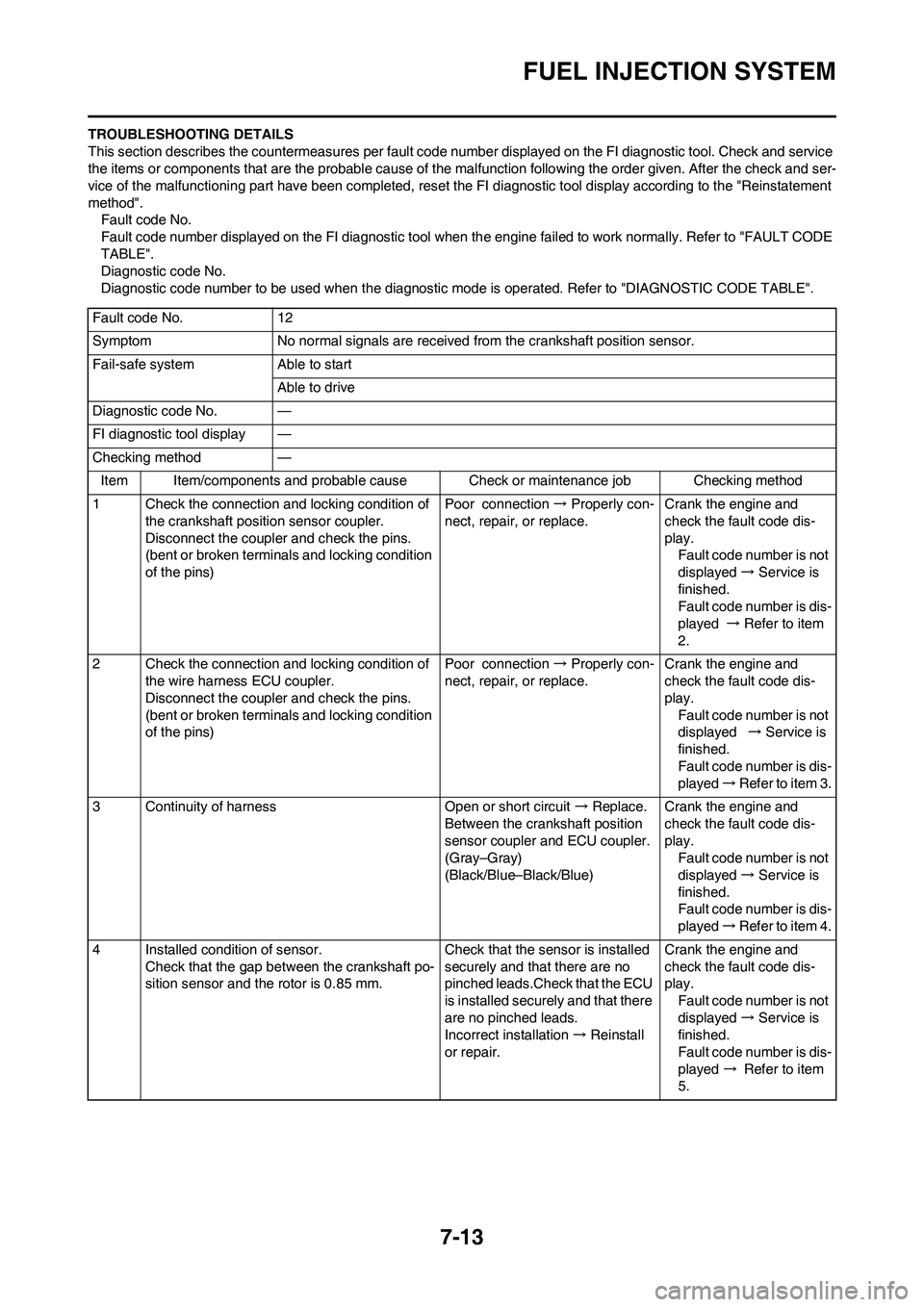
7-13
FUEL INJECTION SYSTEM
TROUBLESHOOTING DETAILS
This section describes the countermeasures per fault code number displayed on the FI diagnostic tool. Check and service
the items or components that are the probable cause of the malfunction following the order given. After the check and ser-
vice of the malfunctioning part have been completed, reset the FI diagnostic tool display according to the "Reinstatement
method".
Fault code No.
Fault code number displayed on the FI diagnostic tool when the engine failed to work normally. Refer to "FAULT CODE
TABLE".
Diagnostic code No.
Diagnostic code number to be used when the diagnostic mode is operated. Refer to "DIAGNOSTIC CODE TABLE".
Fault code No. 12
Symptom No normal signals are received from the crankshaft position sensor.
Fail-safe system Able to start
Able to drive
Diagnostic code No. —
FI diagnostic tool display —
Checking method —
Item Item/components and probable cause Check or maintenance job Checking method
1 Check the connection and locking condition of
the crankshaft position sensor coupler.
Disconnect the coupler and check the pins.
(bent or broken terminals and locking condition
of the pins)Poor connection → Properly con-
nect, repair, or replace.Crank the engine and
check the fault code dis-
play.
Fault code number is not
displayed → Service is
finished.
Fault code number is dis-
played → Refer to item
2.
2 Check the connection and locking condition of
the wire harness ECU coupler.
Disconnect the coupler and check the pins.
(bent or broken terminals and locking condition
of the pins)Poor connection → Properly con-
nect, repair, or replace.Crank the engine and
check the fault code dis-
play.
Fault code number is not
displayed → Service is
finished.
Fault code number is dis-
played → Refer to item 3.
3 Continuity of harness Open or short circuit → Replace.
Between the crankshaft position
sensor coupler and ECU coupler.
(Gray–Gray)
(Black/Blue–Black/Blue)Crank the engine and
check the fault code dis-
play.
Fault code number is not
displayed → Service is
finished.
Fault code number is dis-
played → Refer to item 4.
4 Installed condition of sensor.
Check that the gap between the crankshaft po-
sition sensor and the rotor is 0.85 mm.Check that the sensor is installed
securely and that there are no
pinched leads.Check that the ECU
is installed securely and that there
are no pinched leads.
Incorrect installation → Reinstall
or repair.Crank the engine and
check the fault code dis-
play.
Fault code number is not
displayed → Service is
finished.
Fault code number is dis-
played → Refer to item
5.
Page 200 of 230
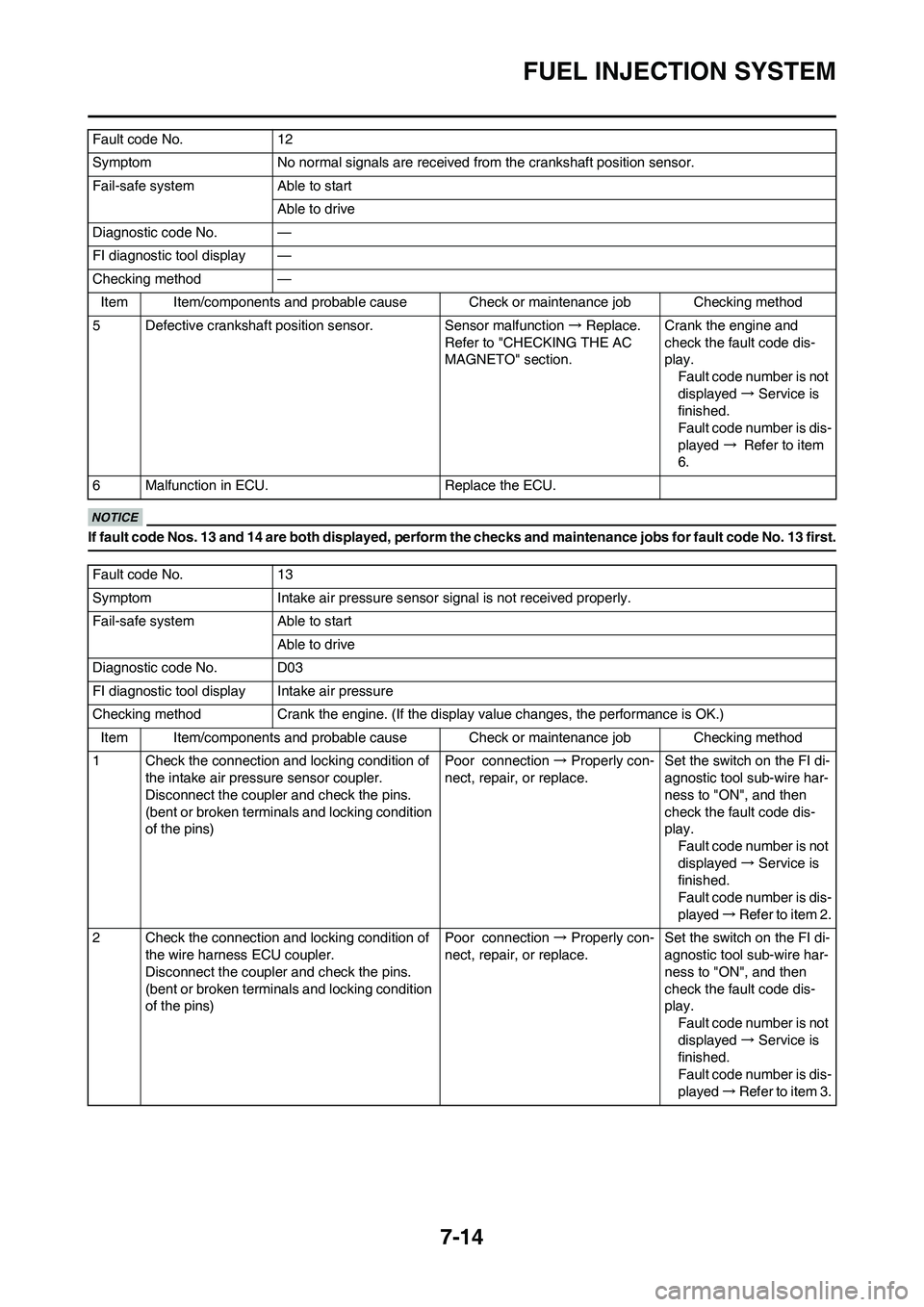
7-14
FUEL INJECTION SYSTEM
If fault code Nos. 13 and 14 are both displayed, perform the checks and maintenance jobs for fault code No. 13 first.
5 Defective crankshaft position sensor. Sensor malfunction → Replace.
Refer to "CHECKING THE AC
MAGNETO" section.Crank the engine and
check the fault code dis-
play.
Fault code number is not
displayed → Service is
finished.
Fault code number is dis-
played → Refer to item
6.
6 Malfunction in ECU. Replace the ECU.
Fault code No. 13
Symptom Intake air pressure sensor signal is not received properly.
Fail-safe system Able to start
Able to drive
Diagnostic code No. D03
FI diagnostic tool display Intake air pressure
Checking method Crank the engine. (If the display value changes, the performance is OK.)
Item Item/components and probable cause Check or maintenance job Checking method
1 Check the connection and locking condition of
the intake air pressure sensor coupler.
Disconnect the coupler and check the pins.
(bent or broken terminals and locking condition
of the pins)Poor connection → Properly con-
nect, repair, or replace.Set the switch on the FI di-
agnostic tool sub-wire har-
ness to "ON", and then
check the fault code dis-
play.
Fault code number is not
displayed → Service is
finished.
Fault code number is dis-
played → Refer to item 2.
2 Check the connection and locking condition of
the wire harness ECU coupler.
Disconnect the coupler and check the pins.
(bent or broken terminals and locking condition
of the pins)Poor connection → Properly con-
nect, repair, or replace.Set the switch on the FI di-
agnostic tool sub-wire har-
ness to "ON", and then
check the fault code dis-
play.
Fault code number is not
displayed → Service is
finished.
Fault code number is dis-
played → Refer to item 3. Fault code No. 12
Symptom No normal signals are received from the crankshaft position sensor.
Fail-safe system Able to start
Able to drive
Diagnostic code No. —
FI diagnostic tool display —
Checking method —
Item Item/components and probable cause Check or maintenance job Checking method