ECU YAMAHA YZ450F 2011 Owner's Manual
[x] Cancel search | Manufacturer: YAMAHA, Model Year: 2011, Model line: YZ450F, Model: YAMAHA YZ450F 2011Pages: 230, PDF Size: 14.09 MB
Page 182 of 230
6-2
FUEL TANK
REMOVING THE FUEL TANK
1. Extract the fuel in the fuel tank through the fuel tank cap with a
pump.
Be careful not to damage the fuel
pump.
2. Remove: • Fuel pump coupler
Although the fuel has been re-
moved from the fuel tank be care-
ful when removing the fuel hoses,
since there may be fuel remaining
in it.
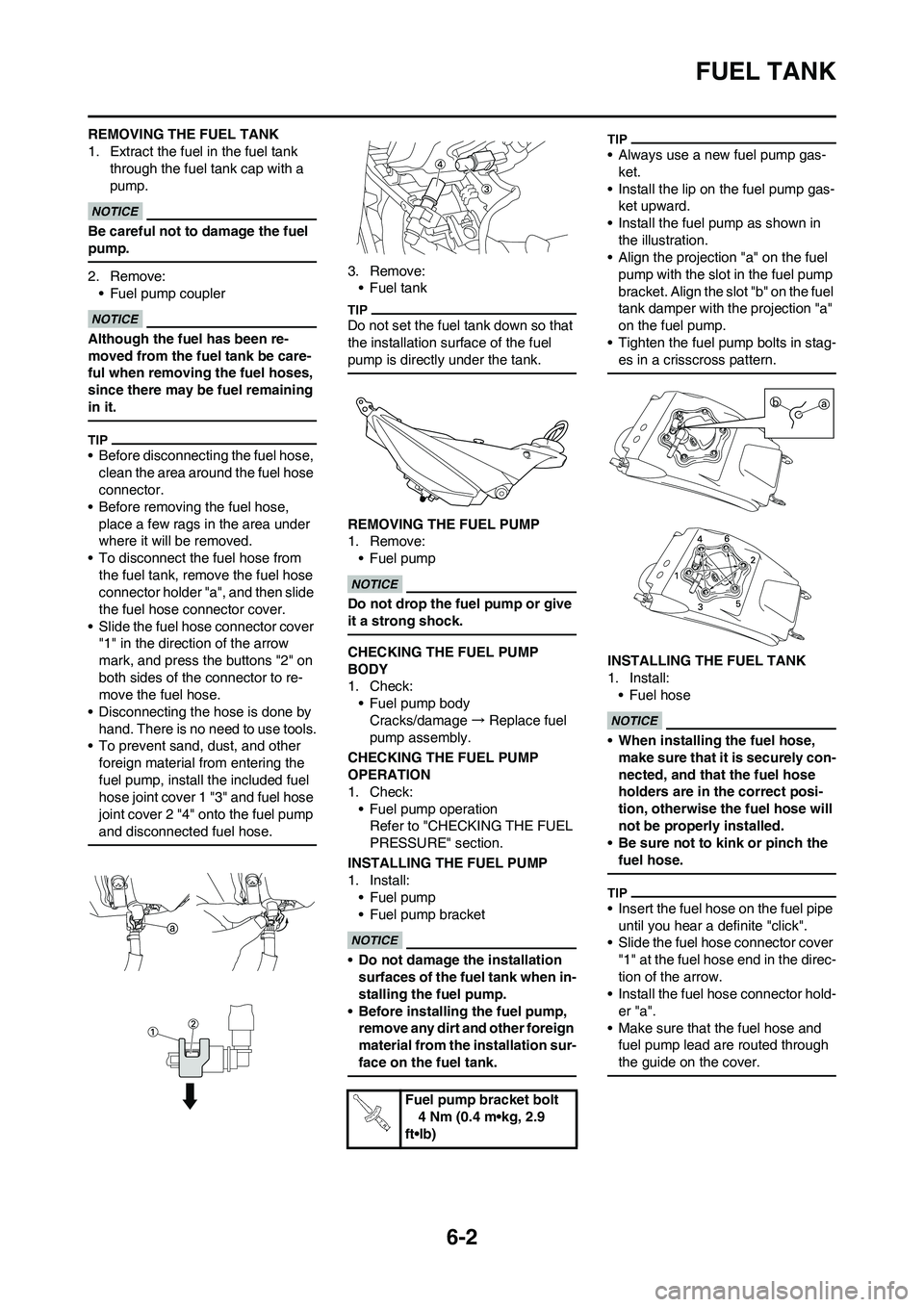
• Before disconnecting the fuel hose, clean the area around the fuel hose
connector.
• Before removing the fuel hose, place a few rags in the area under
where it will be removed.
• To disconnect the fuel hose from the fuel tank, remove the fuel hose
connector holder "a", and then slide
the fuel hose connector cover.
• Slide the fuel hose connector cover "1" in the direction of the arrow
mark, and press the buttons "2" on
both sides of the connector to re-
move the fuel hose.
• Disconnecting the hose is done by hand. There is no need to use tools.
• To prevent sand, dust, and other
foreign material from entering the
fuel pump, install the included fuel
hose joint cover 1 "3" and fuel hose
joint cover 2 "4" onto the fuel pump
and disconnected fuel hose.
3. Remove:•Fuel tank
Do not set the fuel tank down so that
the installation surface of the fuel
pump is directly under the tank.
REMOVING THE FUEL PUMP
1. Remove:•Fuel pump
Do not drop the fuel pump or give
it a strong shock.
CHECKING THE FUEL PUMP
BODY
1. Check:
• Fuel pump bodyCracks/damage → Replace fuel
pump assembly.
CHECKING THE FUEL PUMP
OPERATION
1. Check: • Fuel pump operationRefer to "CHECKING THE FUEL
PRESSURE" section.
INSTALLING THE FUEL PUMP
1. Install: •Fuel pump
• Fuel pump bracket
•Do not damage th e installation
surfaces of the fuel tank when in-
stalling the fuel pump.
• Before installing the fuel pump,
remove any dirt and other foreign
material from the installation sur-
face on the fuel tank.
• Always use a new fuel pump gas- ket.
• Install the lip on the fuel pump gas- ket upward.
• Install the fuel pump as shown in
the illustration.
• Align the projection "a" on the fuel pump with the slot in the fuel pump
bracket. Align the slot "b" on the fuel
tank damper with the projection "a"
on the fuel pump.
• Tighten the fuel pump bolts in stag- es in a crisscross pattern.
INSTALLING THE FUEL TANK
1. Install:•Fuel hose
•When installing the fuel hose,
make sure that it is securely con-
nected, and that the fuel hose
holders are in the correct posi-
tion, otherwise the fuel hose will
not be properly installed.
• Be sure not to kink or pinch the
fuel hose.
• Insert the fuel hose on the fuel pipe
until you hear a definite "click".
• Slide the fuel hose connector cover
"1" at the fuel hose end in the direc-
tion of the arrow.
• Install the fuel hose connector hold-
er "a".
• Make sure that the fuel hose and fuel pump lead are routed through
the guide on the cover.
Fuel pump bracket bolt
4 Nm (0.4 m•kg, 2.9
ft•lb)
Page 187 of 230
7-1
ELECTRICAL COMPONENTS AND WIRING DIAGRAM
ELECTRICAL
This section is intended for those who have basic knowledge and skill concerning the servicing of Yamaha motorcycles
(e.g., Yamaha dealers, service engineers, etc.) Those who have little knowledge and skill concerning servicing are request-
ed not to undertake inspection, adjustment, disassembly, or reassembly only by reference to this manual. It may lead to
servicing trouble and mechanical damage.
ELECTRICAL COMPONENTS AND WIRING DIAGRAM
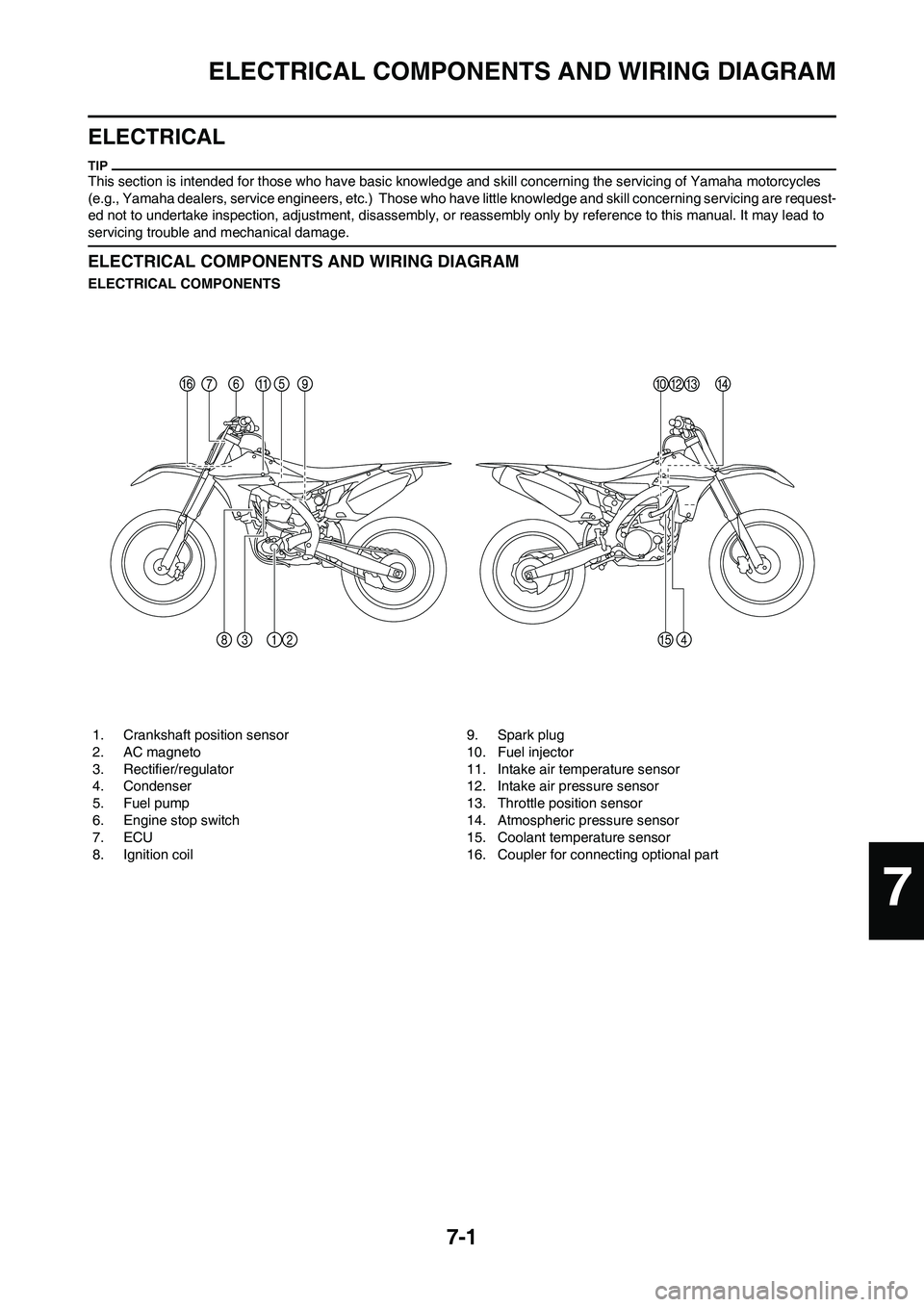
ELECTRICAL COMPONENTS
1. Crankshaft position sensor
2. AC magneto
3. Rectifier/regulator
4. Condenser
5. Fuel pump
6. Engine stop switch
7. ECU
8. Ignition coil9. Spark plug
10. Fuel injector
11. Intake air temperature sensor
12. Intake air pressure sensor
13. Throttle position sensor
14. Atmospheric pressure sensor
15. Coolant temperature sensor
16. Coupler for connecting optional part
7
Page 188 of 230
7-2
ELECTRICAL COMPONENTS AND WIRING DIAGRAM
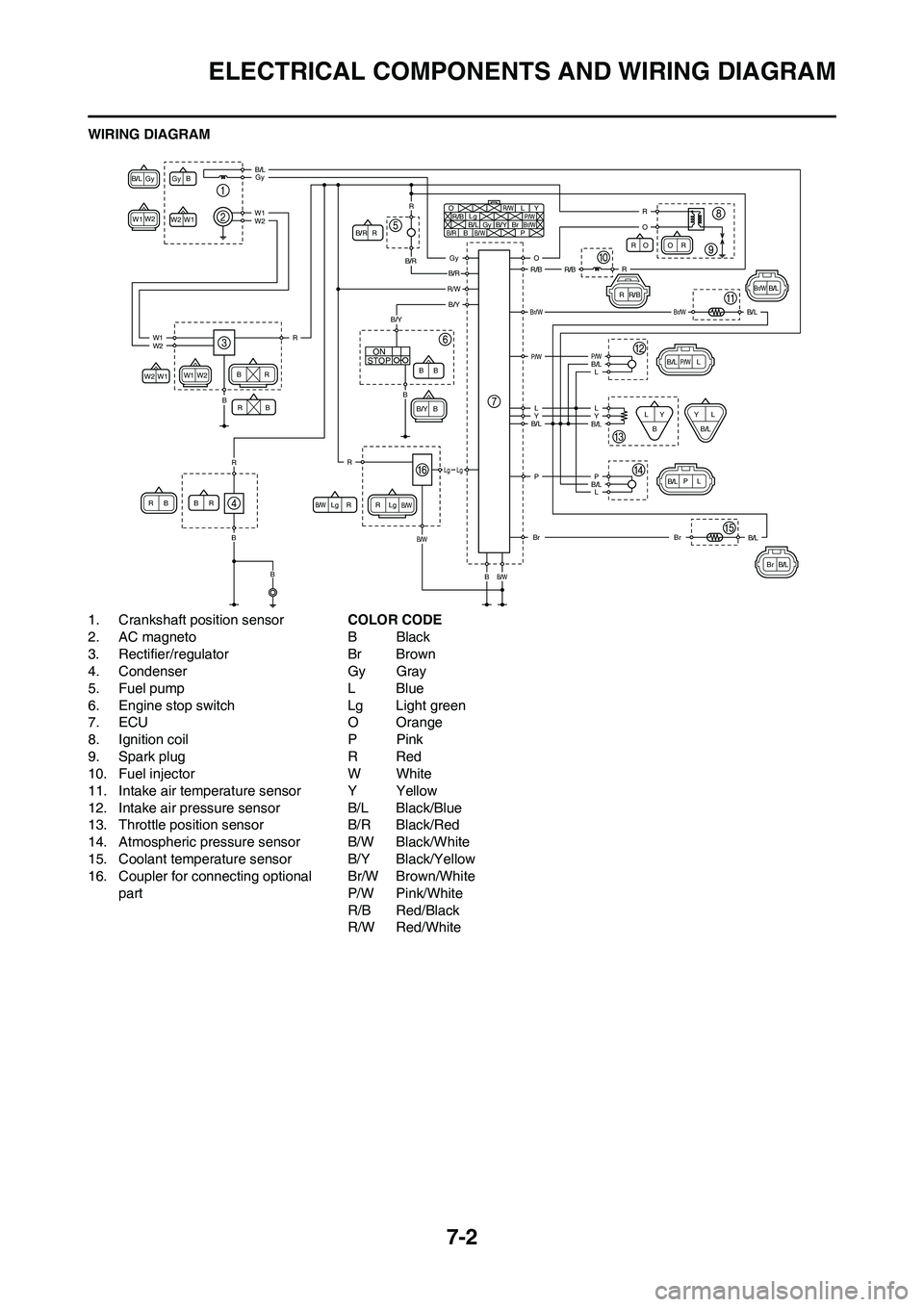
WIRING DIAGRAM
1. Crankshaft position sensor
2. AC magneto
3. Rectifier/regulator
4. Condenser
5. Fuel pump
6. Engine stop switch
7. ECU
8. Ignition coil
9. Spark plug
10. Fuel injector
11. Intake air temperature sensor
12. Intake air pressure sensor
13. Throttle position sensor
14. Atmospheric pressure sensor
15. Coolant temperature sensor
16. Coupler for connecting optional part COLOR CODE
BBlack
Br Brown
Gy Gray
LBlue
Lg Light green
O Orange
PPink
RRed
WWhite
YYellow
B/L Black/Blue
B/R Black/Red
B/W Black/White
B/Y Black/Yellow
Br/W Brown/White
P/W Pink/White
R/B Red/Black
R/W Red/White
STOPON
Gy
Gy
B
B
/L
W1
W2
W2 O
R /B
R RR
R
R
R R
Lg
Lg Lg L
P
/W
P YB
/RB
B B
B
B BB
BB/W
B /W
B/W Br
/WGy
B /L
W1 W1
W2 W2 B
/Y
B /Y Br
B /R
R /W
OO
R /B
RR
R
L
P/W
P YL
L
LY
Br /WB /L
B /L
B/L
B
B/L
B/L
Br
W1
Br
/W
W2
R
R O
B/L
L
Y
B /L
Br
R
P
Gy
Gy
B /R
B
/R
R/WB /Y
B
/L
W1
W2
W1 R
R R
B
B
/Y
Lg Lg
O
R /B
R/B
Br /W
P /W P
/W
L L
Y
B /L B
/L
B/L
Br
B
B /W
B
/W
B
B
B L
B
/L
P
Page 189 of 230
7-3
IGNITION SYSTEM
IGNITION SYSTEM
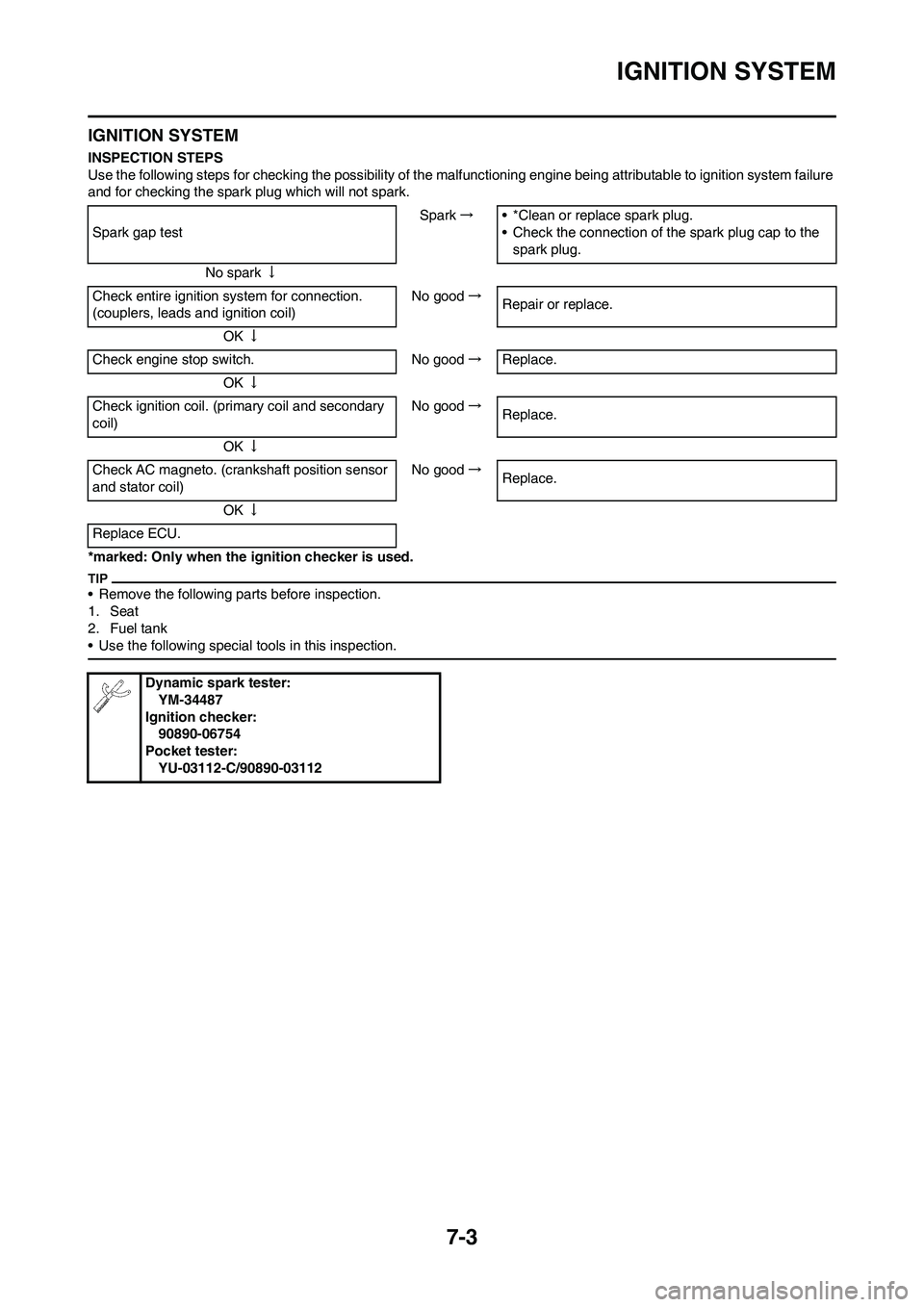
INSPECTION STEPS
Use the following steps for checking the possibility of the malfunctioning engine being attributable to ignition system failure
and for checking the spark plug which will not spark.
*marked: Only when the ignition checker is used.
• Remove the following parts before inspection.
1. Seat
2. Fuel tank
• Use the following special tools in this inspection.
Spark gap testSpark→• *Clean or replace spark plug.
• Check the connection of the spark plug cap to the
spark plug.
No spark↓
Check entire ignition system for connection.
(couplers, leads and ignition coil)No good→
Repair or replace.
OK↓
Check engine stop switch. No good→Replace.
OK↓
Check ignition coil. (primary coil and secondary
coil)No good→
Replace.
OK↓
Check AC magneto. (crankshaft position sensor
and stator coil)No good→
Replace.
OK↓
Replace ECU.
Dynamic spark tester:
YM-34487
Ignition checker:
90890-06754
Pocket tester:
YU-03112-C/90890-03112
Page 190 of 230
7-4
IGNITION SYSTEM
SPARK GAP TEST
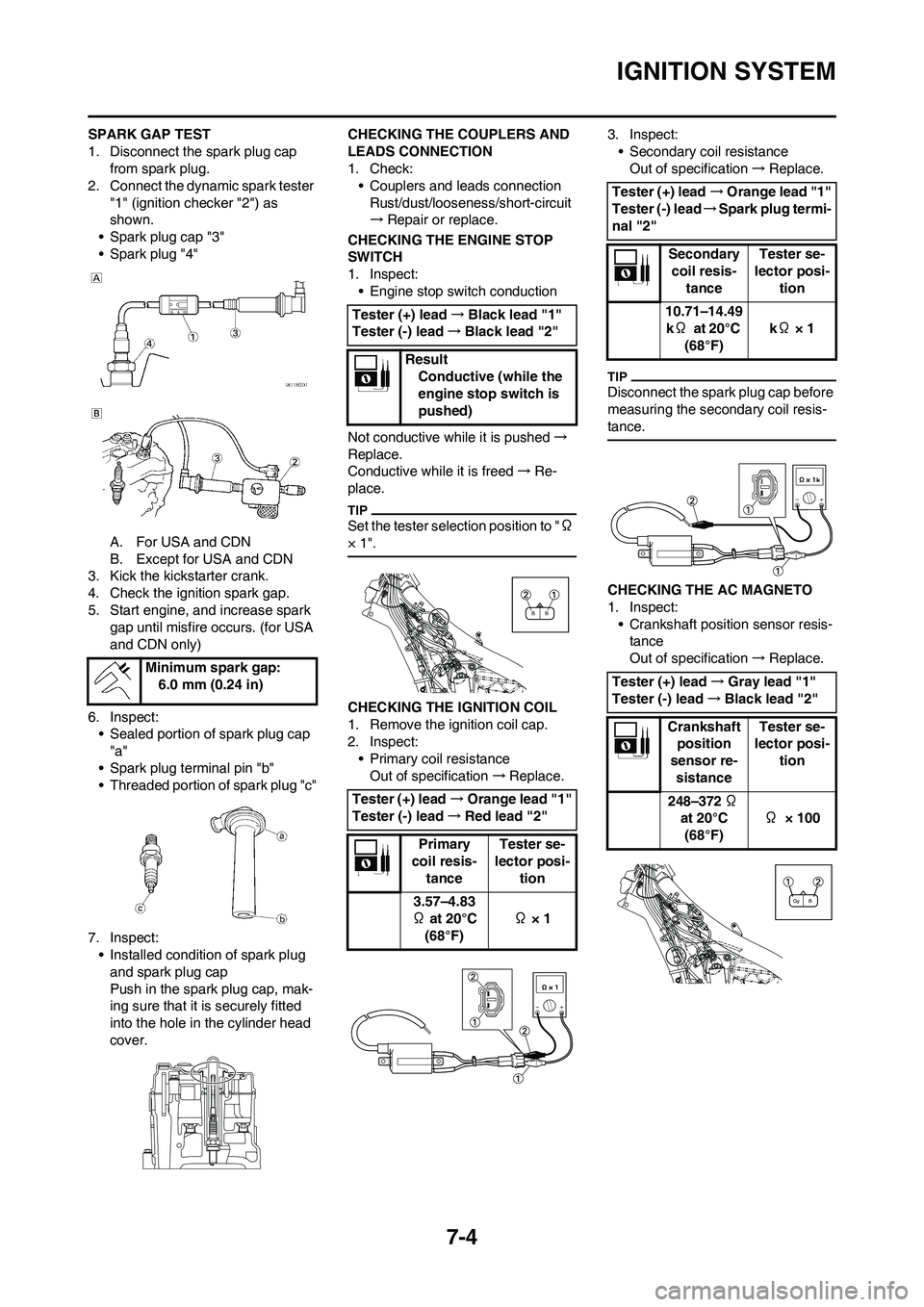
1. Disconnect the spark plug cap
from spark plug.
2. Connect the dynamic spark tester
"1" (ignition checker "2") as
shown.
• Spark plug cap "3"
• Spark plug "4"
A. For USA and CDN
B. Except for USA and CDN
3. Kick the kickstarter crank.
4. Check the ignition spark gap.
5. Start engine, and increase spark
gap until misfire occurs. (for USA
and CDN only)
6. Inspect:
• Sealed portion of spark plug cap
"a"
• Spark plug terminal pin "b"
• Threaded portion of spark plug "c"
7. Inspect:
• Installed condition of spark plug
and spark plug cap
Push in the spark plug cap, mak-
ing sure that it is securely fitted
into the hole in the cylinder head
cover.CHECKING THE COUPLERS AND
LEADS CONNECTION
1. Check:
• Couplers and leads connection
Rust/dust/looseness/short-circuit
→Repair or replace.
CHECKING THE ENGINE STOP
SWITCH
1. Inspect:
• Engine stop switch conduction
Not conductive while it is pushed→
Replace.
Conductive while it is freed→Re-
place.
Set the tester selection position to "Ω
× 1".
CHECKING THE IGNITION COIL
1. Remove the ignition coil cap.
2. Inspect:
• Primary coil resistance
Out of specification→Replace.3. Inspect:
• Secondary coil resistance
Out of specification→Replace.
Disconnect the spark plug cap before
measuring the secondary coil resis-
tance.
CHECKING THE AC MAGNETO
1. Inspect:
• Crankshaft position sensor resis-
tance
Out of specification→Replace.
Minimum spark gap:
6.0 mm (0.24 in)
Tester (+) lead→Black lead "1"
Tester (-) lead→Black lead "2"
Result
Conductive (while the
engine stop switch is
pushed)
Tester (+) lead→Orange lead "1"
Tester (-) lead→Red lead "2"
Primary
coil resis-
tanceTester se-
lector posi-
tion
3.57–4.83
Ω at 20°C
(68°F) Ω × 1
BB
Tester (+) lead→Orange lead "1"
Tester (-) lead→Spark plug termi-
nal "2"
Secondary
coil resis-
tanceTester se-
lector posi-
tion
10.71–14.49
kΩ at 20°C
(68°F) kΩ × 1
Tester (+) lead→Gray lead "1"
Tester (-) lead→Black lead "2"
Crankshaft
position
sensor re-
sistanceTester se-
lector posi-
tion
248–372 Ω
at 20°C
(68°F)Ω × 100
GyB
Page 191 of 230
7-5
IGNITION SYSTEM
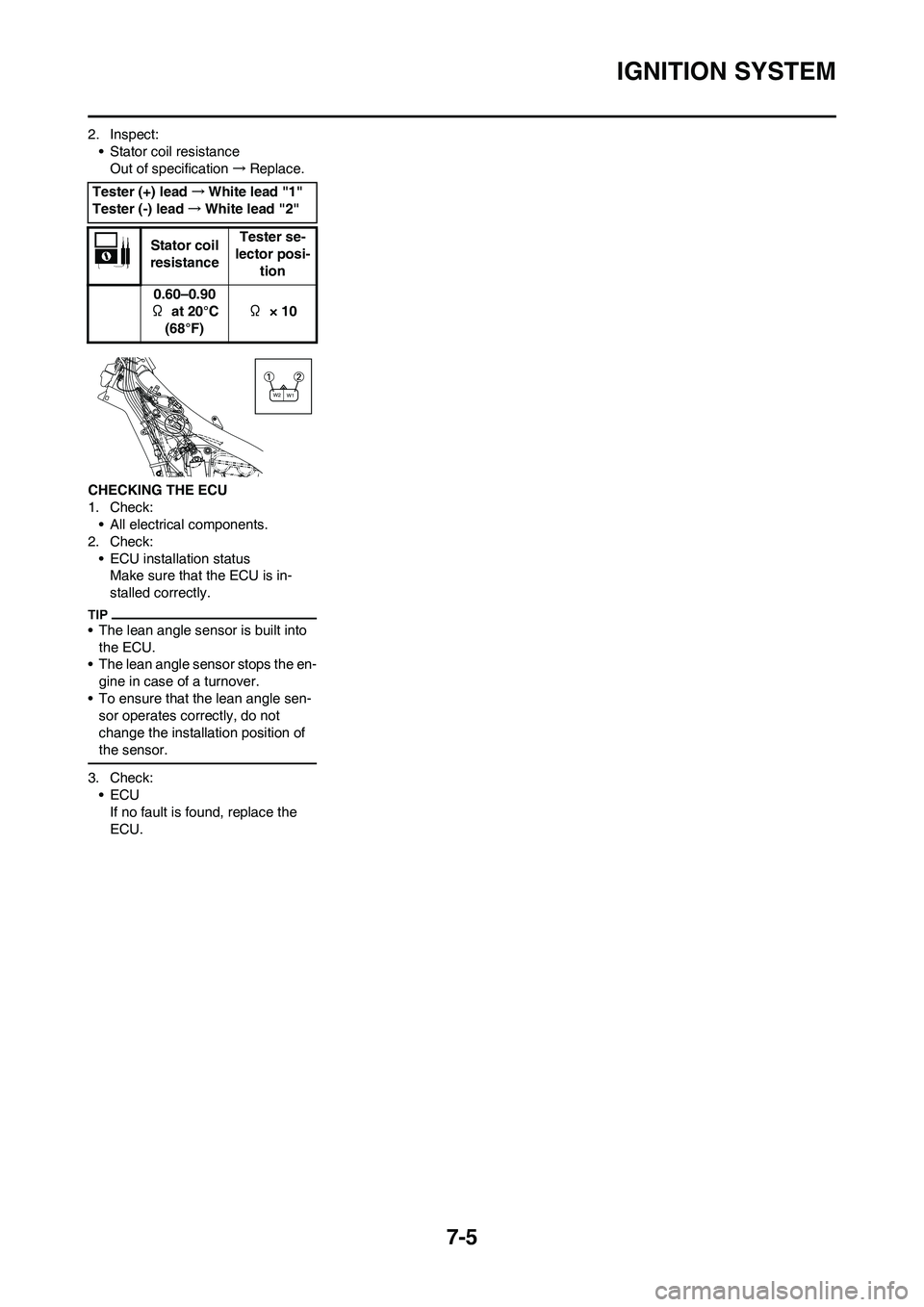
2. Inspect:
• Stator coil resistance
Out of specification→Replace.
CHECKING THE ECU
1. Check:
• All electrical components.
2. Check:
• ECU installation status
Make sure that the ECU is in-
stalled correctly.
• The lean angle sensor is built into
the ECU.
• The lean angle sensor stops the en-
gine in case of a turnover.
• To ensure that the lean angle sen-
sor operates correctly, do not
change the installation position of
the sensor.
3. Check:
•ECU
If no fault is found, replace the
ECU. Tester (+) lead→White lead "1"
Tester (-) lead→White lead "2"
Stator coil
resistanceTester se-
lector posi-
tion
0.60–0.90
Ω at 20°C
(68°F)Ω × 10
W1 W2
Page 192 of 230
7-6
THROTTLE POSITION SENSOR SYSTEM
THROTTLE POSITION SENSOR SYSTEM
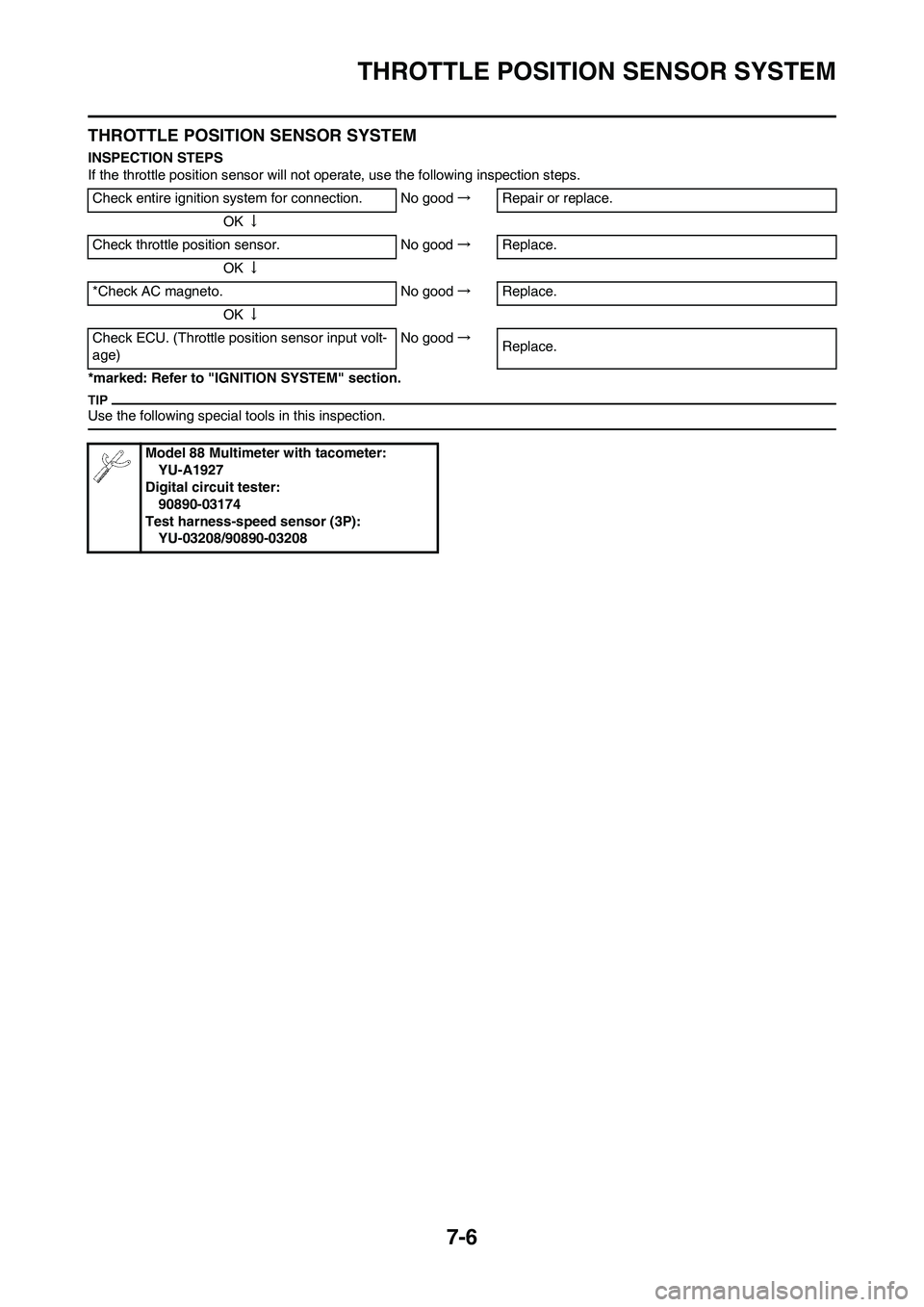
INSPECTION STEPS
If the throttle position sensor will not operate, use the following inspection steps.
*marked: Refer to "IGNITION SYSTEM" section.
Use the following special tools in this inspection.
Check entire ignition system for connection. No good→Repair or replace.
OK↓
Check throttle position sensor. No good→Replace.
OK↓
*Check AC magneto. No good→Replace.
OK↓
Check ECU. (Throttle position sensor input volt-
age)No good→
Replace.
Model 88 Multimeter with tacometer:
YU-A1927
Digital circuit tester:
90890-03174
Test harness-speed sensor (3P):
YU-03208/90890-03208
Page 194 of 230
7-8
THROTTLE POSITION SENSOR SYSTEM
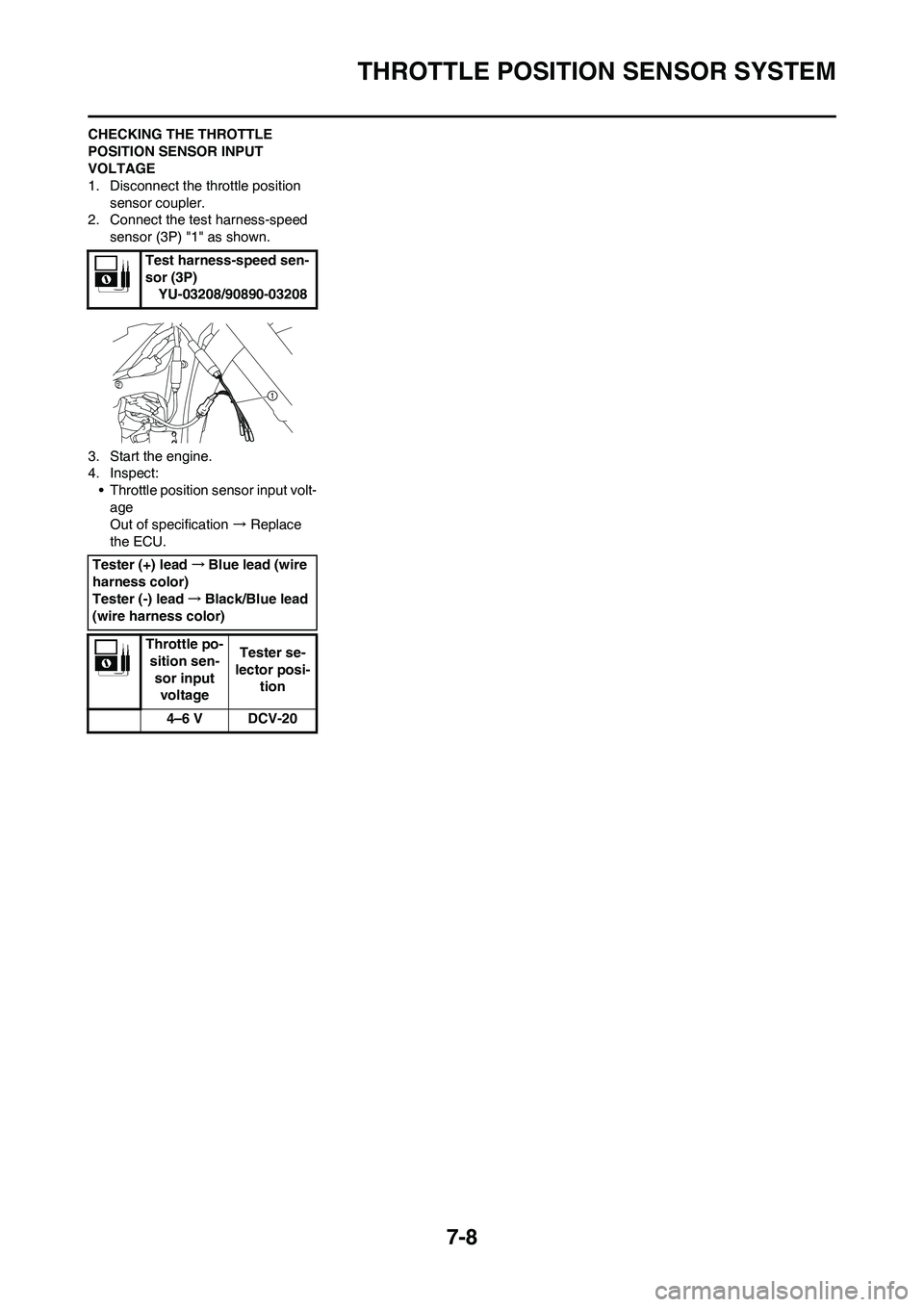
CHECKING THE THROTTLE
POSITION SENSOR INPUT
VOLTAGE
1. Disconnect the throttle position
sensor coupler.
2. Connect the test harness-speed
sensor (3P) "1" as shown.
3. Start the engine.
4. Inspect:
• Throttle position sensor input volt-
age
Out of specification → Replace
the ECU.Test harness-speed sen-
sor (3P)
YU-03208/90890-03208
Tester (+) lead→Blue lead (wire
harness color)
Tester (-) lead→Black/Blue lead
(wire harness color)
Throttle po-
sition sen-
sor input
voltage Tester se-
lector posi-
tion
4–6 V DCV-20
Page 195 of 230
7-9
FUEL INJECTION SYSTEM
FUEL INJECTION SYSTEM
TROUBLESHOOTING METHOD
Engine starting problems, engine
idling speed problems, and medium
and high-speed performance prob-
lems
1. CHECK:
• Refer to "TROUBLESHOOTING"
section in the chapter 3.
2. Connect the FI diagnostic tool.
(Refer to "CONNECTING THE FI
DIAGNOSTIC TOOL".)
3. Check the fault code number.
(Refer to "TROUBLESHOOTING
DETAILS".)
• Check the fault code number that is
displayed on the LCD of the FI diag-
nostic tool.
• Identify the system with the mal-
function.(Refer to "TROUBLE-
SHOOTING DETAILS".)
4. Checking and repair the probable
case of malfunction.
• Fault code No. YES.
Check and repair.
Refer to "TROUBLESHOOTING
DETAILS".
Refer to "SENSOR OPERATION
TABLE".
• Fault code No. NO.
Check each sensor and actuator
in the diagnostic mode.
Refer to "SETTING THE DIAG-
NOSTIC MODE".
Refer to "SENSOR OPERATION
TABLE".
If the sensors or actuators are
damaged, check and, if neces-
sary, repair or replace all faulty
parts.
If the sensors or actuators are not
damaged, check and, if neces-
sary, repair or replace the engine
inner parts.5. Perform ECU reinstatement ac-
tion.
Refer to "Reinstatement method"
of table in "TROUBLESHOOTING
DETAILS".
6. Set the switch on the FI diagnostic
tool sub-wire harness from "OFF"
to "ON", and then check whether
a fault code number is displayed
again.
If other fault code displayed, repeat
steps (2) to (5) until all fault code
number is not displayed.
7. Set the switch on the FI diagnostic
tool sub-wire harness to "OFF",
and then disconnect the FI diag-
nostic tool, FI diagnostic tool sub-
wire harness, and battery. Place
the accessory coupler in its origi-
nal position.
The malfunction history is stored
even if the switch on the FI diagnostic
tool sub-wire harness is set to "OFF".
Erase the malfunction history in the
diagnostic mode. (Refer to "DIAG-
NOSTIC CODE TABLE (Diagnostic
code No. D62)".)
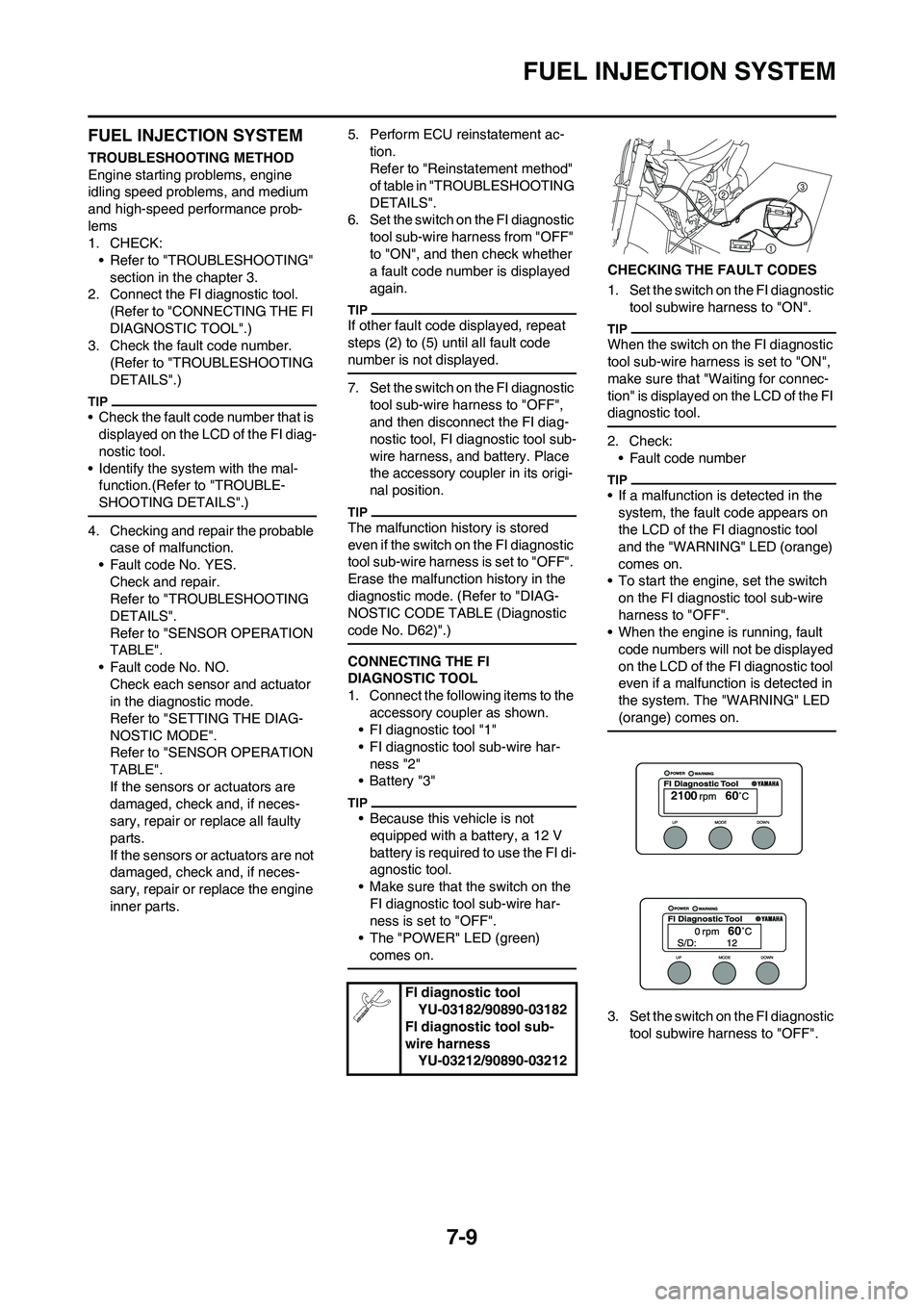
CONNECTING THE FI
DIAGNOSTIC TOOL
1. Connect the following items to the
accessory coupler as shown.
• FI diagnostic tool "1"
• FI diagnostic tool sub-wire har-
ness "2"
• Battery "3"
• Because this vehicle is not
equipped with a battery, a 12 V
battery is required to use the FI di-
agnostic tool.
• Make sure that the switch on the
FI diagnostic tool sub-wire har-
ness is set to "OFF".
• The "POWER" LED (green)
comes on.
CHECKING THE FAULT CODES
1. Set the switch on the FI diagnostic
tool subwire harness to "ON".
When the switch on the FI diagnostic
tool sub-wire harness is set to "ON",
make sure that "Waiting for connec-
tion" is displayed on the LCD of the FI
diagnostic tool.
2. Check:
• Fault code number
• If a malfunction is detected in the
system, the fault code appears on
the LCD of the FI diagnostic tool
and the "WARNING" LED (orange)
comes on.
• To start the engine, set the switch
on the FI diagnostic tool sub-wire
harness to "OFF".
• When the engine is running, fault
code numbers will not be displayed
on the LCD of the FI diagnostic tool
even if a malfunction is detected in
the system. The "WARNING" LED
(orange) comes on.
3. Set the switch on the FI diagnostic
tool subwire harness to "OFF". FI diagnostic tool
YU-03182/90890-03182
FI diagnostic tool sub-
wire harness
YU-03212/90890-03212
2100 60
60
Page 197 of 230
7-11
FUEL INJECTION SYSTEM
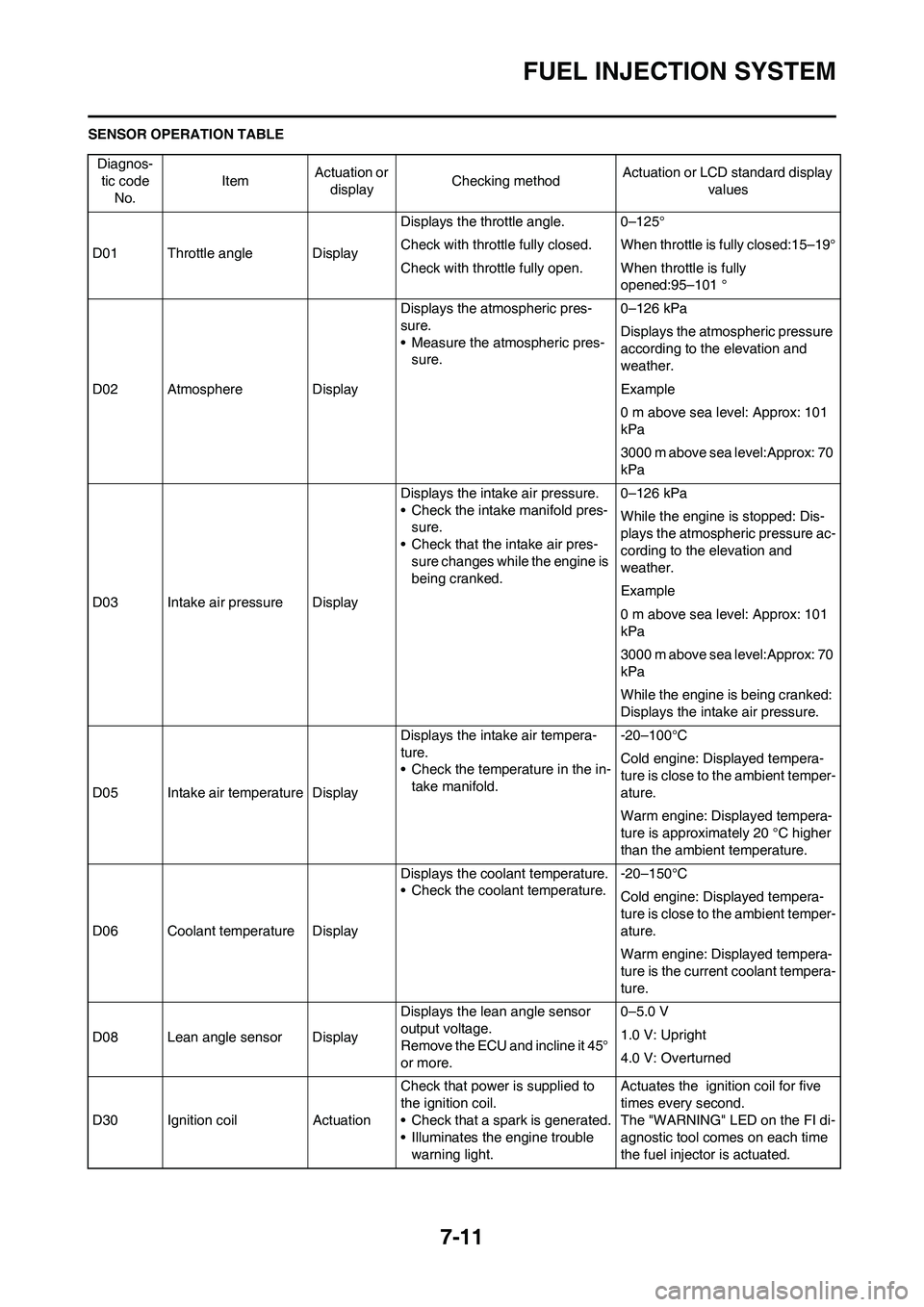
SENSOR OPERATION TABLE
Diagnos-
tic code
No.ItemActuation or
displayChecking methodActuation or LCD standard display
values
D01 Throttle angle DisplayDisplays the throttle angle. 0–125°
Check with throttle fully closed. When throttle is fully closed:15–19°
Check with throttle fully open. When throttle is fully
opened:95–101 °
D02 Atmosphere DisplayDisplays the atmospheric pres-
sure.
• Measure the atmospheric pres-
sure.0–126 kPa
Displays the atmospheric pressure
according to the elevation and
weather.
Example
0 m above sea level: Approx: 101
kPa
3000 m above sea level:Approx: 70
kPa
D03 Intake air pressure DisplayDisplays the intake air pressure.
• Check the intake manifold pres-
sure.
• Check that the intake air pres-
sure changes while the engine is
being cranked.0–126 kPa
While the engine is stopped: Dis-
plays the atmospheric pressure ac-
cording to the elevation and
weather.
Example
0 m above sea level: Approx: 101
kPa
3000 m above sea level:Approx: 70
kPa
While the engine is being cranked:
Displays the intake air pressure.
D05 Intake air temperature DisplayDisplays the intake air tempera-
ture.
• Check the temperature in the in-
take manifold.-20–100°C
Cold engine: Displayed tempera-
ture is close to the ambient temper-
ature.
Warm engine: Displayed tempera-
ture is approximately 20 °C higher
than the ambient temperature.
D06 Coolant temperature DisplayDisplays the coolant temperature.
• Check the coolant temperature.-20–150°C
Cold engine: Displayed tempera-
ture is close to the ambient temper-
ature.
Warm engine: Displayed tempera-
ture is the current coolant tempera-
ture.
D08 Lean angle sensor DisplayDisplays the lean angle sensor
output voltage.
Remove the ECU and incline it 45°
or more.0–5.0 V
1.0 V: Upright
4.0 V: Overturned
D30 Ignition coil ActuationCheck that power is supplied to
the ignition coil.
• Check that a spark is generated.
• Illuminates the engine trouble
warning light.Actuates the ignition coil for five
times every second.
The "WARNING" LED on the FI di-
agnostic tool comes on each time
the fuel injector is actuated.