air condition YAMAHA YZ450F 2012 Owner's Manual
[x] Cancel search | Manufacturer: YAMAHA, Model Year: 2012, Model line: YZ450F, Model: YAMAHA YZ450F 2012Pages: 228, PDF Size: 11.42 MB
Page 212 of 228

7-28
FUEL INJECTION SYSTEM
Fault code No. 39
Symptom Injection system circuit signal is not received properly.
Fail-safe system Unable to start
Unable to drive
Diagnostic code No. D36
FI diagnostic tool display Actuates the injector for five times every second.
The "WARNING" LED on the FI diagnostic tool comes on each time the fuel injector is ac-
tuated.
Checking method Check the operating sound of the injector five times.
Item Item/components and probable cause Check or maintenance job Checking method
1 Check the connection and locking condition of
the fuel injector coupler.
Disconnect the coupler and check the pins.
(bent or broken terminals and locking condition
of the pins)Poor connection → Properly con-
nect, repair, or replace.Start the engine and let it
idle for approximately 5
seconds.
After completing the above
operation, check whether a
fault code number is dis-
played.
Fault code number is not
displayed → Service is
finished.
Fault code number is dis-
played → Refer to item
2.
2 Faulty injector Defective → Replace.
Refer to "CHECKING THE FUEL
INJECTORS"Start the engine and let it
idle for approximately 5
seconds.
After completing the above
operation, check whether a
fault code number is dis-
played.
Fault code number is not
displayed → Service is
finished.
Fault code number is dis-
played → Refer to item
3.
3 Check the connection and locking condition of
the wire harness ECU coupler.
Disconnect the coupler and check the pins.
(bent or broken terminals and locking condition
of the pins)Poor connection → Properly con-
nect, repair, or replace.Start the engine and let it
idle for approximately 5
seconds.
After completing the above
operation, check whether a
fault code number is dis-
played.
Fault code number is not
displayed → Service is
finished.
Fault code number is dis-
played → Refer to item
4.
Page 215 of 228

7-31
FUEL INJECTION SYSTEM
Fault code No. 46
Symptom Power supply to the ECU is not normal.
Fail-safe system Able to start (depending on circumstances)
Able to drive vehicle (depending on circumstances)
Diagnostic code No. —
FI diagnostic tool display —
Checking method —
Item Item/components and probable cause Check or maintenance job Checking method
1 Check the connection and locking condition of
the ECU coupler.
Disconnect the coupler and check the pins.
(bent or broken terminals and locking condition
of the pins)Poor connection → Properly con-
nect, repair, or replace.Start the engine, set the
switch on the FI diagnostic
tool sub-wire harness to
"OFF" while the engine is
idling, and let the engine
continue to idle for 5 sec-
onds or more.
After completing the above
operation, check whether a
fault code number is dis-
played.
Fault code number is not
displayed → Service is
finished.
Fault code number is dis-
played → Refer to item 2.
2 Continuity of harness Open or short circuit → Replace.
Between Rectifier/regulator and
the ECU
(Red–Red/White)
Between Rectifier/regulator and
the condenser.
(Red–Red)Start the engine, set the
switch on the FI diagnostic
tool sub-wire harness to
"OFF" while the engine is
idling, and let the engine
continue to idle for 5 sec-
onds or more.
After completing the above
operation, check whether a
fault code number is dis-
played.
Fault code number is not
displayed → Service is
finished.
Fault code number is dis-
played → Refer to item 3.
3 Malfunction of the rectifier/regulator. Defective → Replace.
Refer to "CHECKING THE RECTI-
FIER/REGULATOR" section.Start the engine, set the
switch on the FI diagnostic
tool sub-wire harness to
"OFF" while the engine is
idling, and let the engine
continue to idle for 5 sec-
onds or more.
After completing the above
operation, check whether a
fault code number is dis-
played.
Fault code number is not
displayed → Service is
finished.
Fault code number is dis-
played → Refer to item 4.
Page 217 of 228

7-33
FUEL INJECTION SYSTEM
Fault code No. waiting for connection
Symptom Communication signal is not received.
Fail-safe system Able to start (unable when ECU is malfunctioning)
Able to drive vehicle (unable when ECU is malfunctioning)
Diagnostic code No. —
FI diagnostic tool display —
Checking method —
Item Item/components and probable cause Check or maintenance job Checking method
1 Check the connection and locking condition of
the FI diagnostic tool coupler.
Disconnect the coupler and check the pins.
(bent or broken terminals and locking condition
of the pins)Poor connection → Properly con-
nect, repair, or replace.Set the switch on the FI di-
agnostic tool sub-wire har-
ness to "ON", and then
check the fault code dis-
play.
Fault code number is not
displayed → Service is
finished.
Fault code number is dis-
played → Refer to item 2.
2 Check the connection and locking condition of
the wire harness ECU coupler.
Disconnect the coupler and check the pins.
(bent or broken terminals and locking condition
of the pins)Poor connection → Properly con-
nect, repair, or replace.Set the switch on the FI di-
agnostic tool sub-wire har-
ness to "ON", and then
check the fault code dis-
play.
Fault code number is not
displayed → Service is
finished.
Fault code number is dis-
played → Refer to item 3.
3 Continuity of harness Open or short circuit → Replace.
Between FI diagnostic tool coupler
and ECU coupler.
(Light green–Light green)Set the switch on the FI di-
agnostic tool sub-wire har-
ness to "ON", and then
check the fault code dis-
play.
Fault code number is not
displayed → Service is
finished.
Fault code number is dis-
played → Refer to item 4.
4 FI diagnostic tool malfunction Replace the FI diagnostic tool. Set the switch on the FI di-
agnostic tool sub-wire har-
ness to "ON", and then
check the fault code dis-
play.
Fault code number is not
displayed → Service is
finished.
Fault code number is dis-
played → Refer to item 5.
5 Malfunction in ECU. Replace the ECU.
Page 218 of 228

7-34
FUEL INJECTION SYSTEM
Fault code No. Er-4
Symptom Registered data cannot be received from the FI diagnostic tool.
Fail-safe system Able to start
Able to drive
Diagnostic code No. —
FI diagnostic tool display —
Checking method —
Item Item/components and probable cause Check or maintenance job Checking method
1 Check the connection and locking condition of
the FI diagnostic tool coupler.
Disconnect the coupler and check the pins.
(bent or broken terminals and locking condition
of the pins)Poor connection → Properly con-
nect, repair, or replace.Set the switch on the FI di-
agnostic tool sub-wire har-
ness to "ON", and then
check the fault code dis-
play.
Fault code number is not
displayed → Service is
finished.
Fault code number is dis-
played → Refer to item 2.
2 Check the connection and locking condition of
the wire harness ECU coupler.
Disconnect the coupler and check the pins.
(bent or broken terminals and locking condition
of the pins)Poor connection → Properly con-
nect, repair, or replace.Set the switch on the FI di-
agnostic tool sub-wire har-
ness to "ON", and then
check the fault code dis-
play.
Fault code number is not
displayed → Service is
finished.
Fault code number is dis-
played → Refer to item 3.
3 Continuity of harness Open or short circuit → Replace.
Between FI diagnostic tool coupler
and ECU coupler.
(Light green–Light green)Set the switch on the FI di-
agnostic tool sub-wire har-
ness to "ON", and then
check the fault code dis-
play.
Fault code number is not
displayed → Service is
finished.
Fault code number is dis-
played → Refer to item 4.
4 FI diagnostic tool malfunction Replace the FI diagnostic tool. Set the switch on the FI di-
agnostic tool sub-wire har-
ness to "ON", and then
check the fault code dis-
play.
Fault code number is not
displayed → Service is
finished.
Fault code number is dis-
played → Refer to item 5.
5 Malfunction in ECU. Replace the ECU.
Page 222 of 228
8-1
CHASSIS
TUNING
CHASSIS
SELECTION OF THE SECONDARY
REDUCTION RATIO (SPROCKET)
• It is generally said that the second-ary gear ratio should be reduced for
a longer straight portion of a speed
course and should be increased for
a course with many corners. Actual-
ly, however, as the speed depends
on the ground condition of the day
of the race, be sure to run through
the circuit to set the machine suit-
able for the entire course.
• In actuality, it is very difficult to achieve settings suitable for the en-
tire course and some settings may
be sacrificed. Thus, the settings
should be matched to the portion of
the course that has the greatest ef-
fect on the race result. In such a
case, run through the entire course
while making notes of lap times to
find the best balance; then, deter-
mine the secondary reduction ratio.
• If a course has a long straight por- tion where a machine can run at
maximum speed, the machine is
generally set such that it can devel-
op its maximum revolutions toward
the end of the straight line, with care
taken to avoid the engine over-rev-
ving.
Riding technique varies from rider to
rider and the performance of a ma-
chine also vary fr om machine to ma-
chine. Therefore, do not imitate other
rider's settings from the beginning but
choose your own setting according to
the level of your riding technique.
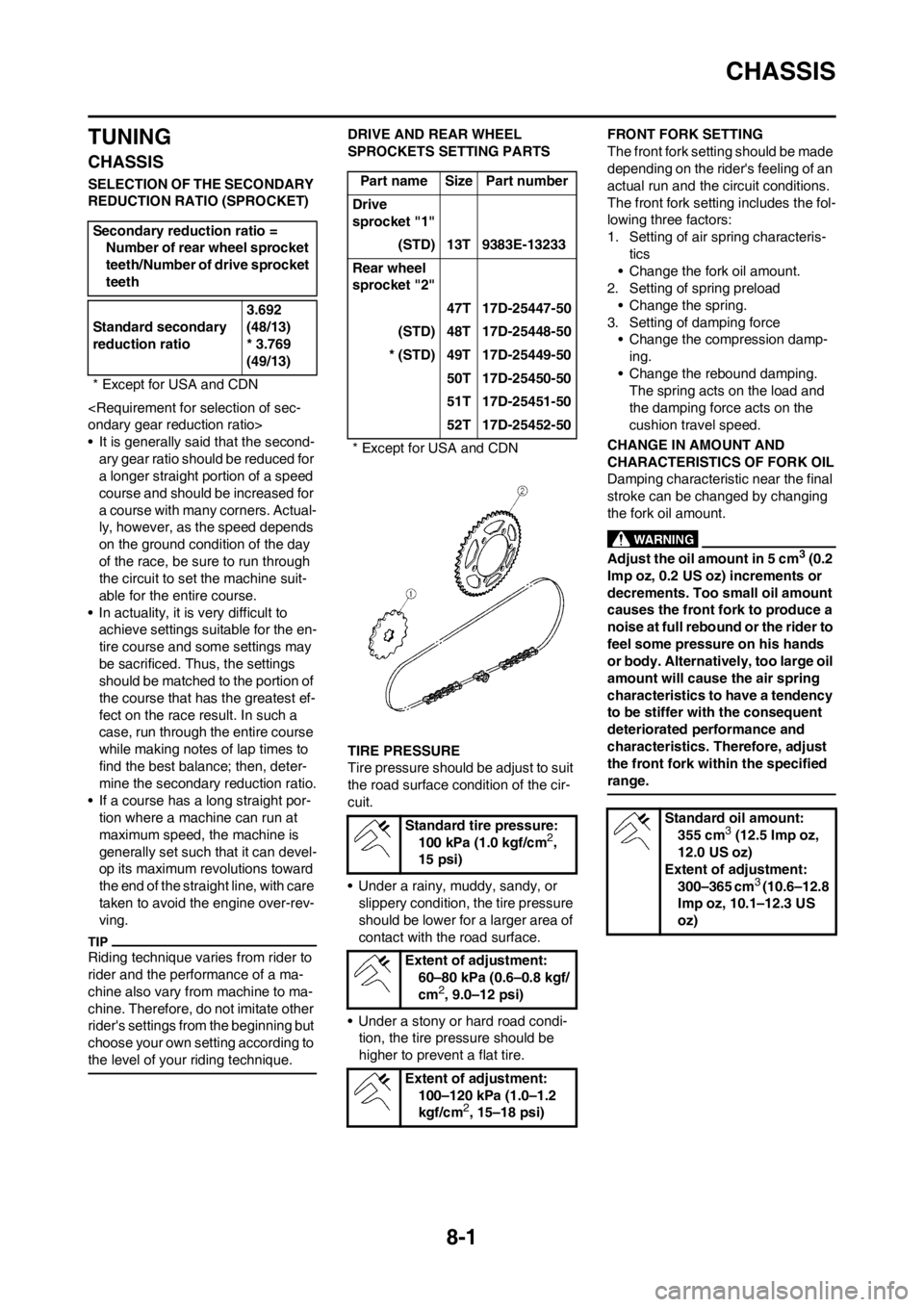
DRIVE AND REAR WHEEL
SPROCKETS SETTING PARTS
TIRE PRESSURE
Tire pressure should be adjust to suit
the road surface condition of the cir-
cuit.
• Under a rainy, muddy, sandy, or slippery condition, the tire pressure
should be lower for a larger area of
contact with the road surface.
• Under a stony or hard road condi- tion, the tire pressure should be
higher to prevent a flat tire. FRONT FORK SETTING
The front fork setting should be made
depending on the rider's feeling of an
actual run and the circuit conditions.
The front fork setting includes the fol-
lowing three factors:
1. Setting of air spring characteris-
tics
• Change the fork oil amount.
2. Setting of spring preload
• Change the spring.
3. Setting of damping force • Change the compression damp-
ing.
• Change the rebound damping. The spring acts on the load and
the damping force acts on the
cushion travel speed.
CHANGE IN AMOUNT AND
CHARACTERISTICS OF FORK OIL
Damping characteristic near the final
stroke can be changed by changing
the fork oil amount.
Adjust the oil amount in 5 cm3 (0.2
Imp oz, 0.2 US oz) increments or
decrements. Too small oil amount
causes the front fork to produce a
noise at full rebound or the rider to
feel some pressure on his hands
or body. Alternatively, too large oil
amount will cause the air spring
characteristics to have a tendency
to be stiffer with the consequent
deteriorated performance and
characteristics. Therefore, adjust
the front fork within the specified
range.
Secondary reduction ratio = Number of rear wheel sprocket
teeth/Number of drive sprocket
teeth
Standard secondary
reduction ratio 3.692
(48/13)
* 3.769
(49/13)
* Except for USA and CDN
Part name Size Part number
Drive
sprocket "1" (STD) 13T 9383E-13233
Rear wheel
sprocket "2" 47T 17D-25447-50
(STD) 48T 17D-25448-50
* (STD) 49T 17D-25449-50 50T 17D-25450-50
51T 17D-25451-50
52T 17D-25452-50
* Except for USA and CDN
Standard tire pressure:100 kPa (1.0 kgf/cm
2,
15 psi)
Extent of adjustment: 60–80 kPa (0.6–0.8 kgf/
cm
2, 9.0–12 psi)
Extent of adjustment: 100–120 kPa (1.0–1.2
kgf/cm
2, 15–18 psi)
Standard oil amount:
355 cm3 (12.5 Imp oz,
12.0 US oz)
Extent of adjustment:
300–365 cm
3 (10.6–12.8
Imp oz, 10.1–12.3 US
oz)
Page 223 of 228
8-2
CHASSIS
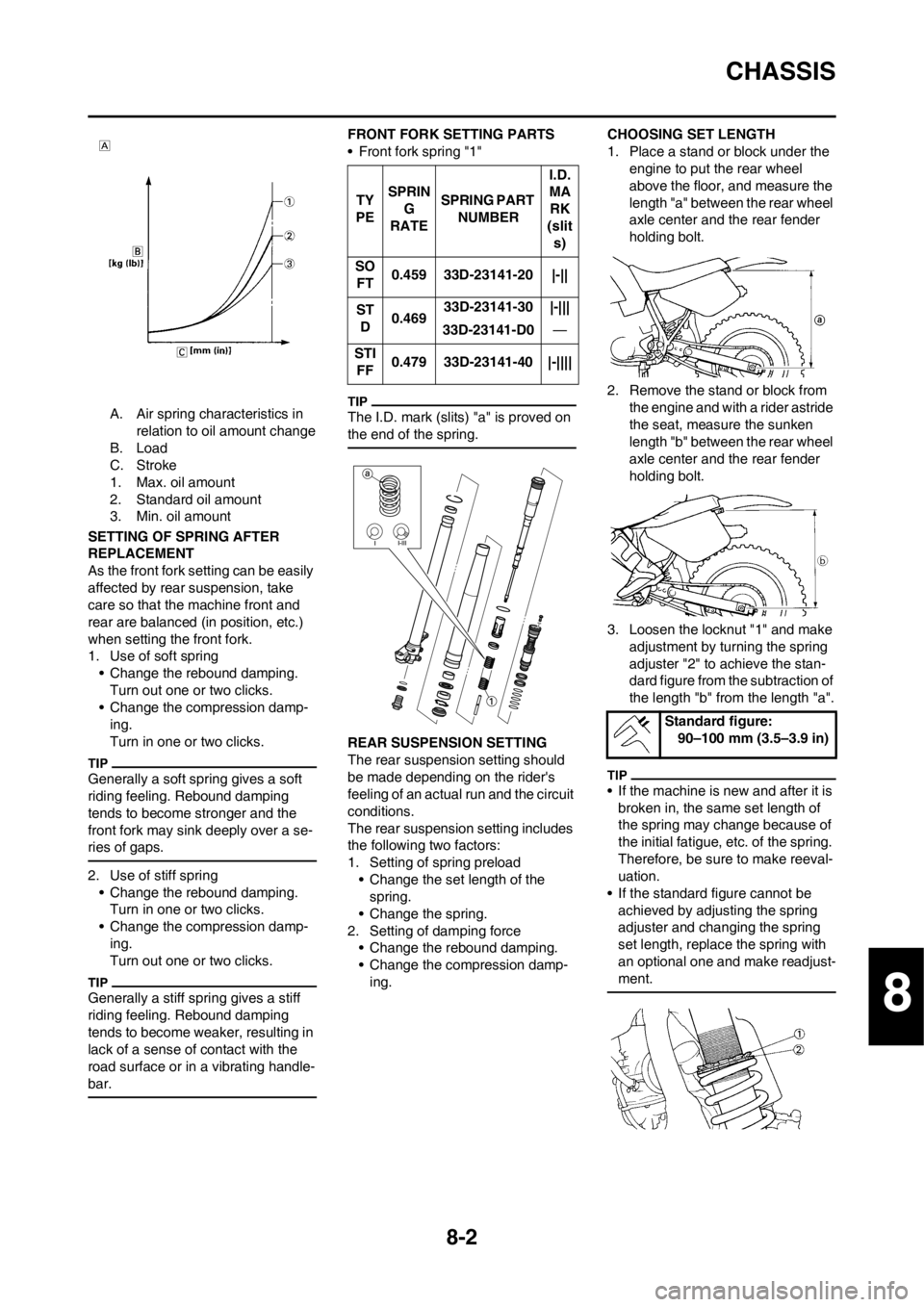
A. Air spring characteristics in
relation to oil amount change
B. Load
C. Stroke
1. Max. oil amount
2. Standard oil amount
3. Min. oil amount
SETTING OF SPRING AFTER
REPLACEMENT
As the front fork setting can be easily
affected by rear suspension, take
care so that the machine front and
rear are balanced (in position, etc.)
when setting the front fork.
1. Use of soft spring
• Change the rebound damping.
Turn out one or two clicks.
• Change the compression damp-
ing.
Turn in one or two clicks.
Generally a soft spring gives a soft
riding feeling. Rebound damping
tends to become stronger and the
front fork may sink deeply over a se-
ries of gaps.
2. Use of stiff spring
• Change the rebound damping.
Turn in one or two clicks.
• Change the compression damp-
ing.
Turn out one or two clicks.
Generally a stiff spring gives a stiff
riding feeling. Rebound damping
tends to become weaker, resulting in
lack of a sense of contact with the
road surface or in a vibrating handle-
bar.
FRONT FORK SETTING PARTS
• Front fork spring "1"
The I.D. mark (slits) "a" is proved on
the end of the spring.
REAR SUSPENSION SETTING
The rear suspension setting should
be made depending on the rider's
feeling of an actual run and the circuit
conditions.
The rear suspension setting includes
the following two factors:
1. Setting of spring preload
• Change the set length of the
spring.
• Change the spring.
2. Setting of damping force
• Change the rebound damping.
• Change the compression damp-
ing.CHOOSING SET LENGTH
1. Place a stand or block under the
engine to put the rear wheel
above the floor, and measure the
length "a" between the rear wheel
axle center and the rear fender
holding bolt.
2. Remove the stand or block from
the engine and with a rider astride
the seat, measure the sunken
length "b" between the rear wheel
axle center and the rear fender
holding bolt.
3. Loosen the locknut "1" and make
adjustment by turning the spring
adjuster "2" to achieve the stan-
dard figure from the subtraction of
the length "b" from the length "a".
• If the machine is new and after it is
broken in, the same set length of
the spring may change because of
the initial fatigue, etc. of the spring.
Therefore, be sure to make reeval-
uation.
• If the standard figure cannot be
achieved by adjusting the spring
adjuster and changing the spring
set length, replace the spring with
an optional one and make readjust-
ment.
TY
PESPRIN
G
RATESPRING PART
NUMBERI.D.
MA
RK
(slit
s)
SO
FT0.459 33D-23141-20 |-||
ST
D0.46933D-23141-30 |-|||
33D-23141-D0—
STI
FF0.479 33D-23141-40 |-||||
Standard figure:
90–100 mm (3.5–3.9 in)
8