electric YAMAHA YZ450F 2013 User Guide
[x] Cancel search | Manufacturer: YAMAHA, Model Year: 2013, Model line: YZ450F, Model: YAMAHA YZ450F 2013Pages: 228, PDF Size: 11.41 MB
Page 186 of 228
7-2
ELECTRICAL COMPONENTS AND WIRING DIAGRAM
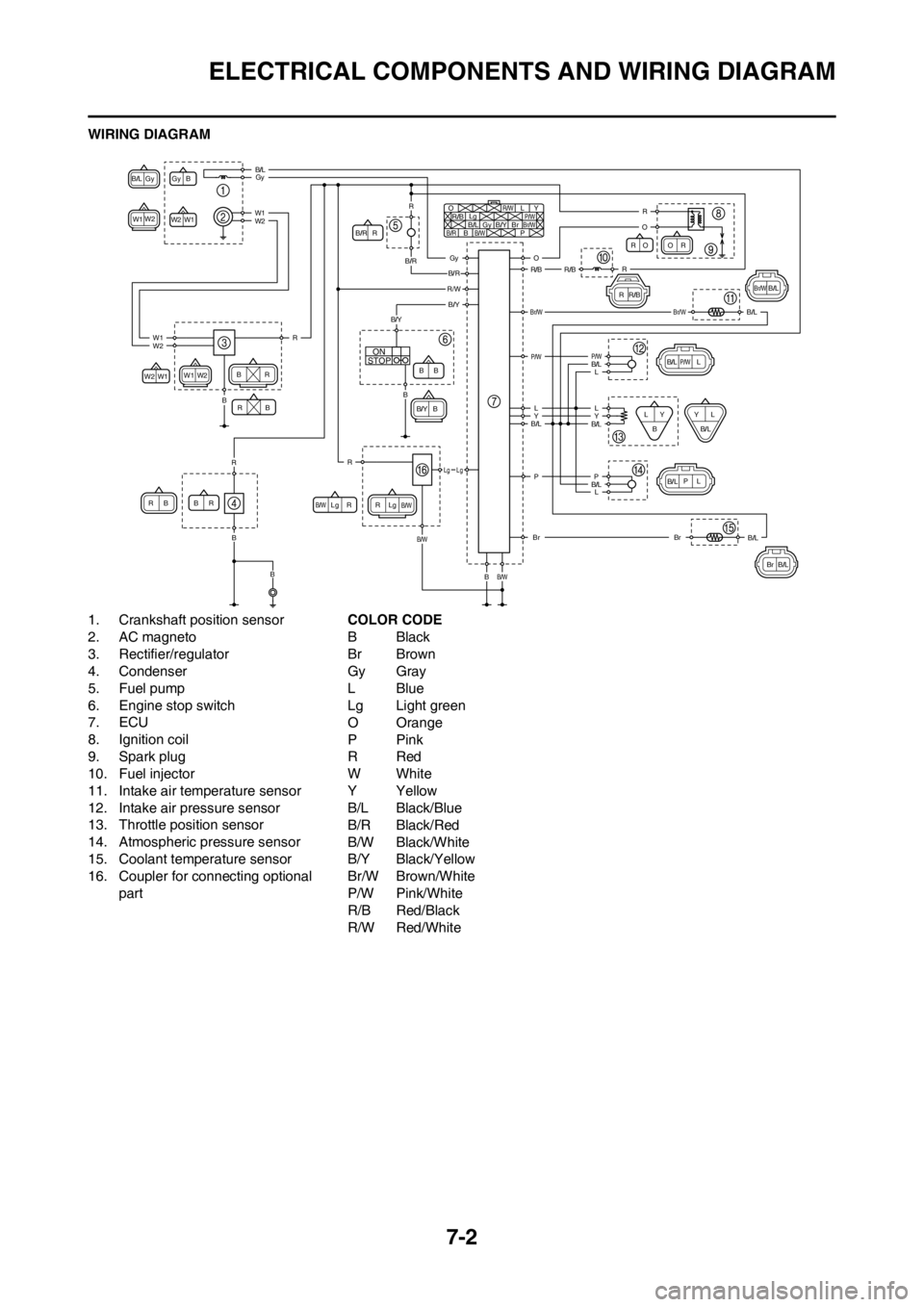
WIRING DIAGRAM
1. Crankshaft position sensor
2. AC magneto
3. Rectifier/regulator
4. Condenser
5. Fuel pump
6. Engine stop switch
7. ECU
8. Ignition coil
9. Spark plug
10. Fuel injector
11. Intake air temperature sensor
12. Intake air pressure sensor
13. Throttle position sensor
14. Atmospheric pressure sensor
15. Coolant temperature sensor
16. Coupler for connecting optional part COLOR CODE
BBlack
Br Brown
Gy Gray
LBlue
Lg Light green
O Orange
PPink
RRed
WWhite
YYellow
B/L Black/Blue
B/R Black/Red
B/W Black/White
B/Y Black/Yellow
Br/W Brown/White
P/W Pink/White
R/B Red/Black
R/W Red/White
STOPON
Gy
Gy
B
B/L
W1
W2
W2 O
R/B
R RR
R
R
R R
Lg
Lg Lg L
P/W
P
YB/RB
B B
BB BB
BB/W
B/W B/W Br/WGyB/L
W1 W1
W2 W2 B/Y
B/Y Br
B/R
R/W
OO
R/B RR
R
L
P/W
PYL
L
LY
Br/WB/L
B/L B/L
B
B/L
B/L
Br
W1
Br/W
W2
R
R O
B/L
L
Y
B/L
Br
R
P
Gy
Gy
B/R
B/R
R/WB/Y
B/L
W1
W2
W1 R
R R
B
B/Y
Lg Lg
O
R/B R/B
Br/W
P/W P/W
LL
Y
B/L B/L
B/L
Br
B
B/W
B/W
B
B
B L
B/L P
Page 189 of 228
7-5
IGNITION SYSTEM
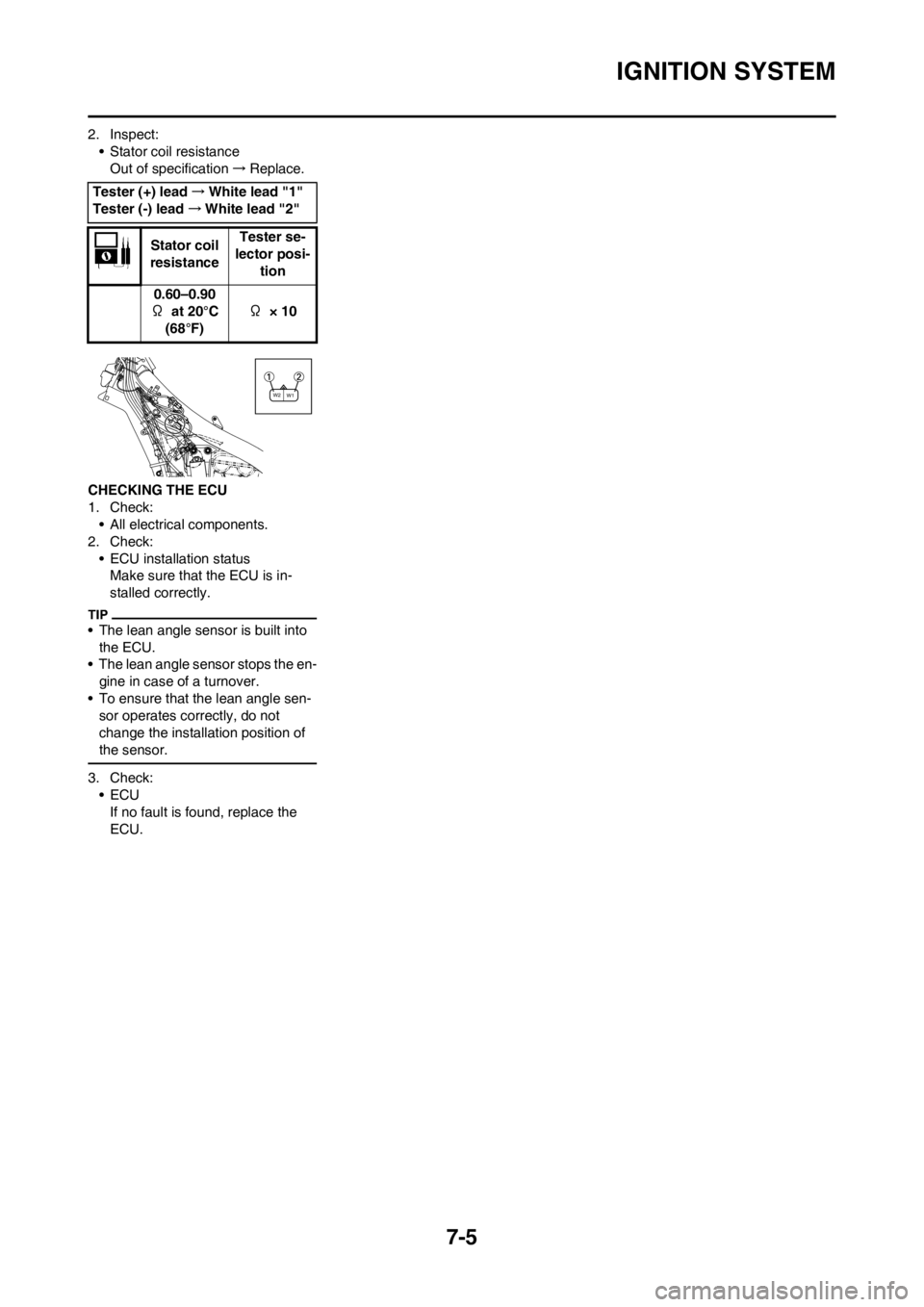
2. Inspect:
• Stator coil resistance
Out of specification→Replace.
CHECKING THE ECU
1. Check:
• All electrical components.
2. Check:
• ECU installation status
Make sure that the ECU is in-
stalled correctly.
• The lean angle sensor is built into
the ECU.
• The lean angle sensor stops the en-
gine in case of a turnover.
• To ensure that the lean angle sen-
sor operates correctly, do not
change the installation position of
the sensor.
3. Check:
•ECU
If no fault is found, replace the
ECU. Tester (+) lead→White lead "1"
Tester (-) lead→White lead "2"
Stator coil
resistanceTester se-
lector posi-
tion
0.60–0.90
Ω at 20°C
(68°F)Ω × 10
W1 W2
Page 220 of 228
7-36
ELECTRICAL COMPONENTS
ELECTRICAL
COMPONENTS
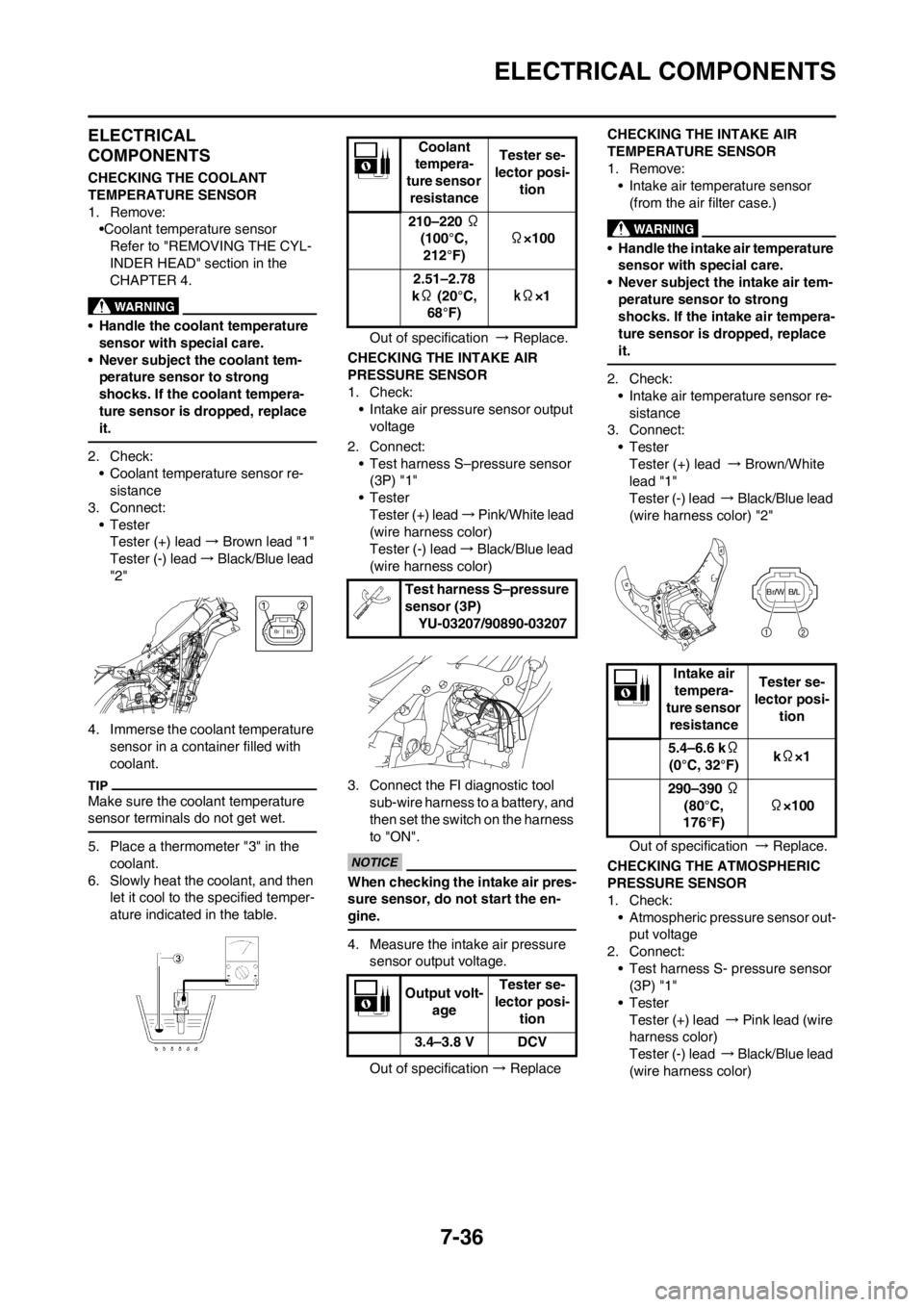
CHECKING THE COOLANT
TEMPERATURE SENSOR
1. Remove:
•Coolant temperature sensor
Refer to "REMOVING THE CYL-
INDER HEAD" section in the
CHAPTER 4.
•Handle the coolant temperature
sensor with special care.
•Never subject the coolant tem-
perature sensor to strong
shocks. If the coolant tempera-
ture sensor is dropped, replace
it.
2. Check:
• Coolant temperature sensor re-
sistance
3. Connect:
•Tester
Tester (+) lead → Brown lead "1"
Tester (-) lead → Black/Blue lead
"2"
4. Immerse the coolant temperature
sensor in a container filled with
coolant.
Make sure the coolant temperature
sensor terminals do not get wet.
5. Place a thermometer "3" in the
coolant.
6. Slowly heat the coolant, and then
let it cool to the specified temper-
ature indicated in the table.Out of specification → Replace.
CHECKING THE INTAKE AIR
PRESSURE SENSOR
1. Check:
• Intake air pressure sensor output
voltage
2. Connect:
• Test harness S–pressure sensor
(3P) "1"
•Tester
Tester (+) lead → Pink/White lead
(wire harness color)
Tester (-) lead → Black/Blue lead
(wire harness color)
3. Connect the FI diagnostic tool
sub-wire harness to a battery, and
then set the switch on the harness
to "ON".
When checking the intake air pres-
sure sensor, do not start the en-
gine.
4. Measure the intake air pressure
sensor output voltage.
Out of specification → ReplaceCHECKING THE INTAKE AIR
TEMPERATURE SENSOR
1. Remove:
• Intake air temperature sensor
(from the air filter case.)
•Handle the intake air temperature
sensor with special care.
•Never subject the intake air tem-
perature sensor to strong
shocks. If the intake air tempera-
ture sensor is dropped, replace
it.
2. Check:
• Intake air temperature sensor re-
sistance
3. Connect:
•Tester
Tester (+) lead → Brown/White
lead "1"
Tester (-) lead →Black/Blue lead
(wire harness color) "2"
Out of specification → Replace.
CHECKING THE ATMOSPHERIC
PRESSURE SENSOR
1. Check:
• Atmospheric pressure sensor out-
put voltage
2. Connect:
• Test harness S- pressure sensor
(3P) "1"
•Tester
Tester (+) lead → Pink lead (wire
harness color)
Tester (-) lead → Black/Blue lead
(wire harness color)
B/L Br
Coolant
tempera-
ture sensor
resistanceTester se-
lector posi-
tion
210–220 Ω
(100°C,
212°F)Ω×100
2.51–2.78
kΩ (20°C,
68°F)kΩ×1
Test harness S–pressure
sensor (3P)
YU-03207/90890-03207
Output volt-
ageTester se-
lector posi-
tion
3.4–3.8 V DCV
Intake air
tempera-
ture sensor
resistanceTester se-
lector posi-
tion
5.4–6.6 kΩ
(0°C, 32°F)kΩ×1
290–390 Ω
(80°C,
176°F)Ω×100
Br/WB/L
Page 221 of 228
7-37
ELECTRICAL COMPONENTS
3. Connect the FI diagnostic tool
sub-wire harness to a battery, and
then set the switch on the harness
to "ON".
When checking the atmospheric
pressure sensor, do not start the
engine.
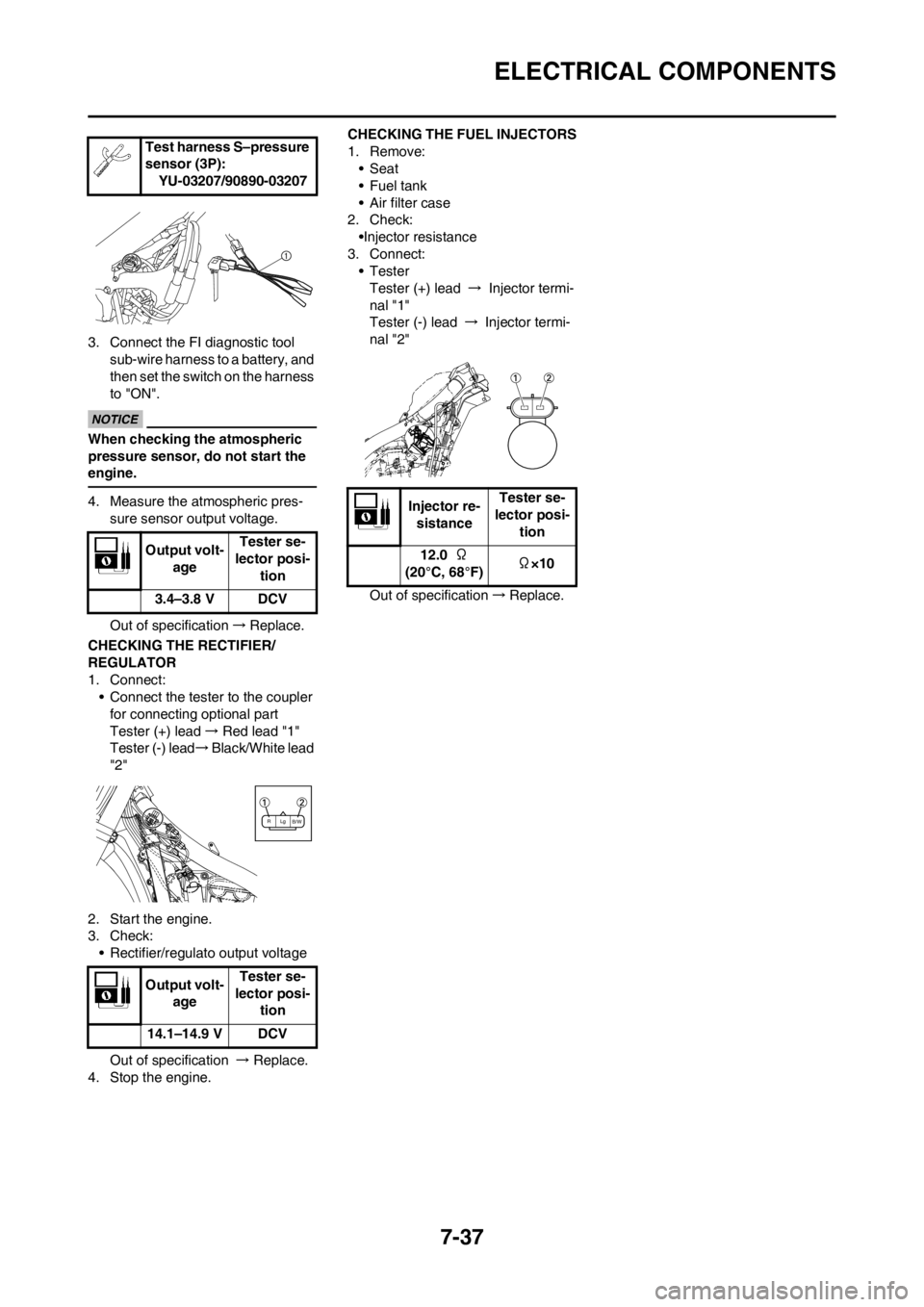
4. Measure the atmospheric pres-
sure sensor output voltage.
Out of specification→Replace.
CHECKING THE RECTIFIER/
REGULATOR
1. Connect:
• Connect the tester to the coupler
for connecting optional part
Tester (+) lead→ Red lead "1"
Tester (-) lead→ Black/White lead
"2"
2. Start the engine.
3. Check:
• Rectifier/regulato output voltage
Out of specification → Replace.
4. Stop the engine.CHECKING THE FUEL INJECTORS
1. Remove:
•Seat
•Fuel tank
• Air filter case
2. Check:
•Injector resistance
3. Connect:
•Tester
Tester (+) lead → Injector termi-
nal "1"
Tester (-) lead → Injector termi-
nal "2"
Out of specification→Replace. Test harness S–pressure
sensor (3P):
YU-03207/90890-03207
Output volt-
ageTester se-
lector posi-
tion
3.4–3.8 V DCV
Output volt-
ageTester se-
lector posi-
tion
14.1–14.9 V DCV
Lg
R
B/W
Injector re-
sistanceTester se-
lector posi-
tion
12.0 Ω
(20°C, 68°F) Ω×10