warning YAMAHA YZ450F 2014 Workshop Manual
[x] Cancel search | Manufacturer: YAMAHA, Model Year: 2014, Model line: YZ450F, Model: YAMAHA YZ450F 2014Pages: 360, PDF Size: 11.76 MB
Page 274 of 360
RADIATOR
6-3
EAS1SL1296HANDLING NOTEEWA1DX1007
WARNING
If coolant seems hot, do not remove the ra-
diator cap.
EAS1SL1297CHECKING THE RADIATOR
1. Check:
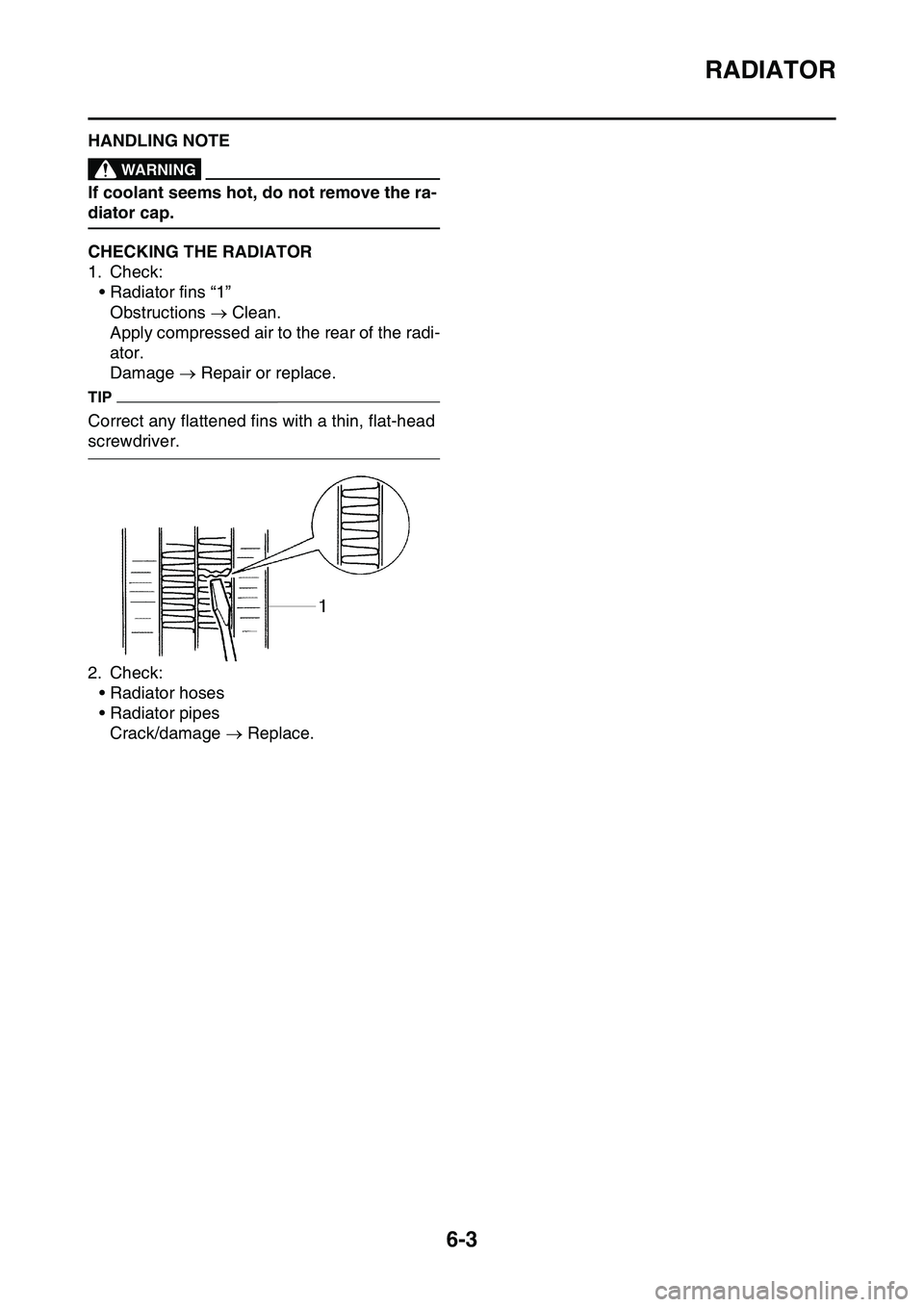
• Radiator fins “1”
Obstructions Clean.
Apply compressed air to the rear of the radi-
ator.
Damage Repair or replace.
TIP
Correct any flattened fins with a thin, flat-head
screwdriver.
2. Check:
• Radiator hoses
• Radiator pipes
Crack/damage Replace.
Page 281 of 360
FUEL TANK
7-2
EAS1SL1306REMOVING THE FUEL TANK
1. Extract the fuel in the fuel tank through the
fuel tank cap with a pump.
2. Remove:
• Fuel hose couplerEWA23P1001
WARNING
Cover the fuel hose connection with a cloth
when disconnecting it. This is because re
-
sidual pressure in the fuel hose could cause
fuel to spurt out when the hose is removed.
ECA23P1090
NOTICE
Make sure that the fuel hose is disconnect-
ed by hand. Do not forcefully disconnect the
hose with tools.
TIP
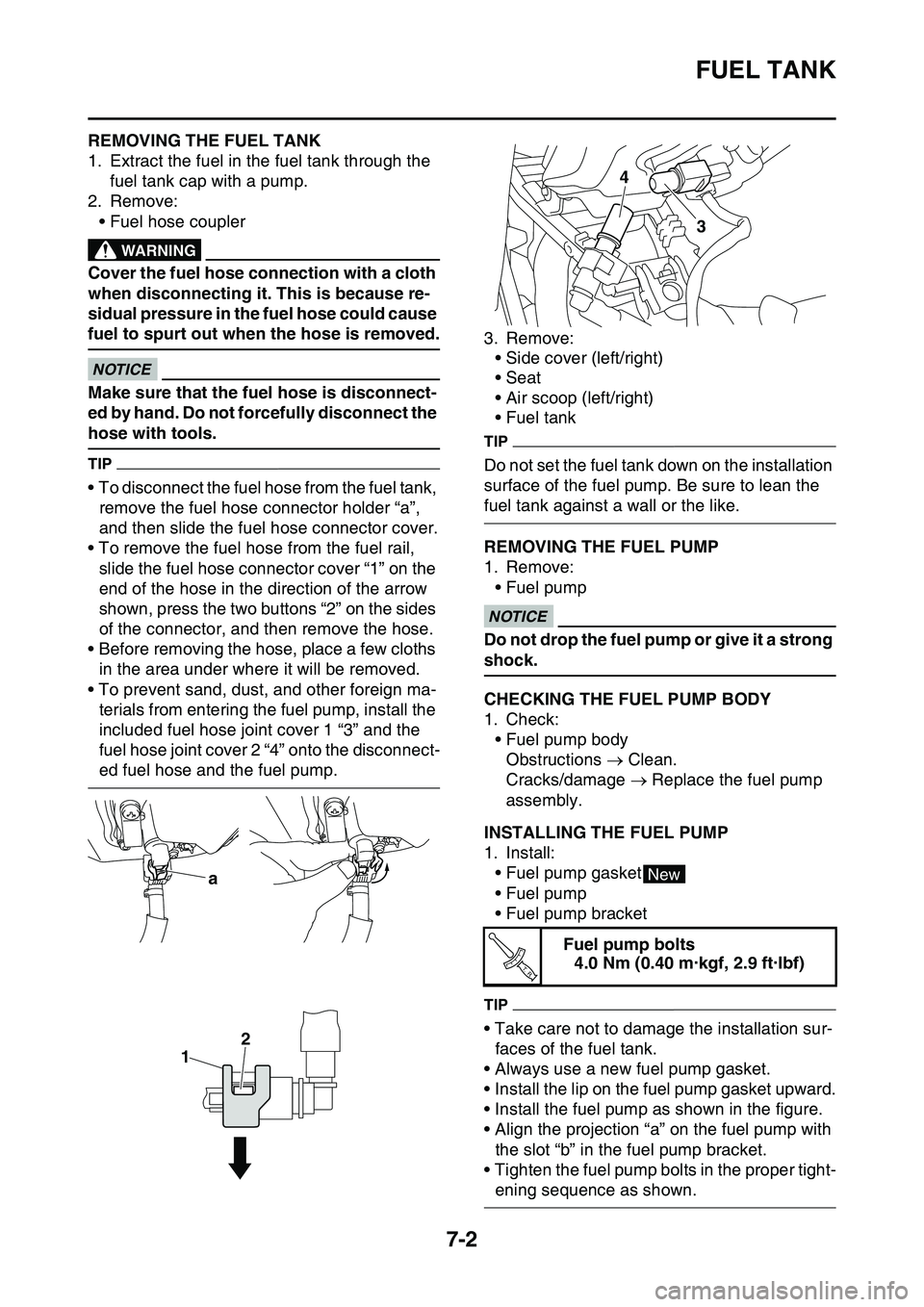
• To disconnect the fuel hose from the fuel tank,
remove the fuel hose connector holder “a”,
and then slide the fuel hose connector cover.
• To remove the fuel hose from the fuel rail,
slide the fuel hose connector cover “1” on the
end of the hose in the direction of the arrow
shown, press the two buttons “2” on the sides
of the connector, and then remove the hose.
• Before removing the hose, place a few cloths
in the area under where it will be removed.
• To prevent sand, dust, and other foreign ma-
terials from entering the fuel pump, install the
included fuel hose joint cover 1 “3” and the
fuel hose joint cover 2 “4” onto the disconnect
-
ed fuel hose and the fuel pump.
3. Remove:
• Side cover (left/right)
• Seat
• Air scoop (left/right)
• Fuel tank
TIP
Do not set the fuel tank down on the installation
surface of the fuel pump. Be sure to lean the
fuel tank against a wall or the like.
EAS1SL1307REMOVING THE FUEL PUMP
1. Remove:
• Fuel pumpECA14720
NOTICE
Do not drop the fuel pump or give it a strong
shock.
EAS1SL1308CHECKING THE FUEL PUMP BODY
1. Check:
• Fuel pump body
Obstructions Clean.
Cracks/damage Replace the fuel pump
assembly.
EAS1SL1309INSTALLING THE FUEL PUMP
1. Install:
• Fuel pump gasket
• Fuel pump
• Fuel pump bracket
TIP
• Take care not to damage the installation sur-
faces of the fuel tank.
• Always use a new fuel pump gasket.
• Install the lip on the fuel pump gasket upward.
• Install the fuel pump as shown in the figure.
• Align the projection “a” on the fuel pump with
the slot “b” in the fuel pump bracket.
• Tighten the fuel pump bolts in the proper tight-
ening sequence as shown.
a
1
2
Fuel pump bolts
4.0 Nm (0.40 m·kgf, 2.9 ft·lbf)
3 4
New
T R..
Page 282 of 360
FUEL TANK
7-3
EAS1SL1310INSTALLING THE FUEL TANK
1. Install:
• Fuel tank
2. Connect:
• Fuel hoseECA33DD069
NOTICE
• Connect the fuel hose securely, and check
that the orientation of the installed fuel
hose holder is correct.
• Take care not to kink or pinch the fuel
hose.
TIP
• Insert the fuel hose into the fuel pipe securely
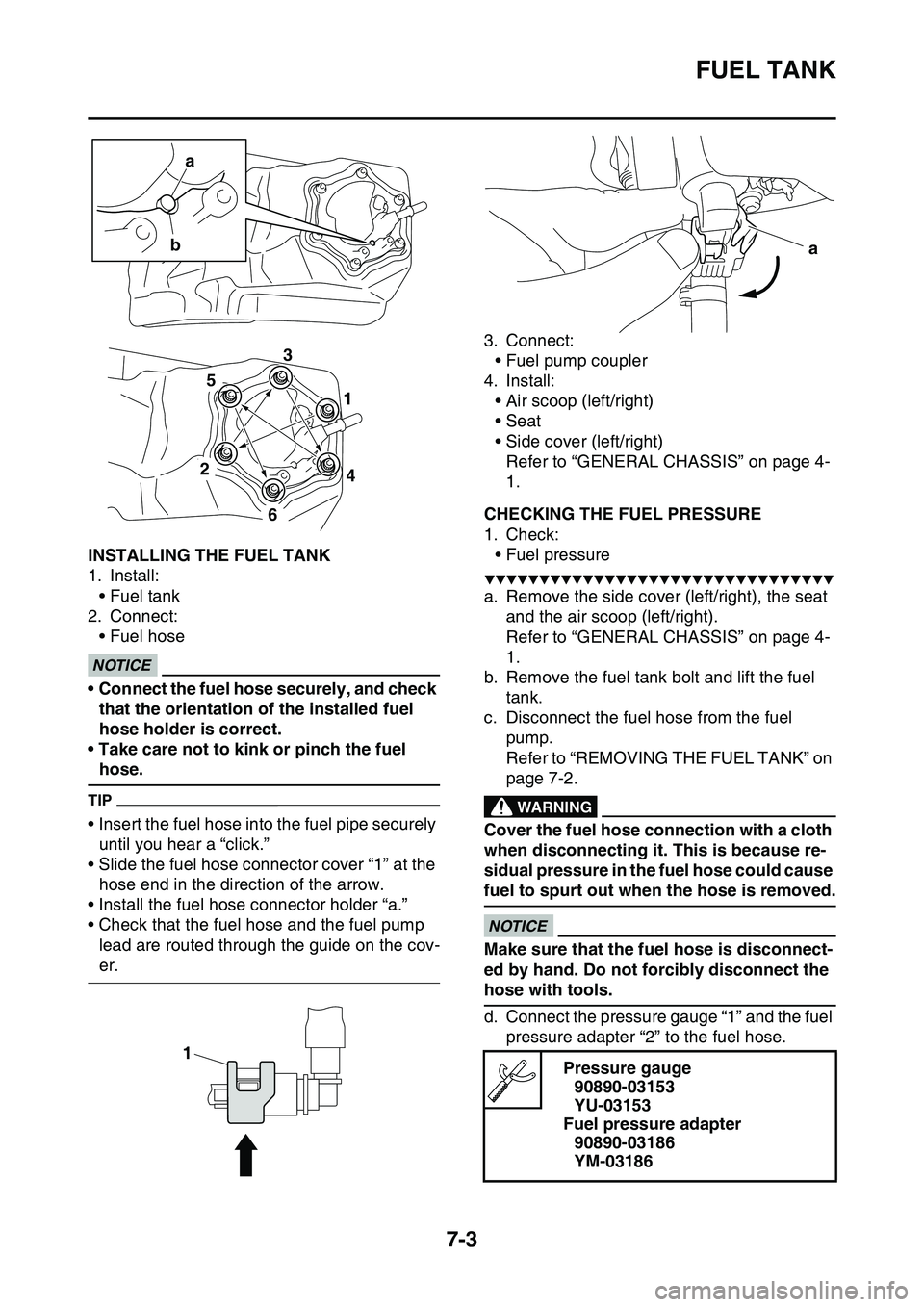
until you hear a “click.”
• Slide the fuel hose connector cover “1” at the
hose end in the direction of the arrow.
• Install the fuel hose connector holder “a.”
• Check that the fuel hose and the fuel pump
lead are routed through the guide on the cov
-
er.
3. Connect:
• Fuel pump coupler
4. Install:
• Air scoop (left/right)
• Seat
• Side cover (left/right)
Refer to “GENERAL CHASSIS” on page 4-
1.
EAS1SL1311CHECKING THE FUEL PRESSURE
1. Check:
• Fuel pressure
▼▼▼▼▼▼▼▼▼▼▼▼▼▼▼▼▼▼▼▼▼▼▼▼▼▼▼▼▼▼▼▼
a. Remove the side cover (left/right), the seat
and the air scoop (left/right).
Refer to “GENERAL CHASSIS” on page 4-
1.
b. Remove the fuel tank bolt and lift the fuel
tank.
c. Disconnect the fuel hose from the fuel
pump.
Refer to “REMOVING THE FUEL TANK” on
page 7-2.EWA1DX1008
WARNING
Cover the fuel hose connection with a cloth
when disconnecting it. This is because re
-
sidual pressure in the fuel hose could cause
fuel to spurt out when the hose is removed.
ECA1DX1025
NOTICE
Make sure that the fuel hose is disconnect-
ed by hand. Do not forcibly disconnect the
hose with tools.
d. Connect the pressure gauge “1” and the fuel
pressure adapter “2” to the fuel hose.
a
b
4 1
2
6
53
1Pressure gauge
90890-03153
YU-03153
Fuel pressure adapter
90890-03186
YM-03186
a
Page 288 of 360
THROTTLE BODY
7-9
ADJUSTING THE THROTTLE POSITION
SENSOR
EWA32D1011
WARNING
• Handle the throttle position sensor with
special care.
• Never subject the throttle position sensor
to strong shocks. If the throttle position
sensor is dropped, replace it.
1. Check:
• Throttle position sensor
Refer to “CHECKING THE THROTTLE PO-
SITION SENSOR” on page 8-44.
2. Adjust:
• Throttle position sensor angle
▼▼▼▼▼▼▼▼▼▼▼▼▼▼▼▼▼▼▼▼▼▼▼▼▼▼▼▼▼▼▼▼
a. Connect the Yamaha diagnostic tool.
Refer to “YAMAHA DIAGNOSTIC TOOL” on
page 8-12.
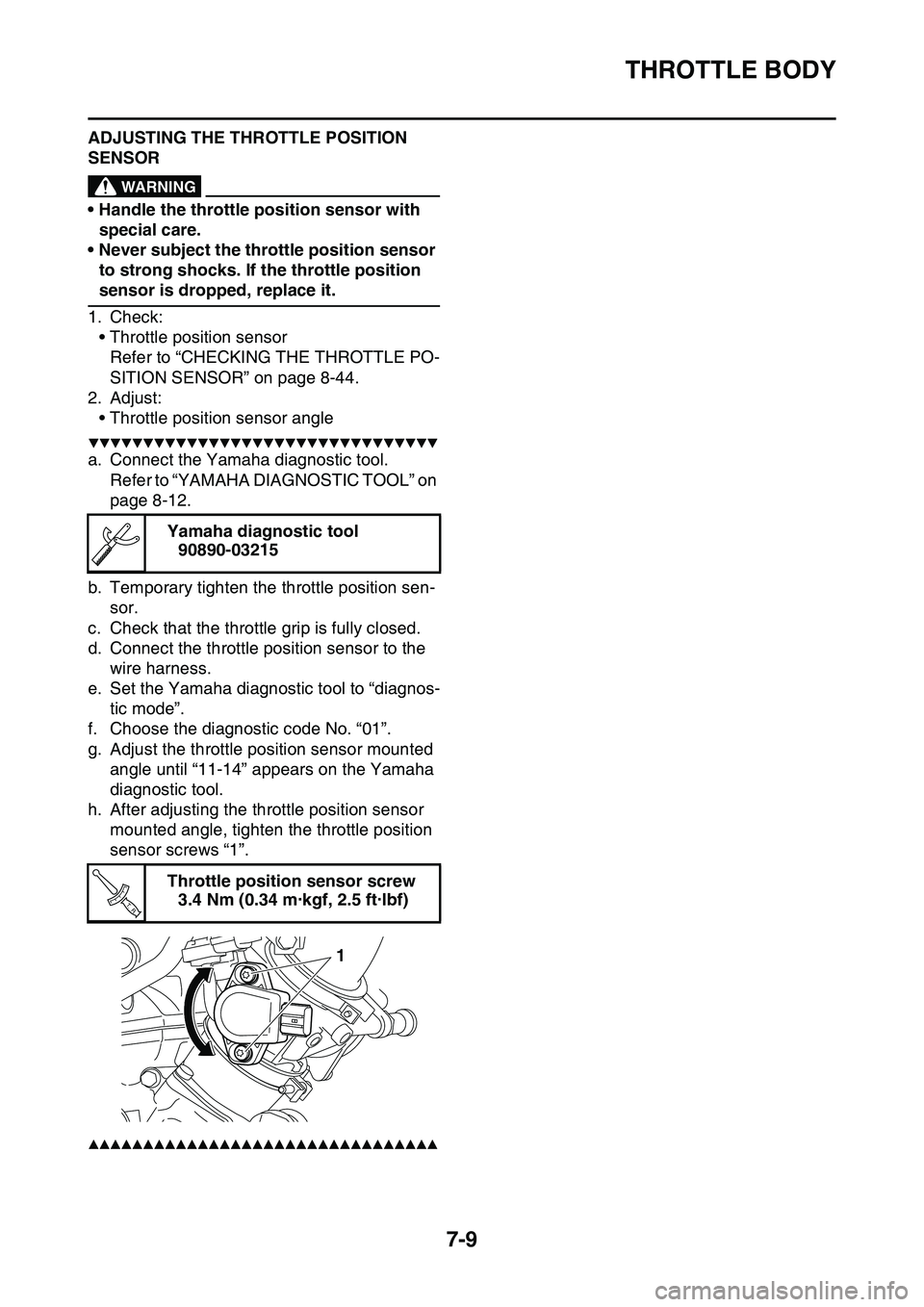
b. Temporary tighten the throttle position sen-
sor.
c. Check that the throttle grip is fully closed.
d. Connect the throttle position sensor to the
wire harness.
e. Set the Yamaha diagnostic tool to “diagnos-
tic mode”.
f. Choose the diagnostic code No. “01”.
g. Adjust the throttle position sensor mounted
angle until “11-14” appears on the Yamaha
diagnostic tool.
h. After adjusting the throttle position sensor
mounted angle, tighten the throttle position
sensor screws “1”.
▲▲▲▲▲▲▲▲▲▲▲▲▲▲▲▲▲▲▲▲▲▲▲▲▲▲▲▲▲▲▲▲
Yamaha diagnostic tool
90890-03215
Throttle position sensor screw
3.4 Nm (0.34 m·kgf, 2.5 ft·lbf)T R..
1
Page 313 of 360
FUEL INJECTION SYSTEM
8-23
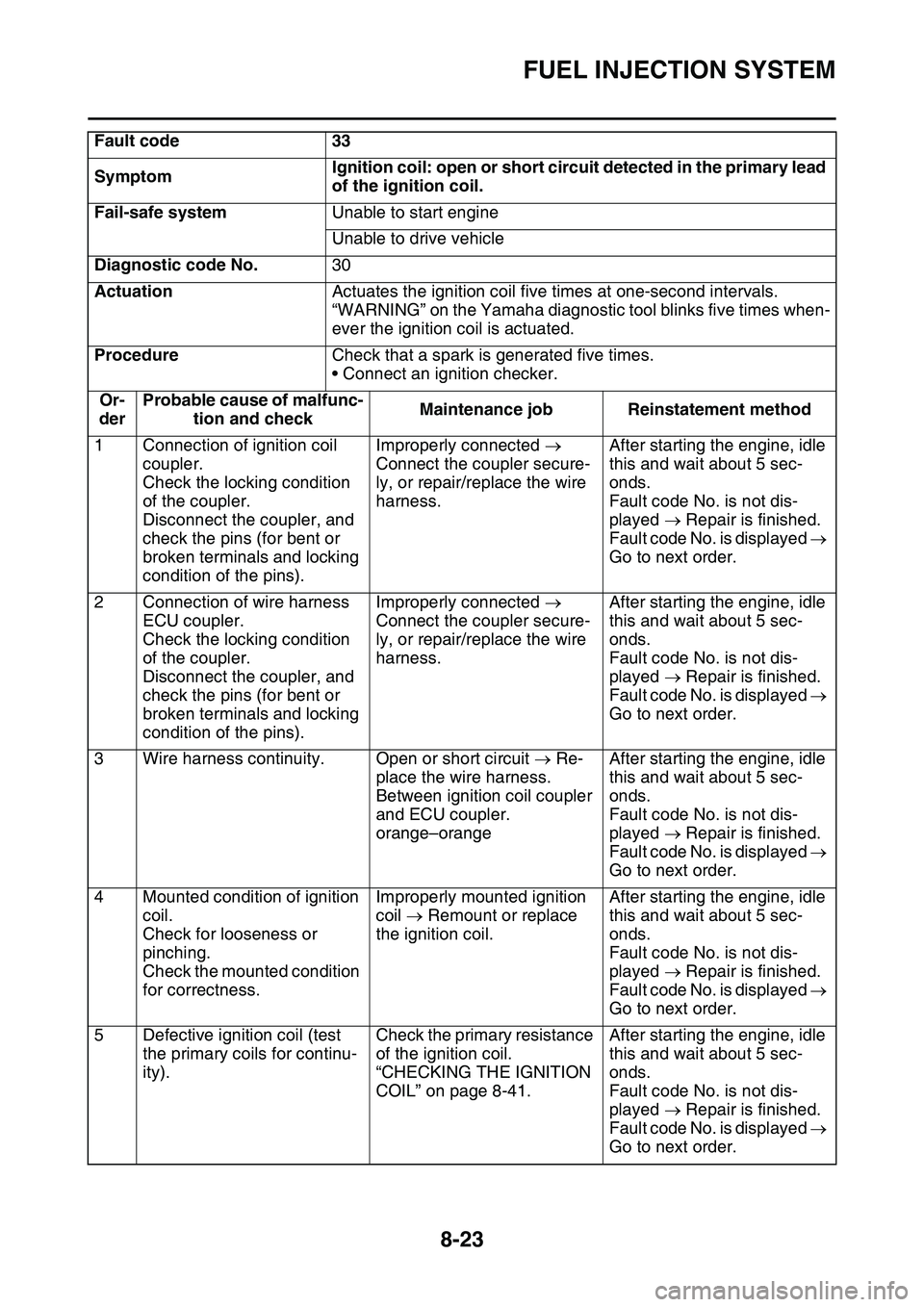
Fault code33
SymptomIgnition coil: open or short circuit detected in the primary lead
of the ignition coil.
Fail-safe systemUnable to start engine
Unable to drive vehicle
Diagnostic code No.30
ActuationActuates the ignition coil five times at one-second intervals.
“WARNING” on the Yamaha diagnostic tool blinks five times when-
ever the ignition coil is actuated.
ProcedureCheck that a spark is generated five times.
• Connect an ignition checker.
Or-
der
Probable cause of malfunc-
tion and checkMaintenance jobReinstatement method
1Connection of ignition coil
coupler.
Check the locking condition
of the coupler.
Disconnect the coupler, and
check the pins (for bent or
broken terminals and locking
condition of the pins).
Improperly connected
Connect the coupler secure
-
ly, or repair/replace the wire
harness.
After starting the engine, idle
this and wait about 5 sec
-
onds.
Fault code No. is not dis-
played Repair is finished.
Fault code No. is displayed
Go to next order.
2Connection of wire harness
ECU coupler.
Check the locking condition
of the coupler.
Disconnect the coupler, and
check the pins (for bent or
broken terminals and locking
condition of the pins).
Improperly connected
Connect the coupler secure
-
ly, or repair/replace the wire
harness.
After starting the engine, idle
this and wait about 5 sec
-
onds.
Fault code No. is not dis-
played Repair is finished.
Fault code No. is displayed
Go to next order.
3Wire harness continuity.Open or short circuit Re-
place the wire harness.
Between ignition coil coupler
and ECU coupler.
orange–orange
After starting the engine, idle
this and wait about 5 sec
-
onds.
Fault code No. is not dis-
played Repair is finished.
Fault code No. is displayed
Go to next order.
4Mounted condition of ignition
coil.
Check for looseness or
pinching.
Check the mounted condition
for correctness.
Improperly mounted ignition
coil Remount or replace
the ignition coil.After starting the engine, idle
this and wait about 5 sec
-
onds.
Fault code No. is not dis-
played Repair is finished.
Fault code No. is displayed
Go to next order.
5Defective ignition coil (test
the primary coils for continu
-
ity).
Check the primary resistance
of the ignition coil.
“CHECKING THE IGNITION
COIL” on page 8-41.
After starting the engine, idle
this and wait about 5 sec
-
onds.
Fault code No. is not dis-
played Repair is finished.
Fault code No. is displayed
Go to next order.
Page 314 of 360
FUEL INJECTION SYSTEM
8-24
TIP
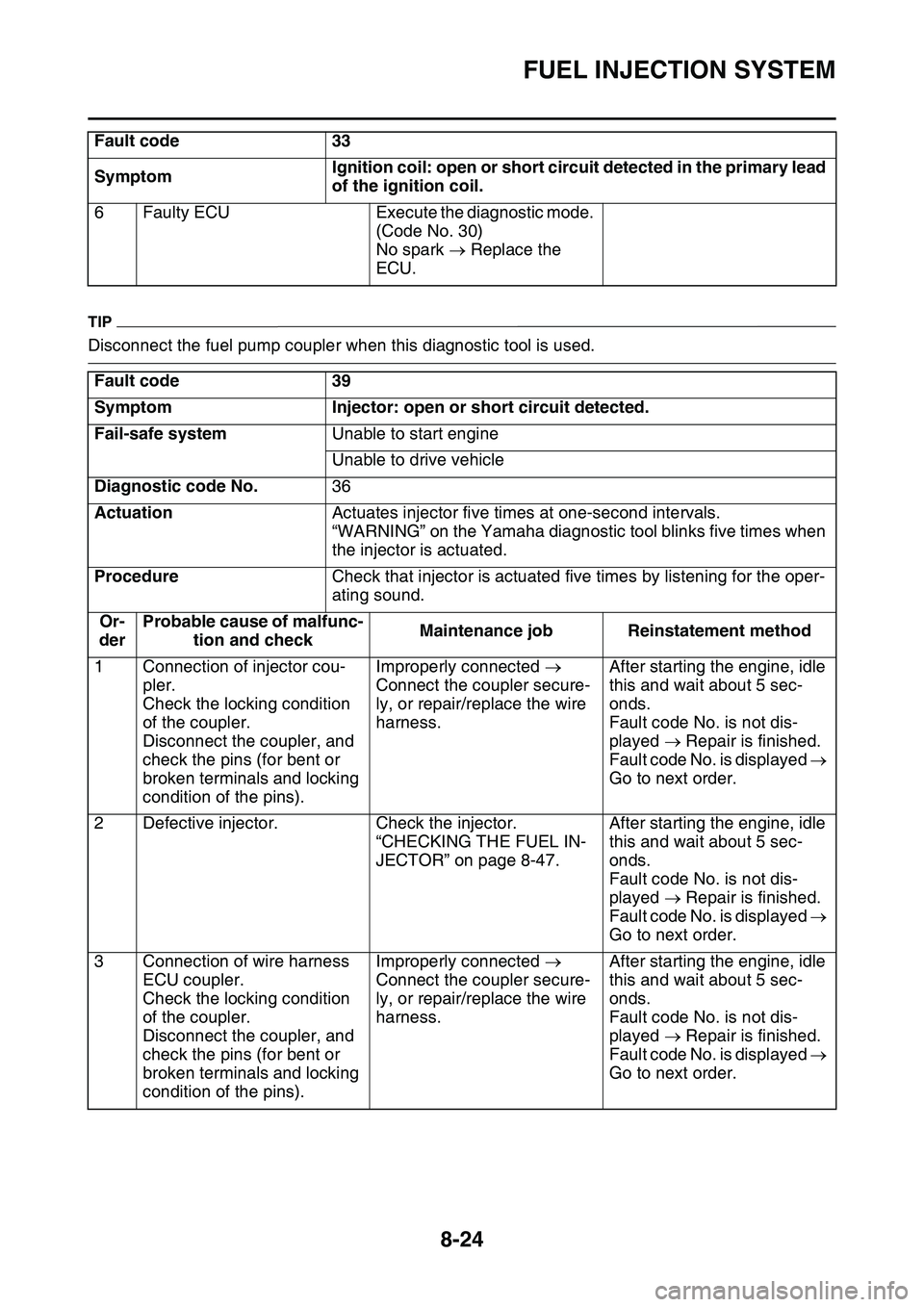
Disconnect the fuel pump coupler when this diagnostic tool is used.
6Faulty ECUExecute the diagnostic mode.
(Code No. 30)
No spark Replace the
ECU.
Fault code39
SymptomInjector: open or short circuit detected.
Fail-safe systemUnable to start engine
Unable to drive vehicle
Diagnostic code No.36
ActuationActuates injector five times at one-second intervals.
“WARNING” on the Yamaha diagnostic tool blinks five times when
the injector is actuated.
ProcedureCheck that injector is actuated five times by listening for the oper-
ating sound.
Or-
der
Probable cause of malfunc-
tion and checkMaintenance jobReinstatement method
1Connection of injector cou-
pler.
Check the locking condition
of the coupler.
Disconnect the coupler, and
check the pins (for bent or
broken terminals and locking
condition of the pins).
Improperly connected
Connect the coupler secure
-
ly, or repair/replace the wire
harness.
After starting the engine, idle
this and wait about 5 sec
-
onds.
Fault code No. is not dis-
played Repair is finished.
Fault code No. is displayed
Go to next order.
2Defective injector.Check the injector.
“CHECKING THE FUEL IN-
JECTOR” on page 8-47.
After starting the engine, idle
this and wait about 5 sec
-
onds.
Fault code No. is not dis-
played Repair is finished.
Fault code No. is displayed
Go to next order.
3Connection of wire harness
ECU coupler.
Check the locking condition
of the coupler.
Disconnect the coupler, and
check the pins (for bent or
broken terminals and locking
condition of the pins).
Improperly connected
Connect the coupler secure
-
ly, or repair/replace the wire
harness.
After starting the engine, idle
this and wait about 5 sec
-
onds.
Fault code No. is not dis-
played Repair is finished.
Fault code No. is displayed
Go to next order.
Fault code 33
SymptomIgnition coil: open or short circuit detected in the primary lead
of the ignition coil.
Page 334 of 360
ELECTRICAL COMPONENTS
8-44
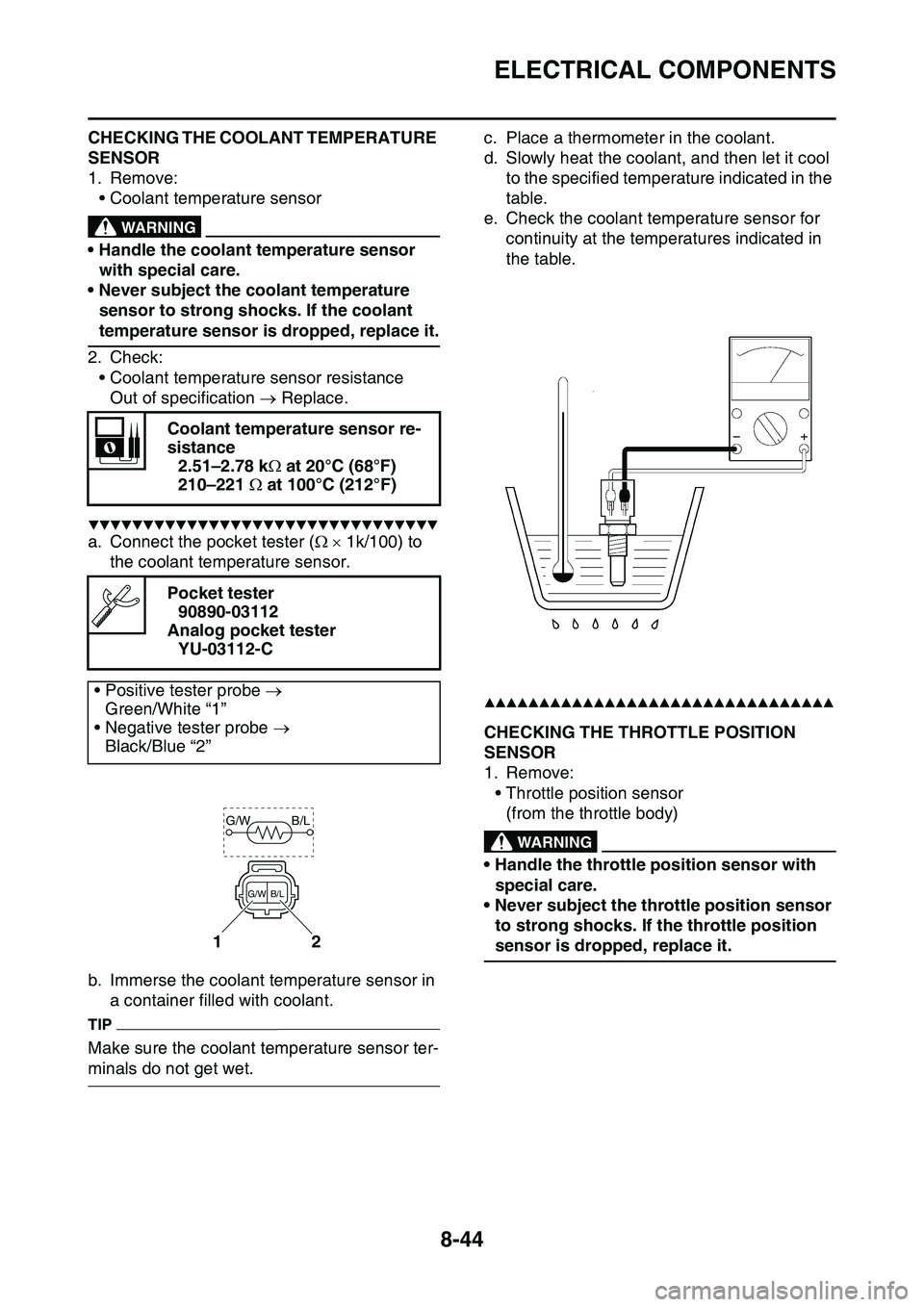
CHECKING THE COOLANT TEMPERATURE
SENSOR
1. Remove:
• Coolant temperature sensorEWA14130
WARNING
• Handle the coolant temperature sensor
with special care.
• Never subject the coolant temperature
sensor to strong shocks. If the coolant
temperature sensor is dropped, replace it.
2. Check:
• Coolant temperature sensor resistance
Out of specification Replace.
▼▼▼▼▼▼▼▼▼▼▼▼▼▼▼▼▼▼▼▼▼▼▼▼▼▼▼▼▼▼▼▼
a. Connect the pocket tester ( 1k/100) to
the coolant temperature sensor.
b. Immerse the coolant temperature sensor in
a container filled with coolant.
TIP
Make sure the coolant temperature sensor ter-
minals do not get wet.
c. Place a thermometer in the coolant.
d. Slowly heat the coolant, and then let it cool
to the specified temperature indicated in the
table.
e. Check the coolant temperature sensor for
continuity at the temperatures indicated in
the table.
▲▲▲▲▲▲▲▲▲▲▲▲▲▲▲▲▲▲▲▲▲▲▲▲▲▲▲▲▲▲▲▲
EAS1SL1343CHECKING THE THROTTLE POSITION
SENSOR
1. Remove:
• Throttle position sensor
(from the throttle body)EWA1DX1009
WARNING
• Handle the throttle position sensor with
special care.
• Never subject the throttle position sensor
to strong shocks. If the throttle position
sensor is dropped, replace it.
Coolant temperature sensor re-
sistance
2.51–2.78 k at 20°C (68°F)
210–221 at 100°C (212°F)
Pocket tester
90890-03112
Analog pocket tester
YU-03112-C
• Positive tester probe
Green/White “1”
• Negative tester probe
Black/Blue “2”
12
G/W B/L
B/L G/W
Page 336 of 360
ELECTRICAL COMPONENTS
8-46
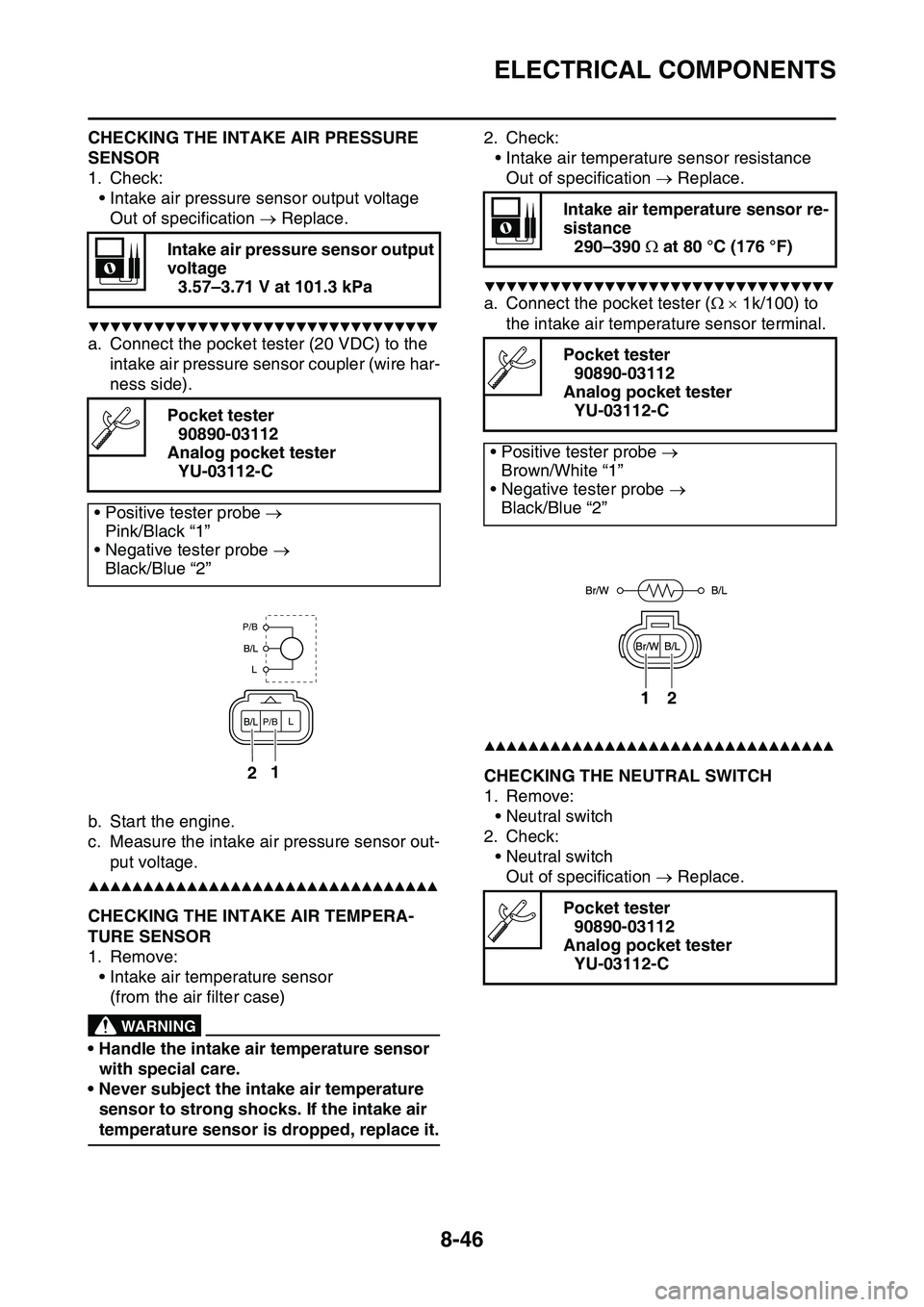
CHECKING THE INTAKE AIR PRESSURE
SENSOR
1. Check:
• Intake air pressure sensor output voltage
Out of specification Replace.
▼▼▼▼▼▼▼▼▼▼▼▼▼▼▼▼▼▼▼▼▼▼▼▼▼▼▼▼▼▼▼▼
a. Connect the pocket tester (20 VDC) to the
intake air pressure sensor coupler (wire har
-
ness side).
b. Start the engine.
c. Measure the intake air pressure sensor out-
put voltage.
▲▲▲▲▲▲▲▲▲▲▲▲▲▲▲▲▲▲▲▲▲▲▲▲▲▲▲▲▲▲▲▲
EAS1SL1346CHECKING THE INTAKE AIR TEMPERA-
TURE SENSOR
1. Remove:
• Intake air temperature sensor
(from the air filter case)EWA1DX1010
WARNING
• Handle the intake air temperature sensor
with special care.
• Never subject the intake air temperature
sensor to strong shocks. If the intake air
temperature sensor is dropped, replace it.
2. Check:
• Intake air temperature sensor resistance
Out of specification Replace.
▼▼▼▼▼▼▼▼▼▼▼▼▼▼▼▼▼▼▼▼▼▼▼▼▼▼▼▼▼▼▼▼
a. Connect the pocket tester ( 1k/100) to
the intake air temperature sensor terminal.
▲▲▲▲▲▲▲▲▲▲▲▲▲▲▲▲▲▲▲▲▲▲▲▲▲▲▲▲▲▲▲▲
EAS1SL1347CHECKING THE NEUTRAL SWITCH
1. Remove:
• Neutral switch
2. Check:
• Neutral switch
Out of specification Replace.
Intake air pressure sensor output
voltage
3.57–3.71 V at 101.3 kPa
Pocket tester
90890-03112
Analog pocket tester
YU-03112-C
• Positive tester probe
Pink/Black “1”
• Negative tester probe
Black/Blue “2”
12
P/B
P/B
Intake air temperature sensor re-
sistance
290–390 at 80 °C (176 °F)
Pocket tester
90890-03112
Analog pocket tester
YU-03112-C
• Positive tester probe
Brown/White “1”
• Negative tester probe
Black/Blue “2”
Pocket tester
90890-03112
Analog pocket tester
YU-03112-C
12
Page 345 of 360
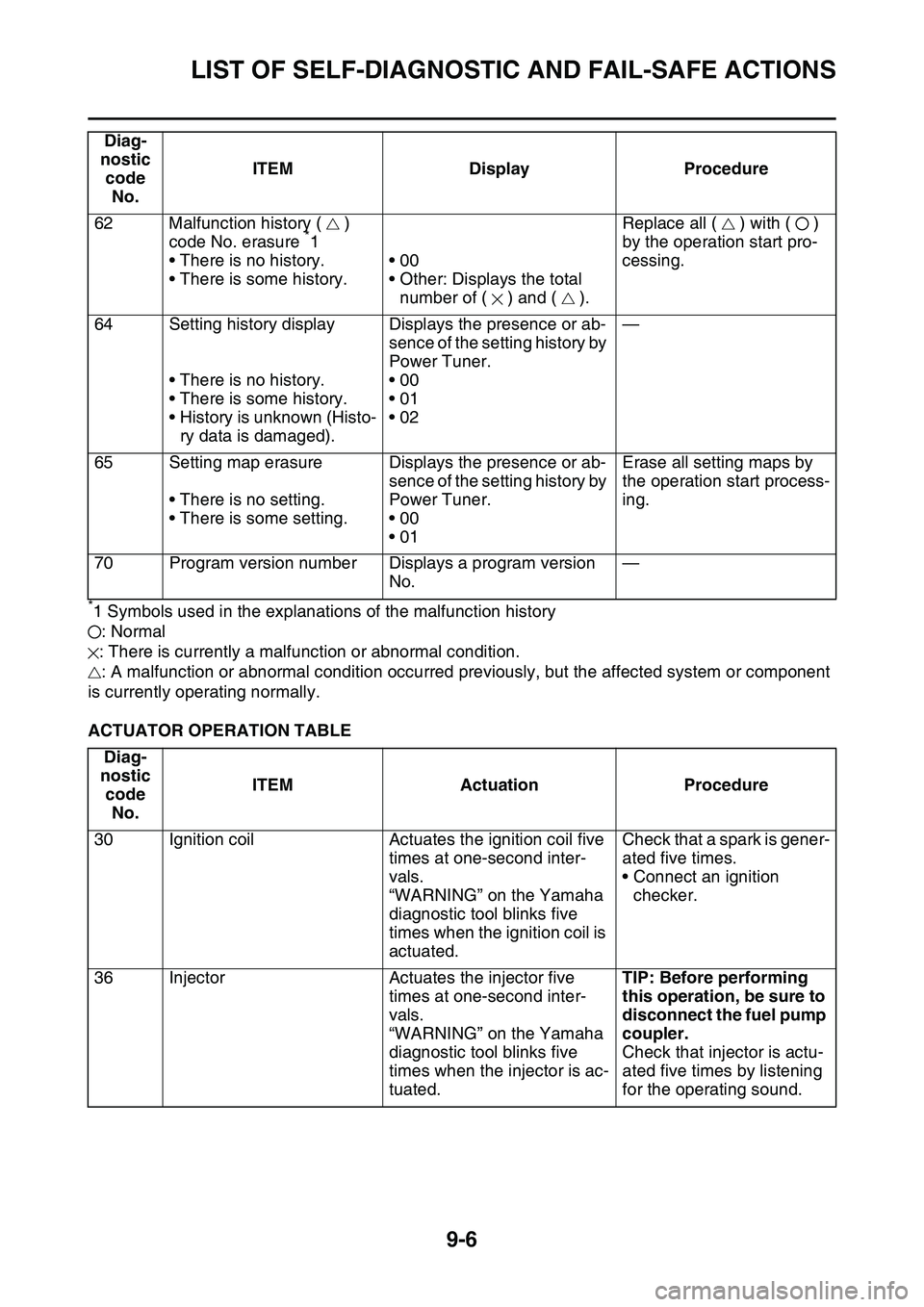
LIST OF SELF-DIAGNOSTIC AND FAIL-SAFE ACTIONS
9-6
*1 Symbols used in the explanations of the malfunction history: Normal
: There is currently a malfunction or abnormal condition. : A malfunction or abnormal condition occurred prev iously, but the affected system or component
is currently operating normally.
ACTUATOR OPERATION TABLE 62 Malfunction history ( )
code No. erasure
*1
• There is no history.
• There is some history. •00
• Other: Displays the total
number of ( ) and ( ). Replace all ( ) with ( )
by the operation start pro-
cessing.
64 Setting history display • There is no history.
• There is some history.
• History is unknown (Histo-ry data is damaged). Displays the presence or ab-
sence of the setting history by
Power Tuner.
•00
•01
•02
—
65 Setting map erasure • There is no setting.
• There is some setting. Displays the presence or ab-
sence of the setting history by
Power Tuner.
•00
•01 Erase all setting maps by
the operation start process-
ing.
70 Program version number Displays a program version No.—
Diag-
nostic code No. ITEM Actuation Procedure
30 Ignition coil Actuates the ignition coil five times at one-second inter-
vals.
“WARNING” on the Yamaha
diagnostic tool blinks five
times when the ignition coil is
actuated.Check that a spark is gener-
ated five times.
• Connect an ignition
checker.
36 Injector Actuates the injector five times at one-second inter-
vals.
“WARNING” on the Yamaha
diagnostic tool blinks five
times when the injector is ac-
tuated.TIP: Before performing
this operation, be sure to
disconnect the fuel pump
coupler.
Check that injector is actu-
ated five times by listening
for the operating sound.
Diag-
nostic code No. ITEM Display Procedure
Page 349 of 360
CHASSIS
10-2
TIRE PRESSURE
Tire pressure should be adjusted to suit the
road surface condition of the circuit.
• Under a rainy, a muddy, a sandy, or a slippery
condition, the tire pressure should be lower
for a larger area of contact with the road sur
-
face.
• Under a stony or a hard road condition, the
tire pressure should be higher to prevent a flat
tire.
EAS1SL1369FRONT FORK SETTING
The front fork setting should be made depend-
ing on the rider's feeling of an actual run and
the circuit conditions.
The front fork setting includes the following
three factors:
1. Setting of air spring characteristics
• Change the fork oil amount.
2. Setting of spring preload
• Change the spring.
3. Setting of damping force
• Change the compression damping force.
• Change the rebound damping force.
The spring acts on the load and the damping
force acts on the cushion travel speed.
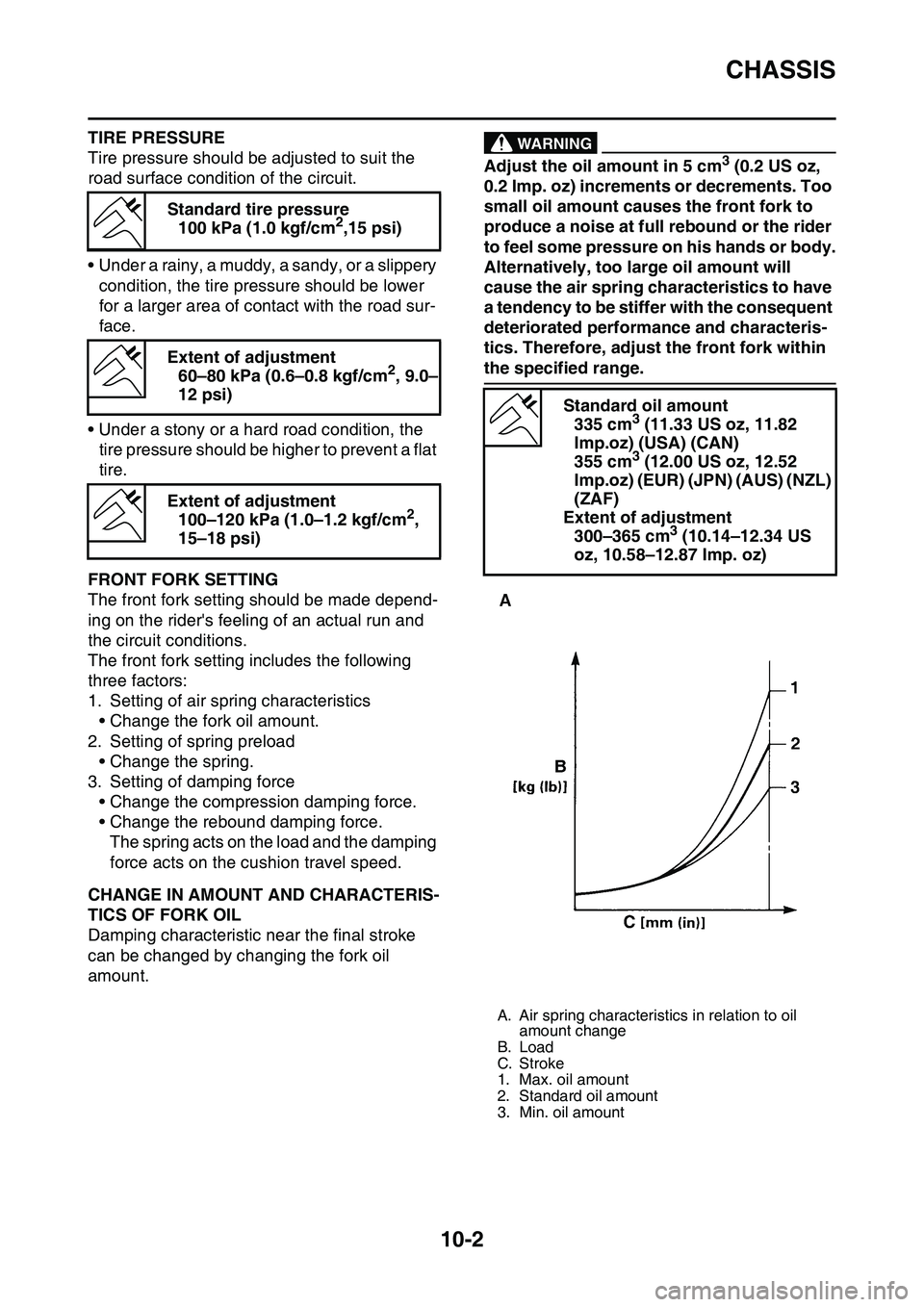
EAS1SL1370CHANGE IN AMOUNT AND CHARACTERIS-
TICS OF FORK OIL
Damping characteristic near the final stroke
can be changed by changing the fork oil
amount.
EWA1DX4001
WARNING
Adjust the oil amount in 5 cm3 (0.2 US oz,
0.2 Imp. oz) increments or decrements. Too
small oil amount causes the front fork to
produce a noise at full rebound or the rider
to feel some pressure on his hands or body.
Alternatively, too large oil amount will
cause the air spring characteristics to have
a tendency to be stiffer with the consequent
deteriorated performance and characteris
-
tics. Therefore, adjust the front fork within
the specified range.
EAS1SL1371
Standard tire pressure
100 kPa (1.0 kgf/cm2,15 psi)
Extent of adjustment
60–80 kPa (0.6–0.8 kgf/cm2, 9.0–
12 psi)
Extent of adjustment
100–120 kPa (1.0–1.2 kgf/cm2,
15–18 psi)
Standard oil amount
335 cm3 (11.33 US oz, 11.82
lmp.oz) (USA) (CAN)
355 cm3 (12.00 US oz, 12.52
lmp.oz) (EUR) (JPN) (AUS) (NZL)
(ZAF)
Extent of adjustment
300–365 cm3 (10.14–12.34 US
oz, 10.58–12.87 Imp. oz)
A. Air spring characteristics in relation to oil
amount change
B. Load
C. Stroke
1. Max. oil amount
2. Standard oil amount
3. Min. oil amount